Here’s a thread for following the vote against Boehner.
UPDATE: Boehner wins on voice vote.
No surprise.

Here’s a thread for following the vote against Boehner.
UPDATE: Boehner wins on voice vote.
No surprise.
They may not be your idea of a culinary thrill, but mochi cakes are tres popular in Japan, especially at New Years. Made of the aptly named glutinous rice (it’s gluey), they are gluggy globs of gelatinous glup.
I happen to like mochi. I once learned how to make the stuff in a macrobiotic cooking class, and they were very good when coated with roasted sesame seeds. Plus, grinding the rice into paste by hand with a mortar and pestle, the way we did it in class, probably resulted in a net weight loss when we ate the things.
But I had no idea eating mochi could kill. Apparently every New Years there are choking deaths, mostly of the elderly, and this year was no exception:
Sticky rice cakes, or “mochi,” are an essential part of the Japanese New Year’s holiday menu. But the glutinous mochi, grilled or cooked in broth or with sweet beans, can get stuck in people’s throats, blocking breathing.
This year’s fatalities appear to have been higher than usual.
The Yomiuri newspaper reported on Friday that at least 128 people were rushed to hospitals after choking on mochi, with nine dying. ..
The department advised people to cut mochi in small pieces, chew slowly and learn first aid.
I have written before of my fondness for Chinese sesame doughnuts filled with bean paste, describing an epic San Francisco quest for them here. In case you’ve never eaten them, here’s a description of these unusual nuggets:
Think of it as a jelly doughnut without jelly, made of sweetened glutinous rice flour, a sticky pully substance that is somewhat gelatinous and yet resistant to the teeth. Inside is a nice dollop of sweetened bean paste, and the whole goopy mess (I say that with affection) is fried in oil till it absorbs enough to be oozing with the stuff.
Mochi is similar, minus the oil and often minus the bean filling too.
I can well imagine that most of you can read these descriptions and not get what the fuss is all about. I’ve been teased about my own predilection for the things. But don’t knock them till you’ve tried them—although I’d suggest going with the small bites.
The homemade kind is best. The internet being the wondrous font of information that it is, I refer you to this recipe for making mochi by hand. You can see what I mean about the work involved, but it’s sort of fun, a bit like kneading bread only with utensils.
[Hat tip: Roger Simon and Ace.]
Diogenes was the father of Cynicism (that’s with a capital “C”). He had a lot of colorful eccentricities:
He inured himself to the weather by living in a clay wine jar belonging to the temple of Cybele. He destroyed the single wooden bowl he possessed on seeing a peasant boy drink from the hollow of his hands. He then exclaimed,” Fool that I am, to have been carrying superfluous baggage all this time!” It was contrary to Athenian customs to eat within the marketplace, and still he would eat, for, as he explained when rebuked, it was during the time he was in the marketplace that he felt hungry.
But Diogenes was most famous for his search for an honest man:
He used to stroll about in full daylight with a lamp; when asked what he was doing, he would answer, “I am just looking for an honest man.” Diogenes looked for a human being but reputedly found nothing but rascals and scoundrels.
Ever since 9/11 a lot of people have been similarly searching for the moderate Muslim. Unlike Diogenes’ elusive honest man, moderate Muslims exist (actually, honest men exist too, but I like the tale). The problem is that once moderate Muslims speak up publicly they tend to have a dangerous and rather short life, especially if they are people of any influence.
Which brings us to Egyptian President al-Sisi, who recently delivered a speech that marks him as a very moderate Muslim indeed, and as a ruler whose days may be numbered. Here are some excerpts:
Speaking to an audience of religious scholars celebrating the birth of Islam’s prophet, Mohammed, he called on the religious establishment to lead the fight for moderation in the Muslim world. “You imams (prayer leaders) are responsible before Allah. The entire world””I say it again, the entire world””is waiting for your next move because this umma (a word that can refer either to the Egyptian nation or the entire Muslim world) is being torn, it is being destroyed, it is being lost””and it is being lost by our own hands.”
He was speaking in Al-Azhar University in Cairo, widely regarded as the leading world center for Islamic learning.
“The corpus of texts and ideas that we have made sacred over the years, to the point that departing from them has become almost impossible, is antagonizing the entire world. You cannot feel it if you remain trapped within this mindset. You must step outside yourselves and reflect on it from a more enlightened perspective.”…
“We have to think hard about what we are facing,” he said. “It’s inconceivable that the thinking that we hold most sacred should cause the entire Islamic world to be a source of anxiety, danger, killing, and destruction for the rest of the world. Impossible.”
These are not just empty words, either. Al-Sisi was originally appointed by the Muslim Brotherhood’s Morsi to the post of commander of the army, but proceeded to oust Morsi and then to outlaw the Brotherhood itself (and you thought Justice Roberts was betraying the people who nominated him!) and to be elected president in his own right.
This speech of al-Sisi’s seems extraordinary in its boldness and reasonableness. Can al-Sisi provide a voice for the heretofore silent—we have no idea whether they are a majority or small minority—of Muslims who might agree with him? Let’s hope he lives long enough for us to find out. His predecessor prior to Morsi, Mubarak, was a dictator, but part of the reason was that heavy-handed tactics are required to deal with the Brotherhood in Egypt (please read this post of mine for an in-depth discussion of the history of the Brotherhood in Egypt). The fight against the Brotherhood was also waged by Nassar and Sadat:
…Nasser himself was more Draconian, establishing concentration camps for the Brotherhood and torturing them, although only killing a few. Sadat and Mubarak made the Brotherhood illegal, but their imprisonment waxed and waned periodically depending on circumstances, and few if any were killed. However, it was Muslim fundamentalists (although not Brotherhood members) who assassinated Sadat…
It seems that al-Sisi is going even further than his predecessors, who kept the fight to the Brotherhood. Al-Sisi appears to be speaking more globally and generally about Islam itself and the course it should take in the 21st Century. I wish him luck. He’ll need it.
[NOTE: No doubt there are additional complicated geopolitical considerations behind al-Sisi’s speech, including the rise of Iran as a nuclear power as well as the terrorist actions of groups such as ISIS.]
Boehner has been an underwhelming and frustrating Speaker of the House. As his challenger Louie Gohmert states, Boehner has broken a number of promises, including one that may have been in the nature of a final straw for Gohmert and others: he gave in to CRomnibus.
I don’t like Boehner as Speaker. I’m not sure anyone does. He seems a strange combination of dull and eccentric and shifty, and definitely does not inspire trust. Of course, the skills of a good Speaker are not necessarily the skills that go to make a person likeable. A Speaker has to be a crafty conniver, negotiator, strategist, power player, and it does no good to pretend otherwise. But it helps when a Speaker also inspires the belief—as Boehner does not—that he/she is committed to principles that are espoused by his/her own party’s rank and file rather than being at war with them.
I have no idea whether the bid to dethrone Boehner will succeed. Early reports were that it didn’t have a chance. But lately the news has been a bit more favorable to the anti-Boehner forces. If I had to make a prediction, I’d say Boehner will retain his position. But if he doesn’t, I would hope his challenger has not only the requisite conservative credentials but all the other attributes that a Speaker needs.
Years ago when I was in college, I took a class where I learned about sickle cell anemia and sickle cell trait, as well as thalassemia major and minor.
They seemed awesome examples of the way heredity works: inherited defects of red blood cells in which, if two genes for the flaw are inherited, the person is very ill (fatally so before modern medicine), but inheriting only one gene for the trait confers the benefit of increased resistance to malaria. That was very important in the many areas around the world where the disease was endemic, because people with the single-gene traits had a leg up for survival. Thus the mutations for sickle cell and thalassemia persisted and even flourished, despite the fact that the double-gene diseases were invariably fatal.
What’s this got to do with anything? When I was in my 30s, a doctor noticed some mild abnormalities in my blood results, and after some specialized testing he told me that I had thalassemia minor, which is the trait rather than the disease. Blood tests show a mild anemia-like pattern, and under the microscope some red blood cells are seen to be oddly shaped and smaller than usual.
Then a couple of years ago, my son surprised me by saying he’d had some weird blood tests results, too, but that he had told the doctor that his mother had thalassemia minor and asked whether this could be the same thing. Yes, indeed, said the doctor; his blood test results fit that pattern exactly.
And so they did. When I looked back at my old blood tests and compared them to my son’s new ones, their slightly-off figures were nearly identical—slightly off in the same direction and to exactly the same degree.
Then I got curious. I had never really thought about it much before, but of course if I had the trait one of my parents almost certainly had had it, too (unless I had a very rare spontaneous mutation). My father’s blood tests are lost in the mists of time, since he died over thirty years ago. But my mother—98 when I started thinking about the question—still had tons of previous blood test reports in her files. And sure enough, when I got hold of her numbers, they were virtually the same as those of my son and me—although no doctor had ever noticed the abnormalities or mentioned a possible thalassemia minor diagnosis to her.
It doesn’t matter much, unless a person marries another person with the gene and runs the risk of having children with the disease rather than just the trait. The single-gene trait doesn’t really affect people, although some claim it makes them a little tired because their hemoglobin isn’t what it should be. Actually, the body tends to compensate for the smaller size and strange shape of the red blood cells by increasing their number slightly, which is what all three of us in my family seem to have done. But there’s something about the figures and their almost exact correspondence to each other across all three generations that made me stop in wonderment at the beauty of both heredity and of science itself, which can study, understand (at least to some extent), and document such a thing.
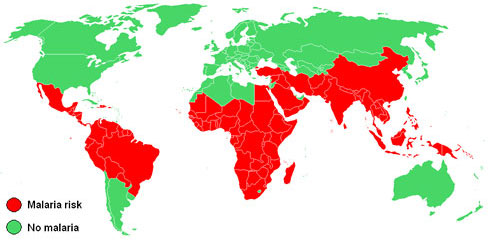
NOTE: Here’s where malaria still exists today, although its distribution used to be much wider:
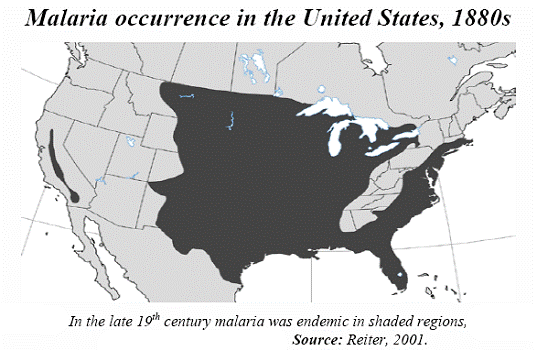
Malaria in the US in the 1880s:
And here’s the distribution of thalassemia:
The distribution of thalessemia:

If Catherine Deneuve and Marcello Mastroianni had a love child, what would she look like?
Think that’s an idle question? Meet Chiari Mastroianni:

Profession? Actress, of course.
Who knew those two had a daughter? Here’s what she has to say about them:
I’ve never seen my parents together, never in my whole life” she says. “They split when I was two, so I’ve no recollection of them as a couple. I’ve never even seen them kiss ”“ except in the movies.”
Deneuve I can take or leave, but I’m a big Mastroianni fan. To see him in any of the comedies he made with Sophia Loren is joy itself, although he tended to play weak men who are not especially admirable. But he had the most wonderful self-mocking, tongue-in-cheek, impish quality.
I don’t see much of Denueve in Chiari. But Mastroianni is there, don’t you think?:

I’m not sure when it happened, but I fear there’s been an insidious change in attitude towards Obama. It occurs to me that the right may have gone through the clichéd five stages of grief—denial, anger, bargaining, depression—and reached cynical acceptance.
Maybe “acceptance” isn’t quite the right word. But there’s more than a whiff of world-weariness and politics-weariness in the air, a feeling that things have reached the point of clarity and yet there doesn’t seem to be enough will or power on the Republican side to do anything about it.
The Russian people under the Soviets used to cope by adopting a cynical and biting wit about their lot. Oh, and also by drinking, of course. We have not experienced anything like the tyranny under which the Soviets lived, but we’ve already seen far more tyranny than we would prefer, and we’ve seen many of our fellow citizens wink at it. There are frightening visions of where this could ultimately go if not stopped and reversed.
It turns out that our Constitution doesn’t really protect us as many of us thought it did. Oh, it’s a great piece of paper, but in the end it’s only as good as its people and their elected representatives. If the people don’t care, the representatives won’t.
As John Hinderaker wrote at Powerline a while back, “For political reasons, impeachment is not an option,” although the overreaches Obama has committed are “the sorts of abuses for which the impeachment remedy was intended.” The only way I see impeachment becoming an option that Republicans actually consider is if Obama’s ratings drop into the cellar, and enough Democrats decide they would join the drive to impeach and convict. The likelihood of that is vanishingly small, although not impossible.
Impeachment may or may not become an option, but it’s hardly the only option. Defunding is another, but do the Republicans have the stomach for the battle? And how many of these less drastic measures such as enhanced border security will come to pass?
The election of 2014 seemed like a repudiation of Obama. But it’s a meaningless one unless the Republican Party has enough commitment, integrity, determination, and skill to fight the president effectively. Nothing so far has indicated they’ve got what it takes.
However, the new Congress will get a chance to show what it’s made of after it is sworn in on January 6th. Let’s hope we’re underestimating them.
Commenter “Lizzy” writes:
I’m thinking it’s no coincidence that women have recently expanded their definition of sexual assault and out-of-bounds male behavior to include things like morning after regret, the unwelcome male gaze, and “slut-shaming.” So women still expect expressions of respect and recognition of their control within the relationship (as was previously demonstrated through chivalry), it’s just been twisted into bizarre expectations in an age of nearly no-strings sex.
When I was in college, curfews were in effect. Freshman women had to sign in and out of the dorm, and on weekdays we had to be back by 11 PM and on weekends 12:30 AM. We could sign out overnight on weekends, too, if we put the name and address and phone number of the people with whom we were staying. For upperclasswomen it was more lax, but I don’t remember the details because by the time I got to that point the rules had simply evaporated, abolished by the administration. Even the rule against boys visiting girls’ dorms and girls visiting boys’ dorms (and I use the terms “boys” and “girls” because that’s what we called ourselves back then) were pretty much finito, all in the space of two short years.
I’m not sure what the rules had been for men when I first entered college, but they had them. I’m pretty sure they were allowed to stay out later than women, but not indefinitely.
The end of the rules occurred because of a combination of pressure from the late-1960s student body and a lack of commitment on the part of those enforcing the rules. Simply put, the administration didn’t seem to care, and one by one the rules fell in record time at college after college across the country. As I remember it (and this description of what happened at a single university bears me out if it’s at all typical), universities became tired of standing in loco parentis and washed their hands of the whole affair once the demand ceased.
Fast forward to now, and the effort by school administrators, egged on by the Obama administration and politically correct thinking, to put new rules of behavior into place for how the sexes ought to relate to each other now that the old rules are a distant memory. Discussions of a supposed campus “rape culture” and what to do about it—including whether it actually exists and what constitutes an objectionable sexual assault—are legion.
One way to conceptualize the whole thing is with an analogy to an endoskeleton versus an exoskeleton, an inner support structure versus an outer one. When I was in school we had both: the university rules were the exoskeleton, and our own personal rules for behavior were an endoskeleton. When the campus rules got jettisoned so precipitously at the same time the sexual revolution was happening, the whole thing turned to a sea of endoplasm for young people of the time, who were left without much guidance, either internal or external, for their sexual behavior. Some people (the religious, for example) retained their previous internal standards as well as the external ones provided by their religious subgroups. But many of the rest became lost, although they probably would not have described it that way—they would have described it as “free.”
But other problems crept in. Morning-after guilt. Women feeling pressured to have more sex than they were comfortable with, either by mores or by men or by their own idea of what their own sexiness should be. Men feeling pressured in other ways, including the perception that they weren’t getting as much sex as other men. Confused communication, misunderstandings.
In recent years all of this has led universities to institute a new exoskeleton, a set of guidelines that are somewhat different than they used to be but that attempt to make explicit the restrictions within the generalized freedom: for example, “yes means yes” laws, rampant “rape culture” fears, and the burgeoning practice of judging men’s behavior without traditional due process protections.
As commenter “mizpants” put it, some of this is a “reaction to the vulnerability of women after the breakdown of traditional social constraints on sexuality.” And it ends up making men more vulnerable, too, particularly to false accusations.
The moral of the story? Societies have always had rules about sexual behavior, and sex among young people who are thrown together at an age when the drive is particularly high and the pressures particularly intense cries out for external and internal rules to assist in dealing with the complexities and temptations of it all.
…because I know how it’s possible to fall flat on your face while exercising.
I did it, and here’s the tale of how it happened. Two and a half years later you wouldn’t know it from looking at me, although there are tiny changes that only I seem to notice—including the fact that a deviated septum now gives me some grief.
Of course, there’s some possibility Reid’s office isn’t telling the truth about how he incurred his injuries. But I can definitely say it’s possible to do what he did just from falling from exercise equipment.
This just may be the most depressing non-political news I’ve had so far in 2015: just how easy it is to reach a grand total of 2000 calories at most restaurants.
An example:
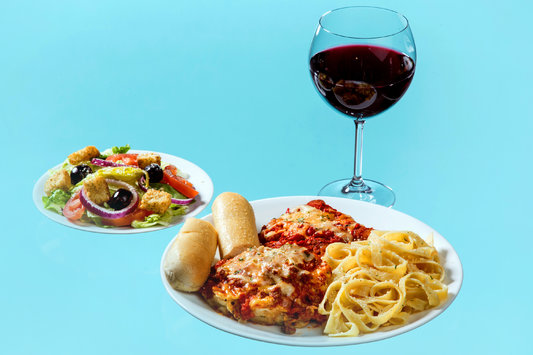
Considering that I gain weight if I eat more than 1,500 calories a day, it’s particularly distressing to see.
Of course, I already knew how easy it is to reach stratospheric levels of caloric ingestion, even away from a restaurant, and how quickly even fruits and vegetables and protein foods and some olive oil (all supposedly good stuff) can add up to above 1,500 over the course of a day.
And please, please, do me a large favor and stop pushing Taubes or Paleo or Atkins or whatever the highprotein/highfat/lowcarb diet du jour is that has been very successful for you. I’ve heard it all before on previous threads. I’m happy for you, but I’ve tried it several times, and it’s not at all successful for me. Au contraire. Not only do I detest that sort of food, but I feel ill on the diet, and what’s more (big drum roll here) I do not lose weight on it. Everyone differs, and for some people it’s great, but not for me.
[Hat tip: American Digest.]
[BUMPED UP]
Now, how did that happen?
The last year I remember noticing as a big transition was the year 2000. We had entered science fiction territory, and 2001 was similar because of the Stanley Kubrick film.
But after that it’s all a blur. How did it pass so quickly? That’s a cliche, but there’s no question that as you get older time seems to fly by more rapidly. One reason is that each segment of time is now a much smaller percentage of the total amount you’ve been alive. A year? Almost a blink.
These days when I try to figure out how much time has passed since an event my gut reaction is to use 2000 as the index year. So, for example, if something happened in 1976 my first response would be to say that that was 24 years ago. Way off, obviously; to get the right answer I have to take that figure and add the current year of the 21st century to it. It’s a laborious process, but since for me the changing year number seems to have stopped at 2000 there’s no way around it.
The title of this post was inspired by a memory from my extreme youth. I was enchanted by a TV car ad campaign from the year 1957 that used the catch-phrase, “Suddenly, it’s 1960!” to indicate how futuristic its car design was. All I had been aware of in my very short life up to that point were the 1950s, and the idea of a decade of 1960s was magical.
Speaking of magical, thanks to the magic of YouTube here’s one of those ads. Until now I wasn’t sure it wasn’t a mere figment of my imagination. You can see why the time-travel aspects appealed to me much more than any message about cars, which I barely even registered. My driving years were still a long way off:
My parents both always drove Chryslers, my mother the small Plymouth Valiant type and my father the big one (before that it was always a DeSoto, but that line was discontinued in the real 1960). And come to think of it, the couple at the very tail end of that ad could pass for my parents if you squinted.