↓
 

The New Neo

A blog about political change, among other things

  • Home
  • Bio
  • Email
Home » Page 1168 << 1 2 … 1,166 1,167 1,168 1,169 1,170 … 1,917 1,918 >>

Post navigation

← Previous Post
Next Post→

The Hitler “Downfall” parody to end all Hitler “Downfall” parodies

The New Neo Posted on February 20, 2015 by neoFebruary 20, 2015

Very meta:

(And yes, it’s a parody. The subtitles are not a correct translation of what he’s actually saying.)

By the way, in case you’re curious and have never seen the movie “Downfall,” here’s the original clip from the film, with the correct English subtitles (I think! I don’t speak German). This is a slightly longer version of the clip; the part that is usually parodied begins at 0:44 and ends at 4:39:

Posted in Movies | 14 Replies

More on spokespeople: revolutions devouring their own

The New Neo Posted on February 20, 2015 by neoFebruary 20, 2015

[NOTE: While writing this post on spokespeople, I came across the following post, which I wrote in 2006, about an Iranian spokesperson in 1979 who shortly thereafter came to a difficult end. His story seems both poignant and still relevant, and I thought I’d publish it again. Ghotbzadeh, unlike so many of our present-day spokespeople, was not merely a spokesperson or a journalist. But it was as a spokesperson for the new Khomeini regime that I—and America—knew him.]

In the Atlantic article I discussed yesterday, a name on the first page caught my eye: Sadegh Ghotbzadeh, the Iranian foreign minister at the time of the hostage crisis.

Suddenly, although I hadn’t thought of him in decades, the memory came back. Ghotbzadeh! I recall his sardonic, jaded, man-of-the-world expression—a strange combination of arrogance and weariness. As the spokesperson for the regime, he was featured often on TV (I think on the nascent “Nightline,” then entitled “America Held Hostage”). As a visible and familiar figure, he became somewhat of a focus for my frustration and annoyance with the entire situation. Something about him seemed hollow, although he was clearly intelligent and articulate.

As events unfolded, it turned out that Ghotbzadeh was one of those cautionary figures, a man who was instrumental in planning a revolution that then got away from him and proceeded to devour him in the process. Like Robespierre, Danton, and Desmoulins; like Trotsky and so many other engineers of the Russian revolution who were slaughtered in the great purges; authors of violent revolutions often come to violent ends at the hands of their violent former comrades.

Thus it was with Ghotbzadeh. Here he is:

Ghotbzadeh was close to the Ayatollah Khomeini while both were in exile in Paris, and became one of his right-hand men back home in the early days of the revolution. He seems to have been motivated most strongly by hatred of the Shah’s regime. But, paradoxically, his role in the hostage crisis was as a relative moderate (accent on the “relative;” moderate in comparison to what?). He seemed to be working for a diplomatic solution, and lost favor with the Iranian powers that be in the process.

Former hostage and Ambassador at the time, Bruce Laingen, has this to say about Ghotbzadeh:

I didn’t like him at the outset for the role he played as Foreign Minister, but I sensed as time went on over those months, that he came to the conclusion, himself, fairly early, that this hostage business was counterproductive to the revolution and that it needed to be ended. I think he genuinely wanted to end it and was prepared to make some concessions to do that. And he stuck his neck out to do that. He showed some guts.

It all unraveled rather quickly:

Ghotbzadeh finally resigned in 1980 over the deadlock in negotiations. That year, after he was arrested and briefly detained after criticizing the ruling Islamic Republican Party, he retired from public life. In 1982 he was arrested on charges of plotting against the regime. Although he denied any conspiracy to take Khomeini’s life, he apparently admitted complicity with Ayatollah Mohammad Kazem Shariat-Madari in a plot to overthrow the government. Ghotbzadeh was convicted in August 1982 and executed the following month.

Did he really plan to end the Khomeini reign, and, if so, with what was he planning to replace it? Or were the charges trumped up, and was he forced to confess to crimes he didn’t commit? At the time, I remember being astounded at the news of his startling reversal of fortune and allegiance; it was quite a switch from disliking him to feeling some sympathy for the man.

Guillotining having gone out of style, Ghotbzadeh was shot by a firing squad shortly after his trial. The revolution had eaten another of its own.

But not everyone connected with the early days of the revolution has met such a fate. Others connected with the hostage crisis have prospered. It’s unclear whether or not the current Iranian President, our good friend Ahmadinejad, was one of those “student” hostage-takers, although several former hostages have identified him as such. But there’s very little doubt about the identity of another former hostage-taker who’s riding high at present: Hussein Sheikholeslam, recently an Iranian diplomat and legislator.

Why do I mention Sheikholeslam? Only because I came across an interesting fact about him, an indication of the sort of cross-fertilization process that seems to have been at work in the revolutions of the 60s/70s. Sheikholeslam may not have been an actual student at the time of the hostage-taking in Iran. But whether or not Sheikholeslam was a student at that point, he certainly had been a student earlier—at UC Berkeley, where he learned a thing or two:

UC Berkeley gained a reputation as a center of student anti-war protest during the 1960s and 1970s. During that tempestuous period, an Iranian student named Hussein Sheikh-ol-eslam attended Cal. He became fluent in English. He also absorbed the demonstrations criticizing American imperialism in Vietnam and other nations.

After Hussein returned to Iran, writes Mark Bowden in his new book, “Guests of the Ayatollah,” his anti-Americanism planted deep roots in his Islamic religion. In late 1979, the tree connected to those roots bore ugly fruit.

The student protests of the 60s didn’t actually revolutionize much in the directly political and traditionally revolutionary (i.e. a sudden overthrow of the existing government) sense in this country. The “revolution” they began here was more cultural than anything else, with resultant political ramifications. But not so in Iran, where students who had learned the anti-American and propaganda lessons of the 60s used them later to great effect. Some forget that the 60s didn’t just happen in this country; the protests occurred in Europe as well.

Khomeini spent some of his exile in France, but I was surprised to learn (from Wikipedia, so this could be taken with a grain of salt) that the French were not necessarily simpatico to him during his rather short sojourn there:

In 1963, [Khomeini] publicly denounced the government of Shah Mohammad Reza Pahlavi. He was thereby imprisoned for 8 months, and upon his release in 1964, he made a similar denunciation of the United States. This led to his forced exile out of Iran. He initially went to Turkey but was later allowed to move to Iraq, where he stayed until being forced to leave in 1978, after then-Vice President Saddam Hussein forced him out…after which he went to Neauphle-le-Ché¢teau in France. According to Alexandre de Marenches (then head of the French secret services), France suggested to the Shah that they could “arrange for Khomeini to have a fatal accident”; the Shah declined the assassination offer, arguing that this would make him a martyr.

[NOTE II: My post about Azar Nafisi, author of Reading Lolita in Tehran, is relevant here. Nafisi, an Iranian national, likewise fell in with other radical Iranian students while studying in this country. Then, when she returned to Iran, she saw quite a few of those former associates imprisoned—and in some cases executed—by their former comrades-in-arms.]

Posted in Historical figures, Iran | 13 Replies

It’s not easy being a spokesperson

The New Neo Posted on February 20, 2015 by neoFebruary 20, 2015

We’ve had our fun with Marie Harf and Jen Psaki, and Josh Earnest as well as Jay Carney before him (for some reason, Robert Gibbs wasn’t a source of much fun). But I admit to a sneaking sort of awe of what they do, although it’s not a good sort of awe.

People are fond of saying that Harf or Psaki are airheaded, for example. I beg to differ. What they are—and what all on that list are—is loyal party apparatchiks with a fair amount of facility (some more than others) at keeping their stories and talking points straight, firing off a flurry of glib words to get those points across, and sticking relentlessly to message in the face of some difficult questions and no small amount of mockery and potential embarrassment.

You might say that they are shameless. Perhaps. However, they are buoyed and driven not only by personal ambition, but also by their dedication to whatever they think their party and their boss stand for, so much so that they believe that telling lies and manufacturing spin is a noble calling. This accounts for their triumph over any lingering shame they might feel. As with Winston Smith’s interlocutor O’Brien, they not only say that 2 + 2 = 5, but they come to actually believe that on a certain level it’s true as soon as they say it.

Or of course they might instead just be sociopaths to whom the only important thing is their personal advancement in the world, and their jobs are their tickets to the stars.

It also takes a certain amount of skill to learn so much information each day in order to get the administration’s stories straight and be able to rattle off the responses without getting rattled. And if the responses are lies, coverup, and/or spin, so much the more difficult, because it’s harder to keep a pack of lies straight than it is to tell the truth. Yes, they get better at it over time, and some people have a special facility for it. But I still believe it isn’t easy just to keep up with the sheer pace of information overload.

Does this mean I have sympathy for their plight? No. I don’t even think they see it as a plight; I think they consider they’ve got a fabulous job in the service of a wonderful president, doing wonderful things. A little ridicule rolls off their backs. Although I did always see something in Jay Carney’s eyes—or did I imagine it?—some mild sense of shame that I haven’t spied in the physiognomy of any of the others. Perhaps it’s just that I remember this:

Posted in Press | 18 Replies

Hillary’s big draws

The New Neo Posted on February 20, 2015 by neoFebruary 20, 2015

Not long after the 2012 election I predicted that Hillary would run in 2016 and that she had an excellent chance of winning. I would currently place her chances somewhat lower than I did then, but still very good.

Arguments that she would be tired and old by that time seemed—and still seem—overridden by other considerations, first and foremost her gender. As I wrote back then:

It’s women in particular who will vote for Hillary in even greater numbers than they did for Obama, and that’s saying a lot. To liberal and moderate women she is a role model, a hero(ine), an intrepid trailblazer (somewhat ironic, since her path to political prominence came through the traditional female route of linkage to a powerful male), and highly-respected star. Men would have to vote against her in a phalanx to overcome that advantage””and they won’t…

The American electorate appears to be highly motivated to elect “firsts” these days. It’s very likely that the prospect of electing the first black president was responsible for at least some of Obama’s initial attraction, and that same “first” impulse would be operating strongly for Hillary in 2016.

There are other plus factors for Hillary, such as incredibly strong name recognition (always important with the low information voter), and the fact that there isn’t really anyone else on the horizon for the Democrats. But overshadowing even that is identity politics and her gender. The only candidate that would be stronger in that respect would be a black or Hispanic woman, and the only one with equal name recognition is—you guessed it!—Michelle Obama.

For years I’ve heard people say that Michelle would run in 2016. I have consistently thought that was balderdash, and I’ve seen not a sign of movement in that direction so far. But lately I’ve decided it’s not balderdash at all. It really depends on what happens in the next year or so, what the Obamas’ actual (as opposed to their perceived) relationship is (in other words, are they of completely the same mind on more or less everything?), whether Barack Obama could bear to cede even the official trappings of power to his wife, and whether America would swallow the idea of someone completely untested in elected office or generalship running for president (Dr. Ben Carson would test that last proposition on the Republican side). But I have very little doubt that Barack and Michelle Obama would love to stay in power if they could, in order to continue whatever unfinished business may remain of the lofty fundamental transformation of America. And if a Michelle Obama candidacy looked like a viable path to that goal, they would take it.

But let’s get back to Hillary, the nominee I still think is far far more likely. Her path has gotten a bit harder than it looked to me to be in 2012, not the least because of the new trouble that that scamp, her husband, might be in (I write “scamp” because I think much of America looks on him with great affection and considers his shenanigans relatively unimportant). But Hillary herself is still highly admired, and as Bill Kristol points out, a poll of voters elicited a majority response that she “represented the future.” None of the Republican candidates were considered to do so, including those newly burst on the scene.

Speaking of the future—another huge draw Hillary would have for the Democrats is the fact that, during the campaign and during her presidency if elected, her gender would allow her to play the sexism card in the same manner that Obama wielded his very formidable race card. That is worth its weight in gold and then some.

And lest anyone think Republicans could finesse this by nominating a woman for president or for VP, I counter with: look what happened to Sarah Palin. Look, also, at what happened to Condoleezza Rice when she was prominent in the Bush administration, and Rice theoretically held both race and gender cards. But as you probably have observed, the rules of racism and sexism work quite differently for Republicans, who are assumed by definition to have betrayed and sold out both blackness and femaleness through their affiliation with the Evil Party.

Posted in Hillary Clinton, Men and women; marriage and divorce and sex, Politics, Race and racism | 19 Replies

The religious omission Obama hasn’t addressed

The New Neo Posted on February 19, 2015 by neoFebruary 19, 2015

In all the uproar about Obama’s refusal to label terrorists of the Muslim faith as being terrorists of the Muslim faith, what’s gotten somewhat lost is Obama’s failure to explain why he won’t label their Christian victims as Christians, and why he is so reluctant to label their Jewish victims Jews as well.

You may or may not accept his explanation of the Muslim-omission phenomenon. But at least he deigned (and I think that’s the correct word) to address it. I have seen nothing that even acknowledges his omission of the faith of the victims, much less explains it. Just denials/excuses/minimization.

I’ve written quite a few posts on it (see this and this, for example), and so have many other observors. The reasons Obama gave for his avoidance of the “Muslim” designation for terrorists cannot possibly apply to his refusal to acknowledge the faith of the victims, either. Whether or not Obama calls the Coptic Christians whom the terrorists beheaded (as the terrorists declared the victims’ Christian faith was the reason for the killings) “Christians” or not is not going to affect terrorist recruiting—except to the degree it makes Obama look ignorant or frightened, which would be likely to enhance recruiting.

I think Obama has not answered this charge because he has no answer that’s even marginally acceptable. All answers reflect very badly on him. So I think he hopes people will just forget about it as new crisis after new crisis comes our way.

Posted in Obama, Religion, Terrorism and terrorists | 33 Replies

Obama explains the strategy behind his refusal to say the terrorists are Islamic

The New Neo Posted on February 19, 2015 by neoFebruary 19, 2015

There’s been much reaction to Obama’s stated reasons for not tying the terrorists to the Muslim religion they so obviously espouse. Before I add mine, let’s look at the heart of his explanation/excuse:

[ISIS and al Qaeda] try to portray themselves as religious leaders — holy warriors in defense of Islam. That’s why ISIL presumes to declare itself the “Islamic State.” And they propagate the notion that America — and the West, generally — is at war with Islam. That’s how they recruit. That’s how they try to radicalize young people. We must never accept the premise that they put forward, because it is a lie. Nor should we grant these terrorists the religious legitimacy that they seek. They are not religious leaders — they’re terrorists. And we are not at war with Islam. We are at war with people who have perverted Islam.

There’s a great deal more of his speech—it’s long. But that’s the essence of the part that deals with the particular issue of why he won’t call an Islamic terrorist an Islamic (or Islamicist) terrorist. He doesn’t want to grant them a religious legitimacy that he thinks will help their recruiting.

Let’s not worry for a moment about whether he’s right or wrong about whether the terrorists are actually holy warriors in defense of Islam or not, and just evaluate his tactic in strategic terms. It’s odd for several reasons, and the first is that virtually no one buys what he’s saying except the already-convinced. ISIS and al Qaeda have actually been religious leaders (although not clerical ones) to huge numbers of Muslim people. But Obama is so used to conning, often successfully, that he thinks he can pull off this con, too, and that it will matter in some way even if he does. And by this speech he’s revealing the con; although he implies that he believes his own words, it’s hard to believe that he does. But whether or not he does, he’s still tipping listeners off to the fact that he’s adopted this much-criticized method for strategic reasons.

In addition, to coin a phrase: what difference does it make? Does Obama actually think his refusal to acknowledge that these terrorists are of the Muslim faith will cause other Muslims to fight against them more vigorously, or motivate Muslim clerics to denounce them with greater force than before? Or, does he believe that if he were to say what everyone paying a particle of attention knows—that the terrorists are Muslims, albeit of a certain extreme type—it would actually cause other Muslims to withdraw from the fight against them? Or to hate the US more? Or that a young man not already inclined to join ISIS would be motivated to join it just because the US president might use some word like “Islamicist” to define the group?

If you read the rest of his speech, it certainly would seem that’s what he believes. But once again, Obama is in love with the power of his own words to effect the change he says he desires, and seems unaware of the much much larger forces (are there any larger forces, in Obama’s eyes?) that shape human reactions to something with as powerful and as threatening a draw as ISIS and al Qaeda.

In a way it’s stranger still that Obama is putting himself in the position of an expert on Muslim orthodoxy. I have never felt he was of the Muslim faith—I strongly believe he is an agnostic or atheist, although I don’t know for sure of course. But it’s a fact that he has a lot of familiarity with Islam based on his upbringing, and so one can assume he knows that Muslims themselves have been fighting for more than a millennium over who is the truest Muslim. With his pronouncement, Obama puts himself in the odd position of a Muslim scholar pronouncing on what is the True Faith, rather than the president of the United States.

Of course there’s always the possibility, as Ann Althouse points out, that Obama thinks that the terrorists themselves are lying when they say they’re Muslims, and that their profession of faith is fake. But is there anyone (including Obama) who actually thinks the terrorists don’t believe themselves to be Muslims? Hardly.

Obama’s statement only makes sense if you believe there’s a possibility that his strategy will be effective. I can’t see a shred of evidence of that, but it seems likely that it does come across to the Muslim world as weak and perhaps hypocritical as well (especially when he announces why he’s doing it).

Meanwhile, if one of the points of the whole charade is to get the backing of Muslim countries in the fight against ISIS, then what on earth do we make of this?:

The Obama administration was given multiple chances Wednesday to endorse a longtime ally’s airstrikes on America’s biggest enemy at the moment, the so-called Islamic State. Over and over again, Obama’s aides declined to back Egypt’s military operation against ISIS. It’s another sign of the growing strain between the United States and Egypt, once one of its closest friends in the Middle East.

This shouldn’t be a complete surprise; Cairo, after all, didn’t tell Washington about its strikes on the ISIS hotbed of Derna, Libya. Still, Wednesday’s disconnect was jarring. White House Press Secretary Josh Earnest passed on a reporter’s question about an endorsement of Egypt’s growing campaign against ISIS. So did State Department spokeswoman Jen Psaki.

“We are neither condemning nor condoning” the Egyptian strikes, is all one U.S. official would tell The Daily Beast…

Privately, some U.S. officials told The Daily Beast they worry that Egypt’s decision Monday to hit Libya””and its vows to do more””could do more harm than good…

The most common question Egyptians politicians, journalists and citizens alike have asked as their nation faced a mounting ISIS threat has been: “Where is the United States?”

First a rift with Israel, heretofore our biggest ally in the region. Now, instead of encouragement to Egypt—one of the very very few countries that has emerged from its turmoil with a government that gives some promise of being better than the one it replaced—perhaps a rift with Egypt just as that country picks up the fight against ISIS. Is Obama mad at al Sisi for calling for the equivalent of a reformation in Islam? Does he think they’re being too hard on ISIS, and that they should offer them jobs instead?

I want to say “unbelievable.” But actually, to anyone who has studied the Obama administration, it’s all too believable, and probably even predictable.

Posted in Obama, Religion, Terrorism and terrorists | 16 Replies

Obama must think Jen Psaki has done such a bang-up job…

The New Neo Posted on February 19, 2015 by neoFebruary 19, 2015

…that it’s time to promote her.

Of course, her job is to transmit his messages without flinching or cringing, so I think she actually has done a good job. Or maybe her true job is to drive the right to a contemptuous frenzy.

Or maybe it’s to make Marie Harf sound good. No; I think it’s the other way around; Harf makes Psaki sound good.

Whatever.

Posted in People of interest | 23 Replies

The NY Times’ assault on language

The New Neo Posted on February 18, 2015 by neoFebruary 18, 2015

Yeah, I know, why bother with the Times?

I continue to find the cleverness of propaganda to be an interesting phenomenon, and the Times is still the respected paper of record for most New Yorkers (and other liberals) I know, and I know plenty of them. What the Times writes still influences and shapes a world of opinion.

And so we have today’s Times editorial—the opinion of the editors as a group rather than the thoughts of a single columnist, and every word carefully chosen—entitled “A Judge’s Assault on Immigration.”

Great title. Yesterday’s injunction on Obama’s executive order issued by Judge Hanen? Just a single lone judge, assaulting (with the word’s penumbra of a violent physical attack) immigration itself (something the ruling does not touch in any way; the ruling concerns a large group of people who entered this country illegally rather than through what used to be known as the immigration process).

That’s a lot of messages packed into one short 5-word phrase. But the editors are good with words, and most readers probably won’t even notice their manipulative skill. That’s what the best propaganda accomplishes.

The rest of the op-ed is really just commentary on the headline. In the first sentence, the editors call those given amnesty by the approved phrase, “undocumented immigrants,” as though they were just people who came here through the immigration process and mislaid their papers, poor things. And much of the rest of the piece is an assault (hey, I can use words, too) on Judge Hanen and his politics, a brief summary of the judgment which leaves out many salient points, and a blast at those mean old Republicans.

Excerpts [emphasis mine]:

As expected, the judge on Monday night temporarily blocked the first of several programs Mr. Obama announced in November to offer work permits and a three-year reprieve from deportation to more than four million immigrants who are parents of American citizens and who have no criminal record.

That move ”” which Mr. Obama took only after years of failed efforts by Congress to pass any immigration reform ”” triggered the fury of congressional Republicans, who responded with threats of, among other things, impeachment proceedings.

I could go on, but suffice to say that almost every sentence is filled with that sort of thing (kindly Obama, driven to do this by Congressional intransigence, aggressive Republicans) designed to drive the reader in a certain direction. The piece closes with a wonderful example of the genre [emphasis mine]:

However the appellate courts come down on the case, Mr. Obama is finding himself once again dealing with a familiar sort of Republican intransigence. With his humane and realistic immigration policy, he is trying to tackle a huge and long-running national problem…

On immigration, the Republicans seem to want only to savage the president’s efforts to address a pressing nationwide crisis, just as they have on health care reform. They are good at unleashing rage against Mr. Obama’s supposed lawlessness, but they have no meaningful solutions of their own.

Raging Republicans, benevolent Obama, and not even an attempt to explain what the real problem is: that this executive order went beyond his powers, even in the opinion of quite a few liberals. As the Times presents it, Republicans are motivated solely by animus rather than any legitimate concerns—and that notion is considered a basic truth by nearly all the liberals I know.

Actually, Republicans do have some meaningful solutions. I’m talking mostly about conservative Republicans. But even some moderate ones who espouse solutions that are not all that different from those the Democrats advocate happen to also have the quaint notion that Congress should be making the laws about this, and that the president’s discretion about the degree to which he will enforce those laws does not include making new law to thwart the ones Congress has passed. The Times, Obama, the left, and liberals don’t happen to like the conservative solutions, though, because they start with actual border security and they involve some deportations, so it’s best to ignore them.

Republicans: just plain mean.

Posted in Law, Press | 24 Replies

Meanwhile…

The New Neo Posted on February 18, 2015 by neoFebruary 18, 2015

…does anyone think we can properly vet the influx of Syrian emigrants? “It’s clearly a population of concern” is an understatement.

And Italy, what can under-defended Italy do about an even bigger version of a similar problem?:

Last weekend in Italy, as the threat of ISIS in Libya hit home with a new video addressed to “the nation signed with the blood of the cross” and the warning, “we are south of Rome,” Italian Prime Minister Matteo Renzi shuttered the Italian embassy in Tripoli and raised his fist with the threat of impending military action. Never mind that Italy has only 5,000 troops available that are even close to deployable, according to the defense ministry. Or that the military budget was cut by 40 percent two years ago, which has kept the acquisition of 90 F-35 fighter jets hanging in the balance and left the country combat-challenged to lead any mission””especially one against an enemy like the Islamic State…

Whether the time is right or not, there is no question that there is a palpable tension in Italy over the ISIS threat””Libya is just 109 miles away from the island of Lampedusa and 300 miles from Sicily””made worse by a 64 percent increase in illegal migrant arrivals by sea since last year. In all of 2014, more than 170,000 people arrived from Libya and Turkey, the highest number ever recorded.

It’s not hard to figure out why a lot of decent people might be desperate to leave Libya or Syria or even Turkey. But it’s also not hard to figure out that a goodly number of terrorists could pose as part of that group. What’s to stop them, and who could tell the difference between the two types of refugee?

Posted in Middle East, Terrorism and terrorists | 11 Replies

The problem is not so much their words…

The New Neo Posted on February 18, 2015 by neoFebruary 18, 2015

…it’s their actions.

Look, I’d love for all presidents and spokespeople to stop the claptrack and call the enemy what it is: vicious jihadi terrorists espousing a wing of Islam that is especially extreme. I don’t want that for merely semantic reasons; it would signal to the enemy that we understand who they are and what goals they have, and that we just may be in this for the long haul.

And then, and far more importantly, we’d have to follow it up with policies and behaviors that demonstrate that knowledge and that resolve. The actions mean far more than the words. Without the actions, all the hard-hitting words in the world mean nothing. With the actions, the wishy-washy words don’t matter nearly as much.

Bush said things that were at least somewhat similar to what Harf and Obama are mouthing about root causes and the like. If you think about it, neocons have generally said something of the sort: thriving democracies that protect human rights are much to be desired in the Middle East and elsewhere. But unless you are going to do something about it (which Obama has no intention of doing), and unless you know how to actually accomplish this goal of basic change (which I must admit at this point seems to be rather elusive knowledge across the board, left or right), concentrate on stopping groups such as ISIS from taking over more and more territory, hearts, and minds.

And that means war, not in the metaphoric sense of a war on poverty, but in the sense of actual military actions of enough magnitude to matter.

When the Iraq War began, I assumed that we were going to stay there at some level of involvement for decades, as in South Korea, because that was the only hope (albeit a slim one) we had of accomplishing meaningful change. But it turned out that that was never the plan, or perhaps it once was the plan but stopped being the plan at some later point.

But even then, the more modest commitment that Bush made (and which Obama initially continued, at least somewhat) was working to keep the situation in check, and more fundamental slow change might even have occurred. But then Obama signaled the end of whatever plan of that sort may have been in place, and left the country entirely. Now we, and the world, are reaping the whirlwind that has followed.

What he and his underlings say about it is just a minor symptom of a far more basic problem.

Posted in Obama, Terrorism and terrorists, War and Peace | 48 Replies

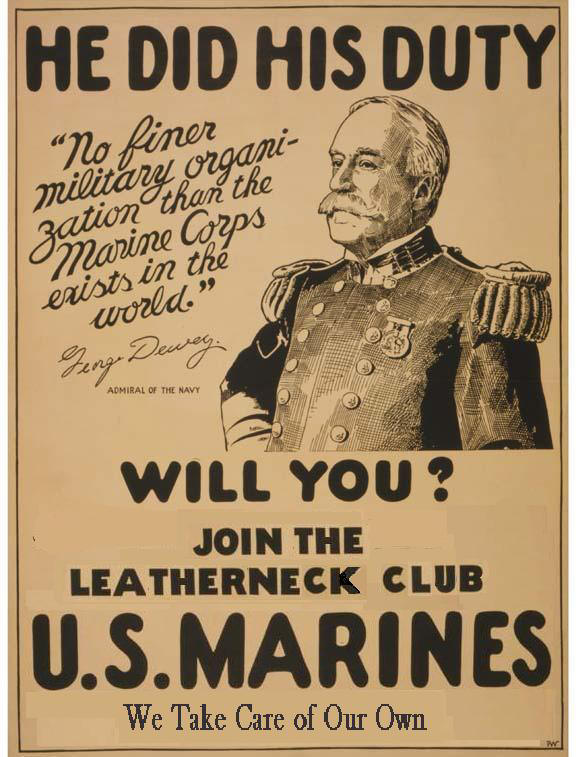
Leathernecks

The New Neo Posted on February 17, 2015 by neoFebruary 17, 2015

leatherneck

A while back, while watching The Kelly File on Fox, I heard Glenn Beck make a remark about the origin of the term “Leathernecks” to refer to the Marines. I decided to investigate to see if he was correct, and sure enough, it appears he was.

Plus é§a change, plus c’est la méªme chose [emphasis mine]:

The term “leatherneck” was derived from a leather stock once worn around the neck by both American and British marines. Beginning in 1798, “one stock of black leather and clasp” was issued to each marine annually. Its use as a synecdoche for Marines began as a term of ridicule by sailors…. The origin of the leather neck collar has to do with early 19th Century military fashion trends in Europe and North America. Its use among enlisted men supposedly improved their military bearing and appearance by forcing the chin high and to serve as protection for one’s neck from sword blows by Muslim pirates.

The stock was dropped as an article of marine uniform in 1872, after surviving through the uniform changes of 1833, 1839, and 1859.

Maybe it’s time to bring them back.

Posted in Military, Violence | 9 Replies

Marie Harf: on how to fight ISIS

The New Neo Posted on February 17, 2015 by neoFebruary 17, 2015

The right is having a field day with Marie Harf’s latest pronouncement on the way to fight ISIS (see this, for example). Here’s Harf (speaking to Chris Matthews):

MATTHEWS: How do we stop this? I don’t see it…If i were ISIS, I wouldn’t be afraid right now. I can figure there is no existential threat to these people. They can keep finding places where they can hold executions and putting the camera work together, getting their props ready and killing people for show. And nothing we do right now seems to be directed at stopping this.

HARF: Well, I think there’s a few stages here. Right now what we’re doing is trying to take their leaders and their fighters off the battlefield in Iraq and Syria. That’s really where they flourish.

MATTHEWS: Are we killing enough of them?

HARF: We’re killing a lot of them and we’re going to keep killing more of them. So are the Egyptians, so are the Jordanians. They’re in this fight with us. But we cannot win this war by killing them. We cannot kill our way out of this war. We need in the medium to longer term to go after the root causes that leads people to join these groups, whether it’s lack of opportunity for jobs, whether”¦

MATTHEWS: We’re not going to be able to stop that in our lifetime or fifty lifetimes. There’s always going to be poor people. There’s always going to be poor muslims, and as long as there are poor Muslims, the trumpet’s blowing and they’ll join. We can’t stop that, can we?

HARF: We can work with countries around the world to help improve their governance. We can help them build their economies so they can have job opportunities for these people”¦

So, what have we here? Boilerplate claptrap from Harf about root causes that doesn’t address the issue we’re facing today and the question Matthews was asking—are we killing enough ISIS fighters to put a dent into the atrocities they are committing right now? Harf’s answer, “We’re killing a lot of them and we’re going to keep killing more of them,” doesn’t define “a lot,” and it’s been pretty clear for quite some time that our efforts in that direction have been very, very small.

But the statement of Harf’s that has caused most of the fuss was this one: “…we cannot win this war by killing them. We cannot kill our way out of this war.” Harf does not even seem to understand what war is, and how wars are won. But this isn’t about Harf, really. It is about the administration for which she is a spokesperson, and its attitudes and policies towards this war. Her remarks reflect a larger attitude on their part, which is that war is not an activity in which you kill them before they can kill you (or others), it is a metaphor. And that idea ties into the administration’s overemphasis on the power of words.

This war is not a War on Poverty or a War on Drugs. Those were cases in which a war metaphor was used to indicate a vigorous effect. This war is—a war. Where you must kill a lot of people to win.

What Harf is doing here is typical of this administration. It involves glossing over the actual question (have we killed enough?) because the truth would reflect poorly on the administration, and going all meta and academic with the answer, an answer that isn’t even factually correct (we’ll get to that in a moment). But it is an answer that appeals to Obama’s base because it sounds less judgmental and harsh, and fits in with a common liberal solution for nearly everything, whether that solution actually has any chance at all of being delivered or not (in this case, as Matthews—a liberal, by the way—immediately points out, it does not).

In addition, even if Harf’s remedy, job opportunities, could somehow be achieved, it would not necessarily be an answer to the problem. Studies have consistently shown that terrorists do not tend to come disproportionately from the unemployed or the poor in the societies from which they emerge:

There should be little doubt that terrorists are drawn from society’s elites, not the dispossessed.

Yet some stereotypes die hard. In 1958 the political scientist Daniel Lerner argued, “The data obviate the conventional assumption that the extremists are simply the `have-nots.’ “

Die hard, indeed. Funny, too, how we don’t see many terrorists from non-Muslim third-world countries, even nations with worse economic situations than exist in those Muslim countries that supply the bulk of the terrorists in the world.

Actually, ISIS is so new that we have a poor idea who its members are, and from what societal layer they come. We know a bit more about the Westerners who join, such as Canadian Andre Poulin:

In the video message, which ISIS later used in a propaganda video, Poulin explained why he had joined the Sunni militant group. “Before I come here to Syria, I had money, I had a family, I had good friends. It wasn’t like I was some anarchist or somebody who just wants to destroy the world and kill everybody. I was a regular person,” Poulin, who later began calling himself Abu Muslim, said in the message. “We need the engineers, we need doctors, we need professionals. Every person can contribute something to the Islamic State.”

John Horgan, a psychologist who specializes in studying terrorists, says that ISIS seeks its recruits (not just its Western ones) online, particularly on social media, with very sophisticated approaches that tap into a desire for power and meaning in one’s life:

Most radicals don’t act on their beliefs, let alone become involved in terrorism. For the most part ISIS is working very hard on trying to not just provide opportunities for people to go out there, but to say that they’re being honest and upfront about their message. They’re offering an opportunity for people to feel powerful. They’re making disillusioned, disaffected radicals feel like they’re doing something truly meaningful with their lives.

There is no indication that poverty or unemployment have anything to do with this, for ISIS or other terrorist groups. For example, in a 2010 study of al Qaeda members, it was found that:

…[T]he al-Qaeda recruit does not fit easily into an economic profile. Some individuals studied had been unemployed for years and were living in poverty, while others came from privileged backgrounds and relative wealth. Those with the means financed their own travel, and those without means found sponsors willing to pick up the tab. As Daniel Pipes of the Middle East Forums notes, radical Islamic ideologies, like other contemporary ideologically based movements, use the rhetoric of economic oppression to enhance their argument; however, their subjects are generally not drawn from the ranks of the desperately poor.

A young Saudi captured while trying to cross into Iraq revealed that he was promoted at work and in line for a substantial pay raise just before he joined a local jihadist group. His is not an isolated case. Among the subjects studied, economic motivations were the least-cited reason for joining a terrorist organization.

If it is true that “radical Islamic ideologies…use the rhetoric of economic oppression to enhance their argument,’ then Harf and the administration are certainly helping them along.

One things needs to be made clear: people do not join ISIS merely because they are Muslims; Islam is a necessary but not sufficient condition. Terrorist groups tend to emphasize a particular interpretation of the Koran, and (as yesterday’s article explains) ISIS has a very special apocalyptic vision about its role in the religion, and is acting on that vision. If it’s anything like al Qaeda (and my guess is that it is at least something like it), this study indicates its ranks would probably be drawn from those with a somewhat spotty and fragmentary schooling in the religion. “As a result, they could become zealous adherents to an unorthodox and distorted version of Islam.” That makes a certain amount of sense.

However, it’s all irrelevant at this point, except that it might assist in the design of counter-propaganda. But Harf’s long-term goals are not only unobtainable, they ignore the problem we face in the here and now: to counter and effectively destroy the enemy, which is not only our enemy, but the enemy of most Muslims, all Christians and Jews, and humankind itself.

Posted in Religion, Science, Terrorism and terrorists, Uncategorized | 99 Replies

Post navigation

← Previous Post
Next Post→

Your support is appreciated through a one-time or monthly Paypal donation

Please click the link recommended books and search bar for Amazon purchases through neo. I receive a commission from all such purchases.

Archives

Recent Comments

  • Kate on The new AI spam comment generator is very very clever
  • Cicero on The new AI spam comment generator is very very clever
  • DT on The Clancy jury apparently will end in a mistrial
  • Selfy on Open thread 9/4/2026
  • Jon Baker on The new AI spam comment generator is very very clever

Recent Posts

  • The new AI spam comment generator is very very clever
  • The Clancy jury apparently will end in a mistrial
  • California doesn’t really care if you’re a citizen or not when you vote
  • Open thread 9/4/2026
  • The latest on my ex

Categories

  • A mind is a difficult thing to change: my change story (17)
  • Academia (328)
  • Afghanistan (98)
  • Amazon orders (6)
  • Arts (8)
  • Baseball and sports (164)
  • Best of neo-neocon (91)
  • Biden (536)
  • Blogging and bloggers (594)
  • Dance (292)
  • Disaster (244)
  • Education (323)
  • Election 2012 (360)
  • Election 2016 (566)
  • Election 2018 (33)
  • Election 2020 (513)
  • Election 2022 (114)
  • Election 2024 (403)
  • Election 2026 (92)
  • Election 2028 (13)
  • Evil (129)
  • Fashion and beauty (324)
  • Finance and economics (1,042)
  • Food (317)
  • Friendship (48)
  • Gardening (18)
  • General information about neo (4)
  • Getting philosophical: life, love, the universe (734)
  • Health (1,161)
  • Health care reform (545)
  • Hillary Clinton (184)
  • Historical figures (337)
  • History (716)
  • Immigration (448)
  • Iran (464)
  • Iraq (227)
  • IRS scandal (71)
  • Israel/Palestine (821)
  • Jews (437)
  • Language and grammar (365)
  • Latin America (212)
  • Law (2,974)
  • Leaving the circle: political apostasy (124)
  • Liberals and conservatives; left and right (1,321)
  • Liberty (1,117)
  • Literary leftists (14)
  • Literature and writing (393)
  • Me, myself, and I (1,497)
  • Men and women; marriage and divorce and sex (929)
  • Middle East (384)
  • Military (324)
  • Movies (353)
  • Music (533)
  • Nature (261)
  • Neocons (32)
  • New England (183)
  • Obama (1,738)
  • Pacifism (16)
  • Painting, sculpture, photography (131)
  • Palin (93)
  • Paris and France2 trial (25)
  • People of interest (1,043)
  • Poetry (258)
  • Political changers (178)
  • Politics (2,793)
  • Pop culture (397)
  • Press (1,635)
  • Race and racism (882)
  • Religion (428)
  • Romney (164)
  • Ryan (16)
  • Science (640)
  • Terrorism and terrorists (971)
  • Theater and TV (266)
  • Therapy (71)
  • Trump (1,630)
  • Uncategorized (4,552)
  • Vietnam (109)
  • Violence (1,444)
  • War and Peace (1,027)

Blogroll

Ace (bold)
AmericanDigest (writer’s digest)
AmericanThinker (thought full)
Anchoress (first things first)
AnnAlthouse (more than law)
AugeanStables (historian’s task)
BelmontClub (deep thoughts)
Betsy’sPage (teach)
Bookworm (writingReader)
ChicagoBoyz (boyz will be)
DanielInVenezuela (liberty)
Dr.Helen (rights of man)
Dr.Sanity (shrink archives)
DreamsToLightening (Asher)
EdDriscoll (market liberal)
Fausta’sBlog (opinionated)
GayPatriot (self-explanatory)
HadEnoughTherapy? (yep)
HotAir (a roomful)
InstaPundit (the hub)
JawaReport (the doctor’s Rusty)
LegalInsurrection (law prof)
Maggie’sFarm (togetherness)
MelaniePhillips (formidable)
MerylYourish (centrist)
MichaelTotten (globetrotter)
MichaelYon (War Zones)
Michelle Malkin (clarion pen)
MichelleObama’sMirror (reflect)
NoPasaran! (bluntFrench)
NormanGeras (archives)
OneCosmos (Gagdad Bob)
Pamela Geller (Atlas Shrugs)
PJMedia (comprehensive)
PointOfNoReturn (exodus)
Powerline (foursight)
QandO (neolibertarian)
RedState (conservative)
RogerL.Simon (PJ guy)
SisterToldjah (she said)
Sisu (commentary plus cats)
Spengler (Goldman)
VictorDavisHanson (prof)
Vodkapundit (drinker-thinker)
Volokh (lawblog)
Zombie (alive)

Meta

  • Log in
  • Entries feed
  • Comments feed
  • WordPress.org
©2026 - The New Neo - Weaver Xtreme Theme Email
Web Analytics
↑