In a previous thread, commenter “Ann” offered a link to an article written in 2008 by James Q. Wilson entitled, “Why Don’t Jews Like the Christians Who Like Them?”
From the article:
Evangelical Christians have a high opinion not just of the Jewish state but of Jews as people. That Jewish voters are overwhelmingly liberal doesn’t seem to bother evangelicals, despite their own conservative politics. Yet Jews don’t return the favor: in one Pew survey, 42 percent of Jewish respondents expressed hostility to evangelicals and fundamentalists. As two scholars from Baruch College have shown, a much smaller fraction””about 16 percent””of the American public has similarly antagonistic feelings toward Christian fundamentalists.
Wilson goes on to write about a lot of things, although most of them have nothing to do with why Jews don’t like evangelicals. His main answer to that question, the one posed in the title, is “because Jews tend to be liberals.” True, as far as it goes. But it doesn’t go very far.
Very unfortunately (and somewhat surprisingly to me), Wilson does not link the survey on which his entire premise about Jews not liking evangelicals seems to rest, nor does he give out enough information that a person could locate it (“one Pew survey” doesn’t quite pin it down, and one survey is not really much to base an entire theory on even if he did give the link). When I Googled the topic, I couldn’t find many surveys about it at all, although I did locate this one, which at least seems to be related although not precisely the same. My guess is that it’s a similar Pew survey, done in a year that’s different but fairly close in time (the one I found was done in 2014, so it’s more recent than Wilson’s article).
So I read the Pew report carefully, and it seems to me it’s pretty much “garbage in, garbage out” regarding the Jews and their opinions. The problems with it are as follows: it doesn’t define “Jews,” nor does it break them down into observant and non-observant, much less which type of observance they follow (there are ordinarily huge differences). Since many Jews in the US are nonobservant (although not necessarily atheists, which is a separate category in the survey), and even most observant Jews are reform Jews, people could describe themselves as Jewish while being basically secular and liberal. Unless the pollsters made a special effort to get Orthodox Jews in their survey (and since there is no breakdown, one can assume they didn’t pay attention to that aspect), that particular group is probably significantly underrepresented.
But perhaps more problematic is the fact that although the entire survey consists of a little over three thousand people, there are only 100 Jews. That’s not out of line with the percentage of Jews in the population—in fact, it’s slightly more, relatively speaking. But it’s by far the smallest religious group in the survey, and a small number in the sense of making it difficult to draw valid conclusions based on it. The results for such a small group are particularly prone to error, and if you look at the following chart you’ll see something interesting about the margin of error for the Jewish response:
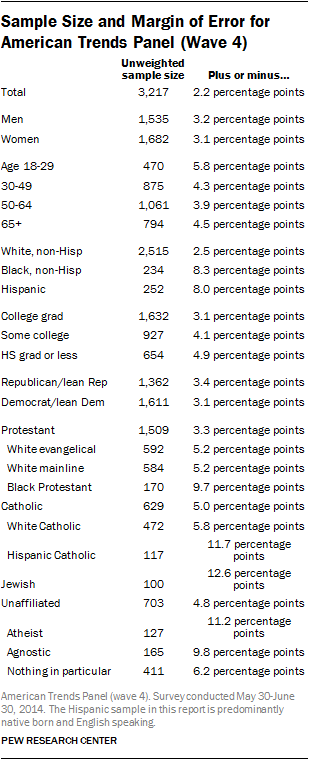
Plus or minus 12.6 percentage points seems pretty unacceptable for a poll. For what it’s worth (which isn’t much), the results were that Jews rated evangelicals on average as 34 on a “feeling thermometer” that goes up to 100, very similar to the score for how they rate Muslims. Jews rated evangelicals very similarly to how agnostics rated evangelicals (giving me a hint that perhaps a lot of the Jews in the survey are really agnostics), and somewhat higher than atheists did.
As a hypothetical, though, let’s just imagine that the results are accurate and that Jews don’t especially like evangelicals. I’m actually not at all sure most Jews even know what evangelicals believe in or stand for. The word sounds a great deal like “evangelist,” (same root), which traditionally has meant “a person who seeks to convert others to the Christian faith, especially by public preaching.”
With the Jews’ lengthy history of being the objects of forced or pressured or coerced conversion attempts, it wouldn’t be unreasonable to be somewhat wary of Christians you thought might be members of a group trying really hard to convert you. Unless a person is conversant with all the different Christian sects, and recent developments in Christianity—which believe me, most Jews and most non-Christians in general are not—it could sound as though “evangelicals” would be people who fit that proselytizing description. This in turn could be a fairly large part of the answer to Wilson’s question of “why” the dislike.
I strongly doubt that most Jews even know that evangelicals are their friends, or what they believe, or that evangelicals support Israel and respect Jews and the Jewish religion. Evangelicals may think those things are well-known facts, but I would wager they’re not at all well-known among Jews, secular or otherwise.
The religious categories the survey subjects were asked to rate did not include any Protestant denominations except evangelicals, which I find to be a curious thing. Most people—even Jews—have a better idea of what Catholicism is and a long history with it, and even some of the larger Protestant denominations (although I think that’s a lot less clear than Catholicism), but evangelicals are more of a mystery. By the way, the Wiki entry for “evangelicalism” mentions that adherants “believe in the centrality of the conversion or ‘born again’ experience in receiving salvation, believe in the authority of the Bible as God’s revelation to humanity and have a strong commitment to evangelism or sharing the Christian message.” That latter part—the commitment to sharing the Christian message—could be the source of some Jews’ fear that evangelicals are people intent on converting the Jews. Although that’s not a correct perception about evangelicals for the most part, it may be an understandable one in the absence of personal knowledge to the contrary.
One last thing—the Pew survey I found asked respondents to rate religions not on a measure of liking or disliking per se, but on a “feeling thermometer” with a cold/warm scale on which 0 was “coldest/most negative” and 100 was “warmest/most positive.” Some unknown number of respondents may have interpreted that in such a way that lower scores meant that the respondent is cold towards the group because he/she doesn’t know much about the it; more of an absence of feeling than an active dislike.
