
↓
 

The New Neo

A blog about political change, among other things

  • Home
  • Bio
  • Email
Home » Page 1106 << 1 2 … 1,104 1,105 1,106 1,107 1,108 … 1,916 1,917 >>

Post navigation

← Previous Post
Next Post→

“Improving” the King James Bible

The New Neo Posted on October 9, 2015 by neoSeptember 2, 2023

[NOTE: This is a post that originally appeared in 2008. I came across it today while responding to a comment, and I thought it worth repeating.]

As a child who loved poetry, I memorized it almost without intending to. Just a few readings of a poem I liked and its cadences seemed to stick in my brain. Lines and phrases came to me at odd times and repeated themselves, the way song lyrics often do.

The best of them had a strange and hypnotic power. As I got older they took on meanings and subtleties I hadn’t understood as a child. But I had always understood the beauty of the words and the way they fit together, sound complementing sense.

The same was true of certain prayers and Bible passages—the Psalms, for instance, which I knew were also poems, although they didn’t rhyme.

Their language was archaic. I learned the King James Version, even though I didn’t know at the time that it was called that. But it was easy to understand, not hard at all. And to me, all those “thys” and “thous” and “eths” and “ests” made it seem as though the psalms came not from the olden days, but from a place beyond and outside of time.

Then I went to a service that used a revised and modernized version of the Bible. I could still recognize the prayers and psalms, but now they had a jarring pedestrian quality, almost like a Dick and Jane reader. I was still relatively young, but even then I felt the tug of nostalgia for the beautiful language of the past, despite the fact that I couldn’t articulate what was missing or why I minded so much.

Well, maybe now I can articulate it. Here’s the 23rd Psalm in the King James Version:

The LORD is my shepherd; I shall not want.

He maketh me to lie down in green pastures: he leadeth me beside the still waters.

He restoreth my soul: he leadeth me in the paths of righteousness for his name’s sake.

Yea, though I walk through the valley of the shadow of death, I will fear no evil: for thou art with me; thy rod and thy staff they comfort me.

Thou preparest a table before me in the presence of mine enemies: thou anointest my head with oil; my cup runneth over.

Surely goodness and mercy shall follow me all the days of my life: and I will dwell in the house of the LORD for ever.

And here’s the same 23rd Psalm in the New American Standard version, written in 1971 with the twin goals of translational accuracy and modernization of the language.

It’s not necessarily identical with the first new version I encountered. But it’s typical of versions that make changes that are relatively minimal and yet still seem to me to represent a loss, however slight, of something very beautiful that was part of what made the earlier version so compelling. Is that loss compensated for by any gain in accessibility? You be the judge:

The LORD is my shepherd,
I shall not want.
He makes me lie down in green pastures;
He leads me beside quiet waters.
He restores my soul;
He guides me in the paths of righteousness
For His name’s sake.
Even though I walk through the valley of the shadow of death,
I fear no evil, for You are with me;
Your rod and Your staff, they comfort me.
You prepare a table before me in the presence of my enemies;
You have anointed my head with oil;
My cup overflows.
Surely goodness and lovingkindness will follow me all the days of my life,
And I will dwell in the house of the LORD forever.

It doesn’t take too many liberties with the older version, not really. Mostly it clears out the “thous,” and substitutes the modern “you,” in addition to removing the archaic endings from the verbs. So it oughtn’t to be so bad, right? And yet, and yet…it feels so much flatter, although you may disagree.

The revisers have made a few other changes that seem to me to be gratuitous, although I imagine they have something to do with translating more literally and correctly from the original Hebrew (of which I understand only a few words, although I’ve heard it’s the very best way of all to appreciate the splendor and poetry of the work, as well as its meaning).

There are a couple of changes that jump out at me in jarring fashion. I feel something akin to a pang at the missing words and phrases, and come close to wincing at the additions.

Why oh why, in line 4 (corresponding to line 2 in the older version), are the waters described as “quiet” instead of “still?” Surely the phrases indicate close to the same thing in English, but “still” has the added virtue of conjuring up other references such as “still waters run deep,” as well as the repetitive “s” sound that harmonically resonates with the “s” at the end of the word “waters” and the one in the middle of “beside.” That’s poetry.

Then there’s the worst offense of all, at least to my ears: the omission of the word “Yea” in line 4 of the old version (it would be line 8 in the new). “Yea” was a great change of pace, a dramatic stopping point where the rhythmic variation of the unstressed and stressed syllables stood still for a moment, like a rest in music, before charging forward again. It worked as wonderful emphasis: yes, indeed; hear hear!

The substitution of “Even though” for “Yea, though” not only fails to serve this rhythmic function, it doesn’t even have the same meaning. “Yea” is an affirmation and an emphasis, underlining the thought to follow. The “even” is weak, tentative: “despite the fact that I walk through the valley….”

I can’t imagine anyone caring quite the same way about the newer version as the older one. It’s hard to imagine anyone wanting to memorize it for the sheer beauty of it, although some of the poetry still comes through. Perhaps there’s even someone who prefers it, just as there are people who prefer frozen french fries to the real thing. But that someone isn’t me.

The changes for the sake of accuracy seem so minimal that I can’t believe they make much of a difference, although in some other parts of the Bible they may be more important. I say keep the important ones and ditch the rest.

I challenge anyone to prefer an even newer version, though, one that departs far more from King James. It’s called the Contemporary English Version, written in 1995 with the purpose of simplicity and ease of reading:

You, LORD, are my shepherd.

I will never be in need.

You let me rest in fields

of green grass.

You lead me to streams

of peaceful water,

and you refresh my life.

You are true to your name,

and you lead me

along the right paths.

I may walk through valleys

as dark as death,

but I won’t be afraid.

You are with me,

and your shepherd’s rod makes me feel safe.

You treat me to a feast,

while my enemies watch.

You honor me as your guest,

and you fill my cup

until it overflows.

Your kindness and love

will always be with me

each day of my life,

and I will live forever

in your house, LORD.

One might just as well call it the Hallmark greeting card version and be done with it. Or maybe it’s the “You Light Up My Life” version.

This version simplifies to the point of boredom. Nearly all the things that make the first (and even the second, to a certain extent) version uniquely vivid are blanded out. I have no idea why the water is now “peaceful,” for example, but it’s certainly the most dull choice of the three.

But perhaps the worst offense in the passage is totally eliminating the specificity of the image of anointing the speaker’s head with oil, substituting instead the generic and soporific (big yawn) “You honor me as your guest.” Yes, I get the reason: the meaning of the ritual, along with all its rich associations, has been lost. But I don’t think it’s that difficult to guess at in context or to teach, even for a child. For what shall it profit a religious text, if it shall gain a small modicum of enhanced comprehensibility, and lose its own power?

The King James Bible was once new and modern, I suppose, back in the early 1600s when it was first written. But there’s a reason why it’s so popular and has stood the test of time: it’s a masterpiece (and wonder of wonders, it’s a masterpiece produced by a committee).

And yet the urge to improve on the King James Version is nearly irresistible, it seems. There are no fewer than twenty other English-language versions listed at the BibleGateway site, and no doubt there are more on the way. That’s progress for you.

Posted in Best of neo-neocon, Literature and writing, Me, myself, and I, Poetry, Religion | 29 Replies

Cornhead hears Hillary so you don’t have to. Again.

The New Neo Posted on October 8, 2015 by neoOctober 8, 2015

Cornhead reports on the new, improved Hillary Clinton in Iowa.

Posted in Hillary Clinton | 15 Replies

Hillary and TPP: not for her the hobgoblin of little minds

The New Neo Posted on October 8, 2015 by neoOctober 8, 2015

Hillary Clinton’s audacious renunciation of the trade agreement she helped negotiate and has bragged about and praised highly in the past is a naked political move that she must have calculated would help her:

With news leaking out that organized labor, the Teamsters in particular, are withholding an endorsement and might even endorse a Republican next year, Hillary is desperate to keep unions in the fold. Even if she holds off Bernie Sanders and Slow-Joe, without strong union support she probably can’t win in November.

So today Hillary announced that she opposes the new Pacific trade agreement that she helped negotiate while she was secretary of state. So she’s not only running against the free trade legacy of her husband and against President Obama””she’s running against herself.

Those of you who read my blog regularly know that I believe it’s possible to change one’s mind and be sincere. But Clinton’s history of repeated duplicity means that she’s forfeited the right to that presumption. However, just as a hypothetical, let’s say she is telling the truth. If so, she would have another problem to explain: how could she have shown such poor judgement as to advocate for the agreement again and again and again—in fact, 45 times between 2010 and 2013, when she was Secretary of State?

Here’s how she attempts to explain:

In July, Clinton told CNN that she never worked directly on the deal.

“I did not work on TPP,” Clinton said Thursday. “I advocated for a multi-national trade agreement that would ‘be the gold standard.’ But that was the responsibility of the United States trade representative.”

While technically true — Clinton’s State Department was not the lead negotiator on the deal — the former secretary of state regularly trumped up trade deals, including what would become the TPP…

…Clinton specifically cited currency manipulation enforcement, benefits for pharmaceutical companies and impacts on American workers as the reasons she was disapproving the deal.

Clinton’s Democratic opponents in the 2016 presidential race are against the deal, unions are against the deal, and now she’s against it too. It’s hard to imagine that a single thinking human being would be convinced that her change of heart and mind is on the merits here. For example, even Ezra Klein finds himself a mite perturbed:

Of late, Clinton is again looking like the kind of candidate who puts polls in front of policy.

First, she came out against Obamacare’s Cadillac tax ”” a policy that enjoys wide support among health economists. Clinton knows the problems of the massive deduction for employer-provided health insurance well; decades ago, her health-care plan wiped out the tax code’s preference for employer-based health care, and in 2008 she had a smaller, more targeted, version of the Cadillac tax in her proposal.

I want to be clear here. Lots of people oppose the Cadillac tax, and for lots of reasons. What I have trouble believing is that Clinton and her policy advisers really think the Cadillac tax is a bad idea. Her past policies embrace its theory, her past advisers helped pass it into law, and virtually everyone who spends their days thinking about how to control health-care costs considers it one of Obamacare’s most promising provisions.

On Wednesday, Clinton came out against the Trans-Pacific Partnership trade deal, saying that she’s concerned with the provisions around pharmaceuticals and the absence of provisions around currency manipulation. But as Tim Lee notes, Clinton strongly supported early versions of the deal ”” she called the TPP “the gold standard in trade agreements” ”” that were worse on pharmaceuticals and identical on currency manipulation…

I don’t truly know what’s in Clinton’s heart ”” perhaps I’m wrong, and despite all evidence to the contrary, she holds all these positions deeply ”” but as a close reader of her record, I’m not convinced that Clinton, in office, wouldn’t support policies like the Cadillac tax or negotiate trade deals like the TPP. And as someone trying to understand Clinton’s likely governing philosophy, it’s unnerving.

And this is a broader problem for Clinton. Her political weakness, fairly or not, is that the voters and the media ”” or maybe it’s the media and, thus, the voters ”” have decided that she’s unusually poll-tested and calculating, even for a politician.

Klein is not enough of a Clinton devotee to be able to say that 2 + 2 = 5 in this case, and he doesn’t even think it would help her to say so, because her flaws have become so obvious. But that doesn’t mean that many of her supporters will abandon her for this sort of thing. In fact, quite a few of them probably agree with this chilling yet revealing piece by Matt Yglesias, which is a must-read if you want to understand the heart/mind of the left:

Clinton is clearly more comfortable than the average person with violating norms and operating in legal gray areas.

This is normally portrayed as a political weakness of hers, and in many ways it is. She can’t credibly portray herself as the kind of outsider who’s going to clean up a broken and corrupt Washington system, because she is very much a part of that system and has been for years.

But it’s also an enormous source of potential strength. Committed Democrats and liberal-leaning interest groups are facing a reality in which any policy gains they achieve are going to come through the profligate use of executive authority, and Clinton is almost uniquely suited to deliver the goods. More than almost anyone else around, she knows where the levers of power lie, and she is comfortable pulling them, procedural niceties be damned.

Democrats have almost no chance of securing a majority in the US Senate and even worse odds of securing a majority in the House. So if there is a future for making progressive policy, that future is executive action.

So, there it is. Vote for Hillary! She’ll continue to trash the Constitution just like Obama in order to get what we want, because how else can we be successful in going around the will of the people?

For their own good, of course.

[NOTE: The title of this post is a reference to the famous Emerson quote about “a foolish consistency” being the “hobgoblin of little minds.”]

Posted in Hillary Clinton, Politics, Press | 15 Replies

“I think I shocked some of you, huh?”

The New Neo Posted on October 8, 2015 by neoOctober 8, 2015

That’s a quote from erstwhile would-be Speaker Kevin McCarthy, who abruptly announced his withdrawal from the race:

There is no clear successor who can overcome the deep divisions in the party and win the post. An influential group of conservatives endorsed a long-shot candidate, Rep. Daniel Webster, on Wednesday, placing McCarthy’s ability to win the House floor vote later this month in doubt.

“If we’re going to unite and be strong, we need a new face to do that,” McCarthy said, adding that he did not want to win the race on the House floor with only enough votes to squeak by.

Personally, I don’t think that McCarthy would be withdrawing at this point if he hadn’t inadvertently given Democrats a beautiful talking point that they immediately twisted and exploited:

McCarthy’s candidacy ran into trouble last week after he suggested that the House’s select committee on Benghazi was an attempt to hurt Hillary Clinton’s poll numbers.

Asked if that affected his decision, McCarthy acknowledged: “Well, that wasn’t helpful.”

Of course, despite the CNN article and all the other Democratic talking points, McCarthy never “suggested” any such thing. What he did say was that the Benghazi investigation had the effect of hurting Clinton politically, not that this was its original motivation and purpose. But truth doesn’t matter; what matters is that his statement was politically inept, and he seems to have realized this.

So, now what? Ryan’s out, Gowdy’s out, Chaffetz is in. Speaker is a powerful job, but in many ways a thankless and extremely difficult one, all the more so now when Republicans are so deeply and contentiously divided.

Posted in Politics | 19 Replies

Spencer Stone, French train hero, stabbed in Sacramento

The New Neo Posted on October 8, 2015 by neoOctober 8, 2015

Spencer Stone is in the hospital with stabbing injuries that have been described as “non-life-threatening.”

All three of the American friends who helped subdue the French train attacker are from the Sacramento area. Sacramento is a pretty rough town, crimewise. The stabbing is reported to have been unrelated to the French attack:

Stone, an Airman First Class with the U.S. Air Force, was out with friends when he was stabbed about 12:45 a.m. near 21st and K streets, Sacramento police said.

A fight in the street allegedly led to Stone being stabbed multiple times in the torso, prompting investigators to block off two blocks in the area, Sacramento police said…”alcohol is believe to be a factor,” police said.

Apparently a bar fight, or after-bar fight, although we’ve learned how often initial reports are inaccurate. We also don’t know what role Stone may have played in the fight; it’s even possible he was trying to stop it.

You don’t—and won’t—hear all that much about the danger of knives, will you? All of Stone’s recent injuries, both abroad and at home, have been the result of knives. In addition, in a strange sequence of events, Stone’s friend and fellow-hero Skarlatos had a near-brush with danger the other day:

Skarlatos returned last week to Roseburg, Oregon where he was living after a gunman opened fire on Skarlatos’ college, Umpqua Community College, killing nine before before the shooter turned the gun on himself.

Posted in Violence | 32 Replies

Political identity: connecting the dots

The New Neo Posted on October 7, 2015 by neoOctober 7, 2015

Yesterday I read this article by John Hinderaker at Powerline:

During our previous wave of mass immigration in the late 19th and early 20th centuries, both immigrants and American officials understood that assimilation into American culture, most importantly learning to speak English, was required. Immigrant parents made great sacrifices so that their children would grow up speaking English, and thereby enjoy the opportunities available to those who can participate fully in America’s economy.

Today, assimilation seems no longer to be even a goal. The Democratic Party is happy to have immigrants ghettoized, with limited opportunities for advancement. It makes their votes easier to harvest.

This chart summarizes the data:

langruage

Seeing that brought back some memories for me of when I first read about the movement for bilingual education—not to teach children a new language, but to teach them in their old language for a longer time in order to ease them into this country and English more gradually.

I don’t remember what year it was (late 60s, perhaps?), but I know that I was a young adult and a liberal. My liberal identity was already so well-rooted, despite my relative youth, that it seemed a part of me that was never going to change, any more than I would wake up one morning and find that I had grown 6 inches. My political growth plates had fused, as it were, and that was that.

That conclusion turned out to be wrong, of course. But that’s another story for another day.

But even back then, despite what I thought of as my set-in-stone liberal political affiliation, I didn’t always agree with everything liberals advocated. I most definitely didn’t agree with the idea of any sort of extended bilingual education. It seemed to me that children had done very well in this country with a fairly pressured crash course of learning English. Their brains were plastic enough (especially with language) to succeed, and if they didn’t have the alternative of speaking their native tongues at school, and the repeated reinforcement of being taught in those tongues, their adjustment might be harder in the short run but easier and better in the long run. As a result, they and everyone else would benefit.

I’ve seen nothing since to disabuse me of that notion.

What I didn’t see at the time, however, was any larger left vs. right issue. My stance seemed to me to be an isolated instance of minor disagreement with one small aspect of the liberal line. I didn’t sense a connection to any other tenet of liberalism, and it had no significance to me in terms of causing me to question the whole. Over the years I had many such points of disagreement with liberalism, but since I was not all that interested in politics at the time, and plenty busy with other things (including, after a while, motherhood), I never connected any dots or had an “aha!” moment about it all until decades later.

I maintain that in this I was hardly unique. Not all habitually liberal voters mark in lockstep with everything on the liberal agenda. Some do, of course; some wouldn’t think of deviating from the party line, and they are the true believers. But there are many more who are somewhat like I was: not happy with everything on the agenda, disagreeing with this or that, perhaps even fairly conservative in their private lives, but voting for liberal Democrats out of personal history and a lack of knowledge of what the alternatives really represent, as opposed to what the Democratic Party and the mainstream media say the alternatives represent.

Nowadays, of course, such ignorance about the right is harder to justify and understand. In an earlier day there was no internet, and it was much harder—although certainly not impossible—to gain easy access to coherent, comprehensive, and undistorted presentations of conservative points of view. A person would have had to be motivated, however, and to know where to look, and if that person was (as I mostly was) surrounded by a liberal echo chamber, motivation and opportunity could be lacking. Without knowledge and information, it would be very hard to connect those dots and finally have that “aha!” moment.

The left knows that. Today, with easier access to alternative points of view, it’s even more important for them to discredit those points of view in advance so that people will think them invalid and duplicitous and never seek them out to hear for themselves. Thus, the myth of “Faux News” is born, reinforced by jokes and sneering whenever liberals gather together.

I know; I gather in those groups all the time, too; sometimes incognito, sometimes not. These days I have a coherent political philosophy and framework into which I can fit the information I read, and a way to explain my own positions. It’s taken me quite a few decades to get there, though, and perhaps that makes me more patient than most on the right with those who never make the journey—or who have yet to make the journey.

But the hour is late, very late. And getting later.

Posted in Immigration, Language and grammar, Leaving the circle: political apostasy, Liberals and conservatives; left and right, Me, myself, and I, Political changers | 38 Replies

Why does Western Europe seem so determined to commit cultural suicide?

The New Neo Posted on October 7, 2015 by neoOctober 7, 2015

Here’s the link to my new article at the Weekly Standard. An excerpt:

Whenever I read about the European response to the current wave of “migrants” to Europe, one of the first questions that comes to mind is, “Why?”

Why do so many of the countries of Western Europe appear determined to hasten the end of their own national identity by refusing to draw any meaningful limits to the current influx of third-world “refugees”””a significant number of whom are probably not bona fide refugees, and a much smaller but still-worrisome number of whom are probably jihadis bent on the destruction of their new host countries?

Click on the link to find my answer.

Posted in Immigration | 83 Replies

Victor Davis Hanson asks the wrong question

The New Neo Posted on October 6, 2015 by neoOctober 6, 2015

I admire Victor Davis Hanson’s writing and thought, and very often I agree with him.

But this time? Not so much.

Hanson lists a host of ills that the Obama years have wrought, and then asks:

Was all this due to incompetence or nihilism?

That’s the wrong version of the old “fool or knave?” question. Calling Obama a nihilist lets him off the hook:

1. total rejection of established laws and institutions.
2. anarchy, terrorism, or other revolutionary activity.
3. total and absolute destructiveness, especially toward the world at large and including oneself
4. philosophy. an extreme form of skepticism: the denial of all real existence or the possibility of an objective basis for truth.
5. the principles of a Russian revolutionary group, active in the latter half of the 19th century, holding that existing social and political institutions must be destroyed in order to clear the way for a new state of society and employing extreme measures, including terrorism and assassination.
6. annihilation of the self, or the individual consciousness, especially as an aspect of mystical experience.

None of these quite fit. (1) Obama does not totally reject established laws and institutions; he works around them
(2) He is neither an anarchist nor a terrorist. He does not want to overrule the established authority; he is the authority, and he came to power through democratic means
(3) He wants to destroy the balance of power in the world, but does not want total destruction, and that urge towards destruction absolutely does not include himself
(4) Obviously not relevant
(5) Similar to #2
(6) Obviously not relevant

I’ve written before that Obama is a puzzle that people keep trying to solve. I wrote that “something about [Obama] continues to elude…many extremely intelligent people…whose intelligence I respect just about as deeply as I respect anyone’s.” That seems to go for Hanson, too.

My contribution to solving the Obama puzzle can be found on this blog many times over (including the post to which I just linked). The summary, simplified version is: he is an ideologue, a man of the left, to be exact. He is a narcissist with a supreme confidence in himself. He is ruthless and focused and knows the use of propaganda. In the interests of that propaganda, he has perfected his presentation of a certain persona, and he doesn’t care if non-supporters see through him; what’s important is that he reach enough other people to accomplish his goals. One main goal is to move America ever leftward, to change its demography so that he creates a permanent majority for the now-ever-more-leftist Democratic Party. Another is to burnish his own “legacy” by doing the first. Still another is to punish America for its supposed sins and bring it down a peg (or actually, as many pegs as possible) in terms of world influence and reputation.

Those are not the actions of a nihilist. And if you see them as his goals, he has not been incompetent in his attempts to reach them.

Hanson also writes:

Obama has nearly destroyed the Democratic Party ”” and all but turned it over either to a veritable crook and has-been or a 73-year-old self-described socialist.

But it won’t matter, will it, if he’s changed the democraphics enough that yellow dog Democrats will vote for them anyway.

He lost both houses of Congress.

And completely stymied them by either going over their heads or vetoing what they pass. So it also doesn’t matter.

The legislatures and governorships are overwhelmingly Republican.

That’s true, and I am pretty sure he doesn’t consider it a good thing. But again, what power do they have against an ever-growing, ever-stronger, federal government? And just one more liberal SCOTUS appointment would weaken them still further.

He turned off millions of working-class old-time Reagan Democrats. His new paradigm ”” demagogue minorities to vote en bloc in record numbers by any means necessary and screw those turned off by his separatist rhetoric ”” is probably not transferrable to other Democratic candidates.

I don’t know on what basis Hanson says that. I see it as very transferable. It’s probably the reason Hillary is still leading the Republicans in many polls; identity politics is one of her appeals.

Otherwise, the Obama record is mostly disasters. He promised over 20 times not to act unconstitutionally and issue blanket amnesties. Then he destroyed the idea of a border, both physically and ideologically ”” and taught the Democratic Party that the salvation for its otherwise unpopular agenda was demographic, as in welcoming in millions of illegal aliens who would form a new constituency for statism. To restore a shred of border security will incur institutionalized charges of racist, nativist, and xenophobe. The only brake on immigration will be bewildered Latino activists who fear that vast increases in illegal Asian immigration will trump their own paradigm, and thus they will call for some sort of immigration enforcement. Obama has left us with an existential question: if there are no borders and no immigration laws, at what point does illegal immigration cease? 100 million foreign-born residents? 150 million? 20 million illegal aliens? 40? 60? When the southern U.S. becomes Mexico or Guatemala, will Guatemalans or Mexicans still wish to come? When Sidwell Friends become bilingual or the Menlo School has translators on campus? Once the law is null and void, the question becomes again philosophical: who is to say that anyone cannot come, once you have said that almost everyone can come? Apparently, the only person we don’t want in this country is someone applying legally for citizenship from a Germany or Denmark, with an MBA, $250,000 in the bank, and perfect English.

I have no idea why Hanson doesn’t consider this a great win for Obama. This, after all, was one of the goals.

Foreign policy will take a decade of recovery. We are seeing a historic Russian, Iranian, Syrian, radical Shiite/Hezbollah, and Hamas arc sweeping across the Middle East.

Again, where’s the problem for Obama? I’m not seeing it. And it “will take a decade of recovery”—that’s if a Republican ever gets elected, and if Republicans stay in power for a decade. How likely is that? And will the world ever trust us again? Since there was one Obama that could be elected for one term, and then a second, and he has been able to undo and dismantle the bipartisan foreign policy consensus that’s held sway for the past eighty or so years, there can always be another, and then another—not exactly the same, to be sure, but similar enough. Once trust has been undermined in our continuity of foreign policy, there is no regaining it—or at least, it would take more than a decade of hard work to do so.

Afghanistan is going the way of Iraq. To appreciate those twin disasters, imagine getting out of Korea for a 1956 reelection talking point and allowing the North to reabsorb what thousands of American lives had saved. Or perhaps imagine Truman as Obama leaving Japan about 1950 to allow the postwar Japanese to work things out with the Communist Chinese next door.

But again, those were Obama’s goals. He made it clear that he wanted out of Afghanistan and Iraq, and he’s never wavered in that intent or its execution, even when the military advised him against doing it. Anyone (and that includes Obama) could have foreseen the consequences; we can assume that Obama foresaw them, too, and therefore intended them.

Hanson adds this curious sentence:

The only mystery about the disasters in Afghanistan, Egypt, Iran, Iraq, Libya, Syria, and Yemen, and our new hostility to Israel and the Gulf states, was whether Obama was incompetent and timid, or a conniving nihilist eager to reduce the Middle East to an anti-American wasteland.

Again, that wouldn’t be nihilism. Wanting the Middle East to be anti-American is not nihilism, it’s anti-Americanism, which is a very different “ism.” What’s more, how on earth can Hanson still be thinking this could be the result of timid incompetence? There is way, way too much evidence on the other side.

[NOTE: It’s slightly off-topic for the subject matter of this post, but Hanson also writes about Obamacare that:

…[M]ost who had their own insurance just shrug that it is now far more expensive for less care, and move on. They are apparently relieved that higher costs for their plans are worth them not devolving entirely into Obamacare coverage.

Perhaps he means “most who had employer-based insurance.” I don’t see how he can really mean “their own insurance,” as in individual insurance, became Obamacare has completely rewritten that insurance market and dictated that all the plans in it must follow the Obamacare template. So the plans in the individual market match the Obamacare plans, and the only difference is the lack of subsidies in the individual private market. Even the networks there are supposedly the same as the Obamacare networks (although I was told by one broker that although they’re mandated to be the same, in practice the self-pay plans often have broader networks).]

ADDENDUM: To all who say “nihilist,” I continue to say “no.” The reason is not that Obama doesn’t want to destroy. He does want to destroy—certain things, to accomplish certain goals. For a nihilist, there are no goals except destruction. Obama is a man of the left through and through. He subscribes to its politics, philosophy, and tactics. The left has long been allied with Islam, by the way—in Iran during the 1979 revolution, for example, and in its anti-Israel sentiment ever since Israel abandoned its socialist beginnings.

The left thinks it’s building something, believing in something. Some nihilists are hangers on with the left, and they only want to destroy. But they’re not leftists, they’re nihilists. It’s a fine distinction, but a real one.

I believe that Obama is a leftist. He destroys, of course, but in order to build something that he believes in. He also destroys what he hates. It’s a twofer for him.

To take a historic example, Goebbels was much more purely a nihilist. He was a hanger-on with the Nazi Party rather than a true believer. I’ve written about that here:

In Goebbels, it seems to have been a purely sociopathic nihilism, compounded by enormous narcissist drives (the following is taken from the Meissner book):

As far as one could tell, Goebbels had no beliefs at all. People still living [the book was written in 1980], who were part of his immediate circle or his household, agree absolutely about this. To him all human existence was nothing but chaos. He considered himself one of the very few intellects capable of surveying it and mastering it.

In fact, it may be that Goebbels didn’t even particularly hate Jews, at least no more than he hated the entire human race. His interest was in power, self-promotion, and persuasion, and he was a rare genius at all three, willing to do literally anything to further those causes.

Obama is also interested in power, self-promotion, and persuasion (as are many politicians). But they are not complete ends in themselves for him, although they are very very important.

Of course, there is always the possibility that his belief in the left is a facade, and that nihilism is what is at his core. That’s not how I read him, but I understand that it’s a possibility.

Posted in Obama | 82 Replies

Fiorina presents a liberal’s dilemma

The New Neo Posted on October 6, 2015 by neoOctober 6, 2015

Democrats are deeply into identity politics, and it’s a well-known fact that a great deal of Hillary Clinton’s appeal—what’s left of it, that is—among women is the fact that she is a woman. So Democrats who are predisposed to care about such things, and to care deeply, are perplexed by Carly Fiorina:

As a scandal-plagued Hillary Clinton continues to flail, feminists have seen there’s a woman out there who’s cleaning her clock as a candidate, fulfilling their dreams of a powerful woman, except that she isn’t one of their own. She’s pro-life, pro-markets and very pro-power. And she’s causing a crisis among female Democrats, who long to embrace her, but can’t. “Carly Fiorina is the candidate I wanted Hillary Clinton to be,” said one wistful feminist. Another asked, “Can you love a campaign, but hate a candidate’s policies?” And a third noted, “As a lot of feminists cheered her on during that [debate] performance, we were loathing her actual policies. There’s an excitement and a horror that those two ”¦ co-exist.” But they do co-exist, and it’s not getting better. Which is giving the sisterhood fits.

The more doctrinaire feminists of the left are almost certainly not the least bit conflicted, however. To them, Carly is the feminist equivalent of the anti-Christ. Sarah Palin was far easier for them to discredit, because although she was a woman of marked accomplishments, her class and her education, her hobbies and her speech patterns, marked her as “other” and made it easier for them to demonize and particularly to mock her.

Not so with Fiorina, who is aware of her effect on less doctrinaire liberal (as opposed to leftist) feminists:

Fiorina responded after Kelly read part of a New York Times story from last week in which one woman remarked of the former Hewlett-Packard executive that, “It’s so weird ”” she looks like one of us, but she’s not.”…

“Actually, note to Democrat Party: We’re half the nation. And so our views differ, just like men’s views differ,” Fiorina said. “And yes, I think I am distinctly horrifying to liberals that I am a conservative woman who right now, head-to-head, beats Hillary Clinton soundly.”

“Horrifying” is a good word for it. They can attack her HP record, but then they’d be trashing a woman who became a head executive in a major company, someone they would ordinarily champion. They can’t join with Donald Trump in ridiculing her face. The only thing they can do is call her a traitor to her sex by being a conservative, but that’s weak tea compared to their usual attack. And secretly, they seem to admire her steely resolve and her obvious intelligence.

Posted in Election 2016, Men and women; marriage and divorce and sex | 18 Replies

Scientists in Antarctica drink a lot

The New Neo Posted on October 6, 2015 by neoOctober 6, 2015

That’s the title of this article, and that’s the subject matter: scientists in Antarctica drink a lot.

Well, you might say, why not? It’s Antarctica, Jake.

NSF managers in Washington say they’re still looking at whether shipping a few breathalyzers to McMurdo (which houses about 1,000 people during the busy summer season) or the smaller Scott-Admundsen South Pole Station (150 staff and scientists) is a good idea, or even legal. Even though the US government owns and operates bases there, Antarctica isn’t US territory. Who would administer the tests? Where would people challenge the order, or the results? Antarctica doesn’t have any courtrooms or, thankfully, many lawyers.

Even science itself conspires against breathalyzers. South Pole Station is at an altitude of 10,000, atop a high plateau. That makes the device difficult to calibrate. “In terms of meeting requirements for the contract, there is a convincing legal argument to be made that ”˜you can’t make me do this,’”Broughton says.

NSF officials say they just want to reduce alcohol-related problems, and that things aren’t as dire as the report makes out.

Why am I highlighting this? Well, I’ve long had a fascination with the idea of going to the Poles. Also, I’m surprised to learn that the South Pole Station isn’t just at the bottom (a mere convention, I know) of the world, it’s also at high altitude. And lastly, it makes me think of an old anthropology teacher of mine.

He was an expert on a New Guinea tribe that had once been cannibals, but I seem to recall they’d given up the practice by the time he got there. He often talked about his field experience among this group of people whom he really, really didn’t seem to like at all. Most of his stories were about quaint customs of theirs that seemed reprehensible; no cultural/moral relativist he.

But most of all I remember him saying that the first rule of doing research was to be sure to lay in the Scotch. Lots and lots and lots of it, enough to last through the whole tour of duty, which could be long and lonely and depressing.

Posted in Science | 11 Replies

Peter Singer and the trap of logic: Part III

The New Neo Posted on October 5, 2015 by neoNovember 3, 2023

[NOTE: To make sense of this post, it would help to have read Part I and Part II.]

In Parts I and II I wrote about Peter Singer’s strange and ultra-“logical” ideas about the value of human life and of animal life, and about how to make decisions involving both. This article has pointed out something I’ve been thinking [emphasis mine]:

Critics say that his moral certainty is one of Singer’s most significant flaws – that he is too demanding, too impersonal, and too dismissive of the way people actually relate to one another. In its rawest form, Singer’s philosophy condemns people for caring more about their families than about strangers. “People do have special relationships with their families, their communities, and their countries,” Alan Ryan, the warden of New College, Oxford, told me. Ryan has written extensively on John Stuart Mill and he taught for many years at Princeton. “This is the standard equipment of humanity, and most people, in all of human history, have seen nothing wrong with it…[H]uman beings just aren’t put together the way that [Singer] wishes they were.”

But that’s not the only criticism of Singer’s ideas:

Other philosophers criticize Singer more for the logical consequences of his beliefs than for his refusal to acknowledge that emotion plays an essential role in the narrative of life. For example, if we could take an action today that would benefit many people in three thousand years, Singer would tell us to do it. It wouldn’t matter that we would never see the benefits – or that the action might even cause us some harm. Yet predicting the long-term effects of something is like guessing how the winds passing over the Sahara this summer will affect the world’s weather in fifty years.

The speaker in this next quote is a disabled woman who has been friendly with Singer:

“Peter is a perfectly sincere man,” McDonald told me. “But he thinks real life is not as important as intellectual life. So he can be very compelling when he talks about the intelligence and the feelings of a pig. But he is somehow not as quick to understand what our problems and possibilities might be. He has all these big ideas, but he has never really gotten his hands dirty. Peter needs to get a little more involved in life if he wants to understand it.”

In recent years, Singer got a little more “involved in life.” It has had some interesting repercussions:

When Singer’s mother became too ill to live alone, Singer and his sister hired a team of home health-care aides to look after her. Singer’s mother has lost her ability to reason, to be a person, as he defines the term. So I asked him how a man who has written that we ought to do what is morally right without regard to proximity or family relationships could possibly spend tens of thousands of dollars a year for private care for his mother. He replied that it was “probably not the best use you could make of my money. That is true. But it does provide employment for a number of people who find something worthwhile in what they’re doing.”

…Singer has responded to his mother’s illness in the way most caring people would. The irony is that his humane actions clash so profoundly with the chords of his utilitarian ethic.

That doesn’t surprise Bernard Williams. “You can’t make these calculations and comparisons in real life. It’s bluff.” Williams told me, “One of the reasons his approach is so popular is that it reduces all moral puzzlement to a formula. You remove puzzlement and doubt and conflict of values, and it’s in the scientific spirit. People seem to think it will all add up, but it never does, because humans never do.”

Singer may be learning that. We were sitting in his living room one day, and the trolley traffic was noisy on the street outside his window. Singer has spent his career trying to lay down rules for human behavior which are divorced from emotion and intuition. His is a world that makes no provision for private aides to look after addled, dying old women. Yet he can’t help himself. “I think this has made me see how the issues of someone with these kinds of problems are really very difficult,” he said quietly. “Perhaps it is more difficult than I thought before, because it is different when it’s your mother.”

“It is different when it’s your mother.” Duh.

Singer’s ethics is an ethics for robots. And you better be careful, even when you design an ethics for robots, that you don’t end up creating something that makes things worse.

Here’s a quote that encapsulates the problem with what I have referred to in the title of this series on Singer as “the trap of logic”:

The problem with a madman, Chesterton wrote, is not that he is not logical; the problem is that he is only logical. Taking no offense, Prof. Singer seemed pleased that I thought him logical, mistakenly equating logical with reasonable.

Logic is a valuable tool, but it is only one tool in the human bag. Elevating that one tool to a position too high, and jettisoning the rest, leads to a kind of madness.

Bear with me on the rest of this post, which may seem to be a digression but is not.

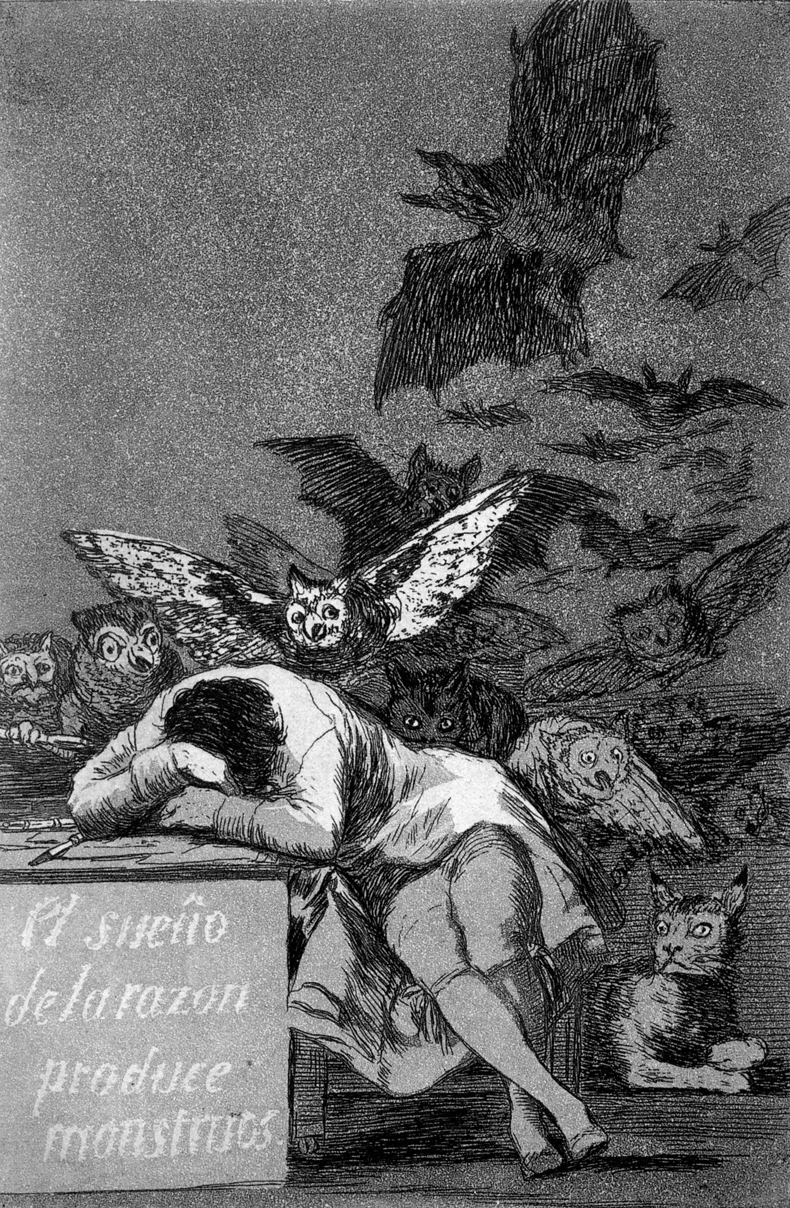
When I was a child of about twelve years old, I came across (I think it was in an encyclopedia) a Goya etching entitled “The Sleep of Reason Produces Monsters.” Here it is:

sleep

At the time, I was puzzled by the title. Did it mean that when reason goes to sleep, bad things happen? Or did it mean that when reason gets free reign, bad things happen? Since then, I’d always seen it interpreted the first way; after all, Goya himself wrote “Imagination abandoned by reason produces impossible monsters.” But that’s not the full quote, which adds, “united with her, she is the mother of the arts and the source of her wonders.”

I’d add to “imagination” something like “emotion,” or perhaps “the eternal and ancient human truths.”

Here’s more:

Kearney (2003) suggests two different meanings based on the dream/sleep debate. Firstly, “reason must govern the imagination”, it must be watchful, otherwise the “forces of darkness”, will be “unleashed on humanity.” Alternatively, a more romantic approach is that the “rationalist dreams” promoted by the “Enlightenment” are just as capable of producing their own “monstrous aberrations.”

Reading about Peter Singer immediately made me think of that Goya etching. His seemingly-logical ethics is ultimately a monstrous one, as he himself may be beginning to discover. But I doubt that he—or any of the people who consider him a genius, with a theory that is not only worthwhile but that should guide our decision-making process—will ever abandon it.

Posted in Academia, Getting philosophical: life, love, the universe, People of interest | 36 Replies

Andrew C. McCarthy on Syria and intervention

The New Neo Posted on October 5, 2015 by neoOctober 20, 2019

There really are no good guys in Syria, says Andrew C. McCarthy:

To repeat, in Syria, there has never been a vacuum – i.e., a void created by the failure to cultivate a viable opposition. Yes, there are some moderates in Syria, but the backbone of Assad’s opposition has always been Islamist: the Muslim Brotherhood and the even more extreme jihadists with whom they seamlessly make common cause. They are not moderates; they want to overthrow Iran’s despicable cat’s paw, Assad, in order to do to Syria what the Brotherhood tried to do to Egypt – and what Islamists have done to Iraq, Libya, Afghanistan, etc.

It is not true that Obama failed to back the Syrian “rebels.” In fact, after the mutual Obama-Beltway GOP strategy of siding with Islamists against Qaddafi blew up on us in Libya, a reprise was attempted in Syria. Alas, the “rebels” we backed kept aligning with the jihadists (just as they did in Libya); the weapons we gave them kept ending up in jihadist hands. That was not just because the “rebels” were insufficiently “vetted”; it was because there was no way to overthrow Assad without the Islamists’ playing a major role ”” and, probably, a leading role.

This contributed to the ascendancy of ISIS, but was not the cause of that ascendancy. The cause is the dominant regional culture – Islamic supremacism.

Sad, but I think true, particularly in Syria.

Then we did a reversal:

Then, to make matters worse, Washington forgot that it had gotten enmeshed in Syria in order to oust Assad. Obama desperately wanted his deal with Iran, which wanted Assad left alone. So the Syria misadventure turned on a dime from targeting Assad on behalf of Sunni Islamists and jihadists to targeting Sunni jihadists – ISIS – to the benefit of Assad. Does anyone wonder why the U.S. has no credibility in the region?

So, what should we do in a situation in which all the alternatives seem very very bad? Not that Obama will do it, of course; but it’s still good to try to think it through, even if it’s just a mental exercise:

Our interests in the region are to defeat both Russia/Iran/Assad and ISIS/al-Qaeda/Muslim Brotherhood. It is not either-or, and it does not serve our interests to elevate one side at the expense of the other. After all, the players change sides – Iran, for example, helps al-Qaeda and Hamas, which is the Muslim Brotherhood. The only thing you can really bank on is that they all hate the United States.

Our vital interest in Syria (and Iraq and elsewhere, for that matter) is to prevent its being used as a platform for the launching of attacks against the United States, our allies, and our interests. Moreover, this, it is crucial to remember, is an American problem. It is not one we could responsibly delegate to another country’s “moderate rebels” even if they were numerous enough to need something bigger than a phone booth for their meetings.

That means it is going to take a large commitment of American forces on the ground as well as in the air to achieve our vital interests. But there is no political support for that in our country at the moment. That, no doubt, is why a candidate like Marco Rubio, who is smart enough to see the writing on the wall, seems reluctant to come out and say it. Even if there were political support for using American force, it would be a losing cause to take up unless and until we finally start seeing Iran the way Iran sees us: as the enemy.

There are not good guys and bad guys in this equation. There are bad guys and other bad guys. And quelling the threat these bad guys collectively pose to the United States is our responsibility…

McCarthy goes on to add that, until we can get it right, we should stay out of Syria.

That’s a tough prescription, because although I can’t disagree with his logic, it leaves the result to chance. Two years ago (June 2013), when I was first writing about the Syrian unrest, I noticed the problem McCarthy is describing:

Who are the rebels?

My strong suspicion is that there are few good guys here. It was the same question I asked about Egypt and Libya. In both places there were some “good guy” elements mixed among the Islamicist fanatics, although I suspected the latter would be the ones to end up with the power, just as they had long ago in Iran. And that seems to be the way it’s trending, although news from both countries has died down for the moment.

In Syria I also have grave doubts about the makeup of the “rebels” – a word I have come to hate and distrust. And, as in Iraq, if we aren’t committed to overseeing the aftermath of a rebellion (which we most assuredly are not), we should be careful of the forces we unleash.

However, in Syria there is a huge difference from Egypt, and that is that the current regime in Syria may be almost as bad and as unfriendly to us as anything that could replace it. In Egypt the situation was markedly different; although Mubarak was a tyrant, he was by no means high on the scale of tyranny in the region, and he was a fairly valuable ally. And yet Obama threw him under – yes, the bus. Qaddafi occupied a position in between Mubarak and Assad, in terms of both extent of his tyranny and his alliance with the US (in recent years, anyway, when Qaddafi had demonstrated a slight mellowing compared to the olden days).

As for the Syrian rebels, well, it’s a mixed bag, and I can only hope we can tell the players without a score card and are encouraging the ones who at least aren’t obviously affiliated with al Qaeda or executing teenagers for blasphemy (read the link and you’ll see what I’m referring to).

That area of the world is, quite frankly, a mess no matter how you look at it. I suppose it’s within the realm of remote possibility that any “rebels” who might defeat Assad and take over the country will be better their predecessor, but I really wouldn’t bet a dime on it.

That was it in a nutshell then. That is it in a nutshell now, although Obama’s weakness and Putin’s aggressiveness have made the situation even worse.

When the choice is between very bad and even worse, it can be incredibly difficult to discover which is which and to act at all. Action is bad. Inaction is bad. And half-assed, wavering, ever-changing action isn’t so great either.

Posted in Middle East, War and Peace | 35 Replies

Post navigation

← Previous Post
Next Post→

Your support is appreciated through a one-time or monthly Paypal donation

Please click the link recommended books and search bar for Amazon purchases through neo. I receive a commission from all such purchases.

Archives

Recent Comments

  • Skip on In case you haven’t followed what Tucker Carlson’s been saying lately (and I can understand it if you haven’t), he seems to be heartily endorsing El-Sayed
  • AppleBetty on Open thread 9/2/2026
  • rbj1 on The latest on my ex
  • huxley on In case you haven’t followed what Tucker Carlson’s been saying lately (and I can understand it if you haven’t), he seems to be heartily endorsing El-Sayed
  • Kate on In case you haven’t followed what Tucker Carlson’s been saying lately (and I can understand it if you haven’t), he seems to be heartily endorsing El-Sayed

Recent Posts

  • The latest on my ex
  • In case you haven’t followed what Tucker Carlson’s been saying lately (and I can understand it if you haven’t), he seems to be heartily endorsing El-Sayed
  • Nature was once a premier scientific journal …
  • Open thread 9/3/2026
  • The Strait of Hormuz

Categories

  • A mind is a difficult thing to change: my change story (17)
  • Academia (328)
  • Afghanistan (98)
  • Amazon orders (6)
  • Arts (8)
  • Baseball and sports (164)
  • Best of neo-neocon (91)
  • Biden (536)
  • Blogging and bloggers (593)
  • Dance (292)
  • Disaster (244)
  • Education (323)
  • Election 2012 (360)
  • Election 2016 (566)
  • Election 2018 (33)
  • Election 2020 (513)
  • Election 2022 (114)
  • Election 2024 (403)
  • Election 2026 (91)
  • Election 2028 (13)
  • Evil (129)
  • Fashion and beauty (324)
  • Finance and economics (1,042)
  • Food (317)
  • Friendship (48)
  • Gardening (18)
  • General information about neo (4)
  • Getting philosophical: life, love, the universe (734)
  • Health (1,160)
  • Health care reform (545)
  • Hillary Clinton (184)
  • Historical figures (337)
  • History (716)
  • Immigration (448)
  • Iran (464)
  • Iraq (227)
  • IRS scandal (71)
  • Israel/Palestine (821)
  • Jews (437)
  • Language and grammar (365)
  • Latin America (212)
  • Law (2,972)
  • Leaving the circle: political apostasy (124)
  • Liberals and conservatives; left and right (1,321)
  • Liberty (1,117)
  • Literary leftists (14)
  • Literature and writing (393)
  • Me, myself, and I (1,496)
  • Men and women; marriage and divorce and sex (929)
  • Middle East (384)
  • Military (324)
  • Movies (353)
  • Music (533)
  • Nature (261)
  • Neocons (32)
  • New England (183)
  • Obama (1,738)
  • Pacifism (16)
  • Painting, sculpture, photography (131)
  • Palin (93)
  • Paris and France2 trial (25)
  • People of interest (1,043)
  • Poetry (258)
  • Political changers (178)
  • Politics (2,793)
  • Pop culture (397)
  • Press (1,635)
  • Race and racism (882)
  • Religion (428)
  • Romney (164)
  • Ryan (16)
  • Science (640)
  • Terrorism and terrorists (971)
  • Theater and TV (266)
  • Therapy (71)
  • Trump (1,630)
  • Uncategorized (4,551)
  • Vietnam (109)
  • Violence (1,443)
  • War and Peace (1,027)

Blogroll

Ace (bold)
AmericanDigest (writer’s digest)
AmericanThinker (thought full)
Anchoress (first things first)
AnnAlthouse (more than law)
AugeanStables (historian’s task)
BelmontClub (deep thoughts)
Betsy’sPage (teach)
Bookworm (writingReader)
ChicagoBoyz (boyz will be)
DanielInVenezuela (liberty)
Dr.Helen (rights of man)
Dr.Sanity (shrink archives)
DreamsToLightening (Asher)
EdDriscoll (market liberal)
Fausta’sBlog (opinionated)
GayPatriot (self-explanatory)
HadEnoughTherapy? (yep)
HotAir (a roomful)
InstaPundit (the hub)
JawaReport (the doctor’s Rusty)
LegalInsurrection (law prof)
Maggie’sFarm (togetherness)
MelaniePhillips (formidable)
MerylYourish (centrist)
MichaelTotten (globetrotter)
MichaelYon (War Zones)
Michelle Malkin (clarion pen)
MichelleObama’sMirror (reflect)
NoPasaran! (bluntFrench)
NormanGeras (archives)
OneCosmos (Gagdad Bob)
Pamela Geller (Atlas Shrugs)
PJMedia (comprehensive)
PointOfNoReturn (exodus)
Powerline (foursight)
QandO (neolibertarian)
RedState (conservative)
RogerL.Simon (PJ guy)
SisterToldjah (she said)
Sisu (commentary plus cats)
Spengler (Goldman)
VictorDavisHanson (prof)
Vodkapundit (drinker-thinker)
Volokh (lawblog)
Zombie (alive)

Meta

  • Log in
  • Entries feed
  • Comments feed
  • WordPress.org
©2026 - The New Neo - Weaver Xtreme Theme Email
Web Analytics
↑