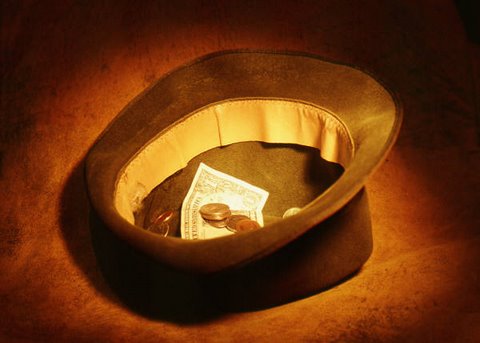
[BUMPED UP: I will be bumping this up today and tomorrow, and then this pledge drive will be over. Today’s posts can be found below this one. ]
It’s that time again.
I’m asking you to click on my Paypal “donate” button (hint hint: it’s on the right sidebar, above the Amazon widget, which is also a handy and helpful gadget to use). I’ve noticed that a couple of readers have set up a system for themselves whereby they automatically contribute a certain amount through Paypal each month. Don’t feel at all pressured to do that, but it’s a mighty fine system.
I give a very special thanks in advance to all of you who so kindly donate money to help keep this blog going. Even small amounts add up, if enough people contribute. But whether you choose to donate money or not (and I certainly hope you do!), I thank all the readers here, be they lurkers or commenters, sporadic or regular. We have some good times, don’t we, despite the often-troubling state of the world?
As a former sufferer from fairly severe chronic pain, news such as this interests me:
Joe Grewal, the first human to be fitted with a permanent implant, said he has suffered chronic back pain for more than 30 years and now “feels amazing”.
The 60-year-old said his pain level had dropped from eight of ten before the treatment to “two or three” immediately afterwards. The device, developed by Saluda, was fitted at the Royal North Shore Hospital in Sydney on Tuesday.
“It’s a significant decrease in pain,” he told Fairfax Media. “I’m so excited about it.”
My injury and chronic pain story can be found here, here, here, and here. By the way, somewhere along the line, I tried a non-implanted TENS unit (a more old-fashioned device somewhat similar to spinal cord stimulators) for a little while, but it didn’t seem to do much at all. That doesn’t mean they don’t help a lot of people, particularly the implanted units.
This new one is different from the other type of implanted spinal cord stimulator that has been in use for many decades:
“Spinal cord stimulators [send] signals into the spinal cord and so the person with pain feels tingling in the pain area and that confuses the brain and they don’t feel the pain, they just feel a pleasant tingling sensation,” Dr Brooker told ABC News.
“[The new] machine can adjust itself to produce whatever set level the patient wants, and that’s a big advance because previously, whenever people moved or their heart was pulsating, various things would make the electrical signal waver up and down quite significantly and they would get shock sensations and not be able to live their lives effectively in many cases.”
Doctors believe the implants could have wider uses beyond chronic pain treatment and potentially help patients with Parkinson’s disease.
Joe Grewal’s happiness at having his pain reduced from an 8 to a 2 or 3 is something that it may be hard to appreciate if you haven’t had significant chronic pain. For many, it’s unrealistic to expect their pain to go away completely, but a reduction of that magnitude is huge. It allows a person to go from being consumed by pain to having it be a relatively mild annoyance. Fortunately (knock wood), my surgery had that effect, and I’m extremely and deeply grateful.
Molly NH: “Bush derangement syndrome is a *chronic illness*”
It’s a fundamental cornerstone of [the leftist] Narrative.
That’s why for Republicans, it’s vital to vigorously rehabilitate [George W.] Bush’s image ”“ even now ”“ by at least setting the record straight, even by those Republicans who don’t agree with all his positions. Because it’s about more than Bush and his positions. It’s about competing the Narrative contest for the zeitgeist.
Conceding a piece of the Left’s narrative on Bush in a misguided individual attempt to move past an issue, differentiate, or seek common ground merely reinforces the Left narrative that is a cornerstone of their social cultural/political advantage.
I’m not sure it’s possible at this point, but I agree that it’s desirable and might even be necessary.
I also wonder what Trump supporters have to say about Trump’s attitude on the subject, which I consider one of Trump’s most reprehensible qualities. Nor has he given any indication of taking it back or even revising it, much less apologizing for it.
Now, knowing Trump supporters as I’ve come to know them, my guess is that they either share his attitude towards Bush, or excuse it in the ways that they excuse everything wrong with him, which is that (a) he’s the only one who’s right on immigration, and immigration is all that’s important (b) he’s the only person who can win. But as I’ve written before, I don’t think he’s the only one who’s right on immigration, because several other candidates have espoused views I think are quite acceptable. And I certainly don’t think Trump is the only “electable” (or even the most electable) of the Republican candidates. But for now, let’s just take what Trump has said about Bush and discuss it, because I think it’s important.
To refresh your memory, from back in 2011 when Mark Levin was fervently against Trump rather than for him:
…Mark Levin excoriated Trump in this clip from 2011, but now doesn’t sing the same tune although the facts he sets out here have not changed in the least (it’s the topmost clip on the page, the one that’s 12:01 minutes long; I can’t figure out a way to embed it).
You can hear lots of fascinating stuff there. Trump likes Nancy Pelosi (5:14). He wanted her to impeach George W. Bush (5:25), because he says Bush lied about WMDs. At 6:27 he speculates that it would be hard to even imagine a worse president than Bush. At 7:26 you hear Trump saying President Bush is evil. He then contrasts Obama (who at the time he was speaking had been elected but not inaugurated), saying that Obama has:
“…a chance to go down as a great president…I think he’s going to lead through consensus. It’s not just going to be just a bull run like Bush did—he just did whatever the hell he wanted—go into a country and attack Iraq, which had nothing to do with the World Trade Center, and just do it because he wanted to do it.”
Now, there are many ways to criticize George W. Bush. Some of them are even valid. But what Trump is saying here: that Bush lied about WMDs, that he’s evil, that it’s hard to imagine a worse president, and that he attacked Iraq “because he wanted to do it” is—well, it’s not only straight out of the leftist playbook, it borders on evil in and of itself. What’s more, Trump shows a fundamental misunderstanding of the reasons Bush actually did attack Iraq.
You might say, who cares anymore? You might disagree with “Eric” that what a candidate says about Bush matters. But I see it as an issue of character—Trump’s character—as well as politics and judgment. Trump could have criticized Bush in any number of ways, including criticism of the Iraq war, without reflecting poorly on Trump’s own character and judgment. But the way he chose to do it was to spout the most vile boilerplate criticisms advanced by the left. He calls Bush “evil”—who but the most doctrinaire leftist did that? He accuses Bush not just of making an error about WMDs but of lying, and attacking Iraq from personal caprice. And then he follows it up with praise for Obama, including one of the most wrongheaded analyses of Obama’s character I’ve ever heard.
I was searching for a more complete transcript of the interviews with Trump found in those Levin clips from 2011. It took me a while, but I finally located one of them, which was an interview on CNN with Wolf Blitzer that occurred in 2007 that was quoted in this Anderson Cooper segment. If you read it, you can see that it’s one of the milder interviews that are quoted, although it does contain some pearls such as praise for Hillary Clinton and Obama.
Then there’s this one with Blitzer from the 2008 campaign. It contained the “impeach Bush” remark:
BLITZER: [What do you think of] Nancy Pelosi, the speaker?
TRUMP: Well, you know, when she first got in and was named speaker, I met her. And I’m very impressed by her. I think she’s a very impressive person. I like her a lot.
But I was surprised that she didn’t do more in terms of Bush and going after Bush. It was almost — it just seemed like she was going to really look to impeach Bush and get him out of office, which, personally, I think would have been a wonderful thing.
BLITZER: Impeaching him?
TRUMP: Absolutely, for the war, for the war.
BLITZER: Because of the conduct of the war.
TRUMP: Well, he lied. He got us into the war with lies.
And, I mean, look at the trouble Bill Clinton got into with something that was totally unimportant. And they tried to impeach him, which was nonsense. And, yet, Bush got us into this horrible war with lies, by lying, by saying they had weapons of mass destruction, by saying all sorts of things that turned out not to be true.
(CROSSTALK)
BLITZER: Their argument is, they weren’t lying, that that was the intelligence that he was presented, and it was not as if he was just lying about it.
TRUMP: I don’t believe that.
BLITZER: You believe that it was a deliberate lie?
TRUMP: I don’t believe it. And I don’t think you believe it either, Wolf. You are a very, very intelligent young man. I don’t think you believe it either.The fact is that he lied. And he got us into a war that was a horrendous mistake. And, any way you take it, that war was a mistake.
Trump then goes on to say that Iraq is a breeding ground for terrorists, and implies that once we leave, terrorists will flourish there and cause a bigger mess. That turns out to have been true, but was a non-controversial opinion (which I shared, which is why I always considered it imperative that we keep a residual force there), and certainly could have been aired without the “Bush lied” defamation.
More of the interview:
BLITZER: [What do you think of} John Edwards? [This question was asked before the Edwards scandal had completely unfolded, but after the Enquirer stories had been published and after Edwards had admitted to having an affair.]
TRUMP: I don’t know him. People like him. I know people that like him very much, but I really don’t know him.
BLITZER: Even though [he] was the vice-presidential nominee last time around?
TRUMP: Well, I think that’s a huge negative, because that was a shame that that race was lost. Because look what we have right now. It’s a disaster.
So you know, I would probably be inclined not to like him on the basis that he lost an election that should have been won. That election should have been won.
I think Bush is probably the worst president in the history of the United States, and I just don’t understand how they could have lost that election.
Later in the interview, Trump advocates that we “just leave” Iraq. This was in October 2008, by the way, when the surge had been over for months and was generally considered to have been successful, and it was after he himself had implied in that same interview that if we leave, terrorists will take over there and it will become an even bigger mess.
Here’s the interview from September of 2007 where Trump says that if the 2008 election features Giuliani vs. Hillary Clinton he’s not sure who he’ll support because “They’re both terrific people, and I hope they both get the nomination.” In the same interview he engaged in the familiar boilerplate obligatory Bush-bashing:
TRUMP: Oh, [Bush has] been a terrible president.
BLITZER: You think he’s the worst in the history of the United States?
TRUMP: I don’t think you can get much worse. Why? I mean, who is worse? Give me a couple of names. Who could be worse?
BLITZER: Well, because, in the last interview we did in March, you said he was the worst.
TRUMP: Well, at least I’m consistent.
BLITZER: But — and the reason you think he’s the worst is?
TRUMP: Well, just look at this country.
We have gone from this tremendous power that was respected all over the world to somewhat of a laughingstock.
Is this really someone you want to support? Again, you can dislike Bush and disagree with the Iraq war, but these sort of statements reveal a criticism of Bush that is of the leftist sort, not the conservative sort. It is indicative of a lack of judgment and basic decency on Trump’s part.
Oh, and although most of Trump’s quotes on Obama are prior to Obama’s presidency, here’s one from shortly after Obama’s election:
The good news is that Obama seems to be well aware of the [economic] situation. His comments have led me to believe that he understands how the economy works on a comprehensive level. He has also surrounded himself with very competent people, and that’s the mark of a strong leader. I have confidence he will do his best, and we have someone who is serious about resolving the problems we have and will be facing in the future. To me that is very good news.
And finally—FINALLY!—I struck pay dirt, a 2008 video showing Trump saying quite a few of the things that Levin quoted back in in 2011, including that Bush is “evil.” Watch and listen:
As I said before, indicative of a lack of judgment and basic decency on Trump’s part, and most definitely not a conservative position. Particularly in the way Trump states it, it’s (as commenter “Eric” has said) a “fundamental cornerstone of the Leftist narrative.”
The issue was raised in a comment by “Phil D,” here.
The answer is contained in this 2005 article from the Weekly Standard. Pay particular attention to page three.
It is very detailed and cannot really be summarized here. However, the conclusion was as follows:
Finally, thanks to radio intelligence, American leaders, far from knowing that peace was at hand, understood–as one analytical piece in the “Magic” Far East Summary stated in July 1945, after a review of both the military and diplomatic intercepts–that “until the Japanese leaders realize that an invasion can not be repelled, there is little likelihood that they will accept any peace terms satisfactory to the Allies.” This cannot be improved upon as a succinct and accurate summary of the military and diplomatic realities of the summer of 1945.
It’s a relatively short volume; only 220 pages in hardcover, and the print’s not small. But it’s dense with thought-provoking ideas. I don’t agree with everything Harris says, but I agree with a great deal of it, and everything he says is worth pondering.
Including this (and again, understand that this was written over ten years ago):
When we think of Hitler or Mussolini or Lenin, we think of them strutting grandiloquently across the stage of history, magnified many times their original size in order to fit the huge dimensions suggested by their gigantic effect on the history of the human race. From such great effects one is tempted to deduce a great cause. But such is not the case.
They all started the same way—as small clubs attended by insignificant men, an uninspiring nucleus of fanatics devoted to the same cause. What gave them their power—aside from sheer dumb luck—was their deliberate deployment of ruthlessness. They stopped at nothing, and nothing held them back. Both agents and victims of a fantasy ideology, they transformed themselves through the power of group hypnosis into men who were able to overcome all the inhibitions of their own middle-class and often prosperous and cultured backgrounds.
To permit any group of this nature to decide the next stage of history is insane, and yet this is precisely what would happen if the United States were to disengage from the world.
I might disagree with “nothing held them back” (some things did, at least for a while). I might also disagree with whether they overcame those “inhibitions of their own backgrounds,” because in sociopaths those inhibitions don’t have to be overcome, they don’t operate in the first place. But it’s that last sentence that caught my eye: “if the United States were to disengage from the world.”
Lee goes on:
Ruthlessness has no root causes. It is not engendered by poverty or illiteracy or a lack of education or the Muslim religion or the concept of jihad. It is a technique for gaining power. That is what it started as and what it will always be.
That is why we must beware of giving ruthlessness a reason to be ruthless. For the moment you have done this, for however noble a purpose, you have fallen into its own fantasy world, and you are seeing an act of catastrophic senseless killing as a legitimate expression of a political grievance. To mistake ruthlessness for desperation is the fundamental error of those whose sympathies are unclouded by judgment.
You see it all around you. It is read as a fatal weakness by the enemy (any enemy, be it Communism or jihadis). And it probably is.
[NOTE: Harris has also written a book entitled The Next American Civil War: The Populist Revolt Against the Liberal Elite. It was written in 2010, partly as a reaction to the Tea Party. I haven’t read it, but it seems prescient, too, since the title describes the 2016 campaign, at least on the Republican side.]
Used to be that the term “RINO” was reserved for Republicans who really were very close to being Democrats—that is, Republicans who crossed the line to vote with the Democrats very often, argued Democratic causes, and were usually although not always ensconced in blue states such Maine (Olympia Snowe comes to mind). Every now and then they went all the way and became actual Democrats (see this; Jim Jeffords and Arlen Spector were prominent recent examples, and Charlie Crist another).
The argument for keeping them in elective office, especially in Congress, rested on the idea that (a) they sometimes did vote with Republicans, which was more often than a Democrat would have (b) if they weren’t in office, a real Democrat would be elected in their place, which would be worse, and (c) they caucused with the Republicans and therefore helped to keep Republicans a majority, which meant control of committees and that sort of thing, and control of what was brought up for a vote and what wasn’t.
So they had at least some value, no matter how they voted. But they made conservatives angry, and understandably so—particularly when it seemed as though Democrats were never plagued with such flagrant turncoats.
Over, the years, more and more ire was directed against these RINOs. Some of it was stirred up by popular talk show hosts on the right; Rush Limbaugh and Mark Levin come to mind, although there are others. RINOs were increasingly seen as lying betrayers, taking the place of someone else who could be elected and would be more conservative. Never mind that a state such as Maine (just to use an example) was unlikely to elect any Republican member of Congress who was conservative rather than Republican-lite. It was worth a try, worth giving up a possible seat, because (the argument went) the Republican Party as is was no different from the Democratic Party, just a bit slower at driving us over a cliff.
But I’ve noticed that in just the last few years the term “RINO” has morphed. It no longer means what I wrote above. Now for many people on the right it means “any Republican who has ever, on any issue whatsoever, taken a less-than-strictly-conservative stand (with the exception of Donald Trump, who is given a pass).”
…[T]wo weeks of Palestinian assaults…began when Hamas killed a Jewish couple as they were driving with their four children in the northern West Bank. Two days later, a Palestinian teenager stabbed two Israelis to death in Jerusalem’s Old City, and also slashed a woman and a 2-year-old boy. Hours later, another knife-wielding Palestinian was shot and killed by Israeli police after he slashed a 15-year-old Israeli boy in the chest and back.
Other Palestinian attacks include the stabbing of two elderly Israeli men and an assault with a vegetable peeler on a 14-year-old. On Sunday, an Arab-Israeli man ran over a 19-year-old female soldier at a bus stop, then got out of his car, stabbed her, and attacked two men and a 14-year-old girl. Several attacks have been carried out by women, including a failed suicide bombing.
Regarding the causes of this Palestinian blood fetish, Western news organizations have resorted to familiar tropes…
Left out of most of these stories is some sense of what Palestinian leaders have to say. As in these nuggets from a speech Mr. Abbas gave last month: “Al Aqsa Mosque is ours. They [Jews] have no right to defile it with their filthy feet.” And: “We bless every drop of blood spilled for Jerusalem, which is clean and pure blood, blood spilled for Allah.”
Then there is the goading of the Muslim clergy. “Brothers, this is why we recall today what Allah did to the Jews,” one Gaza imam said Friday in a recorded address, translated by the invaluable Middle East Media Research Institute, or Memri. “Today, we realize why the Jews build walls. They do not do this to stop missiles but to prevent the slitting of their throats.”
Then, brandishing a six-inch knife, he added: “My brother in the West Bank: Stab!”…
…Above all, it’s time to give hatred its due [as an explanation]. We understand its explanatory power when it comes to American slavery, or the Holocaust…Yet we fail to see it when the hatred disturbs comforting fictions about all people being basically good, or wanting the same things for their children, or being capable of empathy.
Today in Israel, Palestinians are in the midst of a campaign to knife Jews to death, one at a time. This is psychotic. It is evil. To call it anything less is to serve as an apologist, and an accomplice.
And yet our press is deeply engaged in just that sort of apologia.
Here’s a review of the movie “Truth,” which is about to officially open in a few days. The film, which stars Robert Redford, is an attempt to whitewash the Rathergate fiasco and is based on the memoir of one of the perpetrators, Mary Mapes (played by Cate Blanchett).
I’ve already written about the movie (which I haven’t yet seen) here. Right now I’d like to add that the title “Truth” is especially apt, since that is the translation of the name of the Soviet newspaper that served as the mouthpiece of the Communist Party during the Soviet era.
I remember hearing this grim joke when I was a youngster:
As the names of the main Communist newspaper and the main Soviet newspaper, Pravda and Izvestia, meant “the truth” and “the news” respectively, a popular Russian saying was “v Pravde net izvestiy, v Izvestiyakh net pravdy” (In the Truth there is no news, and in the News there is no truth).
I went apple-picking this weekend. It’s easy to do—just drive about 15 minutes, go to the pick-your-own orchard, buy one of their little bags, walk out on a lovely fall day to where the trees are, and begin.
The trees are dwarves. They’re all labeled as to type. I didn’t even have to get on my tippy toes, and I’m only 5’4″. They were laden with fruit, all ripe. Just reach out and grab it, fill up your bag, and walk back to the barn and the cash register. Buy some cider, too, while you’re at it.
The place was loaded with families with young children, who’d even brought the dogs—mostly tiny little dogs like Yorkies. A lot of photo-taking, although not by me.
And, as always happens to me with apple-picking, there’s the poetry that pops into my brain. Frost, naturally:
AFTER APPLE-PICKING
My long two-pointed ladder’s sticking through a tree
Toward heaven still,
And there’s a barrel that I didn’t fill
Beside it, and there may be two or three
Apples I didn’t pick upon some bough.
But I am done with apple-picking now.
Essence of winter sleep is on the night,
The scent of apples: I am drowsing off.
I cannot rub the strangeness from my sight
I got from looking through a pane of glass
I skimmed this morning from the drinking trough
And held against the world of hoary grass.
It melted, and I let it fall and break.
But I was well
Upon my way to sleep before it fell,
And I could tell
What form my dreaming was about to take.
Magnified apples appear and disappear,
Stem end and blossom end,
And every fleck of russet showing clear.
My instep arch not only keeps the ache,
It keeps the pressure of a ladder-round.
I feel the ladder sway as the boughs bend.
And I keep hearing from the cellar bin
The rumbling sound
Of load on load of apples coming in.
For I have had too much
Of apple-picking: I am overtired
Of the great harvest I myself desired.
There were ten thousand thousand fruit to touch,
Cherish in hand, lift down, and not let fall.
For all
That struck the earth,
No matter if not bruised or spiked with stubble,
Went surely to the cider-apple heap
As of no worth.
One can see what will trouble
This sleep of mine, whatever sleep it is.
Were he not gone,
The woodchuck could say whether it’s like his
Long sleep, as I describe its coming on,
Or just some human sleep.
If you think that’s merely a poem about apple-picking, Frost is eluding you. As usual with Frost, the familiar country scene and familiar country activities are merely the jumping off points for much deeper ruminations about life itself: youth versus age, goals and dreams versus accomplishments, energy versus ennui, and of course life and death. In other words, the biggees.
The modern world being what it is, I was able to stand in the orchard, dial the poem up on my cell phone, and read it right then and there. Concentrating on the images in the poem, it struck me for the first time that apple-picking itself has changed mightily, at least in this orchard and at most of the pick-your-own orchards I’ve visited. Ladder? No ladders needed; the fruit is right there at knee level, waist level, eye level. Tired? We pick only what we want, and pay for the privilege.
It’s a Disneyland of apple-picking, a serious activity recast as entertainment for us modern folk. Frost’s daylong, repetitive, wearying task is now a brief, light excursion into a storybook past. As Frost wrote in another poem, “Two Tramps in Mud-Time,” about a different chore (wood-splitting):
…I had no right to play
With what was another man’s work for gain.
My right might be love but theirs was need.
And where the two exist in twain
Theirs was the better right–agreed.
Well, the orchards have figured out how to make their work our play, and have us pay them for the privilege. And we enjoy it, especially on a beautiful day.
I watched about 20 minutes of it, which was 20 minutes more than I wanted to watch.
As regular readers know, I don’t like debates in general, not just Democratic debates. But this debate was unusually strange—or rather, the crop of un-Hillary candidates was unusually strange. Bernie Sanders is your average New York (yes, I know he’s been in Vermont for a long time, but so has much of the population of New York) socialist crazy uncle. Jim Webb is a Republican who’d wandered onto the stage by accident (ought we to call him a DINO, which is an endangered species?). O’Malley? Pretty much a nonentity there, but the consensus among Democratic women is that at least he’s hot. Chafee was weak.
The fact that Clinton was able to string together some forceful sentences in English is considered a major achievement at this point, and enough for the usual suspects in the MSM to sigh in relief and be reassured that she’d make a fine, fine candidate and president. And why not? The bar is rather low for a Democrat right now, and it rests on rhetoric. That Hillary Clinton could best this particular field, and would, was a foregone conclusion.
The other day we had Victor Davis Hanson. Now we have Niall Ferguson as another brilliant and often insightful man who doesn’t seem to have a clue about Obama despite seven years of close observation.
It’s a failure of imagination, a line many otherwise smart people refuse to cross. But why? I don’t think it’s just fear of being called “racist,” either, because they’re certainly criticizing Obama and have been for a long time, and such criticism is often enough to trigger the “racist” charge. But apparently both Hanson and Ferguson would rather twist themselves into pretzels to say “fool, Obama’s nothing but a fool” rather than “knave.” Perhaps “knave” seems to them to be tinfoil hat territory, and that’s why they just won’t go there?
This really says it all in terms of what Ferguson is missing:
Those who know the Obama White House’s inner workings wonder why this president, who came into office with next to no experience of foreign policy, has made so little effort to hire strategic expertise.
I don’t know the “White House’s inner workings,” but I haven’t wondered. I noticed the phenomenon at the outset of Obama’s presidency, and Obama gave us the answer right off the bat, too. This was my first piece on the subject (September of 2009), featuring a quote from none other than commenter Artfldgr:
Why might Obama have a tendency to ignore experts, even those he has appointed? Arrogance and hubris on his part would certainly be one explanation, and not a bad one at that. But another phenomenon may be in play, best summed up by this comment made by “Artfldgr”…:
“Expertise has no place in power. It is irrelevant and an opposing force. so no one under the despot can have expertise except for the lowest proles who have no other options and no way to leverage their expertise except in the service of the power above.
…Power loves a servant, and an independent capable person is a power of opposition, not servant. So they move incompetents into place. The incompetents owe all they have, since they can’t do that well on their own. So their morals are easy to corrupt and they know whom they serve.”
Couple that with Obama’s arrogance/hubris, already in clear evidence in April of 2008, when I wrote this post quoting an ominous interview with Obama, and how could Ferguson have failed to notice these signals from Obama, clearly explaining why he didn’t think he needed experts (or, rather, that he was always the most expert expert in the crowd)?:
Ironically, this is an area””foreign policy is the area where I am probably most confident that I know more and understand the world better than Senator Clinton or Senator McCain.
It’s ironic because this is supposedly the place where experience is most needed to be Commander-in-Chief. Experience in Washington is not knowledge of the world…
“I traveled to Pakistan when I was in college”“I knew what Sunni and Shia was [sic] before I joined the Senate Foreign Relations Committee…
I think that I’m a better speechwriter than my speechwriters. I know more about policies on any particular issue than my policy directors. And I’ll tell you right now that I’m gonna think I’m a better political director than my political director.
Instead of the experts Obama doesn’t think he needs, he surrounds himself with leftists, political operatives, and/or worshipers who agree with him, such as Jarrett:
He knows exactly how smart he is. .”‰.”‰. I think that he has never really been challenged intellectually. .”‰.”‰. He’s been bored to death his whole life. He’s just too talented to do what ordinary people do. He would never be satisfied with what ordinary people do.
Tell me, what need would such a person, with such an opinion of himself, have for conventional “experts,” other than as window-dressing?
In February of 2010, I was still wondering why people don’t get it (in a post about how Obama’s closest advisors are almost all political advisors rather than experts on anything else).
More here (from before his first inauguration) and here, as well as here.
There’s more, but you get the picture. It wasn’t hard to see; it was easy.
In the Ferguson article, he explains that his initial assumption about Obama was that his strategy was to be unlike his predecessor Bush. Ferguson later jettisoned that idea and figured Obama was flailing because he lacked expert advisors. But Ferguson seems determined to ignore the fact that these people have been chosen by Obama over and over again; what’s operating is neither chance nor bad luck. And he ignores Obama’s repeated statements of hubris and arrogance. Ferguson—and so many others—don’t put this all together, nor do they see the overarching goals and patterns of the actual decisions that Obama (or Jarrett and Obama; take your pick) have made—that neither the decisions nor the policies are incoherent, and this is because the Obama administration’s goals are different than they seem, and different from the goals of Obama’s predecessors.