
Mother’s Day is tomorrow
[NOTE: And in honor of the occasion, I’m reposting this essay from 2021.]
One of the tasks that fell to me since my mother’s death years ago was to go through her papers and photos.
Some “getting rid of” candidates were obvious. Medical records, of which my mother kept very many. Not needed any more, now that she was gone. Ditto her lists of things to do, address and appointment books, and random jottings.
But the rest! A few letters from me in high school and college. Greeting cards. At least a hundred letters from my father when they were dating in the late 30s when he was traveling constantly while working for the government as a lawyer. Those tend to take the form of descriptions of cities and small towns visited, but here and there are some more personal nuggets. A scrapbook of clippings about her activities in the community. A similar one made by her mother my grandmother, and one compiled by her grandfather my great-grandfather. That last one contains his wedding invitation, circa 1883.
Yearbooks. As an only child of an only child, my mother also inherited all the family photos going back to Civil War times and earlier. Some are of people I knew but many lovely ones are of the total strangers who must be my ancestors, and whose identities are lost.
Sorting them out has been time-consuming, and the task is still incomplete many years later. But I try, especially with those things that seem of special interest.
For me that includes my mother’s writing – because she was a writer too, an essayist whose work was often published in local newspapers and who’d written poetry as a precocious child and young woman. I had seen many of her poems and essays before, but some were new to me.
Here’s an essay of my mother’s that I found and read for the first time about a year after her death. I thought it might be fun to publish it on the blog; I don’t think that would have bothered her in the least. It appears to be something she wrote at the age of 80 (during the 1990s) for a writing workshop in response to an exercise staged by the teacher. It’s written in longhand, with various cross-outs, but I’m impressed with how few corrections she had to make in the flow of her thoughts, and how graceful her expression was under the circumstances.
And she seemed to like the dash, too—just like me.
It appears that the teacher had played music for the class, lit some candles, and given the students a sheet of guidelines (these were not saved; I have a hunch my mother didn’t think too much of them), telling the students to write for a few minutes. Here’s what my mother produced:
80 years of living has immunized me somewhat to candles, music, and yes, even meditation—so I looked with a somewhat jaundiced eye at first on Guidelines—and what strikes me at once is the word “Proprioceptive”—what does it mean and where does it come from?
Isn’t that awful—but I do like words and I keep wondering about that one—
The music is delightful and I wonder what is making me put words on a yellow legal pad anyway—and why am I resistant—
Probably because I tend to have used humor as a shield all my life—it helped me overlook hurts, and raise children without going crazy, and a laugh has been like medicine—the best for me.
As an only child I looked for friends—-and it helped me acquire them and saw us through good days and bad.
My husband liked a “light view”—but now it is more difficult because people are different—more violent, angry, and sad. I cling to humor—if and when possible—and its not always possible anymore to find it.
Why am I writing about fun and laughter when I could pick anything? Perhaps it keeps me sane when the alleged golden years have crept up and facing the inevitable is too much. Like Scarlett O’Hara—if it’s unpleasant “I’ll think about that tomorrow”—
Writing fiction is almost impossible for me because “truth is stranger than.” Coincidence, friendships, travels, the endless variety in people who cross your life are enough—there is little laughter these days and I plan to hold onto just as much as possible.
Now I have made a neat ending but the time is not up and the music and candles are still with me—and with them go gratitude for good luck and good health and the ability to cope with what comes—so far so good.
My mother and I were temperamentally very different, although we both liked humor. One of the things we shared was writing, and perhaps that’s why her essays mean a lot to me. I was especially struck in this one by her saying she couldn’t write fiction. I’ve written quite a few short stories, but they’re not my natural genre and I gave up writing fiction about fifteen years ago and it’s been essays ever since.
Some of my earliest writing memories involve my mother helping me write. She was a fabulous typist (she could even use carbons, and boy was she fast on a manual!) and a good editor. When we were young, my brother and I would leave our essays for her to read and correct for grammar errors, and she knew what she was doing.
My mother was also an excellent natural untrained dancer. But even though my mother couldn’t really sing, when I saw Bebe Daniels in the movie “42nd Street” on TV as a child, I was transfixed because the actress reminded me so very much of my mother. Here’s Bebe:
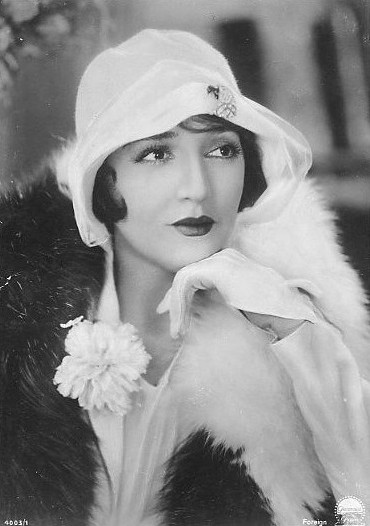
And here’s my mother, at the time of her graduation from college:
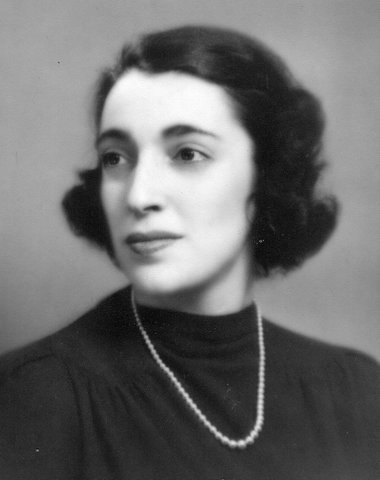
I thought everyone had an editor for a mother. I thought everyone had a mother who could write. Turns out they don’t.
I too have numerous old photos of unidentified people, who were possibly relatives. One uncle, who liked to take pictures, was good about labeling, for which I am very grateful. But most, if they are labeled at all, are labeled with the place where they were taken, which does not interest me very much. I was able to sit down with one of my aunts, in her nineties, and a couple of scrapbooks, but by then there was much she could not remember. One that she was able to identify, and I treasure, is of my great grandmother Josephine, who was married at the age of 18, at the end of the civil war, but lived into the 1930’s.
Now, everything is digital. I try to make all my file names as descriptive as possible, including names, but I wonder what will happen to these in 100 years. Old B&W photos are about as stable a record as you can get, but I suspect a lot of digital files will be lost.
But, Neo, where is the apple for your mother’s picture?
Oh, that’s right, … you are the apple of her eye!
I find it difficult and unappealing to write (or now even read) fiction. I am not much of a story teller, perhaps because I must respect reality and “truth” too much. Spinning a tale is too close to “lying” for me. [Sometimes I wonder about blog comments, though. 🙂 ]
In high school or college I had no problems writing test essay questions or lab reports since they involved repeating the information already available. But finally in grad school I had to write my first research proposal, explaining what I wanted to do and why. I struggled to present something that had not happened yet. I fairly quickly overcame that reticence and could then spin out a plan or activity description, expected costs and schedule, etc. But it was still something I expected to become “true” in the future.
My mother ended up being “only” a homemaker, but she would probably have been much happier being an editor or involved in some other writing related activity. She was certainly an early stage feminist, although she was never involved in any public display of that viewpoint.
I am alive because of my mother.
Allow me to explain.
Three years after mother birthed me, she noticed signs I was having trouble. Doctor after doctor after doctor found no cause for alarm. Mother knew better. She persisted in an unrelentless cause for diagnosis.
The various doctors claimed harassment. They then thought mother to be the trouble. A psychiatrist was notified.
Dad, career USMC, was facing court martial if he couldn’t control his wife.
My signs became worse: constant headaches, uncontrolled vomiting, loss of control of bladder and bowel, terrible nightmares, degraded motor function.
Every doctor in the area refused to see mother or myself. She widened the search.
Finally, a new doctor 5 hours away agreed to testing. After a full day of examinations, dad, mom, me returned home. It was early morning, the sun not up. The phone was ringing as we entered our home.
“We’ve been calling. Bring him back now.”. Physically exhausted, we tanked up for another five hour drive through the night. I saw my first sunrise. It confused me. Why, I asked, is it dark before sunset? I simply could not understand the explanation.
I went straight into surgery. It was a 12 hour surgery, the first of three. I died on the table. Its in the hospital records.
I was in the arms of my LORD. To say everything was fine and wonderful and infused with peace and love is a woeful, pitiful understatement. I saw everything all at once. My still body on the table. There, the discouraged doctors. There, a doctor talking with dad. There, mother head in hands crying her eyes out. She knew. Years later in a very emotional conversation, mother told me that she knew at that very second that I had died.
How much time has passed, I don’t know. Time doesn’t matter, it doesn’t exist. It was a lifetime. The records say four minutes.
I spent over ten months in the hospital. On visits, my parents read books to me. I learned to read. I learned to love books. At age four I began my own library.
Sixteen years of annual neurological testing followed. The records show my recovery has been remarkable.
Mother had not given up on me. A mother knows. She may not understand, but she knows.
I am alive because my mother.
I write this partly for myself. Decades later I still get emotional when recalling that traumatic time. Mostly I write this for the reader. Your mother knows more about you than you may think. That includes loving deeply.
By far, this is to celebrate and cherish mothers.
If she is now passed, know that she loved you endlessly.
How beautiful your mom was!
Amazing story, Rick @2:33am
My wife had a similar (though not so nearly life-and-death). When she was around 14 her back was bothering her. The pain got worse and worse. Doctors couldn’t find anything wrong (there were no MRIs in those days, just X-rays). At some point the doctors suggested it was psychological. Her mother advocated for her relentlessly, kept pushing the doctors. It turned out she had a benign (but growing) tumor in her back, which they could only figure out when the tumor began to crush her spine, and that showed up in X-rays. She had surgery, missed a couple of months of school, but fully recovered.
— Mr. Bill
You’re right to be worried. Format/media changes have already lost huge amounts of information. A lot of libraries that used to have huge newspaper and magazine collections put them on microfilm to save space, and disposed of the originals (otherwise no space is saved, after all). Result: turns out microfilm isn’t immortal, and now microfilm readers are not all that common, so the surviving material needs to be migrated to new media again to make it accessible or even just to survive.
For some purposes hard copy has no better replacement.
Inherited stuff: when my mother died a few years ago, I found myself going through her things. Some of it is straightforward, but some of it is not. For ex, little things that obviously had some kind of sentimental value for my mother, but I have no idea what they meant. There was a box with a dried flower in it, carefully stored. Why? I have no way to know.
Your mother was a good writer, Neo, as are you. I really enjoyed her essay as an 80 year old.
And Rick, I really enjoyed your story too. You have much to celebrate today. Your story reminds me of a Psychiatrist (I believe she was) who had an extremely debilitating stroke from which it took her 7 years to recover. IMO, it was the way her mother, who immediately moved in with her, gently and instinctively lead her back to beginning to use her brain again that paved the way for the rest of her hard work of restoration.
@ HC68 – responding to a couple of your observations:
(1) I am taking pictures (digital I fear, but it’s a start) of family “heirlooms” and keepsakes (I doubt even Antiques Roadshow could make sense of most of the things we still have), adding identifying captions, and also writing paper notes and putting them on or inside items.
Things that are only meaningful to me – yes, dried flowers included – probably won’t make the cut in our latest cleaning out project.
(2) I had to migrate to a new email address recently and spent quite a bit of time forwarding important messages to the new one; I also copied them into Word documents.
No one in the future will have bundles of old family letters to review.
(3) For those concerned about preserving sharing family photos and information, the LDS Church Family History resources are amazing, and are open to anyone to use. (Click the About tab on the bottom menu list.)
https://www.familysearch.org/en/united-states/