
More photos from Artemis
You can find them by clicking here. Once you get there, you can get information on each photo by clicking on the image.
My favorite:
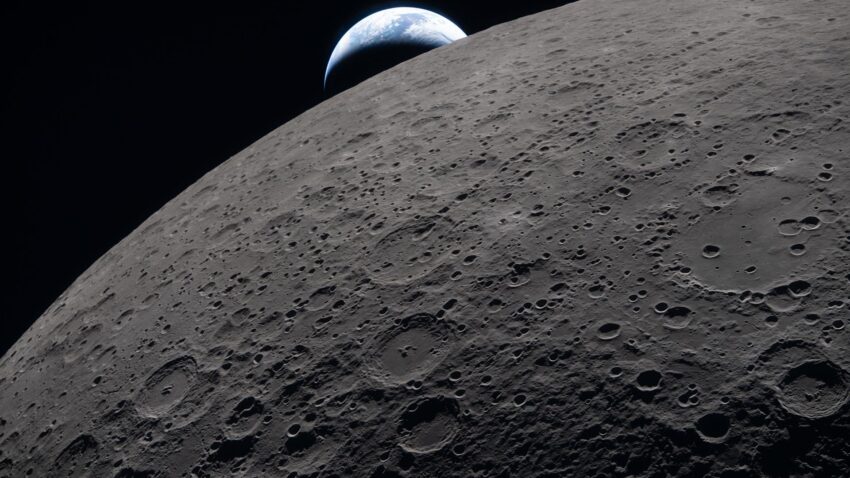
The lunar surface fills the frame in sharp detail, as seen during the Artemis II lunar flyby, while a distant Earth sets in the background. This image was captured at 6:41 p.m. EDT, on April 6, 2026, just three minutes before the Orion spacecraft and its crew went behind the Moon and lost contact with Earth for 40 minutes before emerging on the other side. In this image, the dark portion of Earth is experiencing nighttime, while on its day side, swirling clouds are visible over the Australia and Oceania region. In the foreground, Ohm crater shows terraced edges and a relatively flat floor marked by central peaks — formed when the surface rebounded upward during the impact that created the crater.
During his phone call President Trump asked the astronauts if the Dark Side of the moon looked different from the other side. One astronaut said that it did, because it wasn’t subject to the Earth’s gravity, and so hadn’t developed as many “mares”(?), i.e. dark features viewable from Earth, as the other side.
Nice place to visit but I wouldn’t want to live there.
Will say pictures sent back are incredible
Truly inspiring.
As a fun reminder, the head of NASA in 2024, while testifying to congress about something or other, said the far side of the moon was always dark. Head of NASA. I couldn’t pass up the opportunity to make fun of a government appointee.
The image reminds me of a terrific documentary primarily about the work of Eugene and Carolyn Shoemaker in proving that many large meteorite impacts had occurred on earth over the past couple or few hundred million years.
Not really having any kind of overview of that particular field of geology and astronomy, I was struck by how hostile those communities were to the idea that there could be large impacts.
I guess it was a case of, “Where are the craters?” But jeez, don’t you know there is these things called erosion and plate tectonics!? Not long after seeing that show, my wife & I were on Interstate 40 and decided to make a little detour to see Meteor Crater in AZ. Fascinating, including the crater’s history.
NASA does a great job making photos available. When the Shuttle was flying to ISS, the docking photos would be available to the public just after we got them in the MER. There were “amateur” analysts working about as fast as we were looking for tile damage. Some of the amateurs had better systems, especially in creating stereo-graphics for doing depth estimates. It was cool.
Look around NASA image repository and you’ll find digitals from the Apollo 8 mission “Earth rise” and other iconic Apollo photos.