One of the most interesting things this election cycle is something other than Donald Trump. Yes, you heard me—there is actually something other than Donald Trump in politics.
I’ve been saying for quite some time that, whatever happened with the presidency in the 2016 election, the composition of the Senate would be all-important to either president. If it was a Hillary presidency and a Democratic Senate, there would be a repeat of the heady days when Obamacare first went through. If a Trump presidency and Republican Senate occurred (an eventuality I thought much less likely, but still possible), the Republicans had a decent chance of enacting their policy dreams, whatever they might be. But any mixture in which president and Congress differed would spell more gridlock and a difficulty for either president to get his/her agenda accomplished, and would present that president with more and more temptation to do things by executive order, going around the legislature.
Well, we all know what happened: Republicans control both the presidency and the legislature.
But the state elections are especially interesting, as well. More slowly (it’s been happening for quite some time), the Republicans have pretty much taken over on the local level:
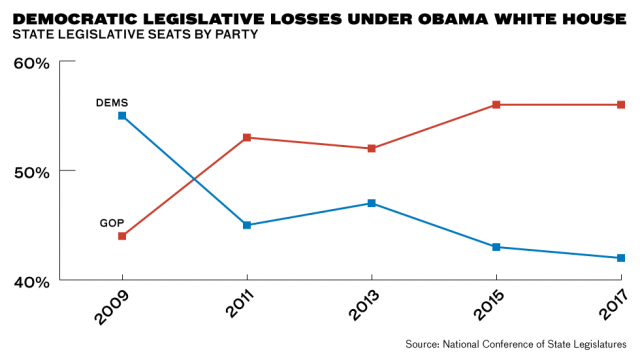
Republicans will control 4,170 state legislative seats after last week’s elections, while Democrats will control 3,129 seats in the nation’s 98 partisan legislative chambers. Republicans picked up a net gain of 46 seats in Tuesday’s elections, while Democrats lost 46 seats, according to the latest vote counts from The Associated Press.
Independents and members of minor parties hold 71 seats, including the entire Nebraska Senate, which is nonpartisan. Nearly two weeks after Election Day, about a dozen seats remain too close to call.
“Republicans have been working for this moment for years, to have a federal government with Republican majorities and now at the state level,” said David Avella, who heads GOPAC, a group that grooms young legislative candidates. “We have to deliver on breaking down barriers to job creation, we have to deliver on putting more money in people’s pockets through tax cuts and through higher wages.”
Remember that, because I don’t think the Democrats did: you have to show results, and good ones, or people will reject you. Reality still overcomes imagology, at least for now.
Note the final sentence here:
Since Obama took office, Republicans have captured control of 27 state legislative chambers Democrats held after the 2008 elections. The GOP now controls the most legislative seats it has held since the founding of the party.
That’s astounding. I’ve noticed that, during the bulk of his presidency when Obama has talked about his legacy, he hasn’t seemed to acknowledge this particular aspect of it. If he did, I missed it. But it seems as though it will be the focus of his immediate post-presidency energies.
Not the UN, but this:
The Democratic Party, “in close consultation with the White House,” has launched a new political group “which will coordinate campaign strategy, direct fundraising, organize ballot initiatives and put together legal challenges to state redistricting maps,” Politico reported Monday [a month ago]. Former Attorney General Eric Holder will chair the new group, named the National Democratic Redistricting Committee. And Obama himself, as Politico writes, has “identified the group ”¦ as the main focus of his political activity once he leaves office.” The group will focus on the “gubernatorial, state legislative and House races” in 2018 and 2020 that will determine the design of the next congressional redistricting maps.
Why would Obama concern himself with such seemingly small-fry politics? One reason could be tradition: Ex-presidents like to give their successors room to breathe, so hieing off to state-level battles is one way for Obama to remain active without meddling in the day-to-day grind of national politics. The other, more important reason is that control of state legislatures is in no way small-fry politics. By throwing his name behind the effort, Obama is trying to fix the colossal infrastructural damage his party sustained under his tenure: the Republican state-level domination””and thus congressional domination””achieved first in the midterms of 2010 and iced in 2014.
The article goes on to describe Obama as attributing these losses at the state level to the artifact of gerrymandering rather than any actual failing by Democratic leadership. He also attributes it—as he does almost every problem he has encountered with public opinion during his presidency—as a problem with messaging and communication. The Slate article I’m quoting is definitely Obama-friendly, but even the author seems to recognize what Obama does not (or at least does not publicly acknowledge), which is that it wasn’t all about districting or messaging:
[Obama’s] explanation is a self-flattering one: We were just so busy implementing perfect policies that we forgot to communicate them properly. One doubts that a more cleverly crafted party message””nipping and tucking an adjective here or there in public speeches””would have overridden the factors that led to Democrats’ catastrophic 2010 losses. The flat economy, the party-line stretch to pass the Affordable Care Act, the gravitational pull that was bound to drag Democrats down to Earth after their big successes in the 2006 and 2008 congressional elections.
That’s hardly an exhaustive list, either.
I wonder if Obama is able to acknowledge his actual failures, and not just the “communication” and districting ones, even to himself. I tend to doubt it. It does seem, though, that unlike most ex-presidents, he plans to stay very active in party politics, although not in an elective office.