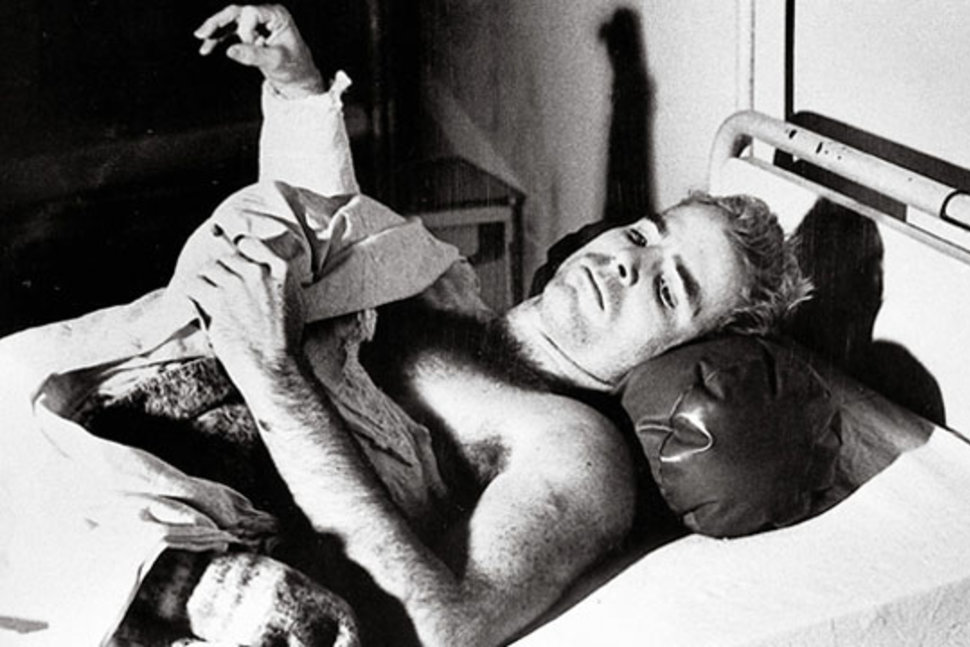
Commenter “Frog” has a question about what makes a hero:
What makes a military hero? What defines heroism? Was McCain in ”˜Nam a Sgt. York equivalent? York risked life and limb many times in accomplishing victories in combat and saving lives of his fellow soldiers. Was York an equal to those that suffered in the trenches, getting gassed or getting trench foot or both, never being able to ”˜take it to the enemy’?
Those are interesting questions, because there are indeed many kinds of heroism as well as many kinds of courage for those who serve in the military. I would say that strictly military heroism involves heroism (bravery and acceptance of risk) in the accomplishment of military exploits—that is, fighting the enemy. It is usually defined actively—not just by slogging it out in a trench but by engaging the enemy more directly—although even those in the trenches could be called “heroic” in terms of endurance.
Then there’s heroism in terms of saving fellow military members (or civilians). That’s a sort of heroism that is sometimes performed by those in combat but can also be shown by medical personnel or chaplains, who have received medals for such exploits.
Then, of course, there’s the sort of heroism—or courage, or character, or all of the above—shown by McCain and others as a military member while a prisoner of war. This can involve not just endurance of a truly exceptional nature, but defiance and self-sacrifice.
I maintain that John McCain showed all three types of heroism during his military service, although to differing degrees. The part of his story that is most well-known is the prisoner-of-war part, but it’s not the only part. McCain didn’t have all that much of a chance to be a hero in the strictly conventional sense of a military (combat) hero because he saw so little service outside of his prisoner of war status. But he made the most of the short time available to him.
McCain volunteered for combat duty. He was sent to Vietnam to serve as a pilot on the carrier Forrestal in May of 1967. The ship got to Vietnam on around July 25, 1967. McCain flew five successful missions. On July 29, 1967, the following disaster occurred:
McCain was almost killed on board Forrestal on July 29, 1967. While the air wing was preparing to launch attacks, a Zuni rocket from an F-4 Phantom accidentally fired across the carrier’s deck. The rocket struck either McCain’s A-4E Skyhawk or one near it. The impact ruptured the Skyhawk’s fuel tank, which ignited the fuel and knocked two bombs loose. McCain later said, “I thought my aircraft exploded. Flames were everywhere.” McCain escaped from his jet by climbing out of the cockpit, working himself to the nose of the jet, and jumping off its refueling probe onto the burning deck. His flight suit caught on fire as he rolled through the flames, but he was able to put it out. He went to help another pilot trying to escape the fire when the first bomb exploded; McCain was thrown backwards ten feet (three meters) and suffered minor wounds when struck in the legs and chest by fragments. McCain helped crewmen throw unexploded bombs overboard off the hangar deck elevator, then went to Forrestal’s ready room and with other pilots watched the ensuing fire and the fire-fighting efforts on the room’s closed-circuit television. The fire killed 134 sailors, injured scores of others, destroyed at least 20 aircraft, and took 24 hours to control.
That may not be Sergeant York territory, but it sounds pretty heroic to me, especially in the second sense (attempting to save other people).
Not to mention the next assignment for which McCain also volunteered:
As Forrestal headed to port for repairs, McCain volunteered to join the undermanned VA-163 “Saints” squadron on board the USS Oriskany. This carrier had earlier endured its own deck fire disaster and its squadrons had suffered some of the heaviest losses during Rolling Thunder. The Saints had a reputation for aggressive, daring attacks, but paid the price: in 1967, one-third of their pilots were killed or captured, and all of their original fifteen A-4s had been destroyed.
I would argue that it takes a certain amount of bravery to volunteer for that kind of mission. It may not be heroism, but it’s not too far behind.
In his short stint of service with that group, McCain’s record wasn’t heroic enough to draw exceptional attention, but it certainly was heroic enough for me. Remember when you read this that he didn’t join Oriskany until September 30 of 1967, so the time frame of all this activity is very compressed:
He volunteered to fly the squadron’s most dangerous missions right away, rather than work his way up to them. During October 1967, the pilots operated in constant twelve-hour on, twelve-hour off shifts. McCain would be awarded a Navy Commendation Medal for leading his air section through heavy enemy fire during an October 18 raid on the Lac Trai shipyard in Haiphong. On October 25, McCain successfully attacked the Phéºc Yéªn Air Base north of Hanoi through a barrage of anti-aircraft artillery and surface-to-air missile fire; credited with destroying one aircraft on the ground and damaging two, the raid would garner him the Bronze Star. Air defenses around Hanoi were at this point the strongest they would be during the entire war.
McCain was shot down less than one month after arriving for his Oriskany tour. Here are the circumstances:
On October 26, 1967, McCain was flying his twenty-third mission, part of a twenty-plane strike force against the Yen Phu thermal power plant in central Hanoi that previously had almost always been off-limits to U.S. raids due to the possibility of collateral damage. Arriving just before noon, McCain dove from 9,000 to 4,000 feet on his approach;[105] as he neared the target, warning systems in McCain’s A-4E Skyhawk alerted him that he was being tracked by enemy fire-control radar. Like other U.S. pilots in similar situations, he did not break off the bombing run, and he held his dive until he released his bombs at about 3,500 feet (1,000 m). As he started to pull up, the Skyhawk’s wing was blown off by a Soviet-made SA-2 anti-aircraft missile fired by the North Vietnamese Air Defense Command’s 61st Battalion…
I have no problem assigning the word “hero” and/or “heroic” to John McCain.
Someone might have pointed out some of these facts to armchair critic Donald J. Trump, the man who joked that he fought his own personal Vietnam by fending off the perils of venereal disease while boffing a variety of models.
[NOTE: I figure I don’t need to describe McCain’s heroism as a prisoner of war. The story is quite well-known, but you can find a short summary here.]