You can follow it here.
UPDATE 11:30 PM: Netanyahu projected to be the winner.

You can follow it here.
UPDATE 11:30 PM: Netanyahu projected to be the winner.
[Please also see the ADDENDUM at the end of the post for further details.]
Just when you think Democrats can’t get any worse, along comes an idea like that of Senator Ron Wyden of Oregon:
Under current policy, capital gains, such as increases in value for held stocks, are only taxable when they are “realized.” In other words, if you own stock that increases in value from $1,000 to $1,500, you’re only liable to pay taxes on the $500 increase in value if you sell the stock at $1,500 and “realize” the $500 gain.
Wyden’s idea, on the other hand, would replace this simpler system with one in which capital gains would be taxed annually whether or not they were realized. In other words, if a stock you held increased in value from $1,000 to $1,500, you would still be liable for that $500 gain even if you didn’t sell and the value only changed on paper.
Wyden would counter that this is an oversimplification, and to an extent he would be right. Long-term capital gains, or capital gains on assets held for more than a year, enjoy a substantial zero percent bracket. Yet short-term capital gains, or capital gains on assets held for less than one year, are taxed as ordinary income. Without changes to this structure, Wyden would be imposing a tax on every new asset a taxpayer acquires that gains any value at all during that year.
In addition to all its other flaws, this would be difficult to carry out because the values of many assets are hard to pinpoint until they are sold. And of course, values that rise can fall, and indeed they often do. You can bet your bottom dollar (apt expression) that if an asset’s value declines by the time a person sells it, the IRS isn’t going to refund all those tax dollars paid out over the years.
So this amounts to a tax on the imaginary or at least potential value of assets. Hey, why not? It’s all in the service of making the rich poorer. And Wyden is quick to assure us that this will only affect the rich, the really really really rich, not you and me, so what the hey?:
Sen. Ron Wyden, D-Oregon, announced on Tuesday that he is working on a mark-to-market system that would tax unrealized capital gains on assets owned by “millionaires and billionaires.”…
This levy, assessed annually, would kick in at the same rate as all other income, Wyden said. Currently, the top marginal rate on ordinary income is 37 percent.
In comparison, long-term capital gains are taxed at a top rate of 20 percent.
And capital gains are now taxed only when assets are sold and the gains are realized and not just on paper.
More:
“Everyone needs to pay their fair share and the best approach to achieving that goal is a mark-to-market system that would require the wealthy to pay taxes on their gains every year at the same rates all other income is taxed,” Wyden said in a statement.
Yeah, the wealthy aren’t paying their fair share, according to Wyden and the Democrats—even though the top 1% are actually paying 37.3% of all income taxes in the US. Unrealized gains are not income at all, they’re imaginary and/or potential. Just ask anyone who’s ever lost money in the stock market after seeing a stock’s value rise and then fall, or invested in some antique or collectible that later goes out of favor with the public:
Mark to market is attractive [sic] when the market is going up, but what happens to revenues when it reverses?
My guess is that the government would then say the equivalent of “Too bad, sucker.”
And of course, being a millionaire isn’t quite what it used to be. A million dollars in assets (not to mention unrealized assets) doesn’t go very far at all in places with a very high standard of living.
This particular idea may not be quite as awful as the Green New Deal, but it’s up there. It’s another attempt to spread the wealth around, but this one is especially stupid/pernicious. Here’s the rationale behind it, ostensibly:
Wyden’s proposal would tax assets as soon as the price goes up, rather than when the asset is sold. The logic behind this is simple — paper gains represent real wealth, since you could sell the asset and get cash any time you want. Waiting until the asset is sold in order to tax it allows the wealth to compound untaxed, which causes wealth inequality to accumulate.
At the risk of repeating myself), I will say that as far as “wealth” goes, paper gains represent potential wealth, wealth that is only made actual if and when the asset is sold. The thing itself has no stable value—the wealth it generates depends on what it actually does generate for the seller at the exact time it is sold. What’s more, an unrealized capital gains tax goes against what I understand to be the entire basis of our income tax laws, which is that they are a tax on income both earned (wages, etc.) and unearned (interest, dividends, etc.).
I’ve said many times that finance and economics are not my forte. But I don’t think a person needs to be an expert to understand (correct me if I’m wrong—I know you will!) that there are different kinds of taxes. Many of them involve the use or purchase of something, or the import of something. Some are local, such as sales taxes. Some are federal. There are many kinds, but as far as I know they all involve paying when there is some kind of actual transaction in the real world, except for property taxes, which are on unrealized gains when revaluation occurs but property is not sold (although California’s Proposition 13 modified that somewhat by limiting such increases; see this; also that’s one of the main objections to the “tax/penalty” on not buying into Obamacare).
But property taxes are local, and locally determined. The federal income tax is a different kettle of fish, and far more broad in its reach and scope. To change that from realized gains to unrealized ones is a big big deal, and a big big change rather than a small one.
Oh, and about those millionaires and billionaires, the only ones it will supposedly affect? That’s the sort of thing that was said in order to get the 16th Amendment passed to have a federal income tax in the first place—that it would only apply to the very very rich. Ha, ha! Who got the last laugh?
[NOTE: About the history of the federal income tax and how it was originally sold and perceived:
At first, few thought the income tax amendment had much of a chance surviving a vote in Congress. But the unpopularity of high tariffs eased the amendment through both the Senate and the House. In just a few days during the summer of 1909, the proposed 16th Amendment was approved by the Senate (77-0) and the House (318-14).
Thirty-six state legislatures had to ratify the 16th Amendment before it could go into effect. The public and most newspapers seemed to favor it. The main argument for ratification was that the amendment would force the wealthy to take on a fairer share of the federal tax burden that had in the past been largely carried by those earning relatively little. Only a few critics spoke out forcefully against the amendment. John D. Rockefeller, one of the country’s richest men, stated: “When a man has accumulated a sum of money within the law. . . the people no longer have any right to share in the earnings resulting from the accumulation.”
Ratification moved slowly but steadily through the state legislatures. Some of the states had already passed income tax laws of their own in seeking new ways to finance public schools and other social needs. Surprisingly, the income tax amendment drew widespread support in cities and in rural areas alike, from both Democrats and Republicans, and in all geographical regions. Even New York ratified the amendment despite the state’s reputation as the capital of “money power” with numerous millionaires among its residents (including John D. Rockefeller). By early 1913, 42 states (six more than needed) had ratified the income tax amendment. Only six states rejected it.
Rep. Cordell Hull introduced the first income tax law under the newly adopted Sixteenth Amendment. He proposed a graduated tax starting with a 1-percent rate for incomes between $4,000 and $20,000 increasing to a top rate of 3 percent for those earning $50,000 or more. The House Ways and Means Committee called upon citizens to “cheerfully support and sustain this, the fairest and cheapest of all taxes. . . .”
The first tax collection day under the new law took place on March 1, 1914. Since the average worker earned only about $800 a year, few people actually had to pay any federal income tax. Less than 4 percent of American families made an annual income of $3,000 or more. Deductions and exemptions further shrank the pool of taxpayers. Nevertheless, the federal government collected $71 million that first year. Millionaire John D. Rockefeller alone paid an estimated $2 million.
All in all, most Americans thought the new tax was a great idea. One taxpayer wrote to the Bureau of Internal Revenue, “I have purposely left out some deductions I could claim, in order to have the privilege and the pleasure of paying at least a small income tax. . . .”
We’ve come a long way, haven’t we?]
[NOTE II: The title of this post is a riff on this.]
[ADDENDUM: Just to clarify—I am pretty sure, although I don’t know the details, that a person still could claim a loss if he/she sells the asset at a lower price later on. But the amount of the deduction a person can take for such a loss is limited per year, and meanwhile the person has been paying taxes on gains that never benefited that person at all.
What’s more, an asset might go up for a while and then at some point start dropping, and yet I sort of doubt the IRS starts to pay back the tax by giving a deduction at that time, in a back-and-forth back-and-forth manner, getting money from the taxpayer in up years and giving money back to the taxpayer (in the form of deductions, I assume) in down years, all without any transaction occurring at all except between the IRS and the taxpayer. Although it’s certainly possible that the proposal contemplates just such a messed-up situation.
I’m pretty sure that at least the taxpayer wouldn’t have to pay additional capital gains taxes in the end if the asset is sold at a profit, except for the increase that occurs in that final year before the sale. I haven’t yet been able to find an article that explains these pesky little details in all their glory, but to me they are irrelevant because the principle of the thing is awful.
David L. Bahnsen calls it “extreme, silly, impractical, dangerous, and inane…inherently destabilizing, logistically farcical, and ethically unforgivable.” in National Review, and adds that “we do not tax theoretical income.” Indeed, we do not, except for property taxes (not a federal tax), as discussed earlier. Bahnsen adds about Wyden’s proposal:
…[T]he compliance costs would be the biggest boondoggle our nation’s financial system has ever seen. How in the world is illiquid real estate that has not sold supposed to be “valued” each and every year, let alone illiquid businesses, private debt, venture capital, and the wide array of capital assets that make up our nation’s economy but do not fit in the cozy box of “mutual funds”? What kind of drain to the economy would such an annual exercise in “mark-to-fantasy” represent, as professionals driven by an objective of tax efficiency are tasked with valuing an asset out of thin air?
But let’s ignore that deal-breaker of a problem for a moment. Let’s just assume we are talking about Microsoft stock, which has an easily definable market value and infinite trading liquidity: What should we do each year when the stock price has gone down?…The cluster-you-know-what that would be created in allowing people to take losses year-by-year on investments that have not been sold probably has the most sophisticated and tax-savvy investors salivating at the opportunity to game this mess of an idea to their own favor.
Much more at the link. Much much more.
By the way, let me add that Wyden is no wild-eyed youngster. He’s not only 69 years old, but he’s the top-ranking member of the Senate’s tax committee.
Ron Insana calls Wyden’s idea “beyond ‘breathtakingly terrible'”:
This is yet another full-employment act for accountants, tax attorneys and others who would then create a wide variety of tax avoidance schemes forged from whatever loopholes may arise from new legislation.
Further, unless one is a trader and not an investor (short term versus long term), this idea will add unnecessary volatility to the financial markets and cause pockets of weakness in them when it comes time to pay the piper each and every year…
The proceeds to pay taxes have to come from somewhere, and no investor will take out loans to pay taxes. They will sell stocks and bonds, thereby creating a season of tax harvesting that will depress prices as the bills come due.
Much more at that link, too. Whether Wyden is serious about this or not, it is a very dangerous development that he is talking about it at all, because it’s another sign of how far the Democrats have gone off the rails, making proposals that are obviously destructive to our entire economy.]
Victor Davis Hanson’s latest essay is a good read. Although it probably won’t tell you anything you don’t know, as a summary of the efforts to invalidate the results of the 2016 presidential election it’s a good reminder of the relentless drive of the self-proclaimed Resistance against Trump. It leaves out a lot of details, of course, but Hanson isn’t writing a book, he’s writing an article.
Excerpt:
When that did not work, celebrities and politicians hit social media and the airwaves to so demonize Trump that culturally it would become taboo even to voice prior support for the elected president. Their chief tool was a strange new sort of presidential assassination chic, as Madonna, David Crosby, Robert de Niro, Johnny Depp, Snoop Dogg, Peter Fonda, Kathy Griffin, and a host of others linguistically vied with one another in finding the most appropriately violent end of Trump—blowing him up, burning him up, beating him up, shooting him up, caging him up, or decapitating him. Apparently, the aim—aside from careerist chest-thumping among the entertainment elite—was to lower the bar of Trump disparagement and insidiously delegitimize his presidency.
When that did not work, during the president’s first year in office, the Democrats and the media at various times sought to invoke the 25th Amendment, claiming Trump was so mentally or physically impaired that he was not able to carry out the duties of president. At one point, congressional Democrats called Yale University psychiatrist Dr. Bandy X. Lee to testify that Trump was unfit to continue. In fact, to prove her credentials, Lee edited The Dangerous Case of Donald Trump that offered arguments from 27 psychiatrists and other mental health experts. In May 2017, acting FBI Director Andrew McCabe and Deputy Attorney General Rod Rosenstein met secretly in efforts to poll Trump cabinet members to discover whether they could find a majority to remove Trump from office—again on grounds that he was mentally unbalanced. According to McCabe, Rosenstein offered to wear a wire, in some sort of bizarre comic coup attempt to catch Trump off-guard in a confidential conversation.
When that did not work…
You can see the structure of the thing, the near-Biblical repetition of the introduction to each paragraph: “When that did not work…”
Hanson ends the piece with this:
The final irony? If the CIA, FBI, and DOJ have gone the banana republic way of Lois Lerner’s IRS and shredded the Constitution, they still failed to remove Donald Trump.
Trump still stands. In Nietzschean fashion what did not kill him apparently only made him stronger.
I understand what Hanson is trying to say, which I believe is that Trump seems stronger now in many ways than when he was elected. I’m not sure I agree, though. If he is stronger politically (which only the 2020 election will tell us), what’s the reason? Is it because these attacks have exposed the desperation and willingness to compromise American institutions on the part of the left? Or is it because of his accomplishments during his presidency so far?
And if Trump is stronger, another question is: stronger than what? Certainly stronger than the left (and some NeverTrumpers who used to be on the right) ever wanted him to be at this point. But I don’t think he’s stronger than he would have been without all this brouhaha, although of course I can’t know. If he’d just been left alone to be president without all the harassment, innuendos, and promises that any moment he’ll be revealed as a traitor, and the American public were allowed to merely evaluate him on the merits of what he’s accomplished, my guess is that he’d be stronger today politically than he actually is. So in that sense, the attacks haven’t made him stronger.
Or maybe they have. They may have done the almost impossible, made the president of the United States seem like an underdog.
[NOTE: When I was reading the comments to Hanson’s article, I noticed that someone had compared the repeated and failed efforts to take Trump down to the struggle to kill Rasputin. That’s an exaggeration, of course. But it struck me as apt nevertheless. The Resistance sees Trump as evil, and some of their imagery in one of the paragraphs I excerpted from Hanson is very violent and very much embodies their fantasy of killing Trump.
Rasputin was nothing like Trump, I hasten to make clear. He was the very opposite of a duly elected government office-holder and was not even born into the Russian nobility (au contraire). He was seen as illegitimately having usurped power (as the left sees Trump, or pretends to see him), and as crazy (as the left sees Trump, or pretends to see him), and a lot else:
The press, unshackled thanks to rights granted to them by Nicholas II in 1905, spread lurid tales about Rasputin both within Russia and abroad. Rumors about Rasputin’s influence over the Czarist regime spread throughout Europe. Petitioners, believing that Rasputin lived with the Imperial family, mailed their requests to “Rasputin, Czar’s palace, Saint Petersburg.”
Soldiers on World War I’s Eastern front spoke of Rasputin having an intimate affair with Alexandra, passing it off as common knowledge without evidence. As the war progressed, outlandish stories expanded to include Rasputin’s supposed treason with the German enemy, including a fantastical tale that he sought to undermine the war effort by starting a cholera epidemic in Saint Petersburg with “poisoned apples imported from Canada.” What the public thought they knew about Rasputin had a greater impact than his actual views and activities, fueling demands that he be removed from his position of influence by any means necessary…
The most well-known account of Rasputin’s murder was the one that Yussupov wrote in his memoirs, published in 1928. Yussupov claimed to have invited Rasputin to his palace to meet his wife Irina (who was in fact away at the time) and then served him a platter of cakes and numerous glasses of wine laced with potassium cyanide. To Yussupov’s astonishment, Rasputin appeared to be unaffected by the poison. A desperate Yussupov borrowed the revolver of the Grand Duke Dmitri, the czar’s cousin, and shot Rasputin multiple times, but was still unable to kill him. According to the memoir, “This devil who was dying of poison, who had a bullet in his heart, must have been raised from the dead by the powers of evil. There was something appalling and monstrous in his diabolical refusal to die.” There was reputedly water in his lungs when his remains were discovered, indicating that he had finally died by drowning.
Yussupov’s account of Rasputin’s murder entered popular culture…
…The autopsy reports do not mention poison or drowning but instead conclude that he was shot in the head at close range. Yussupov transformed the murder into an epic struggle of good versus evil to sell books and bolster his own reputation.
Maybe yes, maybe no. I certainly don’t pretend to know. But the legend lives on.
Oh, and the murder of Rasputin did not have effect the plotters intended:
To the dismay of Yussupov and his co-conspirators, Rasputin’s murder did not lead to a radical change in Nicholas and Alexandra’s polities. To the emergent Bolsheviks, Rasputin symbolized the corruption at the heart of the Imperial court, and his murder was seen…as an attempt by the nobility to hold onto power at the continued expense of the proletariat.
The rest, as they say, is history.]
I ordinarily have no particular fondness for ventriloquists, but this kid’s got mad skills:
Nunes makes a good effort. But will anything ever come of it? I very much doubt it.
A change has been announced:
Department of Homeland Security (DHS) Secretary Kirstjen Nielsen resigned on Sunday after butting heads with President Donald Trump over policy and border control issues. He recently asked her “to close the ports of entry along the border and to stop accepting asylum seekers, which Ms. Nielsen found ineffective and inappropriate.”
Trump has chosen US Customs and Border Protection (CBP) Commissioner Kevin McAleenan as acting DHS secretary, but will he have the toughness Trump desires in the role? Some officials told CNN that they don’t consider McAleenan “an ideologue or fire breather” when it comes to immigration.
McAleenan began his career in 2001. President Barack Obama appointed him as deputy commissioner of CBP in 2017. He became the commissioner in March 2018 after the Senate confirmed him, 77-19.
It looks like McAleenan has respect from both Democrats and Republicans. The Washington Post reported that he “is generally well-liked by leaders in both parties and is viewed as a neutral, technocratic law enforcement official, rather than an immigration hawk.”
However:
McAleenan has shown agreement with Trump about the border. He told The El Paso Times that “the border has hit a ‘breaking point’” during a visit in March…
My read on this is that McAleenan is in basic agreement with Trump, or at least Trump thinks he is, or Trump wouldn’t have appointed him. But he’s a guy with whom the Democrats have been on good terms in the past, and it’s hoped that he will spark more cooperation from them.
Good luck with that. I believe that it an absolute foundation of the Democrats’ plan for 2020 to not give Trump what he wants on the border issue (or really, just about any other issue), in hopes that his base will turn against him in 2020 and allow them to glide to presidential victory.
[ADDENDUM: And this is rather surprising: Bernie Sanders comes out against open borders. Just an old white guy after all, I guess.]
David Solway writes:
The idea of merit has fallen on evil times, as has its corollary concept, objectivity…
In the interests of creating a society based on the axioms of “social justice”—which is really socialist justice—the principles of professional merit and scientific objectivity are dismissed by our mandarin class as forms of bigotry. As the professions, the educational institution, the political arena, and the scientific establishment engage in a process of diversification, accommodating claimants who trade on race and gender rather than ability and native endowment, merit is in the process of being replaced by outright mediocrity.
In the university, for example, no department is safe from the “inclusion and diversity” mania that is bringing higher education into the slough of disrepute—not law, not medicine, not business, not even the STEM subjects. As is, or should be, common knowledge, literature and the social sciences have long succumbed to the social justice, disparate impact, and feminist miasma that has clouded the atmosphere of thought, paving the way for pervasive academic decadence…
…[F]or most of our cultural and political power brokers, “appeals to merit” are merely “white supremacist dog-whistles.”
Solway’s article is excellent and I suggest you read the whole thing. It describes a process I first noted and vocally protested when I went back to graduate school in the early 1990s, a movement spearheaded by feminists, the left in general, and minority-studies academics, among others. My protests barely made a ripple, as you might imagine. At any rate, the whole thing was entirely too far gone already, having taken root outside of my awareness when I was busy doing other things like tending to family matters.
Another big turning point—at least, in terms of the public—was what happened to Larry Summers at Harvard in 2005. At the time I wrote this:
Larry Summers is under fire for daring to suggest that research be done into whether there are biological differences that account, at least in part, for the paucity of women at the pinnacle of science.
…[The reaction to Summers’ remarks] is a case where feelings seem to have triumphed over reason. That academics–and scientists, at that–would allow this to happen is not a good sign. Whatever happened to the Enlightment? If Galileo were to return at this point, he might be in grave danger again–at least, if he were to suggest that the earth didn’t revolve around women.
In my own experience in an academic environment during the ’90s, after decades of being away, I was shocked at how far the PC police had come in stifling academic freedom. It seemed the new criterion for censure was whether a remark had offended someone. However careful the professor might be to couch the remark with qualifications, however delicately it was stated, if it offended the tender sensibilities of anyone in the audience, the professor was in trouble.
My guess is that therapists bear part of the responsibility for this. The popularization of therapy and its portrayal in legions of self-help books and talk shows has helped foster an idea that, since all feelings are in some way valid (if only in the intrapersonal sense), therefore people have a right to demand that their feelings never be hurt. This is a distortion of what true therapy is all about, but it’s a popular one–even among some therapists, unfortunately.
So, Larry Summers seems to have stepped into this particular pile of steaming do-do. The first reports of the reaction to his remarks contain the following gem from MIT biology professor Nancy Hopkins, “I felt I was going to be sick…My heart was pounding and my breath was shallow. I was extremely upset.”
I assume that, as a scientist, Ms. Hopkins had other, more rationally-based objections to Summer’s remarks. But I have yet to read any that make sense. How could anyone have a rational objection to Summer’s call for research into this question? Unless that person were afraid of the truth.
That was fourteen years ago. And yes, they are afraid of the truth, so they must twist it and bury it and call truth a mere function of white male oppression. The truth is that maybe, just maybe, there are some differences that account for the great representation of men in the very top rung of scienctists. That doesn’t mean that a woman can’t aspire to and even achieve similar heights, but it does mean that women just might remain a lot more scarce there.
But those who are afraid of the truth cannot abide that situation and feel that jettisoning the entire idea of merit is worth it in order to equalize the numbers, not the playing field but the score. And we will all suffer because, as Solway puts it:
[Tomas Brage, director of the undergraduate program of studies in physics at Lund University in Sweden] seems blissfully unaware that, aside from unadulterated brilliance, meritocratic traits and criteria are precisely those that STEM demands if it is to prosper. He concludes: “Clearly, the subject of all physics is affected by the background of the researcher, teacher and student, and it follows that a gender perspective is needed.” No, it manifestly does not follow. The individual’s practice of physics may indeed be affected by “the background of the researcher,” but the subject of physics is not. The laws of nature are the laws of nature and must be dealt with on their own terms. Physics is physics—nature’s handmaiden, not feminism’s.
Hear, hear! But there is a long tradition of ignoring or even attempting to defy the laws of nature if they interfere with a deeply-held belief system. Leftism, feminism, progressivism, all of them have taken on the nature of belief systems that have a fundamental opposition to the values of the Enlightenment. In this, they are part of an ancient struggle that will probably never be ended.
The number “Killer Queen” was a somewhat unusual offering from the band Queen when the song first came out in 1974. It’s catchy and has a musical theater rather than hard-rock vibe:
Freddie Mercury [said]:
“People are used to hard rock, energy music from Queen, yet with this single you almost expect Noel Coward to sing it. It’s one of those bowler hat, black suspender belt numbers – not that Coward would wear that. (…) It’s about a high class call girl. I’m trying to say that classy people can be whores as well. That’s what the song is about, though I’d prefer people to put their interpretation upon it – to read into it what they like.”
Brian May [said]:
“‘Killer Queen’ was the turning point. It was the song that best summed up our kind of music, and a big hit, and we desperately needed it as a mark of something successful happening for us.”
Watiching Mercury perform the number in this 1974 video, one word that came to my mind was “camp.” Remember camp? Sort of gayish, tongue-in-cheekish, over-the-top? Mercury was in fact bisexual and then exlusively gay, but at the time this was made he wasn’t “out” and I think this was considered play-acting rather than a statement of his sexual preferences. At any rate, it’s a lot of fun, and one of the things I like about the song is the quirky rhythm and the fabulous high harmonies for which the group is known:
Notice that the above YouTube video so far has over 127 million views; not too shabby for an old group.
Now, with the Queen revival, we have another interesting YouTube phenom, that of Marc Martel, who did some of the singing in the “Bohemian Rhapsody” movie. Martel fascinates me. He actually looks like Mercury in the facial sense, but is nothing like him in personality and performing style. He’s not really a showman and doesn’t have much star quality. Far more laid back than Mercury, and not at all camp, he possesses a voice that is indeed uncannily like Mercury’s (quite a feat) but with a slightly lighter smoother tone. His musicality is astounding, though, and (also like Mercury) he plays a mean piano. He may be even better than Mercury at the piano, and Mercury was quite good.
One of the most interesting things about Martel, in my opinion, is the fact that his voice doesn’t just conjure up something of Mercury’s tones, but he manages at times to imitate—all by himself—the entire group and some of its other stellar vocalists such as drummer Roger Taylor, who had an uncannily high clear almost-metallic falsetto (you can hear this particularly on the little recurring slide on the word “queen” in the phrase “she’s a killer queeeen”). Martel also uses not just his piano, but his voice—and a stellar whistle; please pay attention to the whistle!—to recreate something of the multi-instrument arrangement of the piece:
Here’s a mashup of the Queen rendition (minus Mercury’s voice, if I’m hearing it right) and Martel’s . Somehow it’s less good than either of the other videos, I think. But it’s interesting:
It’s almost a cliche now that unhappiness has been rising among young people. Surveys indicate that it’s a real phenomenon, and the suicide rate has increased sharply.
Social media is often blamed, but as this article describes, the research on that is conflicted and unclear.
There’s an “all-of-the-above” quality to theories about why this is happening. Pressure about grades, social isolation, the declining role of community and religion—you name it, it’s been theorized about.
My own observation, for what it’s worth, is that in addition to all that, two somewhat contradictory forces have combined to feed into the feeling of angst among the young. The first is the idea, fostered in part by social media, that other young people are having a lot more fun than the somewhat-depressed teen looking in at them from the outside. Of course, as the 120+-year-old poem “Richard Cory” describes, looks can be deceiving, and those who appear to be having fun often suffer secret grievances, sometimes of a very serious (and even suicidally fatal, in the case of Richard Cory) sort. But it’s appearances that other people see, and comparisons can be harsh and—well, depressing:
…he glittered when he walked.
And he was rich – yes, richer than a king –
And admirably schooled in every grace:
In fine, we thought that he was everything
To make us wish that we were in his place.
Along with this idealizing of the more-perfect lives of others as viewed in social media, there’s an availability of communities online that glorify (perhaps unintentionally) and instruct on self-harm. There are many websites for what’s known as cutters and for anorexics, for example. These can become arenas for competition in who can be most symptomatically extreme, or for instruction in better ways to outwit authorities (for example, gaming the weigh-ins for anorexics), and that cannot be a good thing.
It used to be that teens who were gay had a hard time, and those were felt they were transgender were quite isolated and alone. There was little information and acceptance, and that was not good. But now teens are confronted with an almost constant barrage of information that could have the effect of making young people almost constantly question their sexual identities even if they otherwise wouldn’t be having doubts. Not good either.
The article mentions something political as well, and it’s quite a statistic:
Sixty-one percent [of young people] have a favorable view of the word “socialism”…and 50 percent would prefer to live in a socialist country. This radicalism should concern many readers. But perhaps young people are flocking to socialism not out of intellectual commitment, but because they are looking for somewhere to belong.
I’m not at all sure those polls are accurate, but I am pretty sure that young people are far more inclined to favor socialism than older people are. Yes, there’s a desire to belong—what I’ve called the “circle dance” (after Kundera). But there’s also a profound ignorance of history and economics, as well as a concerted drive in education to teach young people that the US and the Western world are evil, wrong, and bad, and that they are guilty as participants of the culture to which they belong. This almost certainly plays a role in feelings of gloom, as well as looking to something like socialism for a way to overcome that guilt and make amends.
I’ve written before about the drive to end the Electoral College. And I’m going to write about it again, because I think it’s very important and people need to become aware of what’s going on before it succeeds. Believe me, those pushing for this are very serious and very organized (as well as well-funded, I’m going to assume):
What [Democrats] want is for the extremely blue states of California and New York to decide the election, because that’s the way it would probably be if the Electoral College were to be eliminated. Before the 2016 election, you didn’t hear all that many calls from Democrats for the end of the EC, in part because the EC arrangement was seen to favor Hillary Clinton and the Democrats. Remember all the cries that Trump had no Electoral College “path” to victory? I certainly do.
But since Trump somehow managed to blaze such a path, much to their intense astonishment (and somewhat to mine, I must say), they want the Electoral College gone. And because there is little chance of a constitutional amendment to that purpose passing (probably not enough states would support it), they’ve found a way around that little impediment [the following quote is from the Times editorial]:
“There is an elegant solution: The Constitution establishes the existence of electors, but leaves it up to states to tell them how to vote. Eleven states and the District of Columbia, representing 165 electoral votes, have already passed legislation to have their electors vote for the winner of the national popular vote. The agreement, known as the National Popular Vote interstate compact, would take effect once states representing a majority of electoral votes, currently 270, signed on. This would ensure that the national popular-vote winner would become president.”
Notice how far this movement has gotten without all that much fanfare, considering the enormous changes it would wreak on our entire political system. For example, this just happened, and it doesn’t seem to be that heavily covered:
New Mexico is the 14th state to move away from the traditional use of the electoral college in presidential elections. Yesterday, Governor Michelle Luján Grisham signed House Bill 55 for her state to join the National Popular Vote Interstate Compact. By so doing, the Governor agrees with New Mexico Democrat Party lawmakers to give all the state’s electoral college votes to the winner of the national popular vote. There were no New Mexico Republican lawmakers on board with the decision. The will of New Mexico voters would not be honored if they were to select a different candidate than the winner of the aggregated popular vote in the other NPVIC states. So far the NPVIC laws won’t go into effect. The states approving it must equal 270 electoral votes. With New Mexico’s alignment, there are now 189. Critics of the move away from the traditional use of the electoral college model claim there are constitutional problems with the compact and that if implemented, the end result would be that the most populous states such as California and New York could end up electing the U.S. president. NPVIC supporters deny the criticisms.
If this sort of thing were to pass only in blue states, it probably wouldn’t end up mattering much in terms of electoral results. But New Mexico is sometimes considered to be a swing state—although it’s been trending blue for quite a while.
And Ohio? That could be a big big deal. Ohio is a pivotal swing state that often has a big role in determining the outcome of an election. It’s hard to gauge how much support this has in Ohio, but it may not need all that much support if activists are energized by it and not enough other people realize what’s going on and what it means:
The proposed amendment was submitted to the attorney general’s office by Don McTigue, a Columbus election lawyer, who provided 1,000 signatures from Ohio voters. The signatures were collected by a Washington, D.C. canvasing outfit, but it’s not completely clear who all is behind the effort. Cleveland.com reported that McTigue “referred comment to Reed Hundt, a former Federal Communications Commission chair who is now chair and CEO of Making Every Vote Count, a non-profit pushing for a binding national popular vote.” Hundt declined to respond to Cleveland.com’s request for comment.
Making Every Vote Count is a 501(c)(3) organization registered in Washington, D.C., that is “dedicated to electing the president by a national popular vote,” according to the group’s website.
The Ohio Ballot Board has ten days to decide whether to approve the submitted ballot language and the attorney general must validate the signatures submitted with the petition. If approved, supporters will have until July 3 to collect 442,958 valid signatures (10 percent of the vote in the last gubernatorial election) from registered voters in 44 of Ohio’s 88 counties.
A ballot measure, of course, is the worst possible way to change a law. The outcome largely depends on which activist organizations have the best fear-fueled ad campaigns. It’s the whole reason a comprehensive union reform law — passed by the duly elected legislature in Ohio and signed by the governor — was overturned by a popular-vote referendum in 2011.
I assume they will be able to collect those signatures. All they need is 442,958 Ohio voters who are on the left, and enough workers to reach them. Many many resources will be given to this effort, I’m assuming, because the left certainly realizes that success could change things, big time. Does the right understand what’s going on, and is it ready to fight this with enough resources to make a difference?
[ADDENDUM: I see that John Hinderaker has written on the same topic today. Good. He has a lot more traffic than I do, and I hope his post gets a lot of publicity and raises the alarm. His piece also contains a lengthy discussion of possible constitutionality issues connected with this movement.]
Okay, I admit it. I must be a bad bad person, because I find this Trump tweet very funny:
WELCOME BACK JOE! pic.twitter.com/b2NbBSX3sx
— Donald J. Trump (@realDonaldTrump) April 4, 2019
And yet I’m not supposed to find it funny. The Powers That Be have excoriated Trump for posting such an awful thing.
For example, we have this piece at Vox, “Trump, of all people, tries to score political points on Biden’s treatment of women: The utter shamelessness of the Trump administration, in one tweet.”
Oh yes; shame, shame on Trump. Utter shamelessness.
Sorry, I just don’t share that notion. Nor do I think that Trump “of all people” needs to hold back. I missed the part where Trump is accused of pawing all sorts of women, and doing so in public. What he used to do in private is another story, but it’s his wife’s (or wives’ or ex-wives’) problem, as far as I’m concerned.
Now, don’t get me wrong. I don’t think this creepy behavior of Biden’s should disqualify him from office. I think plenty of other things disqualify him from getting my vote, though, mainly his political policies and his role as Obama’s veep (that’s not meant to be an exclusive list). His behavior with women is creepy indeed, and inappropriate, and doesn’t enhance his resume in my eyes, but it’s not nefarious although it’s evidence of a tone-deafmess to the personal boundaries of other people.
[Hat tip: commenter Ted Clayton.]
Wednesday I wrote this post about a New Yorker article on a huge fossil find that purports to be evidence of the asteroid strike that caused widespread geological perturbations that swiftly killed the dinosaurs and many other creatures around the globe. Now the Smithsonian magazine has weighed in on the find and what’s been claimed about it:
Many paleontologists were quick to raise an eyebrow at the findings presented in the New Yorker, however, particularly because some of the claims in the article are not mentioned in a scientific paper about the site. That research, published by DePalma and colleagues, was released Monday in the Proceedings of the National Academy of Science. The only dinosaur fossil mentioned in the paper is a weathered hip fragment, but the study is nevertheless causing a stir as a window into the extreme effects caused by the asteroid impact.
“Unfortunately, many interesting aspects of this study appear only in the New Yorker article and not in the scientific paper,” says Kirk Johnson, director of the Smithsonian’s National Museum of Natural History. “This is a sloppy way to conduct science and it leaves open many questions. At the present moment, interesting data are presented in the paper while other elements of the story that could be data are, for the moment, only rumors.”
As for the paper itself, the details are part of a broader picture of what transpired 66 million years ago in western North America, along the margins of a vanishing seaway that was draining off the continent at the time. According to DePalma and colleagues, seismic waves emanating from the asteroid impact reached the Tanis area within minutes. The disturbance sloshed local bodies of water in a phenomenon called a seiche—similar to water flowing back and forth in a bathtub—tossing fish and other organisms around in the wave. “As far as we can tell,” DePalma says in an email, “the majority of the articulated carcasses are from animals that were either killed when they were encapsulated by the muddy sediment, or very shortly prior as part of the same violent inundation surge event.”…
Sites demarcating the K/Pg boundary have been found all over the world, and vertebrate fossils at or within the boundary have also been discovered before. Part of what makes the Tanis site stand out, DePalma says, is that “this is the first known example of articulated carcasses, likely killed as a direct result of the impact, associated with the boundary.”
Despite the controversy over how claims of the site hit mass media before the peer-reviewed science paper was available, outside experts note that Tanis truly does seem to be an exceptional spot. “This isn’t the only site that preserves fossils at the K/Pg boundary, but it seems this might be the most sensational one ever discovered,” says Shaena Montanari, a paleontologist and AAAS science and technology policy fellow. The fossil preservation of the fish in particular stands out as unusual.
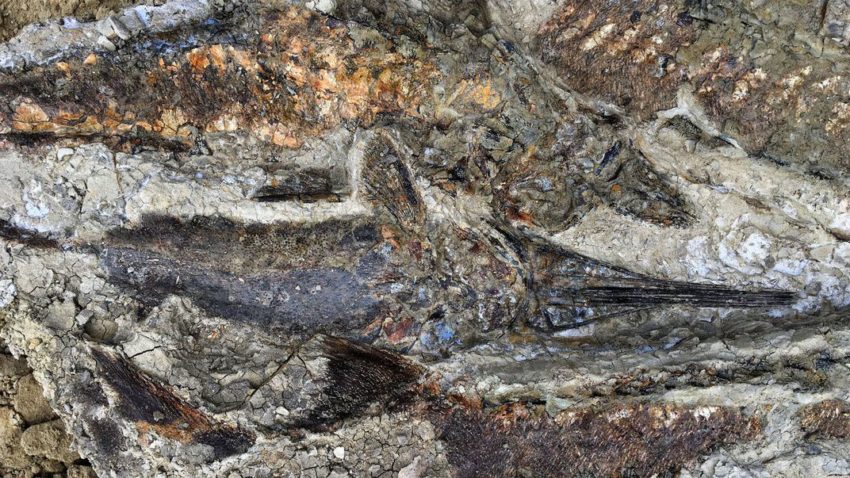
Here are some of the fish (the site is from 66 million years ago):
More reservations, not about the site itself but about its interpretation and meaning:
Other geologic details of the site also merit further investigation. “It seems like the geochemical data are scant and in some cases being stretched a bit to make interpretations,” Montanari says, “although this is not a new thing for paleontology.”,,,
University of California, Berkeley paleontologist Pat Holroyd says that the estimations of when and how quickly the Tanis site formed are based on models without consideration of other possible interpretations. “I don’t think there is any way to conclusively determine the exact amount of time represented in the site,” she says, “but it would have been useful to see how they estimated it.”
The details of what the site actually looks like, and how the layers were deposited, is not clear from what was published in the paper, Holroyd says. Such data is needed to compare Tanis to other K/Pg sites around the world.
It’s good to be cautious, although there are some very exciting things about this find. I also have to say that although computer modeling is certainly of interest, unless we know every variable (and certainly every variable of any importance) that goes into an event, modeling can mislead and create a false state of certainty where none exists.