
↓
 

The New Neo

A blog about political change, among other things

  • Home
  • Bio
  • Email
Home » Page 717 << 1 2 … 715 716 717 718 719 … 1,934 1,935 >>

Post navigation

← Previous Post
Next Post→

Trump vs. Biden: A crisis is an opportunity to be presidential

The New Neo Posted on March 21, 2020 by neoMarch 21, 2020

When people are stressed and worried by world and/or national crises, most of them naturally look to leaders to help: to communicate with them, to reassure them, and to do something. This is true not only of the relationship between citizens and government, but in most human relations. And if a person is perceived as being helpful in a time of stress, people will generally bond to that person more closely.

If the helper is a president dealing with a crisis – FDR, Lincoln, even George Bush in the first weeks after 9/11 – people tend to cut him some slack if he’s perceived as strong and working on their behalf. It’s even better if what he does is effective.

The MSM and the Democrats seem not to have been cognizant of this at first. They concentrated on almost nonstop criticism of Trump’s dealings with the COVID crisis. If he did something, what he did was wrong. If he didn’t do something, what he didn’t do would have been the best course of action. This is nothing new for them, but in a crisis most people don’t like it, especially if much of the criticism doesn’t seem valid or well-meaning.

Thus it was a bit of a surprise when the Democratic governors of California and New York praised Trump’s help for their states and his general demeanor during their interactions with him around this. But then it occurred to me that not only were they truly grateful for the help their states were receiving from Trump – and perhaps even a bit startled that it came at all – but perhaps they also had seen polls that indicated the public was rallying behind the president. The governors might have concluded that they might alienate a lot of people if they kept up the nonstop criticism, not to mention seeming ungrateful for the help offered.

And sure enough, we have this:

An ABC News/Ipsos poll released Friday reports that 55 percent of respondents approve of Trump’s management of the public health crisis, while 43 percent disapprove. The latest figures represent a boost in the president’s rating from the previous iteration of the survey, published one week ago, which showed only 43 percent approval for Trump and 54 percent disapproval.

Another factor is that, with all the closings of businesses and the constant televised appearances and press conferences by Trump, most Americans are probably watching him perform unfiltered. Those who usually just get a few sound bites from a Trump-hating MSM may be surprised at what they see: a guy who seems rather reasonable and knowledgeable and to be doing pretty well in times of great difficulty, beleagured by a carping press focusing on gotcha minutiae.

Among other things, the MSM doesn’t like the way Trump expresses himself. But so far, the American people seem to be liking what he’s doing. In his previous career, Trump has been good at organizing complex projects of a very different sort, although this is far more complex than anything he’s ever faced.

And then we have Joe Biden, who will almost certainly be Trump’s opponent in November. He’s been a petty and unimpressive man his entire life, and not altogether bright, an opinion I had even back when I was a Democrat. That now, in his twilight years, he finds himself within reach of a long-sought goal that had previously eluded him when he was in better shape is one of those ironies of history. Right now he should either get out of the way or be supportive, and wait. But instead he is constantly carping about Trump in the manner of a very annoying back-seat driver.

And he’s incompetent even at that. “I would have done this and I would have done that” – and then he goes on to list the things Trump has already done, or sometimes lies about them. He manages to look like a petty complainer, a braggart, and cognitively challenged all at the same time. It’s quite a feat. Has this man no advisors?
Posted in Health, Politics, Trump | Tagged Joe Biden | 39 Replies

Developing a serological test; and contact tracing

The New Neo Posted on March 20, 2020 by neoMarch 20, 2020

Developing a serological test for COVID-19 is important for many reasons. One is that we can identify people who had the virus and don’t even know it, and are now immune and run no risk and can go back out into the world.

Another is that at least some of these people might be used as blood donors to boost the immunity or aid the recovery of others, as sometimes happened with ebola.

Such a test is being developed:

Serological assays are of critical importance to determine seroprevalence in a given population, define previous exposure and identify highly reactive human donors for the generation of convalescent serum as therapeutic. Sensitive and specific identification of coronavirus SARS-Cov-2 antibody titers will also support screening of health care workers to identify those who are already immune and can be deployed to care for infected patients minimizing the risk of viral spread to colleagues and other patients.

And this is unrelated, but it’s one of the ways South Korea got a handle on its COVID-19: tracing possible contacts through cell phone data. Israel is doing it:

In a statement posted to Facebook, prime minister Benjamin Netanyahu wrote: “We will dramatically increase the ability to locate and quarantine those who have been infected. Today, we started using digital technology to locate people who have been in contact with those stricken by the Corona. We will inform these people that they must go into quarantine for 14 days. These are expected to be large – even very large – numbers and we will announce this in the coming days. Going into quarantine will not be a recommendation but a requirement and we will enforce it without compromise. This is a critical step in slowing the spread of the epidemic.”

There are glaringly obvious privacy and liberty concerns and dangers, and they are very very serious. But if the alternative we seem to be heading towards at warp speed is to effectively put everyone in quarantine (lockdown) and severely undermine the economy, cell phone tracing may actually involve less of a violation of liberty. The people who have been diagnosed are not identified by name, but the people who have been in contact with them are located and quarantined, probably at home.

The US is supposedly considering something like this. One other problem:

That will mean citizens’ smartphones being not just a tool of mass surveillance but also a conduit for targeted containment — raising questions about the impact such intrusive measures might have on people’s willingness to carry mobile devices everywhere they go, even during a pandemic.

I’m not sure this depends on willingness to carry phones outside, though. Is it geographic location that’s involved, or whether a person talks or texts another person who ended up infected?

Posted in Health, Liberty | 31 Replies

The number of news stories is overwhelming

The New Neo Posted on March 20, 2020 by neoMarch 20, 2020

Not only is the situation overwhelming – health, economics, politics – but the number of breaking stories is overwhelming. Since this is a one-person-blog, I can’t cover even all the most interesting ones unless I were to work round the clock. I’ve been immersing myself in this, but there’s a limit.

And so here’s an open thread to discuss stories such as these:

(1) Senators selling stock after briefings on coronavirus. I have no trouble believing politicians are corrupt. But if it’s true (and it may indeed be) that, as these senators have alleged, they’re not even involved in each of their stock decisions because their portfolio buy-sell decisions are managed by others without their input, it may be an invalid accusation. Oh, and most news stories highlight the Republicans, and only mention Feinstein the Democrat as an afterthought, although her stock trade was enormous.

(2) Want some humor? Turn to Ammo Grrrll. Sample:

I ventured into my local Bashas grocery store which resembled either Venezuela or a 7-11 Store in Florida when a hurricane is already at Cat 5. The shoppers looked like they were on a festive field trip from an insane asylum – many wearing colorful long-sleeved rubber gloves, dousing themselves in sanitizer after putting each item in their baskets.

(3) Needed; a reopening plan. You said it. Cost-benefit analyses are definitely needed as well. I’m planning (not today though, folks) a discussion of that, perhaps a multi-parter.

Or – just talk about anything you want.

Posted in Uncategorized | 52 Replies

That was then: reactions to Trump’s January 31 travel restrictions

The New Neo Posted on March 20, 2020 by neoMarch 20, 2020

I remember it well. When Trump restricted travel from China way back on January 31, he was called a xenophobe and a racist, and the restriction completely unwarranted.

Now, of course, experts such as Dr. Fauci have made it clear that they believe those restrictions were prescient and delayed the spread of COVID-19 here, buying us time.

But this is what the pundits and even many health authorities were saying back then. I wonder whether any of those people are now saying “I was wrong.”

Checking to see would take more time that I want to devote to it right now. My guess is probably none or few. I’d love to be proven wrong, though.

[NOTE: Much more here.]

[ADDENUM: Italy didn’t want to be xenophobic, and it has suffered.]

Posted in Health, Politics, Trump | Tagged COVID-19 | 24 Replies

COVID-19: known unknowns and unknown unknowns

The New Neo Posted on March 20, 2020 by neoMarch 21, 2020

There are a great many highly important facts about COVID-19 that are unknown. Many of us know they are unknown, but many people think they are known. An obvious one is the case fatality rate from the disease. It only can be calculated properly if you know the denominator: how many people contract the disease. The numerator is somewhat easier to determine: how many people who contract it die of the disease.

Both require testing. Is is likely that, although some deaths from the disease have been missed or misattributed (false negatives or positives), the majority of people who become critically ill and die of COVID-19 have at some point have been diagnosed. That’s the numerator.

The denominator is a whole other story. In no country has testing been anywhere near universal, even for symptomatic individuals – especially if their symptoms are mild, which is common. Asymptomatic individuals are generally not tested, and yet we know from the Diamond Princess data that, at least in that situation, half the infected people had no symptoms at all.

So we have almost no idea what the denominator should be. We can assume it’s not smaller than the number of confirmed cases, but we also can assume it is magnitudes bigger.

Until we know those things we cannot say what the case fatality rate is, or the death rate in the general population. And yet planning – and calm vs. panic – depends on knowing these and other facts such as ease of contagion. Contagiousness (not just a theoretical RO, but how it actually works in real life conditions as any pandemic runs its course) tells us what percentage of the population will get it. The case fatality rate tells us what percentage of those people who have the illness will die. And another good statistic to know for the sake of planning is what percentage of people will become ill enough to need major medical intervention in order to survive.

Those are the known unknowns. But if you read articles and comments around the internet or in the news, you’ll probably notice a great many people spouting facts and figures about them as though they mean something they don’t mean. For those people, they are unknown unknowns,things they think they know the correct answer to and yet are not even aware they don’t actually know it.

The death rate and/or case fatality rate from COVID-19 are often quoted, for example. Or there’s tremendous alarm about the number of confirmed cases going up without a simultaneous report on how much testing has gone up in the same area, and how many of the diagnosed cases are mild and how many serious. Huge decisions are being made on the basis of today’s numbers and the public really doesn’t know if they are valid.

Here’s a good discussion of the dilemma (hat tip: commenter “physicsguy”):

This evidence fiasco creates tremendous uncertainty about the risk of dying from Covid-19. Reported case fatality rates, like the official 3.4% rate from the World Health Organization, cause horror — and are meaningless. Patients who have been tested for SARS-CoV-2 are disproportionately those with severe symptoms and bad outcomes. As most health systems have limited testing capacity, selection bias may even worsen in the near future…

Projecting the Diamond Princess mortality rate onto the age structure of the U.S. population, the death rate among people infected with Covid-19 would be 0.125%. But since this estimate is based on extremely thin data — there were just seven deaths among the 700 infected passengers and crew — the real death rate could stretch from five times lower (0.025%) to five times higher (0.625%). It is also possible that some of the passengers who were infected might die later, and that tourists may have different frequencies of chronic diseases — a risk factor for worse outcomes with SARS-CoV-2 infection — than the general population. Adding these extra sources of uncertainty, reasonable estimates for the case fatality ratio in the general U.S. population vary from 0.05% to 1%…

That huge range markedly affects how severe the pandemic is and what should be done. A population-wide case fatality rate of 0.05% is lower than seasonal influenza. If that is the true rate, locking down the world with potentially tremendous social and financial consequences may be totally irrational. It’s like an elephant being attacked by a house cat. Frustrated and trying to avoid the cat, the elephant accidentally jumps off a cliff and dies.

Could the Covid-19 case fatality rate be that low? No, some say, pointing to the high rate in elderly people. However, even some so-called mild or common-cold-type coronaviruses that have been known for decades can have case fatality rates as high as 8% when they infect elderly people in nursing homes.

There’s much more at the link that’s well worth reading. But I want to highlight these two thoughts which parallel ideas I’ve had for quite some time [emphasis mine]:

In an autopsy series that tested for respiratory viruses in specimens from 57 elderly persons who died during the 2016 to 2017 influenza season, influenza viruses were detected in 18% of the specimens, while any kind of respiratory virus was found in 47%. In some people who die from viral respiratory pathogens, more than one virus is found upon autopsy and bacteria are often superimposed. A positive test for coronavirus does not mean necessarily that this virus is always primarily responsible for a patient’s demise.…

If we assume that case fatality rate among individuals infected by SARS-CoV-2 is 0.3% in the general population — a mid-range guess from my Diamond Princess analysis — and that 1% of the U.S. population gets infected (about 3.3 million people), this would translate to about 10,000 deaths. This sounds like a huge number, but it is buried within the noise of the estimate of deaths from “influenza-like illness.” If we had not known about a new virus out there, and had not checked individuals with PCR tests, the number of total deaths due to “influenza-like illness” would not seem unusual this year.

Our attention was drawn to COVID-19 right at the outset by the bad situation in Wuhan, which was dramatic and well-covered by the media. And now Italy. But what this means for us, and what it means worldwide is still unclear. Is the worst-case scenario correct, is the best-case scenario correct, or is it something in-between? Our lives – and not just our actual lives, but our economic, social, political, and psychological well-being – may depend on knowing the answer.

Posted in Health, Science | Tagged COVID-19 | 65 Replies

FDA to push ahead with malaria drug for COVID-19

The New Neo Posted on March 19, 2020 by neoMarch 19, 2020

The malaria drug chloroquine “soon will be made available to the public as part of the government’s response to the unfolding COVID-19 pandemic.”

My impression is that it is already possible to use it under a “compassionate care” policy, and that they’re going to speed up testing and also production. It shouldn’t be that hard, since the drug is an old one and its side effects are already known.

I’m really hoping this turns out to be a very effective treatment, even a game-changer.

Posted in Health | 72 Replies

Trump and the Chinese virus

The New Neo Posted on March 19, 2020 by neoMarch 19, 2020

There’s a recurrent pattern ever since Trump has been president: he says something or tweets something that the MSM and the Democrats consider an example of his impulsiveness and his repulsiveness. Then they attack whatever it is, pointing out its supposed racism or some other type of offensiveness to PC discourse.

Meanwhile, the thing is talked about and talked about and talked about. By the time they’re through, no one who follows the news is unaware of whatever the issue might be.

And in the process, the MSM and the Democrats tend to overreach and overreact, and there’s a backlash against them because the public doesn’t buy what they’re saying. Meanwhile, Trump has made his point and a lot of people are getting whatever message he’s trying to deliver. I don’t think this happens by accident and I don’t think it’s an example of his impulsivity. I think it’s planned and purposeful on his part.

The latest example is, of course, his calling COVID-19 the “Chinese virus,” and having the MSM and Democrats say he’s nasty and insensitive and racist. But not only do they sound like carping nitpickers in a crisis, but it gives Trump and his supporters the opportunity to point out the following:

(1) Many viruses are still called by place names signifying their point of origin, although in recent years WHO has discouraged that and prefers the viruses be called by their more technical names.
(2) The virus actually did originate in China.
(3) And most of all, the Chinese engaged in a huge coverup of what was happening back when alerting the world in a timely fashion might have prevented COVID-19’s spread (see this).

Note also that Trump isn’t calling it the “Wuhan virus,” which was the original name even newscasters were giving to it before WHO emphasized “COVID-19.” He’s calling it the Chinese virus, and he’s doing it to make a point about the Chinese government.

Do Trump’s opponents really continue to think that Trump tweets and speaks without thinking? At this point, it they do, it’s a sign of their failure to notice something that’s glaringly obvious.

Posted in Health, Language and grammar, Press, Race and racism, Trump | 77 Replies

Why are we so afraid that our hospitals could be overwhelmed by COVID-19 patients?

The New Neo Posted on March 19, 2020 by neoMarch 19, 2020

Reason number one: it’s a frightening prospect – people dying who might be saved, physicians having to decide whether to turn their backs on elderly patients in favor of the young for want of enough ventilators and ICU beds and people to minister to them.

Reason number two: it’s something that epidemiologists are projecting as a very real possibility because of the contagiousness of the virus and its possible rapid spread throughout an area.

Reason number three, and I believe the biggest reason of all: we’ve seen it happen in China and in Italy.

Not only have we seen it happen, but it’s probably one of the very first things that caught our attention. We perceived the suddenness of the influx, and the fact that this was not in what is ordinarily thought of as third-world countries where health care resources are extremely poor. Whether or not Chinese hospitals or Italian hospitals are exactly on a par with ours is not the issue. The point is that Italy is considered a developed country, and China a developing country.

So COVID-19 has been linked almost from the start with dramatic images involving desperation and scarcity of medical resources. That doesn’t happen with all the flu deaths that occur around the world, or the pneumonia deaths or even previous fairly large previous pandemics such as H1N1 or the 1957 Asian flu. It did happen, however, in many areas during the 1918 pandemic, and although most people today probably don’t have much awareness of that historical time, those of us who have learned about it know that it was a very tough situation.

Back in 1918, of course, medical science couldn’t do as much as it can now. There weren’t mechanical ventilators back then; the first one was the iron lung, invented in 1928. Now, though, because there’s more good that medicine can do in these extreme cases, there’s more angst at not having recourse to it.

Posted in Health | Tagged COVID-19 | 15 Replies

Here’s a thread for all the rest…

The New Neo Posted on March 18, 2020 by neoMarch 18, 2020

…everything that isn’t COVID-19.

For starters, let’s take the big view.

Posted in Uncategorized | 25 Replies

Diamond Princess mysteries

The New Neo Posted on March 18, 2020 by neoMarch 18, 2020

Well worth reading.

Posted in Health | Tagged COVID-19 | 30 Replies

Then and now: COVID-19, H2N2, worst cases, and the economy

The New Neo Posted on March 18, 2020 by neoApril 8, 2020

Here are some estimates for the toll COVID-19 is likely to take in the US. Make of them what you will:

One model from the Centers for Disease Control and Prevention (CDC) suggested that between 160 million and 210 million Americans could contract the disease over as long as a year. Based on mortality data and current hospital capacity, the number of deaths under the CDC’s scenarios ranged from 200,000 to as many as 1.7 million…

Another model built by experts at Resolve to Save Lives, a global health nonprofit, and the Council on Foreign Relations found the number of potential deaths could range from as few as 163,500, if the virus is no more deadly than seasonal influenza, to more than 1.6 million if the virus carries a mortality rate of just 1 percent.

Some will be young, but most will be older than 60, many considerably older, and with pre-existing conditions.

I’m not sanguine about this. I’m older than that myself. But I’m also old enough to remember the 1957 Asian flu (the more PC and official name is H2N2). Let’s take a look. It’s estimated that H2N2 caused 110,000 deaths in the US all told. That’s a lot of deaths, too. In fact, since the population of the US at that time was just about half of what it is now, the deaths then were the equivalent of today’s 220,000. That’s higher than those low-range estimates the models give for COVID-19, although considerably lower than the high-end predictions.

Here’s a description (from the UK) of how frightening the illness seemed to medical authorities at first:

The first cases in the UK were in late June, with a serious outbreak in the general population occurring in August. From mid-September onwards the virus spread from the North, West, and Wales to the South, East, and Scotland. One GP recalled ‘we were amazed at the extraordinary infectivity of the disease, overawed by the suddenness of its outset and surprised at the protean nature of its symptomatology.’

And in the UK, there was a recession:

Not only was £10 000 000 spent on sickness benefit, but also with factories, offices and mines closed the economy was hit: ‘Setback in Production — “Recession through Influenza”’ (Manchester Guardian, 29 November).

In the US there was a recession as well. But be careful attributing it to H2N2:

We haven’t found any sources that link the Asian Flu of 1957-58 with the 1958 Recession and the associated Bear Market directly, but there is strong evidence of a connection.

What mitigation efforts were in place?:

Measures were generally not taken to close schools, restrict travel, close borders, or recommend wearing masks. Quarantine was not considered to be an effective mitigations trategy and was ‘‘obviously useless because of the large number of travelers and the frequency of mild or inapparent cases.’’ Closing schools and limiting public gatherings were not recommended as strategies to mitigate the pandemic’s impact, except for administrative reasons due to high levels of absenteeism….

Despite the large numbers of cases, the 1957 outbreak did not appear to have a significant impact on the U.S. economy.

Well, COVID-19 has certainly had a significant economic impact so far. But the impact (so far) hasn’t been from the illness itself, but from the efforts to mitigate it, and the fear that’s been aroused by the projections. Perhaps those projections are right; perhaps they’re wrong. But they’ve certainly had an effect.

And the other big cause of the economic downturn has been what’s been happening – economically and healthwise – in so many other countries around the world. It’s been dramatic, and reported on inessantly by the 24-hour news cycle that didn’t exist in 1957.

The media and the Democrats are eager to continue to blame a lot of this on Trump, because it suits their purposes. But will a lot of the public buy it, particularly those in the middle? I have read for a long time that the only thing that can lead to a Democrat win in November is a recession. But this isn’t a normal recession. This is a worldwide recession from a worldwide calamity that Trump did not cause and Trump could not stop. Are people so eager for a scapegoat that they’ll blame him and want Joe Biden in charge? That’s my fear, but it seems completely illogical and I retain hope that it won’t be the result.

There are many months to go before November, and many things to play out.

Interesting times.

Posted in Disaster, Election 2020, Finance and economics, Health, History, Uncategorized | Tagged COVID-19 | 69 Replies

COVID-19: explaining South Korea, explaining the US

The New Neo Posted on March 18, 2020 by neoMarch 18, 2020

Here’s an article purporting to explain why South Korea is doing relatively well against COVID-19:

Behind its success so far has been the most expansive and well-organized testing program in the world, combined with extensive efforts to isolate infected people and trace and quarantine their contacts. South Korea has tested more than 270,000 people, which amounts to more than 5200 tests per million inhabitants—more than any other country except tiny Bahrain, according to the Worldometer website. The United States has so far carried out 74 tests per 1 million inhabitants, data from the U.S. Centers for Disease Control and Prevention show.

But a caveat:

Yet whether the success will hold is unclear. New case numbers are declining largely because the herculean effort to investigate a massive cluster of more than 5000 cases—60% of the nation’s total—linked to the Shincheonji Church of Jesus, a secretive, messianic megachurch, is winding down. But because of that effort, “We have not looked hard in other parts of Korea,” says Oh Myoung-Don, an infectious disease specialist at Seoul National University.

New clusters are now appearing. Since last week, authorities have reported 129 new infections, most linked to a Seoul call center. “This could be the initiation of community spread,” through Seoul and its surrounding Gyeonggi province, Kim says.

So it may just be a lull, and a function of the particularly localized pattern of infection in Korea as well as the country’s mitigation efforts. We don’t know what factors are causing what effect, at least I’ve not read anything that indicates an answer.

Testing may have been especially helpful in Korea because of that initial geographic and social localization:

The surge initially overwhelmed testing capabilities and KCDC’s 130 disease detectives couldn’t keep up, Kim says. Contact tracing efforts were concentrated on the Shincheonji cluster, in which 80% of those reporting respiratory symptoms proved positive, compared with only 10% in other clusters.

I would wager that most people who read this article come away convinced that South Korea’s aggressive testing approach has made all the difference, and the US has been negligent in not testing an equivalent number of people. I agree that the glitches in the development of the US testing kits – a manufacturing error, and then slowness involving bureaucratic red tape that needed cutting – has hampered our efforts. But has it actually made all that big a difference?

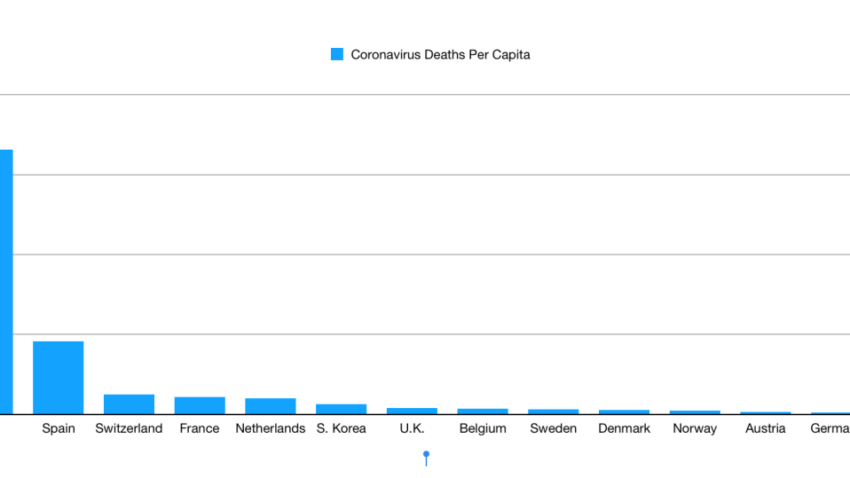
For some reason – and I think it may be the early travel restrictions put in place here – the US actually has a pretty good record compared to South Korea in term of severe cases and deaths. Take a look at this chart for today, the one entitled “Confirmed Cases and Deaths by Country, Territory, or Conveyance.” It has some interesting columns, such as “active cases,” “serious, critical cases,” “total deaths,” and “new deaths,” country by country. Since all the countries involved have different populations, it has another interesting column entitled “total cases per 1 million population.”

At the moment, here are the figures for South Korea: 6789 active cases, 59 cases currently in serious or critical condition, 3 new deaths, and 84 total deaths so far out of 8413 total cases since it all began. That means that in South Korea, the number of cases per million so far has been 164, and the deaths have involved .000001632% of the population.

In the US, we have had 7708 confirmed cases so far (with much less testing, so perhaps the rates are much much higher, perhaps just slightly higher, or perhaps in-between). Our numbers are still in the climbing stage, with 1297 new cases, a total of 120 deaths, and 11 new deaths. But of the 7482 currently active cases in the US, only 12 are considered serious or critical. That’s so low that I wonder whether it’s a typo, but if it’s not it’s pretty extraordinary, and it’s much lower than Korea’s already low ratio of serious cases to active cases.

In addition, because the USA has about seven times more people than South Korea, our deaths have so far involved .0000003667 of our population. That’s a very much smaller figure than in South Korea (we also have 23 diagnosed cases per million people, only about about 14% of South Korea’s figure, although that’s almost certainly because we just haven’t tested all that many people, so I don’t place much importance on the comparison).

It’s the death figures that have gotten my attention. Why is our death rate expressed as a percentage of the total population so much lower? Is it just that we haven’t peaked, and South Korea has? Or is something else going on?

For that matter, why is our death rate per million also so much lower than that of European countries? (From Powerline):

Again, these are just the figures as of today, and we could experience a huge surge. But (and I can’t find the link for this right now, although I remember reading it) our caseload began about the same time as South Korea’s.

My guess is that Trump’s much-maligned restrictions on travel from China, put into place on January 31, when there were only seven diagnosed cases in the US, made a significant part of the difference. The press, the Democrats, the left, and the NeverTrumpers were up in arms about that racist xenophobe Trump. And yet his action – as well as later restrictions on Iran and then on February 29 his adding restrictions on Italy and South Korea – seems very smart, particularly the early restriction regarding China.

The press and the Democrats have invested a lot in conveying to the American people that Trump is both a loose cannon and a racist. So when he does something the rest of the world isn’t doing, and it restricts travel from a certain country, it’s a no-brainer for them to scream “racist!,” and they convince much of America that it’s the case. Now they would like you to conveniently forget that Trump’s action was based on the idea of limiting the importation of a disease early on in order to delay its spread as much as possible in order to give the country and the health care system time to prepare, and that it probably accounts for the fact that the death rate in this country is lower than in most of the rest of the world – so far.

[NOTE: Another factor is that South Korea has supposedly had a lot of success treating patients with the antimalaria drug Chloroquine, a widely available medication that has been used in this country for ages for many things, and which is also cheap. And yet it also appears that the FDA has been setting up roadblocks on its use for COVID-19 in this country. Why, if it’s already been in use and approved and considered very safe? I’d like to hear a lot more about that. I understand that they must test it and make sure it works, but why not allow it to be used in very serious cases only, and have a big push to test it ASAP?]

Posted in Health | Tagged COVID-19 | 33 Replies

Post navigation

← Previous Post
Next Post→

Your support is appreciated through a one-time or monthly Paypal donation

Please click the link recommended books and search bar for Amazon purchases through neo. I receive a commission from all such purchases.

Archives

Recent Comments

  • Art Deco on Trump says his deportation program might have been too tough
  • Sharon W on This type of ed is special, all right
  • Barry Meislin on Open thread 11/10/2026
  • Barry Meislin on Open thread 11/10/2026
  • Barry Meislin on Open thread 11/10/2026

Recent Posts

  • The refinery issue
  • This type of ed is special, all right
  • Open thread 11/10/2026
  • Trump says his deportation program might have been too tough
  • Worldwide “anti-Zionism” – trolls and others

Categories

  • A mind is a difficult thing to change: my change story (17)
  • Academia (330)
  • Afghanistan (98)
  • Amazon orders (6)
  • Arts (8)
  • Baseball and sports (164)
  • Best of neo-neocon (91)
  • Biden (536)
  • Blogging and bloggers (599)
  • Dance (292)
  • Disaster (244)
  • Education (329)
  • Election 2012 (360)
  • Election 2016 (566)
  • Election 2018 (33)
  • Election 2020 (514)
  • Election 2022 (114)
  • Election 2024 (403)
  • Election 2026 (125)
  • Election 2028 (14)
  • Evil (130)
  • Fashion and beauty (324)
  • Finance and economics (1,054)
  • Food (319)
  • Friendship (48)
  • Gardening (18)
  • General information about neo (4)
  • Getting philosophical: life, love, the universe (737)
  • Health (1,169)
  • Health care reform (546)
  • Hillary Clinton (184)
  • Historical figures (338)
  • History (719)
  • Immigration (452)
  • Iran (467)
  • Iraq (227)
  • IRS scandal (71)
  • Israel/Palestine (836)
  • Jews (445)
  • Language and grammar (365)
  • Latin America (216)
  • Law (2,997)
  • Leaving the circle: political apostasy (125)
  • Liberals and conservatives; left and right (1,335)
  • Liberty (1,119)
  • Literary leftists (14)
  • Literature and writing (394)
  • Me, myself, and I (1,523)
  • Men and women; marriage and divorce and sex (935)
  • Middle East (385)
  • Military (327)
  • Movies (355)
  • Music (534)
  • Nature (262)
  • Neocons (32)
  • New England (185)
  • Obama (1,740)
  • Pacifism (16)
  • Painting, sculpture, photography (132)
  • Palin (93)
  • Paris and France2 trial (25)
  • People of interest (1,051)
  • Poetry (259)
  • Political changers (179)
  • Politics (2,797)
  • Pop culture (397)
  • Press (1,636)
  • Race and racism (885)
  • Religion (431)
  • Romney (164)
  • Ryan (16)
  • Science (642)
  • Terrorism and terrorists (983)
  • Theater and TV (266)
  • Therapy (71)
  • Trump (1,638)
  • Uncategorized (4,634)
  • Vietnam (109)
  • Violence (1,465)
  • War and Peace (1,035)

Blogroll

Ace (bold)
AmericanDigest (writer’s digest)
AmericanThinker (thought full)
Anchoress (first things first)
AnnAlthouse (more than law)
AugeanStables (historian’s task)
BelmontClub (deep thoughts)
Betsy’sPage (teach)
Bookworm (writingReader)
ChicagoBoyz (boyz will be)
DanielInVenezuela (liberty)
Dr.Helen (rights of man)
Dr.Sanity (shrink archives)
DreamsToLightening (Asher)
EdDriscoll (market liberal)
Fausta’sBlog (opinionated)
GayPatriot (self-explanatory)
HadEnoughTherapy? (yep)
HotAir (a roomful)
InstaPundit (the hub)
JawaReport (the doctor’s Rusty)
LegalInsurrection (law prof)
Maggie’sFarm (togetherness)
MelaniePhillips (formidable)
MerylYourish (centrist)
MichaelTotten (globetrotter)
MichaelYon (War Zones)
Michelle Malkin (clarion pen)
MichelleObama’sMirror (reflect)
NoPasaran! (bluntFrench)
NormanGeras (archives)
OneCosmos (Gagdad Bob)
Pamela Geller (Atlas Shrugs)
PJMedia (comprehensive)
PointOfNoReturn (exodus)
Powerline (foursight)
QandO (neolibertarian)
RedState (conservative)
RogerL.Simon (PJ guy)
SisterToldjah (she said)
Sisu (commentary plus cats)
Spengler (Goldman)
VictorDavisHanson (prof)
Vodkapundit (drinker-thinker)
Volokh (lawblog)
Zombie (alive)

Meta

  • Log in
  • Entries feed
  • Comments feed
  • WordPress.org
©2026 - The New Neo - Weaver Xtreme Theme Email
Web Analytics
↑