Have you noticed that Judge Sullivan has neither acted nor spoken on the Flynn case since he was ordered to dismiss it? I don’t think the court gave him an explicit time limit for the dismissal, and it’s been nearly two weeks.
However, apparently there is a time limit of 14 days on when Sullivan or another judge could ask the DC Circuit Court to hear the case en banc. The information in that link, however, applies to civil cases of the more ordinary sort and doesn’t mention mandamus cases, so I don’t know if the same rule applies and I don’t know how the 14 days are counted. But it seems as though such a request would have to be made within the next couple of days, if there is indeed a 14-day limit.
Or I suppose Sullivan could petition SCOTUS to hear the case. He’d have more time to do that – I think. I can’t seem to find much discussion of this right now, and these sorts of rules and procedures are not something I know anything about.
Could Sullivan just stonewall it indefinitely? Perhaps. The only information I’ve been able to find about a time frame for how long Sullivan is given to act to dismiss is in this thread, and I don’t know whether it’s correct. Some people there cite three weeks, meaning if Sullivan does nothing, the case is dismissed on July 15.
Now, you might say that Biden the man is the issue, and that’s true. Corrupt, unintelligent and quirky even when he was at his best, and now most definitely not at his best, he would most likely be a mere figurehead if elected. He would be incompetent, but the main powers would be the same crew as Obama had – or people even more leftist, and bolder in their leftism.
If the Republicans are to have a chance of winning in November, even those things probably won’t be enough to do it – although they should be. Biden’s (and other Democrats’) plans, as announced, are also very alarming. Voters need to be made aware of them.
Joe Biden tweeted Sunday night that if he gets elected, his administration “won’t just rebuild this nation — we’ll transform it,” raising speculation online about what exactly in the country will be transformed.
No one who voted for Obama would be fooled into thinking – as Biden et al clearly seem to want them to think – that Biden and Obama are alike in their force of personality or grasp on reality. But this tweet is obviously an attempt to play on two things: Biden’s association with Obama and his disassociation with the hated Trump. Whether it will be Biden doing the transforming (something I doubt anyone believes) or his handlers who will be in charge, or even Obama himself behind the scenes, a lot of people are perfectly fine with that.
But as with Obama’s “hope and change” and “fundamental transformation,” the meaning of the term “transform” is left purposely vague so the reader can fill in the blanks with whatever he or she hopes it will be. The right needs to fill in some blanks for them.
In his third run for the White House, Biden is proposing tax increases of nearly $4 trillion over the next 10 years. If he wins in November and these increases were to pass, they’d be the highest in American history — indeed, in world history…
Are Biden’s proposed tax increases what America needs while our economy is still mired in the coronavirus downturn, and now beset by anti-police protests? What will happen to jobs under that farsighted “leadership”? How long until America’s economy could return to where it was at the beginning of 2020?
Biden proposes an outright repeal of Trump’s tax reform package, raising taxes on the middle class, blue-collar families and American corporations, large and small. Such tax increases would return America’s corporate tax rate to close to 40 percent, the highest in the world.
At the start of the Great Depression in 1929, President Hoover’s tax increases to balance the budget in a collapsing economy caused America to suffer 25 percent unemployment for more than 10 years. Is that what Americans want again?
And Biden also proposes to raise the capital gains tax to 40 percent, doubling it from today’s rate. We know from experience that would dramatically reduce tax revenues from that source and slash investment returns for all Americans.
And then there’s Biden’s plan to continue Obama’s course for the suburbs:
Biden and his party have embraced yet another dream of the radical Left: a federal takeover, transformation, and de facto urbanization of America’s suburbs. What’s more, Biden just might be able to pull off this “fundamental transformation.”
If suburban voters knew what the Democrats had in store for them, they’d run screaming in the other direction. Unfortunately, Republicans have been too clueless or timid to make an issue of the Democrats’ anti-suburban plans. It’s time to tell voters the truth.
I’ve been studying Joe Biden’s housing plans, and what I’ve seen is both surprising and frightening.
Please read the whole thing. And you might want to spread the word.
And no – lo-carb or Taubes or Atkins doesn’t work for me nor for a lot of other people. I’m happy for you if your experience has been more positive. Mine has been that I don’t lose weight on such programs and they make me feel ill.
At this point, I try to eat healthful things most of the time, exercise regularly (weight-lifting is highly limited, though, because of my chronic arm injuries), and not obsess too much about losing that 10-15 pounds, particularly at my age. And yes, it’s generally easier for you guys.
I’ve known people who regularly eat many times what I eat and have been slender all their lives. I know people who eat less and are fatter. I’ve known people who started out as the first type for several decades of their lives and then slowly morphed into the latter.
It was a well-crafted story of America’s past and a pledge about America’s future. As I watched and listened, I felt split. A small part of me – a part that represents the child I was in the 50s and early 60s, growing up and being educated in an America which still taught its children patriotism and a heroic vision of American exceptionalism, and where both parties agreed on that history and even on the basic outlines of a desirable future – listened and felt that almost no one could disagree with the sentiments Trump expressed, they were so noncontroversial.
But a larger part of me – more cerebral, aware, and older – knew that the speech would be excoriated with almost one voice by the press and the Democrats. I even knew what the approach would be, because we’ve heard it before about Trump’s speeches: “dark,” divisive, jingoistic, combative.
And so it went. What was a soaring vision of American accomplishment and aspiration is now seen as an angry lie – that is, to the angry liars that now abound in our press, the Democratic Party, and so many other American institutions.
I wish it weren’t so. But that’s the way it is. And they lie with impunity because they know that they hold a lot of sway, and that the bulk of their followers and listeners will never watch or read the actual speech, but will instead take their word for it, and talk within their personal circles about how awful the speech was, reinforcing the opinion.
I was particularly struck by the parts of the speech describing each of the men whose faces are carved into Mount Rushmore. I also took special note of Trump’s recitation of the things Americans stand for (go to 27:17 in the transcript).
These words resonated as well:
We will raise the next generation of American patriots. We will write the next thrilling chapter of the American adventure. And we will teach our children to know that they live in a land of legends, that nothing can stop them, and that no one can hold them down. They will know that, in America, you can do anything, you can be anything, and together, we can achieve anything.
And note these words in particular, in which Trump directly addressed the issue of slavery:
By tearing down Washington and Jefferson, these radicals would tear down the very heritage for which men gave their lives to win the Civil War, they would erase the memory that inspired those soldiers to go to their deaths, singing these words of the Battle Hymn of the Republic, “As he died to make men holy, let us die to make men free, while God is marching on.” They would tear down the principles that propelled the abolition of slavery and ultimately around the world ending an evil institution that had plagued humanity for thousands and thousands of years. Our opponents would tear apart the very documents that Martin Luther King used to express his dream and the ideas that were the foundation of the righteous movement for Civil Rights. They would tear down the beliefs, culture and identity, that have made America the most vibrant and tolerant society in the history of the earth. My fellow Americans, it is time to speak up loudly and strongly and powerfully and defend the integrity of our country.
In that paragraph, Trump makes several points that I and others have been making lately. No, I don’t think that Trump or his researchers read my blog (although hey, it’s always possible). But he fastened on exactly the quote from the Battle Hymn of the Republic that I highlighted and discussed about a week ago in this post, and for the same reason: it proves that one of the main reasons the North fought the Civil War was to free the slaves, and the men who did so were fully willing to die for that cause if necessary. It is a deep insult to their names and to their lives to say otherwise.
A second point Trump made, that I and others have talked about recently, is that the present radical movements are antithetical to the goals and words of Martin Luther King. And still another is the fact that slavery was not some unique American institution; it had been part and parcel of the world for thousands of years and was not some unique activity of the white race.
The following part of Trump’s speech struck me as especially important. Would that all of America could hear it and understand it:
We must demand that our children are taught once again to see America as did Reverend Martin Luther King when he said that the founders had signed a promissory note to every future generation. Dr. King saw that the mission of justice required us to fully embrace our founding ideals.
[NOTE: This is a repeat of a previous post from many years ago. It was written in the springtime during a visit to New York. Reading it now, it seems almost archaic in some ways – in particular, the crowds in New York walking around freely, an additional testament to liberty compared with the situation now, when people can’t congregate in the same manner and when New York City itself lies bleeding, this time from self-inflected wounds. Liberty is threatened in a more intense way than I can remember from previous times in my life, and that threat comes mostly from within rather than without.]
I’ve been visiting New York City, the place where I grew up. I decide to take a walk to the Promenade in Brooklyn Heights, never having been there before.
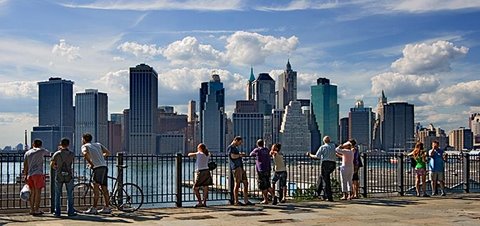
When you approach the Promenade you can’t really see what’s in store. You walk down a normal-looking street, spot a bit of blue at the end of the block, make a right turn–and, then, suddenly, there is New York:
And so it is for me. I take a turn, and catch my breath: downtown Manhattan rises to my left, seemingly close enough to touch, across the narrow East River. I see skyscrapers, piers, the orange-gold Staten Island ferry. In front of me, there are the graceful gothic arches of the Brooklyn Bridge. To my right, the back of some brownstones, and a well-tended and charming garden that goes on for a third of a mile.
I walk down the promenade looking first left and then right, not knowing which vista I prefer, but liking them both, especially in combination, because they complement each other so well.
All around me are people, relaxing. Lovers walking hand in hand, mothers pushing babies in strollers, fathers pushing babies in strollers, nannies pushing babies in strollers. People walking their dogs (a preponderance of pugs, for some reason), pigeons strutting and courting, tourists taking photos of themselves with the skyline as background, every other person speaking a foreign language.
The garden is more advanced in time than gardens where I live, reminding me that New York is really a southern city compared to New England. Daffodils, the startling blue of grape hyacinths, tulips in a rainbow of soft colors, those light-purple azaleas that are always the first of their kind, flowering pink magnolia and airy white dogwood and other blooming trees I don’t know the names of.
In the view to my left, of course, there’s something missing. Something very large. Two things, actually: the World Trade Center towers. Just the day before, we had driven past that sprawling wound, with its mostly-unfilled acreage where the WTC had once stood, now surrounded by fencing. Driving by it is like passing a war memorial and graveyard combined; the urge is to bow one’s head.
As I look at the skyline from the Promenade, I know that those towers are missing, but I don’t really register the loss visually. I left New York in the Sixties, never to live there again, returning thereafter only as occasional visitor. The World Trade Center was built in the early seventies, so I never managed to incorporate it into that personal New York skyline of memory that I hold in my mind’s eye, even though I saw the towers on subsequent visits. So what I now see resembles nothing more than the skyline of my youth restored, a fact which seems paradoxical to me. But I feel the loss, even though I don’t see it. Viewing the skyline always has a tinge of sadness now, which it never had before 9/11.
I come to the end of the walkway and turn myself around to set off on the return trip. And, suddenly, the view changes. Now, of course, the garden is to my left and the city to my right; and the Brooklyn Bridge, which was ahead of me, is now behind me and out of sight. But now I can see for the first time, ahead of me and to the right, something that was behind me before. In the middle of the harbor, the pale-green Statue of Liberty stands firmly on its concrete foundation, arm raised high, torch in hand.
The sight is intensely familiar to me—I used to see it frequently when I was growing up. But I’ve never seen it from this angle before. She seems both small and gigantic at the same time: dwarfed by the skyscrapers near me that threaten to overwhelm her, but towering over the water that surrounds her on all sides. The eye is drawn to her distant, heroic figure. She’s been holding that torch up for so long, she must be tired. But still she stands, resolute, her arm extended.
NOTE: I was going to add a photo of the Statue of Liberty here. But instead I was very taken with a video about how the statue was constructed. I’d never previously thought about the challenges involved and how they were surmounted, but I learned about them here. And the video also caused me to reflect, not for the first time, on how the forces arrayed against the US right now are good at destroying but not at building. Destroying is so much easier:
[NOTE: This is a slightly-edited repeat of a previous post.]
I saw that film on TV maybe 30 times when I was a child. Loved it, and in particular loved the idea that James Cagney—whom I already knew as a tough old gangster—could dance. His dancing fascinated me because it was so non-balletic and idiosyncratic—the strutting, graceful/ungraceful, artful/artless uniqueness of his movement. In particular I recall the wall-climbing part at the end, which delighted me then and still does now.
Cagney wasn’t just an actor and hoofer, although he certainly was both. He was also a political conservative and changer. Excerpts from his Wiki page:
He was sickly as a young child—so much so that his mother feared he would die before he could be baptized. He later attributed his sickness to the poverty his family had to endure…The red-haired, blue-eyed Cagney graduated from Stuyvesant High School in New York City in 1918, and attended Columbia College of Columbia University where he intended to major in art…
Cagney believed in hard work, later stating, “It was good for me. I feel sorry for the kid who has too cushy a time of it. Suddenly he has to come face-to-face with the realities of life without any mama or papa to do his thinking for him.”
He started tap dancing as a boy (a skill that eventually contributed to his Academy Award) and was nicknamed “Cellar-Door Cagney” after his habit of dancing on slanted cellar doors. He was a good street fighter, defending his older brother Harry, a medical student, when necessary. He engaged in amateur boxing, and was a runner-up for the New York State lightweight title. His coaches encouraged him to turn professional, but his mother would not allow it…
In his autobiography, Cagney said that as a young man, he had no political views, since he was more concerned with where the next meal was coming from. However the emerging labor movement of the twenties and thirties soon forced him to take sides…He supported political activist and labor leader Thomas Mooney’s defense fund, but was repelled by the behavior of some of Mooney’s supporters at a rally. Around the same time, he gave money for a Spanish Republican Army ambulance during the Spanish Civil War, which he put down to being “a soft touch.”…He also became involved in a “liberal group…with a leftist slant,” along with Ronald Reagan. However, when he and Reagan saw the direction the group was heading in, they resigned on the same night…
Cagney was accused of being a communist sympathizer in 1934, and again in 1940. The accusation in 1934 stemmed from a letter police found from a local Communist official that alleged that Cagney would bring other Hollywood stars to meetings. Cagney denied this, and Lincoln Steffens, husband of the letter’s writer, backed up this denial, asserting that the accusation stemmed solely from Cagney’s donation to striking cotton workers in the San Joaquin Valley. William Cagney claimed this donation was the root of the charges in 1940. Cagney was cleared…
After [WWII], Cagney’s politics started to change. He had worked on Democrat Franklin D. Roosevelt’s presidential campaigns…However, by the time of the 1948 election, he had become disillusioned with Harry S. Truman, and voted for Thomas E. Dewey, his first non-Democratic vote. By 1980, Cagney was contributing financially to the Republican Party, supporting his friend Ronald Reagan’s bid for the presidency…As he got older, he became more and more conservative, referring to himself in his autobiography as “arch-conservative.” He regarded his move away from liberal politics as “…a totally natural reaction once I began to see undisciplined elements in our country stimulating a breakdown of our system… Those functionless creatures, the hippies … just didn’t appear out of a vacuum.”
Cagney: hoofer, political changer. An original all the way.
I covered some of the events that took place at Evergreen College in 2017, a situation that catapulted Bret Weinstein into minor celebrity for the brave stand he took there. But although I thought I knew a lot about it, there’s still more to learn and it bears repeating.
A documentary on the subject is presented at YouTube in three roughly-equal parts. It’s not at all pleasant to watch these three videos. It’s terrifying and/or anger-provoking. But after watching them you will understand a lot. One thing you will understand better is what’s happening now in America: that is, the far left campus’ indoctrination efforts to go mainstream. Instead of faculty and administrative capitulations and cooperation, we have local blue governments facilitating the whole thing.
Just a couple of years ago, had you watched these videos, you might have thought this merely an insane far leftist fringe cult that would stay on the far left. Now you know it’s a leftist fringe cult trying to take over the US, and getting pretty far in that endeavor at the moment.
I don’t think what happened under the Communists in China and Cambodia, just to take just two examples, was due to some extra-special characteristics of the Chinese or Cambodian people. It can happen here, because of the susceptibility of human beings to group pressure of this sort, if they lack a solid core of other values such as individualism, free speech, and inalienable rights grounded in something more than human say-so. Very few resist the pressure. Milgram knew it, and propagandists everywhere know it.
What are the students in these videos so angry about? They don’t really know. They know the words they’ve been taught to say about it, however, and they scream them out. Something is wrong in their lives, something very big (in the family? society? education?) and they’ve been given a grenade to throw. But they haven’t a clue why. You can see it in their faces, and hear it in their voices.
Give them numbers. That way the names will never have to be changed as the historical revisionists expand their targets – at least, I doubt that numbers will ever be their targets, although I wouldn’t put it past them.
When I was growing up in New York, it was only high schools that had names that were actually used. Our elementary schools had numbers after the acronym “PS” for “public school.” This was the way it was, and we never thought anything of it. Over time, the numbers grew to have a certain emotional valence – one might be the school that everyone knew was “good,” another one “bad,” and still another one “middling.”
Junior high schools (there was actually only one, because that was a very new concept) had names, but they also had numbers and it was the numbers that we used. Force of habit, perhaps. High schools did have names, but the names usually represented the geographic area they served.
Anyway, that’s my little contribution to the wokeness that is so obligatory these days. Harvard could be #1, if it liked, and Yale #2. Or they could duke it out.
Did I say “duke”? Duke University, it turns out, is one of the worst offenders in the name game. Not only did the man after which it’s named have the dread first name “Washington” and a last name that indicates a consciousness of class, but he was a Confederate veteran and a purveyor of tobacco.
No, no, NO! I’m afraid it’s numbers for Duke, too.
Well, fancy that. Apparently, even though stupidhead Trump indicated that hydroxychloroquine might be helpful for COVID, a study indicates he may have been correct. This is the first study I’ve seen that actually uses the drug as suggested: in the correct dose and at the correct time (earlier rather than later):
The large-scale analysis, conducted by Henry Ford Health System, was published Thursday in the peer-reviewed International Journal of Infectious Diseases.
The study examined 2,541 patients who had been hospitalized in six hospitals between March 10 and May 2, 2020.
More than twenty-six percent (26.4%) of patients who did not receive hydroxychloroquine died.
But among those who received hydroxychloroquine, fewer than half that number — 13% — died.
No heart complication side effects emerged.
So, will the people who for political reasons discouraged the use of this drug, and touted the results of studies that used it in the wrong dose and at the wrong time, ever apologize or even express a bit of doubt as to whether they were a bit too harsh a bit too soon? I believe I can answer my own question: no.
The vast majority received the drug soon after admission; 82% within 24 hours and 91% within 48 hours of admission. All patients in the study were 18 or over with a median age of 64 years; 51% were men and 56% African American…
Henry Ford Health System is currently also involved in a prophylactic hydroxychloroquine study: “Will Hydroxychloroquine Impede or Prevent COVID-19,” or WHIP COVID-19. The study is a 3,000-person, randomized, double-blinded look at whether hydroxychloroquine prevents healthcare and frontline workers from contracting the COVID-19 virus.
How does CNN headline its story? About as you’d expect: “Study finds hydroxychloroquine may have boosted survival, but other researchers have doubts.” And the lede goes like this:
A surprising new study found the controversial antimalarial drug hydroxychloroquine helped patients better survive in the hospital. But the findings, like the federal government’s use of the drug itself, were disputed.
Surprising to CNN, anyway. Controversial because of a controversy the MSM and Democrats stirred up prematurely. And gee, the findings of a study were disputed? How very novel.
Findings like this are apparently a bitter pill to swallow – for CNN. Time will tell if more studies duplicate this type of finding, but for now it’s encouraging. Or should be.
At least CNN covered the story, as did Fox and the NY Post and some other sites that lean right as well as some science sites. So far, however, as I write this, nothing from the NY Times or the WaPo has come up in my search, even though they’re usually at or towards the top of the Google listings on any topic.
I also did a search for the drug at the Times site and found nothing recent. I suppose they may end up covering it, but they certainly aren’t racing to do so, unless I somehow missed it.
[NOTE: But it’s the Democrats who have dubbed themselves the Party of Science.]
Beijing-controlled police “arrested more than 300 people on Wednesday as protesters took to the streets in defiance of sweeping security legislation introduced by China to snuff out dissent,” Reuters news agency confirmed.
The so-called National Security Law was passed by the Chinese Communist Party-controlled National People’s Congress without consulting the Hong Kong legislators, a violation of its constitution agreed when the territory came under Beijing’s control in July 1997. China is creating a new security apparatus in the region to apply the law. The crackdown coincides with the 23rd anniversary of Britain handing over of Hong Kong to Communist China…
Hong Kong residents could be deported to Mainland China and face life imprisonment if found guilty under its provisions.
The “law empowers Beijing to bring into Hong Kong many of the methods that mainland Chinese agencies use for policing activities that challenge Communist Party rule,” the Wall Street Journal reported on Tuesday.
Durkan’s emergency order booting protesters from the six-block cop-free zone makes mention of the “narcotics use and violent crime, including rape, robbery, assault, and increased gang activity” within the CHOP since it first emerged in early June.
June 2 to June 30 saw the 525 percent jump in crime compared to the same period last year.
It includes “22 additional incidents, in person-related crime in the area, to include two additional homicides, 6 additional robberies, and 16 additional aggravated assaults (to include 2 additional non-fatal shootings),” Durkan’s order on Tuesday says.
Seriously, though – how would they even know what the crime rates in CHOP were? After all, without the police, all they would have to go on are anecdotal reports and 911 calls, but it’s hard to believe that most crime victims would call the police if police had been banished from the area and the caller didn’t expect them to be able to come in response to a call.
The idea to defund the police and insult, demoralize, and banish them seems incredibly stupid, particularly if it’s coupled with the idea that crime won’t soar as a result. But anarchists have long had an agenda that includes getting rid of police, who are considered instruments of state oppression, and that was even before the all-important racial angle was added to give the idea a special attraction for those suffused with racial guilt. If you want to read a more recent anarchist article on the subject of police abolition, try wading through this.
How many people are buying the proposal? Recent polls don’t show a ton of support – and it’s hard to know how people interpret the phrase “defund the police” in terms of the extremity of the policies it represents. Also, the polls were taken a couple of weeks ago, before publicity about the murders in CHAZ and the murder spikes in cities such as Chicago.
I said that the polls don’t show “a lot” of support. Anything over low single digits would be way too much, however, and the levels shown in the polls are much higher than that, varying from a quarter to a third of those polled. What’s more, in some groups it’s higher:
In the two polls where results were broken down by race, Black respondents said they supported defunding the police by an average of 45 percent to 28 percent…Similarly, in the three polls with breakdowns by party, Democrats on average supported the “defund the police” movement 50 percent to 34 percent, and Republicans on average opposed it 84 percent to 11 percent. Granted, only about a quarter of Democrats “strongly” supported it, per Morning Consult/Politico and Reuters/Ipsos, but three-quarters of Republicans “strongly” opposed it.
To me, the idea that social workers can somehow replace police is both absurd and dangerous. There actually are some social work family interventions that have been demonstrated to reduce crime if begun when acting-out kids are still underage, but it’s not an either/or thing. If a city or state wants to raise money to expand those programs that have been found to be effective, that’s well and good. But at the same time, police are needed and without them things fall apart – which is so obvious it should hardly need saying.
We have fallen down the rabbit hole of irrationality.
I keep reading that the above states are in big trouble, but I don’t see it the way a lot of people seem to see it. I suppose it depends on what you mean when you say “in trouble.”
Obviously, I can’t foretell the future, and I may be wrong. But this is what I see.
First, an aside about Sweden, the country that decided not to shut down, but instead to let people decide to social distance or not, and to protect the elderly as much as possible. Otherwise, things were open and life continued more or less as usual. What happened? There was indeed an initial spike of cases and deaths. Sweden’s current deaths per million stands at 532, on the high side but hardly astronomical, lower than some countries that shut down and higher than some that shut down. But most of those deaths were in April and early May. There’s a graph at that link that shows the daily death count, and it’s extremely low now. At the high, the daily counts were in the seventies, eighties, and at times slightly over 100. Now? The numbers have been going down down down, and at present there’s been a string of single-digit days. That’s for the entire country of Sweden.