The subject of the Tolstoy marriage came up in this thread, in the context of a discussion about Tolstoy’s novel Anna Karenina. In that book, Tolstoy presents a thinly-disguised more idealized version of his own marriage to his wife Sonya, told through the story of the relationship between the characters Levin and Kitty.
I read that book in high school, and I remember quite a bit of Levin and Kitty’s story. Much later I became extremely interested in the real-life tale of the Tolstoy marriage, an intense relationship that careened from love to hate and back again with some regularity, and featured the interaction of two complex and gifted individuals blessed with extraordinary energy and the ability to drive each other nearly mad.
It’s a story that’s not only fascinated me, but several authors. There are three major books on the subject, two of which I’ve read, and a movie I’ve seen that I don’t much like but that was highly praised. The two books I’ve read are titled Married to Tolstoy and Lev and Sonya, and the one I haven’t read is a tome by none other than William Schirer and is entitled Love and Hatred: The Tormented Marriage of Leo and Sonya Tolstoy.
That last title is no exaggeration.
It’s hard to summarize what was going on there, but I’ll just say that the Tolstoy marriage was not only one of the most intense (in every sense of the word) on record, but it was also one of the most amply documented. Both parties kept voluminous no-holds-barred diaries which they regularly left for each other to read.
The Tolstoys had thirteen living children – only eight of whom survived childhood – and if memory serves me, Sonya had several more pregnancies that ended in miscarriages. Meanwhile, Tolstoy later in life developed a moral or religious aversion to sex even in marriage, although he continued to engage in sexual relations with his wife quite regularly. He even wrote a long short story on the subject (“The Kreutzer Sonata”), and Sonya wrote a rebuttal. Just to get a little flavor of that story of Leo Tolstoy’s, here’s a description:
The work is an argument for the ideal of sexual abstinence and an in-depth first-person description of jealous rage. The main character, Pozdnyshev, relates the events leading up to his killing of his wife: in his analysis, the root causes for the deed were the “animal excesses” and “swinish connection” governing the relation between the sexes.
As for Sonya’s reaction, here’s what happened:
It was fair to say Sofiya was humiliated and incensed when [The Kreutzer Sonata] was published and her marriage to The Great Man became suspect, subject to nationwide speculation. (And yet such was her devotion she made a special plea to the Czar to allow its publication after Orthodox Church objections banned it)…
For a long time, it had been thought Sofiya kept her dismay to her private diary. But…it turns out she wrote an entire novella of her own that has languished unpublished and untranslated in the depths of the archives of the Tolstoy Museum in Moscow for more than a century.
…Just published for the first time in English in a translation by the scholar Michael R. Katz, it appears in a Yale University Press edition that includes not only Tolstoy’s original Kreutzer, not only Sofiya’s “answer novel,” not only a response document from Tolstoy’s son and from his daughter, but much more. The volume is called The Kreutzer Sonata Variations.
Here’s Sonya’s book, which I haven’t read, so I don’t know whether I would agree or disagree with the Slate author’s description:
Specifically, Sofiya pulls off a remarkable structural feat in mirroring Kreutzer’s wife-murder plot from the point of view of the murdered wife. And she does it with prose that (in English at least) comes across as graceful, emotionally intuitive, and heartbreaking.
Thematically, she counters her husband’s rage against sex and love with what is, cumulatively, a deeply affecting defense of love. A portrait of love from a woman’s point of view unlike any you can find (or I have found) in Tolstoy.
Meanwhile, in real life Sonya ran the large estate – with help, but it still required enormous work and energy – dealt with a bunch of eccentric Tolstoy-admiring hangers-on, fought her husband’s efforts to deprive their children of education and their inheritance, and copied out his manuscripts in longhand as a tireless secretary. I believe she copied out War and Peace something like eight or so times as it was being written and rewritten, deciphering Tolstoy’s handwriting and revisions, staying up long hours at night to do it. Over the years she is reported to have become more difficult and more emotionally distraught, and although it’s pretty easy to see why that may have happened, it couldn’t have been easy for Tolstoy either.
Commenter “Zaphod” mentions a famous incident: “Shouldn’t have shown his newlywed wife his diary.” You better believe it. Tolstoy was 34 when he married, almost twice the age of his 18-year-old fiancee, and he had lived a very dissolute life as opposed to her innocence at the time. Here’s how Wiki describes the incident, plus the literary reference in Anna Karenina:
On 17 September 1862 the couple became formally engaged after Tolstoy gave Sophia a written proposal of marriage, marrying a week later in Moscow. At the time of their marriage, Leo Tolstoy was well known as a novelist after the publication of The Cossacks. On the eve of their marriage, Tolstoy gave Sophia his diaries that detailed his sexual relations with female serfs. In Anna Karenina, 34-year-old Konstantin Levin, a semi-autobiographical character behaves similarly, asking his 19-year-old fiancée Kitty to read his diaries and learn of his past transgressions. The diary included the fact that Tolstoy had fathered a child by a woman who remained on the Yasnaya Polyana estate. In Anne Edwards’ Sonya: The Life of Countess Tolstoy, she describes Sophia as having a deep fear that Tolstoy would re-enter a relationship with the other woman.
Anne Edwards doesn’t just describe that fear; it features prominently in Sonya’s diaries over the years, and she could not avoid seeing the woman now and then on the estate where she still lived. Why did Tolstoy decide to have Sonya read his account? He wanted to unburden himself of a guilty conscience and decided full disclosure was necessary, but I believe he was putting his own needs way before those of his bride and ignoring how terribly it would affect her. The man who could write so eloquently about Kitty’s feelings wasn’t nearly as thoughtful about those of the real-life Sonya. At any rate, the decision to have her read the diary backfired, as did so many of the things they did to each other.
The 2009 movie about the last years of the Tolstoy marriage was called “The Last Station.” I saw it, but by then I was somewhat of an expert on the Tolstoy marriage, and although it starred Christopher Plummer and Helen Mirren (two good actors) I found many things wrong with it, although perhaps I was being nitpicky. At any rate, the last chapter in their marriage – which did occur at a railway station, where Tolstoy died very shortly after leaving Sonya when he was 82 years old – is especially tragic.
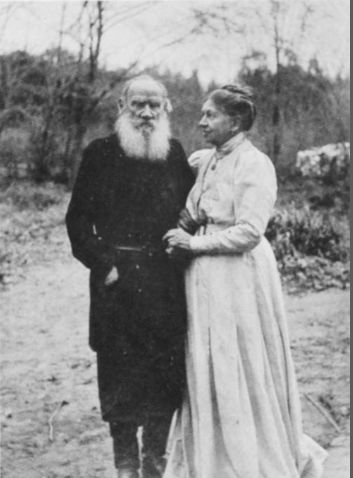
For anyone interested – and not everyone will be, I’m pretty sure – I recommend any of this material. I also offer what I believe is the last picture ever taken of the couple together (just a few weeks before his “escape” and death), which I think expresses Sonya’s pain and desperate need to hold on, and Tolstoy’s resentment and resolute need to go:
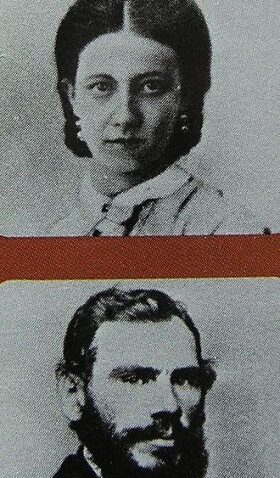
In younger days, around the time they were married:
And if you’re interested in learning what drew these two together in the first place, Tolstoy explains in Anna Karenina in a scene that occurs between Levin and Kitty. I can’t remember where I read it (maybe in one of their diaries?), but I distinctly recall learning that this is based on something that actually happened:
A silence followed. [Kitty] was still drawing with the chalk on the table. Her eyes were shining with a soft light. Under the influence of her mood he felt in all his being a continually growing tension of happiness.
‘Ah! I’ve scribbled all over the table!’ she said, and, laying down the chalk, she made a movement as though to get up.
‘What! shall I be left alone—without her?’ he thought with horror, and he took the chalk. ‘Wait a minute,’ he said, sitting down to the table. ‘I’ve long wanted to ask you one thing.’
He looked straight into her caressing, though frightened eyes.
‘Please, ask it.’
‘Here,’ he said; and he wrote the initial letters, w, y, t, m, i, c, n, b, d, t, m, n, o, t. These letters meant, ‘When you told me it could never be, did that mean never or then?’ There seemed no likelihood that she could make out this complicated sentence; but he looked at her as though his life depended on her understanding the words. She glanced at him seriously, then leaned her puckered brow on her hands and began to read. Once or twice she stole a look at him, as though asking him, ‘Is it what I think?’
‘I understand,’ she said, flushing a little.
‘What is this word?’ he said pointing to the n that stood for never.
‘It means never,’ she said; ‘but that’s not true!’
He quickly rubbed out what he had written, gave her the chalk, and stood up. She wrote, t, i, c, n, a, d.
…He was suddenly radiant: he had understood. It meant, ‘Then I could not answer differently.’
He glanced at her questioningly, timidly.
‘Only then?’
‘Yes,’ her smile answered.
‘And n … and now?’ he asked.
‘Well, read this. I’ll tell you what I should like—should like so much!’ She wrote the initial letters, i, y, c, f, a, f, w, h. This meant, ‘If you could forget and forgive what happened.’
He snatched the chalk with nervous, trembling fingers, and, breaking it, wrote the initial letters of the following phrase, ‘I have nothing to forget and to forgive; I have never ceased to love you.’
She glanced at him with a smile that did not waver.
[NOTE: Sonya was an excellent early amateur photographer – in her copious free time? – when photography required a lot of technical know-how and patience. Here’s a book of many of her photographs; it includes some diary excerpts.]
