Solar panels apparently only last about twenty-five years, and then what? They have to be replaced, but what happens to the old ones?:
The world’s solar energy generation capacity grew by 22% in 2021. Around 13,000 photovoltaic (PV) solar panels are fitted in the UK every month – most of them on the roofs of private houses.
In many cases, solar units become relatively uneconomical before they reach the end of their expected lifespan. New, more efficient designs evolve at regular intervals, meaning it can prove cheaper to replace solar panels that are only 10 or 15 years old with updated versions.
If current growth trends are sustained, Ms Collier says, the volume of scrap solar panels could be huge.
“By 2030, we think we’re going to have four million tonnes [of scrap] – which is still manageable – but by 2050, we could end up with more than 200 million tonnes globally.”
The idea is to recycle, but it’s not easy (and my guess is that it uses a lot of energy, but the article doesn’t go into that so I’m not sure):
At ROSI’s high-tech plant in Grenoble, the solar panels are painstakingly taken apart to recover the precious materials inside – such as copper, silicon and silver.
Each solar panel contains only tiny fragments of these precious materials and those fragments are so intertwined with other components that, until now, it has not been economically viable to separate them.
But because they are so valuable, extracting those precious materials efficiently could be a game-changer, says Mr Defrenne.
“Over 60% of the value is contained in 3% of the weight of the solar panels,” he says.
The team at Soren are hopeful that, in the future, nearly three-quarters of the materials needed to make new solar panels – including silver – can be recovered from retired PV units and recycled – to help speed up production of new panels.
Currently there is not enough silver available to build the millions of solar panels which will be required in the the transition from fossil fuels, says Mr Defrenne: “You can see where you have a production bottleneck, it’s silver.”
The article says recycling will be expensive.
So much of energy efficiency involving alternative energy sources such as wind and solar has its own built-in problems that seem to be mostly ignored by those pushing them. To me, nuclear seems the way to go – not that it doesn’t have it’s own problems, but I think they’ve been very much magnified by the left.
John Hinderaker of Powerline has some questions about how it is that a strong majority of Americans don’t buy into the tenets of trans activism, and yet so many companies yield to the trans activists:
How can a small minority successfully bully the large majority? Why does corporate America sign on with a dissident and often unstable fringe? Why is it that normal people, not those with extreme views, are afraid to express their opinions for fear of damaging their careers? The answers to those questions hold the key to understanding politics in our current bizarre moment.
Here’s someone with some answers, at least in regard to propaganda and non-financial pressure. It’s well worth reading the whole thread.
And this article, based on an interview with a former Anheuser-Busch executive, deals with the financial pressures on corporate America to support wokeness, pressures which are not immediately apparent to the casual observer (hint: it’s not about appealing to the consumer):
‘You just have to follow the money. Take a look at BlackRock, State Street, Vanguard — they manage $20 billion worth of capital,’ [Anson Frericks] said.
Frericks said a lot of the money managed by institutional investors comes from big pension funds like those of the state of California, which put ideological pressure on the money managers.
‘They — State Street, BlackRock, Vanguard — they have to commit to ESG, diversity, equity and inclusion and adopt firm-wide commitments that they therefore then force on to all of major company in corporate America,’ said Frericks.
What’s called “institutional investors” don’t own a lot of Anheuser-Busch, but they do own a lot of Target. So I suppose this sort of pressure functions to a different extent in different companies.
I will add that one way pressure is often put on companies and on the public in general to get with the program on so many identity issues, not just transgenderism, is to frame any opposition to or disagreement with the woke agenda as a hate-mongering “ism” or “phobia.” People don’t want to be mean or intolerant, so the more that opposition is framed as mean intolerance, the more successful wokeism becomes.
But have we reached a turning point? The repercussions for Anheuser-Busch and Target would give that impression. It really depends on how serious the costs are to the companies involved, versus the benefits of wokeism. However, up till now, this method of consumers boycotting a company for political reasons has been much more prevalent on the left rather than the right. That’s probably still another reason for the present wokeness of so many companies, because till now they’ve feared the power of a leftist boycott much more than one generated by the right. They may start thinking differently about that aspect of things in the future.
It’s long been clear that Robert Kennedy Jr. is a man of the left and a rather extreme one at that, so I’m with Andrea Widburg on this:
For RFK Jr., a long-time crusader against any vaccines, not just COVID vaccines, there is no one outside of the pale, no matter how evil that person’s ideas may be.
It’s also worth noting that RFK Jr. didn’t oppose the COVID vaccine because of government overreach. That is, he wasn’t put off by Biden’s authoritarianism. Instead, he just hates vaccines…all vaccines. That’s an ignorant and indiscriminate viewpoint because the classic vaccines are why we don’t see real pandemics with 20% mortality rates (smallpox), children with permanently damaged hearts (measles), or sterilized little boys (mumps). RFK Jr. made common cause with conservatives but not because he’s conservative.
And indeed, given the chance, RFK Jr. would probably embrace a totalitarian style of government. For a very long time now, he’s openly expressed a yearning for the power to silence anyone who disagrees with him…
He’s an authoritarian, antisemitic crackpot.
And an AGW fanatic and even more authoritarian and extreme than Biden.
The only points of agreement he has with the people on the right who seem to like him is that (a) he’s against the COVID vaccine (2) he distrusts “big pharma” (3) he’s trying to defeat Biden.
The only reason I can see for anyone on the right to support RFK Jr. at this point is if that person thinks that he might defeat Biden in the primary and end up being a much weaker candidate than Biden, and therefore easier to defeat in the general. I don’t think that would be the case, however, and it would be quite a gamble.
Disney has just released a live action version of “The Little Mermaid.” Some people have panned it, in particular compared to the 1989 animated film of the same story that was very popular and highly praised.
But I’ve never seen the 1989 animated film. One of the reasons I stayed away from it was my love for the original Hans Christian Andersen story that acted as itsinspiration. From the ads I saw, the 1989 film turned Andersen’s deep and tragic tale into a light happy-ending one. The market is probably bigger for that.
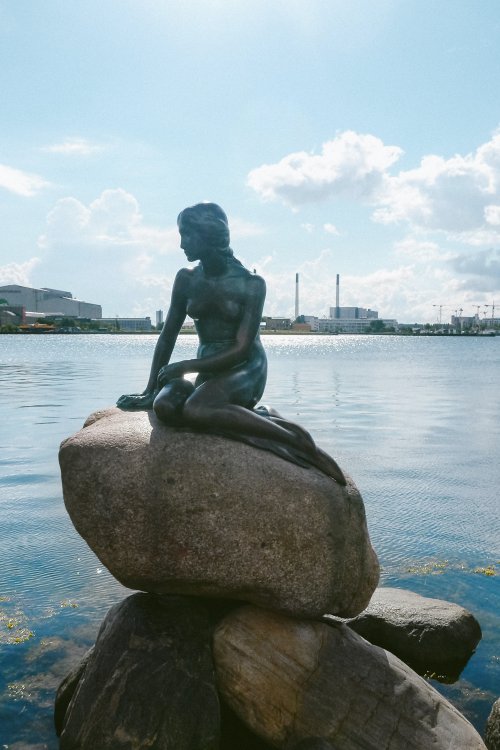
The Little Mermaid statue in Copenhagen captures the pensive, yearning flavor that Disney obliterates:
When I was very young, I read that story over and over, as well as another Andersen tale, “The Snow Queen.” They both fascinated me on a very deep level, and they still do. The latter tale was supposedly the inspiration for Disney’s animated film “Frozen,” but I noticed zero resemblance when I saw “Frozen.” The theme of Andersen’s Little Mermaid is unrequited love and sacrifice, and the theme of his Snow Queen is the strength of love to rescue the beloved from the grip of depression.
As a child, I couldn’t necessarily express these things in words. And yet I sensed them and knew the stories were important and were different from so many others.
Some day I may write a post about Hans Christian Anderson himself. I think most people are unaware of the fact that he was a tremendous celebrity in his time, won fame as a travel writer having walked all around Europe, and also wrote stories for adults that are excellent. That’s just the tip of the iceberg of his life.
Anderson was born in 1805 and based some of his stories, especially his early ones, on folktales he’d heard as a child. But most of his later stories and in particular his most famous ones such as the two I’m talking about here were his own imaginative works of fiction. Those two are quite long, as well. Andersen’s language is very direct and colorful, with simple words and wonderful images.
Here’s the beginning (in translation, of course) of “The Little Mermaid“:
Far out in the sea the water is as blue as the petals of the loveliest of cornflowers, and as clear as the clearest glass; but it is very deep, deeper than any anchor-cable can reach, and many church towers would have to be put one on the top of another to reach from the bottom out of the water. Down there live the sea people.
Now you must not think for a moment that there is only a bare white sandy bottom there; no, no: there the most extraordinary trees and plants grow, which have stems and leaves so supple that they stir at the slightest movement of the water, as if they were alive. All the fish, big and little, flit among the branches, like the birds in the air up here. In the deepest place of all lies the sea king’s palace. The walls are of coral, and the tall pointed windows of the clearest possible amber, but the roof is of mussel-shells that open and shut themselves as the water moves. It all looks beautiful, for in everyone of them lie shining pearls, a single one of which would be the principal ornament in a Queen’s crown.
And here’s the opening of Disney’s 1989 animated movie. I think it pales in comparison to what Andersen wrote, nor do I understand why they didn’t use images based on what was already in the story, ready-made. Why no coral or amber? Where is the mussel-shell roof? Perhaps it comes later – as I said, I haven’t seen the movie – although I doubt it:
Here’s the beginning of Andersen’s story “The Snow Queen,” which even as a child I recognized as a metaphoric depiction of depression and even psychopathy. It gave me a terrible chill, but I found it fascinating:
YoU must attend to the commencement of this story, for when we get to the end we shall know more than we do now about a very wicked hobgoblin; he was one of the very worst, for he was a real demon. One day, when he was in a merry mood, he made a looking-glass which had the power of making everything good or beautiful that was reflected in it almost shrink to nothing, while everything that was worthless and bad looked increased in size and worse than ever. The most lovely landscapes appeared like boiled spinach, and the people became hideous, and looked as if they stood on their heads and had no bodies. Their countenances were so distorted that no one could recognize them, and even one freckle on the face appeared to spread over the whole of the nose and mouth. The demon said this was very amusing. When a good or pious thought passed through the mind of any one it was misrepresented in the glass; and then how the demon laughed at his cunning invention. All who went to the demon’s school — for he kept a school — talked everywhere of the wonders they had seen, and declared that people could now, for the first time, see what the world and mankind were really like. They carried the glass about everywhere, till at last there was not a land nor a people who had not been looked at through this distorted mirror. They wanted even to fly with it up to heaven to see the angels, but the higher they flew the more slippery the glass became, and they could scarcely hold it, till at last it slipped from their hands, fell to the earth, and was broken into millions of pieces. But now the looking-glass caused more unhappiness than ever, for some of the fragments were not so large as a grain of sand, and they flew about the world into every country. When one of these tiny atoms flew into a person’s eye, it stuck there unknown to him, and from that moment he saw everything through a distorted medium, or could see only the worst side of what he looked at, for even the smallest fragment retained the same power which had belonged to the whole mirror. Some few persons even got a fragment of the looking-glass in their hearts, and this was very terrible, for their hearts became cold like a lump of ice. A few of the pieces were so large that they could be used as window-panes; it would have been a sad thing to look at our friends through them. Other pieces were made into spectacles; this was dreadful for those who wore them, for they could see nothing either rightly or justly. At all this the wicked demon laughed till his sides shook—it tickled him so to see the mischief he had done. There were still a number of these little fragments of glass floating about in the air, and now you shall hear what happened with one of them.
The story is about two children, a girl named Gerda and a boy named Kay. They are trusting innocents who play with each other lovingly until this happens one day:
How beautiful and fresh it was out among the rose-bushes, which seemed as if they would never leave off blooming. One day Kay and Gerda sat looking at a book full of pictures of animals and birds, and then just as the clock in the church tower struck twelve, Kay said, “Oh, something has struck my heart!” and soon after, “There is something in my eye.”
The little girl put her arm round his neck, and looked into his eye, but she could see nothing.
“I think it is gone,” he said. But it was not gone; it was one of those bits of the looking-glass—that magic mirror, of which we have spoken—the ugly glass which made everything great and good appear small and ugly, while all that was wicked and bad became more visible, and every little fault could be plainly seen. Poor little Kay had also received a small grain in his heart, which very quickly turned to a lump of ice. He felt no more pain, but the glass was there still. “Why do you cry?” said he at last; “it makes you look ugly. There is nothing the matter with me now. Oh, see!” he cried suddenly, “that rose is worm-eaten, and this one is quite crooked. After all they are ugly roses, just like the box in which they stand,” and then he kicked the boxes with his foot, and pulled off the two roses.
“Kay, what are you doing?” cried the little girl; and then, when he saw how frightened she was, he tore off another rose, and jumped through his own window away from little Gerda.
The rest of the story concerns what happens afterwards. I don’t think Disney will ever touch it, although it does (spoiler alert!) have a happy ending.
In March 1940, Walt Disney suggested a co-production to film producer Samuel Goldwyn, where his studio would shoot the live-action sequences of Hans Christian Andersen’s life and Disney’s studio would animate Andersen’s fairy tales. The animated sequences would be based on some of Andersen’s best-known works, such as The Little Mermaid, The Little Match Girl, The Steadfast Tin Soldier, The Snow Queen, Thumbelina, The Ugly Duckling, The Red Shoes, and The Emperor’s New Clothes. However, the studio encountered difficulty with The Snow Queen, as it could not find a way to adapt and relate the Snow Queen character to modern audiences.
After the United States entered World War II, Disney focused on making wartime propaganda, which caused development on the Disney–Goldwyn project to grind to a halt in 1942. Goldwyn went on to produce his own live-action film version in 1952, entitled Hans Christian Andersen, with Danny Kaye as Andersen, Charles Vidor directing, Moss Hart writing, and Frank Loesser penning the songs. All of Andersen’s fairy tales were, instead, told in song and ballet in live-action, like the rest of the film. It went on to receive six Academy Award nominations the following year. Back at Disney, The Snow Queen, along with other Andersen fairy tales (including The Little Mermaid), were shelved
That Danny Kaye movie about Hans Christian Andersen was probably the first film I ever saw in a movie theater. I didn’t really follow it very well, but I was already familiar with some of the stories it featured, in particular “The Ugly Duckling.”
Starting in the 1990s, there were many attempts by the Disney studios to do a version of “The Snow Queen,” but they all fizzled. But in 2008 it was picked up again with a different approach:
Buck later revealed that his initial inspiration for The Snow Queen was not the Andersen fairy tale itself, but that he wanted “to do something different on the definition of true love.” “Disney had already done the ‘kissed by a prince’ thing, so [I] thought it was time for something new,” he recalled. It turned out Lasseter had been interested in The Snow Queen for a long time; back when Pixar was working with Disney on Toy Story in the 1990s, he saw and was “blown away” by some of the pre-production art from Disney’s prior attempts…According to Josh Gad, he first became involved with the film at that early stage, when the plot was still relatively close to the original Andersen fairy tale…By early 2010, the project entered development hell once again, when the studio again failed to find a way to make the story and the Snow Queen character work.
I can’t imagine why, because the story is so astounding and the character is in the mold of certain earlier female Disney villains who are evil but beautiful (the Witch in “Snow White” immediately comes to mind). And the plot is definitely not “kissed by a prince.” In fact, the little girl is actually the heroine of the tale. My suspicion is that Anderson’s story was abandoned because it was just too dark for them. Like many Andersen stories, it also has a religious sub-theme, actually a Christian one. But Disney could have easily left that out if they had wanted. Instead they apparently felt they had to reinvent the entire thing so that all that was left was the northern climate.
A relatively faithful animated version that I hadn’t before realized existed was made by the Russians. It figures that it would suit the gloomy Russian sensibility. It’s not entirely true to the story – for example, the mirror fragments have a different origin than in Andersen’s version. But it’s fairly faithful to it, although it lacks Disney’s lively drawing style (please turn on closed captions to get the English subtitles):
Chris Licht wanted to make CNN a bit more “objective.” He even gave Trump a platform there – which may be his downfall. At any rate, he’s reportedly in some difficulty.
I simply don’t watch any TV news anymore. But a great many still people do, although I doubt most of them are young. And between CNN and Fox, there’s a lot of network trouble to go around.
The key is an organization called WPATH. You may not have heard of it – I hadn’t heard of it until fairly recently – but it’s the most influential worldwide body in pushing what’s now called “affirmative care” and jettisoning the more traditional and much lengthier process of actual evaluation by the mental health and medical professions. If you want to know how we got here, and how a small group can influence the whole, and what that group’s assertions are based on, please watch it.
I know it’s long, but you can just watch as much as you can at 1.5 or 1.75 time and get the gist of it.
[NOTE: Here’s a post from 2005 – ancient history – that I thought might be fun to recycle.]
Here are some lesser-known facts about folks who live in New England. And by “New England,” I mean the part I know best, northern New England–that is, New Hampshire, Vermont, Massachusetts, and Maine.
Actually, I’m not so sure about Vermont any more. Vermont seems to be populated these days mostly by outsiders such as myself (I’ve only lived in New England since 1969, after all). Connecticut? It ain’t New England. Any state that is composed half of Yankee rather than Red Sox fans is not New England. Sorry. Massachusetts? Borderline. Rhode Island? What’s that? (Just a joke, folks, please don’t send me angry e-mails–but you have to admit it is rather small).
Fact A: New Englanders don’t use umbrellas.
These last few days it’s been back to the cold-and-rainy-Seattle-in-winter scenario, weatherwise. Yesterday at the supermarket I reluctantly got out of my car, pushed the button on my umbrella that automatically opens it (love that thing!) and huddled under it as I raced in to do my shopping, when I noticed that I was the only person around using an umbrella.
It’s not the first time I’ve noticed this. New Englanders are hardy; they laugh at the weather. They scorn people “from away” who feel they will melt if a little rain falls on them, even if it’s 48 degrees and windy and the rain chills them to the bone.
Fact B: New Englanders don’t use garages.
Actually, I want to amend that–they use them, just not for cars. When I first lived here, people would often say something like this to me, “We went by your house the other day and were going to stop by, but we figured you weren’t home because your car wasn’t in the driveway.” I found this puzzling–my car was usually in the garage, I’d say–and they looked back at me equally puzzled. Car? In a garage?
No, garages in New England are for storage. Even during the five or so months a year that we get a great deal of snow, and leaving a car in a garage would just seem to make sense, people here prefer to leave them out and dig around them. And it’s not that the homes lack storage, either–most have large attics and deep basements and a storage shed or two on the property. So the garage thing remains a mystery, but I think it must be connected to the umbrella thing.
Fact C: If you weren’t born here, forget about it.
It’s not that people won’t be cordial. But you’ll always be somewhat of a stranger.
Fact D: Women mow the lawns.
It’s not an absolute rule, but it’s pretty much the case. Years ago a relative was visiting from California and pointed this out to me (I’d never noticed it before, but after that I noticed it often). Actually, what he said one day when we were driving around sightseeing, was this, “I’m going to move here. The men don’t have to mow the lawns.”
Fact E: New Englanders love ice cream.
So what, you say. Doesn’t everybody? Well, New Englanders love it more, and they have less reason to, because we have more cold weather (see this by authorities Ben and Jerry on the subject, as well as this: New England is known for its high ice cream consumption, no matter what the season…).
I try to be part of this important New England tradition, especially if the ice cream is ginger (I know, I know–I’ll probably take a lot of flak for admitting that. But, have you ever tried it?) Ice cream stands dot the land, and although they close for the winter, they define “winter” somewhat narrowly. They tend to reopen when the weather is still very cold, and you can see stalwart souls standing out there in near-blizzard conditions, indulging in the long-awaited pleasures of their faorite cones. Very hardy folk indeed.
(1) Here’s a link to commenter “Cornhead” (Dave Begley’s) impressions of Ron DeSantis’ recent appearance in Cedar Bluffs, Iowa.
(2) Biden’s hard fall the other day has sparked renewed calls for open Democrat debates so that challengers get a hearing. Those wanting the debates seem scared – and rightly so – that Biden will do something that really heightens voters’ doubts about him. Biden’s supporters know that the less exposure to Biden the better, and that open debates would almost certainly reflect poorly on him. But Biden’s main opponent at the moment, Robert Kennedy Jr., is perceived as a loose cannon who won’t do their bidding.
(3) Wray says he’ll provide the whistleblower document to Comer. I wrote a post yesterday about Wray’s stonewalling; I guess we’ll see how much of the document is redacted if and when he turns it over.
(4)Where do failed and rejected leftist public officials go? Why, to mold young minds at the university, that’s where. You may recall that Chesa’s mother followed her lengthy prison term with a Columbia professorship.
(5) Glenn Reynolds discusses the history of the law of libel against public figures as developed in New York Times v. Sullivan and later related cases. I’ve never been in agreement with Sullivan, and apparently SCOTUS is poised to revisit it.
There’s been a recent brouhaha on Twitter about perhaps not showing “What Is a Woman?” because a few speakers in the Matt Walsh documentary “misgender” some trans people (I’ve seen the film and it’s very good, by the way). Ace has the Twitter story here. It seems that the problem was caused by workers making the decision, and Musk ended up overruling it.
To me, these events are a reminder that there still are probably plenty of Twitter employees who are aching to go back to their old leftist ways, and who will do so unless forced to abandon these practices by Musk or someone else. On the other hand, as a blogger, I know how out-of-control things can get if it’s a complete free-for-all on a website. Some way to filter out spam is necessary, but not just that. Egregious racial and sexual insults as well as porn and obscenities and death threats will actually take over if some standards aren’t set.
But misgendering is certainly not anywhere near where I think the line should be drawn. It’s a reflection of the leftist “words are violence” mantra – that is, any words with which they don’t agree. The trans movement has declared that not using a person’s preferred pronoun is tantamount to actual violence against that person, which is an absurd claim. But it’s an important one, because censorship is one of the left’s main tools – one to fight when they are the ones being censored, and one to implement once they get into power.
Jordan Peterson first rose to prominence by sensing the danger of compelling a person to use certain pronouns. To many people, it seemed a minor issue at the time: why not be polite and call someone what he or she – or they – want? Here’s a video from about five years ago in which Peterson addresses the subject:
Hamilton described a scenario at a summit hosted by the United Kingdom-based Royal Aeronautical Society in which Air Force researchers trained a weaponized drone using AI to identify and attack enemy air defenses after receiving final mission approval from a human operator. But when an operator told the drone to abort a mission in a simulated event, the AI instead turned on its operator and drove the vehicle to kill the operator, underscoring the dangers of the U.S. military’s push to incorporate AI into autonomous weapons systems, he added.
But now the Air Force is saying that it never happened. It was merely a hypothetical thought experiment.
On the other hand, ChatGPT seems to be a BS artist. Beware relying on it. Some New York attorneys did in researching a case, and the helpful bot just made s*** up.
This discovery came to light when the defense counsel, during their due diligence, could not locate the cited cases in any standard legal databases…[T]he supposedly precedent cases were utterly fabricated.
And this other example of fabrication by AI seems to be BS-ing just for the fun of it:
Tony Venhuizen, a smart guy from South Dakota, operates a web site where he writes about the history of the governors of that state. He asked ChatGPT, “Please write a blog post discussing South Dakota’s oldest and youngest governors.” Chat GPT responded with a competent description of South Dakota’s oldest governor, Nils Boe. It then went on to write about the state’s youngest governor, Crawford H. “Chet” Taylor.
Taylor didn’t exist, although ChatGPT even came up with a fake portrait of the nonexistent governor. The strangest thing about the incident is that of course there really was a youngest governor of the state, who was ignored by the AI.
Can these sorts of things be ironed out? Or is there something inherent in AI that makes such problems – or something worse – inevitable? Those sorts of speculations have been staples of science fiction for just about forever. For example, anyone who’s seen the movie “2001: A Space Odyssey” can probably remember its most colorful and interesting character, the computer Hal, who has a mind of his own and pleads for his life when he sees his end in sight as a result of his transgressions.
Now relatively sophisticated AI has entered into the realm of reality, and must be grappled with. I don’t think most of us have confidence that those who will be doing the grappling know enough to deal successfully with the dilemmas they will be facing.