
I’ve discussed this before, but Lee Smith is on point about it. The parallels are strong:
Obama’s “permission structures” seem to have gone awry
Commenter “Dax” and others have pointed out this piece in Tablet by David Samuels entitled “Rapid-Onset Political Enlightenment: How Barack Obama built an omnipotent thought-machine, and how it was destroyed.” It’s very long, and quite a few bloggers are writing about it. However, I found it ultimately unsatisfying because I think that although parts of it are brilliant it somewhat misses the point.
For example, here’s Samuels’ description of what David Axelrod – whom the author sees as absolutely central to Obama’s success both in Illinois and on a national level – did to further Obama’s political career:
Permission structures, a term taken from advertising, was Axelrod’s secret sauce, the organizing concept by which he strategized campaigns for his clients. Where most consultants built their campaigns around sets of positive and negative ads that promoted the positive qualities of their clients and highlighted unfavorable aspects of their opponents’ characters and records, Axelrod’s unique area of specialization required a more specific set of tools. To succeed, Axelrod needed to convince white voters to overcome their existing prejudices and vote for candidates whom they might define as “soft on crime” or “lacking competence.” As an excellent 2008 New Republic profile of Axelrod—surprisingly, the only good profile of Axelrod that appears to exist anywhere—put it: “‘David felt there almost had to be a permission structure set up for certain white voters to consider a black candidate,’ explains Ken Snyder, a Democratic consultant and Axelrod protégé.
I find that somewhat peculiar in terms of what I know of Obama’s political course in Chicago. His success actually depended on a number of other things, which I’ve chronicled in many posts. Chief among them were knocking out all his political rivals in the Democratic primary on petition signature challenge technicalities, and Axelrod’s greatest assistance involved releasing embarrassing court records of his opponents’ marital strife. Very old-fashioned stuff, although Axelrod had great allies in the conventional press to rely on to spread the word. Another aspect of Obama’s early career, this time on the national level, was avoiding challenging black incumbents such as Bobby Rush, and running in districts more white.
So no, I don’t think that Axelrod got people who were racists to change their minds and vote for Obama. Axelrod’s tactics helped the very person – Obama – who was uniquely positioned to exploit white voters’ desire to prove their supposedly post-racism beliefs. There was a host of voters who were eager to virtue-signal how incredibly tolerant and open-minded they were, and Barack Obama was the perfect vehicle for demonstrating that they really had overcome anti-black racism. Obama, the “clean and articulate” black person (one of Biden’s more unfortunate phrases but one of his more revealing), was the candidate who appealed to this impulse the most.
And yes, during the Obama and “Biden” administrations, businesses and social media and the MSM parroted whatever the Obama administration promoted. This certainly amplified the message, but I don’t think it convinced people not already disposed in the direction. If that’s what meant by a “permission structure” than I guess the phenomenon did occur, especially with phenomena such as gay marriage. But I think that the most important element was not giving permission but rather making agreement obligatory lest one be called a bigot and ostracized in various ways. So it wasn’t so much giving permission to agree; it was withdrawing permission to disagree.
But I don’t recall the public being in favor of Obamacare prior to its passage (see the early years in this chart). As for the Iran deal, also discussed at length in Samuels’ article, I don’t think the public ever bought into it. Only the party most faithful accepted any rationale for the Iran deal – and of course the ever-compliant MSM. So Obama didn’t enter into those things by convincing the public, whatever the media said and however the media helped. He accomplished them through Congressional machinations with the help of confederates such as Pelosi, and in the case of the Iran deal by ignoring any requirement that Congress approve it.
Biden was simply not as adept at any of this, even if he’d been in full possession of his faculties (which he was not). And although Obama was pulling strings behind the scenes, it was no longer working. Much of the public had found in Trump a spokesperson who was remarkably plainspoken and in the position of being an adult who functioned much as the child in the Emperor’s New Clothes story: Trump said what he actually saw and for much of the public it was what they saw, too, and felt relief at finally hearing someone say it loud and clear and in a non-mealy-mouthed manner. Plus, by 2024, the public had seen the left in all its manipulative power-mad glory, and increasing numbers of the public didn’t like it.
The American people have gotten mugged by reality, and that’s a pretty powerful experience.
Open thread 12/20/2024
Is a hostage release plan actually in the works?
It’s been about fourteen and a half months since the Israeli hostages were taken to Gaza. It has been a nightmare for their families and friends, and although there is probably some comfort in the fact that the war has been going better than expected lately, it doesn’t change the intensity of the pain and the horror of the imaginings that fill the gap left by little to no information about who is alive and who dead, what hideous psychological and physical torture the hostages themselves have endured, and when and if it will ever end.
And so I keep paying attention to stories such as this:
Prime Minister Benjamin Netanyahu was set to hold a high-level meeting on Thursday with top security officials as efforts to reach a hostage-ceasefire deal with Hamas appeared to gather momentum, Israeli televion reported Wednesday.
Netanyahu’s planned assessment, which will include Defense Minister Israel Katz and Strategic Affairs Minister Ron Dermer, comes as CIA chief William Burns reportedly arrived in Qatar Wednesday night to try and hammer out the outstanding issues. Channel 12 news said that if there was progress, senior Israeli officials would join the talks. …
Despite optimism that a deal can be reached in the next few weeks, the report said there are still disagreements on several key issues including the number and identity of the hostages to be freed; a mechanism for the return of displaced Gazans to the north of the strip; the identity of the Palestinian security prisoners to be released as part of the deal; and a mechanism for exiling the most dangerous of those prisoners to other countries.
I seem to recall that during the Obama years, some of the Guantanamo prisoners were released to other countries with a supposed guarantee that they wouldn’t be able to leave those countries, and the promise was not kept. Anyone who believes such promises at this point is very very gullible.
Trump’s impending presidency looms large in these talks:
Hamas is concerned that US President-elect Donald Trump will allow Israel to resume fighting in Gaza at the completion of the first phase of the three-stage ceasefire that is currently in advanced negotiations, four sources familiar with the matter told The Times of Israel.
They are right to be “concerned.”
Trump said again this week that he wants the war in Gaza to end, but an Israeli official told The Times of Israel that Prime Minister Benjamin Netanyahu believes he’ll have more flexibility under Trump to resume fighting after the first phase than he would under Biden.
The two things are hardly contradictory. Sometimes the way to end a war is to end it more quickly through decisive victory.
Georgia Court of Appeals kicks Fani Willis off the Trump case
It’s about time:
The Court of Appeals of Georgia disqualified Fulton County DA Fani Willis from President-elect Donald Trump’s election case over her relationship with former special prosecutor Nathan Wade.
“The remedy crafted by the trial court to prevent an ongoing appearance of impropriety did nothing to address the appearance of impropriety that existed at times when DA Willis was exercising her broad pretrial discretion about who to prosecute and what charges to bring,” wrote the court.
The court didn’t throw out the indictment, so a new prosecutor will get to decide whether to keep going with this case.
Here’s Jonathan Turley:
This case against Trump should never have been brought, and should have at the very least been thrown out on the merits longs ago. I hope that any newly-appointed prosecutor will stick a fork in it; it’s done.
The CR bill: it’s not business as usual
Oh, they tried to make it business as usual. But the message went out from the incoming administration and the voters that this wasn’t going to be okay. And Congress was forced to listen.
The revolt was spearheaded by Elon Musk, one of Trump’s closest advisers and co-chair of the nongovernmental Department of Government Efficiency, as he went on a tirade on X Wednesday against Republicans who supported the stopgap measure.
Trump and Vice President-elect JD Vance then weighed in on the GOP battle in a lengthy statement issued from the Ohio senator’s X account in which they called on Republicans to be “tough” and “smart” and not accede to Democratic requests.
The leaders also issued a new directive that had not been discussed previously: Pass a debt limit increase before Trump comes into office so the deliberations are held now under President Biden’s term.
Trump then went on Truth Social and directly threatened Republicans who wouldn’t vote for a debt limit increase now with a primary.
What now? Perhaps this:
“I was communicating with Elon last night,” Johnson said Wednesday on Fox & Friends. “Elon, Vivek [Ramaswamy] and I were on a text chain together, and I was explaining to them the background of this. And Vivek and I talked last night, about almost midnight, and he said, ‘Look, I get it.’ He said, ‘We understand you’re in an impossible position. Everybody knows that.’”
Several people on comments threads have been pointing out that AI has helped the dynamic duo, Vivek and Elon, to evaluate the pitfalls in the bloated 1500-page bill quickly.
The Ramaswamy/Musk DOGE team is a fascinating and innovative development that only emerged in the latter part of the Trump campaign and especially after the election. Two smart fellows, they felt smart. Washington DC is often where smart people meet their match in bureaucratic boondoggle. But we’ll see; this development has a lot of promise.
And it really really helps that Trump won a decisive victory that is seen as a mandate for change. That’s unusual for a second term, but this is an unusual second term – a second term that’s noncontiguous with the first term.
And you know what? “Government shutdown” isn’t quite the threat it used to be. This old dog may not hunt anymore:
“Republicans have now unilaterally decided to break a bipartisan agreement that they made,” Jeffries, a New York Democrat, told reporters Wednesday night. “House Republicans will now own any harm that is visited upon the American people that results from a government shutdown or worse. An agreement is an agreement. It was bipartisan. And there is nothing more to say.”
Oh, I’m pretty sure there will be more to say from both sides.
Open thread 12/19/2024
Thanks, Biden administration, for Tren de Aragua
A Venezuelan dissident who is running for office in Utah warned that local authorities “are not ready” to deal with Tren de Aragua — as the vicious prison gang has expanded its territory to at least 18 states.
Carlos Moreno, who is running for Salt Lake County Council in District 2, spoke out in a previous interview with The Post against Tren de Aragua gangbangers, who have been linked to at least two separate crimes in the Beehive State capital — including an alleged prostitution ring. …
Tren de Aragua members embedded themselves in the large waves of migrants who arrived at the US-Mexico border under the Biden administration.
Federal authorities released some of them because they lacked access to Venezuelan databases — but they also couldn’t return them because the Maduro regime stopped accepting deportation flights.
Roughly 2,000 migrants who arrived in Utah in recent months were shipped there by nearby Denver, which has received 40,000 migrants since 2022 and has also been hit with its own wave of gang-linked crimes.
Hey, spread the joy, right?
Assassins: Luigi Mangione and John Wilkes Booth
[NOTE: Let’s assume for the moment that alleged killer Mangione is guilty, for the sake of this post.)
Luigi Mangione and John Wilkes Booth: what on earth do they have in common?
Well, it’s a stretch, but there are some odd commonalities. They were both from prominent families. They were both raised in Baltimore. They both shot their victims in the back – for Booth and Lincoln, it was the back of the head. They both escaped after the shooting but were caught a few days later: 12 days for Booth and 5 days for Mangione (one big difference is that Booth was killed and Mangione taken peacefully). And they were both 26 years old at the time.
One of many big differences is that John Wilkes Booth was already a huge celebrity when he killed Lincoln, and Mangione was not. And of course Lincoln was also a far more prominent man than Thompson. But Booth’s celebrity status points to another thing he had in common with Mangione: he was considered extraordinarily handsome.
Now, a caveat: I don’t consider Mangione extraordinarily handsome. But he’s a fairly good-looking guy, and a certain female mostly leftist (and not just female) segment of the internet has gone wild about his “hotness.” So I’ll just stipulate that he’s handsome.
Booth, on the other hand, was an old-fashioned bona fide “matinee idol” of startlingly good looks. I recall the first time I ever saw his photo; I was shocked by how classically handsome he was. He was actually often called “the handsomest man in America” at the time:
John Wilkes Booth wasn’t the best actor in the Booth family: he was outshone by his father, Junius Brutus Booth, and by his brother Edwin. But John Wilkes was the most beautiful of the Booths, the handsomest man in all America, it was said: lithe and feline, with dark Fauntleroy curls and a leading-man mustache.
Indeed, and many fans – and there were many, prior to the assassination – had photos of Booth such as this one:
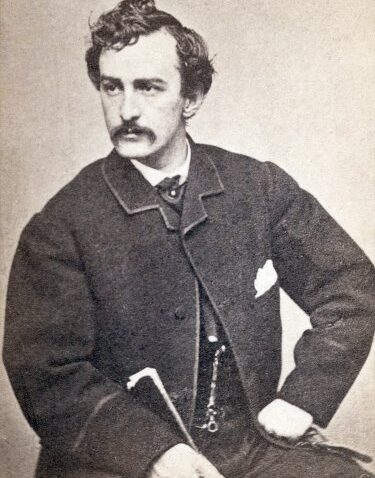
“The stage door was always blocked with silly women waiting to catch a glimpse” of “this sad-faced, handsome boy,” Reignolds wrote. Booth was the first celebrity on record to have the clothes torn off his body by crazed fans.
Of course, that was before he became an assassin. For Mangione, the crazed and lusting women came after.
I sometimes think about what a stupendous shock Lincoln’s assassination must have been, even more shocking perhaps than any other presidential assassination. Not only was he the first US president ever to be assassinated, but he was killed only five days after Robert E. Lee’s surrender. And to top it all off, Lincoln’s killer turned out to be the Brad Pitt and Robert Redford and Errol Flynn and Tyrone Power of his day all rolled into one. We accept the strange event as a given because we learned about it as children and it was just history, long ago and far away. But at the time if occurred, it wasn’t history, it was news.
Why does Kamala Harris want to run again?
Kamala Harris hasn’t lost her taste for politics. Apparently, she may want to be the next governor of California. And Californians seem to be gluttons for punishment, so she might even succeed in getting elected.
Then again, maybe she wants to run for the presidency in 2028, says the same report. Can this be true? She seemed so tense and stressed, so clearly not up to the task, in 2024. Despite the “joy” campaign message, I don’t think she felt much joy at all running for president.
So maybe this report about possibly running again in 2028 is just face-saving garbage. Or maybe not. Maybe she’s banking on the Trump administration failing, and then she could say “I told you so.”
Her motive? Power, I guess. And I think she did enjoy the perks of the vice-presidency. Once you’ve tasted that, maybe you hunger for more. Plus there’s the attraction of the chance to be the very first woman president.
(Note the “Election 2028” tag. It’s begun. This is actually my second post with that tag.)
Open thread 12/18/2024
Here’s one of the consequences of Trump’s 2024 win
WATCH: Softbank CEO Masayoshi Son speaks with President Trump after announcing a $100B investment in America over the next five years:
"My confidence to the economy of the United States has tremendously increased because of his victory. Because of that, I am excited to commit… pic.twitter.com/X4GgtvPgpk
— Trump War Room (@TrumpWarRoom) December 16, 2024
A confession: I’d never heard of Softbank before this announcement was made.