↓
 

The New Neo

A blog about political change, among other things

  • Home
  • Bio
  • Email
Home » Page 1789 << 1 2 … 1,787 1,788 1,789 1,790 1,791 … 1,863 1,864 >>

Post navigation

← Previous Post
Next Post→

A trip back in time: Bakhtiar and the Revolution (Part II)

The New Neo Posted on August 31, 2006 by neoFebruary 26, 2025

[Part I of this series can be found here. Part III is here.]

Shapour Bakhtiar took office as Prime Minister of Iran on Jan 6, 1979. He was appointed by the Shah in one of the latter’s final acts in Iran, a country from which the Shah departed on Jan 16.

But Bakhtiar was not the Shah’s man. He was a well-known dissident who was appointed in an effort to show that the Shah was ready to reform in ways that would satisfy those who were proponents of greater freedom and civil liberties in Iran.

The Shah is one of those figures in history who, like Ataturk in Turkey, was faced with the dilemmas common to those who would modernize and Westernize a third-world country, and especially one with a strong traditional Islamic clerical tradition. It is beyond the scope of this post to discuss why Ataturk was able to successfully buck the fairly substantial opposition of religious leaders and the populace in Turkey, and why the Shah’s effort ultimately failed in Iran. Some day I may attempt to tackle that one–but suffice to say for now that the Iranian Shah had the same goal of modernization as Ataturk, but the opposition to his rule was stronger, and his efforts to crush it far more Draconian.

The Shah’s secret police–SAVAK, usually referred to with an adjective such as “dreaded” or “hated” before the acronym–was active in Iran to stifle those who would oppose him. There is a great deal of controversy over just how dreadful SAVAK actually was in the larger scheme of things. Was it a wide-ranging and indiscriminate effort to track down, torture, imprison, exile and/or murder all those who dissented, or who even were thought to dissent, much like the operations of the Soviet KGB? Or was it far more benign, only dealing with those who would violently overthrow the government (such as Khomeini and his henchmen), and using torture only sparingly? If history is written by the victors–and, in this case, the victors so far in Iran have been the Khomeinists–then how can we know the truth about SAVAK?

What we do know, however, is this: there were many protests against the Shah’s modernizing changes, which especially threatened the religious establishment in Iran. For example, religious students demonstrated against land reforms that the Shah had instituted to try to offer the populace of Iran some economic benefits, with the goal (among other things) of increasing his popularity with them.

If that was the Shah’s intent, it backfired, because the land reforms imposed hardships on the Shiite clerical establishment (which had owned some of the land). Khomeini, who was still in Iran at the time, issued a fatwa. Protests were organized, the Shah’s government began to ridicule the clerics as old-fashioned, and more clerics took offense and joined the opposition. In addition, crackdowns on protesters became very brutal–for example, a group of theological students protesting against the opening of liquor stores were killed, and these deaths ultimately reached into the hundreds.

It appears that the Shah was already fighting the same extreme fanatics who were to take over the country in 1979. As often happens, his efforts to stop them had the paradoxical effect of making them martyrs, agitating their sympathizers, and ultimately making the movement against him grow stronger. Had his policies against his enemies–the enemies of modernization–been less heavy-handed, might the movement have died down? Or would it only have grown larger and more powerful more quickly? Unanswerable questions, I’m afraid.

History gave its own answer. I’ve written before about how the Shah had hesitated to have Khomeini executed in 1964 when the latter was imprisoned, because the Shah feared making the already popular and powerful cleric into a martyr. Perhaps if he’d done so others would have filled Khomeini’s shoes and carried on in his name, and history would have taken more or less the same course as it ultimately did.

But perhaps not. Perhaps there was something especially charismatic about Khomeini that would have been lost to the clerics’ cause without his particular presence. Once again, we’ll never know; what we do know is that Khomeini’s life was spared, he was ultimately exiled, and he lived to return to Iran in triumph and take over the government. As unrest and discontent with the Shah was brewing in the late 1970s, Khomeini became the de facto head of the opposition, which was a strange amalgam of restrictive clerics, liberals who supported human rights, and socialists–each with an agenda, each jockeying for position:

Anti-Shah intellectuals, secular and Islamic, moderate and leftist misread developments. They believed that they were using the popular Khomeini and that he could be shunted aside as democracy was established. It was believed that with the success of the revolution the ulama (official community of scholars of Islam) and Khomeini would return to their mosques and schools and perhaps advise the government on Islamic matters.

Such hubris is misplaced. The moral of the story is to never underestimate the power of a demagogue fully bent on acquiring it (the same mistake was made, by the way, by Franz von Papen and Hindenberg. In the waning days of the Weimar Republic, they thought they could “control” that silly-looking upstart, Hitler.)

Which brings us to Bakhtiar. On Bakhtiar’s appointment as the new Prime Minister, Khomeini condemned him, of course, from his exile in France. But Khomeini continued to live his charmed life; Bakhtiar allowed him to return to Iran shortly thereafter. The reason? A combination of Bakhtiar’s own devotion to freedom of speech, and the Shah’s old conundrum: Khomeini was so popular that to try to ban him would cause such public unrest in Iran that it seemed counterproductive. In essence, Bakhtiar, although a far different ruler than the Shah, faced the same dilemma; he resolved it in favor of not suppressing the opposition.

So who was Bakhtiar? Like many Iranians, he’d spent many formative years in France, acquiring graduate degrees in political science, law, and philosophy. But he was also a man of action; residing in France during the Nazi occupation, he fought for the Resistance. Returning to Iran after WWII, he continued his resistance, becoming an opponent of the Shah, who imprisoned him for many years.

Thus Bakhtiar had his bona fides–no patsy of the Shah, he had been one of the leaders of those who were against the Shah’s regime because of its human rights abuses, and he himself had suffered greatly for his bravery. But by the time Bakhtiar came to power it was most decidedly too late, both for him and for the Shah’s modernization program, as well as for the civil rights that Bakhtiar championed. Perhaps the only beneficiary of that campaign for civil rights was Khomeini himself, ironically enough.

Bakhtiar’s regime lasted about two weeks before Khomeini and the clerics took over, establishing the primacy of Sharia law, abolishing most of the rights women had enjoyed, banning alcohol and gambling and a host of other un-Islamic pursuits as well as newspapers, and instituting his own murderous crackdown to stifle all opposition. Khomeini didn’t have to worry about making martyrs of his enemies, nor about whether to allow them to remain in Iran and exercise freedom of speech. Tyranny doesn’t struggle with the same sort of philosophical questions about how much toughness is too much, questions with which its opponents wrestle mightily:

It was announced that any spreading of corruption would be punished by death. A variety of the Shah’s former friends, colleagues and generals were seized, and after trials of a few minutes they were executed immediately – to prevent news spreading to the others who were detained – the executions lasting without stop for several weeks. The bodies of the prisoners were loaded into meat containers and dumped into mass graves. Khomeini dismissing international protests, saying that criminals did not need to be tried, just killed.

Bakhtiar, however, was not one of them–at least, not right away. He left Iran and settled in Paris again. From that venue he organized another resistance–a movement to fight the Islamic Republic of the mullahs. For his pains, he was almost assassinated in 1980; a policeman and a neighbor died, but Bakhtiar lived to fight another day.

In 1991, however, the number of this brave man was finally up. The assassins got their man; Bakhtiar and his secretary were murdered in his home. The assailant later was captured and tried in France. At his trial he admitted to having been sent by the Iranian government.

What lessons can we draw from the life of Bakhtiar? The first is that one can be both committed to freedom and personally courageous, and yet lose the battle against repression and tyranny. The second is more of a question: is it sometimes acceptable (or perhaps even necessary) to use greater ruthlessness, to be willing to use oppressive tools against an enemy that–if successful–would not hesitate to abolish all the civil liberties and the advances for which you are fighting?

This is the dilemma faced not just by Bakhtiar, but by all those who would oppose the likes of Khomeini. How much of a crackdown is too much? How little is too little? At what point do you compromise your own principles so much that you become too much like the enemy you are fighting?

There are no easy answers. Only the questions–and Khomeini’s regime, in its present-day manifestation, Ahmadinejad– remain.

Posted in Iran | 24 Replies

Podcast time again

The New Neo Posted on August 30, 2006 by neoAugust 30, 2006

The latest Sanity Squad podcast is now playing at Politics Central at Pajamas Media. We discuss the kidnapping and release of the Fox News correspondent and cameraman–both the psychological effects of such kidnappings and the phenomenon of forced conversion.

My headset has been generating some weird audio effects, from low volume to hissing and popping and otherwise strange carryings-on. The very patient and kind audio guy at Pajamas did some troubleshooting yesterday, and has decided that the problem is one of microphone placement. So next time I think that my voice will sound more as it actually does in real life. Stay tuned.

Oh, and the following has nothing to do with the podcast (at least I hope it doesn’t!), but it’s a photo of Keith Richards I found at the PJ website. Be afraid, be very afraid.

Posted in Uncategorized | 14 Replies

A trip back in time: Khomeini and the Revolution (Part I)

The New Neo Posted on August 30, 2006 by neoJune 15, 2009

One of my favorite verses from The Rubaiyat of Omar Khayyam (the Fitzgerald translation of the Persian original) is this:

The Moving Finger writes; and, having writ,
Moves on: nor all your Piety nor Wit
Shall lure it back to cancel half a Line,
Nor all your Tears wash out a Word of it.

Ah, but if only we could go back, to wash out a few of the most terrible words! That’s the deep desire that propels most time travel fantasy: to undo some event that you know led to untold suffering.

The answer given by science fiction—and life—is that it just can’t be done. Even if it could, doing so might cause a cascade of other unforeseen effects. But the wish remains, especially for those happenings that seem to have been unmitigated tragedies for humankind.

One of those events was the triumphal return of Ayatollah Khomeini to Iran from his long exile in Iraq and his short sojourn in France (and Khayyam is an especially apt source to quote for the occasion—since modern day Iran is, of course, ancient Persia).

I was around when Khomeini made his return trip, one that propelled Iran’s own trip back in time to some horrific amalgam of the Dark Ages crossed with the tools of a modern totalitarian state. I noticed Khomeini’s arrival in Iran, although I had no idea of its significance. Neither did most.

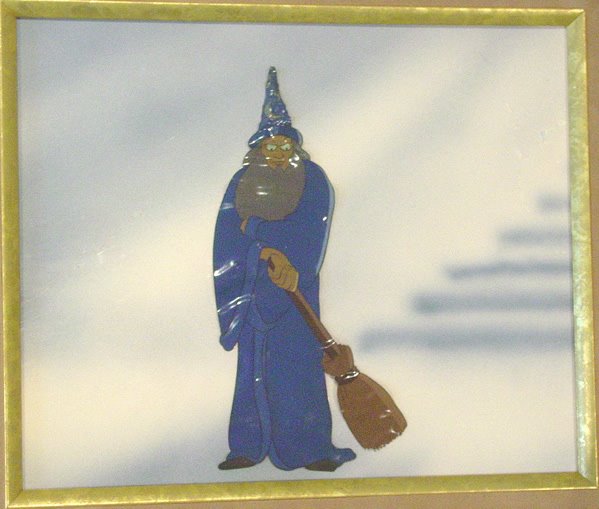
He seemed and dark and brooding figure from some stern and gloomy ancient past. Or the sorcerer from Disney’s “Sorcerer’s Apprentice:”


It was difficult to understand the veneration the Iranian people seemed to have for him. In this photo, taken on his return, he looks as though he’s already become a statue:

Here’s an article that chronicled the event. Reportedly, “up to” five million people lined the streets of the capital to witness it. The revolution he had helped orchestrate from Paris (how apropos!) was in motion; its Reign of Terror was about to begin.

The Iranian revolution took almost everyone by surprise, including many of its participants. It was an amalgam of several of the strangest bedfellows in the world—a religious movement to impose a theocracy of strictest Islamic law, a group dedicated to Westernization and classical liberal human rights, and an active Marxist contingent.

All in all, a heady concoction that couldn’t fail to explode. The only question at the beginning was which faction would win out, because they certainly couldn’t all coexist. Khomeini was pretty sure he had an answer to that question. While in exile he had carefully played to the crowd that believed in human rights, but he made it crystal clear once he had consolidated his power that he had no intention whatsoever of following through on that score. Au contraire.

Khomeini addressed the assembled crowd at the Cemetery of Martyrs a few miles south of Tehran on February 1, 1979:

I will strike with my fists at the mouths of [the current Iranian] government. From now on it is I who will name the government.

Khomeni had learned his French lessons well: L’etat, c’est moi.

Shapour Bakhtiar, the newly-minted and ineffectual Prime Minister of Iran at the time–he had less than two weeks to go in that position—replied as follows:

Don’t worry about this kind of speech. That is Khomeini. He is free to speak but he is not free to act.

I almost wrote, “the ineffectual and clueless Bakhtiar.” But I’m glad I didn’t, because when I started to do some research on Bakhtiar himself, I found a man of rare courage and no small prescience, a tragic figure in history who made at least one fatal error.

[Part II.]

Posted in Iran | 6 Replies

Must-read: on Israel, chosenness, supercessionism

The New Neo Posted on August 30, 2006 by neoJuly 25, 2009

Richard Landes of Second Draft and Augean Stables has written what just might be the definitive answer to those who–like Norwegian writer Jostein Gaarder–accuse Israel of heinous crimes and intents based (among other things) on the accusers’ complete misunderstanding of certain principles of Judaism such as the knotty problem of “chosenness.” There’s also a clear and concise discussion there about what’s known as “supersessionism,” and how various religions stack up on that score.

One of the many problems with discussions on these topics is that people of good will often feel they are starting with a basic agreement on concepts. They are not. A phrase such as “chosen” is one that people often think they intuitively understand. Because Christians and Jews have a common history that goes way back, it’s easy to jump to the conclusion that the religions have more in common than they actually do.

The problem is compounded by the fact that many–if not most–Jews in this country and elsewhere consider themselves secular and have very little grounding in the tenets of their own nominal religion. Therefore even most Jews probably share the misconceptions common among non-Jews about some basic Jewish concepts such as that of having been “chosen.”

So, please read.

Posted in Israel/Palestine, Religion | 29 Replies

Who’s afraid of the big bad UN?

The New Neo Posted on August 29, 2006 by neoAugust 29, 2006

Certainly not Ahmadinejad.

On the other hand, the rest of us should be afraid–very afraid.

Because the UN, by holding out a false promise that it cannot possibly keep–that it is able to defuse potentially explosive conflicts–diddles and fiddles as the situation is allowed to grow exponentially worse.

Posted in Uncategorized | 77 Replies

We are all investigative reporters now–or should be

The New Neo Posted on August 29, 2006 by neoJuly 25, 2009

David Frum has summarized some of the hoaxes perpetrated on and by the media in recent weeks. From Reutergate to counterfeit bills passed by Hezbollah, from Green Helmet guy doing photo ops at Qana to the Ambulance Hoax, the MSM has been at the very best disingenuous and at the very worst complicit in the spread of lies and fraud. If not for bloggers, none of this would have been exposed.

Also, please check out Richard Landes’s latest efforts at Second Draft, entitled “The Birth of an Icon.” As you watch more of the footage of the alleged death of the boy Mohammad al Durah (“caught in the crossfire”), it becomes ever more likely that the entire thing was a hoax–and a very influential one at that, especially in Europe, where al Durah’s death became a rallying cry for sympathy with the bloody Second Intifada.

So, what’s up with the media? Frum lists the possibilities: they are gullible, they are biased, they are in collusion, they are frightened of retaliation, they are some of the above, they are all of the above.

Here is my call to the MSM: put the “investigative” back into reporting. Traditionally, investigative reporting–in which the writer deeply questions the obvious, and brings an attitude of skepticism and critical thinking to the story, almost like a detective researching a case–has been limited to local scandals and corruptions. But it needs to be more broadly applied these days. What used to be a straight news story of war reportage–a photographer comes upon a bombed vehicle, is told by the locals what happened, and takes a photo–is no longer so straightforward. Perhaps it never was. And local stringers, who are often used as photographers and reporters in war torn areas–even those who’ve worked a long time with a news agency– might be found to have their own political agendas that distort coverage.

It makes for a lot more work, to be sure. And if the reporter isn’t ideologically inclined to doubt the sources, the healthy skepticism that’s a prime requirement of all investigative reporting is going to be especially hard to bring to the story. But at this point it couldn’t be more clear that it’s necessary to do so. No, not just necessary; it’s absolutely vital.

Posted in Paris and France2 trial, Press | 19 Replies

The Palestinians: loving death, loving life

The New Neo Posted on August 28, 2006 by neoJuly 25, 2009

It’s been said before in parts of the Arab world, by Hezbollah leader Nasrallah and others: “We are going to win because [the Israelis] love life and we love death.”

Loving death: what an amazing thing to brag about. It’s a boast that’s meant to make the listener cower in awe of the bravery of the speaker, and to feel as though opposing such a person would be futile.

How can one deter or fight an enemy with such determination, one who’s not even wary of death? And this love of death is not just a macho pose or hyperbolic rhetoric (although it’s at least partly that); suicide bombers have definitely put their money where their mouths are in that respect. The Palestinian indoctrination of children has been an education in the veneration of death, and has borne fruit in this desire for martyrdom.

It goes without saying that such an attitude isn’t healthy for a society. In a less looking-glass world, it would in fact be a sign that such a culture was about to get its wish–that it was on the brink of extinction. Why? In the past, self-preservation and the desire to live, both as individuals and as a group, was one of the basics for societal survival.

It’s true that all societies require a certain amount of sacrifice, as well. For example, in order to keep both internal law and order, as well to defend the group against attacks by outsiders, there always needs to be a certain number of people who are willing to give their lives in order to protect the others (these people can be conceptualized as sheepdogs, in a metaphor that was discussed previously, here).

But in most societies, these protectors are far from eager to give up their lives. As General Patton famously said, “The object of war is not to die for your country but to make the other bastard die for his.”

Exactly and precisely. Patton was one of the least PC military men who ever lived. He was controversial even back in WWII, when political correctness was hardly a gleam in the Left’s eye. But now even the military is far more PC than it ever was; in recent decades, the military has become more reluctant to make “the other bastard” die for his. Like it or not (and Jacksonians don’t like it), the gloves are on when we’ve fought the wars of this century, at least so far.

One can only conclude that if the Palestinians, Hezbollah, and Iran had the weaponry the US has, they would not hesitate to obliterate anyone they perceive as having wronged them, shamed them, or gotten in their way. Their love of death is not limited to seeking their own deaths; they definitely embrace the deaths of their enemies.

And in a more Darwinian and less PC world, the Palestinians’ love of death, their lack of advanced weaponry, and their aggressiveness towards an enemy who does possess that weaponry would long ago have resulted in their getting their wish: death. Their own deaths, and the death of their society.

But in a strange ironic twist, such a culture can continue to exist if it faces an enemy that has such a love for life that it refuses to unleash its own arsenal on those who would seek to destroy it. So Palestinian society is protected by the reticence of its enemy, even as it declares that enemy to be ruthless and evil. It counts on that reluctance, that “love of life”–even the life of the Palestinians–to allow Palestinian society to live to fight another day.

The picture is a dismal one, to be sure. So I’m going to clutch at a tiny ray of light; I’ll take it wherever I can find it. This time it’s from Hamas spokesman Ghazi Hamad, of all people (hat tip: Captain Ed.)

An article in the Jerusalem Post quotes Hamad as complaining that Gaza is “caught in anarchy and thuggery.” What’s new about that? Simply this: Hamad isn’t blaming the Israelis, he’s blaming the Palestinians themselves.

This is different, especially for a Hamas spokesman. Those in Israel who advocated the withdrawal from Gaza hoped this would be one of the benefits: Palestinians taking responsibility for their own failures. Without the convenience of being able to blame the occupation, the Palestinians would have to face their own flaws (I wrote about this previously, here)

Here’s a quote from Hamad:

“We’re always afraid to talk about our mistakes,” he added. “We’re used to blaming our mistakes on others. What is the relationship between the chaos, anarchy, lawlessness, indiscriminate murders, theft of land, family rivalries, transgression on public lands and unorganized traffic and the occupation? We are still trapped by the mentality of conspiracy theories – one that has limited our capability to think.”

It’s not that Hamad has suddenly become an Israelophile (if he had, it might be his own ticket to death). Perhaps he just wants Palestinian society to reform, the better to attack its old enemy.

But perhaps not; I like to think not. And this final quote from Hamad lends credence to that possibility. It sounds to me as though it might even be a crie de cour, his reassertion of the energy of life rather than death:

Addressing the various armed groups in the Gaza Strip, Hamad concluded: “Please have mercy on Gaza. Have mercy on us from your demagogy, chaos, guns, thugs, infighting. Let Gaza breathe a bit. Let it live.”

Posted in Israel/Palestine, Terrorism and terrorists, Violence | 26 Replies

Dr. Sanity channels Elton

The New Neo Posted on August 28, 2006 by neoAugust 28, 2006

My esteemed colleague Dr. Sanity is at it again.

Here’s another wonderful song parody of hers, this time of Elton John’s “I Guess That’s Why They Call It the Blues.”

To refresh your memory (and to better appreciate Dr. Sanity’s–dare I say it–yes, her genius), here are the words of the chorus of the Elton John original:

And I guess that’s why they call it the blues
Time on my hands could be time spent with you
Laughing like children, living like lovers
Rolling like thunder under the covers
And I guess that’s why they call it the blues.

And here’s Dr. Sanity’s version:

And I guess that’s why they all hate the Jews;
Blame them for their failures; and kill them for news
Blow up their children, bask in confusion
Believe that their strengths are just an illusion–
And I guess that’s why they all hate the Jews.

Read the rest, and sing along.

Posted in Uncategorized | 4 Replies

Hezbollah: still Miss Congeniality in Lebanon?

The New Neo Posted on August 27, 2006 by neoAugust 27, 2006

Our modern asymmetrical wars, post-Tet, no longer seem to consist of strategic battles fought on the ground by the military, with the winners declared through the gaining of territory and the loss of fighters and equipment. Rather, they are mainly propaganda wars, won or lost in the press and the field of public opinion.

In this country, views about foreign wars are largely shaped by the MSM. So the basic perception here is that Hezbollah, despite its losses in men and materials, won last month’s round with Israel handily. That opinion is probably widely held in Europe, for similar reasons, not to mention Europe’s greater sympathy to the Hezbollian cause.

And perhaps, after all–as that North Vietnamese colonel famously told the American negotiator at the end of the Vietnam War–winning battles isn’t so very important, but rather irrelevant; perception of victory is all that matters.

I don’t pretend to know whom the Lebanese perceive the winner to have been. One thing I think we can safely say is that they don’t regard themselves as the winners. But there do appear to be rumblings in Lebanon, among the people who experienced this war up close and personal rather than filtered through the giant maws of the MSM, that the verdict on Hezbollah is becoming a bit harsh.

Here’s Amir Taheri’s take on the subject. He points out that criticism of Hezbollah in Lebanon has been growing since the war, not shrinking, and that public opinion is against those rightly perceived as starting a useless war in which the Lebanese people suffered. Nor were those Lebanese people consulted, and they appear to be quite angry, despite the payoffs Hezbollah has tried to mount–featuring crisp new money from Iran–to buy them off.

Then there’s Michael Totten, who made a lot of friends during his lengthy prewar sojourn in Lebanon. He sees the unprecedented statements by Lebanese Prime Minister Fouad Siniora accepting the possibility of peace talks with Israel as a watershed. Prior to the war, to breathe even a hint of the possibility of peace with Israel was committing political suicide.

And of course, perhaps it is; Siniora may have signed his own death warrant, as Alexandra speculates.

To those who say I’m picking and choosing articles that support my own wishful thinking, I plead guilty. But at least I’m acknowledging that fact. Yes, it is indeed my hope that Hezbollah has lost face and support in Lebanon. And it’s my fervent wish that this loss of popularity will end up mattering, that the people and government of Lebanon will muster both the will and the force to excise this entity from their body politic and their society.

And I have another hope, and that is that our own MSM would stop doing the propaganda work of the enemy. I can dream, can’t I?

[ADDENDUM: It’s not short, and yet it’s concise and well worth reading–an article that concurs with the notion that it’s only in the MSM that Hezbollah won this war. Hat tip Pajamas Media.]

{ADDENDUM II: And then there’s this.]

Posted in Uncategorized | 28 Replies

If you only read one thing today…

The New Neo Posted on August 26, 2006 by neoAugust 26, 2006

…it should be this (hat tip: too many sources to list).

The Red Cross Ambulance Incident appears to have been an influential hoax, picked up by an uncritical, unthinking, and uninformed MSM and then disseminated around the world to great effect. It took blogger “zombie” a great deal of time and effort to deconstruct the story.

One of the advantages the blogosphere offers is that–and this is no secret, nor is it a criticism–many bloggers have some form of OCD (obsessive-compulsive disorder). Now, OCD in its milder form isn’t necessarily a bad thing. It’s only really a problem if it’s over the top and out of control, such as the Jack Nicholson role in the movie “As Good As it Gets.” But the milder form of OCD merely lends those who demonstrate it an enhanced ability to tend to detail, to persevere and follow through on a line of questioning and research.

And this tendency, marked in many bloggers, allows them to have uncovered a phenomenal phenomenon, to wit: the number of hoaxes perpetrated both on and by the media. From the debunking of the Rathergate memos to Pallywood to Green Helmet Guy to the present sordid and alarming story, the Red Cross Ambulance Hoax, it took the time and perspicacity available to bloggers to uncover some exceptionally disturbing–and historically influential–trends.

How long has this deception been going on? How much of world opinion has been formed by what amounts to deliberate lies, spread and perpetrated by either a naive or actively colluding media (I vote for naive, but others may differ)?

Posted in Uncategorized | 38 Replies

“Unsatisfactory” is diplomatspeak for bad, bad, bad

The New Neo Posted on August 25, 2006 by neoJuly 25, 2009

France gives Iran quite the tonguelashing: Foreign Affairs Minister Philippe Douste-Blazy describes Iran’s refusal to halt its uranium enrichment program as “unsatisfactory”.

“Unsatisfactory” is such a tepid way to describe what Iran is actually doing, which is to defy and mock the entire international community, and to continue blithely with its nuclear brinksmanship.

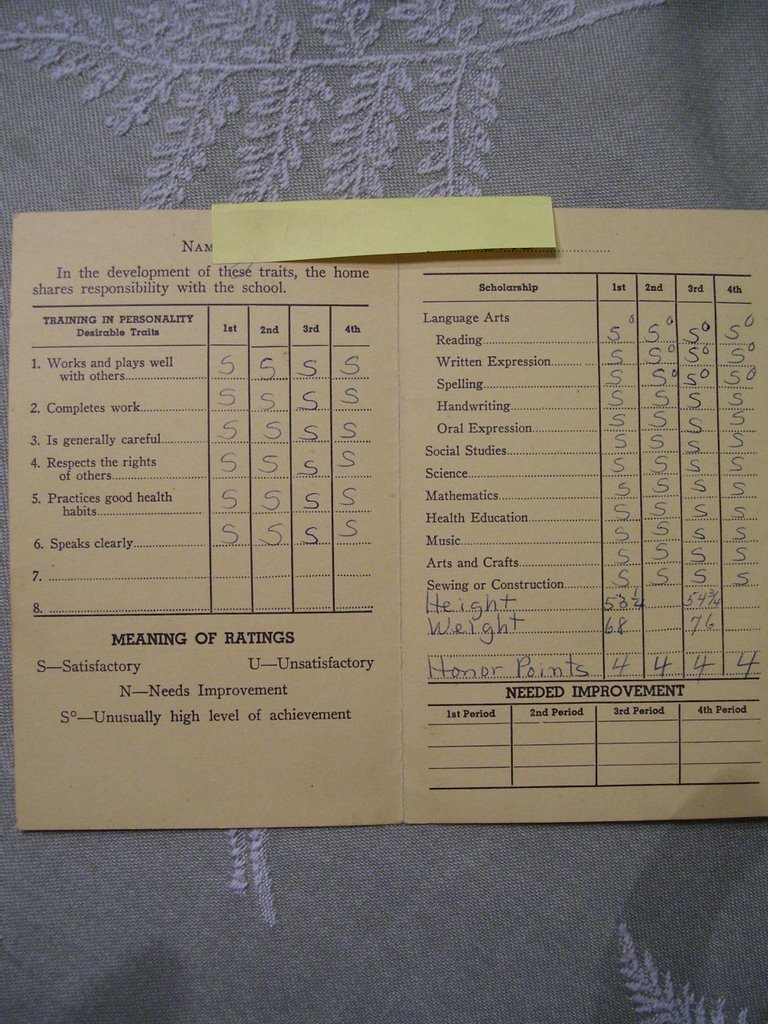
“Unsatisfactory.” It’s a term that conjures up my grade school report cards. Remember those report cards, fellow boomers?

Well, I happen to have one of mine from third grade, circa 1950-something:

Not an “unsatisfactory” among those grades, I’m proud to state. Satisfaction all around. And note that my better marks were in reading, writing, and spelling. There’s a certain consistency in my life, I guess.

As there is consistency in diplomatic life. That’s probably why John Bolton isn’t regarded as the diplomat’s diplomat; he’s much too blunt for that. Diplomacy is all about nuance and appearances, about allowing others to save face while deals are cut behind the scenes.

I hope that some deals are being cut behind these dismal scenes, because there’s absolutely no evidence that Iran is negotiating in good faith. Here are a few clues that there might be at least some sort of method behind what appears to be the diplomatic madness:

State Department officials, on the other hand, pressed to “keep the temperature down,” as one American put it….”The thinking was, even though we all know the Iranian response doesn’t amount to much, before rejecting it out of hand we should remember that at least two members of the group have a Security Council veto,” one European diplomat said, referring to Russia and China and their historic aversion to penalties. He referred to the strategy as “giving Iran the rope to hang itself.”

Even though diplomats–especially European ones–are not known for hyperbolic rhetoric, this “enough rope to hang itself” routine seems an exaggeration, to say the least. And speaking of exaggerations, I think the UN could give Iran an infinite amount of rope without there being quite enough for it to “hang itself.” Because all of this delicate diplomatic maneuvering leads, in the best-case scenario–to what? Sanctions.

And to “weak sanctions,” at that. China and Russia both have substantial economic interests in Iran, and are loathe to shoot themselves in the foot, to coin another hyperbolic metaphor (but then, I’m not a diplomat).

What are some of these sanctions China and Russia might be persuaded to get behind? Why, “a ban on travel by Iranian officials and curbs on imports of nuclear-related technology.”

I am sure that the mullahs are shaking in their robes. I was probably more terrified of getting an “Unsatisfactory” on that third-grade report card than they are of whatever the diplomats might impose on them in the way of penalties.

Posted in Iran | 47 Replies

To editors: thanks for all the fish

The New Neo Posted on August 24, 2006 by neoJuly 25, 2009

Back in the 80s I read the Hitchhiker’s Guide to the Galaxy series by Douglas Adams.

I opened the first page of the first book in the series without much expectation, started reading, and immediately realized I was encountering a most unusual and almost endlessly entertaining and quirky mind, one that could truly be described with that overworked word, “unique.”

I’m not sure what made me look Adams up yesterday. I was tired of thinking about politics, perhaps, and the phrase “So long, and thanks for all the fish,” was roiling around in my head for some reason. I remembered that Adams had died suddenly and way too young some years ago, and I became curious to read more about him.

Despite a wide-ranging and probably frenetic mind, and varied interests, Adams’s creative output was narrow rather than wide. His lasting oeuvre, his literary contribution, was the Hitchhiker series itself. That’s not anything to be ashamed of; it’s a great accomplishment to have entertained and amused people at such an extraordinary level of wit.

As a writer and ideaphoric myself (although admittedly one of a lesser degree than Adams) I wondered how he managed to harness his freewheeling brain long enough to do the sort of sustained work necessary to create so many novels.

I got my answer in Wikipedia:

While working on the radio series (and with simultaneous projects such as The Pirate Planet) Adams developed problems keeping to writing deadlines that only got worse as he published novels. Adams was never a prolific writer and usually had to be forced by others to do any writing. This included being locked in a hotel suite with his editor for three weeks to ensure that So Long, and Thanks For All the Fish was completed. He was quoted as saying, “I love deadlines. I love the whooshing noise they make as they go by.”

Locked in a hotel suite with his editor. So he got by with a little–or perhaps a lot–of help from his friends.

That’s true of a number of authors, I believe; we just usually don’t see the workings of the behind-the-scenes handlers and shapers and coaxers and helpers. Editors, for example, are often very instrumental in forming the work, even in motivating the writer, but only the insiders know for sure.

Spouses can act as literary helpers, as well. As inspiration, of course, but also in more practical ways. Some day I may write a piece on the marriage of Tolstoi and his wife (that’s quite a segue, Neo–from Doug Adams to Tolstoi). I happen to be a minor expert on the subject of the Tolstoi marriage, having read a number of books many years ago on the subject, notably this one.

The story isn’t pretty, although it starts the way most marriages do, with love. The relevant part in terms of this essay, however, is that Tolstoi’s wife Sonya, who was responsible for overseeing the day-to-day matters of his estate, who gave birth to and raised thirteen live children as well as having several other pregnancies, was also Tolstoi’s scribe and sometime editor.

Yes, in those days before there was Word there was the written word, penned by the human hand. Every night after her other duties were done (not that they were ever done; you know what they say about women’s work, and she had more of it than most) Sonya carefully transcribed a fair handwritten copy of what her husband had penned in messy draft form.

Here is a description of Sonya’s efforts, based on a book William Shirer wrote about the Tolstoi marriage:

Sonya had the burden of copying her husband’s almost illegible scrawls into her meticulous handwriting. She copied War and Peace seven times. Shirer calculates, “Since it runs to 1,453 printed pages in my edition that means that her fair copy came to at least 3,000 manuscript pages. So she must have written down in her own careful handwriting 21,000 pages.” (Actually, Sonya’s burden was much greater than Shirer envisions. Like most English translations, Shirer’s edition is well shy of the Russian original. My Russian-language edition of War and Peace contains 1,544 pages; an equivalent English version would have more than 2,000 pages.)

I think Adams’s editor probably had it easy in comparison.

Posted in Literature and writing, People of interest | 14 Replies

Post navigation

← Previous Post
Next Post→

Your support is appreciated through a one-time or monthly Paypal donation

Please click the link recommended books and search bar for Amazon purchases through neo. I receive a commission from all such purchases.

Archives

Recent Comments

  • Richard Cook on The press and that Iranian school that was reported to have been hit
  • Steve (Retired/recovering lawyer) on Peeking through Iran’s fog of war
  • F on Peeking through Iran’s fog of war
  • SD on Peeking through Iran’s fog of war
  • Richard Aubrey on The press and that Iranian school that was reported to have been hit

Recent Posts

  • Peeking through Iran’s fog of war
  • The press and that Iranian school that was reported to have been hit
  • As the sun quickly sets, not on the British Empire – that’s already gone – but on Britain itself
  • Open thread 3/11/2026
  • Those plucky ISIS kids

Categories

  • A mind is a difficult thing to change: my change story (17)
  • Academia (318)
  • Afghanistan (97)
  • Amazon orders (6)
  • Arts (8)
  • Baseball and sports (161)
  • Best of neo-neocon (88)
  • Biden (536)
  • Blogging and bloggers (580)
  • Dance (286)
  • Disaster (238)
  • Education (319)
  • Election 2012 (360)
  • Election 2016 (565)
  • Election 2018 (32)
  • Election 2020 (510)
  • Election 2022 (114)
  • Election 2024 (403)
  • Election 2026 (11)
  • Election 2028 (3)
  • Evil (126)
  • Fashion and beauty (323)
  • Finance and economics (999)
  • Food (316)
  • Friendship (47)
  • Gardening (18)
  • General information about neo (4)
  • Getting philosophical: life, love, the universe (724)
  • Health (1,132)
  • Health care reform (545)
  • Hillary Clinton (184)
  • Historical figures (329)
  • History (699)
  • Immigration (426)
  • Iran (400)
  • Iraq (223)
  • IRS scandal (71)
  • Israel/Palestine (785)
  • Jews (412)
  • Language and grammar (357)
  • Latin America (201)
  • Law (2,880)
  • Leaving the circle: political apostasy (124)
  • Liberals and conservatives; left and right (1,269)
  • Liberty (1,097)
  • Literary leftists (14)
  • Literature and writing (386)
  • Me, myself, and I (1,463)
  • Men and women; marriage and divorce and sex (902)
  • Middle East (380)
  • Military (307)
  • Movies (342)
  • Music (523)
  • Nature (254)
  • Neocons (32)
  • New England (176)
  • Obama (1,735)
  • Pacifism (16)
  • Painting, sculpture, photography (126)
  • Palin (93)
  • Paris and France2 trial (25)
  • People of interest (1,015)
  • Poetry (255)
  • Political changers (176)
  • Politics (2,764)
  • Pop culture (392)
  • Press (1,609)
  • Race and racism (857)
  • Religion (411)
  • Romney (164)
  • Ryan (16)
  • Science (621)
  • Terrorism and terrorists (965)
  • Theater and TV (263)
  • Therapy (67)
  • Trump (1,573)
  • Uncategorized (4,327)
  • Vietnam (108)
  • Violence (1,393)
  • War and Peace (958)

Blogroll

Ace (bold)
AmericanDigest (writer’s digest)
AmericanThinker (thought full)
Anchoress (first things first)
AnnAlthouse (more than law)
AugeanStables (historian’s task)
BelmontClub (deep thoughts)
Betsy’sPage (teach)
Bookworm (writingReader)
ChicagoBoyz (boyz will be)
DanielInVenezuela (liberty)
Dr.Helen (rights of man)
Dr.Sanity (shrink archives)
DreamsToLightening (Asher)
EdDriscoll (market liberal)
Fausta’sBlog (opinionated)
GayPatriot (self-explanatory)
HadEnoughTherapy? (yep)
HotAir (a roomful)
InstaPundit (the hub)
JawaReport (the doctor’s Rusty)
LegalInsurrection (law prof)
Maggie’sFarm (togetherness)
MelaniePhillips (formidable)
MerylYourish (centrist)
MichaelTotten (globetrotter)
MichaelYon (War Zones)
Michelle Malkin (clarion pen)
MichelleObama’sMirror (reflect)
NoPasaran! (bluntFrench)
NormanGeras (archives)
OneCosmos (Gagdad Bob)
Pamela Geller (Atlas Shrugs)
PJMedia (comprehensive)
PointOfNoReturn (exodus)
Powerline (foursight)
QandO (neolibertarian)
RedState (conservative)
RogerL.Simon (PJ guy)
SisterToldjah (she said)
Sisu (commentary plus cats)
Spengler (Goldman)
VictorDavisHanson (prof)
Vodkapundit (drinker-thinker)
Volokh (lawblog)
Zombie (alive)

Meta

  • Log in
  • Entries feed
  • Comments feed
  • WordPress.org
©2026 - The New Neo - Weaver Xtreme Theme Email
Web Analytics
↑