↓
 

The New Neo

A blog about political change, among other things

  • Home
  • Bio
  • Email
Home » Page 1788 << 1 2 … 1,786 1,787 1,788 1,789 1,790 … 1,863 1,864 >>

Post navigation

← Previous Post
Next Post→

Fraidy cats and fear itself: Left and Right

The New Neo Posted on September 7, 2006 by neoSeptember 1, 2010

There’s been a longstanding meme on the Left about the Right, one I’ve written about before. It’s a twist on the old schoolyard taunt, “Fraidy, cat, fraidy cat!”

The allegation is that the Right is motivated by fear–and unrealistic and wildly exaggerated fear, at that. My esteemed colleague Shrinkwrapped has written a recent and excellent piece on the subject.

Funny; when I look about me on the Right, I don’t see a whole lot of fear. Anger, perhaps, both at the Left and at the Islamist totalitarian enemy. But on the whole, the Right seems to me to be realistically facing and evaluating the threat before us, taking the enemy at its word about what it intends to do, and trying to learn the lessons of history. The Right wishes to take action against that enemy rather than wait in passive denial, wring its hands in fear, or pursue the false hope of appeasement.

One can disagree with the methods and approach of the Right without disagreeing about the degree of threat represented by the enemy. The Left, however, in choosing the “fraidy cat” argument, appears to be thinking along the following lines (excerpt from that previous post of mine about fear):

The legacy of Vietnam is that the left has a lingering mindset that considers national security concerns to almost always be mere excuses for government spying…The left, and many liberals, seem to feel that the raising of security issues in these situations is almost always bogus–a sort of screen, used by a proto-totalitarian government to cover its own misuse of power, with the goal of getting away with domestic spying on its enemies, and the further consolidation of its own power. If this is the conception, then national security concerns must be downplayed in almost all cases, and the role of fear as motivation for those concerns exaggerated instead.

I see the Right as motivated by realism about the goals of Islamist totalitarianism, and this leads to calls for action to block the enemy before the threat it represents becomes even greater, and the possibility of even more devastation looms larger.

But even if we are willing to grant, for the sake of argument, the Left’s charge that the main motivation on the Right is fear, we can say two things. The first is that in facing an enemy bent on one’s destruction and willing to purposely kill as many innocents as possible with all the weapons at its disposal, some element of fear (as in “apprehension of a danger”) is certainly warranted. The real question is whether the fear is realistic or whether it is exaggerated, and whether the person is paralyzed by that fear, or whether he/she takes appropriate action to forestall the feared consequences.

The left has its own fears, of course, and they are potent motivators, as well. As previously stated, they fear abuse of power by our own government in the pursuit of national security more than any foreign threat. To parse it even more finely, sometimes it seems that they fear abuse of power by a Republican executive branch more than anything; back in the days of FDR they liked a powerful federal government well enough, when it was run by a Democrat.

Speaking of FDR, it was he who famously said, “The only thing we have to fear is fear itself.” The context in which he made that statement is interesting; take a look at his First Inaugural Address, delivered in March of 1933, when the nation faced the Great Depression, the subject matter of FDR’s speech.

FDR does indeed say, “The only thing we have to fear is fear itself” (and, by the way, listen to the audio; what a speaker he was!). But this is the message in which his quote was embedded:

…the only thing we have to fear is fear itself””-nameless, unreasoning, unjustified terror which paralyzes needed efforts to convert retreat into advance. In every dark hour of our national life a leadership of frankness and vigor has met with that understanding and support of the people themselves which is essential to victory…In such a spirit on my part and on yours we face our common difficulties [he follows with a long list of the problems the nation faced at the time]…Only a foolish optimist can deny the dark realities of the moment.

Then, as now, the danger of fear is not really fear itself. It is, as FDR stated [emphasis mine], “nameless, unreasoning, unjustified terror which paralyzes needed efforts.”

I submit that those words define the stance of the Left today far more than that of the Right–in fearing, for example, warrantless NSA wiretapping of calls with terrorist foreign nationals more than the consequences of not using reasonable tools in our arsenal in order to fight an implacable and vicious enemy (and see here if you wish to revisit the complexities of the legal arguments concerning these wiretappings).

And I agree, along with FDR, that “only a foolish optimist can deny the dark realities of the moment.” I happen to think the Left fits the definition of “foolish optimist” in denying the dark realities of the present-day Islamist totalitarian threat. The Left, of course, thinks people such as myself to be foolish optimists in denying the dark realities of the threats posed by the would-be dictators Bush and Rove, and that we are timid and cowering fraidy cats in assuming that people such as Ahmadinejad mean exactly and precisely what they say.

[NOTE: And speaking of fear…]

Posted in Liberals and conservatives; left and right | 60 Replies

Bloggers and vacations

The New Neo Posted on September 6, 2006 by neoSeptember 19, 2007

The Wall Street Journal is on to the not-so-well-kept secret of bloggers, which is that is that they tend to have some degree of obsessive-compulsive disorder.

The ubiquity of the internet, laptops, and the like means that bloggers need never be very far away from their connections. Now, “connection” is a word with a double meaning, of course: it can refer to being hooked up to the Web, or simply to being hooked, as in “addicted.”

Yes, some would argue that blogging is an addiction–perhaps what’s referred to as a Positive Addiction, but an addiction nonetheless.

The WSJ article highlights the very special dilemma facing bloggers who want to take some time off:

In the height of summer-holiday season, bloggers face the inevitable question: to blog on break or put the blog on a break? Fearing a decline in readership, some writers opt not to take vacations. Others keep posting while on location, to the chagrin of their families. Those brave enough to detach themselves from their keyboards for a few days must choose between leaving the site dormant or having someone blog-sit.

According to the WSJ, even the biggest bloggers seem to mull over–or perhaps obsess over–the problem.

But me? No. Not moi. Not addicted, not at all. No siree. I have no difficulty whatsoever in resolving this issue. When I’m on vacation–and I’ve taken rather lengthy ones each of the two summers I’ve been blogging–I continue to post. But I take a middle road and lighten my load considerably. I won’t bore you with the secrets of how I do it, but I’ve managed to keep up the blog without ruining my vacations. At least so far.

The truth is that bloggers depend on addictions, both in themselves and in others. After all, aren’t we trying to form an addiction in our readers–an addiction to reading our blogs? Maybe a better word would be “habit”–makes us all feel better.

And, just to show how very unaddicted I am, I’m now going out to enjoy some of that thing known as “real life.” Till later…

Posted in Blogging and bloggers, Me, myself, and I | 6 Replies

More shameless self-promotion: Sanity Squad podcast

The New Neo Posted on September 6, 2006 by neoSeptember 6, 2006

The latest Sanity Squad podcast is up at the Politics Central site at Pajamas Media.

There are still a few technical kinks–every now and then, Shrinkwrapped’s voice goes all metallic and he gets stuck in a strange time warp. But I think you’ll find the group interesting and entertaining–although not as entertaining as you might have found them had the technical guy not decided that my joke about France was way lame, and edited it out.

What joke about France? Well, after Siggy challenges us all to name a nation under the sway of tyranny that isn’t a third-world country, I respond with, “France?”

Come to think of it, maybe the technical guy was right.

Posted in Uncategorized | 7 Replies

Conversations on conversion

The New Neo Posted on September 5, 2006 by neoJuly 25, 2009

Alexandra is incensed at Bill Maher for making light of forced conversion to Islam.

Maher isn’t one of my favorites (surprise, surprise, you say), and I don’t really tend to follow his shows. But in a comedy routine (video here; starts at minute two), Maher said:

New rule: If converting to Islam is all it takes to get the terrorists off our backs, then all I have to say is, “Lalalalalalala! [ulalates loudly]”…Now, I know what you’re thinking: “Bill, if we convert to Islam, doesn’t that mean the terrorists have won?” Well, sort of, but it’s a win-win, because they get to declare victory, and we get to take hair gel on the plane. Plus, we’re not really converting to Islam. We’re just telling our enemies what they want to hear, and trying to convince them we’re something we’re really not…And, it’s so simple to convert this way. You know, if you want to convert to Judaism, it’s a huge hassle. You’ve got to find a Rabbi, study the Torah, get circumcised, go to dental school. But, Mohammed made joining his team easy: two line pledge, and you’re in.

Maher loves to be controversial, and this rant is no exception. He goes on to add that conversion doesn’t matter because Americans are Christians in name only and don’t fulfill most of the obligations of Christianity, and that one religious fanatic is much the same as another.

To treat Maher’s charges with a seriousness they perhaps don’t deserve, he ignores the fact that imperfection in religious observance (charity, for example, and other kindly acts) is the rule for humanity across the board, not just in the case of Americans. He also ignores the major differences between fanatical Christians and fanatical Moslems and fanatical Jews, especially in their attitudes towards conversion, but in many other respects, as well.

Most of us can agree with Maher, however, that allowing religious fanatics of any stripe to be in charge of government would be a bad thing. The disagreement arises in the definition of “fanatic.” Some, no doubt, believe that all Zionists are by definition religious fanatics. Some, no doubt, feel that the entire anti-abortion crowd–not just those who murder abortionists–are religious fanatics.

I happen to believe that not all religious fanatics are the same. And I think the evidence is clear that present-day Islamist fanatics are louder, more numerous, more powerful in their own countries, more willing to use coercion to force beliefs and practices on others, and more intent on killing very large numbers of people in their desire for religious hegemony.

That attitude towards religious hegemony–and the best means to go about achieving it, if desired–is another huge distinction between the three Abrahamic religions. Even though he’s not trying to be serious, Maher touches on a very fundamental and important difference among the religions as far as conversion goes, and it’s not a tangential one. The distinction goes to the heart of what each religion is in modern times–how it sees itself, its message, and its mission in the world.

Judaism makes conversion difficult for a reason. Islam makes it extremely easy for a reason. Christianity occupies a middle ground for a reason (the issues and history are far more complex than can be dealt with in this post, so the following is, quite naturally, a simplification).

Judaism has a “live and let live” attitude towards other religions. Here’s a statement of the Jewish point of view:

Judaism, unlike say Christianity and Islam, is not a proselytising religion. Because it teaches that the righteous of all nations shall enter the gates of heaven, it does not have any compelling urge to rescue non-Jews from hell and damnation. There is a requirement in Jewish law to ensure the sincerity of a potential convert. Essentially, [the religious authorities] want to be sure that the convert knows what he is getting into, and that he is doing it for sincerely religious reasons.

Christianity is a proselytising religion. In modern times it does so through nonviolent means–persuasion, preaching, missionary work–although in the past coercion was sometimes involved. The idea behind both the nonviolent and the violent conversions was that Christianity was the only way to salvation, and thus it was incumbent on Christians to spread the faith.

The same is true of Islam. Islam’s early tradition is one of jihad through martial conquest, giving defeated peoples “of the Book” (Christians, Jews) a choice: conversion, dhimmitude, or death. The choice for infidels was simpler: conversion or death. This was done despite verses in the Koran framing religious choice as something that should not be coerced. As in much of Islam, there are other contradictory hadiths–for example, the Verse of the Sword–that seem to prescribe forced conversion.

There is no question that Islam is a religion with a mainstream–not a fringe–belief that everyone on earth should ultimately become Moslem. In fact, it considers conversion to be a misnomer; the proper word might be reversion, since it is also believes that everyone on earth is actually born a Moslem. Islam is also the only religion of which I’m aware that considers death the punishment for renouncing the religion.

As a group that has been subjected to forced conversions for centuries–both at the hands of Christians and from Moslems–Jews have long pondered the dilemma of the reluctant potential convert. Should one resist to the death? Or is a far more serious version of Bill Maher’s suggestion (“We’re not really converting to Islam”) acceptable: pretended conversion, allowing the convert to live and to practice Judaism in secret, hoping at some future date to become openly Jewish once again?

The great Jewish rabbi-philosopher Maimonides pondered the issue in the twelfth century, writing his “Epistle on Forced Conversion.” Maimonides had an extremely personal interest in the topic, since he himself had been forced to convert to Islam in Spain in order to save his life, after which he fled that country, ending up in Egypt and returning to the practice of Judaism. His answer is that it is best to leave the area, if possible, rather than to convert, but that conversion is acceptable and forgivable in order to save one’s life, especially if the intent is to practice secretly and/or to ultimately emigrate and practice the religion openly once again.

Some who are not religious may find it hard to understand what all the fuss about forced conversion is. But most probably realize that forced conversion is an affront to freedom of belief and practice, which includes the freedom to not believe and to not practice. And even Maher, in his lucid moments–and I’m sure he has a few–would agree that any religious group bent on forcibly and aggressively imposing both its belief system and its practices on others is one that must be vigorously fought against and defeated. Conversion at the point of a sword–or a gun–is the unmistakable marker of such a religious group. And such conversion seems to be the exclusive province of Islamist totalitarians these days.

Posted in Religion | 21 Replies

Watch for it

The New Neo Posted on September 5, 2006 by neoSeptember 5, 2006

Airing this September 10-11, the five-year anniversary of 9/11, this ABC miniseries sounds awfully good.

[ADDENDUM: A caveat about the historical accuracy of a certain scene involving the Clinton administration. Perhaps there’s a bit of Oliver Stonism creeping in?]

Posted in Uncategorized | 5 Replies

Can’t get enough of the voice of neo-neocon?: audio from down under

The New Neo Posted on September 5, 2006 by neoJuly 25, 2009

I’m the guest interviewee on this podcast from Shire Network News, found at Blogmatrix. You can download through iTunes, or just download it directly from the Blogmatrix site, here.

The interview with me starts about a third of the way into the podcast. My voice can’t compete with the mellifluous British tones of Brian of London, who begins the podcast, nor can it measure up to the dulcet harmonies of Tom Paine, my Australian interviewer (love those accents, guys!). But on this podcast my voice comes the closest so far to sounding like my actual self. And the topic I’m talking about is one near and dear to my heart–my “change.” And, if you want to hear me at least attempting to make a few jokes, there’s a moment or two when I do just that.

Blogmatrix specializes in podcasts, and often injects humor into the proceedings. You might want to take a look at some of their previous efforts, as well.

Posted in Me, myself, and I | 6 Replies

Traveling without divisions, you don’t get no respect

The New Neo Posted on September 4, 2006 by neoJuly 25, 2009

Iran and Ahmadinejad have once again demonstrated the great and awesome power of the UN and their fear of its sanctions, in Iran’s continued defiance of the UN’s call for limitations on its nuclear program. Although Kofi Annan made a special trip to Iran to discuss these matters, the Iranian leader might very well have paraphrased Stalin (instead of the historical tyrant he usually prefers to channel, Hitler) and asked: how many divisions does Kofi Annan have?

The answer? Quite a few, but unfortunately they lack the ability to fight, being either unarmed or lightly armed and only allowed to fire in self-defense. And the UN’s proposed sanctions, hardly frightening in and of themselves, are likely to be blocked by Iran’s buddies Russia and China, as Iran is well aware.

As for Annan himself, he well might paraphrase Rodney Dangerfield and say: I don’t get no respect, despite (or perhaps because) of Iran’s praise for his visit as “good, suitable, and positive.” In other words: powerless, meaningless, and suiting Iran’s aims to place a cooperative face on its nuclear ambitions.

Annan made a small gesture of relative defiance by criticizing Iran’s nose-thumbing announcement of a conference devoted to the fact that the Holocaust was an “exaggeration,” as well as the mounting of an exhibit in Teheran of cartoons mocking said Holocaust (or, rather, un-Holocaust).

Annan’s statement of the Holocaust’s historical reality is okay as far as it goes, which isn’t all that far. It illustrates the tepid nature of the UN response–or the diplomatic response in general–when faced with evil. Annan is typical of those groups in trying to reason with the unreasonable, and to plead with the inhumane. Such reasoning and pleas are doomed to fall on deaf ears.

Posted in Iran, War and Peace | 15 Replies

Noah’s eyes: still point in the turning world

The New Neo Posted on September 4, 2006 by neoSeptember 4, 2006

If you’re having a slow Labor Day, take a look at this (hat tip: Pajamas Media): a young man named Noah takes a photo of himself every day for six years (yes, count ’em–or rather, maybe you’d better just take his word for it).

Ah, Noah, despite your relative youth and my relative age, I can empathize. What am I talking about? Why, the hair, of course! Every day a different experience–every hour a different experience. Those of us with strongly wavy hair that has a mind of its own can understand; others probably cannot.

The variety of directions in which Noah’s hair chooses to go is not matched by any variety in his own moods, however. Never I have seen so little change of expression in my life. And his eyes–how does he do that? They appear to remain focused on a single point throughout the over two thousand photos.

Posted in Uncategorized | 5 Replies

Almost-fall garden interlude

The New Neo Posted on September 3, 2006 by neoJuly 25, 2009

When I moved to my present house I inherited a perennial garden.

That wasn’t my main concern. Just having a marginally affordable place to live was the important thing, because I managed to buy my house in a seller’s market (and I bet that, whenever I move, it will be a buyer’s market. Ah, well.)

The garden was an unintended responsibility, one I wasn’t sure I could meet. Actually, although the house is fairly small, there were three gardens–one in front, the sun garden; a terraced rock one on the side and one in the back, both shade gardens. I had to do a lot of reading and learning about growing flowers to rise to the occasion and do right by those gardens, since I knew virtually nothing on the subject when I first moved here.

But I think, all things considering, I’ve done rather well. Some plants died and I replaced them with others. Some thrived. I moved things around. I learned that what looks good in June or July can look crummy and bloomless in August. I learned my favorite garden joke, which I’ve written before but will repeat once more, with feeling:

Q: What’s the definition of a perennial?
A: It’s a plant that comes back every year, if it had lived.

It’s not always easy to get the garden to look good in September. But I will restrain my innate modesty to say that I think mine isn’t all that shabby right now. And, getting an even tighter grip on that innate modesty, I’m going to post a couple of photos of the front garden, taken just yesterday, when it wasn’t pouring rain, unlike today:


Posted in Gardening | 9 Replies

Beslan: second anniversary

The New Neo Posted on September 2, 2006 by neoJuly 25, 2009

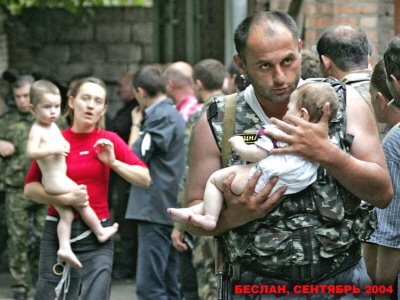
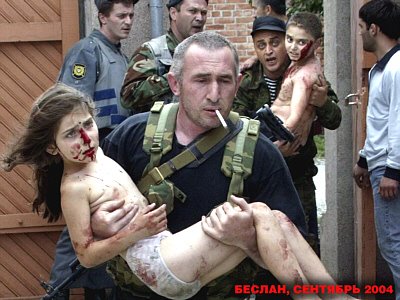
It’s the second anniversary of one of the worst terrorist acts in history, the Beslan kidnapping and massacre.

I wrote this post one year ago, on the first anniversary. Nothing much has changed since then. The sorrow of the parents who lost children has probably not eased much, although it has gotten a little older.

The main thrust of most articles written on this second anniversary (and there are relatively few, especially outside of Russia) focus on the rage the families feel at the Russian authorities for what is perceived as their negligent handling of the incident. This feeling has been fueled by a new and controversial report by a member of the State Duma, Yury Savelyev, who disagrees with the official findings that the first shots fired in the final confrontation were set off by the terrorists. He writes that the initial blasts came from the Russian authorities.

It’s impossible from this vantage point to even begin to evaluate who might be correct. Some accuse Savelyev of distorting the facts for political gain (sound familiar)? Whatever the truth might be, his report–and other articles about the anniversary–are definitely part of a trend that I’ve noticed before under similar circumstances, which is this: when terrorists attack, people often seem to direct the bulk of their anger at their own authorities, blaming them for failure to protect.

In this case, my guess is that the Russian authorities are indeed guilty of some sort of contributory negligence. Perhaps they didn’t fire at the school first, despite what Savelyev has said. But they may indeed have messed up in some way or other, perhaps even in several different ways.

But any negligence on their part is contributory only. There’s no question this was a terrorist attack of extreme and unusual coldbloodedness. The guilt and responsibility lie squarely with the terrorists themselves. They were the ones who chose a target with a predominance of children among the victims, they were the ones who subjected those children and others to great suffering both before and during their deaths, and they were the ones who had a chance to view that suffering and yet still did not relent (even shooting some of the children in the back as they fled the final conflagration).

But most of those terrorists–except one–are now dead. They are out of reach; the Russian authorities are not. It’s a normal human reaction to blame those close at hand, especially if they are perceived as having had a duty to protect and as having failed that duty.

But history only plays once; we don’t have an alternate universe in which the Russian military and police get another opportunity to do something different, something more effective, something that preserved more lives. Was there any chance of a more successful outcome, given the ferocity of the hostage-takers? I personally don’t think so, but I have no way of knowing. Neither does anyone else.

Many people in Russia criticize the fact that the terrorists were not stopped somewhere on the way to their target. This is similar to criticisms mounted in this country towards the CIA and FBI for not noticing and stopping the 9/11 hijackers long before they did their nefarious business.

A group calling itself the Mothers of Beslan speaks out:

“We are convinced that the difficult last two years have not brought us to the truth about the Beslan tragedy but to the covering up of the truth.”

That lack of trust means that even the trial of Nurpashi Kulayev, who officials say was the only hostage-taker not to die during the fighting, failed to bring closure to victims and their relatives.

“One person cannot be responsible for the deaths of more than 300. Those who allowed the fighters to travel unhindered to Beslan along federal roads should sit in his place. And those who allowed the bloody ending,” said Valery Karlov, who lost his father.

That last quote says a great deal. There is only one person left alive from among the perpetrators, hardly enough to bear the brunt of all the rage and grief the families–and much of Russia–still feel. The authorities, however, are alive and kicking, as well as numerous.

And no doubt there are plenty of reasons to blame them, as their response was far from perfect, as are most human responses to an unforeseen and unprecedented crisis. The basic human need to believe that, if the police and military and government had done their job correctly, no one need have died, is compounded by a traditional (and probably justified) distrust of the Russian government. Any official report from that source is already seen as a whitewash.

But we can all agree that Beslan was one of the saddest episodes yet in the annals of terrorism, and that many of the rescuers distinguished themselves that day. Here are some poignant photos, for remembrance (I have omitted any photos of the dead out of respect, although there are many at the website from which I got these pictures):


Posted in Terrorism and terrorists | 34 Replies

A trip back in time: Jimmy Carter and the Iranian Revolution (Part III)

The New Neo Posted on September 1, 2006 by neoAugust 25, 2015

[Parts I and II.]

For anyone who was alive at the time and old enough to pay attention to the news, the first thing that comes to mind when thinking of Jimmy Carter and the Iranian Revolution is the hostage crisis that occurred less than a year after the installment of the Khomeini regime. We watched, impotently, as America was brought to its knees by a bunch of anti-American Iranian kidnappers and a US President who seemed powerless to do anything about them. And the incident wasn’t a short one, either, lasting a Biblical-sounding 444 days.

Carter did do a few things about the crisis, it’s true. He froze Iranian assets in the US and halted oil imports, as well as trying diplomacy. In desperation, about six months into the mess, he approved a half-baked and doomed rescue attempt that ended in tragedy and more humiliation for the US (see here for my post about this incident). In the final ignominy for Jimmy (but a relief for the nation), the hostages were freed on the day of Ronald Reagan’s inauguration.

Here’s more about Carter’s reasoning and the strategies behind it during the hostage crisis:

As winter turned to spring, and negotiations failed to produce a deal, frustrated Americans demanded stronger action. “No one can know how much pressure there was on Jimmy to do something,” Rosalynn Carter recalled. “I would go out and campaign and come back and say, ‘Why don’t you do something?’ And he said, ‘What would you want me to do?’ I said, ‘Mine the harbors.’ He said, ‘Okay, suppose I mine the harbors, and they decide to take one hostage out every day and kill him. What am I going to do then?'”

Based on that evidence, I’d prefer Rosalynn to have been in charge. Carter’s mindset was zero tolerance for even the possibility of a hostage being killed. His basic orientation was pacifist, and the hostage crisis revealed him to the world as an ineffectual and timid leader. By extrapolation, his role implied that the United States was the same. And, for the moment at least, it was.

It’s easy to pay attention to dramatic events such as the hostage crisis, which thrust themselves into nearly everyone’s consciousness in a way that could hardly be ignored. It’s much easier, however, to ignore the more subtle, far less widely-covered events that led up to the Shah’s downfall and Khomeini’s rise, events in which President Carter played a large role as well.

Perhaps, as I wrote yesterday, no policy of the Shah’s in his final years in power could have stopped the steamroller of discontent with his policies and the increasing support for the mullahs. After all, the Iranians knew what they disliked about the Shah, and there was something with which everyone could find fault. The Shah was brought down by an unholy and bizarre alliance, a trio made of three groups with beliefs that utterly contradicted those of the other two– civil libertarians, socialists, and totalitarian Islamists. Each group had reasons to dislike the Shah, and each of them calculated that they’d be the only ones left standing in the end. But there was room for only one winner, and that turned out to be the mullahs.

So maybe Carter’s pre-Revolutionary policies towards the Shah weren’t all that important in bringing about the latter’s downfall. Or maybe they were. What were those policies?

First, a bit of background. The Shah had been a staunch ally of the US for his lengthy reign (see this for some background. Yes, it’s Wikipedia, but it seems fairly straightforward and quite detailed). A particularly complex (and controversial) event in US-Iranian relations involved the Shah’s cooperation with the Eisenhower administration in a 1953 coup (or, to be technical, a counter-coup) against Mossadegh, the elected Prime Minister of Iran who was suspected at the time of being a Communist sympathizer .

The Shah lived in what’s known as a “rough neighborhood.” This meant that, in order to implement the modernization of Iran, he felt he needed to be harsh in dealing with the opposition. Jimmy Carter was dedicated to the cause of spreading human rights throughout the world, and he decided to put pressure to bear on the Shah to expand civil liberties and relax his policies towards those in his country who were against him.

Carter threatened the Shah with cutting arms shipments, and in response:

The Shah…released 357 political prisoners in February, 1977. But lifting the lid of repression even slightly encouraged the Shah’s opponents. An organization of writers and publishers called for freedom of thought, and 64 lawyers called for the abolition of military tribunals. Merchants wrote letters requesting more freedom from government controls. Some people took to the streets, perhaps less fearful of being shot to death, and they clashed with police. A group of 120 lawyers joined together to publicize SAVAK torture and to monitor prison conditions. Dissident academics formed a group called the National Organization of University Teachers, and they joined students in demanding academic freedom. Political dissidents started disseminating more openly their semi-clandestine publications.

As events spiraled out of control, there were demonstrations throughout Iran. Police reacted harshly, and many protesters were killed, which led to more demonstrations and more deaths, which led to–well, you get the idea.

A genie of dissent had been unleashed–a valid one, because there was much to protest. But as things escalated, and the Shah eventually lost the support of the army and the police (a turning point), few seemed to be prescient enough to predict what forces would replace his regime–not what was hoped for, but what was likely to do so. There were only three choices, and two of them–the mullahs and the Marxists–could reasonably be expected to be far more repressive than the Shah.

Jimmy Carter was probably sincere in wishing that his pressure on the Shah would lead to greater civil liberties, not fewer. But if so, it was one of the gravest miscalculations in history. Be careful what you wish for.

On New Years Eve of 1977:

President Carter toasted the Shah at a state dinner in Tehran, calling him “an island of stability’ in the troubled Middle East….Did the Carter administration “lose” Iran, as some have suggested? Gaddis Smith might have put it best: “President Carter inherited an impossible situation — and he and his advisers made the worst of it.” Carter seemed to have a hard time deciding whether to heed the advice of his aggressive national security advisor, Zbigniew Brzezinski, who wanted to encourage the Shah to brutally suppress the revolution, or that of his more cautious State Department, which suggested Carter reach out to opposition elements in order to smooth the transition to a new government. In the end he did neither, and suffered the consequences.

Even after it became known that the Shah was suffering from cancer, President Carter was reluctant to allow him entry to the United States, for fear of reprisal against Americans still in Iran. But in October, when the severity of the Shah’s illness became known, Carter relented on humanitarian grounds. “He went around the room, and most of us said, ‘Let him in.'” recalls Vice President Walter Mondale. “And he said, ‘And if [the Iranians] take our employees in our embassy hostage, then what would be your advice?’ And the room just fell dead. No one had an answer to that. Turns out, we never did.”…

No, they never did. And soon the whole world knew it.

Posted in Historical figures, History, Iran | 46 Replies

And Britain also hopes Santa will give it a pony for Christmas

The New Neo Posted on September 1, 2006 by neoSeptember 1, 2006

I don’t know about you, but this headline seems both absurd and tragic to me:

Britain says it hopes for negotiated deal over Iran’s uranium enrichment

The statement was actually by British Foreign Secretary Margaret Beckett, but I doubt she was speaking for herself only. This appears to be official British policy.

Perhaps Beckett’s statement was merely an example of “keeping the temperature down” (a strategy of the West mentioned in this post), and not really meant as a true reflection of the expectations of the Western powers vis-a-vis Iran.

But then again, perhaps it was exactly what it sounds like: a dreamy pie-in-the-sky reflection of a befogged and befuddled–and bewitched, bothered, and bewildered–state of mind on the part of people who should know better.

But some are not quite so wishful in their thinking. Some have taken the measure of the West and judged it to be exactly as they had hoped–which is to say, not up to the fight ahead. The last sentence of the article reads as follows:

Iranian President Mahmoud Ahmadinejad said Friday that his country would never give up its nuclear program and accused the West of lying when it claims Tehran is pursuing nuclear weapons.

Clear enough. So, let’s talk!

(What’s the relevance of the photo above? It’s from a production of the definitive work on false hope, “Waiting for Godot.” And it’s written by another Beckett–Samuel, rather than Margaret.)

Posted in Uncategorized | 22 Replies

Post navigation

← Previous Post
Next Post→

Your support is appreciated through a one-time or monthly Paypal donation

Please click the link recommended books and search bar for Amazon purchases through neo. I receive a commission from all such purchases.

Archives

Recent Comments

  • Jim Melcher on Peeking through Iran’s fog of war
  • Richard Cook on The press and that Iranian school that was reported to have been hit
  • Steve (Retired/recovering lawyer) on Peeking through Iran’s fog of war
  • F on Peeking through Iran’s fog of war
  • SD on Peeking through Iran’s fog of war

Recent Posts

  • Peeking through Iran’s fog of war
  • The press and that Iranian school that was reported to have been hit
  • As the sun quickly sets, not on the British Empire – that’s already gone – but on Britain itself
  • Open thread 3/11/2026
  • Those plucky ISIS kids

Categories

  • A mind is a difficult thing to change: my change story (17)
  • Academia (318)
  • Afghanistan (97)
  • Amazon orders (6)
  • Arts (8)
  • Baseball and sports (161)
  • Best of neo-neocon (88)
  • Biden (536)
  • Blogging and bloggers (580)
  • Dance (286)
  • Disaster (238)
  • Education (319)
  • Election 2012 (360)
  • Election 2016 (565)
  • Election 2018 (32)
  • Election 2020 (510)
  • Election 2022 (114)
  • Election 2024 (403)
  • Election 2026 (11)
  • Election 2028 (3)
  • Evil (126)
  • Fashion and beauty (323)
  • Finance and economics (999)
  • Food (316)
  • Friendship (47)
  • Gardening (18)
  • General information about neo (4)
  • Getting philosophical: life, love, the universe (724)
  • Health (1,132)
  • Health care reform (545)
  • Hillary Clinton (184)
  • Historical figures (329)
  • History (699)
  • Immigration (426)
  • Iran (400)
  • Iraq (223)
  • IRS scandal (71)
  • Israel/Palestine (785)
  • Jews (412)
  • Language and grammar (357)
  • Latin America (201)
  • Law (2,880)
  • Leaving the circle: political apostasy (124)
  • Liberals and conservatives; left and right (1,269)
  • Liberty (1,097)
  • Literary leftists (14)
  • Literature and writing (386)
  • Me, myself, and I (1,463)
  • Men and women; marriage and divorce and sex (902)
  • Middle East (380)
  • Military (307)
  • Movies (342)
  • Music (523)
  • Nature (254)
  • Neocons (32)
  • New England (176)
  • Obama (1,735)
  • Pacifism (16)
  • Painting, sculpture, photography (126)
  • Palin (93)
  • Paris and France2 trial (25)
  • People of interest (1,015)
  • Poetry (255)
  • Political changers (176)
  • Politics (2,764)
  • Pop culture (392)
  • Press (1,609)
  • Race and racism (857)
  • Religion (411)
  • Romney (164)
  • Ryan (16)
  • Science (621)
  • Terrorism and terrorists (965)
  • Theater and TV (263)
  • Therapy (67)
  • Trump (1,573)
  • Uncategorized (4,327)
  • Vietnam (108)
  • Violence (1,393)
  • War and Peace (958)

Blogroll

Ace (bold)
AmericanDigest (writer’s digest)
AmericanThinker (thought full)
Anchoress (first things first)
AnnAlthouse (more than law)
AugeanStables (historian’s task)
BelmontClub (deep thoughts)
Betsy’sPage (teach)
Bookworm (writingReader)
ChicagoBoyz (boyz will be)
DanielInVenezuela (liberty)
Dr.Helen (rights of man)
Dr.Sanity (shrink archives)
DreamsToLightening (Asher)
EdDriscoll (market liberal)
Fausta’sBlog (opinionated)
GayPatriot (self-explanatory)
HadEnoughTherapy? (yep)
HotAir (a roomful)
InstaPundit (the hub)
JawaReport (the doctor’s Rusty)
LegalInsurrection (law prof)
Maggie’sFarm (togetherness)
MelaniePhillips (formidable)
MerylYourish (centrist)
MichaelTotten (globetrotter)
MichaelYon (War Zones)
Michelle Malkin (clarion pen)
MichelleObama’sMirror (reflect)
NoPasaran! (bluntFrench)
NormanGeras (archives)
OneCosmos (Gagdad Bob)
Pamela Geller (Atlas Shrugs)
PJMedia (comprehensive)
PointOfNoReturn (exodus)
Powerline (foursight)
QandO (neolibertarian)
RedState (conservative)
RogerL.Simon (PJ guy)
SisterToldjah (she said)
Sisu (commentary plus cats)
Spengler (Goldman)
VictorDavisHanson (prof)
Vodkapundit (drinker-thinker)
Volokh (lawblog)
Zombie (alive)

Meta

  • Log in
  • Entries feed
  • Comments feed
  • WordPress.org
©2026 - The New Neo - Weaver Xtreme Theme Email
Web Analytics
↑