
↓
 

The New Neo

A blog about political change, among other things

  • Home
  • Bio
  • Email
Home » Page 1783 << 1 2 … 1,781 1,782 1,783 1,784 1,785 … 1,863 1,864 >>

Post navigation

← Previous Post
Next Post→

Wars, civil and/or religious: Part I (civil war–nothing civil about it)

The New Neo Posted on October 18, 2006 by neoSeptember 19, 2007

The thread on Iraqi federalism inspired a debate in the comments section about whether Iraq is facing a civil war or a religious war, or neither, or both.

Perhaps it’s just a question of semantics. We could (and no doubt will) quibble over each and every word in the alternate definitions: “civil,” “religious,” and “war.” But I think we can all agree that the sectarian, religious, and ethnic violence there is greater than desired, and that it’s difficult to see how it will end in the near future.*

So, how can we get perspective on what’s happening in Iraq right now? One thing that’s occurring represents a common phenomenon–as I wrote in this post on Russia and this one on North Korea–which is that, when dictatorships are removed, we face the spectre of chaos and dueling for position between rival factions now released from previous supression.

Dictatorships not only can make the trains run on time (although neither the USSR nor North Korea were/are famous for that), they put a firm lid of tyranny on the simmering tensions of ethnic and religious and other strife, and create an illusion of harmony. Then, when that lid is removed, the pot boils over. In addition–and especially if dictatorships are in power for a long time–they stir up the desire for revenge for old grievances perpetrated by the regime itself.

In Iraq, the pot is boiling, or at least simmering. The split seems to be along Sunni-Shiite lines, which indicates a religious war. But it’s not quite that simple (I’ll deal in greater depth with this question, and discuss religious wars in general, in Part II, tomorrow).

The Sunni-Shiite split occurred almost at the beginning of Islam, and Iraq is far from the only place it’s being played out. To simplify: Shiites dominate Iran, and Sunnis are more numerous in most Arab states (although not in Iraq, where Shiites constitute about two-thirds to the Sunni one-third). But the division is far from clear, and tribes, which also dominate the region, can be quite mixed, as Saudi Prince Turki has observed:

“…in most of Iraq the links and interlinks of Sunni and Shiites go far beyond the efforts to drive them apart,” Prince Turki said.

Many Iraqi tribes and clans contain both Sunnis and Shiites, and there are many Sunni-Shiite intermarriages, he noted, and the tribal and clan and personal links cross sectarian lines.

“In practical terms, how could such a civil war happen?” he asked. “It is practically impossible to divide Iraq into sectarian regions. It would mean mass emigration and ethnic cleansing, and a lot of killing between families and tribal groupings.

But that’s often true of areas where civil wars erupt. In fact, it’s one of the great tragedies of civil war itself. One has only to look at our own bloody Civil War, in which brother literally fought brother, and members of the same graduating class at West Point were generals on either side of the divide, to see how very possible it is.

To give one more example, the Tutsis and Hutus involved in the terrible genocide in Rwanda (mostly Hutus killing Tutsis, but moderate Hutus were also at risk) were commonly presented as sharply delineated ethnic groups. But in actuality this was far from the case:

Many researchers point out that both groups speak the same language, have a history of intermarriage and share many cultural characteristics. Traditionally, the differences between the two groups were occupational rather than ethnic…Tutsi can often be physically distinguished as taller than Hutu, but according to the vice president of the National Assembly Laurent Nkongoli, frequently “[y]ou can’t tell us apart, we can’t tell us apart.”

So one thing we can safely say is that the divisions in such wars are murky, and that family ties and long-term interactions don’t preclude the explosion of bitter and terrible violence.

Another thing we can say is that civil wars are exceedingly common, even though the majority of them receive far less publicity than the present conflict in Iraq. Take a look at this fascinating article by Monica Duffy Toft, associate professor of Pulic Policy at Harvard’s Kennedy School.

Toft discusses whether the present conflict in Iraq qualifies as a civil war. Short answer: yes, it meets all the criteria, which are: (1) dispute over whom will govern; (2) [at least] two groups of organized combatants; (3) the state one of the combatants; (4) at least 1,000 battle deaths per year on average; (5) ratio of total deaths at least 95 percent to 5 percent for the two sides; (6) fought within the boundaries of an internationally recognized state.

But what’s most fascinating about Toft’s article–at least to me–is its conclusion, which is simply a list of all the civil wars that have darkened the world since 1940.

To save you the trouble of following the link, I hereby reproduce that list. You may get tired of scrolling down, but please bear with me:

Afghanistan I Civil War: Mujahideen, Taliban 1978 2001

Algeria I War of Independence 1954 1962

Algeria II Opposition to Bella 1963 1963

Algeria III Fundamentalists 1992 .

Angola I War of Independence 1961 1974

Angola IIa Angolan Civil War 1975 1994

Angola IIb UNITA Warfare 1998 2002

Argentina Coup 1955 1955

Azerbaijan/USSR Nagorno-Karabakh 1988 1994

Bangladesh Chittagong Hill 1972 1997

Bolivia I Popular Revolt 1946 1946

Bolivia II Bolivian Revolution 1952 1952

Brazzaville Ia Elections 1993 1993

Brazzaville Ib Factional Warfare 1997 1997

Burma I Communist Revolt 1948 1989

Burma II Karens 1948 .

Burma III Shan 1959 .

Burma IV Kachins 1960 1994

Burundi Ia Hutu Coup Attempt 1965 1965

Burundi Ib Hutu Rebellion 1972 1972

Burundi Ic Hutu/Tutsi 1988 1988

Burundi Id Hutu/Tutsi 1991 1991

Burundi Ie Hutu/Tutsi 1993 2003

Cambodia Ia Khmer Rouge 1970 1975

Cambodia Ib Viet Intervention 1978 1991

Cameroon War of Independence 1955 1960

Chad FROLINAT 1965 1997

Chile Army Revolt 1973 1973

China I Com Rev: Final Phase 1945 1949

China III Cultural Revolution 1966 1969

China IIa Tibet 1950 1951

China IIb Tibet 1954 1959

Colombia I La Violencia 1948 1958

Colombia II FARC 1964 .

Costa Rica Civil War 1948 1948

Cuba Cuban Revolution 1956 1959

Cyprus Ia Greek/Turk Clashes 1963 1964

Cyprus Ib Coup/Turk Invasion 1974 1974

Domin Republic Dominican Civil War 1965 1966

Egypt Free Officers’ Coup 1952 1952

El Salvador FMLN/FDR 1979 1992

Ethiopia I Eritrea 1961 1993

Ethiopia II Tigray 1975 1991

Ethiopia III Ogaden 1977 1978

Georgia I South Ossetia 1990 1992

Georgia II Abkhazia 1992 1993

Greece Greek Civil War 1944 1949

Guatemala I Coup 1954 1954

Guatemala II Guatemalan Civil War 1960 1996

GuineaBissau I War of Independence 1963 1974

GuineaBissau II Coup 1998 1999

India II Hyderabad 1948 1948

India III Naga Revolt 1956 1997

India IV Sikh Insurrection 1982 1993

India Ia Part/Kash/In-Pak War 1946 1949

India Ib Kashmir 1965 1965

India Ic Kashmir 1988 .

Indonesia I War of Independence 1945 1949

Indonesia III Acheh Revolt 1953 1959

Indonesia IV PRRI Revolt 1958 1961

Indonesia V PKI Coup Attempt 1965 1966

Indonesia VI East Timor 1975 1999

Iran I Kurds/Mahabad 1946 1946

Iran IIa Iranian Revolution 1978 1979

Iran IIb NCR/Mojahedin 1981 1982

Iraq I Army Revolt 1958 1958

Iraq II Mosul Revolt 1959 1959

Iraq IIIa Kurds 1961 1970

Iraq IIIb Kurds 1974 1975

Iraq IIIc Kurds 1980 1991

Iraq IV Shi’ite Insurrection 1991 1993

Israel/Palest Unrest/War of Indep 1945 1949

Jordan Palestinians 1970 1971

Kenya I Mau Mau 1952 1956

Korea Korean War 1950 1953

Laos Pathet Lao 1959 1973

Lebanon Ia First Civil War 1958 1958

Lebanon Ib Second Leb Civ War 1975 1990

Liberia NPFL 1989 1997

Madagascar MDRM/Independence 1947 1948

Malaysia Malayan Emergency 1948 1960

Moldova Trans-Dniester Slavs 1991 1997

Morocco I War of Independence 1952 1956

Morocco II Western Sahara 1975 1991

Mozambique I War of Independence 1964 1975

Mozambique II RENAMO 1976 1992

Namibia War of Independence 1966 1990

Nicaragua Rev/Contra Insurgen 1978 1990

Nigeria I Biafra 1967 1970

Nigeria II Maitatsine 1980 1984

Pakistan I Bangladesh 1971 1971

Pakistan II Baluchi Rebellion 1973 1977

Paraguay Coup Attempt 1947 1947

Peru Shining Path 1980 1999

Philippines I Huks 1946 1954

Philippines II NPA Insurgency 1969 .

Philippines IIIa Moro Rebellion 1972 1996

Philippines IIIb Moro Rebellion 2000 .

Romania Romanian Revolution 1989 1989

Russia Ia First Chechen War 1994 1996

Russia Ib Second Chechen War 1999 .

Rwanda Ia First Tutsi Invasion 1963 1964

Rwanda Ib Tutsi Invasion/Genoc 1990 1994

Sierra Leone RUF 1991 2002

Somalia Clan Warfare 1988 .

South Africa Bl/Whit, Bl/Bl 1983 1994

South Korea Yosu Sunch’on Revolt 1948 1948

Sri Lanka II Tamil Insurgency 1983 .

Sri Lanka Ia JVP I 1971 1971

Sri Lanka Ib JVP II 1987 1989

Sudan Ia Anya Nya 1955 1972

Sudan Ib SPLM 1983 2005

Syria Sunni v. Alawites 1979 1982

Tajikistan Tajik Civil War 1992 1997

Tunisia War of Independence 1952 1956

Turkey Kurds 1984 .

USSR I Ukraine 1942 1950

USSR II Lithuania 1944 1952

Uganda I Buganda 1966 1966

Uganda II War in the Bush 1980 1986

Vietnam I French-Indochina War 1946 1954

Vietnam II Vietnam War 1957 1975

Yemen Southern Revolt 1994 1994

Yemen North I Coup 1948 1948

Yemen North II N. Yemeni Civil War 1962 1970

Yemen South S. Yemeni Civil War 1986 1986

Yugoslavia I Croatian Secession 1991 1995

Yugoslavia II Bosnian Civil War 1992 1995

Yugoslavia III Kosovo 1998 1999

Zaire/Congo I Katanga/Stanleyville 1960 1965

Zaire/Congo II Post-Mobutu 1996 .

Zimbabwe Front for Lib of Zim 1972 1979

You probably have noted quite a few things. First, the list is incredibly long. Second, these are virtually all third-world countries. Third, many of them have had not just one, but a long series of civil wars. Fourth, Iraq has had six previous civil wars since 1940.

The present one would be the seventh. And yes, it’s happening on our watch. But the forces that are represented there are the forces that have been long brewing in Iraq. Similar forces are brewing in many unsettled third-world countries (and sometimes it seems that most third-world countries are unsettled).

In addition, some of these civil wars on the list are also proxy international wars, in which foreign powers ally with one segment or other to try to influence matters to the benefit of that foreign power. There’s an argument to be made that the present war in Iraq is at least partly just such a proxy war between the US and Iran, just as the Vietnamese war represented (as did so many civil wars of that era) a struggle between Communism and the US.

[Tomorrow, Part II: religious wars]

*[Another thing we can quibble about is whether the present violence in Iraq should have been foreseen, and what (if anything) could have been done to nip it in the bud. I’ve put this question in a footnate to try to avoid derailing the thread into an argument about these old and oft-debated questions. For myself, I think the shortness and ease of the original, official war was clearly illusory; I fully expected a longer-drawn-out war at the beginning, with violence of the street-to-street variety. And, for the record, I think many errors of judgment were made (and continue to be made) in terms of clamping down more harshly on elements such as Sadr, back when he was first consolidating power; the perception of impending anarchy gripped the nation from the first postwar days. And yet I’ve never seen alternatives (more troops, etc., or even leaving Saddam in power) as simple solutions–they create their own, alternative, problems.]
Posted in Iraq, War and Peace | 42 Replies

Using Korean refugees as leverage on China? It’s a thought, anyway

The New Neo Posted on October 17, 2006 by neoOctober 17, 2006

The current crisis in North Korea shines a harsh light on all the usual solutions and finds them wanting.

Sanctions? As the world-weary and resigned Allahpundit writes: Symbolic sanctions are a perfect non-solution to an unsolvable problem.

Yes, the UN Security Council acted with surprising alacrity; but no, the sanctions lack the economic pressure that China and South Korea could bring to bear, as well as enforcement measures–for example, it makes searching North Korean ships for banned material discretionary rather than obligatory.

As this editorial in the Australian cogently states: That this pusillanimous policy is seen as a sign that the UN is determined to get tough with North Korea demonstrates how little the world has come to expect from the Security Council.

“The Security Council.” One of those names that has become Orwellian, doing the opposite of what it purports. No real security to be found there-.

So what’s left? With main player China uncooperative in knocking off Kim Jong-il, and no one wanting to anger the North Koreans or to destablize the region through military action, are we back to the Fifties, as Dennis Byrne writes? Is the MADness of Mutually Assured Destruction our only hope?

And would Kim even be amenable to the arguments of MAD, considering that it’s based on leaders having some sort of regard for the continuing existence of the people of their own nations? One wonders just how mad Kim Jong-il is–because, despite its name, MAD is based on the premise that leaders are at least somewhat rational.

John O’Sullivan, writing in the Chicago Sun-Times, has a different idea. He finds all the current “solutions” wanting, but suggests a possible way to force the Chinese to “turn the Chinese key in the lock.”

Take a look. The short version of his premise is that Korean refugees to China are routinely returned to be worked to death in their land of origin, a Chinese policy that constitutes a violation of UN human rights treaties China itself has signed.

So what, you say, and rightly so. What good do those treaties do anyway? O’Sullivan thinks, however, that there’s a chance that something worthwhile can come of them:

There is a large and growing left-right coalition of Korean Americans, traditional human rights groups and evangelical churches. They were the political forces behind the North Korean Human Rights Act passed two years ago by Congress…They will now be raising the issue of North Korean refugees in Washington, on TV, in churches, in rallies and on the Internet.

North Korean refugees will eventually become a bipartisan political issue on the scale of the plight of Soviet Jews in the 1970s. Just as that issue produced the Jackson-Vanik amendment, forcing the Soviets to choose between allowing their emigration or losing access to the U.S. market, so the plight of North Korean refugees will eventually present China with a similar choice. And trade with America is vastly larger and more important to a fast-growing capitalist China than it was to a stagnant and impoverished Soviet Union.

O’Sullivan realizes, of course, that China could retaliate by “selling its U.S. bonds and provoking a fiscal crisis and a trade war simultaneously.” But he concludes that China’s interests lie in installing a regime in North Korea that isn’t so much of a loose cannon as the present one, and this pressure might just help it to realize that. America’s interests, of course, lie in that direction as well. It’s a scenario in which everybody would win except Kim Jong-il.

O’Sullivan concludes:

…if Beijing were to make a few telephone calls to its favorite generals in Pyongyang, suggesting they would benefit from his overthrow and the gradual liberalization of his regime, it could advance its own interests and seek some reward from Washington, Tokyo and the U.N. for being an international good neighbor.

A consummation devoutly to be wished.

So, how realistic is this option? And how dangerous? Not very, and somewhat. But then, consider those alternatives…

Posted in Uncategorized | 12 Replies

Dean calls me out

The New Neo Posted on October 16, 2006 by neoOctober 16, 2006

Dean Esmay has publicly called me out. And when Dean calls me out, that means I need to step up to the plate. And take a swing.

And stop making stupid puns, and instead predict who’s going to win the Mets-Cards National League Championship Series, as Dean has requested.

Dean predicts the Mets. And last night they tied up the series, so perhaps he’s right. But I have a confession to make: I haven’t a clue, because I haven’t followed baseball for two years.

How can that be? After all, aren’t I a baseball fan? Yes indeed, I am, as you can see by this post of mine, which Dean may have recalled when he issued his challenge. I learned to love the game when my son insisted on playing it and I was forced to watch it and learn its rules and lore–the beauty of a team sport that highlights individual moments: waiting, tension, drama, and then the sudden explosion of action. The oxymoronic but satisfying fact that baseball is the most quantifiable and statistics-bound of all sports, and yet at the same time the most graceful.

The arc of the home run swing. The satisfying thwack of a wooden bat hitting the ball in just the right spot at just the right time–even though if you or I were standing in the batter’s box we’d hardly even see it, but merely hear it whiz by and then pop! into the catcher’s glove. The slide that kicks up the dust. The swipe of the tag. The astounding, bounding leap to catch the ball that would otherwise go into the stands.

I definitely did my time as a baseball aficionado. From the 70s onward I was that saddest of sacks, the Red Sox fan, spring and summer elation turning to fall dejection with the same regularity as the leaves’ transformation from green to orange to brown to fallen.

How can that be, when I’m a native New Yorker, and the Red Sox’s nemesis was always the Yankees? It’s true that I grew up in New York in the Yankees’ classic heyday, but they held no interest for me. I didn’t like them for precisely the same reason most people rooted for them, which was that they were perennial winners. To me, that was no fun. There was no drama, no pathos.

I wanted a rags-to-riches story, not a riches-to-greater-riches to ever-more-boring-riches one. And I got it in my twenties when I moved to Boston and found the Red Sox.

It was love at first sight, and I kept my vigil till that fabled fall of 2004, when the impossible happened and the Red Sox won the World Series, handily. All of Boston–and most of New England north of that epic Yankees/Sox dividing line of Hartford–breathed a sigh (or shouted a shout) of blessed relief.

Ever since then, I haven’t really followed the game. And I never really followed the National League at all (shh! don’t tell Dean!)

So the Mets and the Cards don’t mean a whole lot to me, I’m afraid. But I know who I’d be rooting for, if I were rooting. It would be the Mets, because they’re the underdogs. And I’m a sucker for underdogs.

Posted in Uncategorized | 8 Replies

Iraq: federalism and/or bust?

The New Neo Posted on October 15, 2006 by neoJuly 25, 2009

The Iraqi Parliament has passed a law allowing for the establishment of federal regions in Iraq.

This isn’t the sort of thing that makes good sound bites or titillating headlines. Its real effect on the course of history in Iraq remains to be seen, but speculation is rife. Is it good for the US? Or for Iran? Or, for that matter, for the principal country involved, Iraq? Will it lead to fragmentation and Balkanization of the region, with three countries at odds: a Kurdish one, a Sunni one, and a possibly Iran-dominated Shiite one? Or will it lead to a unified country with autonomous but integrated and functioning parts?

After all, the US itself is a republic. Our central government has become so strong that we sometimes forget how relatively weak it was at the beginning, and how powerful the separate state identities. After all, it was only a century and a half ago (and less than a century at the time I was born) that we fought an exceptionally bloody and costly civil war to decide–among other things–just this very question of the autonomy of various regions with opposed points of view.

Wretchard writes:

One ought to distinguish between an Iraq in three warring pieces and an Iraq of three federal pieces. I am by no means persuaded that a federation is dead. And the main reason is oil. The Kurds need to ship their oil to markets and this will be difficult, if not impossible without coming to some sort of arrangement with the Sunnis and Shi’a. The Sunnis for their part need to get a share of revenue from the Shi’a and the Kurds. Without some federal government structure through which they can negotiate their differences, little can be achieved.

Wretchard goes on to state in his own comments section (for some reason I could not make the link work; his is the fourth comment in the thread) that Iraq was always known to be headed for some form of federalism because of the relative balance in the three sections of the country. I recall reading as much, myself, almost from the start: that the natural form the Iraqi state would take would have to be federalist.

This 2004 document, for example, written by Dawn Brancati and appearing in the Spring 2004 issue of the Washington Quarterly, is a lengthy and academic discussion (which I’ve only briefly and partially skimmed) that argues the benefits–and in fact, the necessity–of federalism for Iraq. This is a much shorter version of the same argument: that a too-strongly centralized government in Iraq would be likely to point the way to a new tyranny, and that federalism wouldn’t necessarily fracture the country but could unite in the only viable way: loosely.

Federalism is the way our own country dealt with the knotty problem of unifying disparate and sometimes clashing elements. Of course, Iraq is far from being the US after the American Revolution. For one thing, it has a far bloodier and more traumatic history. For another, it lacks the US’s natural protection from neighboring countries with a huge agenda. For still another, it is divided much more along religious lines.

Under Saddam, Iraq was a country with a Shiite majority ruled by tyrannical members of the Sunni minority. After the fall of Saddam and without federalism, it would likely be run by the majority Shiites if people voted along religious lines, possibly under the strong and tyrannical influence of Iran. With federalism, it may break into three factions, one of them run by the majority Shiites, possibly under the strong and tyrannical influence of Iran, but needing to cooperate with the others to get things done. Which is better, which is worse?

If you bother to read the comments in Wretchard’s thread on the subject, you’ll find arguments on both sides. This could be another disastrous step in the process of bloody civil war. Or it could be part of a long-drawn out journey towards a more stable and functional Iraq. I don’t know; Wretchard says he doesn’t know, and of course no one knows, although someone will be proven right some day with the hindsight of 20/20 vision.

Posted in Iraq | 37 Replies

Daniel Pearl’s killer: all the perfumes of Arabia

The New Neo Posted on October 13, 2006 by neoSeptember 19, 2007

Remember Daniel Pearl? His kidnapping and brutal murder in the winter of 2002 sent shock waves throughout this country, back in a time when we were still relatively shockable.

The still shots released of Pearl during his captivity reinforced the idea that somehow we knew him, even though we didn’t. He looked so intensely and immensely likeable–friendly, intelligent, humorous–and the reports of friends, colleagues, and family painted a picture that only accentuated that impression.

Pearl met his death by beheading. The manner of his death seemed especially cruel, medieval, and barbaric–and it was, and it was meant to be. That shocked us further. It meant that even though many of us thought at the time that we knew this enemy, it turned out that we really didn’t know this enemy. Not yet.

Well, we know more now. Beheadings became relatively commonplace, and videos were often part of the brutal PR game, the marriage of ancient bloodthirstiness with modern media savvy. Who would have thought that beheadings would be used as a recruitment tool? But it’s no longer any sort of surprise.

The manner of death matters. Pearl suffered greatly, and it massively increased the suffering of his family to know how he died, and to know that millions around the globe were watching it with glee and rejoicing.

But in another sense it hardly mattered: Pearl would have been just as dead, just as lost to his family, if he’d been given a relatively humane lethal injection.

And now it turns out that there’s another way in which the manner of Pearl’s death may end up mattering: the video made by the killers, in which only the hands of the murderer were seen, appears to have led to the identification of the man who actually wielded the blade.

Khalid Sheikh Mohammed, captured in Pakistan in March of 2003, was apparently not content to merely mastermind death in this case; it seems he wanted a direct hands-on experience. Here are some of KSM’s exploits. It’s been known for quite a while that KSM was involved in the Pearl kidnapping, but an analysis of his hands while in captivity and a comparison to those in the beheading video has implicated him as the actual murderer.

KSM, who is a Pakistani-Kuwaiti national, was originally held and interrogated in a prison or prisons of unknown and disputed location, with CIA involvement. His interrogation may or may not have involved physically coercive techniques such as waterboarding. But we can be pretty sure it involved some sort of stress, if only psychological. KSM supposedly confessed to Pearl’s murder, “admitting without remorse that he personally severed Pearl’s head and telling interrogators he had to switch knives after the first one ‘got dull.'”

“Without remorse;” no Lady Macbeth, he. Although KSM’s hands are far more blood-stained, he’s not looking for the perfumes of Arabia to sweeten them.

And now he makes his home in Guantanamo. That much is certain. In fact, last night–before I’d read the piece about KSM’s implication in Pearl’s beheading–I heard on the news that the International Red Cross had visited him recently there.

KSM now gets three square meals a day and a chance to communicate with his relatives. And soon, perhaps, he’ll even get a chance to face charges in a military tribunal, now that Congress has allowed such trials to be held.

I’m looking forward to KSM facing justice, and I agree that a military tribunal is the way to go. KSM is not an ordinary criminal, but a war criminal, and must be treated as such. It was true at Nuremberg, and it’s true now.

Such remedies are flawed, but they’re the best we have here on earth. What would real justice for KSM be? We must leave that to the great beyond. KSM, no doubt, believes it will be heaven and the seventy-two virgins. Others believe otherwise. I frankly state I do not know. But earthly justice can’t come soon enough.

[I’ve written before, at length, here , about the complex question of torture–or even milder forms of coercion–for terrorists.]

Posted in Law, Terrorism and terrorists | 32 Replies

Clearing out the closets

The New Neo Posted on October 12, 2006 by neoSeptember 19, 2007

Just now I’ve been trying on clothes in preparation for a very exciting trip I’m planning to take in about nine days (more about that when the time comes; I like to retain my aura as a woman of mystery).

Ever since I’ve been blogging, and probably for a long time before, I’ve yearned to become more organized and streamlined in my life. That means, for example, that those file cabinets brimming with old papers-and the haphazard piles of same that surround them–need to be reduced by a factor of approximately 75% (although, of course, if I did that, I would be sure to keep my old report cards so I could properly illustrate posts such as this).

Likewise the clothes–oh, those clothes! Although I’m not a totally fashion-obsessed woman, I do try to look at least passably au courant (although not while blogging; pajamas would probably be an improvement over what I habitually wear while blogging).

When traveling, I’m always trying to simplify and take as little as possible. Yeah, right, say those who’ve seen my suitcases, stuffed to the gills with things I might need for this or that contingency or the sudden snow squall in July. But I’m trying, I’m trying.

Trying on, that is. And all those clothes that looked so decent last year or the year before (or, in some cases, ten years ago) don’t quite cut it now. And speaking of “cut it,” out went the last remnants of the shoulder-padded linebacker look–what were we thinking of?

Yes indeed, I’m just a brainwashed slave of fashion. Plus, my closet seems to hold clothes in three closely related but differing sizes. It’s the range I’ve covered throughout most of my life, except for those very skinny ballet years. My clothes from last year are all too large–ordinarily not a bad phenomenon–but this poses a dilemma. Should I assume that this relative slenderness is my new and stable state, and have them altered to fit? Or will that sort of hubris cause an immediate weight gain, in much the same way that leaving an umbrella at home invariably precipitates a rainy day?

Clearing out the excess not only frees up space, it frees the spirit as well. And yet it’s so easy to put off the chore of going through it all and reducing the clutter, the piled-up detritus of the years. Instead, other things always seem more pressing. Doing what absolutely needs to be done: work, food, brushing one’s teeth. Reading, reading, reading. Having an actual social life, among real people. Going outside on a beautiful day. Writing today’s post.

Posted in Getting philosophical: life, love, the universe, Me, myself, and I | 10 Replies

Between the Scylla of dictatorship and the Charybdis of anarchy, Part II: North Korea

The New Neo Posted on October 11, 2006 by neoJuly 2, 2014

North Korea is a country formed by a war that never ended.

Pacifists are fond of saying that war never solves anything. I beg to differ–war, for example, solved the problem of Adolf Hitler and German expansionist aggressiveness, although at great cost.

But that war was fought to the bitter end, unlike many subsequent ones. Revulsion at war–which I share, by the way, although my critics won’t credit that–has led to a series of unfinished, prematurely truncated wars. And like most unfinished business, there’s a tendency for these conflicts to come back to bite us.

The Korean War was the first modern “limited war,” a concept with which we’ve grown familiar. (The division of Korea was a result of the conclusion of World War II, by the way–so you might say that, if that Second World War solved the problem of Hitler, it led indirectly to the creation of the problem of Kim Jong il.)

Why was the Korean War not fought to a conclusion, but rather a stalemate? Each side wanted to unify the peninsula under its leadership, and each side failed. Each side was supported by a much larger power in its endeavors, but the larger powers were both exhausted, partly from fighting the Second World War. The US was reluctant to use the atomic bomb again, which would certainly have broken the stalemate–although MacArthur was purportedly in favor of it.

Little was accomplished by the Korean War in terms of change in the borders between the two countries, unless you consider the killing of hundreds of thousands of people an accomplishment (I don’t). The best you can say is that it kept the South from being swallowed up by the North–which, given what the North has become, is certainly a good thing.

But now the long-postponed conflict is coming to a head once again. And now North Korea is a dictatorship of such tyranny and oppression that it’s hard to find anyone who wouldn’t consider the end of such a regime to be an unequivocally good thing.

But as I wrote in yesterday’s piece, it’s not always so simple. This article by Robert Kaplan, appearing in the Atlantic, poses the question: what will happen when [and if] North Korea fails?

Answer: a potentially chaotic humanitarian and political disaster, as the tyrannical structure that holds together the failed state and its suffering people fails apart:

“It could be the mother of all humanitarian relief operations,” Army Special Forces Colonel David Maxwell told me. On one day, a semi-starving population of 23 million people would be Kim Jong Il’s responsibility; on the next, it would be the U.S. military’s, which would have to work out an arrangement with the Chinese People’s Liberation Army (among others) about how to manage the crisis…

In order to prevent a debacle of the sort that occurred in Iraq””but with potentially deadlier consequences, because of the free-floating WMD””a successful relief operation would require making contacts with KFR generals and various factions of the former North Korean military, who would be vying for control in different regions. If the generals were not absorbed into the operational command structure of the occupying force, Maxwell says, they might form the basis of an insurgency. The Chinese, who have connections inside the North Korean military, would be best positioned to make these contacts””but the role of U.S. Army Special Forces in this effort might be substantial. Green Berets and the CIA would be among the first in, much like in Afghanistan in 2001.

Does this mean it’s best to keep Kim Jong il in power? Of course not. But be careful what you wish for, and be prepared–much better prepared–to deal with the consequences than you were in Iraq.

After the horrors of World War II, we faced the problem of reconstruction in Germany and in Japan, as well as most of Europe, which was in near ruins.

But, just as World War II was a total war, the reconstruction was an all-out effort as well. At the time, the US held no fear of words like “occupation” in Japan. If we were imperialist, so be it; we were out to change the country we had conquered. And change it we did, and most agree it was for the better.

Reconstructing North Korea would probably be a much more daunting task than reconstructing Japan. And all-out war, plus all-out reconstruction, doesn’t seem to be an option. But without the latter, the prospects seem grim.

Scylla and Chraybdis, indeed.

[Part I here.]

Posted in Best of neo-neocon, History, Neocons, Politics | 34 Replies

Between the Scylla of dictatorship and the Charybdis of anarchy: Russia

The New Neo Posted on October 10, 2006 by neoJuly 2, 2014

I’m with Winston Churchill when he said that democracy is the worst form of government, except for all the others. Truly democratic states, with guarantees of human rights and freedom of speech, press, and religion, are precious and yet rare commodities.

Russia is an excellent case in point. When the Soviet Union collapsed in 1989-1991, the winds of freedom ushered in–what? A surprisingly chaotic and poverty-striken country, although of course in retrospect it shouldn’t have been such a surprise. However, the sorry state of the Russia that emerged from the collapse of the once-mighty USSR surprised even most experts and analysts in the field, just as the collapse itself surprised most prognosticaters.

So much for predictions. As I’ve written before, the failure of pundits to foresee events that occurred during and after the end of the Soviet Union made me realize that political soothsaying was not much more reliable than ordinary soothsaying. One of the reasons is that there are just too many unknowns that interact in mysterious ways; that’s true in all complex human endeavors. But certain general principles are clear, and one of them is that it’s not an easy task to create a functioning democratic state out of one that’s fallen on hard times and is used to despotism of one type or another.

That’s one of the messages of Dostoevsky’s “Grand Inquisitor,” in which the Inquisitor says:

In the end [the people] will lay their freedom at our feet, and say to us, “Make us your slaves, but feed us.” They will understand themselves, at last, that freedom and bread enough for all are inconceivable together, for never, never will they be able to share between them! They will be convinced, too, that they can never be free, for they are weak, vicious, worthless, and rebellious.

It’s no accident the Dostoevsky was Russian, even though he predated the Communist takeover. The problem is both a long-term Russian one and a near-universal one. It’s the tendency of the majority of states to drift to one form of tyranny or another, in order to counter the forces of civil war, anarchy, and chaos.

What prompted this soliliquy of mine? The murder of Russian journalist Anna Politkovskaya, who was a critic of Putin’s government. It’s not likely that Putin or his henchmen actually killed her, but they didn’t have to:

…even if Vladimir Putin’s associates had nothing to do with Politkovskaya being gunned down in an elevator of her apartment building in the center of Moscow, his contempt for law created the climate in which the murder was carried out. Like the murder of Archbishop Thomas Becket in his Canterbury Cathedral many centuries ago, the crime was committed in the clear belief that it would please the king.

Read the whole Ha’aretz article to get an idea of how Putin’s Russia has become, in the words of the author, a “Potemkin village,” where “the same arbitrary brutes rule” as before.

I think that’s hyperbole; no one’s alleging that the situation has gone back to anywhere near what it was under Stalin, for example. But present-day Russia is a dreadful disappointment to reformers who thought something very different was going to happen back in the heady days of the 90s.

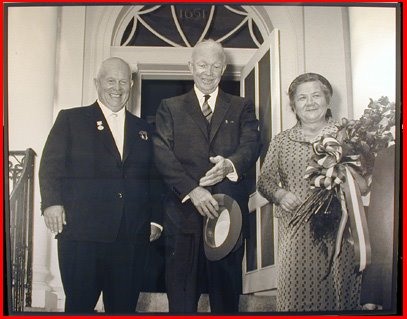
It turns out that the author of the article has a special interest in these things. Her name immediately caught my eye: Nina Khrushcheva.

Nina Khushcheva–could it be? As a reader of countless Russian novels, I recall how those Russian names work–it’s the feminine form of Khrushchev. And of course, as a person of a certain age, I remember that Nina was the name of Khrushchev’s wife:

The present day Nina, who turns out to be their great-granddaughter, teaches at the New School in NY and is a Soviet expert. In this reminiscence, she weaves her memories of her great-grandfather Nikita with her analysis of the ebb and flow of Russian politics.

Khrushchev’s famous 1956 speech denouncing Stalin’s murders was an epochal event in the history of Communism because–as Nina well describes–it let in the first breaths of freedom and reform, even though those breaths were small and self-serving (in an amazing quote, she says that Nikita “confessed he had needed to tell the story in part because his own arms were ‘covered with blood up to the elbows'”).

Khrushchev didn’t want the USSR or Communism to fall, and neither did Gorbachev when he instituted his much broader reforms. But events always have unforeseen consequences, and reform is one of those events–it can end up causing the whole ship to founder. And then, when the dictatorship is overthrown, the country whose economy has been tanking, whose population has lost initiative, whose social ties have been shattered by decades of informing on one another, whose trust in government has devolved to the most abject cynicism possible–how does that country go about rebuilding into a functioning democracy that protects human rights, as well one that boasts a robust economy?

It’s a daunting task, and the Grand Inquisitor’s solution always beckons. Putin definitely hears its siren call. But the alternative–the realpolitik policy of leaving dictators in place–is a lousy one, as well. Therein lies the conundrum.

[Part II here.]

Posted in Best of neo-neocon, History, Neocons, Politics | 37 Replies

North Korea joins the nuclear club

The New Neo Posted on October 8, 2006 by neoOctober 8, 2006

North Korea is somewhat of an informational black hole. But apparently even black holes may give off a few emissions now and then. Yesterday was one of those times for North Korea, which claims to have successfully accomplished an underground test of a nuclear weapon.

The interpretation of the event is a challenge (was it actually nuclear? how large was it?), not to mention the even greater and crucially important question of how to deal with it, and what it signifies for the future.

The UN leaped to the offense in its usual way–although with a rare unanimity of opinion–and voted to condemn the act. President Bush said, in a sentence that seems loaded with irony to me, “Once again, North Korea has defied the will of the international community and the international community will respond.”

If verbal disapproval were enough to affect North Korean policy, we’d be sitting pretty right now, because everyone who matters–including main North Korean ally and supporter China–has issued some sort of reprimand to the rogue state. But even diplomats are not naive enough to think that mere words will accomplish much; the question is what sort of teeth will go along with the tongue-clucking.

Speaking of diplomats–in a strange coincidence, this test occurs just as a South Korean is posed to become (on January first) the new Secretary-General of the UN. And in another coincidence (although a meaningless one) the new Secretary-General’s name is “Ban.” Would that he could. But he can’t; the cat is long out of that particular bag.

No one quite knows what to do to be effective, which is probably one of the reasons North Korea has done what it’s done (there’s a good roundup of a variety of opinions and articles on North Korea and the bomb test here at Pajamas Media).

Economic sanctions are possible, but they impact heavily on an already-suffering population held hostage by dictator Kim Jong-il. The EU has no plans to stop its aid (which only amounts to about twelve million dollars anyway), but South Korea is pondering an end to its engagement policy with the North, according to President Roh. Japan is considering unspecified “harsh measures,” although a statement was issued that the country is not planning to go nuclear. The US is considering some version of a naval blockade, although not to the point that it would constitute an act of war.

And China, key player as the main support of North Korea and vital to its continued existence as a minimally functioning economy, is somewhat of an enigma itself. Here’s an attempt by Joe Katzman at Winds of Change to solve the riddle of the Chinese sphinx. It’s well worth reading, although very sobering. The main thrust is the thought that, even though there are some drawbacks for China to a nuclear North Korea, there are many possible advantages that would lessen China’s motivation to really stop them:

…friction with the USA, paralysis that keeps their North Korean client safe from retaliation, and positioning Korea psychologically to be responsible for the North later (but not, for instance, for starving North Korean refugees now)… all are exactly what China’s doctor ordered from a geo-political perspective.

If Katzman’s analysis is correct (and it seems as good a one as any other I’ve read so far), perhaps the best thing to come out of the North’s nuclear test would be if South Korea drops its seeming naivete regarding its other half.

How did it come to this? Clinton played for time and helped create the monster through his own naive policies; the Bush administration was left holding the bag but never could figure out what to do with it. And the international community’s response to the lack of proof of weapons of mass destruction post-Iraqi war has shifted the burden of proof in a way that’s singularly unhelpful.

Of course, North Korea–unlike Saddam prior to the war (although it may be that his pose was just bravado), or Iran’s behavior now–isn’t trying to hide anything. On the contrary, the North is flaunting its newfound toys. But one thing is certain: the whole world is watching to see what will happen next, because how the world deals with this threat will set a tone for future threats. And future threats are bound to come in the age we appear to have entered now, that of relatively easy nuclear proliferation.

Posted in Uncategorized | 32 Replies

The Sanity Squad goes to Washington

The New Neo Posted on October 8, 2006 by neoOctober 8, 2006

Another week, another podcast. This time the Sanity Squad takes on Congress, in particular the Foley scandal, and the Squad doth not its punches pull.

(And if I sound a bit disconnected on this podcast, let me just drop the following hint as to what may have happened: Frank, the technical wizard at Pajamas, was far more successful than all the king’s horses and all the king’s men at putting the Skype-betrayed Humpty’s words together again.)

Posted in Uncategorized | 6 Replies

Subways: a token

The New Neo Posted on October 7, 2006 by neoJuly 25, 2009

I’m in New York City for the weekend, the town where I was born and raised but don’t visit all that much any more.

It seems to me there are more people here than ever. Whether that’s true or just my perception, they certainly sport more iPods than ever. Subway riders are more subdued than they used to be, dreamily lost in contemplation of their musical selections, bereft of the otherwise ubiquitous cell phones that don’t seem to function deep in the bowels of the stations.

This latter fact poses a dilemma, of course, when one is rushing to a meeting, as I was yesterday. Now, those who know me are aware that I tend at times to run just a tad late, but yesterday my tardiness was enhanced by the fact that I had to buy a subway card (the subway tokens of my youth long gone, along with the fifteen-cent fare).

The man in the booth–and they still do have a man in the booth, and I thought dealing with him would be faster than trying to relearn how to operate the automatic card machines–was relatively laconic about how the whole thing worked, however. Unlike most New Yorkers, he seemed to savor the slowness. By the time I managed to purchase the card (“I’d like one ride;” “I can’t sell you one ride;” “What’s the smallest number of rides I have to buy?” “Two;” “How much will that cost?” “Four dollars”) and put it in the turnstile slot and then step up to the train–my train, serendipitously arrived at the station while he and I were having it out–the subway doors slammed shut.

The wait for the next one was uncharacteristically long. And I was surprised at how antsy the lack of phone coverage made me. Apparently the cell phone has become such a regular part of my life that I take it for granted, although I’m not one of those people who walks around the city streets habitually jabbering on one. But they are incredibly useful items for just this very purpose: to say I’ll be a few minutes late; to say “Where are you?” when I’m meeting people in a public place and can’t find them.

The train did eventually come, as trains eventually do. Despite what I’d imagine would (and should and could) be major advances in technology, the guy who announces each station (at least, that’s what I think he does) is just as unintelligible as he was back in the days when Saturday Night Live made fun of him. The young lovers still smooch. The remnants of my high school Spanish are still such that I can understand all the ads in that language (“Learn English to become more independent”). New York is still the quintessential melting pot. People-watching is still a great sport here.

A few snapshots: an elegant and worried-looking person with profound cheekbones, so tall and thin and hawk-nosed, and with such a severely short haircut that it took me a while to ascertain she was in fact a woman, holds a dog carrier of a size that could only contain something tiny and yippy and frivolous, like a Yorkie. An Afro-American woman looks for all the world like Cleopatra, ancient and mysterious. The young man standing in front of me and holding onto the bar exudes a Brando-esque smolder (the young Brando of “Streetcar,” that is, not his nearly unrecognizable older manifestation).

Emerging at Times Square and walking to my destination–a hotel there, to meet some friends–it strikes me that this is not the Times Square of my youth. And I spent a great deal of that youth in this general area, because that’s where so many ballet studios were clustered, including the one where I spent several formative years, at the old Metropolitan Opera House.

At ten and eleven and twelve and thirteen and fourteen I rode the subway there and walked through a small part of what was then a sleazy and not-all-that-inhabited Times Square, keeping my head down, not wanting to make eye contact with the drunks and the perverts who seemed to be its main inhabitants. But yesterday (and every day these days, or so I hear) it brimmed with vast crowds of the mostly young to middle-aged, mostly upbeat and on the move. The signs are brighter and more numerous (although I miss–oh, how I miss–that old Camel smoking sign). And I, no longer a dancer or even young, moved among them, somewhat of a tourist in the city I once knew so well.

Posted in Getting philosophical: life, love, the universe, Me, myself, and I | 14 Replies

Steve Beren, changer extraordinaire: Part II

The New Neo Posted on October 6, 2006 by neoMarch 17, 2015

[Part I of my interview with McDermott challenger Steve Beren can be found here. We take up the second half of the interview shortly after 9/11, when Beren had become convinced that the unity the country faced was temporary and was bound to be disrupted by an antiwar movement.]

[B]: Events early in 2002 justified my thought there would be a large antiwar movement. I’d said it on Oct 31, 2001””and it was brewing on campuses already. Far left groups were already doing their spadework.

[N]: Your background as an activist seems to have given you insight as to how this was going to go down on the left. I was curious–what do you think it was about your experience that gave you this ability?

[B]: I was not only an antiwar activist. I was a trained Socialist in the antiwar movement. We had to study not only Marxist thought, but the tactics and strategies of past antiwar movements. I took that to heart. It had previously not occurred to me that all wars had antiwar movements””there was a small one during World War II but a big one before it actually began, and I took a special interest in those who remained antiwar throughout World War II such as the Nation of Islam, Quakers, etc.

[N]: So you were a historian of antiwar movements–

[B]: And antiwar strategy and tactics. And I was a participant in the Vietnam antiwar movement. I’ve written and spoken about Kerry’s involvement. There’s a plan: always bring religious people in, plus some disgruntled soldiers, and racial minorities saying there is injustice (for instance, the Nation of Islam in World War II didn’t want to fight against what they referred to as another colored race, meaning Japan). That combination appealed to a broad spectrum.

In the beginning of the Afghanistan war, there were rumblings in the media: there were rocky mountains, the British had failed there, the weather would be bad, this could be trouble. And back when John Kennedy had sent troops at the beginning of Vietnam the antiwar movement did it this way (in Vietnam, the Socialists supported the Communist takeover””but you don’t put that on a flyer, do you?) During the Cuban missile crisis what you’d say is that Kennedy is all concerned about Cuba, but he’s ignoring what’s happening in Vietnam. Or in Berlin. Then when he’s in Vietnam, you talk about how he’s ignoring Cuba. Ted Kennedy now talks about North Korea.

[N]: So these are strategies for all situations.

[B]: Yes, it’s a rhetorical device. You go from one thing to another, to add negativity to the media and the academic world. Regular people don’t like war””who does?–we all hope a rumor of war is not true. And if we start hearing things to discourage us it feeds on that: “we can’t win anyway, and we should be doing something else that’s more important.”

[N]: So, what’s your strategy for your Congressional campaign?

[B]: I’m running in a very liberal area in general. There’s an 80% Democratic district, and a 75% Democratic district. McDermott has gotten between 71 and 86 percent of the vote when he’s run [7th District].

But we’re gonna get way more votes than usual. In recent years the Republican party hasn’t even run an active campaign here; we’d announce we’re not contesting it””the last time they did was 1980; we got 40 percent of the votes against McDermott’s predecessor.

We decided to do it differently this time. We met with various Washington Republicans–eastern Washington is Republican, and you need better than usual Republican turnout in Seattle to win the state. I applied the Bush re-election strategy to the local election””which is to increase Republican turnout. I said, “What if we run an aggressive campaign, not a token? Start early and hit McDermott hard, play to win. Probably McDermott won’t lose but–but what if we got 30, 35 percent of the vote? It will help the statewide Republican candidates and generate enthusiasm for the other Republican candidates.”

I’ve appealed to Republican activists and they are very excited about my campaign, the goal of which is to help Republican candidates statewide, and to grow the Republican Party in Seattle of all places. I want to take my expertise on war and foreign politcy, take on McDermott on his territory in Seattle, and have more people here change their minds on the war on terrorism, decrease the number of people in denial in Seattle, and realize it’s not a “so-called” war. I’ve gotten exceptional coverage in the major dailies here.

[N]: You’re bringing a lot of energy, motivation, and optimism to your campaign.

I want to go back to something–in my change process, reading was enormously influential””especially on the internet; reading a variety of sources. One thing I thought interesting in your story was the incredibly important role reading 1984 had when you were young””was reading a part of your later change experience?

[B]: To this day I deliberately look at Democrat and Socialist websites. I find it fascinating to see how people are thinking””you have to know what the other side says if you want to change minds.

I learned to read at age two. My father would deliberately bring me books on subjects I wasn’t interested in. If I was reading all about dinosaurs, he said I should stop reading about dinosaurs and he’d bring me books about airplanes, or baseball, and said, “You must expand your horizons.” He was not an educated man, but at a very young age””I might have been ten””we were talking about Mein Kampf. He thought it was important to read it because you should expose yourself to views you find distasteful and don’t agree with–there’s something important about that.

That was my father’s way–he taught me to read and encouraged me to deliberately look at opposing views.

[N]: An important part of keeping your mind open so change could occur.

[B]: And it was annoying to fellow Socialists. I wasn’t just reading the other side in order to plan strategy but wondering “is that true?” And “what did newspapers say about it at that time?”

[N]: I have an idea that people who are able to change have always been critical thinkers in some way. That’s probably true of you. Even when you were toeing the party line you were more of a critical thinker than many who were in there with you.

[B]: Nevertheless I remained a Socialist for 20 or so years, with a long slow evolution away from it.

That was the conclusion of the Beren interview. I found the last exchange especially telling and even moving–the description of Beren’s father, encouraging (practically ordering) the boy to look at all sides, even those with which he disagreed. It was a foundation that allowed Beren to be a maverick who embraced Socialism and made it his life’s work, but that same attitude kept his questioning mind open to other points of view.

Now Beren is throwing himself into his present campaign with the same vigor that marked his earlier dedication to the cause of Socialism. If the old saying (often attributed–perhaps erroneously–to Churchill) that anyone who’s not a liberal at twenty has no heart and who’s not a conservative at forty has no brain, then we can safely say that Steve Beren is a man with both heart and brain.

Posted in Political changers | 60 Replies

Post navigation

← Previous Post
Next Post→

Your support is appreciated through a one-time or monthly Paypal donation

Please click the link recommended books and search bar for Amazon purchases through neo. I receive a commission from all such purchases.

Archives

Recent Comments

  • Former legislator on Open thread 3/12/2026
  • Steve (retired/recovering lawyer) on Open thread 3/12/2026
  • Niketas Choniates on Open thread 3/12/2026
  • om on Open thread 3/12/2026
  • IrishOtter49 on Open thread 3/12/2026

Recent Posts

  • Open thread 3/12/2026
  • Peeking through Iran’s fog of war
  • The press and that Iranian school that was reported to have been hit
  • As the sun quickly sets, not on the British Empire – that’s already gone – but on Britain itself
  • Open thread 3/11/2026

Categories

  • A mind is a difficult thing to change: my change story (17)
  • Academia (318)
  • Afghanistan (97)
  • Amazon orders (6)
  • Arts (8)
  • Baseball and sports (161)
  • Best of neo-neocon (88)
  • Biden (536)
  • Blogging and bloggers (580)
  • Dance (286)
  • Disaster (238)
  • Education (319)
  • Election 2012 (360)
  • Election 2016 (565)
  • Election 2018 (32)
  • Election 2020 (510)
  • Election 2022 (114)
  • Election 2024 (403)
  • Election 2026 (11)
  • Election 2028 (3)
  • Evil (126)
  • Fashion and beauty (323)
  • Finance and economics (999)
  • Food (316)
  • Friendship (47)
  • Gardening (18)
  • General information about neo (4)
  • Getting philosophical: life, love, the universe (724)
  • Health (1,132)
  • Health care reform (545)
  • Hillary Clinton (184)
  • Historical figures (329)
  • History (699)
  • Immigration (426)
  • Iran (400)
  • Iraq (223)
  • IRS scandal (71)
  • Israel/Palestine (785)
  • Jews (412)
  • Language and grammar (357)
  • Latin America (201)
  • Law (2,880)
  • Leaving the circle: political apostasy (124)
  • Liberals and conservatives; left and right (1,269)
  • Liberty (1,097)
  • Literary leftists (14)
  • Literature and writing (386)
  • Me, myself, and I (1,463)
  • Men and women; marriage and divorce and sex (902)
  • Middle East (380)
  • Military (307)
  • Movies (342)
  • Music (523)
  • Nature (254)
  • Neocons (32)
  • New England (176)
  • Obama (1,735)
  • Pacifism (16)
  • Painting, sculpture, photography (126)
  • Palin (93)
  • Paris and France2 trial (25)
  • People of interest (1,015)
  • Poetry (255)
  • Political changers (176)
  • Politics (2,764)
  • Pop culture (392)
  • Press (1,609)
  • Race and racism (857)
  • Religion (411)
  • Romney (164)
  • Ryan (16)
  • Science (621)
  • Terrorism and terrorists (965)
  • Theater and TV (263)
  • Therapy (67)
  • Trump (1,573)
  • Uncategorized (4,328)
  • Vietnam (108)
  • Violence (1,393)
  • War and Peace (958)

Blogroll

Ace (bold)
AmericanDigest (writer’s digest)
AmericanThinker (thought full)
Anchoress (first things first)
AnnAlthouse (more than law)
AugeanStables (historian’s task)
BelmontClub (deep thoughts)
Betsy’sPage (teach)
Bookworm (writingReader)
ChicagoBoyz (boyz will be)
DanielInVenezuela (liberty)
Dr.Helen (rights of man)
Dr.Sanity (shrink archives)
DreamsToLightening (Asher)
EdDriscoll (market liberal)
Fausta’sBlog (opinionated)
GayPatriot (self-explanatory)
HadEnoughTherapy? (yep)
HotAir (a roomful)
InstaPundit (the hub)
JawaReport (the doctor’s Rusty)
LegalInsurrection (law prof)
Maggie’sFarm (togetherness)
MelaniePhillips (formidable)
MerylYourish (centrist)
MichaelTotten (globetrotter)
MichaelYon (War Zones)
Michelle Malkin (clarion pen)
MichelleObama’sMirror (reflect)
NoPasaran! (bluntFrench)
NormanGeras (archives)
OneCosmos (Gagdad Bob)
Pamela Geller (Atlas Shrugs)
PJMedia (comprehensive)
PointOfNoReturn (exodus)
Powerline (foursight)
QandO (neolibertarian)
RedState (conservative)
RogerL.Simon (PJ guy)
SisterToldjah (she said)
Sisu (commentary plus cats)
Spengler (Goldman)
VictorDavisHanson (prof)
Vodkapundit (drinker-thinker)
Volokh (lawblog)
Zombie (alive)

Meta

  • Log in
  • Entries feed
  • Comments feed
  • WordPress.org
©2026 - The New Neo - Weaver Xtreme Theme Email
Web Analytics
↑