
↓
 

The New Neo

A blog about political change, among other things

  • Home
  • Bio
  • Email
Home » Page 1651 << 1 2 … 1,649 1,650 1,651 1,652 1,653 … 1,864 1,865 >>

Post navigation

← Previous Post
Next Post→

Confessions of a creditholic

The New Neo Posted on May 19, 2009 by neoMay 19, 2009

Ann Althouse says she wanted to smack Edmund L. Andrews, author of “My Personal Credit Crisis“, when she read his article in Sunday’s NY Times Magazine. And it wouldn’t be a love tap, either.

I’m with Althouse.

Andrews begins by saying, “If there was anybody who should have avoided the mortgage catastrophe, it was I. As an economics reporter for The New York Times, I have been the paper’s chief eyes and ears on the Federal Reserve for the past six years.”

And yet, not only did Andrews fail to avoid the catastrophe, and not only did he plunge into it with verve and vigor when he of all people should have known better, he continued to throw good money after bad, refusing to acknowledge his errors and getting ever more deeply into the hole as he covered his overextensions with ever-spiraling credit card debt.

And for what? It’s not as though Andrews and his wife-to-be (who sounds like somewhat of a financial ditz, but at least she’s got an excuse—she’s not an economics reporter for the Times) were poverty-stricken. It was just that they wanted to live in a manner to which their salaries really did not allow them to become accustomed: buying the dream house, taking the dream vacations, indulging the kids in the dream indulgences, and pretending they never had to think about whether they could afford these things.

The banking and credit industry was only too happy to oblige, by lending them more money than they could afford to pay, counting on the fact that their new home would only appreciate. Sound familiar? Andrews and his fiance, despite being highly educated and supposedly sophisticated, continue to plead ignorance and the seductiveness of easy money—pretty strange coming from a man with his job [emphases mine]:

I thought I knew a lot about go-go mortgages. I had already written several articles about the explosive growth of liar’s loans, no-money-down loans…Yet for all that, I was stunned at how much money people were willing to throw at me…

As I walked out of the settlement office with my loan papers, I couldn’t shake the sense of having just done something bad . . . but also kind of cool…It had been so easy and fast. Almost fun…

Meanwhile, neither of us was paying attention to how easy our bank had made it to build up debt…

Patty and I were now unwittingly tapping into our credit line at a terrifying pace…

Our debt spiraled up faster than I had ever dreamed possible…

Between humongous loan balances and high rates, we had hung ourselves with the rope they gave us…

Andrews remains mystified as to how this could have happened to him. I can help him out on that: greed and denial. No one forced him to do any of this, and he of all people ought to have known better. But his story is an excellent example of how far many people in this country have come from any idea of personal responsibility.

And that lack of responsibility continues. Who’s paying now? It certainly doesn’t seem to be Andrews, whose bank is so overloaded with potential foreclosures that it hasn’t gotten around to modifying his loan yet (“don’t call us, we’ll call you”). The last sentence of his piece is “Eight months after my last payment to the bank, I am still waiting for the ax to fall.”

So he and the family are living rent-free in their lovely suburban home while the rest of us idiots pay our mortgages and/or our rents and try to live more or less within our means. Sweet.
Posted in Finance and economics | 86 Replies

Obama meets Netanyahu

The New Neo Posted on May 18, 2009 by neoMay 18, 2009

I’ve read eight articles so far on today’s meeting between Obama and Israeli PM Netanyahu, and I’m convinced that none of the authors knows much of anything about what will happen.

You might say that’s always been true of the Middle East, and most particularly of the Israel/Palestine situation. But it’s especially true right now, because of two wild cards: President Obama and the leaders of Iran.

Netanyahu is more of a known quality, a hardliner on the issue of Israel’s survival against the threat posed by the Palestinians and their supporters on one hand and a potentially nuclear Iran on the other:

A senior aide to Netanyahu, national security adviser Uzi Arad, suggested the Israeli leader might not yield to pressure from Obama for a two-state solution to the Middle East conflict. He also seemed to hint that Israel might consider military action against Iran when he said there was a “sense of urgency” in Israel over the Iranian nuclear threat.

Obama is his usual shifting self. It’s not so much that he’s a blank slate; it’s that he’s given out such a variety of mixed messages, and has changed his tune on so many other things, that there’s no telling which way he’ll jump. However, the preponderance of evidence points in the ominous Jimmy Carteresque direction:

For 30 years, Israel has not had to deal with as difficult—sometimes even hostile—a U.S. administration as the Carter one. I [Yehuda Ben-Meir] can personally attest to the brutal style and blatant threats that characterized the relationship between Jimmy Carter and Menachem Begin. Indeed, Carter is someone whose beginnings can be seen in the way he has ended up.

The Obama White House, meanwhile, has been accepting and welcoming of those who spent years arguing that American foreign policy has been enslaved to Israel’s interests and is influenced by the Jewish lobby, but were unable to get a foot in the door during the Reagan, Clinton and Bush administrations.

But Obama has previously surprised his Left flank by changing his tune on such matters as the treatment of terrorists and their legal rights. So I don’t consider it outside the realm of possibility that he will be more Israel-friendly than seems likely. I also don’t consider it outside the realm of possibility that he will be even less Israel-friendly than seems likely.

As for Iran, our policy towards that country rests entirely on an analysis of whether its leaders are guided by any remaining pragmatism, or whether they are following the dictates of religious and cultural fanaticism, rampant anti-Semitism, and demonization of the state of Israel. Their rhetoric certainly indicates the latter; they don’t call Israel the “little Satan” for nothing.

How deep is Obama’s belief that Iran can be reasoned with? How far is he willing to go, how patient is he willing to be, how much is he willing to risk, to find out? And how much time is Netanyahu willing to give Obama before he takes matters into his own hands to stop Iran from acting out on what appears to be an existential threat to Israel’s existence?

Anyone who offers an answer to any of these questions right now is only guessing, I’m afraid. So I’m not even going to try.

Posted in Israel/Palestine, Obama | 83 Replies

Surprise! The rich act in their own self-interest when taxed

The New Neo Posted on May 18, 2009 by neoMay 18, 2009

Troubled state governments often look to raise taxes on the rich in their attempt to shore up their depleted coffers.

It’s a no-brainer, right? After all, the rich can afford it, and the rest of us can’t. Plus, it appeals to the current Obama-stoked rage at all those nasty greedy (fill in the perjorative adjective of your choice) financiers who caused all the trouble in the first place, talking the rest of us poor (or poorish, or relatively poor in comparison to the filthy rich) folk into maxing out on credit cards and buying mansions we couldn’t afford.

Oh, but it turns out that the rich actually have brains, and they tend to use them to preserve their own assets. Fancy that; how avaricious of them:

Here’s the problem for states that want to pry more money out of the wallets of rich people. It never works because people, investment capital and businesses are mobile: They can leave tax-unfriendly states and move to tax-friendly states…

E.J. McMahon, a fiscal expert at the Manhattan Institute, measured the impact of large income-tax rate increases on the rich ($200,000 income or more) in Connecticut, which raised its tax rate in 2003 to 5% from 4.5%; in New Jersey, which raised its rate in 2004 to 8.97% from 6.35%; and in New York, which raised its tax rate in 2003 to 7.7% from 6.85%. Over the period 2002-2005, in each of these states the “soak the rich” tax hike was followed by a significant reduction in the number of rich people paying taxes in these states relative to the national average. Amazingly, these three states ranked 46th, 49th and 50th among all states in the percentage increase in wealthy tax filers in the years after they tried to soak the rich.

How can this be? Arthur Laffer and Stephen Moore, the authors of the article, and a book entitled Rich States, Poor States write:

We believe there are three unintended consequences from states raising tax rates on the rich. First, some rich residents sell their homes and leave the state; second, those who stay in the state report less taxable income on their tax returns; and third, some rich people choose not to locate in a high-tax state. Since many rich people also tend to be successful business owners, jobs leave with them or they never arrive in the first place. This is why high income-tax states have such a tough time creating net new jobs for low-income residents and college graduates.

I suppose that if all states started adopting the strategy of raising taxes on the rich, the disparities would eventually be erased and people would become less mobile. But unless and until the Obama administration tries to abolish the states’ rights to set their own taxes (or starts attempting to shame those states that don’t ask their rich to “sacrifice” enough), I think we’re safe from that sort of forced equality. And even if all the states (or the federal government, for that matter) were to raise tax rates on the rich, I think we’d see the rich becoming less productive and/or lying on their tax returns, and/or searching ever more assiduously to find effective tax shelters.

Beware the law of unintended consequences.

[NOTE: Laffer is indeed the Laffer, of the famous Laffer curve. He also made a public bet with doomsayer Peter Schiff that the housing bubble wouldn’t burst when it did. Laffer lost, and Schiff had the last laugh.]

Posted in Finance and economics | 21 Replies

Could someone pleaze muzzle Joe Biden?

The New Neo Posted on May 18, 2009 by neoMay 18, 2009

Apparently not. But it’s time.

Posted in Uncategorized | 7 Replies

Hitchens on Obama’s humor

The New Neo Posted on May 18, 2009 by neoNovember 2, 2012

Christopher Hitchens makes an excellent point about one of the things that’s wrong with Obama’s attempts at humor:

President Bush used to tell jokes about his weaknesses, the most salient of these being his tragic struggle with grammar, itself quite possibly rooted in dyslexia. Many of President Obama’s jokes, his speechwriters should take note, were at the expense of his strengths”””I might lose my cool”””and were thus bordering on the narcissistic. (If I have a fault, and I’m the first to admit it, it’s probably this: I am too sweet and too patient and too tolerant of the mistakes of others.)

My only beef with this would be that Obama’s jokes, like the man himself, don’t “border” on the narcissistic. They most definitely cross that line.

Posted in Obama | 4 Replies

Let’s hear it for the fillies

The New Neo Posted on May 16, 2009 by neoMay 16, 2009

I don’t follow horse racing, but I do take an interest in fillies. And so I’m very happy to hear that Rachel Alexandra (doesn’t really sound like a horse, does it?—even a girl horse) has won the Preakness, the first filly to do do since 1924.

What’s more, she seems in fine fettle after the feat. A far cry from last year’s Kentucky Derby, and the sad memory of what happened to another extraordinary filly of yesteryear, Ruffian.

Posted in Baseball and sports | 14 Replies

Obama and responsibility

The New Neo Posted on May 16, 2009 by neoMay 16, 2009

There have been a number of reversals from Obama lately on what used to be called the “war on terror.” All of these switches are in the same direction, towards Bush’s once-reviled policies and away from the standard liberal/Left line.

In this recent post, I speculated on what might be causing these changes when I wrote, “now that Obama will own whatever happens in Afghanistan, it behooves him to be more careful, doesn’t it?” One can extrapolate from “Afghanistan” to “war on terror,” and theorize that Obama isn’t eager to have another terrorist attack occur here on his watch.

Good, I say; I’m not eager to have that happen, either. But the phenomenon of Obama’s backtracking is an example of something even larger, the general issue of taking responsibility.

So far Obama has been, without question or rival, the President most heavily involved in holding his predecessors responsible for everything that has gone wrong since his taking office. The cries of “don’t blame us for anything we’ve done about the economy; after all we inherited it,” have been nearly unceasing, and are unprecedented for an incoming administration.

This tactic of continual blame fits in with well with, and is fostered by, the MSM, as well as being nicely congruent with widespread Bush Derangement Syndrome in its larger and smaller manifestations. But it also dovetails neatly with Obama’s personality and history: my sense is that the man has almost never before had to take responsibility for his actions and their consequences, at least in the public realm.

Read any summary of Obama’s life and achievements and you will be struck by the fact that Obama always impressed people by his very being; something about the man inspired confidence and conveyed competence. But in each of his career moves, his actual accomplishments were few—although it was hard to notice because he rarely stayed long enough for people to expect him to have shown something for his tenure. You might say that “hope and change” was Obama’s mantra, even back then: people would hope a great deal of him, and then he’d change jobs before they noticed that he hadn’t delivered much.

Now Obama is stuck; there’s nowhere to go after the Presidency but down, careerwise. He’s here for four years at least, and under the sort of constant scrutiny he’s not accustomed to (nor is anyone, really, prior to taking on the office). Even though the press is in his pocket and always has been, there are more rumblings of discontent now coming from that source than Obama has probably ever experienced before in his life. Moreover, he must be aware that, as time goes by, and despite his blame-Bush propensities, at some point more people are likely to start holding him accountable for what goes on while he’s President.

Obama is most vulnerable in the realm of the war on terror. After all, even the most committed Bush-hater has to begrudgingly admit that after 9/11 no more terrorist attacks of any magnitude occurred on our soil, although nearly everyone expected them (of course, some of the most committed Bush-haters think that it was Bush himself who was the perpetrator of 9/11—but let’s assume they’re a mere fringe element). Through hook or by crook, Bush “kept us safe,” and Cheney and company are harping on that fact and suggesting that Obama won’t be able to do the same.

This must haunt Obama and cause him to do a bit of thinking. As time goes on, whatever happens will become more and more difficult to pin on Bush, although he’ll probably continue to try. Thus, the willingness to take some responsibility and defy his own supporters on the Left, who are up in arms about his backtracking on the “abuse” photos, the military tribunals, and indefinite detention.

Previously in his public life, Obama was a senator—first state, then federal. Senators are notorious for being able to pass the buck. They are one of a group, after all, and groups diffuse responsibility.

The presidency is a very different beast indeed. Those who aspire to it can say what they will. But once they are in office, the buck tends to stop at their very own desk—even if they continue to desperately try to pass it.

Posted in Obama | 44 Replies

Why Pelosi must lie

The New Neo Posted on May 16, 2009 by neoMay 16, 2009

Some people have asked why Pelosi hasn’t just said, “Look, at the time of the briefings I thought waterboarding was okay, but now I see the light and I’m against it.” Such a statement would have arguably gotten her in a lot less trouble than the course she’s taken instead: a series of ever-changing and hedgy excuses that read as lies, culminating in her making accusations against the CIA that have roused its formidable defenses against her.

I don’t think Pelosi is stupid, although I agree with almost nothing she stands for or says. She has shown great political savvy and cunning in her long career. Why does it appear to be deserting her now?

I see Pelosi as having been put between a rock and a hard place by Obama’s release of the “torture memos” and the resultant brouhaha. If she were to make the statement I posited in the first paragraph of this post, she would be admitting something that would contradict the entire Democratic Party “narrative” of the Bush administration’s decisions regarding terrorists.

Going that route would destroy the tale the Democrats have ridden to victory and power: that the Bush administration was evil, lying to us (rather than sometimes mistaken), trampling on liberties for the sake of power and even sadism. How can Democrats contradict themselves by acknowledging now that nearly all of Bush’s decisions in the war on terror were arrived at after due deliberation, analysis of the best information available at the time (the conclusion that Saddam Hussein possessed WMDs would be a prominent example), acting in the best interests of our country, and with an effort to preserve as much liberty and protection as seemed possible?

For Democrat leaders to do so would be to undercut their own story about Bush, which was (and remains) vital to their own success. So it cannot be done, and Pelosi knows it—even if she also knows it is actually the truth of why she did nothing to stop or protest waterboarding back when she was first informed about it.

[NOTE: Please read this article about the “torture memos” and the legal decision-making behind them.]

Posted in Politics | 23 Replies

House-sitting, squared

The New Neo Posted on May 16, 2009 by neoMay 16, 2009

Back in my more peripatetic days, I used to think that house-sitting might be a good gig. Spend some time here and there in other people’s pleasant homes, paying nothing or maybe even getting paid, with hardly more responsibility than making the place look occupied, and feeding and walking the dog.

And now I read that, in certain upscale areas of our depressed housing market, the erstwhile house-sitter has morphed into the resident manager, a person willing to move quickly, with all his or her worldly stuff, into an otherwise vacant house and give it that certain je ne sais quoi that says “home” to prospective buyers.

It’s not an easy life. For starters, there’s all that moving—although the stay could be rather long if the house doesn’t sell right away. Then there’s the strain of keeping the place neat at all times, so it can be shown at a moment’s notice (refrigerated cookie dough is necessary too, to pop into the oven to give the place that tantalizing aroma). And anything too controversial, decoratively speaking, is a no-no.

But the rent is cheap. And a commission can be earned at closing time. Acting credits are a plus—and so it’s good that many of these job openings are in California, where unemployed actors abound.

But it’s not just California:

Showhomes Management LLC, a franchise operation based in Nashville, has 350 “resident managers” living in homes for sale in 46 high-end markets, including in Florida, Arizona and Illinois. The company has seen revenues increase 88% since last year, says vice president Thomas Scott. Unoccupied staged houses aren’t selling as well as those with people in them, he says, “because people can still tell they’re vacant.”

Call me behind the times, but somehow I don’t think there’s going to be a whole lot more growth in this particular industry.

Posted in Finance and economics | 2 Replies

The evolution of Queen Nancy

The New Neo Posted on May 15, 2009 by neoMay 16, 2009

Unless you’ve been on another planet recently, you are probably aware of the current brouhaha over House Speaker Nancy Pelosi; what she knew about waterboarding and when, and just who’s the biggest liar.

I’d call Pelosi a polarizing figure, except that I’ve noticed that even her defenders aren’t really all that keen on her. Her strangely offputting affect, her tense and confused body language (even before this incident), have made it easy for epithets such as “wicked witch” and “Queen Nancy” to come trippingly to the tongue of detractors.

So I wondered how it was that this particularly uncharismatic woman got her start in politics. This Wiki entry describes some of Pelosi’s background, and it’s an interesting tale.

Born to a family deeply involved in Democratic power and politics, she was the daughter of a Congressman from Maryland and mayor of Baltimore, and her brother was also a two-term mayor of that city. Early on, Pelosi interned for Senator Daniel Brewster, a Maryland Democrat. It was there that she met fellow intern, and later colleague and rival, Steny Hoyer.

Pelosi married a San Francisco man and moved to that city, where her brother-in-law was involved in local politics as well. It was perhaps inevitable that, during the time Pelosi was raising her five children, she would get involved in the local Democratic Party:

She was elected as party chairwoman for Northern California on January 30, 1977. She later joined forces with one of the leaders of the California Democratic Party, 5th District Congressman Phillip Burton. In 1987, after her youngest child became a high school senior, she decided to run for political office.

In a sense, the well-connected Pelosi was actually annointed rather than elected. Here’s the story, according to Wiki:

Phillip Burton died in 1983 and was succeeded by his wife, Sala. In late 1986, Sala became ill with cancer and decided not to run for reelection in 1988. She picked Pelosi as her designated successor, guaranteeing her the support of the Burtons’ contacts. Sala died on February 1, 1987, just a month after being sworn in for a second full term. Pelosi won the special election to succeed her, narrowly defeating San Francisco Supervisor Harry Britt on April 7, 1987, then easily defeating Republican candidate Harriet Ross on June 2, 1987; Pelosi took office a week later. She has the distinction of contributing the most among members of Congress to other congressional campaigns because she is in a safe district and does not need the campaign funds.

Therein lies a hint of Pelosi’s power: once she was picked by Sala, she was home free, with nearly-guaranteed reelection for as long as she wanted it (her district has a grand total of 13% registered Republicans). She also was in a position to reward those who cooperated with and supported her, because of her ability to donate funds to them.

I don’t pretend to have the inside scoop on how Pelosi rose to power within the House. Perhaps a full autobiography (such as this) would tell, but I haven’t read one. However, it’s clear from this article that initially it was due to her remarkable fundraising abilities, and that later she showed a flair for organizing the defeated Democrats during the Bush presidency, giving them the notion they could win back Congress and then coming up with the strategy to do so.

So Pelosi’s rise has been marked by political savvy, beginning in childhood and developed during an entire lifetime in Democrat politics. She may not be a great intellect, but until now she’s been a genius at reviving her party and choosing issues that will rally voters to its side. Her lack of personal charisma has not mattered at all: designated as successor by a mentor, running in a completely safe district, she hasn’t needed it.

In taking on the CIA, has Pelosi finally gained an enemy more formidable than the Republican Party—or Majority Leader Steny Hoyer, her old colleague who has remained her nemesis and might be waiting in the wings? (Wiki states that “Pelosi and Hoyer had a somewhat frosty relationship dating back to 2001, when they ran against each other for minority whip.”)

All I can say is that time will tell. A month ago no one would have predicted that the decision to release the “torture memos” would backfire on Pelosi in this way, and no one can predict the final outcome of this intriguing set of circumstances.

[ADDENDUM: Now Panetta draws a line in the sand.]

{ADDENDUM II: Back in 2002, Jim Miller saw Pelosi as one in a long line of machine politicians. I concur.]

Posted in People of interest | 28 Replies

RIP Hugh Van Es

The New Neo Posted on May 15, 2009 by neoMay 15, 2009

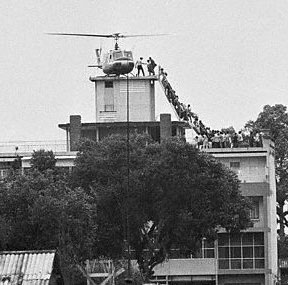
Hugh Van Es, the photographer who took the iconic “helicopters on the roof” photo of the fall of Saigon, has died at 67:

[Van Es’s] shot of the helicopter escape from a Saigon rooftop on April 29, 1975 became a stunning metaphor for the desperate U.S. withdrawal and its overall policy failure in Vietnam.

As North Vietnamese forces neared the city, upwards of 1,000 Vietnamese joined American military and civilians fleeing the country, mostly by helicopters from the U.S. Embassy roof.

A few blocks distant, others climbed a ladder on the roof of an apartment building that housed CIA officials and families, hoping to escape aboard a helicopter owned by Air America, the CIA-run airline.

From his vantage point on a balcony at the UPI bureau several blocks away, Van Es recorded the scene with a 300-mm lens—the longest one he had.

Van Es spent a great deal of time attempting (usually in vain) to correct the popular notion that his photo was of the US Embassy roof, where the bulk of the evacuations took place. Here’s his photo:

saigon-helicopter.jpg

I’ve written several pieces about the fall of Vietnam and the meaning this and similar photos have taken on in the aftermath (see these posts). But today I’d like to reprise one of them, which describes the real story of the evacuations at the end of the war.

A view of that famous day in 1975, from eyewitness Col. Harry G. Summers, appears here, (see pages four through six). Col. Summers paints a vivid and detailed picture of the Herculean but ultimately unsuccessful efforts of the military to make sure everyone at the embassy was evacuated, as they had been promised.

One seldom-remembered fact is that the evacuation had been ongoing for several weeks, beginning with fixed-wing flights that had to be creatively managed because (in another seldom-remembered fact), the South Vietnamese government had barred its officials and its military personnel from leaving.

Even so, there was no way all those who wanted to go could be evacuated in time. But on that fateful day on the Embassy roof, Summers relates that all of those who had gathered there to be airlifted could have successfully escaped, and the majority there did. Of thousands who had already been helicoptered out from the Embassy alone on that single day and night, “only” 420 were left behind. Summers describes some of them:

America had not only fecklessly abandoned its erstwhile ally in its time of most desperate need but also had shamefully abandoned the last several hundred of those evacuees who had trusted America to the very end. Included were the local firemen who had refused earlier evacuated so as to be on hand if one of the evacuation helicopters crashed into the landing zone in the embassy courtyard; a German priest with a number of Vietnamese orphans; and members of the Republic of Korea (ROK) embassy, including several ROK Central Intelligence Agency officers who chose to remain to the end to allow civilians to be evacuated ahead of them and who would later be executed in cold blood by the North Vietnamese invaders.

After calming the panicky crowds by speaking in Vietnamese to them, clearing a landing area so that the choppers could do their work (it was impossible to evacuate the people by any other vehicle, since the streets of Saigon had become virtually impassible with the enormous crowds), why were the Marines forced to abandon some of their allies who had gathered at the Embassy?

The worst of it was that it was all unintentional, the result of a breakdown in communication between those on the ground running the embassy evacuation, those offshore with the fleet controlling the helicopters, and those in Honolulu and Washington who were making the final decisions. In short, it was the Vietnam War all over again.

As Summers tells it, there were only six planeloads left, and the Marines were determined to airlift them. But then the order came:

At 4:15 a.m. Colonel Madison informed Wolfgang Lehmann that only six lifts remained to complete the evacuation. Lehmann told him no more helicopters would be coming. But Colonel Madison would have none of it. We had given our word.

Madison and his men would be on the final lift after all the evacuees under our care had been flown to safety. Lehmann relented and said the helicopters would be provided. That message was later reaffirmed by Brunson McKinley, the ambassador’s personal assistant. But McKinley was lying. Even as he reassured us, he knew the lift had been canceled, and he soon fled, along with the ambassador and Lehmann, his DCM.

Apparently, the helicopter squadron commander back at the fleet had given the command to cease. But it was a misunderstanding; in Summers’s words, the commander had “believed they were dealing with a bottomless pit, and no one realized they were but six lifts from success.”

But it was too late now; the evacuation was over, and the images remain. And although it’s true that more of these people were successfully rescued that day than is commonly believed, it’s also true that they only represented a tiny fraction of those who wanted to leave but could not. The vast numbers of boat people who tried to follow later proved that, only too well.

Posted in Press, Vietnam | 7 Replies

Does anyone believe Nancy Pelosi? And does it matter?

The New Neo Posted on May 14, 2009 by neoMay 14, 2009

My answer to the first question is: nobody, not even Pelosi. Maybe especially not Pelosi.

Her story on the waterboarding briefings has changed so many times, and is stated with such verbal hesitancy and telegraphing of prevarication, that even the commenters on the liberal blogs I’ve visited don’t seem to think she’s telling the truth.

Pelosi appears to be intent on kicking up enough dust, making so many accusations of “liar” towards those in the CIA who allegedly informed her, that people will be too distracted to care when and how and why and exactly what she was told about the practice of waterboarding, and what she then did or didn’t do about it.

The gist of the most common liberal reaction I’ve seen so far is: she’s probably a liar. But she’s not as bad a liar as Bush and Cheney and the CIA and every Republican on earth, so who cares? That cynicism has reached this pretty pass is a sad thing, but that’s the way it appears to be.

Not only does no one seem to believe Pelosi, no one really seems to like her, even in her own party. There’s something about the woman that positively shrieks “naked and self-serving political animal,” something so coldly calculating and strategic and amoral that it stands out even among her fellow politicians.

But power is power, and Pelosi’s got it, because the Democrats have it. The real question is: will this incident end up leading to her undoing? Is a “truth commission” (Orwell, anyone?) going to be launched? And does any of it matter?

Posted in Uncategorized | 35 Replies

Post navigation

← Previous Post
Next Post→

Your support is appreciated through a one-time or monthly Paypal donation

Please click the link recommended books and search bar for Amazon purchases through neo. I receive a commission from all such purchases.

Archives

Recent Comments

  • mkent on Pundits unbound
  • Wendy K Laubach on One movie after another
  • TJ on Open thread 3/16/2026
  • huxley on Pundits unbound
  • Bob Wilson on Still another update on the SAVE Act

Recent Posts

  • Pundits unbound
  • Still another update on the SAVE Act
  • I actually watched the Oscars last night
  • Open thread 3/16/2026
  • One movie after another

Categories

  • A mind is a difficult thing to change: my change story (17)
  • Academia (318)
  • Afghanistan (97)
  • Amazon orders (6)
  • Arts (8)
  • Baseball and sports (161)
  • Best of neo-neocon (88)
  • Biden (536)
  • Blogging and bloggers (581)
  • Dance (286)
  • Disaster (238)
  • Education (319)
  • Election 2012 (360)
  • Election 2016 (565)
  • Election 2018 (32)
  • Election 2020 (510)
  • Election 2022 (114)
  • Election 2024 (403)
  • Election 2026 (13)
  • Election 2028 (4)
  • Evil (126)
  • Fashion and beauty (323)
  • Finance and economics (1,000)
  • Food (316)
  • Friendship (47)
  • Gardening (18)
  • General information about neo (4)
  • Getting philosophical: life, love, the universe (724)
  • Health (1,132)
  • Health care reform (545)
  • Hillary Clinton (184)
  • Historical figures (329)
  • History (699)
  • Immigration (426)
  • Iran (402)
  • Iraq (223)
  • IRS scandal (71)
  • Israel/Palestine (785)
  • Jews (414)
  • Language and grammar (357)
  • Latin America (202)
  • Law (2,882)
  • Leaving the circle: political apostasy (124)
  • Liberals and conservatives; left and right (1,271)
  • Liberty (1,097)
  • Literary leftists (14)
  • Literature and writing (386)
  • Me, myself, and I (1,465)
  • Men and women; marriage and divorce and sex (902)
  • Middle East (380)
  • Military (308)
  • Movies (344)
  • Music (524)
  • Nature (254)
  • Neocons (32)
  • New England (176)
  • Obama (1,735)
  • Pacifism (16)
  • Painting, sculpture, photography (126)
  • Palin (93)
  • Paris and France2 trial (25)
  • People of interest (1,015)
  • Poetry (255)
  • Political changers (176)
  • Politics (2,765)
  • Pop culture (392)
  • Press (1,610)
  • Race and racism (857)
  • Religion (411)
  • Romney (164)
  • Ryan (16)
  • Science (621)
  • Terrorism and terrorists (967)
  • Theater and TV (263)
  • Therapy (67)
  • Trump (1,575)
  • Uncategorized (4,332)
  • Vietnam (108)
  • Violence (1,394)
  • War and Peace (961)

Blogroll

Ace (bold)
AmericanDigest (writer’s digest)
AmericanThinker (thought full)
Anchoress (first things first)
AnnAlthouse (more than law)
AugeanStables (historian’s task)
BelmontClub (deep thoughts)
Betsy’sPage (teach)
Bookworm (writingReader)
ChicagoBoyz (boyz will be)
DanielInVenezuela (liberty)
Dr.Helen (rights of man)
Dr.Sanity (shrink archives)
DreamsToLightening (Asher)
EdDriscoll (market liberal)
Fausta’sBlog (opinionated)
GayPatriot (self-explanatory)
HadEnoughTherapy? (yep)
HotAir (a roomful)
InstaPundit (the hub)
JawaReport (the doctor’s Rusty)
LegalInsurrection (law prof)
Maggie’sFarm (togetherness)
MelaniePhillips (formidable)
MerylYourish (centrist)
MichaelTotten (globetrotter)
MichaelYon (War Zones)
Michelle Malkin (clarion pen)
MichelleObama’sMirror (reflect)
NoPasaran! (bluntFrench)
NormanGeras (archives)
OneCosmos (Gagdad Bob)
Pamela Geller (Atlas Shrugs)
PJMedia (comprehensive)
PointOfNoReturn (exodus)
Powerline (foursight)
QandO (neolibertarian)
RedState (conservative)
RogerL.Simon (PJ guy)
SisterToldjah (she said)
Sisu (commentary plus cats)
Spengler (Goldman)
VictorDavisHanson (prof)
Vodkapundit (drinker-thinker)
Volokh (lawblog)
Zombie (alive)

Meta

  • Log in
  • Entries feed
  • Comments feed
  • WordPress.org
©2026 - The New Neo - Weaver Xtreme Theme Email
Web Analytics
↑