
Here’s a good summary of Obama’s m.o., written by a Canadian journalist.
Health care reform: I am sick and tired of…
…bad faith, distortions, and lies on the part of the bill’s proponents—plus their counter-accusations that it’s actually only the opponents of the bill who are guilty of bad faith, distortions, and lies.
Many of you have probably already seen the video of the “wink, wink, ‘this is the first step towards single-payer but don’t let the public know'” statements of so many pushing this bill. But if not, here it is:
And, speaking of “don’t let the public know,” whatever happened to transparency and the posting of prospective bills online in a timely fashion? Although some on the Right are trying to force the issue on the health care reform bill, the Democrats in Congress who head the Committee in charge know they can stonewall by keeping the American people in the dark about the details through most of the August recess, the better to head off any substantive objections and the better to spread reassuring misinformation about how wonderful it will all be:
Unfortunately, the House Energy and Commerce Committee is dragging its feet on posting the final bill. When we called them yesterday morning to get a copy, we were told that the amended version might not be compiled until after the August recess. When we called back for an official comment, spokeswoman Lindsey Vidal gave us the slightly less jarring news that it would take at least two to three weeks, even though we live in an age of computer cut-and-paste.
The press has its own obfuscating role, as well. First, there’s the need to keep quiet about all of the above. Then, there’s the need to paint the vast majority of those who object to the bill as mere tools of the big bad evil health insurance industry rather than reasonable and concerned citizens.
Next, it’s very important to set up strawmen and then to knock them down. Jonathan Alter of Newsweek has written an excellent example of this genre, painting opponents of Obamacare who are satisfied with their own health insurance as uncaring dolts who feel that the entire health insurance system is perfect just the way it is.
This is duplicitous sophistry on Alter’s part but hey, what else is new? If the American public is too deficient in critical thinking to understand the strawman technique and to reject it; well then, that’s just too bad for our country, I’m afraid.
Alter writes his piece in the sarcastic pretend voice of Obamacare’s opponents, who are portrayed thusly:
I like the status quo on health care in the United States. I’ve got health insurance and I don’t give a damn about the 47 million suckers who don’t. Obama and Congress must be stopped. No bill! I’m better off the way things are…I like the fact that if I lose my job, I won’t be able to get any insurance because of my illness…I like the absence of catastrophic insurance today…speaking of fair, it seems fair to me that cost-cutting bureaucrats at the insurance companies””not doctors””decide what’s reimbursable. After all, the insurance companies know best…
And how could the supporters of these reform bills believe in anything as stupid as a “public option”? Do they really believe that the health-insurance cartel deserves a little competition to keep them honest? Back in the day, they had a word for competition. A bad word. They called it capitalism…
And on and on and on. You really have to read the whole thing to get the full flavor of it.
Alter ignores the myriad statements on the part of Obamacare opponents criticizing many aspects of the current system, as well as all of their suggestions for improving it except tort reform (see this, for example, for a GOP plan which eliminates the pre-existing condition problem as well as freeing health insurance from its ties to employment, among other things; also note that allowing catastrophic insurance is something that Republicans support and Obamacare eliminates and/or discourages ).
The fact that the Republicans do have ideas for changing health care coverage, and that they are merely different from the ones in the current bill—and might indeed be better—is something Alter needs to hide, because fair debate on the parties’ competing ideas for reform is not on the agenda of most Obamacare proponents. He also needs to hide what actually is in the current bill, because most Americans would be quite alarmed were they to find out.
Alter is also following the party line in his representation of a public option as traditional capitalistic competition. In doing so, he’s relying once again on the ignorance of the American public (I am paying him the compliment of assuming that Alter himself is not so ignorant as to actually believe what he writes). As he must know, the government has an advantage in the game: it is subsidized by our tax dollars, and can therefore compel the public to fund a government plan that can then undercut whatever competition the health care industry can muster and drive it out of the market.
But perhaps my favorite line in the Alter piece is his sarcastic “speaking of fair, it seems fair to me that cost-cutting bureaucrats at the insurance companies””not doctors””decide what’s reimbursable. After all, the insurance companies know best.” Just replace the phrase “insurance companies” with “the federal government” and you’ve got the program he’s pushing, to wit:
[S]peaking of fair, it seems fair to me that cost-cutting bureaucrats in the federal government””not doctors””decide what’s reimbursable. After all, the federal government know[s] best…
If that doesn’t send a chill down your spine, nothing will.
Chronic pain, health insurance, and me
Almost twenty years ago I hurt my back and sustained injuries to both arms that left me with what’s known as neuropathic pain.
We all know what pain from an injury feels like. But if you’re fortunate, you don’t know—and will never have to learn from personal experience—what neuropathic pain is like.
Nerves ordinarily conduct pain impulses when tissues are damaged, but that sort of pain corresponds to the degree of injury and is time-limited. Once healing occurs, the pain (or almost all of it) goes away. Neuropathic pain is different; it arises from injury to the nerves themselves. They become disordered in a host of ways, and the quality of the pain impulses is quite different from that of the more familiar types of pain, and has a marked tendency to become chronic:
Neuropathic pain, in contrast to nociceptive pain, is described as “burning”, “electric”, “tingling”, and “shooting” in nature. It can be continuous or paroxysmal in presentation.
Not that much is known about nerve pain today, and it remains exceedingly difficult to treat. But about twenty years ago, when I began to deal with it myself, it was the relative Dark Ages of pain control.
When I hurt my arms it was terrifying; the pain felt like nothing I’d ever had before, and it was with me 24/7. The best I can do to describe it is to say that among its many horrific qualities was the feeling of having sustained a severe sunburn on the entire surface of both arms. But with a real sunburn, there are salves and ointments to apply, you know why you’re hurting, and you know that in a few days the pain will go away.
This pain was different. It waxed and waned in odd and erratic fashion, although it tended to be at its worst at night, which made sleep nearly impossible and the nights a long drawn-out torment. It wasn’t just the burning, either. There was also tingling and stabbing pain and severe achiness and exquisite sensitivity and weakness and pressure and all sorts of odd sensations that gave me the feeling that my body had become a sadistic trickster bent on driving me mad.
I’m grateful that no doctor ever suggested my pain was imaginary or psychogenic in nature. It was clear to them from my history and findings that I had sustained nerve injuries in both arms. Several nerves were affected, but by far the most severe symptoms were in the ulnar nerves:
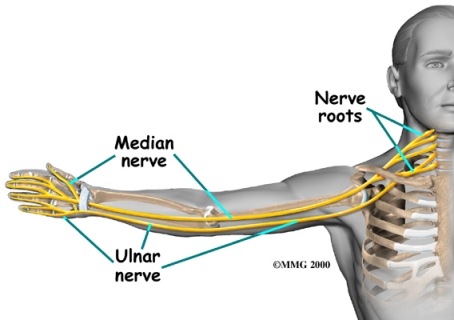
The first doctor I saw was an arm specialist, and he sent me to a neurologist for tests called EMGs that measure nerve conductivity and attempt to pinpoint the site and extent of the damage. My results were ambiguous: conductivity was slowed, especially across the elbow, but not enough to indicate a need for surgery, and not enough to show which of several different types of surgery I should have (if you look at the diagram above you’ll see that there are a number of possible areas for compression of the ulnar nerve, and the site determines the type of surgery indicated).
When my doctor told me the news, he sent me home after saying that he could do nothing for me. I still remember his chilling words, “Even morphine won’t touch this sort of pain.”
It turned out he was wrong about that; morphine will touch it, but only a little. In fact, methadone tends to touch it a lot more firmly. But I wasn’t seeking drugs, especially opioids, which have a host of dangerous side effects; I was seeking a way to heal.
Over the years I tried many things, to little or no lasting effect. Several types of non-opioid medication. Many different sorts of physical therapy, too numerous to count. Cortisone. Experimental MRIs that were supposed to image damaged nerves. I also sunk many thousands of dollars into the alternative medicine industry. Acupuncture. Osteopathy. Homeopathy. Naturopathy. Reiki. Magnets. And more. Along the way I met many good people and many charlatans, the kind and the cruel, the caring and the indifferent.
And after a while I went to the experts. Since my case was somewhat unusual and some of the various syndromes under consideration somewhat rare, there weren’t a lot of knowledgeable people and the ones who did exist were spread out around the country. I don’t remember exactly how many I consulted—quite a few in Boston, for example—but to find the most expert of experts I had to do a lot of research and travel quite a distance.
My insurance covered much of this, except for the alternative practitioners. I had always had a horror of not having medical choices, so for years my husband and I had paid extra to have the freedom to go to other states, and not to be bound by a primary care physician’s recommendations and restrictions.
It was money well spent. But I soon discovered that even the experts disagreed as to what the best treatment would be. One wanted me to have a very invasive and dangerous surgery to remove my first rib through my armpit. One thought I should have a scalene muscle in my neck removed as well. Each thought the surgery would probably help somewhat, but they told me the risk of complications and permanent damage was high, and the chances of marked improvement not good.
There was a also a somewhat less risky (although still chancy) elbow surgery I could have (actually, I had a choice among at least three types of elbow surgery). But the doctors in Boston and the East refused to perform it on me because, although my symptoms pointed to ulnar nerve entrapment at the elbow, the findings on my EMG tests (which had been repeated about five times over the years) remained ambiguous.
Finally, nine years into this, facing continual debilitating and demoralizing pain, and having exhausted all the non-surgical remedies I could find, I went with my gut and made my decision. My perception was that the bulk of my pain originated in the elbow area. If doctors in the East wouldn’t operate on my elbow (the right, which was worse than the left), there was a famous doctor in the West who would. He was one of the world’s experts in elbows and had done more surgery of this type than almost any other surgeon in the world. He took a careful history, looked at all my tests, and examined me thoroughly. He announced himself willing to perform the surgery to release my ulnar nerve from the elbow and move it to a new place under a muscle in my forearm.
Before the surgery I was given a sheet full of dire warnings for me to sign. I knew that most other doctors would have disagreed with this man’s decision. I had no idea whether I was doing the right thing, and he gave me no guarantees whatsoever, except that he would do his best. But I knew I had run out of alternatives and that I could not live with myself if I didn’t try for what now appeared to be my best (and perhaps only) hope of getting better. I also knew I would probably never be normal, but I’d almost forgotten what that was; I’d settle for “improved.” So I was at peace with my decision.
I remained at peace with it throughout my lengthy and extremely difficult recuperation, lasting about two years.
In the recovery room right after the surgery, the two doctors who’d operated on me had a fascinating but sobering tale to tell: they were surprised at the amount of damage they’d found in my elbow, much worse than expected. My ulnar nerve itself was red and swollen. There was at least an inch of thick scar tissue pinning it down completely within the cubital tunnel, the passageway in the elbow through which the ulnar nerve normally runs, so that in my case the nerve was unable to move freely. This is what had caused at least some of the terrible pressure and pain; every time I’d moved my arm I was stretching and injuring the nerve.
The doctors added that the surgery had taken twice as long as normal, and had traumatized the nerve much more than usual. They also had noticed that other smaller nerves had gotten tangled up in the mess of scar tissue, and they’d had no recourse but to cut those nerves as well. They could not predict what the effects of that severing would be.
The doctors made it clear that they did not know how well I’d recover, or how long it would take. We were in uncharted waters. But I knew I’d gone to the best people possible. And they told me something else that I took to heart during the many dark hours that followed: it seemed I’d had the correct surgery, after all. Although they could not guarantee that I would improve, the damage they had viewed when they had opened up my arm was so bad that they could not see how I ever could have improved without an operation.
Now I’m grateful every day that I had that surgery. Although it took a couple of years to recover, I would say I’ve improved about 75% as a result of the operation. That means, quite simply, that I got my life back. Not a completely normal life—but I wasn’t really expecting that. It’s a life that, although I still have to be protective and careful, allows me to do so many things I couldn’t do before, and to do them without significant pain or the need to take powerful medications.
Why am I telling this long and tedious and rather personal tale? Although all these years have passed, I’ve thought of it recently in connection with the health care reforms being discussed in Washington. The flexibility of my insurance coverage was one of the main reasons I was able to go so far in seeking relief; without it I have little doubt that I’d still be be in terrible trouble.
It was actually my injuries that first propelled me online over ten years ago, looking for information to help me with my decisions, and to read about the experiences of other people who suffered from similar problems. One of the things I found at that time that made a deep impression on me were the stories told by patients in Canada and Britain. Although they didn’t have to worry about insurance coverage, they were uniformly the most miserable of all the chronic pain patients on several message boards I frequented. They had to wait forever for tests. There were far fewer specialists in Canada and Britain who knew anything about their injuries or how to treat them either surgically or medically. The problems of these patients were generally considered unimportant and they were given low priority.
Until that time, if I’d thought about the health care system in those countries at all, I had assumed it was a great thing that there was universal coverage. But during this experience I learned that, at least for nerve injuries and chronic pain of the sort I had, the care here was far better. In fact, many of these people dreamed of saving up enough money to come to the US to some of the surgeons I’d been able to see. But they could not afford it, and they continued to suffer.
I’m not a rich person. But ever since then I’ve continued to pay extra for the medical insurance most likely to preserve my freedom to choose. If I hadn’t been able to have surgery on the west coast, I believe that even now, ten years later, I would probably be suffering from pain at or above the level of those early years. The prospect is so dreadful that I shudder to even think about it. I’m just grateful that wasn’t the case.
My back injury had a different course. I still have some pain and vulnerability there but I’ve never had surgery, because I got major relief from an epidural steroid injection I received about fifteen years ago. That’s probably why this article about a newly-announced British policy towards those very same injections caught my eye:
The Government’s drug rationing watchdog says “therapeutic” injections of steroids, such as cortisone, which are used to reduce inflammation, should no longer be offered to patients suffering from persistent lower back pain when the cause is not known.
Instead the National Institute of Health and Clinical Excellence (NICE) is ordering doctors to offer patients remedies like acupuncture and osteopathy…
The NHS currently issues more than 60,000 treatments of steroid injections every year. NICE said in its guidance it wants to cut this to just 3,000 treatments a year, a move which would save the NHS £33 million.
That’s a proposed 95% reduction in the number of these injections, which are an invaluable aid to the treatment of back injury—which, by the way, is an area of medicine for which “the cause” is rarely known. As the article goes on to point out, such treatments are a relatively simple and less risky way of saving many people from being on opioids for the rest of their lives, or having much more expensive and risky surgery in the future. Penny wise and pound foolish.
And perhaps a portent of things to come here.
On the nirthers and the press
You’ll notice I haven’t weighed in yet on the subject of Obama’s birth certificate. That’s because I consider it a non-issue at this point, except as it’s being used to discredit perceptions of Republicans and people on the Right as crazies.
I also believe–along with several commenters on this thread, that the consequences of a finding that he’s not a natural born citizen would be chaotic, and his replacement would hardly be better than he is.
But as far as the merits of the case go, I believe that it is highly likely that Obama was born in Hawaii, just as he’s claimed. That said, I also think it is very odd that he has refused so far to release the long form of his birth certificate (if those who say that Obama and only Obama could obtain a copy from the state of Hawaii, and that the long form is different from and more complete than the certificate of live birth that he has already offered of us, are correct).
This furtiveness on Obama’s part ties into his secrecy about other aspects of his life. I’m referring most particularly to his school records, from Occidental and Columbia and Harvard Law. These, we know he could release. This failure of his leads inexorably to the perception that the man is hiding something, although we don’t know exactly what or exactly why. But our guesses fill the void, and it’s not with innocent explanations.
The situation is rather similar to Kerry’s refusal to release his full military records in 2004; he released a sort of “short form” version instead. And in Obama’s case his actions are especially hypocritical because of his rhetoric about transparency. Of course, the press has completely abdicated its duty to explore (as it did with Kerry, as well). Instead, it has taken on the task of defending Obama and excoriating his questioners (as it did with Kerry and the Swift Vets, as well).
This has nothing to do with whether Obama was born in Hawaii, as I’ve noted. It has everything to do with transparency, however. And it has everything to do with the failure of the press to do its job. Compare and contrast with the way the press (in the person of Dan Rather and associates), not being satisfied with Bush’s full cooperation with the release of his National Guard records, decided they had to help out by either creating a forgery or failing to fully vet a forgery that reflected poorly on him.
Totally looks like a great blog
We all need some fun and distraction these days, don’t we?
Sometimes, it’s provided by Jello. But sometimes, only “separated-at-birth” photos will do.
I just discovered a blog totally devoted to such comparisons. Feast your eyes; you’ll be glad you did.
Here’s a tiny sampler to whet your appetite:
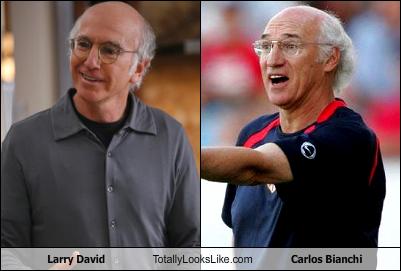
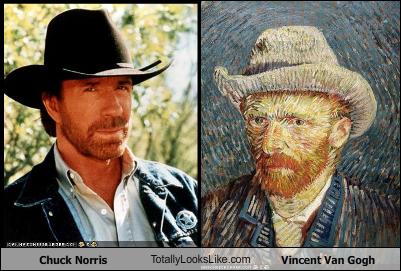


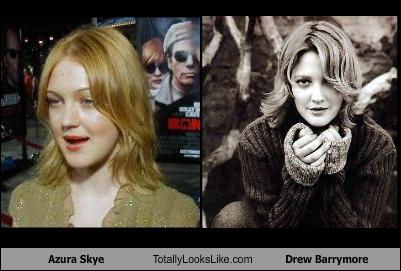
There’s lots more where those came from.
Can’t afford steak? Let them eat lobster
That filet mignon of the sea, lobster, is cheap and plentiful right now. Enjoy—and help out the lobster industry of New England.
Obama and the new template
Commenter Wolla Dalbo wrote of the situation we find ourselves in lately:
I have been arguing here that most of us in the U.S. are applying the old, traditional, and fatally wrong template, the calculus of the usual and the expected, of our past history, the calculus that just assumes a President’s good faith, respect for and adherence to Democracy and the Constitution to Obama and his presidency””and, by doing so, can make little sense of his startling and rapid actions”“and that to really understand his actions, we need to apply a new template, one that, unfortunately for us, fits much better, the template of Tyranny, of Dictatorship and of Socialism, Fascism or Marxism for, if we do this, Obama’s actions then become all too understandable, and very ominous; a reality calling for a totally different response from us than usual.
I have come, albeit very reluctantly, to agree with Wolla Dalbo’s evaluation of Obama’s motive and methods. The dilemma is that, once one has crossed over that line into the mindset that Wolla Dalbo describes, what is there to do?
I’m not advocating some sort of armed insurrection. I believe Obama can, and must, be defeated at the polls, and that the same thing has to happen to a significant number of Democrats in Congress. It seems an urgent matter to work for this.
But the blogosphere represents only a small minority of the population. What we have in common here is that we pay more attention than the average person to political and world events; otherwise, we wouldn’t be spending all this time at our computers reading and writing. Whether as a group we’re more intelligent or wiser than people who don’t do this is unknown and unknowable, but we are at the very least more well-informed and more strongly motivated.
Some here (such as Wolla Dalbo, for example) saw Obama as a radical almost from the start of his candidacy, or at least early on. Others (and here I include myself) were troubled by the evidence as it began to amass, but only in the last few months have come over to believing the worst.
And what is “the worst?” For some of us, it’s that Obama is a puppet run by others on the Left who have nefarious plans of various sorts. For some (and again, I’m in this group I’m about to describe) he is mostly his own man, an ideologue of the Left who has grandiose ideas of how he will make this country into something between a European welfare state and Chavez’s Venezuela, grabbing greater and greater power for the executive branch, and cooking the election rules (through redoing the census, relaxing voter registration laws even further, and enlisting the help of ACORN in outright fraud) so thoroughly that he hopes that his wing of the party will never lose control. As for foreign policy, whether Obama be the pawn of others or the master of his own fate, his plan appears to be to weaken the US and its influence on the world stage, bowing to international groups such as the UN and other organizations that feature a preponderance of tyrannies, as well as selling out Israel.
To most people in this country, however, this sounds not only absurd but unhinged. There’s no question that Obama’s approval ratings have fallen, but they are still high. There’s also no question that more and more people have become greatly disillusioned with him, but mainly about his competence in handling the economy (some of them are even on the Left; they’re angry that radical health care reform hasn’t sailed through yet, but I will ignore them for the purposes of this discussion because they would consider the new template a feature rather than a bug).
The gap between the slightly negative point of view that’s growing among the general middle-of-the-road population and the new template I’ve been describing here is far more profound than the difference between “slightly disapprove” and “strongly disapprove.” The “new template” folks have made a leap of non-faith, a statement of lack of basic trust, not just dissatisfaction with the details of one program or another.
I don’t think there’s any way to bridge that gap. The only thing to do is to keep stating the facts and hope that people will come to their own conclusions, sooner rather than later.
But I’m not sure it’s not even necessary to bridge the gap in order to defeat Obama. If enough voters decide, for whatever reason, to turn on the Democrats in Congress in 2010, Obama will find it more difficult to enact his program. And then, in 2012…there’s “hope” that the “change” that year will be his defeat, and the undoing of many if not most of the worst excesses of his time in office.
Walpingate and the sound of crickets
Remember Gerald Walpin, the IG for Americorps who was summarily fired by the White House under suspicious circumstances? Remember the investigation launched into his firing?
Heard anything about it lately?
Thought not. But imagine for a moment if such a chain of events had happened during the Bush administration. Does anyone doubt we’d be hearing about it ad nauseam? My guess is that even if it had been the Clinton administration that was involved, the press would have given us regular updates, as they did with Whitewater. And this is true even if nothing of real substance was ever found.
But now we only have the resolute Byron York to let us know what’s happening with the Walpin firing investigation. And even he is a bit remiss in not telling us the “who” of it, as in who are “the investigators” to whom he keeps referring?
I can’t find an exact answer so far, but it seems from York’s piece that the ones doing the investigating are certain Republican members of the Senate Judiciary Committee, as well as some on the House Committee on Oversight and Government Reform.
Just to recap, here’s a very brief summary of the matters under study:
They know that AmeriCorps gave an $800,000-plus grant to Kevin Johnson, the mayor of Sacramento, Calif., who just happens to be an influential friend and supporter of the president. They know that Walpin investigated Johnson’s misuse of that federal money. They know that as a result of Walpin’s probe, Johnson was suspended from receiving any new federal grants, a fact that caused controversy in Sacramento when leaders realized it could prevent the city from receiving millions in federal stimulus money. They know that, amid the local uproar over the Johnson affair, the acting U.S. attorney in Sacramento, Lawrence Brown, made a deal to let Johnson off the hook, and then took the unusual step of denouncing Walpin. They know that Walpin vigorously objected to Johnson’s getting off easy. And they know that after Walpin protested, the president fired him.
The investigators haven’t found much so far, and one of the reasons is that the astoundingly transparent, open, and honest Obama adminstration has been stonewalling:
[I]nvestigators have been stymied by the White House’s refusal to answer any inquiries about any communications or other dealings it might have had on the subject [of Walpin’s firing]. Brown has also refused to answer questions.
Right now they are looking into some interesting statements made by Rep. Doris Matsui, the Democratic congresswoman from Sacramento:
Asked whether Johnson’s problems could prevent the city from receiving stimulus funds, Matsui said that, at Johnson’s request, she had “been in conversation with officials at the White House and OMB [Office of Management and Budget] and others to ensure that we don’t lose any money at all.”
Just a couple of days later the ban was lifted and Sacramento got the funds, and Brown took the unusual step (unusual for a US attorney, that is) of issuing a press release celebrating that fact.
And then there’s this:
In June, Rep. Darrell Issa, the ranking Republican on the House Committee on Oversight and Government Reform, sent a list of 20 questions to Brown and received no response. A follow-up in July was similarly ignored. “Your unwillingness to be cooperative with our investigation raises further questions about your role in this matter,” Issa wrote Brown.
It’s clear that the White House and Brown will not volunteer any information unless forced. And that doesn’t appear to be happening any time soon. And with the press’s cooperation, the pressure of public opinion does not seem to be building.
Is anyone the least bit surprised at all this? Disturbed, yes. But hardly surprised.
Health care reform, the polls, and you
A WSJ poll finds that more Americans are against Obamacare than are for it:
In mid-June, respondents were evenly divided when asked whether they thought Mr. Obama’s health plan was a good or bad idea. In the new poll, conducted July 24-27, 42% called it a bad idea while 36% said it was a good idea.
Among those with private insurance, the proportion calling the plan a bad idea rose to 47% from 37%.
Even the NY Times, in a separate poll, has noticed a decline in support. But the Times sees it, as it sees so many such things, as a PR problem for the administration rather than a problem with the health care bill itself. Here’s the lede:
President Obama’s ability to shape the debate on health care appears to be eroding as opponents aggressively portray his overhaul plan as a government takeover that could limit Americans’ ability to choose their doctors and course of treatment, according to the latest New York Times/CBS News poll.
Ah, those evil and “aggressive” opponents, who portray the bill that way and make if hard for our earnest, hardworking, and meek President to “shape the debate” properly.
One of the problems is that health care reform is not only complex and lengthy, it’s a moving target. Is the bill being considered today the one that will be considered tomorrow? Who can wade through it and understand it? And are there any objective interpreters? And how about the intended consequences vs. the unintended ones?
President Obama and the Democrat leaders in Congress would like to tell the American people not to bother their pretty little heads about all this. Just trust us and all will be well, they say. But most Americans aren’t inclined to do that, especially after the perception of betrayal caused by the stimulus bill and its failure to revive the economy or even to be implemented as promoted.
In addition, health care reform is a bill of a very special nature. It’s hard to think of another subject that affects so many people, and on such a personal and even intimate level. There are the economic repercussions, and then there are also the physical effects on vital aspects of peoples’ lives: the ability to choose a doctor and get decent health care when you need it. And I sincerely hope that no amount of soothing words by the baritone voice of our current President insisting that “if you like your doctor, you keep your doctor; if you like your health care plan, you keep your health care plan” will be enough to convince them that it’s so.
The devil, as they say, is in the details. And, as this Politico piece points out, the details regarding the health care reform bill are murky, complex, and changing. But what the article doesn’t point out is the dearth of efforts to evaluate and explain them objectively, and the difficulty of knowing which analysis is spin and which is fair.
I have been searching my memory for a time when a party has tried to push through a bill of such major and potentially transformative importance to the day-to-day lives of the American people amidst so much opposition and doubt from the people. I can’t think of one; can you?
Congress and health care reform: the hive and the worker bees
As you probably know, the Democrat majority in Congress contains quite a few so-called “Blue Dog Democrats,” representatives of the party elected in districts that are relatively conservative. To a certain extent they are the mirror image of RINOs in the Seante such as Snowe and Collins of Maine—supportive of their party’s viewpoints on certain issues, but divergent on others (however, I get the impression the Blue Dogs are more true-blue Democrats on most issues than Snowe and Collins are true-red Republicans).
When we elect a representative, we tend to vote for whomever we think is the best person among those nominated for the job. Since most of us are not Washington cognescenti, we don’t usually think strategically about the way things work once those people go to DC and take their seats in Congress. But in that latter process, Party is King. And a party hierarchy determines the way the power flows.
I don’t pretend to be knowledgeable about all the details of the jockeying for position in the halls and dens and warrens of the House and Senate. But I do know that those who end up on top—Pelosi and Reid at this point—are hardly the ones with the most integrity or the deepest commitment to serving the people. They are the ones who know how to wield the power and crack the whip.
Exactly how they do so—what threats and what promises they offer, what methods they use to control their underlings—I’m not certain. Some of it must involve the awarding of perks such as committee placements and the like, as well as support in future elections vs. being hung out to dry, and the placement of local pork in bills of various sorts.
At any rate, we know that sometimes there is a huge disconnect between principle and pragmatism for members of Congress—that is, for those who still retain some smattering of principle. Sometimes they vote with the party and against their principles, in order to placate the Congressional powers that be. Sometimes—and this is perhaps true for at least some of the Blue Dogs right now—both their principles and their constituencies (and therefore their re-election chances) line up together to dictate a certain vote, such as one against Obama’s health care bill in its present form or anywhere near it.
But party unity has its own strong pull and a different sort of pragmatism, helped along by those behind-the-scenes threats and maneuvers. And yet, wouldn’t it seem to be counterproductive for party leaders to tell the Blue Dogs to vote with the party and yet in such a way that it would be likely to lead to those same Blue Dogs losing their bids for re-election in 2010, and their districts being represented by Republicans instead?
It would seem so, but I think it’s a case of priorities. And it defends how many votes the party has to spare on this bill. If it will pass handily without all the Blue Dogs, some of them will be allowed to defect. But if not, watch for the party to whip them into compliance (see this, for example).
The bottom line is that the party cares most about the party and its goals right now, not the fate of its individual members at some future date. Although the way the party gets its power is through the numbers, and of course this requires that many individuals from the party be elected, the identity of each of these people doesn’t tend to be especially important, nor would every single one of them ordinarily be required to be re-elected in order for the party itself to retain power (unless, of course, the party’s majority is very small, which is certainly not the case at present).
Pelosi and Reid know they are probably at their strongest point right now in terms of these numbers, and so its important for them to enact what they see as their agenda while they can. And this is the moment they think they can, so the individual principles and/or electoral fate of any one particular member of Congress is no concern of theirs.
Does the hive care about what happens to a worker bee or two (or three or four)? No, it’s the work itself that matters.
This is one of the reasons that, once a party has huge numbers in Congress, it tends to enact (or attempt to enact) an agenda the extremity of which causes it to lose popularity with the American people, which can lead to a backlash against the party in the next election. This overreach seems to be almost built into the system. The party is bargaining that the backlash won’t be great enough for it to lose control of Congress, and/or that the legislation they pass that is so important to their agenda now will be difficult to repeal once it has become law.
We got that swing
Why do we swing our arms when we walk? It turns out that scientists find it has some advantages:
“Rather than a facultative relic of the locomotion needs of our quadrupedal ancestors, arm swinging is an integral part of the energy economy of human gait,” says the paper.
Or, rather:
Sowell on the “post-racial” Obama
Thomas Sowell is a wonderful writer, one of those on the Right with whom I was unfamiliar until the last few years. His writing may lack flamboyance, but it is remarkably clear and concise, and this recent piece is one of his very best.
As a black man himself, Sowell compells extra respect in speaking on the subject of how Obama uses race. Here, for example, is one of the most succinct statements of what is so deeply wrong with Obama that I’ve ever seen:
[Obama] found it expedient to appeal to a wider electorate as a post-racial candidate, just as he has found it expedient to say a lot of other popular things ”” about campaign finance, about transparency in government, about not rushing legislation through Congress without having it first posted on the Internet long enough to be studied ”” all of which turned to be the direct opposite of what he has actually done after getting elected.
Those who were shocked at President Obama’s cheap shot at the Cambridge police for being “stupid” in arresting Henry Louis Gates must have been among those who let their wishes prevail over the obvious implications of Obama’s 20 years of association with the Reverend Jeremiah Wright. Anyone who can believe that Obama did not understand what the racist rants of Jeremiah Wright meant can believe anything.
Read. The. Whole. Thing.