One of the things I love about blogging are the discoveries that can result from late-night meandering down paths that lead to the unexpected.
That’s what happened the other evening when, after doing some research on Keynes and Hayek, I went to Keynes’ Wiki entry. There was almost nothing there about his private life except for a few facts about his parents, brother, and nephews, and then under the subheading “death,” the following sentence: “His widow, Lydia Lopokova, lived on until 1981.”
Now, I may not know tons about economics, but I have other fields of expertise, and one of them allowed me to immediately recognize and place that name. Lopokova was a Diaghilev ballerina, one of many who left Russia in the early part of the 20th century. She danced with Nijinsky and Karsavina, and knew Picasso (who drew her several times).
I was astonished. Keynes married Lopokova??
Indeed, he did—and therein lies a tale even more fascinating than that simple fact would indicate. First, though, let’s take a look at the happy couple:
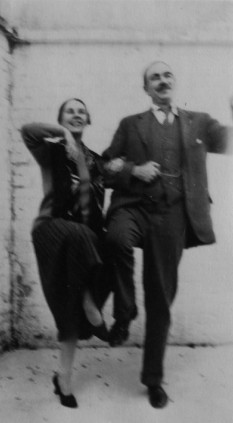
The circumstances of their meeting were not exactly auspicious in terms of a future marriage. For one thing, Lopokova didn’t speak English all that well. For another, Keynes was gay. Not only that, but he was very gay, if we can speak of degrees in these things. But, in the mysterious ways of the human heart (and body), he fell madly—and rather swiftly—for Lydia, in a manner that wasn’t the least bit platonic, and which seems to have riled the literary/artistic Bloomsbury folk with whom he’d previously hung out:
Keynes first saw her perform in 1921. In December of that year they saw each other face to face: “[Maynard] seems to have anticipated no more than a casual date,” Mackrell writes. “Yet desire evidently sparked at that meeting and it flared so fast that within two weeks Maynard had become Lydia’s lover, and within seven weeks had established her in rooms that were just four doors away from his own house.”
The close-knit Bloomsbury Group already had its doubts about Keynes’s less than socially exalted background. Its members openly resented his new, oddball, female lover. But their relationship was both more solid and more playful than any other in the group.
She called him “the big walk” of her life; he had an armoury of affectionate nicknames for her–“Lydochka” and “pupsik” among them–and their sex life was inventive and intense, according to the extracts Mackrell quotes from their letters.
How does anyone attempt to explain this? I won’t even try. This is what Lopokova’s biographer has to say about it:
He never lost his interest in young men,” asserts Mackrell, “and had an active fantasy life, I’m certain. But he stayed faithful. For that and for his brilliance, I came–this you have to do as a biographer–to love him, almost more than Lydia.”
Here’s more about the special flavor of their relationship:
Her English was terrible but beguiling: “To you I send a chirp from under the left breast,” she would write, “I place melodious strokes all over you.”
And this:
…Keynes and his “dearest darling Lydochka” are in the throes of the kind of bonkers badinage that lovers adore, expressed in the “Lydian English” that Keynes found so engaging. “You do develop my cranium miely Maynarochka,” she says, “and I am so glad I…am intimate with your little holes.” She also declared that The General Theory of Employment, Interest and Money, Keynes’s greatest work, was “beautiful like Bach”.
Lopokova may have sounded airheaded, but she ultimately proved her mettle:
After she nursed [Keynes] devotedly in the declining years of his life (he died at 62 from heart disease), Lopokova went into the seclusion for the rest of her life. She refused interviews and never wrote an autobiography, dying 35 years later.
[NOTE: I never thought I’d get a chance to use the tabs “Finance and economics,” “Dance,” and “Men and women; marriage and divorce and sex” all for the same post. Yet here it is.
Oh, and earlier in life, Lopokova was Stravinsky’s mistress. What’s more, in 1915, while in New York, she became engaged to the New York Morning Telegraph sportswriter Heywood Broun, who later became a member of the celebrated Algonquin Round Table. She certainly had eclectic tastes in men.]