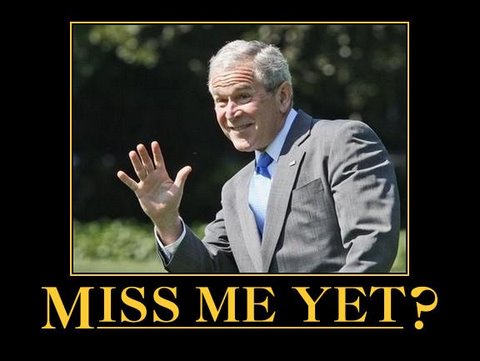
A number of people have recommended this article by Walt Harrington about George W. Bush, whom the journalist first met back in the 80s and became friendly with. Those people are correct; it’s a fascinating read.
Their friendship endured throughout Bush’s presidency. Despite the fact that Harrington seems to be a Democrat, he clearly likes Bush and has long been outraged by the hatred directed against him.
Harrington describes watching the advent of BDS (he doesn’t call it that, though) from his perch as journalism professor at the University of Illinois during the early years of the Bush presidency. He was shocked and mystified, knowing Bush as he does and knowing the man that he is. He sees some graffitti reading “Kill Bush” scrawled on a wall at the university and wonders “Is this America?”
Although Harrington did not vote for Bush, he did write a column during his presidency attacking the attackers and saying, “[Bush is] smart, thoughtful in a brawny kind of way and, most of all, a good and decent man…It baffles me that grown people must convince themselves that those with whom they disagree are stupid or malevolent.”
Those who feel that Bush is actually stupid and malevolent (and their numbers are legion) probably either are not reading Harrington’s piece, or are discounting it if they happen to read it. They know what they know, and one thing they know for sure is that Bush never reads and that even if he did he wouldn’t understand what he read, although Harrington describes a Bush whose love of reading (especially history) goes back at least to their meeting in the 80s, when Bush was still called “Junior” and his father was still president.
Harrington quotes Bush as once having told me that “reading books means you’re not lonely.” But one thing the Harrington article makes clear is that loneliness has not ordinarily been a big problem for Bush; he’s always been good at making friends and keeping them. This ability was probably Bush’s most salient characteristic, going back at least as far as his school days at Andover (see this about Bush’s prep school career, which describes a well-liked, friendly, and humorous guy whose people skills were already highly developed; also see this profile in Time that appeared before BDS had taken such a firm hold of the press).
Harrington writes about how disturbed Bush II was during the Bush I presidency at the bad press his father was getting, and when I read that I wondered how the son had subsequently managed to handle his own far more vicious press so well. He had learned something in the interim:
“When I got elected governor and president, history gave me a chance to study the decisions of my predecessors,” Bush says. As governor, he read The Raven, by Marquis James, a biography of Sam Houston, the father of Texas statehood. “I was fascinated by the story of Houston voting against secession, and reading a description of him basically being driven out of town by angry citizens. ”¦ My only point is that one lesson I learned, if they’re throwing garbage on Houston, arguably Texas’s most famous politician””Sam Houston Elementary School, where I went to school in Midland, was named for him!””if they’re throwing garbage on him, they can throw garbage on me.”…
When Bush read, in Presidential Courage, by Michael Beschloss, that historians were still debating whether George Washington had been a good president, he told Laura that if they were still debating Washington’s presidency more than 200 years later, he would not worry what public opinion was saying about him now. “And the other thing for me was that I saw a great man be criticized, as you might recall,” he says, referring again to the vitriol aimed at GHWB during the losing reelection campaign of 1992. “On the harshness meter, it seemed unusually harsh to me, as the son. So, therefore, when I became president, the criticism to me was nothing compared to the criticism to him. And so I was able to keep life in perspective two ways: one, through reading of history and how other leaders were treated, but also having witnessed history with my dad.”
Also there’s this (and as I read it, I can’t help but wonder if Obama, who seems to revere Lincoln as well, has read 14 biographies of him, as Bush has. Certainly if he has, he’s not learned the lesson about signaling weakness, or passing the responsibility buck):
Bush believes that one of the most important stage requirements of the presidency is indeed never to signal weakness or self-doubt or confusion: “One of the things you learn about great leaders is that they never project the burdens of responsibility on others.” He remembers Richard Carwardine’s Lincoln: A Life of Purpose and Power (one of 14 Lincoln biographies Bush read while he was president), which recounts the 16th president’s perseverance through not only military defeat after defeat, stupefying troop casualties, and public ridicule, but also the death of his son Willie and the debilitating emotional turmoil of his wife.
“You’re not the only person that’s ever gone through hard things,” Bush says of the lessons he has learned from history. “In other words, can you imagine the signal I would have sent had I said, ”˜Ah, why me? Why am I thrust in the middle of all this stuff?’ And they had kids on the front line of combat who were actually having to do all the work.”
But perhaps the most interesting part of the article is when Harrington visits his old friend GW at the White House in 2003, and asks him what it’s like to be president. Bush answers only after ascertaining that his response will be off the record:
And he began to talk””and talk and talk for what must have been nearly three hours. I’ve never told anyone the specifics of what he said that night, not even my wife or closest friends. I did not make notes later and have only my memory. In the journalism world, off the record is off the record. But I have repeatedly described the hours as “amazing,” “remarkable,” “stunning.”…
As he talked, I even thought about an old Saturday Night Live skit in which an amiable, bumbling President Ronald Reagan, played by Phil Hartman, goes behind closed doors to suddenly become a masterful operator in total charge at the White House. The transformation in Bush was that stunning to me.
Here’s Bush in a later post-presidency interview with Harrington, on how history will judge him:
“Some people walk up and say, ”˜Oh, man, history is going to judge you well.’ And my quip is, ”˜I’m not going to be around to see it.’ And to me, that’s one of the most important lessons you learn through history””you’re just not gonna be around to see it. ”¦ I’m confident of this: that those conclusions will be more objective with time than they could conceivably be now.”
I wonder whether those judgments are already starting to change.