…maybe not so much.
[Hat tip: Instapundit.]

…maybe not so much.
[Hat tip: Instapundit.]
You may not know about the 24-hour Wiki blackout*, but I certainly do, because it’s cramping my style.
Just a little, anyway. Wiki is often a surprisingly good source for general background information, although it’s hardly impeccable. But then, few things are; the truth often requires assembling information from a lot of sources, and even then it can be very elusive.
There are certainly other ways to get information online. But without Wiki—and to a far greater extent, Google—bloggers like me would have trouble writing as fast and furiously as we do. It’s a race against time here. How could we do our requisite speedy research on various and sundry subjects with only the library, a home encyclopedia set, and our local newspaper?
Of course, some might say that’s a good thing: haste makes waste and all that, you know. But Wiki and other online sources have helped me immeasurably in learning a little bit, or even a medium bit, about a lot of things that interest me. And I can’t imagine that that’s not a good thing.
Way back in the mid-90s, before I even had an email address and had almost never used a computer, people would talk them up to me. But I resisted; I couldn’t figure out what I’d want to do with one. It was my son who turned the tide by showing me, not telling me. He sat down at a computer and asked me to give him a line of favorite poetry (he knew I loved poetry). Using the old pre-Google search engines (I can’t even remember what they were called, but they seem very inefficient now) he typed it in and up popped sites that showed the entire poem from which the line originated.
A whole new research world opened before my eyes. If a line of a poem or a song was bugging me and I didn’t know the source (something that happened with some frequency), I didn’t need to go crazy any more, I could just search for it and in a matter of moments I’d have the answer! And all in the privacy of my own home!
That’s all I needed; I was a goner. Now, of course, I spend an inordinate amount of time on the computer, a great deal of it engaged in the search for information, and some of it at Wiki. And now, when I type in the word “neocon” at Google, I come in #9 on the list.
[*NOTE: The Wiki blackout is to protest certain anti-piracy laws before Congress. For the details, see this.]
Notice I haven’t written a thing about the 2012 presidential campaign today. I hope you appreciate my forbearance. Of course, you can use the comments section of this thread to keep on discussing the candidates and the debates, if you so desire. Tomorrow I plan to resume regular programming.
Now, if I could only go to the beach without freezing my butt off.
Our own roiling political waters have obscured some of the other important things going on in the rest of the world. So I hereby present the ever-insightful Theodore Dalrymple, who has a lot to say on the euro crisis and national identities.
It’s worth reading the whole thing, but here are some excerpts to whet your appetite:
[A journalist asked me] whether I thought that nationalism was dangerous. The question implied that the choice before Europe was between the European Union and fascism: that all that stood between us and the ascension to power of new Mussolinis, Francos, and Hitlers were the free lunches of senior Eurocrats. I replied that dangerous forms of nationalism existed, of course, but that in the present circumstances, supranationalism represented by far the greater danger. Not only was such supranationalism undemocratic, for it reflected no widespread demand or sentiment among the population; it also risked provoking the very kind of nationalism against which it was to stand as the bulwark. Further, the breakup of supranational polities in Europe tends to be messy, as history demonstrates…
It happens that the central offices of the E.U. are located in Brussels. Yet the political difficulties of Belgium [two very separate factions in one very small country] do not give the European unionists pause for thought””or, if they do pause, they reach a peculiar conclusion: that what has not worked in two centuries in a small area with only two populations will work in a few years in a much larger area with a multitude of populations. It does not occur to the unionists that different countries really are different: not a little bit, but radically, in culture, language, history, traditions, and economies. The term “European” is not meaningless, but whatever content the term may have, it is not sufficient for the formation of a viable polity.
The debt crisis has revealed differences in national character of precisely the kind that make any closer union both difficult and dangerous. Indeed, the very attempt to force a union is at the root of the crisis, for if Greece and Ireland, to take two countries at the geographical extremes of the continent, had not been able to borrow in euros under the false supposition that eurozone membership effectively guaranteed their sovereign debts, it is unlikely that they would have wound up in their current straits.
Dalrymple goes on to describe the different reactions of the Irish and the Greeks to their respective financial crises, and the role Germany has had to play, almost against its will. He concludes:
In short, the incontinent spending of many European governments, which awarded whole populations unearned benefits at the expense of generations to come, has””along with a megalomaniacal currency union””produced a crisis not merely economic but social, political, and even civilizational.
We all probably have a fantasy of finding something very valuable and rare in an old attic or barn, neglected by the world till now. And every now and then it actually happens. When it does there’s something very, very satisfying about it.
But I doubt that paleontologist Dr. Harold Falcon-Lang of the University of London thought he’d find anything quite so exciting as this (for paleontologists and science historians, anyway) when he opened a drawer in a wooden cabinet generically marked “unregistered fossil plants” in the British Geological Survey.
But let’s hear him tell it:
What I found inside made my jaw drop! Inside were hundreds of beautiful glass slides. Almost the first I picked up was labelled ‘C. Darwin Esq.’ This is an amazing snapshot into Darwin’s working life. This was one of the most exciting periods in the history of science, forming the mind of the man who would develop the theory of evolution, which would change the world.”
Falcon-Lang, according to AP, said when he found one of the slides labelled “C. Darwin Esq,” It took him a while “just to convince myself that it was Darwin’s signature on the slide…
To find a treasure trove of lost Darwin specimens from the Beagle voyage is just extraordinary…There are a lot of very, very significant fossils in there that we didn’t know existed.
So the find is a double discovery: the light it sheds on Darwin’s life and voyage, and the information the slides contain about the fossil record. Maybe someone should go through the rest of the organization’s old drawers.
Here’s a rather risky method of marriage therapy. But it seems to have worked—for now:
Australian miner Rob Elcombe and his wife, Tracey Gunn, told Melbourne’s Herald Sun newspaper they booked a spot on the Concordia as a last ditch effort to save their marriage.
Instead, the couple found themselves trying to save their lives when they boarded the very last lifeboat to leave the ship with survivors.
“This has made our bond much, much stronger,” Elcombe told the paper. “Who needs couples counseling, when you survive a Titanic experience?”
Indeed.
Rosalyn Rincon was an escape artist—for real:
Rosalyn Rincon, a 30-year-old magician’s assistant, found herself stuck inside a magician’s trick box when the Concordia hit the rocks.
“She was in the middle of magic show [when it ran aground], inside a magic box. And then all the lights went out so she struggled to get out of the box,” Rincon’s mother, Claire Rincon, told BBC News.
Rincon, who suffered cuts and bruises but managed to escape both the coffin and the ship safely, called her mom as the ship was keeling over.
“Rosalyn was a bit hysterical, saying the ship was sinking. But seeing she’s a dancer and they do drama, I just thought it was all a bit surreal,” she said. “You don’t hear about big ships sinking like that nowadays”¦”
Twenty-nine people are still missing, however.
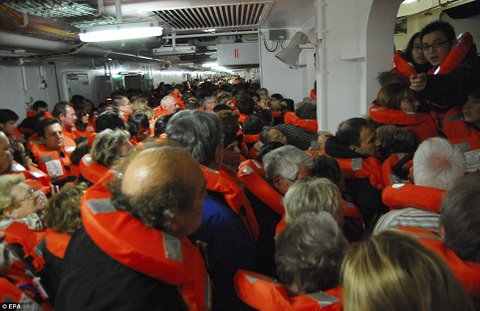
Some pretty amazing photos from the disaster can be found here. One that isn’t as obviously dramatic as some of the others, but becomes more so upon reflection, is this one taken by a passenger in the crowd waiting for the lifeboats to be launched:
…discuss tonight’s debate here, if you’d like.
…is missing some tie-dyed sheets:

[ADDENDUM: Here’s a clip of a classic spoof of the scene in “Gone With the Wind” where Scarlett wears a dress she’s had made from her curtains. Carol Burnett is Scarlett, Vicki Lawrence Sissy, Dinah Shore Melaine, Harvey Corman a great Gable-esque Rhett, and Tim Conway is Ashley:
And here’s the original:
Leigh’s seamstress was considerably better than Burnett’s.]
I have trouble with the hagiography of Martin Luther King. Yes, he was a great man who did a great thing for which he should be duly honored: he was an inspirational figure in the non-violent civil rights movement in this country, as well as a remarkable speaker.
The two, of course, are related. It was his personal qualities of leadership and what George H.W. Bush might rightly call “the vision thing” that enabled King to bring together so many people to peacefully demonstrate in furtherance of a lofty and necessary goal, that of ending discrimination against blacks in this country.
As for the rest of it—well, I think it can be summed up by saying that King was a flawed human being. Perhaps MLK himself would be the first to agree; he was a preacher, after all, and he knew a lot about human sin and error. It’s pretty much certain he was a philanderer as well as a plagiarist, and in later life he seemed to veer ever more leftward (some think that’s a feature, not a bug). Does that diminish his achievements? I don’t think so, if we keep it in perspective. I’ve always been more interested in real human beings who accomplish great things despite their own weaknesses than I am in a pretended (and mostly unachievable) perfection.
[NOTE: One thing that’s long amazed me is that King was so young when he was assassinated. At the time I thought him a man in his 50s, but he was actually a mere 39 years old. If he were alive today, he would only have just turned 83 yesterday.
There’s a lot of speculation on what King would have thought of current trends had he lived. I’m no expert on everything the man wrote and said, but it’s my impression that although he seemed to be in favor of some sort of reparations—which he did not limit to blacks, by the way—he would not have backed affirmative action or gay marriage. However, people do change—as I know only too well.]
I’ve seen a lot of comments around the blogosphere from people who feel angry because the present primary system so often leads to the nominee being chosen (de facto, anyway) quite early on. The complaint goes like this: Why should a few stupid little states like Iowa, New Hampshire, and South Carolina decide the whole shebang?
But every New Hampshire (or South Carolina, or to a lesser extent Iowa, because it’s done there by caucuses) voter stands for many thousands more. Each state isn’t typical of the whole, of course; state primaries are not the same as a poll in which the sample is carefully selected (and even those polls and samples are often flawed, sometimes deeply flawed). But I’d bet that when you average out the results of the first three or four or five states to vote, then the results become more and more typical of the entire country. And if the earlier results point pretty powerfully in a single direction to a single winner—which doesn’t always happen, of course—it’s a good bet that this will probably continue to be the trend unless some fresh scandal erupts or some new events emerge to change the picture.
My talk of cumulative representativeness in the early primaries doesn’t mean I like the way the primary system is set up at the moment; I don’t. I think it lends itself to a bandwagon effect, and that having so many primaries on a single day (“Super Tuesday“) favors the candidate with the most money (but then, just about everything about campaigns favors the candidate with the most money). I also think primaries lock in a candidate too soon and make it impossible for a party to retain enough flexibility to react to changing circumstances and events, as well as allowing a less popular candidate to be nominated when the vote is split on the other side by the entry and persistence of a large number of candidates from one faction of the party.
I think the latter is one of the reasons many conservatives are so angry at the growing sense that Romney may run away with this thing. Ah, if only more of the others would drop out, they say. Then the conservative vote would unite behind one candidate who could defeat RINO Romney and be nominated instead. While that argument may have some merit, I’m not at all sure it would work that way. I see all the alternative conservative candidates as having disqualified or marginalized themselves in the eyes of too many voters, and I think a substantial number of their votes would go to Romney.
Wiki lists a number of proposals that have been made in an attempt to improve the primary system. After a quick look, I lean towards one called a “balanced primary system“:
Under this plan, primary contests would be held during 13 out of the 18 weeks, starting in late January and ending in late May. California would vote about halfway through the process. Before California votes, each week’s contest would choose about 12% of the delegates necessary for the nomination, from a single state, or a group of contiguous states. After California votes, the contests would award more delegates in larger groups of states, since the positions of the hopefuls would be better known by then.
To provide balance, diversity in each contest would be maximized. Liberal states would be paired with conservative states; urban areas would be mixed with rural areas. The contests would move around so that each region of the country would award some delegates before California votes. In subsequent years, groups of states could trade off dates, so that the same states did not vote early in every election.
The advantages of this system include the feature that lesser known candidates could still have a chance by using retail politics in small states early, without giving those early small states too much influence. Travel time and advertising cost would be minimized by requiring that groups of states be contiguous, thus saving the hopefuls’ time and money.
Like many election reform ideas, though, I don’t think it’s going to happen. Many states have too vested an interest in being first. What’s more, it’s the sort of proposal that keeps falling by the wayside once the primaries and the election are over and we’ve got a lot of other and seemingly more pressing things on which to focus our attention.
Word is that Huntsman will drop out of the race on Monday and endorse Romney.
Huntsman never really caught on, and I think it was partly a personality thing. It’s hard to define why certain personalities appeal to voters and others don’t, but he seemed especially low-key and had no natural constituency to speak of. Not as conservative as some nor as well-known as others, he didn’t seem to have that fire in the belly. It didn’t help, either, that he was the ambassador to China under Obama.
My guess is that most of Huntsman’s votes will go to Romney. But since he didn’t have that many votes, I doubt it will be of much import.
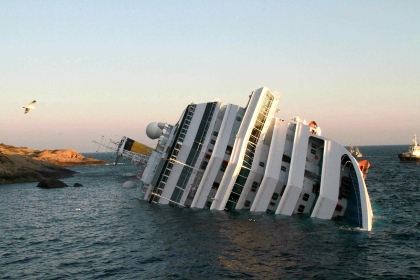
…sounds much worse than I’d originally thought.
The captain’s been arrested and is being investigated for possible manslaughter and abandoning ship.
Passengers report that there was delay in launching the lifeboats, and general chaos.
Three people are reported dead and all passengers are not accounted for.