…with more of this horse manure.
I refer you back to this for an explanation, and a tribute to Tsongas.

…with more of this horse manure.
I refer you back to this for an explanation, and a tribute to Tsongas.
Commenter “gcotharn” writes that Peggy Noonan wants Romney to give a fuller picture of his thoughts in order to woo the Republican establishment, but gcotharn (who thinks that Romney needs to win the “first principles” conservatives as well) says:
My creeping suspicion of the problem, with Mr. Romney giving a fuller picture of his thoughts, is that Mr. Romney’s thoughts are less sophisticated and less wise than, say, Governor Perry’s thoughts. And we saw how far that got Governor Perry. In fact, let me restate: my suspicion, of Mr. Romneys shallowness, is not creeping, but rather is a runaway herd of wild horses. Mr. Romney reminds of Barack in this way: Mr. Romney is doing his best to impersonate a blank slate. He sees no reason to reveal who he, in actuality, is not. As in: a person of philosophic depth.
Later on he quotes Noonan as adding that another problem is:
…[Romney’s] insides are unknown to them. They don’t know what’s in there. They fear he hasn’t absorbed any philosophy along the way, that he’ll be herky-jerky, unanchored, merely tactical as president.
I agree that’s the perception of Romney. But I don’t think it will be changed by any speech or further elucidation of his principles. That’s because I’ve seen him state conservative principles many times and it’s either ignored or treated as a lie or rejected for other reasons.
For me to go into examples of this right now would be to expand this post to book length, and it’s already going to be plenty long. So suffice to say that other examples aren’t hard to find. My point is that conservatives and many “establishment Republicans” already don’t trust Romney, and there’s virtually nothing he can do to change that.
Why? Both groups don’t like him much because of what they perceive as his wooden personality, his slick “Ken-doll” near-perfection in the physical realm, and the fact that he was governor of an ultra-liberal state and had to make major concessions to that during his administration. Everything he says is now filtered through the prism of his personality and that particular history, which sticks in their craws and makes them doubt his conservatism. But in my opinion, the more he states that conservatism, the more many people who already distrust him may say, “Look what a hypocrite he is, on top of everything else!”
You might say that with a candidate so flawed, why nominate him? And a year ago I’d have agreed. But a year ago I thought a host of other people I thought would be better candidates would enter the fray. However, as we all know, they didn’t, and I have very little doubt that the flawed Romney is the best of the even-more-deeply-flawed candidates remaining (and I’m not going to debate that issue in this post either, for that afore-mentioned length reason).
But at least one of those Romney flaws for conservatives has the paradoxical quality of appealing to many independents. No, I’m not talking about his personality—although his looks are a draw for some women in particular. No, I’m talking about the fact that Romney was able to function as the governor of liberal Massachusetts and to work for the most practical (and, actually, the most conservative) solutions possible at that time for that state and that legislature.
Independents like a practical man who shows a bit of flexibility, rather than a doctrinaire ideologue who will not budge no matter what. Most “first principles” conservatives would probably prefer the latter. And that is one of the paradoxes inherent in national elections.
“Ah, but what about Ronald Reagan?” you ask. “Now, there was a man who could state conservative principles and appeal to independents at the same time. All we have to do is find someone like that.”
Well, another Reagan might be nice, but good luck in finding one. Not this year anyway, for sure. Sometimes I think that Ronald Reagan’s presidency hangs like a millstone around the necks of conservatives. Or maybe that’s not the right analogy. Perhaps a better way to put it is that the situation resembles that of a person who had a wonderful marriage and then the spouse died, and he or she is looking for another spouse as close as possible to the first one (or to memories of the first one). But that can be a futile quest, and a dead end.
There’s a notion on the right that Reagan’s great strength was his ability to elucidate conservative values in a way that people could understand, follow, and admire. I’d love to take the time to go back and look at Reagan’s addresses and see where he did that, and then look through many of Romney’s speeches and see how they measure up. Maybe some other time; certainly not now or that book will be written again.
And I’ll also skip the part of this post where I list some of the things Reagan did, both as governor of California and president, that went against those values and principles; I’ve done that before and so have others. And don’t think I’m saying he didn’t have those basic conservative values, and that they weren’t elucidated at times, and that it didn’t matter at all when he did. But he didn’t always follow them; he was a practical man, as well.
I think Reagan’s rhetorical statements of conservative principles meant a lot to some people, especially the sort of people who read blogs, and that it did inform many of his decisions, too. But I also think that most people did not gravitate to Reagan and vote for him and then revere him and respect him because of those statements of values. You politics geeks may not like it, but most people make voting decisions based on other reasons.
Reagan had an unusual combination of attributes besides those values, and the ones that appealed to a lot of voters were personality characteristics he projected: calm, optimism, strength, decisiveness, trustworthiness. It didn’t hurt that he was very good-looking in a grandfatherly way, but not too good-looking either. He also was an actor, and had learned to speak well and convey the affect he wanted to convey (he was mocked for that by his enemies, but it was a stupendous skill). In addition, he had a record of executive accomplishment to point to, and little personal baggage other than a prior divorce, which hardly meant anything in the face of his long-term and solid second marriage.
Plus—and do not underestimate this fact—the public was heartily sick of Jimmy Carter. Without this factor, Reagan wouldn’t have had a chance of election, for all his pluses. And without a record that was basically positive during his term as president, it all would have been so much hot air. Most people want to see results, too.
Flash forward to the present, and Mitt Romney. There are some seeming similarities between then and now: a handsome ex-governor candidate facing a liberal president who’s become unpopular in his first term, as well as an economy with grave problems. His record and his personality are different, however, as are his strengths.
For those who would like Romney to elucidate conservative principles more, I’d like to know which ones you want to hear that he hasn’t mentioned already. Romney has written an entire book entitled, “No Apology: The Case for American Greatness.” I haven’t read it yet, but you might want to if you’re interested. But it wouldn’t take too long to familiarize yourself with Romney’s stump speech. Part of it goes like this:
President Obama boasts that he will “fundamentally transform” America. I want to restore America to our founding principles.
I believe that our founding principles are what made America the greatest nation in the history of the earth.
Among those core principles is what the founders called the “pursuit of happiness.” We call that opportunity, or the freedom to choose our course in life. That principle is the foundation of a society that is based on ability, not birthright.
In a merit-based society, people achieve their dreams through hard work, education, risk-taking, and even a little luck. An opportunity society produces pioneers and inventors; it inspires its citizens to build and create. And these people exert effort and take risks, and when they do so, they employ and lift others and create prosperity.
Their success does not make others poorer. It makes all of us better off.
President Obama sees America differently. He believes in an entitlement society.
Once we thought that “entitlement” meant that Americans were entitled to the privilege of trying to succeed in the greatest nation in the world. Americans fought and died to earn and protect that entitlement. But today, the new entitlement battle of this president is over the size of the check you get from Washington.
President Obama has reversed John Kennedy’s call for sacrifice. He would have Americans ask, “what can the country do for you?”
Just a couple of weeks ago in Kansas, President Obama lectured us about Teddy Roosevelt’s philosophy of government. But he failed to mention the important difference between Teddy Roosevelt and himself. Roosevelt believed that government should level the playing field to create equal opportunities. President Obama believes that government should create equal outcomes.
In an entitlement society, everyone receives the same or similar rewards, regardless of education, effort and willingness to take risk. That which is earned by some is redistributed to others. And the only people who truly enjoy real rewards are those who do the redistributing””government.
The truth is that everyone may get the same rewards under that kind of system, but virtually everyone will be worse off.
President Obama’s entitlement society would demand a massive growth of government. To preserve opportunity, however, we have to shrink government, not grow it.
It goes on in that vein. Let me repeat: that’s Romney’s stump speech—not a one-shot deal, but his basic message, although the details and exact words may change now and then.
Now, how many of you believe he means it? I do. Will he be able to execute it as president? Darned if I know. But I think he has the best chance of doing so of all the Republicans now running.
…that so far today, I’m avoiding politics. We’ll see whether I succeed.
But just because I’m trying to take a day off from the fray, that doesn’t mean that you have to. Here’s a nice open thread for you. Tempting, isn’t it?
Now that I’ve got your attention—
Have you noticed the latest fashion in cheeks? Now I know there didn’t used to even be fashions in cheeks, but with the ubiquity of cosmetic surgery that wonderful day has come to pass.
Why do I compare the new cheeks to breasts? Because breasts also used to be a natural thing, and if a woman was relatively well-endowed or not it was pretty much genes (or, at the very most, the temporary fix of a padded bra) that were responsible. With the advent of breast implants not only did that change, but the very nature of the desirable breast shape became different, especially for the young and those who pay attention to these things.
Models and movie stars are the traiblazers, and as we gaze on them more over time the new unnatural becomes the familiar and then the standard. For example, is there an unaltered breast in the entire Victoria’s Secret catalogue? I can’t say I know; but I suspect not, because the combination of very slender body and very full breasts exists only rarely in nature, and breasts that are the shape of grapefruits or tennis balls not at all. But these have become the thing to emulate now, and whole websites are devoted to showing young women what natural breasts look like, because so many of them fear that their own unenhanced ones are abnormal.
Now the cheek has followed suit. Cheek implants and fillers were originally designed to offset the ravages of age, when the cheeks can lose subcutaneous fat and droop. But now even the young have them, especially if in the public eye, and the additions are so noticeable and generally odd-looking that they give their bearers an alien yet almost-familial resemblance to each other. They are intended to “simulate the look of high cheekbones,” but it ain’t necessarily so.
I suppose this post should be illustrated with a ton of photos. But it makes me too sad to start searching for examples of what I’m talking about, especially in the young, so this example will have to suffice:
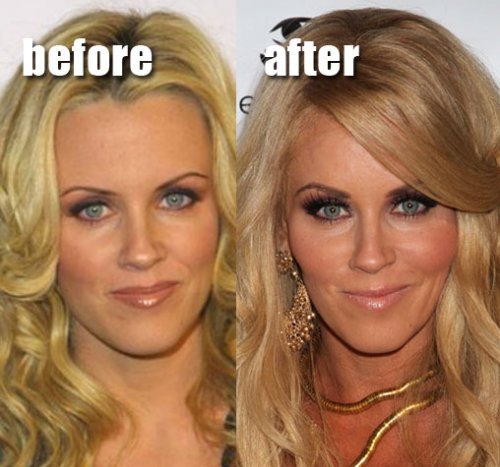
The lady above is now thirty-nine years old. I suppose that’s a dangerous age for women who fear the ravages of time. I barely remember it, it seems so young to me now. But I do know that, young or old, the faces I see in Hollywood are becoming more ghastly and otherworldly, with a fierce bright sharpness and definition that partakes more and more of the cartoon as opposed to the human.
Simply put, it creeps me out.
Which made me think of this, even though cheek implants have nothing to do with it:
…let’s do it till we get it right:
The singer formerly known as Cat Stevens is nothing if not controversial. It’s hard to write about him even now without generating a firestorm of hatred. But I’m going to try.
Stevens (now Yusuf Islam) is hated by a lot of people mainly for two reasons. One, he became a Muslim, and in the early days of his conversion he seemed to support the fatwah against Rushdie (he later said the remarks were a joke, but not many buy that). Two, he left performing after he converted, dismaying his devoted fans—although it was Steven’s intensity and spirituality they’d always liked in the first place (as well as his music, of course), which made the extremes of his commitment to his chosen faith a bit less surprising but no less disturbing.
A few years ago Stevens returned to performing. In more recent clips of his concerts, it appears that he has lost some of his intensity, which is not all that surprising. What originally drove it? Youth was probably a good part of it, and there would be a natural diminution of energy as he aged. But I think some of that early energy was fueled by his spiritual quest which, according to his Wiki entry, was a search Stevens had been on for quite some time.
When a person finds what he’s looking for he can lose some of that edge. Stevens’ edge was never all that edgy to begin with, though; he was sincere and touchy-feely, but not saccharine. That’s part of what made him great—that slight hint of bite combined with the sweetness in his lovely and immediately distinctive voice.
Even before Cat’s conversion he showed an almost trance-like quality in many of his performances. projecting a seemingly unselfconscious sincerity in surrendering to this religiously-inspired feeling that is unlike that of any performer I’ve seen. If you look at the comments at YouTube on many of his old videos, many people write “I love him!” and I think it’s because Stevens used to seem emotionally naked when he performed, even though he had all his clothes on. And his nakedness did not have as its source—as with some performers, such as for example Janis Joplin—the emotion of anguish. It seemed, instead, to spring from ecstasy.
Like most great singers, Stevens has an instantly recognizable and unique voice, now somewhat deepened with time. Here he is in his heyday, performing his signature piece (which he did not write, by the way; it’s a Christian hymn written in the 1930s and set to a traditional tune):
And here he sings the same song much more recently. You can see (and hear) the difference:
Here’s another before-and-after. In this case one of the oddities of the song “Oh Very Young” is that, although Stevens wrote it when he was very young, the words are more suited to an older person. I love this early version, despite the gratuitous and random still photos that the compiler of this video has chosen to add:
Here’s the same song from the perspective of age (I left in the intro because I wanted to show that the old guy still looks awfully good):
I defy you to find a cover of “Morning Has Broken” that can compare to Stevens’ original version. And I defy you to find an even halfway decent cover of “Oh Very Young” at all. Most YouTube cover versions of the latter song—as well as the cover versions available through iTunes, which number quite a few—are too sweet, icky sweet and slow, unlike Stevens’ original, with its rhythmic drive and verve. “Oh Very Young” is a song about the transience of life, but Stevens makes it energetic and upbeat whereas other performers seem to just make it syrupy. Yuck. When Stevens sings the song it may sound simple, but it most assuredly is not, and his rhythms always surprise.
There’s plenty of post-Florida-primary musing around the MSM and the blogosphere today. This piece by Byron York has a lot to recommend it, especially this observation:
Gingrich did not learn the lesson of Romney’s first wave of attacks against him. At that time, Gingrich reacted angrily and publicly, complaining constantly and accusing Romney of lying. Voters in New Hampshire who were once open to Gingrich’s candidacy turned away from him, saying his hot-tempered response to the ads — rather than the ads themselves — just turned them off…In Florida, Romney’s answer was a second, even bigger, wave of attacks. And Gingrich reacted in the same complaining, self-defeating way he did the first time, only more so…
Every time Gingrich, provoked by a Romney ad, made an angry speech, as he did in Mount Dora, the answer he gave showed voters exactly where Angry Newt was. Romney, in the persona he presents to voters, doesn’t have that subtext of anger.
I’m an issues person, and I spend a lot of time here talking about just that: issues. But I can’t help but notice that in all campaigns, spectators aren’t exactly the Jack Webbs of the voting process: just the issues, Mister, just the issues. There’s a lot of emotional reaction involved too, including the evaluation of the affective qualities of the candidates themselves. That may sound irrational (and some of it is) but it’s really not. Temperament matters, especially in a president.
I think a big part of Gingrich’s problem is temperament, and the problem is real. As far as Newt’s supporters are concerned, his anger is one of his strengths and not a problem at all. When it’s directed at the media it seems to work for him, although that may be getting a bit old. When it’s directed at Mitt Romney it has been working less effectively, especially when it features attacks that are from the left and/or hyperbole.
Gingrich is already a “hot” candidate rather than a cool one, and he runs the risk of seeming intemperate and out-of-control when he goes off like that. I submit that his decision to go angry in Florida was not just a tactical one; it was dictated by his personality itself. Voters in Florida decided that was not the sort of man they wanted facing Obama, or in the Oval Office.
Remember back in the fall of 2008, when the financial crisis happened and Obama seemed so cool and collected while John McCain seemed like an impulsive hothead running around in circles? Remember that McCain had been ahead up to the time of the meltdown (the financial one, and his own) and then he fell behind? There were many reasons it happened—one was that McCain was not perceived as being knowledgeable about the economy, as he himself had previously admitted. But the other (and I submit that it was a major factor) was that people felt uneasy about his temperament and soothed by Obama’s.
Romney is much more like Obama in that regard: he has a calm demeanor. Some say too calm; he needs more pizazz. His problem (at least, one of them) is that he’s considered fake and inauthentic. So a little righteous anger does nothing to hurt him; it actually reassures people that he’s human.
[ADDENDUM: Rusty Shackleford says much the same thing, just in a different way. We disagree on one thing, though: he thinks it’s stupid to judge candidates on things like personality rather than issues. As I wrote above, I don’t think it’s all that stupid at all.]
Here’s a thread to discuss it.
If you dare.
[ROLLING UPDATES: Romney is projected the winner. As things look now, he may even get a total percentage similar to the combined totals of Gingrich and Santorum.
In Romney’s acceptance speech (going on right now), I noticed one smart thing at the outset: he warned Democrats that a tough fight like this won’t help the winner: it will prepare him. Then he’s gone on to talk only about Obama, and to repeat the magic pledge to repeal Obamacare.
More reflections: Florida is a primary in which Independents can’t vote, so the results there represent Republicans only.
Apparently, the polls were correct.
Quite a few of Gingrich’s recent attacks on Romney have been attacks from the left: he’s a Bain vulture, he invested in funds that included Fannie/Freddie, and he’s a cost-cutting meanie who nixed kosher meals. I’m trying to think of any time that Romney attacked Gingrich from the left, but I can’t come up with anything. I think that’s telling. It undercuts Gingrich’s claim to be the real conservative.
Listening to Santorum’s speech, it occurs to me (and not for the first time, either) that he may be positioning himself for the VP spot.
Oops, in Gingrich’s speech, he isn’t being kind to Santorum. He says the race is a 2-person one between him, the “conservative leader,” and the moderate Romney. Gingrich goes on to cast himself a populist (it’ll be a “people’s campaign”) and predicts he’ll be the new comeback kid (no, he doesn’t actually call himself that, but that’s the idea).]
I think this is another bad tactical move of Gingrich’s:
…Newt Gingrich returned Monday to his tried-and-true offensive against the media, declaring that if he’s the Republican nominee, he will not debate President Obama if a reporter serves as moderator.
“…[A]s your nominee, I will not accept debates in the fall in which the reporters are the moderators because you don’t need to have a second Obama person on the debate.”
…The former House speaker has said that as nominee he would challenge the president to seven, three-hour Lincoln-Douglas style debates, despite the fact that the debate schedule has already been set by the Commission on Presidential Debates.
He may think it makes him look as thought he’s a tough alpha-guy taking on everybody’s favorite nemesis, the media. But I think it makes him look whiny, inflexible, and afraid of facing Obama in a debate unless it’s on Gingrich’s terms. Since that isn’t going to happen—does anyone really think Obama or the media would take him up on his “offer”?—it makes him look as though he’s refusing to debate Obama at all.
And, since one of his strengths as perceived by his supporters is that Gingrich could best Obama in a debate, this weakens his cause still further.
I just don’t get it.
[NOTE: I wonder what Gingrich-supporters think of this approach of Newt’s. Is it just political business as usual?
As for me, I agree with this comment at Ace’s:
The worst and most revoltingly hypocritical aspect of the “ZOMG ROMNEY HATES THE JEWS!” argument coming from Gingrich now, in his final despair, is that he is criticizing Romney for attempting to cut wasteful government spending. That’s right: Newt Gingrich, True Conservative Tea Party Hero, is attacking supposed Big Government Spending RINO Mitt Romney for trying to slash government subsidies and spending”¦and attacking him as a crypto-anti-Semitic religious bigot, no less.
Newt just can’t help attacking from the Left.]
[ADDENDUM: And this comment from that same thread at Ace’s is priceless:
Newt just gave a speech to a retirement community in Pembroke Pines, FL and he converted to Judaism in the middle of the speech.]
[ADDENDUM II: Here’s an interesting video in which Romney employs the fist-in-the-velvet-glove approach on Gingrich:
It really has been very sad and painfully revealing about the speaker to see him railing on like this. I think in some respects this helps us understand why it is that out of the hundreds who he worked with as speaker, only a handful are willing to support him.
]
So says this study.
At least for teenagers. Who write blogs about their personal problems. And whose blogs are not especially popular:
In all the groups, the greatest improvement in mood occurred among those bloggers who wrote about their problems and allowed commenters to respond.
Interestingly, the commenters on the blogs were overwhelmingly supportive. “The only kind of surprise we had was that almost all comments made by readers were very positive and constructive in trying to offer support for distressed bloggers,” Dr. [Azy] Barak wrote in an e-mail…
The trolls, the bullies, they go where they can be seen. Some of the most well-trafficked sites on the Internet have the worst commenters. In general, smaller blogs with dedicated readers — whether personal journals or niche-interest publications — have lively, thoughtful, and smart conversations in their comments sections.
The site has had its share of trolls and bullies, although I have ways of blocking them and keeping it to a minimum so far. But I love the comments section here, and probably wouldn’t continue to write this blog if I didn’t have a fairly lively one. The article didn’t define a “smaller” blog—mine would probably be called medium-sized—and this ain’t no support group.
But still, there are elements in the comments section here that give it something in common with the helpful ones in the study. Mainly, it acts as a community—one that sometimes challenges and even enrages, but always engages and sometimes supports—but a community nonetheless.
This comment by “rickl” made me think of the following Simpsons episode. You may especially enjoy it if you’ve got a yen (and really, who doesn’t?) to revisit the 1996 presidential campaign:
…Syria is in an uproar. Sound familiar?
As with similar situations before, the rebels can easily be overpowered by the government, if their numbers don’t reach a critical mass, and if the army and police stay loyal to ruler Assad. Otherwise, all bets are off; there’s probably a limit to how far Russia will go to protect the rulers there.
Unlike Egypt, Syria is not an ally of ours; that may even be an understatement. So it’s easier to say that in the event of an overthrow in Syria, the replacement government probably won’t be much worse.