…an article entitled, “Dangers in your mattress.”
Do you?

…an article entitled, “Dangers in your mattress.”
Do you?
It’s not determinative, but it certainly tends to buttress Zimmerman’s claims.
Has New York’s stop and frisk law really reduced crime? After all, remember that correlation is not causation.
And are black men unfairly targeted by it, or is the proportion just about right considering the demographics of crime?
And speaking of the demographics of crime, isn’t it mainly the black population that’s being protected by this law, if it has indeed caused crime rates to go down?
Another interesting question is whether New York crime has gone down more than in other cities that don’t have stop and frisk. And why doesn’t every article on the subject attempt to answer that question? Surely someone must have done some research on that. And if not, why not?
To me, the most important issue is whether New York’s stop and frisk laws are being used to stop people (of any race or ethnic group) for little or no reason, or whether they are being used responsibly to stop people the police have reason to believe are acting unlawfully.
Why am I writing about this post, anyway? Well, today a federal judge “elevated to class-action status a lawsuit accusing officers of using race as a factor in stopping people on the city’s streets, opening the door to a vast number of additional plaintiffs.” Some statistics:
The stops ”“ as a practical matter ”“ are notable for the measure of racial disparity that occurs: black and Hispanic people generally represent more than 85 percent of those stopped by the police though their combined population makes up a smaller share of the city’s racial composition. Critics, including the New York Civil Liberties Union, also point out that the number of those who get arrested or issued a summons hovers around 10 percent of the stops ”“ and that it is proof that the majority of those stopped have done nothing wrong.
Would the NY Civil Liberties Union be happier if the police arrested more of these people rather than fewer? Don’t think so.
By the way, I wonder how many of New York’s finest are black or Hispanic themselves. I haven’t a clue, but I was unable to find that statistic, which surprised me. If it’s a rather high percentage, it would certainly cast some doubt on the “New York cops are racists” meme.
I note also that 93% of those stopped are men. But I don’t see any class action suit by men, although that would be every bit as justified (or unjustified, as the case may be) as the racial suit, wouldn’t it?
[NOTE: I finally found some figures that address the question in my next to last paragraph, although they are outdated (from 2008). But for what it’s worth, here they are:
In the lower ranks, the number of blacks has increased in the department; minorities have represented 53 percent of the officers hired during the Bloomberg administration. The 36,000-member department is 54.3 percent non-Hispanic white, 16.4 percent black, 25.7 percent Hispanic and 4.2 percent Asian-American.
Those figures are getting closer to mirroring a city that, based on 2006 figures from the Census Bureau, was 34.7 percent non-Hispanic white, 23.7 percent black, 27.6 percent Hispanic and 11.6 percent Asian-American.
Mr. Kelly’s tenure has also been characterized by Police Academy classes that more closely resemble the racial makeup of the city’s eight million residents. The class that graduated from the academy in July 2005, which was 18.3 percent black, was the first predominantly minority class in the department’s history. “We have recruits born in 50 countries,” Mr. Kelly said.]
In the lastest New Yorker, John Cassidy writes:
In my neck of artisanal, hormone-free Brooklyn, the latest CBS News/New York Times poll, which shows Mitt Scissorhands leading “The First Gay President” by three points, landed with a nasty thud. “I can’t believe he might lose,” my wife said when she spotted the offending numbers on the Web. “People are really willing to vote for Mitt Romney? They hate Obama so much they’d vote for Romney?”
The rest of the article is an attempt to fire up the troops, an exhortation to liberals to take the threat seriously but not to be afraid, because it doesn’t necessarily mean a whole lot yet. But I focus on the paragraph above because I think it captures the essence of a certain liberal mindset, what we might call the Pauline Kael syndrome.
You may remember that Pauline Kael, film critic at that very same New Yorker, whose lengthy tenure there (1968-1991) was extremely influential in shaping the viewpoints of the cognoscenti, was supposed to have said, in response to Richard Nixon’s 1972 landslide victory, “that she ‘couldn’t believe Nixon had won’, since no one she knew had voted for him.”
Kael’s real quote appears to have been more nuanced. As best we can tell, she may have actually said this:
I live in a rather special world. I only know one person who voted for Nixon. Where they are I don’t know. They’re outside my ken. But sometimes when I’m in a theater I can feel them.
That’s a more interesting statement because it owns up to its own insularity. The speaker is well aware that she lives in an echo chamber in which she not only is not exposed to other viewpoints, but can’t even fathom them. Whether she would like to understand better or not is another question; my impression is that the speaker is rather proud of only associating with the elite, and really isn’t interested in finding out what the great unwashed might think, or why. I read into her remarks a certain disdain for those who voted for Nixon; whatever their reasons might be, they certainly couldn’t have been good.
That’s where Cassidy and his wife come in, all these long years later. There’s the same kneejerk dismissal of the views of others, the same concomitant inability to understand them and reluctance to try (conservatives may be intolerant of the views of liberals, or even hate them, and certainly can misunderstand them, but my distinct impression is that they spend an inordinate amount of time at least trying to fathom them, and tend to know many liberals rather well).
The assumption is that no one could possibly have rational reasons to vote for the obviously—obviously what? hateful? incompetent? evil?—Romney, and so the only impetus for supporting him must be hatred of Obama. Which brings us to another interesting point: people who will be voting for Romney are assumed not to merely disapprove of what Obama has done or not done as president, but to hate him. The motive is personal, malevolent—and quite possibly racist (although the article doesn’t say that). Politics as pure emotion.
Again with the race card:
He said this in 2008.
He’s saying it again: “When your name is Barack Obama, it’s [an election] is always tight.”
So that’s the reason he thinks it’ll be tight? Because the public is bigoted against his name?
This is a hard case to make, given that he won in 2008, and not just by a little bit, with the same name.
He seems to think it’s still 2008.
He wishes it’s still 2008.
If you look at the video, though, you could make a case that Obama is joking. But it’s a joke with an agenda. Then, after Barbara Walters has a brief moment in which she remembers she was once an actual journalist, Obama gets more serious. But the video cuts off his answer before we hear the whole thing; my guess is that he goes into some version of his “I inherited the problems from Bush” routine, another old favorite:
From the start of the latest underwear bomber story, I wondered who the leaker was. Now we learn more, including the fact that the undercover agent who was exposed wasn’t even our own guy, he was a British operative:
The leaks about the operation from the American side have infuriated British intelligence officials, who had hoped to continue the operation. The leaks not only scuttled the mission but put the life of the asset in jeopardy. Even CIA officials, joining their MI5 and MI6 counterparts, were describing the leaks as “despicable,” attributing them to the Obama administration.
And especially interesting is the relative disinterest of the MSM in this matter. Remember the Plame affair? Compare and contrast. And Plame’s risk was nothing compared to this guy’s.
It’s all Scooter Libby’s fault, no doubt.
It’s hard to know quite what to say about Jennifer Lopez in this dress, except that it’s hideous, although JLo is a very attractive woman. What was she thinking? The only person who could pull this off would be a rail-thin model. And even then, why bother?
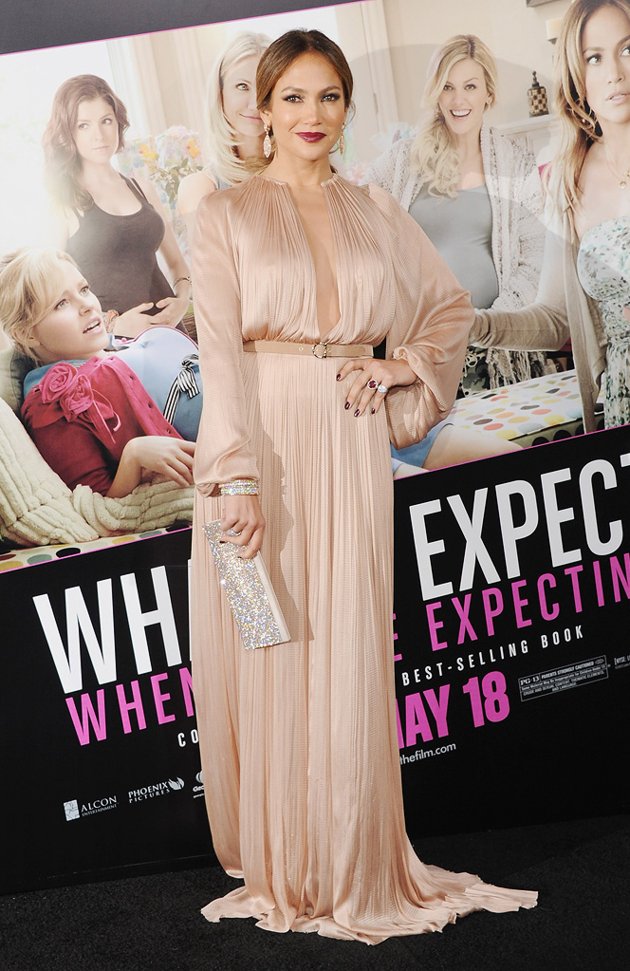
It would also help to be long-waisted—as I know, since I’m not.
I think she was going for something vaguely Grecian, plus a lot of plunging cleavage of course. Or maybe 30s Hollywood, something like this:
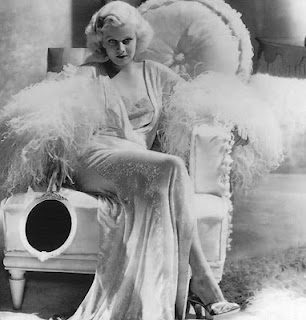
Instead, she just looks matronly—which is hard for JLo to do.
Remember when Reverend Wright owned up to the obvious when he stated, “[Obama]…says what he has to say as a politician”? Well, in the matter of Obama’s gay marriage change of heart, America seems to agree, much to the consternation of the NY Times, which is hard-pressed to explain how that can be, other than a problem with the timing of the announcement.
Obama? Politically motivated? Say it isn’t so, Joe America:
Sixty-seven percent of those surveyed by The New York Times and CBS News since the announcement said they thought that Mr. Obama had made it “mostly for political reasons,” while 24 percent said it was “mostly because he thinks it is right.” Independents were more likely to attribute it to politics, with nearly half of Democrats agreeing.
Actually, political motivation is the most logical conclusion to draw, given the fact that the change was seemingly unprompted by anything other than Joe Biden’s “chance” remarks (yea, right) and discussions Obama reportedly had with his daughters, during which he suddenly saw the light on gay marriage because they had friends with gay parents and those parents shouldn’t be treated differently. Hello? He’d never thought about that aspect of the issue before?
If we take Obama’s words at face value, his description of his own thought process on the subject makes him seem to be an unserious thinker. Better, perhaps, that we should look at it cynically and see him as offering a self-serving excuse for a cynical and pragmatic political decision—one that might end up backfiring, as the Times points out:
The poll showed that relatively few voters consider same-sex marriage their top issue amid continued economic uncertainty, and more than half said it would make no difference in their choice for president. But among those who said Mr. Obama’s position would influence their vote, more said they would be less likely to vote for him as a result; in a close race, even a small shift in swing states could be costly.
Obama, profile in courage.
Not.
[NOTE: I want to make it clear that I think Obama actually does support gay marriage. So that “cynical and pragmatic political decision” I mention ought to refer to his original decision to oppose gay marriage rather than his change to supporting it. Or perhaps we should say that both announcements were cynical, pragmatic, and political, although one represents his true opinion and the other doesn’t.]
…just say no to the Christian Democrats.
Merkel’s party lost a lot of ground in that section of Germany yesterday, and the Social Democrats (the SPD, described as “centre-left”) picked up what the CDU lost. This follows the pattern in the recent election in France, although Merkel is still ahead nationwide:
The blow comes only two days before France’s new president, Socialist Francois Hollande, is due to visit Berlin and press Merkel for a shift away from austerity and more emphasis on growth-oriented measures in Europe.
Other big countries like Italy also want Merkel to take a more balanced approach to the debt crisis and an election in Greece last week showed massive public resistance to tough austerity.
Strangely enough, although I consider myself a fiscal conservative (especially by European standards), I’m not an advocate of austerity-only solutions. And I don’t think that most conservatives would disagree; there’s nothing wrong with growing an economy. The disagreement with the left, of course, is how to do this, and especially on what the role of a central government ought to be.
I’ve tried to discover exactly what it is that the left in Germany is suggesting as an economic growth program. But in a relatively brief search, although I found a bunch of MSM articles alluding to the German election, none of them discussed the proposals in any detail. This far-left Socialist periodical has an interesting perspective, which is that both Merkel’s party and the SDP are advocating austerity and balanced budgets, it’s just a question of the left sounding a bit better (to Socialist ears, that is):
The SPD and Greens hope that following an election win in NRW, they will be back in charge of the federal government by autumn 2013 at the latest. While they fully support the austerity measures and social cuts of the Merkel government, they are trying to create the illusion that this can be combined with investments in economic programmes, education, research, culture, etc. On closer inspection, however, the “Growth Pact” they are demanding is revealed as a further deregulation of the labour markets.
Here’s another article in the leftist press that tries to explain the situation (it’s not that I favor the left’s perspective, it’s just that they seem to be the only ones going into any detail on this. If you can list some links from the right, I’d be curious to read them.) In it, Frank-Walter Steinmeier, the leader of the SPD parliamentary group in the German Bundestag, points out that Europe is in bad trouble economically—as anyone who didn’t just drop down from planet Xenon knows. Specifically, it compares unfavorably in economic growth to even the growth-challenged US:
While countries around the world are making up ground, the European economy will shrink by 0.5% this year ”“ the United States (up 1.8%) and China (up 8.2%) will grow.
And Steinmayer’s description of the problem seems pretty on-target to me:
Unless there is a breakthrough in the current recessionary spiral, no one will be able to guarantee repayment of these loans [made after the 2008 crisis to save the economies of European nations in trouble]. Europe, and especially creditor nations like Germany, are banking on a trend shift that they hope will provide new economic verve. The EU and IMF rescue packages assume that the countries receiving emergency loans today will soon be able to generate primary budget surpluses. If that fails to happen, they will keep needing new loans to prop them up. This will put the eurozone countries to a test of fiscal strength and, above all, political endurance. Ultimately, it could lead to the collapse of the monetary union.
Well, if by “the monetary union” he means the EU—and I believe he does—many would say “good riddance,” and I’d be among them. That is what tied the economies of member countries together so tightly, and put nations such as Germany in nearly the same boat as Greece.
But Europe doesn’t seem to be about to abandon that dream, and in any case it does seem that more growth is necessary for Europe, with or without the EU. But does “growth” mean stimulus spending a la Keynes? Does it mean increasing government regulation of the economy or decreasing it, or just changing its emphasis? And is the big problem something more basic, some decrease in personal initiative that has occurred in Europe in the last few decades?
Steinmeyer discusses the SDP’s proposed solutions, which don’t sound like pure Keynes to me [emphasis mine]:
The debt sustainability called for by the adjustment programmes will only be achieved when Europe regains its capacity for economic growth. That will not happen by itself. Europe will need a growth programme if the consolidation of government finances is to succeed. However, this must not lead to a new round of government debt for the sake of short-lived economic stimulus measures. Instead, Europe needs a comprehensive investment and development programme that overcomes the financial crisis, sets a course that focuses on the real economy, modernises structures, improves competitiveness, increases value added, and strengthens European unity [this last idea seems counterproductive, IMHO; it’s “European unity” that magnified the problems in the first place].
The financial crisis exposed the source of European imbalances. If we do not work to fix them, they will lead to a deeper, more serious split. Europe has lost its equilibrium. While countries like Germany and Poland manoeuvred through the crises relatively safely, the economies of countries in the southern eurozone are nose-diving. There is no end in sight to their downward spiral. No wonder growth forecasts diverge so widely between countries in Europe. Poland and Lithuania are expected to grow by 2.5% and 2.3% respectively, while Greece and Portugal are set to shrink by 3% and 3.2% respectively.
Weak growth almost always goes hand in hand with a weak status of real value added. The manufacturing sector has lost its significance in nearly every European country. During the last decade, industry’s share of GDP fell on average from 23% to 16%. However, it is clear that countries which held on to their industrial sector are now doing significantly better than countries that pursued de-industrialisation. Poland is an impressive example…Preserving a broad value chain secures jobs and creates an environment that spurs on new growth.
In addition to retaining a solid industrial basis, boldly implementing structural reforms has also paid off. Germany, for example, has spent the last decade reforming its labour market, which has strengthened its competitiveness for the long term. And following a painful slump during the crisis of 2008-2009, Lithuania introduced structural reforms that have enabled it to set out on a new path to growth.
Boy, it must hurt when Western Europe has to look to Eastern Europe for economic models and guidance.
Steinmeyer goes on to describe how different the countries in Europe are from each other, but he doesn’t draw the conclusion that the EU was a bad idea that’s got to go. And although it’s true that, as Steinmeyer writes, the economies of the European countries are dependent on each other because unless there are markets there’s no way to sell the products or services made, why not let this interdependency happen in natural fashion, rather than yoking them together in an artificially-created union that has the effect of dragging them all down if a few go under, and fails to allow them to tailor individual solutions to fit their individual differences?
Finally, Steinmeyer gets to the specific proposals of his party, the SDP. The first suggestion is a financial transactions tax to raise revenue. Again, I don’t understand the fine points, but my first thought was, “wouldn’t that impede economic growth rather than help it?” And I’m certainly not alonge; there’s some support for that conclusion. The tax would probably be limited, however, to the secondary financial markets (derivatives and their like), the area that supposedly engendered the 2008 problems in the first place, although that would hardly seem to change the fact that the tax would be likely to inhibit growth.
The rest of the SDP plan seems to involve ideas to strengthen what Steinmeyer refers to as “industrial renewal.” Again, nothing wrong with that. The main question on which left and right differ is the government’s role in achieving such a goal. The SDP seems to think that the EU must be involved in a trans-European project to do it, which is about what you’d expect from the left but seems both unnecessary and potentially counterproductive to me.
The devil tends to be in the details, and in the amount of time available to me to write this post I couldn’t become expert enough on the economic policies and proposals of the different political parties in Europe to be able to critique them as effectively as I’d like. I rely on you, my trusty readers, to take up the discussion—especially a few of you who live in Germany and could probably shed a lot more light on the subject than I.
In the matter of the dueling shock-value Newsweek and Time magazine covers, Ed Driscoll explains it all for you.
And there’s something so disturbing about the Time cover that I’m not putting the image on the blog. It’s certainly not because I’m a prude, or that I’m anti-breastfeeding. I’m very pro.
My objection is not to the woman so much as the boy. If she wants to flaunt herself in whatever fashion, and finds a willing co-conspirator in the now-tabloidesque Time, so be it. But there’s something about using the kid in that way that seems very, very, very wrong. He’s not of the age of consent, just a prop who’s being exploited by his mother and the magazine.
[NOTE: This is a repeat of a previous post.]



Okay, who are these three dark beauties?
A hint: one of them is the very first picture you’ve ever seen on this blog of neo-neocon, sans apple. Not that you’d recognize me, of course. Even my own mother might not recognize me from this photo.
My own mother, you say? Of course she would. Ah, but she’s here too, looking a bit different than she does today—Mother’s Day—at ninety-eight years of age. Just a bit; maybe her own mother wouldn’t recognize her, either.
Her own mother? She’s the one who’s all dressed up, with longer hair than the rest of us.
The photo of my grandmother was taken in the 1880’s; the one of my mother in the teens of the twentieth century; and the one of me, of course, in the 1950s.
Heredity, ain’t it great? My mother and grandmother are both sitting for formal portraits at a professional photographer’s studio, but by the time I came around amateur snapshots were easy to take with a smallish Brownie camera. My mother is sitting on the knee of her own grandfather, my grandmother’s father, a dapper gentleman who was always very well-turned out. I’m next to my older brother, who’s reading a book to me but is cropped out of this photo. My grandmother sits alone in all her finery.
We all not only resemble each other greatly in our features and coloring, but in our solemnity. My mother’s and grandmother’s seriousness is probably explained by the strange and formal setting; mine is due to my concentration on the book, which was Peter Pan (my brother was only pretending to read it, since he couldn’t read yet, but I didn’t know that at the time). My mother’s resemblance to me is enhanced by our similar hairdos (or lack thereof), although hers was short because it hadn’t really grown in yet, and mine was short because she purposely kept it that way (easier to deal with).
My grandmother not only has the pretty ruffled dress and the long flowing locks, but if you look really closely you can see a tiny earring dangling from her earlobe. When I was young, she showed me her baby earrings; several miniature, delicate pairs. It astounded me that they’d actually pierced a baby’s ears (and that my grandmother had let the holes close up later on, and couldn’t wear pierced earrings any more), whereas I had to fight for the right to have mine done in my early teens.
I’m not sure what my mother’s wearing; some sort of baby smock. But I know what I have on: my brother’s hand-me-down pajamas, and I was none too happy about it, of that you can be sure.
So, a very happy Mother’s Day to you all! What would mothers be without babies…and mothers…and babies….and mothers….?
I saw the Boston Ballet perform last night. The first dance was forgettable, the second a great classic, Jerome Robbins’ “Fancy Free.”
That alone would have been worth the price of admission, with its Bernstein music, its swingy 40s ambiance, and its fabulous three solos for its three show-off sailors that perfectly express their differing personalities, with steps choreographed by Robbins that flow so freely that it seems as though the dancers are improvising them on the spot through an excess of high spirits.
But I was surprised that it was the third ballet, Harald Lander’s “Etudes,” that turned out to be the highlight of the evening for me and much of the audience. It’s a piece I’d seen many times before and liked well enough, back in the 70s and performed by American Ballet Theater, although I’d not seen it since then till last night. A classroom-to-stage ballet, starting with a stylized, revved-up version of the dancers’ daily barre exercises and segueing through various styles of ballets (Romantic, imperial, character), “Etudes” is an ever-accelerating high-speed train ride of a ballet. Forget plot; this is ballet stripped bare of everything but its classical elements: tradition, tutus, and technique.
In the many decades that have passed since I first saw the Boston Ballet its technical skill has vastly improved, as was made abundantly clear last night. “Etudes” is totally unforgiving; it requires ensemble work of tremendous difficulty and everyone not only has to be on the beat, but incredibly powerful and of major soloist caliber. The music (a live orchestra last night, always a huge treat) is based on familiar Czerny exercises, but with the full complement of instruments it built and built along with the choreography until the usually staid Boston audience was practically in a frenzy.
Unfortunately, I don’t have a video of that production, so this will have to do. It’s the Royal Danish Ballet in the last few minutes of what’s actually a 40-minute performance. Recall that dance on video is two-dimensional and only has about one-tenth the impact and depth and pizazz of the same thing seen in person—which last night included, of course, the full orchestra in the glorious Boston Opera House. What’s more, the Boston dancers were significantly better than this crew (who are awfully good, too), even though the piece was originally choreographed for the Danes back in 1948: