What’s the difference between:
Mohameed Morsi…

…and David Mamet?
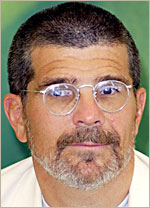
Rectangular glasses versus round.
[Hat tip: commenter David Guaspari.]

What’s the difference between:
Mohameed Morsi…
…and David Mamet?
Rectangular glasses versus round.
[Hat tip: commenter David Guaspari.]
The Newtown killings got the attention of the entire country, and rightly so: a large death toll with young children as the bulk of the victims, and a perp who’d been described as strange and whose motives are still unknown. Afterward, there were calls for more gun control and easier mental health commitments and the like.
But as it turns out, a great deal of the reporting in the Newtown massacre was incorrect, whether merely irresponsible or purposefully misleading it’s difficult to say. As far as we know now (which isn’t very far), the killer’s “mental illness” seems to not have been of the commitable variety, and there seems to have been no prior hints of his dangerousness. He took the guns from his mother, but how she stored them and how he obtained them is completely unknown. Reports from a friend or friends that she had taken her son to shooting ranges seem to be unsubstantiated as well (although he visited one, he apparently was alone at the time, and there doesn’t seem to be a clear record of him shooting there).
Thin gruel for those who are jumping on the case to further this cause or that, but that doesn’t stop them.
Then there’s this horrific murderer, William Spengler of Webster, New York, who set a fire in his own house and several others and then lay in wait for firefighters to arrive in order to kill them. He proceeded to do just that to two of the responders (and wounded two others), then killed himself. In the burned-out ruins of his home was found the body of his older sister.
That’s not children and teachers as victims, to be sure, but it’s pretty hideous nevertheless and I think the word “evil” is quite appropriate. Compared to Lanza, we know a bit more about Spengler’s motives, who left a note that said in part, “I still have to get ready to see how much of the neighborhood I can burn down, and do what I like doing best, killing people.”
And although killers such as Spengler always remain somewhat of a mystery (nature or nurture, for example), we knew a lot more about his potential dangerousness than we did about that of Adam Lanza. In fact, it wasn’t just potential; Spengler had long ago proven what sort of guy he was, because he had served 17 years in prison for the 1980 hammer slaying of his grandmother.
That previous killing occurred when Spengler was about 30 years old, no impressionable teenager who lacked maturity. And as an ex-felon, Spengler was apparently forbidden to legally buy weapons. Clearly, no gun law stopped him from getting them.
But why did the justice system let me off so easy back in 1980? The answer is unclear, but here’s a hint:
Spengler had been charged with murder in his grandmother’s death but pleaded guilty to a reduced charge of manslaughter, apparently to spare his family a trial.
So the DA thought letting him cop a plea was sparing the family? It certainly didn’t spare the sister, as it turns out, although in defense of the DA’s decision, perhaps it was made at the family’s request—and since both victim and killer were relatives of the family, that might have been the reason the family’s request would have been honored. But it didn’t spare society, either; those firefighters who lost their lives would not have died had Spengler still been in prison.
CNN (which seems to be unable to do simple arithmetic, since it writes that Spengler would have been around forty in 1980, which is clearly incorrect if his present age was 62) has a bit more information on the sentencing:
After his 1981 manslaughter conviction, Spengler was given an indeterminate sentence, said Monroe County District Attorney Sandra Doorley.
He ended up spending nearly 18 years behind bars until his release in 1998. Through 2006, Spengler was on supervised parole, during which time Doorley said she wasn’t aware of any events suggesting he had gotten into further trouble.
This article is somewhat more informative:
According to reports, [in 1980 Spengler’s grandmother] was found at the bottom of the basement stairs in her home on Lake Road. She had been beaten with a hammer. Spengler pled guilty to manslaughter and was sentenced to 8 1/3 to 25 years behind bars.
While in prison, Spengler did not seem like a man seeking mercy or repentance. I-Team 10 has obtained a copy of his 1997 parole hearing. At that hearing, the commissioner says “you didn’t want to come here today?”
Spengler replied, “I thought it was mandatory.”
When told it was not, Spengler said, “Then it’s not worth the time and effort.”
He was denied parole, but was released six months later after serving two-thirds of the maximum. Since his release, police say he’s been a quiet member of the Webster community.
So, where are the cries for tougher sentencing in the wake of Spengler’s killings? The demands for fewer plea bargains for killers who appear on the face of it to be violent sociopaths? This case and those causes don’t seem to fit the agenda of the MSM or the left—except for the single angle we keep reading, which is that the type of weapon Spengler used was the same as Lanza wielded in the Newtown massacre. I’m not a weapons expert, but that doesn’t seem especially relevant to me; couldn’t Spengler have committed this crime with any decent rifle? And note that his first crime was with a tool commonly found around the house: a hammer. Where there’s a will there’s a way, if killing’s one of the things a person likes best.

On Christmas Day—blog?
I’d rather have grog,
Or maybe eggnog,
Then go walk the dog.
Or watch a Yule Log,
And eat like a hog,
Then go for a jog.
Blogging’s a bog.
My mind’s in a fog,
Or maybe agog
From much dialogue.
I’ll return to the slog
Tomorrow, and blog.
[NOTE: This is another recycled poetic effort.]
[NOTE: This small poetic effort of mine has become somewhat of a holiday tradition. So here (with a few words changed for the sake of meter) it comes again—just like the holiday itself. Merry Christmas Eve!]
‘TWAS THE BLOGGER’S NIGHT BEFORE CHRISTMAS
‘Twas the night before Christmas, and all through the ”˜sphere
Bloggers were glad to see Christmas draw near.
Their laptops were turned off and all put away
The bloggers were swearing to take off the day.
Their children were nestled all snug in their beds
While visions of extra time danced in their heads
With a father or mom not distracted by writing
No posts to compose, and no links to be citing.
But we all know that vows were just meant to be broken
And the vows of a blogger can be a mere token.
There’s always a chance that some sort of temptation
Will rise up to make them of fleeting duration.
For instance, there might be found under the tree
A sleek Mac; well, what better sight could there be?
And who could neglect it and wait the whole day?
It cries to be tried out, one just can’t delay.
Or maybe somewhere there’s a fast-breaking story
Important, and complex, and covered with glory.
It can’t be ignored, there’s really no choice,
So add to the din every blogger’s small voice.
And then there are some who may just like to rhyme
(I’m one who at times must confess to this crime),
And it’s been quite a while since Clement Clarke Moore
Wrote his opus (though authorship’s been claimed by Gore)””
So it seems about time it was newly updated
And here’s my attempt””aren’t you glad you all waited?
Forgive if it sounds a bit awkward to read.
In writing, I set a new record for speed.
I had to get under the wire and compose it
Before Christmas Day. Now it’s time that I close it.
But let me exclaim (or, rather, I’ll write)
Happy Christmas to all, and to all a good-night!
Unlike over a billion of the world’s population, I only just got introduced to this weird phenom, which probably signals the end of civilization as we know it:
It immediately reminded me of something I hadn’t thought about in close to five decades, the Pony:
And of course, since one of the most important functions of YouTube is to show us how difficult it is to have a truly unique and novel idea, I then almost inevitably found this:
A lot of bloggers have recommended reading this Boston Globe piece on why Romney lost. It’s probably good, with a lot of inside info, but I could only get through about a third of it because (a) the topic has been beaten into the ground already; and (b) almost any answer/explanation will do and it may not really matter anyway because in 2016 the situation will be different (and my guess is that the Republican generals will be fighting the last war rather than adjusting to those changed circumstances).
But now that I’ve said all that, I can’t resist piling on. Just a little bit.
I am fairly certain I know why Romney lost. In talking to a number of non-blog-reading conservative friends of mine (I do have a few such friends, you know), I’ve come to my own conclusion about it, and it’s a rather simple conclusion. These people don’t know each other, and yet each told me almost exactly the same thing, in almost exactly the same words: “Romney doesn’t understand.” “Romney doesn’t care.” “Romney doesn’t understand what it’s like for regular people.”
Now, if those people (none of whom had any intention of voting for Obama in the first place) felt this and were deeply affected by it, you can bet it was a very widespread and troubling perception. You can say that particular perception became widespread because (as the Globe article suggests) the Obama campaign was successful in painting Romney this way, and that Romney never answered the charge effectively. But you know what I think, in retrospect? There was no way for him to answer it effectively. He could have saturated the airwaves with stories of what a caring guy he is. He could have filled the media with tales of how he struggled and ate macaroni and cheese when he and Ann were starting out. But it wouldn’t have made a dent in this perception.
Romney has a naturally patrician and removed air that feeds into that impression. Voters like me couldn’t care less; I don’t need someone who’s walked in my moccasins, I just want someone smart and capable, with qualities of leadership, conservative principles, and America’s interests at heart. But many people do care about it, deeply.
And it’s not about Romney’s being rich, either. FDR and JFK were rich men born to rich families, but they were able to convey to the general public that despite that background they understood and cared, whatever that meant at the time. Democrats have a natural advantage in this, because the Democratic Party bills itself as—and is widely perceived as—the party that cares. Never mind if Democrats can’t actually fix things and make them better, or even sometimes make them worse—they’ve got the right rhetoric, they’ve got the temporary bandaids, and they hold your hand. And all those things are sometimes what people want, and think they need, when they’re hurting.
Republicans have a different message, a tough-love message. And to effectively deliver that message in a way that doesn’t come across as unsympathetic and/or harsh and/or elitist they probably need a very different sort of person than Romney (or than anyone who entered the fray this year).
My perception of who that person might be was the reason I had secretly hoped that Chris Christie might enter the race in 2012, and was disappointed in the field that did enter instead. Christie is from the general region of the country I’m from, so maybe I’m drawn to him because of the familiar cadences of home that I hear in his voice, an accent I’ve eradicated from my own speech. But I think, whatever the accent, Republicans need to find leaders who can speak directly and sincerely to people and reach them on a caring level. Good man though he is, Romney didn’t have that ability, and his “47%” remark most assuredly didn’t help and may even have been fatal to his chances.
Personality styles like this can’t be faked, either, and it’s not about ads or spin or lack thereof. You may object to Christie because you think he’s a RINO, or because he sucked up to Obama after the Sandy floods, or because he’s fat, or for whatever reason you want. You may say the country’s in such bad shape and you’re so angry at the Republican Party that you don’t care anymore: a plague on both their houses, and on the House too.
But if either RINOs or conservatives or libertarians or some combination of the three that now goes by the name of the Republican Party is going to try to take back the country from runaway liberalism in 2016, the personality characteristics of the nominee are going to matter. Don’t you think that people thought that Reagan cared about them and understood them? And don’t you think that was at least partly responsible for his success at the polls?
I’ll stop now. And perhaps this is the last post that will be filed under the heading “Election 2012.” But I’m making no promises.
This is how deep the rot goes.
I won’t bother to excerpt any quotes, because I think you should read the whole thing.
And once you’ve read it, note that I disagree with the author’s penultimate sentence. She writes that “one can’t help but know” that the hiring process she describes “did subtle violence to intellectual integrity.” I submit that indeed, one can “help but know” it, and many people manage to do so every day. Such is the human capacity for denial, self-deception, ignorance, and groupthink.
In my mental image of poet Emily Dickinson, dog ownership was never part of the picture. I imagined her dressed all in flowing white, flitting about the upstairs rooms of her family’s spacious Amherst home, sitting down to write amazing poetry and voluminous letters, becoming more and more self-sufficient and less and less willing to go outside as time went on.
A dog never entered into it, I thought. And yet I was quite wrong.
I discovered this when I noticed a poem of Dickinson’s (and video to go with it) at Vanderleun’s blog. The poem begins:
I started Early – Took my Dog –
And visited the Sea –
Took my dog?? Visited the sea?? What kind of Emily Dickinson was this, pray tell?
Anyone who knows Massachusetts geography (or who has access to Google Maps) knows that a walk from Amherst to the sea would be one mighty long trek:
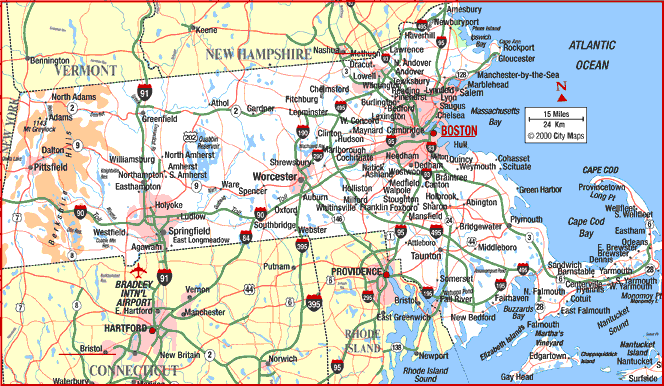
Poetic license, I assume; and who better to use it than Dickinson?
But that dog was such an odd detail that it seemed real to me. And sure enough, it was: I figured a spaniel, for which there was a certain vogue back then, but a Newfie named Carlo? Wow; that’s a whole lotta dog. A lot to feed, a lot to walk, a lot to train, a lot to handle (Dickinson referred to Carlo in a letter as “a Dog large as myself, that my Father bought me.”)
A Newfoundland is the sort of dog I could imagine another favorite literary Emily might have—Emily Bronte, she of “no coward soul is mine.” Walking on the moors, wild wind blowing in her hair…
And then I thought it might be time to find out whether Emily Bronte actually had a dog, too, and if so what type. The answers were yes, and a bull mastiff. Bingo! (no, not the dog’s name—that was “Keeper”):
Emily often sat on a rug and used Keeper as a back rest. She sketched pictures of him. And her attachment to Keeper was illustrated in Charlotte’s portrayal of Shirley in the book of the same name about a character based on Emily.
Here is Emily’s sketch of Keeper:

When Emily died of the family scourge tuberculosis (at the age of 30), Keeper—true to his name–was inconsolable:
The accounts of Emily’s funeral all mention Keeper (Garber, 1996). Charlotte wrote that Keeper “followed her funeral to the vault,” and then came into the church with the family, “lying in the pew couched at [their] feet while the burial service was being read”( Barker, 1998, p. 240). According to Gaskell (1975), Keeper “walked first among the mourners to her funeral; he slept moaning for nights at the door of her empty room, and never, so to speak, rejoiced, dog fashion after her death” (p. 269). In her visits with Mrs. Gaskell after Emily’s death, Charlotte…[often] mentioned Keeper sleeping every night at the door of Emily’s empty room, “snuffing under it, and whining every morning” ( Wise, 1980, vol. 4, p. 87).
After reading all of this about Emilys and their dogs, it struck me that Emily Dickinson’s dog Carlo may not only have been one of her closest, dearest, and most direct and uncomplicated relationships, but that the animal’s death in 1866 might have had something to do with her segue into extreme isolation. I’d never read any speculation on this before (have I managed to come up with an original piece of Dickinson scholarship? No; apparently others have trod this way before me), but in checking the dates I see that Carlo died in 1866, and yes indeed (at least according to Wiki), Dickinson, already somewhat housebound, became far more reclusive that year and thereafter:
Around this time [the year 1866], Dickinson’s behavior began to change. She did not leave the Homestead unless it was absolutely necessary and as early as 1867, she began to talk to visitors from the other side of a door rather than speaking to them face to face. She acquired local notoriety; she was rarely seen, and when she was, she was usually clothed in white. Few of the locals who exchanged messages with Dickinson during her last fifteen years ever saw her in person.
Dogs tend to get you out of the house, don’t they? Especially large ones that get antsy if they don’t get a lot of exercise.
Although this isn’t about Dickinson or her dog, I find it an extraordinary picture of the poet:
Despite her physical seclusion, however, Dickinson was socially active and expressive through what makes up two-thirds of her surviving notes and letters. When visitors came to either the Homestead or the Evergreens, she would often leave or send over small gifts of poems or flowers. Dickinson also had a good rapport with the children in her life…
When Higginson [a writer for the Atlantic Monthly who was one of long-term epistolary correspondents] urged her to come to Boston in 1868 so that they could formally meet for the first time, she declined, writing: “Could it please your convenience to come so far as Amherst I should be very glad, but I do not cross my Father’s ground to any House or town”. It was not until [Higginson] came to Amherst in 1870 that they met. Later he referred to her, in the most detailed and vivid physical account of her on record, as “a little plain woman with two smooth bands of reddish hair … in a very plain & exquisitely clean white pique & a blue net worsted shawl.” He also felt that he never was “with any one who drained my nerve power so much. Without touching her, she drew from me. I am glad not to live near her.”
A picture of a quiet and powerful intensity of almost frightening dimensions. No, an itty bitty dog just would not have done for Emily Dickinson:

[NOTE: In his twilight years, Emily Bronte’s father Patrick (who knew the terrible tragedy of having his wife and all six of his children predecease him by a considerable number of years) had two dogs named Cato and Plato.
And just to complete the circle here: Charlotte Bronte’s character Mr. Rochester in Jane Eyre had a dog named Pilot who was almost undoubtedly a Landseer (black and white) Newfoundland. What’s more, it is thought that Emily Dickinson’s dog Carlo was named after the dog owned by the character St. John Rivers in one of Dickinson’s favorite books: Jane Eyre again.]
Here’s an organization that sounds like it has some promise. Something to think about and support if you like what you see:
Apgar Foundation, Inc. (the Foundation) makes grants to undergraduate programs that increase knowledge of and exposure to aspects of Western and American culture that have been instrumental in creating and sustaining the United States and other liberal democracies. The Foundation wants college faculty and students to deepen their understanding and appreciation of Western and American traditions, institutions, and values.
Minding the Campus looks like an interesting site, as well.
In yesterday’s comments about Obama’s nomination of John Kerry as Secretary of State, Geoffrey Britain referred to Kerry as a “loathsome type.”
That reminded me that it was that very quality of John Kerry’s that helped drive me to become a blogger way back in 2004, when my posting was intermittent and I had a readership of about three—and two of them were me.
Sure enough, if you go back to posts from the earliest days of this blog (and eliminate “testing,” and two posts I’d written for other venues first and simply republished on the blog) you come to the very first post I wrote expressly for the blog. It appeared on September 30, 2004, and the subject was Democratic nominee John Kerry.
Revisiting it now, after all these long and eventful years (eight, count ’em), I find that not only do I still agree with the description there of Kerry, but that it also is a fairly good fit for Obama.
Odd—but still another reason why Obama might find Kerry so very simpatico:
Kerry is one slick operator, very experienced in this venue [debates] and relatively cool, calm, and collected. But his narcissism (and I mean that in the clinical sense) was on full display last night. The word “I” is not only his favorite word, but his voice caresses it and draws it out in a way that is very telling. He seems to believe that he only has to say that he will do something, and–by virtue of being the very remarkable “I” that he is–he will convince us that it will be done. It is a remarkable and very consistent trait, not a good thing in a leader, and clearly antithetical to any idea of coalition-building.
As for Kerry’s policy statements, others have discussed them better than I (for example, see this and this ). But I must say that Kerry said a few things that literally made my jaw drop: his emphasis on “summits” and the UN (I thought I was back in the early 60s); the giving of nuclear fuel to Iran as some sort of test; and the nixing of the bunker busters, one of the few weapons that have the potential to allow us to destroy nuclear weapons and material stored in underground bunkers by the likes of Iran or North Korea…
I wonder how anyone can credit a person like Kerry who only says, “He, Bush, did it wrong; but I, Kerry, would do it right,” without providing a crumb of evidence as to why that would be so.
And now he’s going to be Obama’s Secretary of State. In retrospect, it seems inevitable.
[NOTE: The subject of John Kerry and Vietnam is so vast that it can be hard to know where to stop. But for those of you unfamiliar with Kerry’s post-Vietnam exploits and why his appointment might especially gall those Vietnam vets who are not on the left, see this about Kerry’s Winter Solder Investigation and whether it was based on truth or not (also see this for a discussion of the more general problem of false witness by fake Vietnam vets). Also, there’s Kerry’s famous 1971 testimony before the Senate Foreign Relations Committee—a committee of which he is presently chairman, forty-one years later.
I was going to choose some excerpts from that testimony of his. But I can’t. Or rather, I could, but I won’t, because I’d really like you to read the whole thing. I think it needs to be taken in as a whole.
And then afterwards it might be sobering to reflect on the fact that this man—with his “most people didn’t even know the difference between communism and democracy” mentality, is about to become our new Secretary of State. As such he will be instrumental, along with President Obama, in setting and implementing our foreign policy around the world.
I’d also like to direct you to discussions of just a few of the “facts” cited by Kerry in his testimony. One is the quote about destroying the village in order to save it (see this and this for discussions of the veracity of the quote). Another is his assertion that black soldiers had the highest percentage of casualties (see this for some actual statistics, as well as this).
I will add that, strangely enough, back when I was a liberal in the 60s and 70s, something about Kerry almost instantaneously raised my hackles. He seemed a phony, self-aggrandizing, pompous, opportunistic, narcissistic windbag even back then. Or maybe especially back then.]
[Bumped up.]
Today will not be the end of the world, NASA assures us on its website.
Thanks, NASA, we needed that.
It is, however, the end of one Mayan long-count calendar cycle and the beginning of a new one, for all the Mayans among us.
And it also is the winter solstice:
The December solstice occurs when the sun reaches its most southerly declination of -23.5 degrees. In other words, it is when the North Pole is tilted 23.5 degrees away from the sun. Depending on the Gregorian calendar, the December solstice occurs annually on a day between December 20 and December 23. On this date, all places above a latitude of 66.5 degrees north (Arctic Polar Circle) are now in darkness, while locations below a latitude of 66.5 degrees south (Antarctic Polar Circle) receive 24 hours of daylight.
That explains why I’ve long been confused about the date of the solstice: it floats around. And here I thought I was just being absent-minded.
Today the weather befits the occasion, dark and gloomy and rainy all up and down the northeast. Even though it’s still nominally daytime, it hardly looks it.
I’ve always looked forward to the day’s getting longer as compensation for the temperature getting colder, and this year is no exception. And I think it no accident that both Christmas and Chanukah are festivals of light.

…nominates Massachusetts Democratic Senator John Kerry for the post of Secretary of State.
I’ve written about this choice before (including earlier, when Kerry was being considered for Secretary of Defense). So I’ll just quote myself:
…[T]his would be another example of what a keen sense of humor Obama has. For what better way to enrage the majority of conservative men who served in Vietnam long ago? They harbor enormous resentment toward Kerry for his Winter Soldier hearings (perceived by many to be based on exaggerations and outright lies), accusations of widespread American war crimes, and communicating with the enemy as some sort of self-nominated unofficial ambassador in Paris.
Take a look:
In a question-and-answer session before a Senate committee in 1971, John F. Kerry, at the time a leading anti-war activist, asserted that 200,000 Vietnamese a year were being “murdered by the United States of America” and said he had gone to Paris and “talked with both delegations at the peace talks” and met with Communist representatives.
Kerry, now [in 2004] the presumptive Democratic presidential nominee, confirmed Wednesday through a spokesman that he did go to Paris and talked privately with a leading Communist representative. But the spokesman played down the extent of Kerry’s role and said Kerry did not engage in negotiations.
Asked about Kerry’s saying the United States had “murdered” 200,000 Vietnamese annually when the country was at war, Kerry spokesman Michael Meehan said in a statement that “Senator Kerry used a word he deems inappropriate.”
Meehan said Kerry “never suggested or believed and absolutely rejects the idea that the word applied to service of the American soldiers in Vietnam.”
Meehan declined to say to whom Kerry was referring when he said the United States had murdered the Vietnamese; Kerry declined to be interviewed about the matter…
When Kerry was asked by committee Chairman Sen. J. William Fulbright how he proposed to end the war, the former Navy lieutenant said it should be ended immediately and mentioned his involvement in peace talks in Paris.
“I have been to Paris,” Kerry said. “I have talked with both delegations at the peace talks, that is to say the Democratic Republic of Vietnam and the Provisional Revolutionary Government and of all eight of Madam Binh’s points. … ”
The latter was a reference to a Communist group based in South Vietnam. Historian Stanley Karnow, author of Vietnam: A History, described the Provisional Revolutionary Government as “an arm of the North Vietnamese government.”…
Kerry’s suggestion before the Senate committee that there be an immediate pullout led to questions about whether such a move would endanger the lives of South Vietnamese allies who had counted on U.S. military support.
Kerry responded that “this obviously is the most difficult question of all, but I think that at this point the United States is not really in a position to consider the happiness of those people as pertains to the army in our withdrawal.”
If the United States did not withdraw, Kerry said, then U.S. bombing would continue, and “the war will continue. So what I am saying is that yes, there will be some recrimination but far, far less than the 200,000 a year who are murdered by the United States of America.”
Yeah, let’s make him Secretary of [State]. Why ever not?