In my mental image of poet Emily Dickinson, dog ownership was never part of the picture. I imagined her dressed all in flowing white, flitting about the upstairs rooms of her family’s spacious Amherst home, sitting down to write amazing poetry and voluminous letters, becoming more and more self-sufficient and less and less willing to go outside as time went on.
A dog never entered into it, I thought. And yet I was quite wrong.
I discovered this when I noticed a poem of Dickinson’s (and video to go with it) at Vanderleun’s blog. The poem begins:
I started Early – Took my Dog –
And visited the Sea –
Took my dog?? Visited the sea?? What kind of Emily Dickinson was this, pray tell?
Anyone who knows Massachusetts geography (or who has access to Google Maps) knows that a walk from Amherst to the sea would be one mighty long trek:
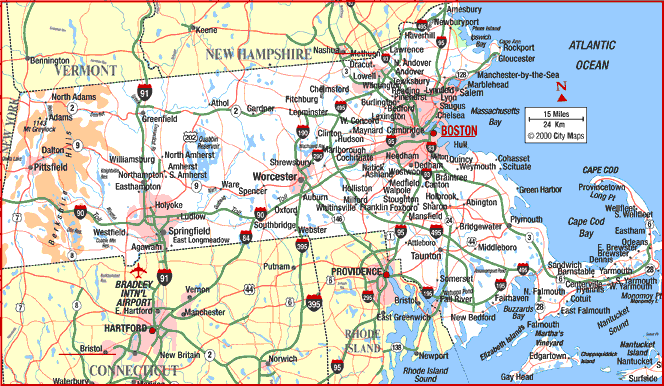
Poetic license, I assume; and who better to use it than Dickinson?
But that dog was such an odd detail that it seemed real to me. And sure enough, it was: I figured a spaniel, for which there was a certain vogue back then, but a Newfie named Carlo? Wow; that’s a whole lotta dog. A lot to feed, a lot to walk, a lot to train, a lot to handle (Dickinson referred to Carlo in a letter as “a Dog large as myself, that my Father bought me.”)
A Newfoundland is the sort of dog I could imagine another favorite literary Emily might have—Emily Bronte, she of “no coward soul is mine.” Walking on the moors, wild wind blowing in her hair…
And then I thought it might be time to find out whether Emily Bronte actually had a dog, too, and if so what type. The answers were yes, and a bull mastiff. Bingo! (no, not the dog’s name—that was “Keeper”):
Emily often sat on a rug and used Keeper as a back rest. She sketched pictures of him. And her attachment to Keeper was illustrated in Charlotte’s portrayal of Shirley in the book of the same name about a character based on Emily.
Here is Emily’s sketch of Keeper:

When Emily died of the family scourge tuberculosis (at the age of 30), Keeper—true to his name–was inconsolable:
The accounts of Emily’s funeral all mention Keeper (Garber, 1996). Charlotte wrote that Keeper “followed her funeral to the vault,” and then came into the church with the family, “lying in the pew couched at [their] feet while the burial service was being read”( Barker, 1998, p. 240). According to Gaskell (1975), Keeper “walked first among the mourners to her funeral; he slept moaning for nights at the door of her empty room, and never, so to speak, rejoiced, dog fashion after her death” (p. 269). In her visits with Mrs. Gaskell after Emily’s death, Charlotte…[often] mentioned Keeper sleeping every night at the door of Emily’s empty room, “snuffing under it, and whining every morning” ( Wise, 1980, vol. 4, p. 87).
After reading all of this about Emilys and their dogs, it struck me that Emily Dickinson’s dog Carlo may not only have been one of her closest, dearest, and most direct and uncomplicated relationships, but that the animal’s death in 1866 might have had something to do with her segue into extreme isolation. I’d never read any speculation on this before (have I managed to come up with an original piece of Dickinson scholarship? No; apparently others have trod this way before me), but in checking the dates I see that Carlo died in 1866, and yes indeed (at least according to Wiki), Dickinson, already somewhat housebound, became far more reclusive that year and thereafter:
Around this time [the year 1866], Dickinson’s behavior began to change. She did not leave the Homestead unless it was absolutely necessary and as early as 1867, she began to talk to visitors from the other side of a door rather than speaking to them face to face. She acquired local notoriety; she was rarely seen, and when she was, she was usually clothed in white. Few of the locals who exchanged messages with Dickinson during her last fifteen years ever saw her in person.
Dogs tend to get you out of the house, don’t they? Especially large ones that get antsy if they don’t get a lot of exercise.
Although this isn’t about Dickinson or her dog, I find it an extraordinary picture of the poet:
Despite her physical seclusion, however, Dickinson was socially active and expressive through what makes up two-thirds of her surviving notes and letters. When visitors came to either the Homestead or the Evergreens, she would often leave or send over small gifts of poems or flowers. Dickinson also had a good rapport with the children in her life…
When Higginson [a writer for the Atlantic Monthly who was one of long-term epistolary correspondents] urged her to come to Boston in 1868 so that they could formally meet for the first time, she declined, writing: “Could it please your convenience to come so far as Amherst I should be very glad, but I do not cross my Father’s ground to any House or town”. It was not until [Higginson] came to Amherst in 1870 that they met. Later he referred to her, in the most detailed and vivid physical account of her on record, as “a little plain woman with two smooth bands of reddish hair … in a very plain & exquisitely clean white pique & a blue net worsted shawl.” He also felt that he never was “with any one who drained my nerve power so much. Without touching her, she drew from me. I am glad not to live near her.”
A picture of a quiet and powerful intensity of almost frightening dimensions. No, an itty bitty dog just would not have done for Emily Dickinson:

[NOTE: In his twilight years, Emily Bronte’s father Patrick (who knew the terrible tragedy of having his wife and all six of his children predecease him by a considerable number of years) had two dogs named Cato and Plato.
And just to complete the circle here: Charlotte Bronte’s character Mr. Rochester in Jane Eyre had a dog named Pilot who was almost undoubtedly a Landseer (black and white) Newfoundland. What’s more, it is thought that Emily Dickinson’s dog Carlo was named after the dog owned by the character St. John Rivers in one of Dickinson’s favorite books: Jane Eyre again.]