Here’s an organization that sounds like it has some promise. Something to think about and support if you like what you see:
Apgar Foundation, Inc. (the Foundation) makes grants to undergraduate programs that increase knowledge of and exposure to aspects of Western and American culture that have been instrumental in creating and sustaining the United States and other liberal democracies. The Foundation wants college faculty and students to deepen their understanding and appreciation of Western and American traditions, institutions, and values.
In yesterday’s comments about Obama’s nomination of John Kerry as Secretary of State, Geoffrey Britain referred to Kerry as a “loathsome type.”
That reminded me that it was that very quality of John Kerry’s that helped drive me to become a blogger way back in 2004, when my posting was intermittent and I had a readership of about three—and two of them were me.
Sure enough, if you go back to posts from the earliest days of this blog (and eliminate “testing,” and two posts I’d written for other venues first and simply republished on the blog) you come to the very first post I wrote expressly for the blog. It appeared on September 30, 2004, and the subject was Democratic nominee John Kerry.
Revisiting it now, after all these long and eventful years (eight, count ’em), I find that not only do I still agree with the description there of Kerry, but that it also is a fairly good fit for Obama.
Odd—but still another reason why Obama might find Kerry so very simpatico:
Kerry is one slick operator, very experienced in this venue [debates] and relatively cool, calm, and collected. But his narcissism (and I mean that in the clinical sense) was on full display last night. The word “I” is not only his favorite word, but his voice caresses it and draws it out in a way that is very telling. He seems to believe that he only has to say that he will do something, and–by virtue of being the very remarkable “I” that he is–he will convince us that it will be done. It is a remarkable and very consistent trait, not a good thing in a leader, and clearly antithetical to any idea of coalition-building.
As for Kerry’s policy statements, others have discussed them better than I (for example, see this and this ). But I must say that Kerry said a few things that literally made my jaw drop: his emphasis on “summits” and the UN (I thought I was back in the early 60s); the giving of nuclear fuel to Iran as some sort of test; and the nixing of the bunker busters, one of the few weapons that have the potential to allow us to destroy nuclear weapons and material stored in underground bunkers by the likes of Iran or North Korea…
I wonder how anyone can credit a person like Kerry who only says, “He, Bush, did it wrong; but I, Kerry, would do it right,” without providing a crumb of evidence as to why that would be so.
And now he’s going to be Obama’s Secretary of State. In retrospect, it seems inevitable.
[NOTE: The subject of John Kerry and Vietnam is so vast that it can be hard to know where to stop. But for those of you unfamiliar with Kerry’s post-Vietnam exploits and why his appointment might especially gall those Vietnam vets who are not on the left, see this about Kerry’s Winter Solder Investigation and whether it was based on truth or not (also see this for a discussion of the more general problem of false witness by fake Vietnam vets). Also, there’s Kerry’s famous 1971 testimony before the Senate Foreign Relations Committee—a committee of which he is presently chairman, forty-one years later.
I was going to choose some excerpts from that testimony of his. But I can’t. Or rather, I could, but I won’t, because I’d really like you to read the whole thing. I think it needs to be taken in as a whole.
And then afterwards it might be sobering to reflect on the fact that this man—with his “most people didn’t even know the difference between communism and democracy” mentality, is about to become our new Secretary of State. As such he will be instrumental, along with President Obama, in setting and implementing our foreign policy around the world.
I’d also like to direct you to discussions of just a few of the “facts” cited by Kerry in his testimony. One is the quote about destroying the village in order to save it (see this and this for discussions of the veracity of the quote). Another is his assertion that black soldiers had the highest percentage of casualties (see this for some actual statistics, as well as this).
I will add that, strangely enough, back when I was a liberal in the 60s and 70s, something about Kerry almost instantaneously raised my hackles. He seemed a phony, self-aggrandizing, pompous, opportunistic, narcissistic windbag even back then. Or maybe especially back then.]
The December solstice occurs when the sun reaches its most southerly declination of -23.5 degrees. In other words, it is when the North Pole is tilted 23.5 degrees away from the sun. Depending on the Gregorian calendar, the December solstice occurs annually on a day between December 20 and December 23. On this date, all places above a latitude of 66.5 degrees north (Arctic Polar Circle) are now in darkness, while locations below a latitude of 66.5 degrees south (Antarctic Polar Circle) receive 24 hours of daylight.
That explains why I’ve long been confused about the date of the solstice: it floats around. And here I thought I was just being absent-minded.
Today the weather befits the occasion, dark and gloomy and rainy all up and down the northeast. Even though it’s still nominally daytime, it hardly looks it.
I’ve always looked forward to the day’s getting longer as compensation for the temperature getting colder, and this year is no exception. And I think it no accident that both Christmas and Chanukah are festivals of light.
…nominates Massachusetts Democratic Senator John Kerry for the post of Secretary of State.
I’ve written about this choice before (including earlier, when Kerry was being considered for Secretary of Defense). So I’ll just quote myself:
…[T]his would be another example of what a keen sense of humor Obama has. For what better way to enrage the majority of conservative men who served in Vietnam long ago? They harbor enormous resentment toward Kerry for his Winter Soldier hearings (perceived by many to be based on exaggerations and outright lies), accusations of widespread American war crimes, and communicating with the enemy as some sort of self-nominated unofficial ambassador in Paris.
In a question-and-answer session before a Senate committee in 1971, John F. Kerry, at the time a leading anti-war activist, asserted that 200,000 Vietnamese a year were being “murdered by the United States of America” and said he had gone to Paris and “talked with both delegations at the peace talks” and met with Communist representatives.
Kerry, now [in 2004] the presumptive Democratic presidential nominee, confirmed Wednesday through a spokesman that he did go to Paris and talked privately with a leading Communist representative. But the spokesman played down the extent of Kerry’s role and said Kerry did not engage in negotiations.
Asked about Kerry’s saying the United States had “murdered” 200,000 Vietnamese annually when the country was at war, Kerry spokesman Michael Meehan said in a statement that “Senator Kerry used a word he deems inappropriate.”
Meehan said Kerry “never suggested or believed and absolutely rejects the idea that the word applied to service of the American soldiers in Vietnam.”
Meehan declined to say to whom Kerry was referring when he said the United States had murdered the Vietnamese; Kerry declined to be interviewed about the matter…
When Kerry was asked by committee Chairman Sen. J. William Fulbright how he proposed to end the war, the former Navy lieutenant said it should be ended immediately and mentioned his involvement in peace talks in Paris.
“I have been to Paris,” Kerry said. “I have talked with both delegations at the peace talks, that is to say the Democratic Republic of Vietnam and the Provisional Revolutionary Government and of all eight of Madam Binh’s points. … ”
The latter was a reference to a Communist group based in South Vietnam. Historian Stanley Karnow, author of Vietnam: A History, described the Provisional Revolutionary Government as “an arm of the North Vietnamese government.”…
Kerry’s suggestion before the Senate committee that there be an immediate pullout led to questions about whether such a move would endanger the lives of South Vietnamese allies who had counted on U.S. military support.
Kerry responded that “this obviously is the most difficult question of all, but I think that at this point the United States is not really in a position to consider the happiness of those people as pertains to the army in our withdrawal.”
If the United States did not withdraw, Kerry said, then U.S. bombing would continue, and “the war will continue. So what I am saying is that yes, there will be some recrimination but far, far less than the 200,000 a year who are murdered by the United States of America.”
Yeah, let’s make him Secretary of [State]. Why ever not?
Glenn Reynolds at Instapundit links to this piece on how to negotiate a “friends with benefits” relationship.
It seems to be addressed to women, and the gist of its main caution is to make sure you don’t care, and make sure you’re in control of the situation.
Sounds like so much fun! (Not.)
When I was growing up this wasn’t something that magazines for young women recommended. It’s not that such behavior was unheard of; I knew contemporaries who operated that way, even back then. But they were outliers, and not necessarily something to be emulated or envied.
What’s more, it seemed plausible that the act of sex and especially orgasm causes women to release a hormone that enhances bonding. When we college girls of yesteryear (we called ourselves “girls” back then, not women, because for the most part we pretty much were girls) talked into the wee hours of the morning about love and boys and what was quaintly known as “dating,” we agreed that we tended to fall in love with those guys with whom we had sex (or even sex short of intercourse), whether we wanted to fall in love with them or not.
I don’t think biology has changed very much, either, in the intervening years. But the messages given to women—and men—certainly have.
[NOTE: And yes, I know it’s political, and part of the left’s agenda.]
The incomparable Hanson points out the rise of what he calls “racial tribalism” on the part of a growing number of affluent and successful black people.
It’s not just identification with blacks as a group, either. It’s this:
Here is actor Jamie Foxx joking recently about his new movie role: “I kill all the white people in the movie. How great is that?” Reverse white and black in the relevant ways and even a comedian would hear national outrage. Instead, his hip “Saturday Night Live” audience even gave Foxx applause.
Race-obsessed comedian Chris Rock tweeted on the Fourth of July, “Happy white peoples (sic) independence day …”
Actor Samuel L. Jackson, in a recent interview, sounded about as unapologetically reactionary as you can get: “I voted for Barack because he was black. … I hope Obama gets scary in the next four years.”
No one in Hollywood used to be more admired than Morgan Freeman, who once lectured interviewers on the need to transcend race. Not now, in the new age of racial regression. Freeman has accused Obama critics and the Tea Party of being racists. He went on to editorialize on Obama’s racial bloodlines: “Barack had a mama, and she was white ”“ very white, American, Kansas, middle of America … America’s first black president hasn’t arisen yet.”
Freeman’s racial-purity obsessions were echoed on the CNN website, where an ad for the network’s recent special report on race included a crude quote from three teen poets: “Black enough to be a n—–. White enough to be a good one.”
…ESPN sports commentator Rob Parker blasted Washington Redskins quarterback Robert Griffin III last week for admirably stating that he did not wish to be defined by his race rather than by his character: “He’s black, he does his thing, but he’s not really down with the cause.” Parker added: “He’s not one of us. He’s kind of black, but he’s not really like the kind of guy you really want to hang out with.” (ESPN suspended Parker for his remarks.)
Unfortunately, the new racialist derangement is not confined to sports and entertainment. The Rev. Joseph Lowery — who gave the benediction at President Obama’s first inauguration — sounded as venomous as the Rev. Jeremiah Wright in a speech that Lowery delivered to a black congregation shortly before this year’s election: “I don’t know what kind of a n—– wouldn’t vote with a black man running.” Lowery reportedly preceded that rant by stating that when he was younger, he believed that all whites were going to hell, but now he merely believes that most of them are. And in his 2009 inauguration prayer, Lowery ended with his hopes for a future day when “white will embrace what is right.”
None of this should be any surprise. As Hanson also points out, Obama and his AG Holder have fostered some of it by various remarks (as has “put y’all back in chains” VP Biden). But I contend that, although they have all acted as releasers for these sorts of sentiments, the real culprits (as Hanson also points out) are those educators who have taught over and over in the last few decades that racism is only racism when practiced by white people, and that black people are eternally and forever their innocent victims.
One of the hopes of Barack Obama’s election as president was that there would be some sort of racial healing as a result. How’s that working out for ya? Not very well. And perhaps I’ve missed it, but has Obama ever denounced racist remarks uttered by a black person towards whites? The only time I can recall—and in this his hand was forced—was when he threw former mentor Reverend Wright under the bus in order to get elected in 2008.
“Meltdown” is really the meme du jour for House Republicans’ failure to coalesce around Boehner’s Plan B.
Great Speakers (and/or Majority Leaders) are not necessarily great statesmen (or stateswomen; let us not forget Nancy Pelosi). Perhaps that quality is even counter-indicated, and at any rate statesmanship seems rather rare these days in politics. But what great Speakers absolutely need to be is great herders of cats—that is, House members of their own Party.
They also need to be great strategists, although perhaps that’s the same thing.
And that means that, for starters, they shouldn’t open their big Speaker mouths to play this sort of game without knowing, absolutely knowing, they’ve got those cats in the bag.
Boehner didn’t—keep his mouth shut, that is, or absolutely know he had those votes lined up.
If you’re curious what actually happened, this piece by Robert Costa in National Review purports to describe the process. But short of saying, in a rather lengthy way, “many conservatives defected,” it doesn’t really tell us all that much.
Apparently some of those defectors were surprised and somewhat disappointed that Plan B didn’t go through despite their own failure to support it; perhaps they’d hoped that they could vote “no” as individuals and thus please their conservative base (and win re-election, of course; isn’t that what it’s all about?) while still allowing the bill to pass. In other words, they wanted to have their cake and eat it too. But sometimes that just doesn’t work out, and someone left this cake out in the rain.
DrewM at Ace’s counsels that it’s all not really such a big deal because the bill was never going to be law; Democrats in the Senate wouldn’t pass it and Obama wouldn’t sign it:
Passing it in the House alone was simply a public offer of good faith designed to have something to point to when Obama pushes the country over the cliff.
Yes, but the GOP desperately needed a “public offer of good faith” right now, in order to at least try not to have this thing pinned on them. Now they’ve lost even that, and look foolish in the process.
DrewM goes on:
We’re at this point because of the deal that Boehner and the GOP made in the summer of 2011 to avert hitting the debt ceiling. The $1.2 billion in cuts from sequestration everyone wants to avoid like the plague? That was our PRIZE.
But don’t forget that during the debt hike debate and shortly after, Boehner kept talking to Obama about a “grand bargain”. As part of that talk he put revenue on the table ($800 billion or so). Obama then demanded more revenue and the talks died.
And remember, the debt deal was supposed to be about SPENDING CUTS to more than offset the debt hike. Obama however pocketed Boehner’s willingness to include new revenue as a concession and gave nothing back in return.
So the deal was cut last year setting up the fiscal cliff (the tax extensions, the payroll tax holiday, the death tax cut, and of course the looming sequestration cuts once the “Super Committee” failed). The GOP was betting Mitt Romney or some other Republican would beat Obama. That was….unwise.
Now here we are.
As far as I can tell, Boehner has been one of the worst Speakers in history, at a time when we desperately need one of the best. This particular error—acting as though you have the votes when you don’t—is an unforced rookie error, something like a lawyer asking a question to which he/she doesn’t know the answer.
So, as Ezra Klein asks: will Boehner continue as Speaker when it comes to a vote on January 3? I don’t pretend to know any inside baseball about this—or about who his challenger would be, and whether that person would be better than Boehner, but it’s hard to believe he/she could be worse.
[NOTE: Also, this rift mirrors the larger rift in the Republican Party between the so-called “establishment” and the more conservative and/or Tea Party wing. Perhaps it’s even the reason that Romney lost the election—the failure of the Party to coalesce behind him, or as many conservatives and/or libertarians might put it the failure of the establishment to allow them to have a more conservative or libertarian candidate (although I’ve never understood exactly how they were stopped, when no attractive candidate of such ilk threw a hat into the ring, and nominees are selected through primaries). The Republican Party is not only weak right now but dangerously divided.
Or perhaps it’s weak because it’s dangerously divided. The Democratic Party, on the other hand, leaves whatever principles it has behind in order to win politically. Whatever Pelosi did to get those votes on HCR, she sure got em, didn’t she? And although the Party lost temporarily as a result in 2010, look how it’s bounced back.]
[ADDENDUM: Oh, and in case you want to know—and in case it’s not obvious from the foregoing—I think Boehner’s got to go, ASAP. Republicans desperately need someone new at the helm.]
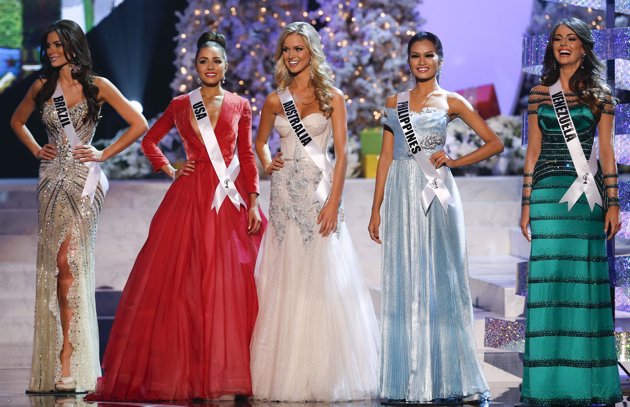
Forgive me my regional boosterism, but it’s highly unusual for a girl from Rhode Island who goes to Boston University to win Miss USA, let alone Miss Universe. And yet Olivia Culpo has done both—and she’s a classical cellist as well.
I have to say I like Culpo’s red dress here. Note how the rest of the gowns look very pageant-y, but hers is more elegant, like something a classical musician or opera singer might wear for a solo concert.
Note also the very full skirt—the better to play the cello in (not that Culpo played cello in the pageant; there’s no talent competition in Miss Universe, unless you consider strutting your stuff in front of a gazillion people wearing a bikini and sky-high heels a talent, which I suppose it is).
Although I’m very curious, I could find no videos of Culpo sawing away at her cello. But there were three stills, which I present here in ascending (or descending?) order.
First we have the cellist next door:
Next, the Viva Las Vegas cellist:
And finally, sex and the single cellist (I’d never seen a white cello before this, especially one with what appear to be decals on it, but I can’t say I’ve kept up with cello fashion)::
So don’t say I never give you cheesecake. But I try to do it with a little culcha.
It’s a topic you hear a lot about these days, especially from the left: the growing gap in income inequality, and what it means for the country.
If you’re interested in reading a fascinating perspective on the concept from the conservative side, take a look at this piece by William Voegeli, in which he reviews two recent books on the subject, one by Timothy Noah and the other by Joseph E. Stiglitz.
And if you’re interested in a far greater rarity, a conversation between a conservative (Voegeli, who tore Noah’s book apart in his review) and a liberal (Noah) that’s respectful, content-based, and really quite illuminating, then read this as well.
If you’d like to read even more from Voegeli, here’s a book of his that sounds interesting: Never Enough: America’s Limitless Welfare State.