I put the word “debates” in scare quotes because they aren’t really debates.
What they are at this point is an opportunity for the MSM to play “gotcha” and elicit a series of sound bites that will make each Republican candidate in turn look bad, as well as a chance to have the candidates tear each other down and weaken the eventual nominee. Why should the Democrats work any harder than they have to?
It’s high time—in fact, way past the time—Republicans learned that making nice to the MSM will get them noting but grief, and that it isn’t even necessary. Both Barack Obama and Hillary Clinton have successfully thumbed their noses at the media and it has paid off for them. I realize the Republicans are in a position that is the polar opposite because the MSM is on the other side. But that doesn’t change the fact that the MSM has become more openly biased and more and more unnecessary, so why bother?
[NOTE: Drew M. at Ace’s suggests a candidate forum as an alternative.]
Most of you have probably read about the fight yesterday between two rival motorcycle gangs in Waco, Texas, in which nine people were killed and at least 18 injured.
To call these groups “motorcycle gangs” is a bit like calling Genghis Khan and his Mongol hordes “horseback riders.” A mode of transportation is not a completely adequate description.
Not all the articles about the fight explain who was fighting here. These gangs bear a mild resemblance (although not a stylistic one) to the gangs of the prohibition era (see this, for example), in that they also tussle for control of various criminal operations, and are not at all averse to murdering each other in public or semi-public places. The criminal operation in the case of the earlier groups was mainly alcohol; these days it’s apparently meth. The targets of the violence of both types of group have mostly been each other rather than bystanders.
Here’s an informative article from about a year and a half ago on violent biker gangs. Here’s another article of similar vintage. As for race and ethnic origin—which don’t appear to be large motivating factors here—the protagonists seem to be mostly white with some Hispanics as well. For example, despite its name, the “Banditos” are predominantly white although with some Hispanic members, whereas the “Cossacks” are even more white in makeup.
Sgt Swanton…added: “This is not a bunch of doctors and dentists and lawyers riding Harleys. These are criminals on Harley-Davidsons.”
Criminals who have a worldwide reach. The phenomenon and the membership is not limited to the US:
Worldwide, the Bandidos were involved in the “Great Nordic Biker War” with Hells Angels in Scandinavia from 1994 to 1997…
They were also involved in the largest mass killing in the history of Ontario, Canada, when they carried out an “internal cleansing” in 2006. Eight members were found shot dead in cars.
Why? It appears she’s not quite leftist and doctrinaire enough. Too “old school.” But they’ll vote for her anyway—and that’s before they know the Republican nominee, who of course is completely out of the question:
And Hillary Clinton came to look like the symbol of an older generation of women more concerned with female empowerment””in particular, with white, middle-class, American female empowerment””than with broader issues of social and economic justice. Svokos says she’ll vote for Clinton in 2016, but she’s not expecting her to make social justice and inequality true priorities if she makes it to the White House. “I find her lacking, in that I realize she’s not likely to push for the kind of change I’d like to see,” Svokos says. “At the same time, though, I believe she knows how to manage politics and will be more than capable in the position.”
The article goes on to make this rather risible comment:
While it’s not exactly news that Clinton is a less-than-ideal candidate for many on the Left, the critique of her from those on the vanguard of contemporary feminism is more surprising…
Excuse me, writer Molly Mirhashem of National Journal, but you don’t think “those on the vanguard of contemporary feminism” are the left?
Meanwhile, the Democrats prepare their plan of attack on the newest Republican frontrunner, white Hispanic Marco Rubio.
It’s always unexpected, except that so often it was expected by conservatives, who really don’t matter:
Medicaid enrollment under Obamacare is skyrocketing past expectations, giving some GOP governors who oppose the program’s expansion under the health law an “I told you so” moment.
More than 12 million people have signed up for Medicaid under the Affordable Care Act since January 2014, and in some states that embraced that piece of the law, enrollment is hundreds of thousands beyond initial projections. Seven states have seen particularly big surges, with their overruns totaling nearly 1.4 million low-income adults.
That a surging Medicaid enrollment as a result of Medicaid expansion would be unexpected by anyone is preposterous. If you offer a freebie, people will usually be happy to take it. It was necessary to talk it down in order to try to get Obamacare passed, and to soothe the public into thinking all would be okay and that there really is a free lunch, and that the free lunch would be courtesy of the feds.
But nothing should have been unexpected, as Rick Scott points out when he says: “Name the health care program ”” I think the only one is Medicare Part D ”” that cost less than what they initially anticipated”¦Historically, if you look at the numbers, with the growth in Medicare costs, Medicaid costs, it’s always multiples.”
But, nevertheless, here we have that surprise factor again in the use of the word “startling”:
In some states that did expand, the take-up has been startling ”” the result, officials say, of significant pent-up demand for coverage.
Well, du-uh. Who would have thought we needed “officials” to tell us that?
Beyond the low-income adults that became newly eligible for Medicaid because of the health care law, states have long feared the budget impacts of the “woodwork effect” ”” people previously eligible for Medicaid who are only enrolling now because of the broader outreach surrounding Obamacare. Generally, even the states that have shunned Obamacare Medicaid expansion are seeing enrollment growth.
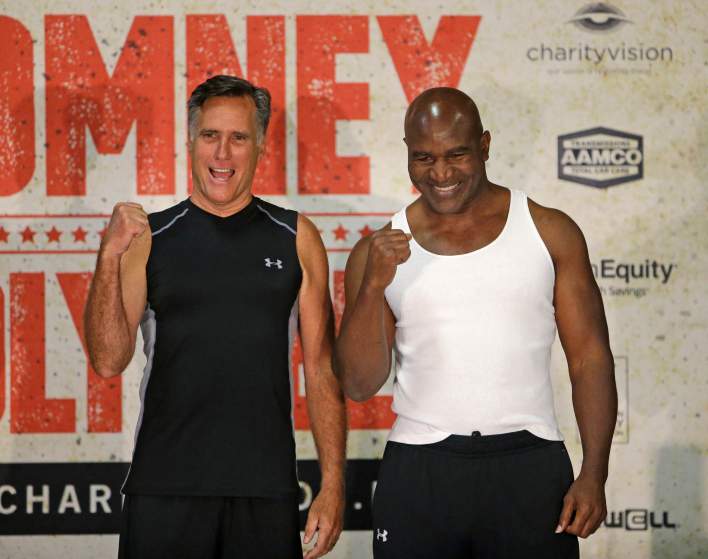
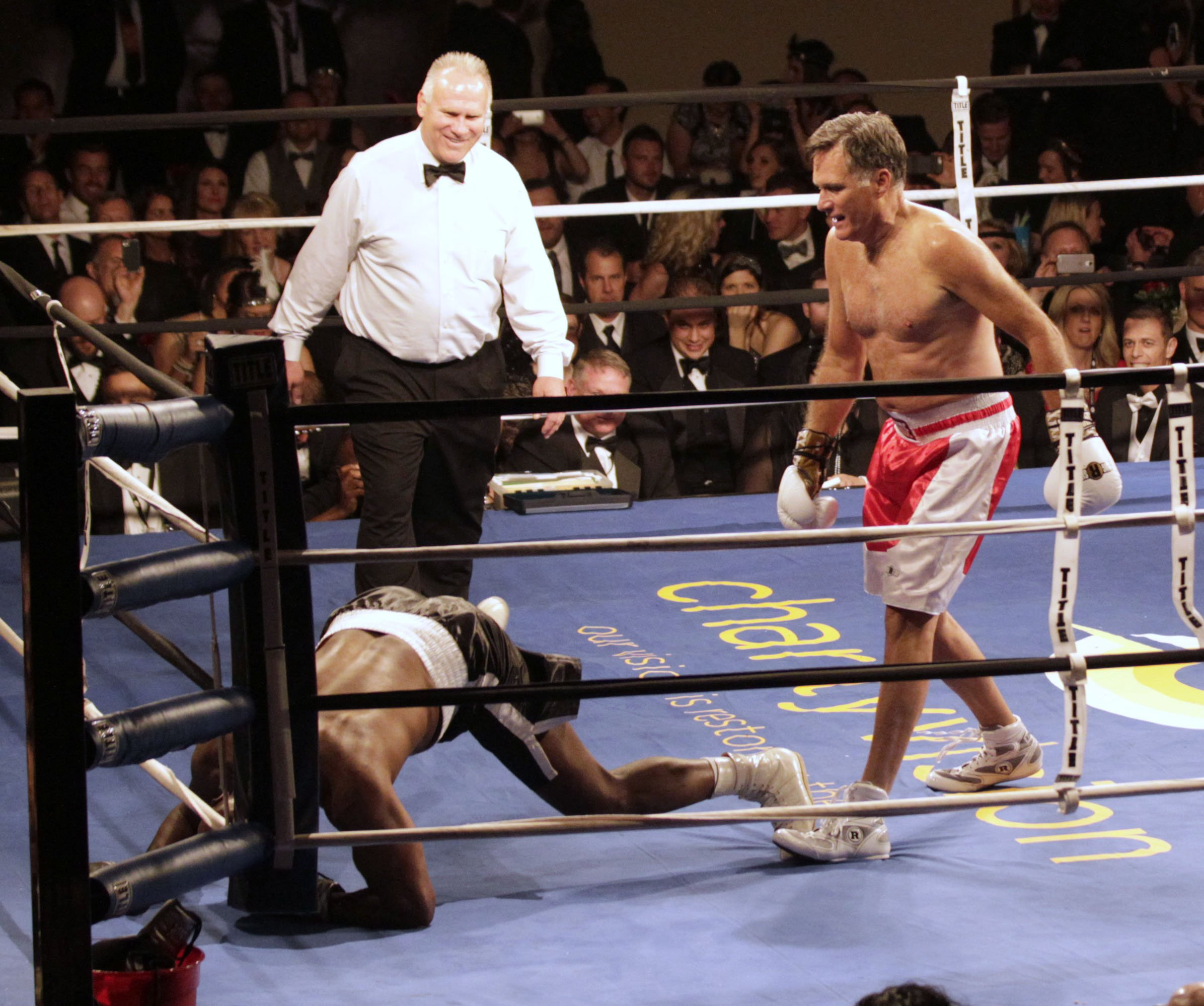
Former Republican presidential candidate Mitt Romney and five-time heavyweight boxing champion Evander Holyfield squared off in the ring at a charity fight night event in Salt Lake City.
Romney, 68, and Holyfield, 52, sparred, if you could call it that, for just two short rounds Friday before Romney ran away from the boxer and threw in the towel, giving up a round early in the lighthearted fight that came amid several other fights by professional boxers and an auction.
Even though Romney threw in the towel early, don’t call him a coward. Any man who would appear shirtless in a boxing ring at the age of 68 is courageous in my book.
Looking mighty good, shirted:
And shirtless:
I like my men with a little more meat in the calf. But that’s really a very minor quibble.
All of the following quotes from John Adams can be found here:
“Posterity! You will never know how much it cost the present Generation to preserve your Freedom! I hope you will make good use of it. If you do not, I shall repent in Heaven, that I ever took half the Pains to preserve it.”
“Democracy never lasts long. It soon wastes, exhausts and murders itself. There was never a democracy that did not commit suicide.”
“Children should be educated and instructed in the principles of freedom.”
“Liberty cannot be preserved without a general knowledge among the people.”
“Liberty, once lost, is lost forever.”
“Human passions unbridled by morality and religion”¦would break the strongest cords of our Constitution as a whale goes through a net.”
“The jaws of power are always open to devour, and her arm is always stretched out, if possible, to destroy the freedom of thinking, speaking, and writing.”
U.S. commandos mounted a rare raid into eastern Syria overnight, killing a senior Islamic State leader in a firefight, capturing his wife and rescuing a Yazidi woman held as a slave, the Pentagon said Saturday.
We don’t have information on what led the raid to be launched, since (as the article indicates) that is not the usual modus operandi these days:
The raid was the first known U.S. ground operation targeting IS militants in Syria. A U.S.-led coalition has been striking the extremists from the air for months, but the only previous time American troops set foot on the ground in Syria was in an unsuccessful commando mission to recover hostages last summer.
My guess is that they had particularly good intell on this one.
It is reported that there was heavy fighting, including hand to hand combat, but that no US forces were killed or injured nor were any women and children although both were present. The captured wife of the terrorist is being “debriefed to obtain intelligence about IS operations” by US forces in Iraq. Would those be the small group of advisers Obama finally consented to send there a while back?
Not sure how much is this report is true, but it’s a bit of success in a mostly dark picture these days.
Now we have an effort to teach “gender fluidity” in middle and high school:
Fairfax County Public Schools released a report recommending changes to their family life curriculum for grades 7 through 12. The changes, which critics call radical gender ideology, will be formally introduced next week…
“Students will be provided definitions for sexual orientation terms heterosexuality, homosexuality and bisexuality; and the gender identity term transgender,” the district’s recommendations state. “Emphasis will be placed on recognizing that everyone is experiencing changes and the role of respectful, inclusive language in promoting an environment free of bias and discrimination.”
Eighth graders will be taught that individual identity “occurs over a lifetime and includes the component of sexual orientation and gender identity.”
“Individual identity will also be described as having four parts ”“ biological gender, gender identity (includes transgender), gender role, and sexual orientation (includes heterosexual, bisexual, and homosexual).”
The district will also introduce young teenagers to the “concept that sexuality is a broader spectrum.” By tenth grade, they will be taught that one’s sexuality “develops throughout a lifetime.”
“Emphasis will be placed on an understanding that there is a broader, boundless, and fluid spectrum of sexuality that is developed throughout a lifetime,” the document states. “Sexual orientation and gender identity terms will be discussed with focus on appreciation for individual differences.”
This is so general that it’s hard to get a bead on what would actually be taught, but that may be part of the plan. I doubt it’s just a call for tolerance of differences and an admonition to avoid name-calling (neither of which I would object to); this sounds like a great deal more than that. And starting this in seventh grade, when children are vulnerable to all sorts of confusion and stress around issues of their burgeoning sexuality anyway, seems like an effort at indoctrination.
There is disagreement between the Fairfax School Board spokesperson and the head of a parents group opposing the measure about whether students can opt out, with the parent saying they will not be able to and the Board person saying they will. But even if they are allowed to opt out, doing so places that student in the spotlight and highlights their disagreement with the curriculum, and could have a chilling effect on exercising the right. In addition, I would imagine that many parents of a religious bent might end up feeling the need to pull their children out of public school if they find the curriculum is more than just a discussion of respecting everyone and not calling anyone names. The curriculum changes do not appear to have come as a result of any sort of demand by parents; au contraire.
It is true that gender is not always a simple thing in the biological sense (take a look at this, for example, if you don’t believe me). But that is a fairly advanced topic in biology that is not needed for junior high or high school students. The aforementioned tolerance for differences and admonition to avoid name-calling ought to suffice in that age group. Apparently in our current brave new world it does not.
Despite denials, the curriculum change certainly appears to be related to the following, although it’s not part of exactly the same action:
The Fairfax County Public School Board in Virginia voted Thursday to add “gender identity” as a protected class to its non-discrimination policy despite heated remarks during the meeting from parents who are concerned about the implications of the change.
Fairfax County School Board member Elizabeth Schultz, the only member who voted against the change, said the Board was warned by a local school official that federal funding could be pulled if the change was not adopted. She called it a case of federal overreach that must be opposed.
The memo warning about federal Education Department funding was issued by Steven A. Lockard, the deputy superintendent of the Fairfax County Public Schools, just prior to the vote.
It states: “The Office of Civil Rights (OCR) of the U.S. Department of Education is requiring that school divisions 1) revise their non-discrimination policies to include gender identity, and 2) hire a consultant to advise on revisions to regulations and, more generally, how school divisions should handle individual cases of transgender students. If the School Board amends Policy 1450, we will be able to tell them that we have already done the two things that OCR is requiring.”
“If FCPS refuses to amend its policy, OCR has the right to recommend the termination of federal funding to FCPS,” Lockard’s memo emphasized.
Will this memo end up being sent to every school district in the US? If not, why Fairfax County? Has it been designated some sort of pilot program for the feds?
A well-known U.S. hacker told F.B.I. agents he took momentary control of an airplane’s engines mid-flight by hacking into its inflight entertainment system, according to a document filed in U.S. federal court and obtained by APTN National News…
he document shows F.B.I. agents investigating Roberts believe he has the ability to do what he claims: take over flight control systems by hacking the inflight entertainment computer.
Roberts has not yet been charged with any crime. The allegations contained in the search warrant application have not been proven in court.
Roberts is the founder of One World Labs and he is widely viewed as an expert on counter threat cyber security.
One of three conductors aboard the Amtrak train that derailed in Philadelphia this week told investigators she heard the locomotive’s engineer say the train had been struck by an object, National Transportation Safety Board member Robert Sumwalt said Friday.
The assistant conductor said she overheard radio transmissions made Tuesday by Amtrak engineer Brandon Bostian and the engineer of a Southeastern Pennsylvania Transportation Authority (SEPTA) train.
“She recalled that the SEPTA engineer had reported to the train dispatcher that he had either been hit by a rock or shot at, and the SEPTA engineer said that he had a broken windshield, and he placed his train into emergency stop,” Sumwalt said. “She also believed that she heard (the Amtrak) engineer say something about his train being struck by something.”
As part of the investigation of the Amtrak crash, the engineer of the SEPTA train will be contracted. This is interesting information, as well:
The locomotive’s windshield was shattered in the derailment. But Sumwalt said there is “particular damage” to the lower portion of the windshield that the FBI will examine. He described it as a “circular pattern that emanates out just a bit.”
This may turn out to be a false lead. But it could be the tip of a very disturbing iceberg.
I don’t think the jurors cried from sympathy. I think they cried from excess of emotion, relief, and exhaustion. It’s somewhat surprising that in Boston, a town where 62% had favored a life sentence, the jury was willing to impose the death penalty. But these jurors had already been death-penalty-qualified in order to be able to serve.
Tsarnaev’s cool demeanor during the trial only solidifies my opinion that he’s a psychopath. His lawyer, Judy Clarke, who had never lost a death penalty case until now, had said:
“If you’re looking to me for a simple and clean answer as to why this young man, who had never been arrested, who had never sassed a teacher, who spent his free time in school working with disabled kids ”¦ if you expect me to have an answer, a simple, clean answer as to how this could happen, I don’t have it,” Clarke told jurors in her closing statement. “I don’t have it.”
I do. But it’s an answer—psycopathy—that doesn’t really answer much of anything, because it’s something we do not understand.
To those who say “he’s a jihadi terrorist” I say “Of course.” But, unlike a lot of terrorists (including his older brother, Tamerlan), I don’t think philosophy or religion was the primary motivator in Dzhokhar’s case, although it certainly was something he spouted. But, as I wrote in my PJ piece back in July of 2013, in which I quoted psychopathy expert Hervey Cleckley’s definitive work The Mask of Sanity:
”¦[T]he [psychopath’s] central personality”¦[is] covered over by”¦a perfect mask of genuine sanity, a flawless surface indicative in every respect of robust mental health. .. [T]hose called psychopaths are very sharply characterized by the lack of anxiety (remorse, uneasy anticipation, apprehensive scrupulousness, the sense of being under stress or strain)”¦
It is my opinion that when the typical psychopath”¦occasionally commits a major deed of violence, it is usually a casual act done not from tremendous passion or as a result of plans persistently followed with earnest compelling fervor. There is less to indicate excessively violent rage than a relatively weak emotion breaking through even weaker restraints.
Dzohkhar’s jihadism was “a relatively weak emotion breaking through even weaker restraints.” It seems as though Tsarnaev didn’t care much whether his victims lived or died, but it also seems as though he only cares marginally more whether he lives or dies.
Here’s one more video to show you at least a tiny bit of what made Maya Plisetskaya one of the most wonderfully unique dancers who ever lived.
Some dancers do the steps more perfectly, with a more elegantly stretched and lengthened line. Some look less like real women and more like ectomorphic fantasy creatures. Some have more beautiful faces. Most dancers in the corps of any major, and most minor, companies today have more strongly arched and gracefully curved feet. And on and on and on.
It doesn’t matter. Plisetskaya dances, and her dancing is so vitally alive that it makes the others look like mannered mechanical dolls. This is especially true of the dancers of today, so many of whom seem to be performing without all that much joy. You want to see joy? Take a look at this, every last bit of it: