Is Pope Frances a leftist, and should we even be talking about him in the context of politics? Or, as Kemberlee Kaye writes at Legal Insurrection, is it better to think of him this way:
Pope Francis is not speaking as a politician. He’s not an economist. He’s never claimed to be any of the above. He speaks as a moral authority…
If we could extricate ourselves from the political cesspool for a measly ten minutes, perhaps we could appreciate Pope Francis’ words of encouragement. Maybe we could heed the gentle reminder that we have a responsibility to be diligent stewards with what we’ve been entrusted. We might even be able to enjoy the perspective of an Argentinian who recognizes and reveres America’s long-standing tradition of religious freedom. We might even remember that we are all on a journey ”” irrespective of our partisan leanings, and that even those with which we disagree respond to truth and love.
And it’s this view I choose.
Here’s the view I choose.
You may notice I’ve written very little about Pope Francis on this blog. There are several reasons for that. First and foremost, I suppose, is that since I am a non-Christian and non-Catholic, a pope doesn’t grab my attention all that much. That’s just the way it is for me, although I’m well aware that millions and millions of people see it very differently.
The second reason is that I tend to think that we often seem to get the popes that match our times. Ever notice some sort of harmonic resonance between popes and other public figures of the day? For example, when Reagan and Thatcher were our secular leaders in the West, the Pope was John Paul II, also a strong anti-Communist. The anti-relativist and more traditional Pope Benedict came on the scene during the Bush/Blair era, and exited it while Obama’s tenure was in full swing.
Now we have Obama—and sure enough, Pope Francis comes along. Somehow it’s not a surprise that he’s in line with Obama in many ways.
Another point I’d like to make is that there’s no way for a pope to retreat from politics, unless he is going to speak on ritual matters only and never venture into a single more general statement. To paraphrase Madonna (not the Madonna, but Madonna Ciccone), we are living in a political world. When Pope Francis speaks of any world events or trends, it has political meaning and is a political statement, even if he tries to couch it in more neutral language.
Pope Francis is reported to have given an interview on the flight over here in which he explicitly denied being a liberal. Since the conversation was in Spanish, and the Pope is from Argentina, I’m not sure how he defines “liberal” but my guess is that it’s well to the left of the way we would define it in this country. He also said this:
It is I who follows the church ”¦ my doctrine on all this ”¦ on economic imperialism, is that of the social doctrine of the church.
“Economic imperialism” sure sounds like leftist language to me. Again, perhaps something got lost in translation. But my guess is that Pope Francis has been so steeped in the leftism of his Argentine milieu that he may not be aware of how much it has influenced him.
For Catholic believers, the Pope is supposed to be infallible. But my understanding of that principle is that it’s only the case when the Pope is speaking ex cathedra (see this), which is a formal process that is not happening here.
Pope Francis is speaking at least partly politically when he talks about climate change, because it is a hot-button political issue and no one can avoid political repercussions when it comes up, not even the Pope. Maybe especially not the Pope, because he influences a great many people every time he speaks on anything.
Noah Rothman writes, in “The Poisonous Obama Years,” on the effect Obama’s tenure has had on the public as a whole:
The scale of this scandal [about Middle East intelligence-twisting in the Obama administration], as exposed in a recent piece published in The Daily Beast, is chilling. “Some analysts have also complained that they felt ”˜bullied’ into reaching conclusions favored by their bosses, two separate sources familiar with analysts’ complaints said,” the report read. “In some cases, analysts were also urged to state that killing particular ISIS leaders and key officials would diminish the group and lead to its collapse. Many analysts, however, didn’t believe that simply taking out top ISIS leaders would have an enduring effect on overall operations.” How high up the chain does this culture of corruption that prevailed at CENTCOM lead? Who knows? No one is asking.
It is simply too coincidental that this White House, which wanted nothing more than to avoid becoming embroiled in a new conflict in the Middle East, was being fed intelligence that reinforced their preferred preconceptions. It is the height of irresponsibility for an informed citizenry to learn that the commander-in-chief of the military was allegedly being misled by his subordinates, putting American interests in jeopardy in the process, and to simply brush it off as the cost of doing business.
Do Americans no longer care about good governance? Has the public grown so inured to scandal that most are willing to dismiss them or to excuse them when they arise? Is the popular political press so committed to preserving the mythology surrounding this administration that it would abdicate its responsibilities to the public? The reprehensible revelations above are just a handful of the abuses of public trust that have occurred over the last six years. Americans have grown complacent over the course of Barack Obama’s presidency. A sense of disillusionment that would shrug off these and other misuses of the public trust is unnerving and dangerous. It is a level of dissatisfaction that paves the way for Caesarism. For the sake of the republican ideals, the voters and the press must get serious about holding this White House to account.
The cynicism Rothman describes became clear to me some years ago. I wrote this post about it shortly after the 2012 election, and I wrote another about two months later, entitled “What difference does it make?”
But although I yield to no one in my feeling that Obama has poisoned discourse in this country and contributed greatly to that growing cynicism, I don’t lay the blame entirely on him. Equal blame (maybe even more, in a way) goes to an MSM that has abdicated its role in informing the public (and not just in the Obama administration, as Rothman seems to be suggesting, although it has gotten worse during that time). If the press keeps saying “nothing much to see; move along” when incredibly important outrages are occurring, if the press covers up for the president and the federal government, if the press fails to make a big deal over what actually is a big deal, much of the public doesn’t know, or if it knows it doesn’t care.
Most people follow the lead of others, and most people don’t dig behind the story; that’s why propaganda is so effective. Non-coverage is a negative form of propaganda, as well. If the people are told it’s no big deal, they will think it so.
Another group I blame are the educators. If the press has a duty to tell the public some current truths about current events, educators have a duty to tell the public some ancient truths about past events and principles in order to teach Americans how to put the present into the context of the past. Educators also are supposed to guide students towards critical thinking—how to evaluate and assimilate new information without getting taken in.
None of these things have been happening. And they haven’t been happening for a long time, although that has greatly accelerated and reached critical mass under Obama. Obama is just the visible iceberg’s tip. A huge number of people have been working hard for many decades to make it all happen.
It was about nine years ago that it was first impressed on me how little France and most of Europe defends the right of freedom of speech, as compared to this country. The context of that learning was a libel trial in France, but I’m also well aware of Europe’s hate speech laws, which I deplore.
So it doesn’t come as such a surprise to me that this sort of thing can happen, and is happening, in France today:
Marine Le Pen, head of France’s far-right National Front party, will face trial in October on a charge of inciting racial hatred for having compared Muslim street prayers to the occupation of France by Nazi troops during World War II, Agence France-Presse reported Tuesday.
The charge, which relates to comments that Le Pen made to a group of party activists in eastern France 2010, creates an unfortunate distraction for the far-right leader as she seeks election in the Nord-Pas-de-Calais region in December.
“It’s an occupation of swathes of our territory, of neighborhoods in which religious law is applied,” she said at the time. “Indeed there are no tanks, no soldiers, but there is an occupation just the same, and it weighs on the inhabitants.”
The remarks prompted two anti-discrimination groups to file lawsuits against Le Pen and a court in Lyon, where the remarks were made, opened a preliminary investigation against her.
In 2013, the European Parliament, of which Le Pen is a member, lifted her immunity, allowing the Lyon court to launch a formal investigation, which led to Tuesday’s decision that she would have to face trial.
“It is scandalous that a politician should be sued for expressing their opinions,” Le Pen told Le Monde newspaper, reacting to the ruling. “I will go before the court in order to say so.”
The trial is due to take place in the middle of a hotly-contested election campaign in which she’s leading.
It is now a form of secular blasphemy (not an oxymoron) to state the truth about what’s going on with the Islamic inhabitants of Europe.
I don’t care if you are against this candidate or that candidate, as long as you’re against them for what they actually do and say and not what someone else says they are doing and saying.
In other words, check it out.
Now we read stuff like this, quoted by commenter “MJR” in the comments section here. MJR writes* [see “ADDENDUM” below], “Ya just lost me, Ms. Fiorina ”” for good, I’m afraid,” and then quotes that linked post, which said:
Carly ordered Ben Carson to apologize about the “Muslim” issue and highlighted her belief that the Islamic Civilization of the 800-1500 era was the most “enlightened,” reiterating a theme she brought up in a post 9/11 letter to HP staff, prior to laying them all off.
“When people get to know me, they tend to support me,” she told Fallon. “That’s what you see in the polls.”
Perhaps everyone should try looking up what Fiorina actually said, rather than what other people falsely report her as having said.
Just as Palin never said she could see Russia from her house, Fiorina did not say what she is quoted there as having said.
The Fallon interview is available. Here it is; I’ve kept whole thing, but the relevant part starts at minute 1:48:
Watch it and see what she actually says; don’t take my word (or anyone else’s) for it.
Fiorina does not ask Carson to apologize nor does she laud Islamic civilization in that interview. She states that Carson was wrong to dismiss a candidate simply on the basis of religion, because the Constitution explicitly forbids any religious tests for office.
I don’t care if you like Fiorina or don’t like her. But don’t misquote her—or any other candidate—just to whip up hatred towards them.
This sort of thing will be happening quite regularly. It’s a favored political tactic, and right now the long knives are out for Fiorina. Again, feel free to disagree with what Fiorina (or anyone else says)—but keep it to what she actually said. And I don’t care if it’s Fiorina or anyone else; I try to correct misquotes from any candidate when I find them. These memes get going and the lie replaces the truth in most people’s minds.
[NOTE: By the way, I noticed that the article MJR quoted has a lot Facebook comments. It’s stirring up a storm. If you would like to correct the misstatement on Facebook, please go to the post and do so. I can’t, because I’m not on Facebook, and you have to be on Facebook to do it, I believe.
And if I’m wrong about this, and I missed part of Fiorina’s Fallon interview and she really did say things on the show yesterday like “Carson should apologize” and/or reiterate her 2001 HP speech about Islam being so enlightened (although I don’t think she did), please let me know and I’ll correct myself.]
[ADDENDUM: * “M J R” wants me to add that M J R deeply regrets the error and has offered an apology in the comments, which can be found here. My reply to M J R is here.]
Given the recent reductions in the defense budgets of NATO member countries and American pullback from the region, Ochmanek says the blue team was outnumbered 2-to-1 in terms of manpower, even if all the U.S. and NATO troops stationed in Europe were dispatched to the Baltics — including the 82nd Airborne, which is supposed to be ready to go on 24 hours’ notice and is based at Fort Bragg, North Carolina.
“We just don’t have those forces in Europe,” Ochmanek explains. Then there’s the fact that the Russians have the world’s best surface-to-air missiles and are not afraid to use heavy artillery.
After eight hours of gaming out various scenarios, the blue team went home depressed. “The conclusion,” Ochmanek says, “was that we are unable to defend the Baltics.”
For those who don’t get the reference in the title of this post, see this (I’ve cued it up to start at the right point; watch it from there till about minute 14:00):
That exchange has become even more bitterly ironic with the passage of time. It’s not just that Obama was wrong (or purposely duplicitous, or both). It’s that he was so spectacularly, comprehensively wrong, and that in his wrongness he excoriates Romney for his supposed wrongness when Romney is, in fact, completely right. It’s that Obama accuses Romney of errors that are actually Obama’s own (if in fact they are errors at all, versus intentional acts), and describes himself as doing the opposite of what’s he’s doing. It is an almost perfect bizarro world, where everything is backwards.
And it’s not just that, either. It’s the way Obama does it. Mean-spirited, disrespectful, condescending, snarky. Meanwhile, Romney is the consummate gentleman, although he’s fairly tough in his response.
Of course, no liberal pundit seems to want to hark back to this moment. They flush it down the memory hole. But forgive us conservatives for not quite trusting Obama’s perspective on the Iran deal, since he’s proven himself to be such a fine, fine prognosticator.
Oh, and those who didn’t vote for Romney in 2012…are you reconsidering whether that move was wise?
Obama’s affect is even more more offensive when it’s not in split screen. This is how it looked in real life:
I have an idea. I think that whoever the Republican nominee ends up being ought to take some excerpts from these videos and make them into an ad. Even though neither Romney nor Obama will be running in 2016 (at least, I hope not), a point could be made about Republicans vs. Democrats, and about who’s been right and who’s been wrong. It might also be tied into Hillary Clinton or Biden’s role as supporting Obama’s disastrous policies, whichever one of them ends up as the nominee.
Actually, if it ends up being Biden, there’s one that’s practically ready-made:
Chris Cillizza’s article on Walker’s dropping out of the race is entitled “How Donald Trump Destroyed Scott Walker’s Presidential Chances.”
I’m no Trump fan, to say the least. But I beg to differ. I think Trump’s huge popularity and aggressive tone didn’t help, but I think it’s Walker who “destroyed” Walker’s presidential chances. I believe that even if Trump had never been in the race, other candidates would have overshadowed Walker because of that mild-mannered “blandness” factor of his that worried me from the start. Trump’s presence may have (in fact, did) emphasize it because the contrast was great, but the contrast was already present without Trump and I believe it would have always proved fatal.
Cillizza himself seems to somewhat agree:
Walker, despite his relative prime position on the stage — a vestige of the national polling bump he got after that speech at the Iowa event way back in February — seemed diminished when standing among his rivals for the nomination. And it wasn’t just Trump whose persona towered over Walker; Bush, Marco Rubio, Carly Fiorina and Chris Christie all just seemed — and I know this is a loaded word –more presidential than Walker. In the second debate last week, Walker spoke for the shortest period of time of any candidate on the stage; his campaign complained about the lack of speaking time but part of running for president is being able to butt your way into conversations and making moments. He did neither.
Nice guys often finish last—or in Walker’s case, close to last. That’s not Trump’s fault.
The primary fight is a difficult test that candidates must meet and master in order to compete in the general. Sometimes good people fall by the wayside; actually, they often do. It takes toughness to win, among other things. That’s why Walker was a paradox; he’s shown such tremendous toughness in real life, but somehow in his persona and his rhetoric during the primary campaign he couldn’t make us believe it. And that, more than anything else, is why he’s gone. It’s not just being mild-mannered, either, that did him in; Carson is mild-mannered, but to me he also seems tough, and Walker did not.
IMO this is the (inadvertent) purpose of the Trump campaign. Perry and Walker are out (both of whom had enviable track records). The next will perhaps be Graham, Santorum, Pataki and Jindal.
Fiorina, Carson and Cruz continue to improve. This test of their mettle in the primary system will, I hope, temper them for the real campaign against Clinton or Biden. Trump is forcing the issue and causing opponents to make their mistakes now. What doesn’t “kill” them in the primary makes them stronger in the general election.
Now, the only question is: Can any one of them eventually turn the tables on Trump himself to jump from second, third or fourth place to first place in the polls?
My response is that they don’t have to “turn the tables” on Trump, not exactly. From what I’ve seen, most or at least much of Trump’s support will remain firmly wedded to Trump. The race for Fiorina, Carson, Cruz, and Rubio (I see those four as having the best chance at this point) is against each other, not against Trump.
Trump will be Trump, and he will get his support and probably keep it. He may (accent on the “may”) not get much more support over time, though. His chances of victory in the primaries depend on keeping as many candidates running as possible (in fact, since he’s got so much money, maybe he should donate to his opponents’ campaigns just to keep them in the race).
Their real chance to win is for one of them to emerge above the others, and for more and more candidates to drop out. If one (or even two) candidates can corner the un-Trump vote, that’s the way to win.
The report is that he’ll be announcing his departure from the race at a news conference starting at 6 PM.
This makes me sad, because I actually think Walker would have made a good president. It also would have surprised me very much to have been told six months ago that he’d be dropping out so early in the game.
But I probably won’t mourn too much, because he failed to “bring it” to the campaign. I don’t know why that was so; I think it’s more a temperament thing, where his fighting spirit just didn’t come across on a national level. In a different year, with just a few candidates, he might have shone. But he might not have shone even then; his positive attributes just didn’t translate to a broad national appeal, and that would probably have hurt him in the general, too.
His departure will free up his supporters to get behind other candidates. His leavetaking also points out that raising money is a huge, huge factor in today’s presidential races. I don’t see that as a good thing. However, Walker would have amassed more money by this time had he been attracting more voters. People like to latch onto a winner.
I believe that Walker is a very good man. His rise was meteoric, and so was his fall. But it was only a fall from the 2016 campaign; it need not be a fall in any other sense.
I didn’t watch Walker’s speech live, but Ace reports:
He said that “it was his calling” to “clear the field” in the race. I imagine he probably meant “so that people can gather behind a non-Trump candidate,” but he didn’t say that. Actually, he does say that. Now that I see the video, he specifically calls upon other candidates to drop out so that voters can focus on a “limited number of candidates” who can offer a “positive message” in opposition to the “current front runner.”…
AllahPundit noted that Scott Walker did something very unusual — he called on other (unspecified) candidates to drop out, too.
Here’s the video, which I just watched:
I absolutely agree with him about the importance of some candidates dropping out. I wish one of the earliest ones hadn’t been Walker, though.
Trump says it wasn’t Swedes who blew up the World Trade Center.
That’s for sure, although it actually might have been—in the sense that Sweden has its own problems with a radicalized Muslim population within its borders. I’m pretty sure that, had a Muslim immigrant to Sweden been involved in terrorism, the MSM would refer to him/her as “a Swedish man/woman.”
The Trump quote also reminded me of an incident from my own life. During the 1960s my family had a wonderful cook/housekeeper, an elderly woman who was Norwegian through and through. She’d been born on a farm there, the youngest of 16 children, and emigrated to this country as a young woman. She’d always worked for mega-wealthy people on large estates as a sort of Mrs. Bridges, American-style. And although in her later years she was retired, she just couldn’t stand not to work, and came out of retirement for the relatively unchallenging job of working for us. Her pastry was out of this world, and although I have her recipes and have followed them assiduously, mine don’t compare.
When JFK was assassinated I remember she was particularly upset. Why? Her extra reason for angst was that Oswald was of Norwegian extraction, and she was afraid people would blame the Norwegians. I remember my mother assuring her that this was highly unlikely to happen; in fact no one (except our housekeeper, perhaps) was even thinking of his name or connecting it to Norway.
I watch so little TV that I’ve never heard of 99% of the stars at the 2015 Emmys.
But of course I have to take a look at the women’s dresses. As Tolstoi said, all happy families are alike, but each unhappy family is unhappy in its own way.
Apparently something similar is true for dresses.
And so we have (drum roll please):
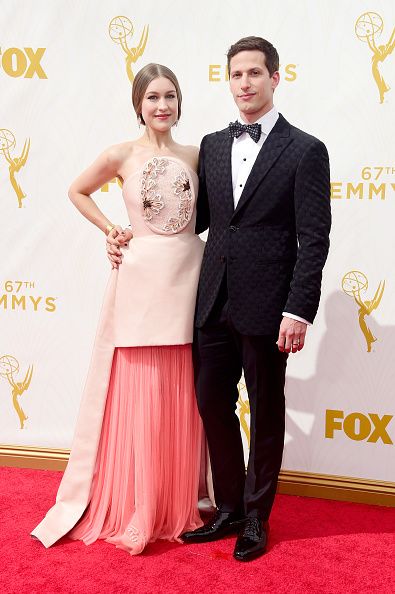
Someone named Joanna Newson. This must have seemed like a good idea at the time, but to me it seems schizoid:
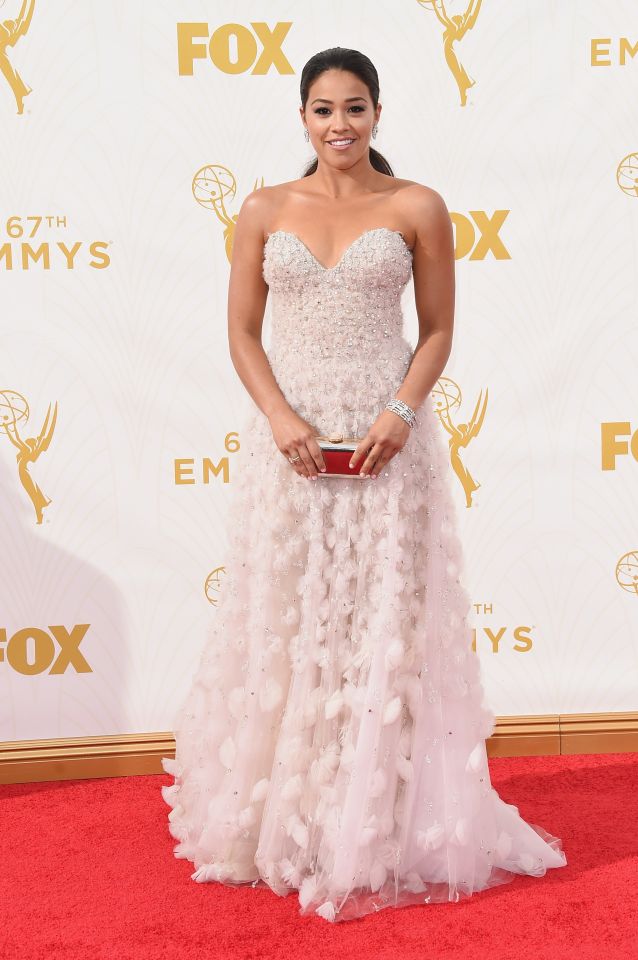
Then there’s someone named Gina Rodriguez who stopped by on the way to her wedding ceremony:
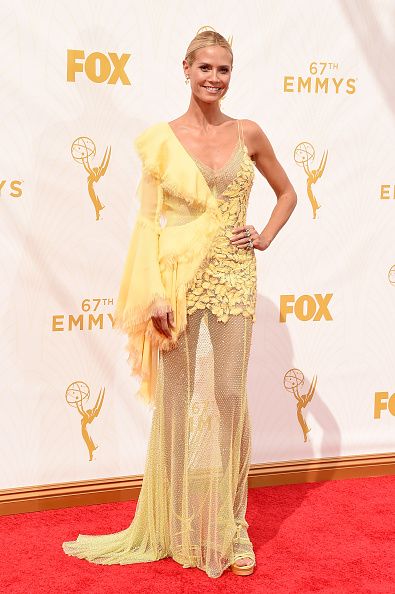
Speaking of schizoid, here’s model Heidi Klum (I’ve actually heard of her before) in what I can only describe as a half-and-half dress, or maybe it’s a four quarters dress. Or maybe it’s not a dress at all, it’s just a bad dream. You know, the one where you’re walking down the street partially unclothed:
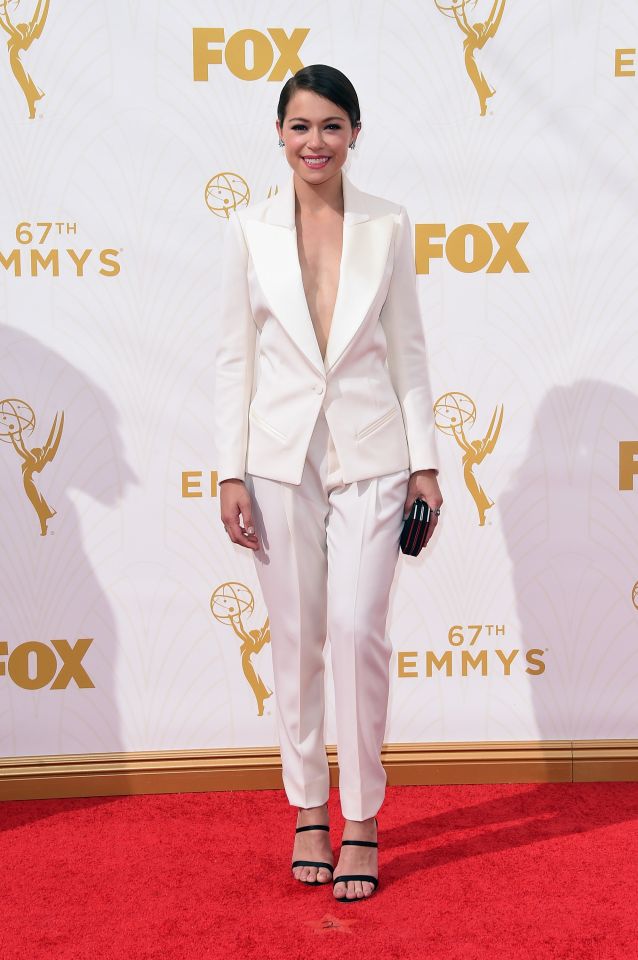
Whereas Tatiana Mosley [correction: Maslany] unfortunately was in such a hurry she forgot her shirt. But she soldiered on bravely nonetheless:
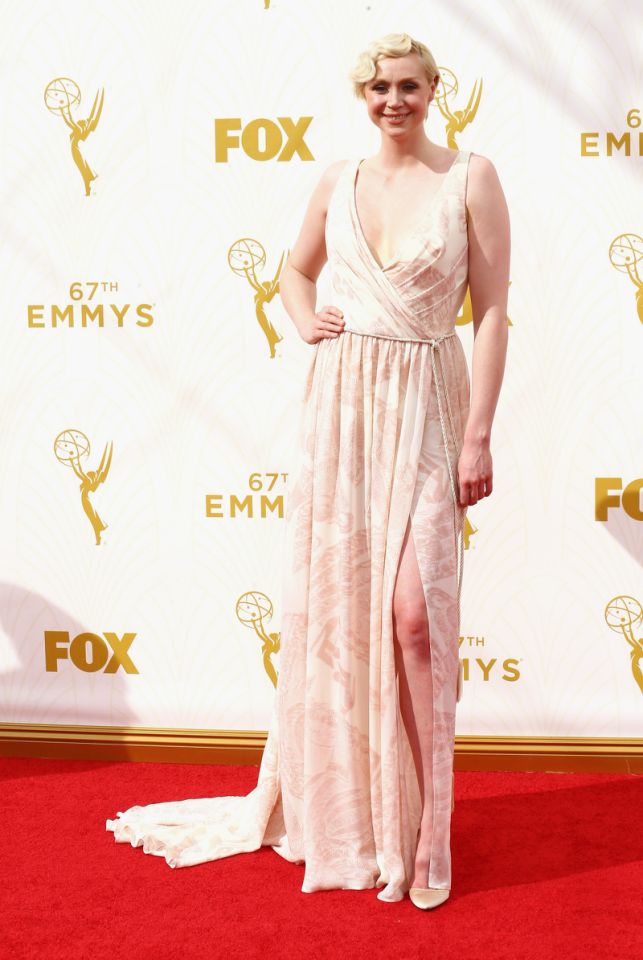
Then there’s someone named Gwendoline Christie. I will now reproduce the commentary about her dress from the website:
Who said pale people can’t wear light colors? Gwendoline Christie’s really light dress surprisingly didn’t drown her out despite the old adage that says it should.
Shhh, don’t tell, but I think that old adage just may have been correct.
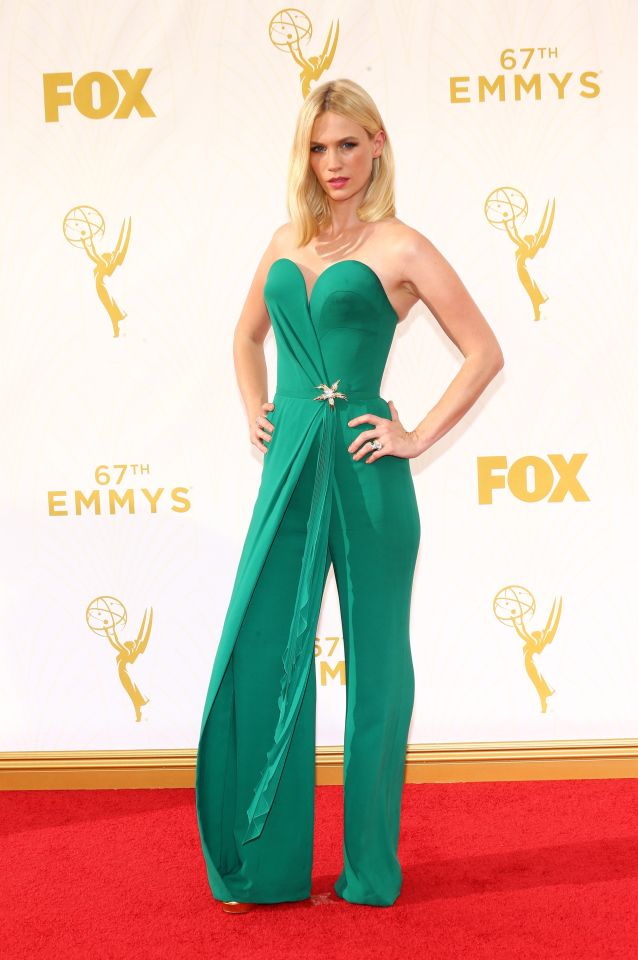
And now we have perhaps the most mysterious dress of all. Worn by January Jones (another actress I’ve heard of), it’s missing something. Or rather, she’s missing something. Can you spot what it might be?
Photoshop is not always your friend.
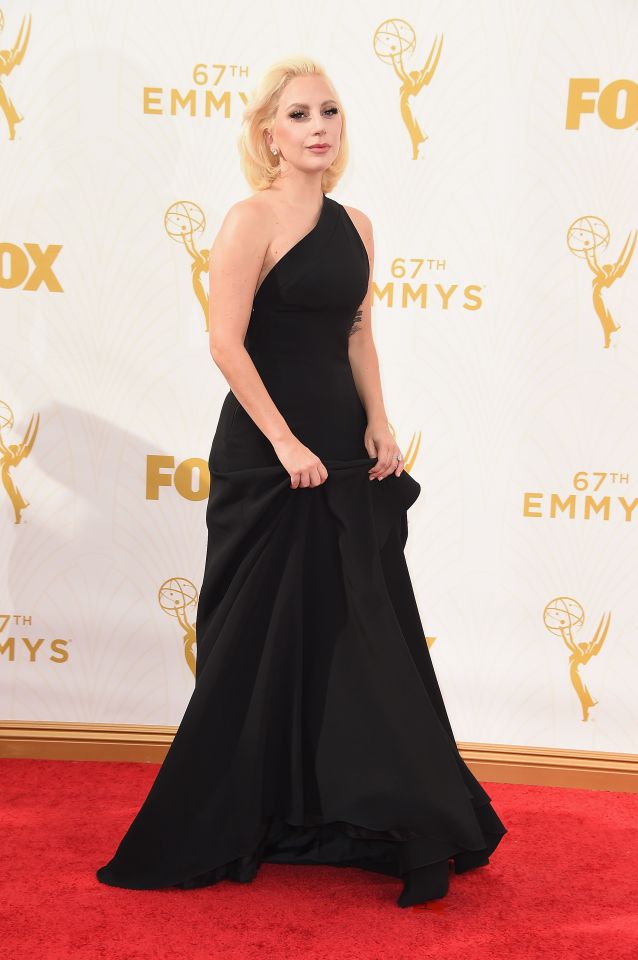
Now we have a dress I happen to like, worn by none other than—yes, believe it—Lady Gaga:
White House tech advisor Jake Brewer, 34, the husband of conservative pundit Mary Katherine Ham, has been killed in a bicycle accident during a charity bike ride and fundraiser to raise money for fighting cancer.
The couple has a young child and another on the way.
I didn’t know Brewer, but Mary Katherine Ham is well-known, well-loved, and well-respected in the conservative community. I met her at a PJ function quite a few years ago and was impressed with her graceful, friendly nature and sharp intelligence. She has published this statement and tribute to her husband’s life and her love for him.
RIP.
If you’re the praying sort please pray for the entire family.
…Chrissie Hynde has waded into another contentious area ”“ the overly sexualised nature of modern pop music.
In an obvious reference to scantily-clad stars such as Miley Cyrus and Rihanna, the former Pretenders lead singer branded them ”˜sex workers’ for selling music by ”˜bumping and grinding’ in their underwear. The 64-year-old also accused them of doing ”˜a great deal of damage’ to women with their risque performances…
Miss Hynde added: ”˜I don’t think sexual assault is a gender issue as such, I think it’s very much it’s all around us now.
”˜It’s provoked by this pornography culture, it’s provoked by pop stars who call themselves feminists. Maybe they’re feminists on behalf of prostitutes ”“ but they are no feminists on behalf of music, if they are selling their music by bumping and grinding and wearing their underwear in videos.
”˜That’s a kind of feminism ”“ but, you know, you’re a sex worker is what you are.’
There are two messages here. One is that today’s female pop stars go so far in their sexual come-ons, and their scanty dress, that they effectively are porn stars of the soft-core variety. The second is that this behavior creates an atmosphere that provokes and increases sexual assault.
I pretty much agree with the first. I’m not at all sure about the second, and it’s a subject so vast (what encourages sexual assaults and what decreases them, and also how broadly one should define the term “sexual assault) that I’m going to shelve it for now and concentrate instead on the first.
Over the years I’ve watched pop music degrade to the point that it’s so sexually explicit as to be virtually indistinguishable from what was considered to be soft-porn entertainment in my youth. That sort of thing is now mainstream, accepted, and even considered by many feminists to be empowering. Who was the entertainer who made it that way—Madonna (whom I’ve always found coldly repellent—but then again, I’m neither a heterosexual male nor a lesbian woman, nor even a gay guy)? Whoever it was, it’s in full flower now, and even pre-pubescents get to watch, right in the comfort of their own homes.
When I read what Hynde had said, I immediately thought of Allan Bloom’s 1987 book The Closing of the American Mind (not necessarily an obvious segue, I know). The book has long been one of my favorites, and I’ve written about it and recommended it many times, usually in the context of a discussion of education (especially colleges) and PC thought, and the takeover of the university by special interest groups.
Bloom’s book was focused on the university and its effect on our society. In fact, it’s subtitle was “How Higher Education Has Failed Democracy and Impoverished the Souls of Today’s Students.” You can see the emphasis on colleges, but what is sometimes lost is the second half of the subtitle, the part about impoverishing the souls. In the service of that idea, Bloom mounted an attack on rock and roll music, a critique I thought odd at the time I first read it, and which I haven’t discussed much on this blog when I’ve written about him because it hasn’t been relevant. Now I look back on it and I think I understand better what he was getting at:
Civilization…is the taming or domestication of the soul’s raw passions—not suppressing or excising them, which would deprive the soul of its energy—but forming and informing them as art…Music, or poetry…always involves a delicate balance between passion and reason, and even in its highest and most developed forms—religious, warlike, and erotic—that balance is always tipped, if ever so slightly, towards the passionate. Music, as everyone experiences, provides an unquestionable justification and a fulfilling pleasure for the activities it accompanies: the soldier who hears the marching band is enthralled and reassured; the religious man is exalted in his prayer by the sound of the organ in the church; and the lover is carried away and his conscience stilled by the romantic guiter. Armed with music, man can damn rational doubt. Out of the music emerge the gods that suit it, and they educate men by their example and their commandments….
[Rock music] has risen to its current heights in the education of the young on the ashes of classical music, and in an atmosphere in which there is no intellectual resistance to attempts to tap the rawest passions…[R]ock music has one appeal only, a barbaric appeal, to sexual desire—not love, not eros, but sexual desire undeveloped and untutored. It acknowledges the first emanations of children’s emerging sexuality and addresses them seriously, eliciting them and legitimizing them, not as little sprouts that must be carefully tended in order to grow into gorgeous flowers, but as the real thing. Rock gives children, on a silver platter, with all the public authority of the entertainment industry, everything their parents always used to tell them they had to wait for until they grew up and would understand later…
…[A]n enormous industry cultivates the taste for the orgiastic state of feeling connected with sex, providing a constant flow of fresh material for voracious appetites…
I could go on and on and on quoting Bloom, but I’ll stop there and just say you should read the book, or reread it (Bloom has a whole chapter entitled “Music,” from which I got those quotes). He further ties the sexuality fostered by rock music, and the rebellion against parents and authority that it both reflects and engenders, as generalizing to a more blanket condemnation of parents, authority, tradition, and society, and also to the embrace of leftism: “From love comes hate, masquerading as social reform…In short, life is made into a nonstop, commercially prepackaged masturbational fantasy.”
Bloom’s book was published in 1987, and it was based on his lectures and notes that in some cases were even older. The rock music of that time was chaste compared to that of today (and much of the music was better, too, IMHO). Going back even further, the rock music of my 50s/60s youth was, comparatively speaking, a celebration of puppy love (“I Want to Hold Your Hand”). And yet it contained the seeds of the blatant and loveless sexuality we see today.
I like quite a bit of pop music, especially the music of my youth. However, I find today’s explicit and coarse sexuality in music, that Hynde deplores and blames—and that Bloom already seemed to foresee, although I wonder whether even he would have been stunned by how far it’s come so fast—deplorable. But I’m not the demographic it’s appealing to, and that demographic celebrates and is affected, influenced, and shaped by it.
[NOTE: And yes, the left intends these developments, which suit their purposes admirably.]
ADDENDUM: Here’s one of my favorite rock songs and rock performances. And yes, it’s very orgasmic, but in a different way from what Hynde is describing (and there are no women, except in the audience). I love Mark Knopfler and I love Dire Straits, and this performance occurred in the summer of 1983, a bit before the years in which Bloom wrote his book but roughly during the same era.
Here the sexuality is inherent in the music itself, although there are also some suggestive moves by the performers (not so much Knopfler, who has a cooler quality, but mostly the other guitarists). The “orgasm” part I’m talking about starts at around 7:26 and goes till the end: