And yet, he is.
It’s Donald Trump’s 70th birthday.
I wrote a previous post on the advanced ages of the candidates; you can find it here.

And yet, he is.
It’s Donald Trump’s 70th birthday.
I wrote a previous post on the advanced ages of the candidates; you can find it here.
For fun, I watched the Tony Awards last night—which is the only way to keep up with Broadway shows nowadays without taking out a loan.
About the entertainment at the Tonys I have two things to say. The first is that—although I know that the dancers in the wedding scene from “Fiddler” (the present revival) are not really poor Jewish guys from the shtetl, and I know they are all the most polished dancers Broadway money can buy—when they dance with such socko, sell-it, over-the-top Broadway pizzazz, they’re missing the tone and style of the thing. I saw the original production many times, and although the dancers were excellent and of course far better than could be found in any little village way back when, they still preserved a sort of charm and modesty that seemed far more believable and authentic.
But Broadway shows were very very different back then, and in my opinion far better. I can even remember, dinosaur that I am, when the stage wasn’t miked. That wasn’t so completely great because it meant that even a little tyke like me with good hearing would lose some of the words. But that problem was compensated for because what the audience did hear didn’t have that fake quality. These days if I do go to a Broadway show I can close my eyes and believe I’m listening to the recording. That’s not the sound quality I’m looking for in a live show, but I may be in the minority on that.
Second thing I want to mention is that the play “Hamilton”—which I expected to be a travesty—actually looked quite interesting and doesn’t make a mockery of history, as I thought it might.
Now for the important stuff—the women’s fashions. They were very very odd. There was an overabundance of all-over-floral print gowns. It’s not something you ordinarily see, but I guess it must be au courant this year and everybody got the word.
It’s very hard to wear all those flowers, even for beautiful young women. It’s easy to look too much like upholstery or wallpaper. I chose just one of the most sedate examples of the genre, one of the least overpowering. But here she looks like a little girl or a preteen going to a dance:

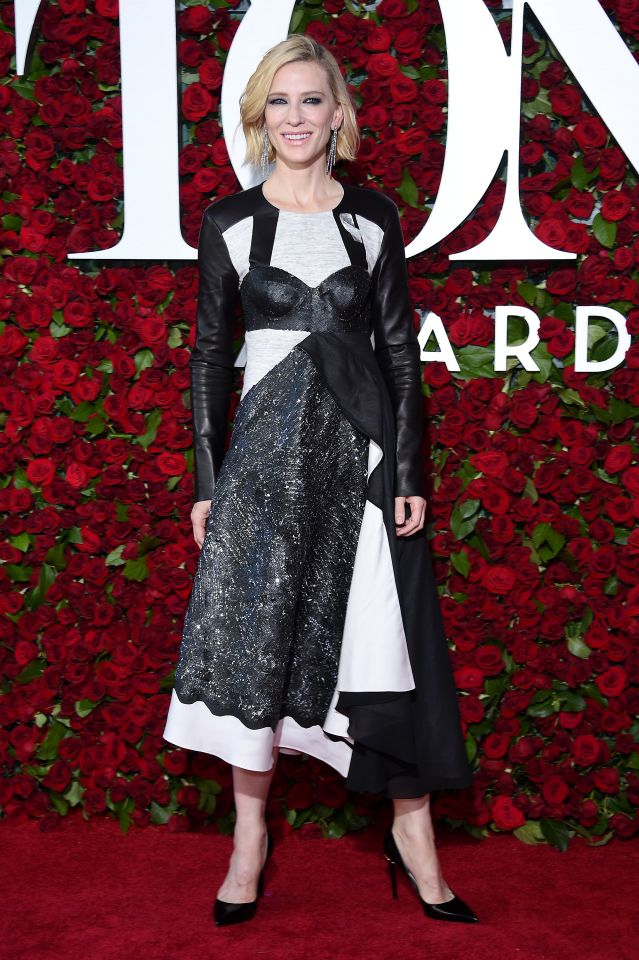
On to the next one; no flowers here. It’s Cate Blanchett, known for unusual dresses: “I dreamed I went to the Tonys in my Maidenform bra—and a piece of one skirt sewn to a piece of another skirt sewn to a piece of another skirt sewn to an old tablecloth”:
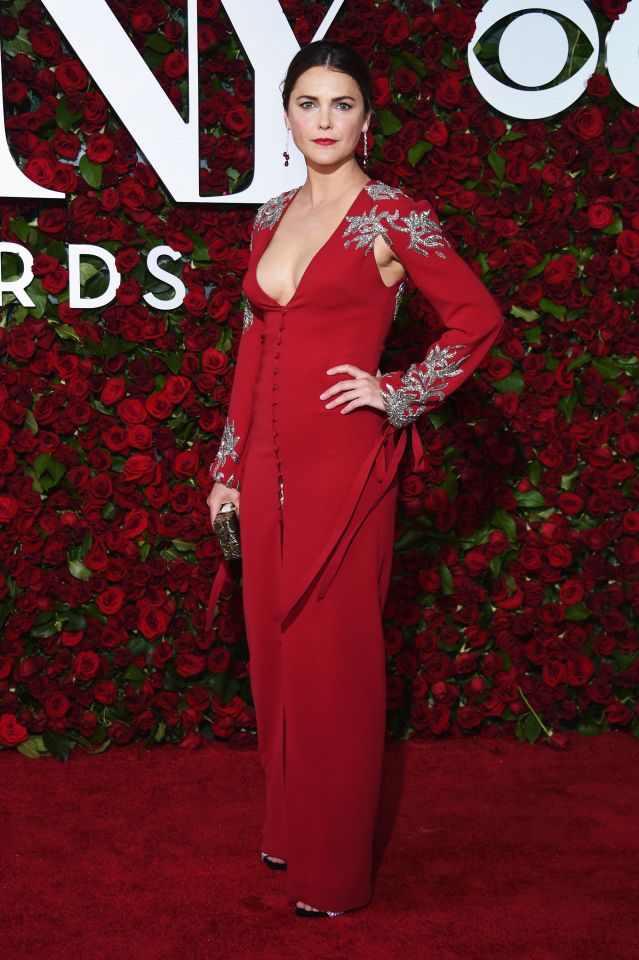
Next—it must be awfully embarrassing to have forgetten to sew those underarm seams. Then again, it probably cuts down on the sweating. And it must be almost as embarrassing as to have had the top made several sizes too small. And yes, I’m well aware it’s purposeful. But unlike most dresses that emphasize the décolletage, this one looks to me like the top of the dress (or maybe jumpsuit?) is too small and she just can’t button it. But she looks defiant:
This is one of the few dresses from the evening that I like. A lot. It reminds me of the night sky:

And here’s a throwback to old-style movie glamor:
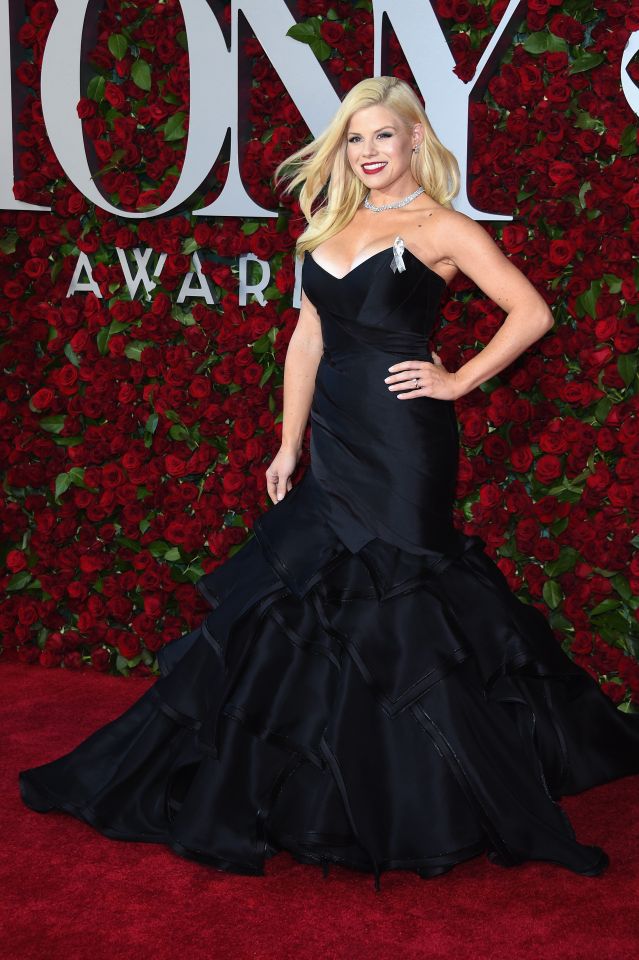
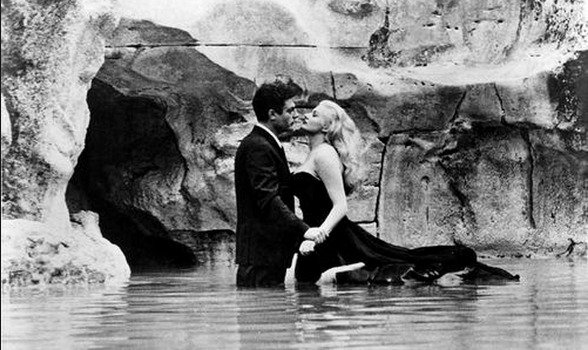
I think the above dress is actually a very specific reference to this iconic dress worn by Anita Ekberg in “La Dolce Vita,” 1960:
As to this one—what is happening here? What is happening here? Actually, what isn’t happening here. There’s way too much going on—with the wide diagonal stripes; the drape, the pleats, and the train; and in particular that convoluted stuff that snakes up and down on the bodice:

As for this one, I don’t quite know what to say. A schoolgirl whose mother let her dress herself this morning, with disastrous consequences? She’s even standing like a very young schoolgirl. I think there’s something here I’m not understanding. I think it may be a Japanese thing:

Oh-oh—in Venezuela, the fact that they may have run out of other people’s money seems to have trickled down:
Party officials stressed to The London Times that Maduro’s distribution system has “broken down and that conditions are ripe for civil war.” He hoped the system would end the long lines “and black marketeers at state-subsidised supermarkets.” Riots have exploded in these areas:
“What is striking is that the riots ”” sometimes half a dozen a day in the capital ”” are in working-class slums far from the middle-class areas where support for the opposition has traditionally been strongest. The opposition, which controls congress, is trying to push through a referendum to remove Mr Maduro but that will take time and hungry people are more concerned about procuring food.”
These economic conditions are an absolute outrage in a country that had everything going for it just a few decades ago.
I wonder, though, what the rioters think is the cause, and what the remedy. They were susceptible to the pie-in-the-sky promises of socialism before. Do they still remain susceptible, and do they just think that Maduro isn’t a very good practitioner of socialism? Or do they blame the entire mess on the socialist system of government itself? And what do they want to replace it?
It’s an old old story: the left refuses to name this enemy. Either they can’t even say the word “terrorist,” or they certainly can’t use any modifier that implies that Islam has anything to do with it.
And Obama, as a man of the left, follows suit.
In the wake of a large and deadly attack such as the one in Orlando, where it is clear that the perpetrator was an Islamic (or Islamicist, or radical Islamic) terrorist, it is glaringly apparent that Obama is refusing to call the attack what it is. And this is a weakness that Donald Trump is determined to exploit, and rightly so.
Does it matter what we call them? Obviously, both Obama and Trump—coming from opposite sides of the question—agree on the fact that it does matter, or this rhetorical battle wouldn’t be going on. By using the words he uses, Trump wants to signal his resolve to oppose Islamic terrorism, as well as opposition to PC leftist language. What does Obama want to signal? Deference to the Muslim community, emphasis on his underlying policy goal of increased gun control, and minimization of the hugely increased threat from ISIS that occurred on his watch while he poo-pooed it.
The always-intelligent Richard Fernandez has this to say about it:
The administration has a security model that is not really working. FBI are looking for ordinary criminals and “hate mongers” and, armed with these descriptions, keep letting the usual suspects go because they don’t fit the bill. Yet time and again they come back as a surprise. Maybe the greatest trick Islamic terrorism ever pulled was convincing Obama it didn’t exist.
The photo that goes with the article has the caption “Can’t solve a problem you can’t define.” That’s probably true, but I don’t think that Islamic terrorism “convinced Obama it didn’t exist.” Perhaps Fernandez is being sarcastic there, and he doesn’t really think Obama is convinced of that either, but at any rate I believe that Obama—and certainly the FBI—know full well that it exists and that it is here. Obama doesn’t want to admit it for the reasons I’ve stated above. And the FBI and other agencies are somewhat hamstrung by the guidelines laid done from the top, plus a very real dilemma involving how proactive they can be and still preserve our liberties.
I doubt that most of the people who work for the FBI would refuse to name the enemy if left to their own devices. And I doubt they are unaware of the danger of radicalized Muslim jihadis in our midst. But what are they to do if a person has engaged in “mere” associations, and “mere words,” and if they have to be careful to protect that person’s civil rights (especially for US citizens such as the Orlando perpetrator)? Marco Rubio (remember him?) hit the nail on the head about this when speaking of the Orlando massacre:
There are two parts to the problem of jihadis in the US. The first is the nomenclature; what we call people is not just semantics, it signifies the way we are looking at the issue and the way we will approach it. The second is what we will actually do about it. If you remember the Patriot Act that was passed in the wake of 9/11, it brought up the dilemmas inherent in that second part—the action part—dilemmas we’ve been fighting over ever since.
Barack Obama has been deficient in both regards, speech and action. Donald Trump seems to be doing okay with the first part, but is somewhat vague on the second. Rubio, in my opinion, is grappling more intelligently with both parts, but he is not in line to be president. Hillary Clinton, Trump’s opponent, seems to be following the basic Obama playbook, which does not inspire confidence.
One other fact about the Orlando massacre is that, unlike other terrorist attacks on our soil, it targeted a very specific group: gay people. This is a group that has been allied much more with the Democrats and the left than it has with the right, but the left doesn’t seem all that energized to protect them, and that has not gone unnoticed:
Oh sure, all year I’ve been playing the “Bernie or Hillary?” game with all the other default-Democrats in my social and professional circles. But this is no longer some kind of game. Our lives are on the line. Although I voted for Hillary in the primary, I now cringe inwardly with shame and embarrassment at having done so, and in November I will vote for Trump.
Why? Yes, I know that Trump is an a**hole, Trump is a clown, Trump is a motormouth buffoon. You don’t have to convince me of that. But he’s also the only person saying anything about putting the brakes on Islamic extremism, and in light of what happened last night in Orlando, suddenly that is the only issue that really matters when it comes to the health, well-being and safety of the queer community.
Ted Cruz—another man who wanted to be president—has astutely called out the left on this:
If you’re a Democratic politician and you really want to stand for LGBT, show real courage and stand up against the vicious ideology that has targeted our fellow Americans for murder,” he said.
They won’t meet the challenge, despite paying lip service to the LGBT community.
Last night’s vicious attack at a gay nightclub in Orlando has resulted in the highest death toll ever in a US mass murder, and the largest death toll in a terrorist attack on US soil since 9/11.
Those are not records you want to see broken.
As usual with these attacks, we don’t know the full story yet, and some of the facts I’m going to summarize in this post will probably ultimately be found incorrect. But so far the event seems to have followed the template of other attacks of the last few years:
The shooter was Omar Mateen, a Florida resident. Like so many recent terrorist perpetrators, he was a young man who had been born in the West (New York in this case) of immigrant parents (Afghanistan in this case).
And like so many others, he also was already on law enforcement’s radar screen:
The senior law enforcement source reports that Mateen became a person of interest in 2013 and again in 2014. The Federal Bureau of Investigation at one point opened an investigation into Mateen but subsequently closed the case when it produced nothing that appeared to warrant further investigation.
“He’s a known quantity,” the source said. “He’s been on the radar before.”
Depending on whether Mateen had direct ties to a terrorist group (there’s no evidence of that so far), we may be looking at another “known wolf” perpetrator, like so many before him. We don’t know much about what triggered that earlier investigation, but authorities can’t detain people on the mere suspicion that they might commit a crime in the future, and there are so many people like Mateen that I doubt they have the resources to track them further in the absence of huge red flags (or even, perhaps, in the presence of them).
Mateen seems to have been violent in the sense of abusing his former wife, who alleges that he beat her during their 2009-2011 marriage. She also has said that “he was not very religious” and that he “seemed like a normal human being.”
If it’s “normal” to beat your wife, that is. And of course, “not very religious” is not the same as “not religious at all”—nor does “not very religious in 2011” mean “not very religious in 2016.” The religion in question here is Islam. And since Mateen was shot dead by police (or he killed himself while under police fire; it’s not completely clear which), all that we will learn about his motives will come from family and friends/acquaintances, and whatever information he may have left behind on his computer and elsewhere.
His father (who has apologized) has said that Mateen was angered by “the sight of two men kissing” and that the attack “has nothing to do with religion.” That latter is very difficult to believe, particularly since “FBI Agent Ron Hopper told reporters Mateen may have had leanings toward Islamic extremism.” I’m not sure what that “may have” is based on, but my guess is that it’s based on something more than idle speculation.
Put it all together and you get a probable scenario: anti-gay attack by home-grown Islamic terrorist “known wolf.”
Mateen has another characteristic that makes him even more disturbing, although it’s quite disturbing enough already: he had “a valid firearms license in Florida and worked as a security guard at a facility for juvenile delinquents.” It sounds as though both things were still current, despite the FBI investigation.
As you might imagine, the scene in the nightclub was one of horror and chaos. The shooter also took some people hostage for a while. There’s little doubt that even more people would have been killed had the SWAT team not intervened.
And there’s also little doubt that various political groups will make use of this incident to further their own agenda. The left is probably very disappointed that, instead of being an anti-gay extremist on the right, the perpetrator was a Muslim. This does not fit their preferred narrative, but it’s not a surprise, given the attitude of Islam and most Muslim countries towards homosexuality. And of course, somehow this will be fit into a gun-control template (it already has, actually).
You can find many more articles and blog posts on the attack here.
To the victims and their families: RIP and condolences.
[NOTE: Some news reports are giving a death toll of 50, some 53.]
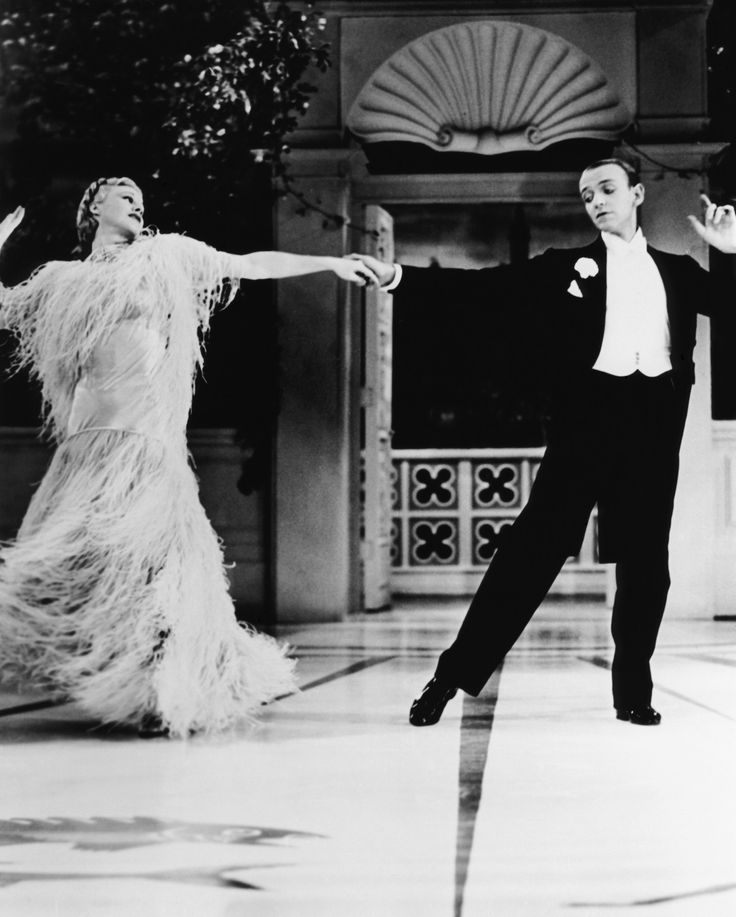
When I was a child there were a lot of Fred Astaire and Ginger Rogers movies shown on TV. I probably saw all of them (some, many many times), and I loved them.
Most of these movies displayed Astaire and Rogers as a sophisticated duo. Her ball gowns were part of the attraction—talk about Hollywood glamour! So many to choose from, but the ostrich feather gown might just be the most famous of all (best seen in motion):
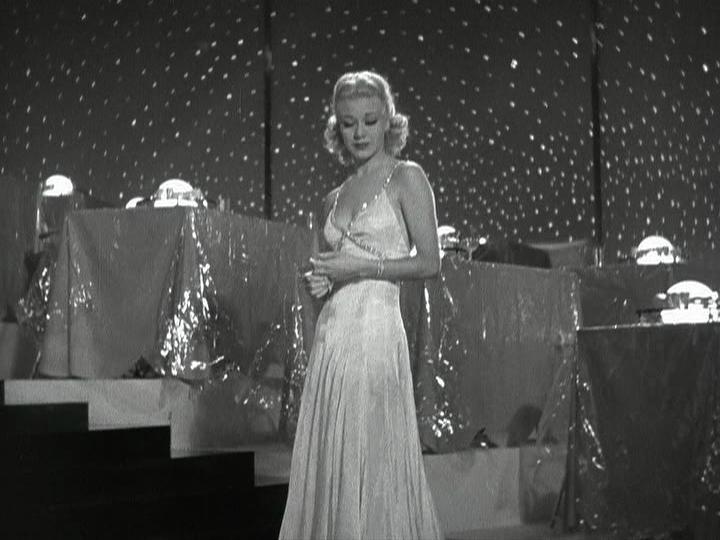
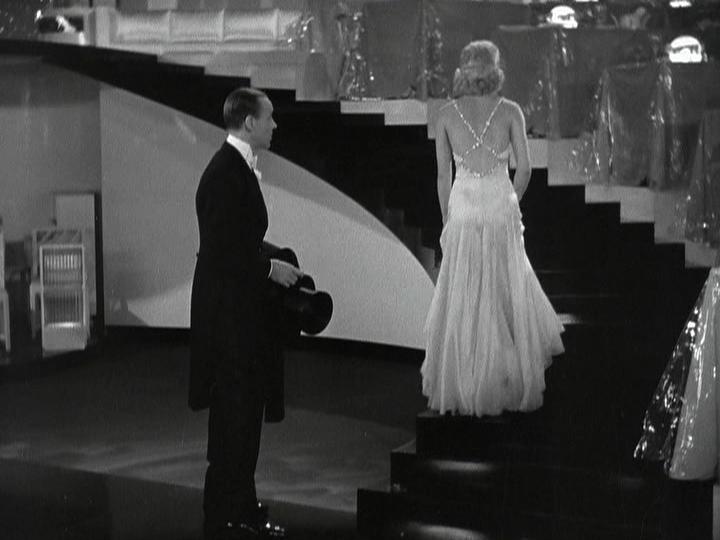
Her “Swing Time” dress was deceptively simple, but showcased her fabulous body. Most women need a lot more assistance than Rogers did, front or back:
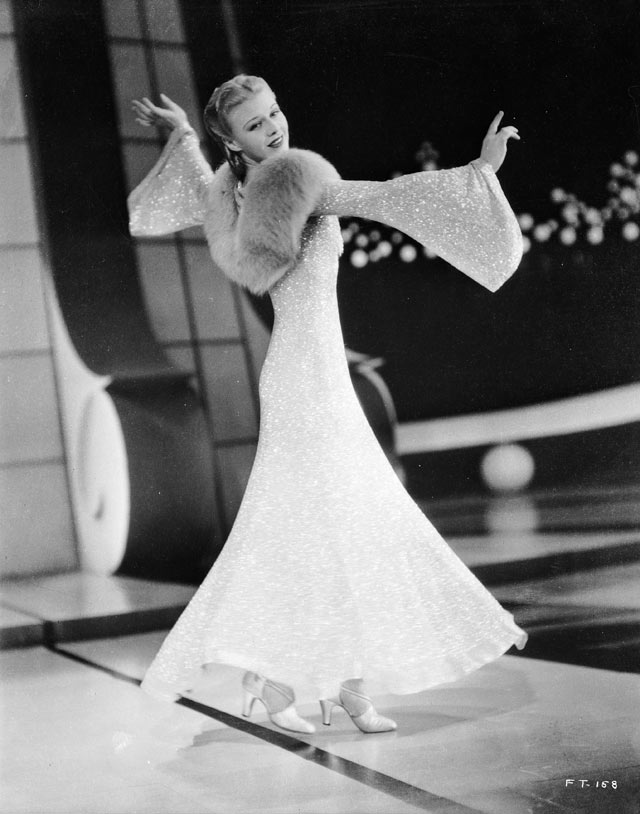
Last but not least, this:
But as much as I loved the glam, my favorite movie was an atypical one, “Follow the Fleet,” in which they played more ordinary folk (albeit excellent dancers, of course!). For me, there was just something about it—her shiny bell-bottomed costumes, his sailor suit, and particularly the semi-humorous, cocky choreography. Astaire and Hermes Pan (the creators of all the dances) never repeated themselves, and that’s what kept it ever-fresh. And Rogers not only kept up with the steps, but she infused them with a light grace and flair that made them seem not only improvised on the spot but the most wonderful of fun (songs: Irving Berlin):
Astaire said something interesting about Rogers:
According to Astaire, when they were first teamed together in Flying Down to Rio, “Ginger had never danced with a partner before. She faked it an awful lot. She couldn’t tap and she couldn’t do this and that … but Ginger had style and talent and improved as she went along. She got so that after a while everyone else who danced with me looked wrong.
Astaire was a great great dancer, Ginger a very very good one. But she complemented him so well, with her own special joie de vivre, that everyone else did look wrong.
[NOTE: Both were Republicans, by the way.]
I’ve been online for about 20 years, and it’s a huge part of my life these days.
It started small, as many habits do. I wanted to look up information on the nerve injuries I had, and the internet provided me (for the very first time, actually) with a way to do that as well as support groups for people who shared same the physical difficulties. I was elated; what a find! It was extraordinarily helpful in making me feel much less alone.
Another thing that attracted me right away was the internet’s ability to conjure up favorite literary excerpts. My son—who in 1995 already knew at least something about the internet and about me—showed me a trick he knew would strike a deep and resonant bell. “Just give me a line from a poem you like,” he said temptingly. When I responded, he typed in my answer and—lo and behold! Like magic, the entire poem appeared.
That was it for me; I was hooked. What a wondrous tool!
And so it has been. But early on—very early on—I discovered there was a dark side, a side that didn’t surprise me. Pornography, one of the oldest attractions and preoccupations of humankind, is probably the single most numerous topic online, and not all of it is of the mainstream type, to say the least. For a while, it was hard to block that sort of thing from your computer—it kept popping up unsolicited.
And it didn’t take too long for me to encounter trolls—in fact, one of my very first online experiences (a discussion board for nerve injuries) was to watch the predations of a vicious troll who initially masqueraded as a soothing avuncular type and who ended up messing heavily with the minds of vulnerable people.
Not long after that, I realized that anti-Semitism was also rife online. The internet gives this old hatred with a long pedigree new and sturdy legs. Do a search for some topic connected with the Holocaust, for example, and pretty quickly you would encounter the Holocaust deniers and websites devoted to spreading anti-Semitic lies about all manner of Jewish things and all points of Jewish history. These sites are slick, numerous, and wide-reaching, and I have little doubt that they have increased the number of anti-Semitic people in the world who are firmly convinced that they are privy to the truth about Jews.
Which brings us to the current campaign season, and the modern spread of anti-Semitism. I only heard of the following for the first time yesterday, via commenter OM (see this), but I noticed that today there’s a NY Times article about it:
The Anti-Defamation League added a new symbol this week to Hate on Display, its database of prominent white supremacist imagery. It’s called the “echo,” and it is used online to call attention to Jewish names in the news.
The symbol originated in 2014 on an anti-Semitic podcast, “The Daily Shoah,” which applied a novelty sound effect to Jewish names that made them echo ominously.
That practice then spread to blogs and Twitter, where the podcast’s creators and fans created a visual translation of the echo sound effect by placing three sets of parentheses around a Jewish name, like (((Cohen))) or (((Goldberg)))…
This is how a hate symbol rises in 2016: A podcast sound effect becomes a Twitter meme and a browser extension before it finally slithers into the physical world.
The “echo” is the first officially recognized symbol to emerge from the “alt-right,” a movement of white-and-proud extremists who are as obsessed with cultural memes as they are with white nationalism. They play fast and loose with white supremacist iconography, remixing it with pop culture and the sardonic tone of internet subculture. Their regressive message, cloaked in an ultramodern skin, is being spread online to a new generation of race warriors.
Of course, the alt-right is not solely composed of anti-Semites and white supremicists (nor, or course, are the ranks of Trump supporters). But it is folly to ignore the fact that there is a sizable proportion of the alt-right that does fit that description. Many people have an image of white supremicist anti-Semites as a bunch of inarticulate thugs, unsophisticated and not all that bright. Untrue; plenty of them are very knowledgeable about human behavior, just as they were in Nazi Germany. They may prey on the unsophisticated sometimes, but this is a polished, clever group that is especially internet-savvy.
They are also characterized by the left as being of “the right.” But they are not actually of the right—that’s why they call themselves the “alt-right.” They want to displace and then replace the current right by growing their own power and influence.
Commenter “Geoffrey Britain” raises an interesting point:
To exclusively focus upon Trump’s faults is to make voting for him less likely, which at least in swing states makes Hillary’s election more likely.
If Trump loses, that will be the time to focus upon his faults, as in reaction to his supporter’s distress it will provide a ”˜teaching moment’. That would also be the time to attempt to enlist Trump’s supporters in Eric’s conservative social activist movement.
If he wins, he should be given the traditional ”˜honeymoon period’ to see how he actually performs. If he goes “off the reservation” that will be the time for criticism, the purpose of which should not be to tear down but to rein in his excesses.
We all know Trump’s flaws, even those who make excuses for him. It does actual harm to dwell upon them because regardless of intent, it assists the Left. Rationalizing that criticism as simply objective observation, changes that assistance not in the least.
Were there an electable 3rd party alternative, that name would have emerged by now.
Let’s leave aside the question of whether anyone here is focusing “exclusively” on Trump’s flaws (answer: no), and just concede that we’ve talked a great deal about Trump’s flaws since last fall. And I won’t dismiss GB’s argument out-of-hand with some generalized reference to the need to have fair and free discussion of everything relevant to this campaign, although I also think that is true. I’d like to take his argument seriously, because I believe it originates in intense concern at the prospect of a Hillary Clinton candidacy, rather than the thought that Donald Trump is some sort of good guy. I share that intense concern, as do probably most of the commenters here and most people on the right who are nevertheless unsure about what they will do regarding Trump come November.
Nor is this post meant to be an attack on GB, and I hope he and everyone else realizes that. I think his suggestion comes from a feeling of desperation and frustration with how this election year has played out, a desperation and frustration a great many of us share (I certainly do). But we react to it in different ways.
GB’s argument rests on one principle, which is that Trump would be better than Hillary as president. Better for you, better for the conservative cause, better for the US, better for the world—different people may have different ways of parsing “better,” but “better” it would have to be in order to even begin to justify this idea of shutting up about all the dreadful things Trump has done and is doing.
But it’s not obvious to a lot of us that Trump would be better. I’m not going to go into the lengthy arguments we’ve had many times on this blog about that; suffice to say that reasonable men and women may differ, and Trump supporters’ assertions that it’s obvious that he’d be better are not the least bit convincing to the unconvinced.
GB’s argument also is less than compelling if you think there is a third-party possibility or possibilities, and that many names have emerged and in fact almost any reasonable Republican would have a decent chance not only of being “better” than both candidates, but of winning. Again, that’s a topic that has been discussed many times on this blog and I’m not going to get into it again here (after all, I don’t want to be chained to my computer for the entire afternoon).
And those problems are in addition to GB’s argument’s suppress-the-truth message, which in itself is troublesome. If Trump is good enough to win, and would be a better president than Hillary, wouldn’t airing of the truth about him have to support that? If the truth reveals that he really should not be president, don’t we need to know about it? And no, we don’t “all know Trump’s flaws,” and certainly not all of them. What’s more, we are in the middle of deciding something, and need more light on the topic, not less. Hillary’s flaws have also been thoroughly aired for many, many years, and we probably all know those even more thoroughly than we know Trump’s.
Looking back, I cannot recall that a single person, on this blog or elsewhere, chided “don’t criticize Romney because it will help elect Obama” back in 2012. Maybe people said it, but I certainly don’t remember it. People did say that voters on the right who didn’t like Romney should hold their noses and vote for Romney despite their disapproval—just as people are now suggesting the necessity of voting for Trump—and although I think the situation is not analogous (see this and this) I understand the argument and might even succumb to it in the end. But a suggestion that we not talk about what’s wrong with Romney? No, it didn’t happen, and Romney’s opponent Obama was also perceived as very dangerous to the world, the country, and to the right.
This “shut up about the flaws of our candidate” admonition seems to me to be new, and ominous. Why is it happening now? I believe it has something to do with the style of Trump himself, although that’s not the whole reason. I think it’s also that, if many of us thought 2012 was our last chance to reverse things, 2016 would have to have even more urgency for a lot of people.
But what I probably disagree with most vehemently in that comment of GB’s is this assertion:
If Trump loses, that will be the time to focus upon his faults, as in reaction to his supporter’s distress it will provide a ”˜teaching moment’. That would also be the time to attempt to enlist Trump’s supporters in Eric’s conservative social activist movement.
Sounds good, but I don’t think it’s at all relevant to the particular situation we face. There are two types of Trump supporters, the enthusiastic and the reluctant. The first group supported him in the primaries, when there were many alternatives. The second group only supports him now, under duress, because they see no alternative anymore. I don’t really consider the second group “Trump supporters”—not exactly, anyway—because they really didn’t like Trump in the first place and don’t like him now, so there will be no sharp disillusionment for them if he loses and therefore no real need for GB’s “teaching moment.’ It’s that first group, about a third of GOP voters (or perhaps even up to 40%), who GB thinks might have that “teaching moment” after a Trump loss, and become conservative activists.
I do not see that happening. Let me repeat: I DO NOT SEE THAT HAPPENING (and yes, I’m shouting). In fact, I think the opposite will happen.
I’ve watched these people, listened to them, read what they’ve written, for about a year now. Many have come to this blog and most have left again. I strongly suspect that, if Trump loses, they will blame his loss on the Republicans who did not vote for him or support him. They will explode in rage at those people, and develop a “stab in the back” theory of why it happened, and how every bad thing that happens thereafter during a Clinton presidency (and there will be plenty of bad things) could have been fixed or prevented by Trump if only, if only! The rage will increase rather than decrease.
I am convinced that the schism in the party is already permanent and that it predated Trump, who is acting as both lightening rod and amplifier for it.
I’ve mentioned before that I’ve taken to watching the TV program “Forensic Files,” often as background while I’m writing or reading online. I used to use cable news stations for that purpose, but no more. I haven’t watched a single cable news program since many months ago, some time in February I believe. The constant Trump coverage turned me off.
“Forensic Files” may seem an odd escape. But escape it is, at least for me. It’s grim, very grim. Most of the time it exposes the heart of darkness in a sizeable proportion of human beings—those who kill, for pleasure or money or revenge or sex or who-knows-why. Many are sociopaths; I would say “most,” having watched many episodes of the program. Some are not. The “heartwarming” aspects of the stories, however (and there are some) concern the hard and painstaking work of the detectives and forensic specialists dedicated to the task of bringing the perpetrators to justice.
Most of the stories are far more amazing than those told on the series’ fictional counterpart, the CSI group of TV shows. They are quite short, as well (typically, 21-22 minutes). And they have the added advantage (to me, anyway) of being true.
Here’s one that I find especially fascinating, perhaps because of the literary angle:
So, was she a sociopath? Before you answer that question, you might want to read this article, which contains some background information that the TV show lacked.
[NOTE: Here’s a previous post I wrote on a related topic.]
There are a lot of myths that people accept as true about historical events. Some of these myths are relatively minor, such as the one I’m going to write about today. Some of these myths concern events/facts about which we’ve only recently learned the truth. Sometimes the MSM has purposely misinformed us about them—that is, propaganda has overwhelmed the truth. And some are about events that happened long, long ago and have gotten lost in the mists of time.
But some are about more recent happenings. And some are about things that are easily verifiable, not difficult-to-ascertain at all, and about which there hasn’t been a whole lot of purposeful propaganda, although there certainly does seem to be a great deal of casual misinformation.
And I’m not just talking about myths believed by extremely-low-information folks who don’t know who the vice president is, or what any of the branches of government are. I’m talking about myths believed by people who, if not history buffs exactly, are at least conversant with the main events of history and even some of the lesser ones.
And of course everyone has some of these myths, because we don’t even know they are myths if we think they are true.
The myth I’m going to write about today, which is a sort of pet peeve of mine since I’m a big Churchill admirer, is that the British public was so ungrateful to Winston Churchill that they threw him out for good after the war. What’s wrong with that? Indeed, they did throw him out after the war, so we can’t really call it a “myth”:
With a general election looming (there had been none for almost a decade), and with the Labour Ministers refusing to continue the wartime coalition, Churchill resigned as Prime Minister on 23 May. Later that day, he accepted the King’s invitation to form a new government, known officially as the National Government, like the Conservative-dominated coalition of the 1930s, but in practice known as the Churchill caretaker ministry. The government contained Conservatives, National Liberals and a few non-party figures…
Although polling day was 5 July, the results of the 1945 election did not become known until 26 July, owing to the need to collect the votes of those serving overseas. Clementine…[met] her husband for lunch. To her suggestion that election defeat might be “a blessing in disguise” he retorted that “at the moment it seems very effectively disguised”. That afternoon Churchill’s doctor Lord Moran commiserated with him on the “ingratitude” of the British public, to which Churchill replied “I wouldn’t call it that. They have had a very hard time”. Having lost the election, despite enjoying much support amongst the British population, he resigned as Prime Minister that evening, this time handing over to a Labour Government. Many reasons for his defeat have been given, key among them being that a desire for post-war reform was widespread amongst the population and that the man who had led Britain in war was not seen as the man to lead the nation in peace. Although the Conservative Party was unpopular, many electors appear to have wanted Churchill to continue as Prime Minister whatever the outcome, or to have wrongly believed that this would be possible.
Now, that’s certainly interesting. The rejection may have been a sort of “Moses was a good leader for the years in the desert, but he can’t lead us to the promised land” syndrome. Or it may have been an artifact of the parliamentary system and not so much of a rejection of Churchill himself at all. At any rate, the reason I call this a “myth” (more rightly a half-myth or semi-myth) is that the rejection—whatever its reason—wasn’t permanent. Churchill did not leave politics at that point, as many people seem to think. He remained a visible and active leader of the opposition until the event occurred that so many people seem to forget (and certainly don’t usually mention), which was his re-election as Prime Minister in 1951.
That’s the part I find confusing and puzzling. Many people who seem to know about his 1945 loss seem to regard it as the end of his political career. It was not. He served again as PM from 1951 to 1955, and resigned at that point due to health reasons (he had had several strokes, and the one he had close to his resignation had been relatively severe). What’s more, he was 80 years old by the time of his resignation.
Doesn’t sound like much of a rejection of Churchill to me.
Well, why do so many people who are relatively knowledgeable get this wrong? I think it’s a question of the story and its relative drama. Doesn’t it make a much better story to have Churchill’s career end with his rejection by an ingrate public after his war years of heroism and strength? His later prime ministership was relatively anticlimactic (what wouldn’t be, after WWII?), and his final leave-taking was, sadly, due to infirmity. So it’s a much less dramatic story.
[NOTE: I plan to write about other myths of history in subsequent posts.]
Trump supporters remind me of the Osgood character in “Some Like It Hot.” You remember:
Point out Trump’s manifest and myriad flaws? Trump supporters always have an answer.
All the other candidates who have held public office have a political record to point to and complain about. Governors, senators, they’ve all had to compromise on policies that reflect on what they might have to do as president. Trump has no such baggage. His political record consists of two things: words and donations to candidates.
He’s got a plethora of words that would sink any other Republican candidate. Even at the outset, there was his previous praise for Hillary Clinton and Nancy Pelosi and Barack Obama, and support for single payer health care. He had made statements that George W. Bush was the worst president ever and should have been impeached, and during one of the debates he spouted the “Bush lied” charge that is popular on the left. He has had enormous praise for unrestrained government power under eminent domain, and previous long-term membership in the Democratic Party.
It would be laughable in any other serious Republican candidate. But in Trump, his supporters shrug it off, like Osgood’s sanguine excuses at the end of that movie.
History of liberal positions? He’s changed; nobody’s perfect.
Present-day liberal positions? Doesn’t matter. He doesn’t really mean it—or, alternatively, he talks tough on illegal immigration, the others don’t, and that’s the only thing that matters. Talk is cheap, of course, and he’s walked back most or all of his talk. Doesn’t matter to his supporters. It’s the bluster that counts.
Polls suggested right along that Trump would do more poorly than the other major candidates against Hillary Clinton. Didn’t matter. His supporters kept asserting that either (a) the polls were lies (b) the polls will change over time and improve for him. Well, first they did (somewhat, that is), and now they’re sinking again. His supporters have disregarded his high disapproval ratings—which are not the function of the public not knowing him, because the public does know him quite well.
Trump’s use of juvenile mockery, and his self-aggrandizing narcissism? Doesn’t matter. Even though they hated it in Obama, and even though Trump makes Obama look like Emily Post and St. Francis of Assisi put together, they excuse him because, don’t you know, it’s all a pose. Or because it shows his boundless self-confidence and alpha-maleness.
Did someone on the right criticize Trump? Accuse that person of being a cuckservative or RINO or GOPe or “elite” or secretly wanting Hillary to win and use that to dismiss what the person is saying.
Trump shows ignorance of something very basic or fails to do his homework—for example, what the nuclear triad is, when he’s been asked the question before and failed to answer it? Doesn’t matter. Never fear. He’ll learn whatever he needs to learn when he needs to learn it. Or he’ll appoint the right people. They’ll figure it all out.
Above all, keep saying Trump can and will win. And, should he be nominated and lose the general election, blame his loss on the fact that the establishment didn’t help him enough. They sabotaged him, stabbed him in the back. Because everyone knows that Trump is actually a winner.
[NOTE: I think I wrote this post mainly so I could put up that clip. I love the movie “Some Like It Hot.”]
I can’t remember why I was doing it, but the other night I was researching the life of Harriet Beecher Stowe and I discovered a few surprising things.
The first was that Stowe had seven children in addition to writing Uncle Tom’s Cabin.
The second was that in her later years (Stowe lived to be 85), when she suffered from dementia, Stowe forgot she had written the book and set out to write it again:
The incurable mental malady of Harriet Beecher Stowe has progressed alarmingly. Mrs. Stowe’s vagaries, regarded as mere eccentricities, first amounted to actual aberration of mind about a month prior to the final attack. The interval was chiefly spent by her in writing “Uncle Tom’s Cabin” over again. She imagined that she was engaged in the original composition, and for several hours every day she industriously used pen and paper, inscribing long passages of the book almost exactly word for word.
This was done unconsciously from memory, the authoress imagining that she composed the matter as she went along. To her diseased mind the story was brand new, and she frequently exhausted herself with labor which she regarded as freshly created. The worldwide fame of “Uncle Tom’s Cabin” was now an anticipation to her, and she talked wildly of the popularity which the book was going to win. Even to the kind of pen, paper and ink used, Mrs. Stowe repeated the first composition, and if the manuscript could be compared with the corresponding portions of the original copy it is not likely that much difference of appearance would be discovered.
That is astounding, although sad. But it also sounded a bit familiar. It sounded like a short story by Jorge Luis Borges that appeared in his wonderful book Ficciones
Borges’ high-toned, somewhat ironic style takes a bit of getting used to if you haven’t read him before. But here’s an excerpt from the story (which is not so much a “story” as a spoof of academic literary criticism). It’s about a man named Pierre Menard who sets out to write Don Quixote:
He did not want to compose another Quixote ””which is easy”” but the Quixote itself. Needless to say, he never contemplated a mechanical transcription of the original; he did not propose to copy it. His admirable intention was to produce a few pages which would coincide””word for word and line for line””with those of Miguel de Cervantes…
The first method he conceived was relatively simple. Know Spanish well, recover the Catholic faith, fight against the Moors or the Turk, forget the history of Europe between the years 1602 and 1918, be Miguel de Cervantes. Pierre Menard studied this procedure (I know he attained a fairly accurate command of seventeenth-century Spanish) but discarded it as too easy. Rather as impossible! my reader will say. Granted, but the undertaking was impossible from the very beginning and of all the impossible ways of carrying it out, this was the least interesting. To be, in the twentieth century, a popular novelist of the seventeenth seemed to him a diminution. To be, in some way, Cervantes and reach the Quixote seemed less arduous to him””and, consequently, less interesting””than to go on being Pierre Menard and reach the Quixote through the experiences of Pierre Menard…“My undertaking is not difficult, essentially,” I read in another part of his letter. “I should only have to be immortal to carry it out.”…
The rest of the rather brief story is a subtly humorous comparison of the two versions (Menard’s is presented as being fragmentary), such as this:
It is a revelation to compare Menard’s Don Quixote with Cervantes’. The latter, for example, wrote (part one, chapter nine):
. . . truth, whose mother is history, rival of time, depository of deeds, witness of the past, exemplar and adviser to the present, and the future’s counselor. Written in the seventeenth century, written by the “lay genius” Cervantes, this enumeration is a mere rhetorical praise of history. Menard, on the other hand, writes:
. . . truth, whose mother is history, rival of time, depository of deeds, witness of the past, exemplar and adviser to the present, and the future’s counselor.
History, the mother of truth: the idea is astounding. Menard, a contemporary of William James, does not define history as an inquiry into reality but as its origin. Historical truth, for him, is not what has happened; it is what we judge to have happened. The final phrases””exemplar and adviser to the present, and the future’s counselor ””are brazenly pragmatic.
The contrast in style is also vivid. The archaic style of Menard””quite foreign, after all””suffers from a certain affectation. Not so that of his forerunner, who handles with ease the current Spanish of his time.
So here’s my question: was Harriet Beecher Stowe’s second version of Uncle Tom’s Cabin informed by everything that had happened in her life since she wrote the first one, including the Civil War? I would love for Borges to explain.