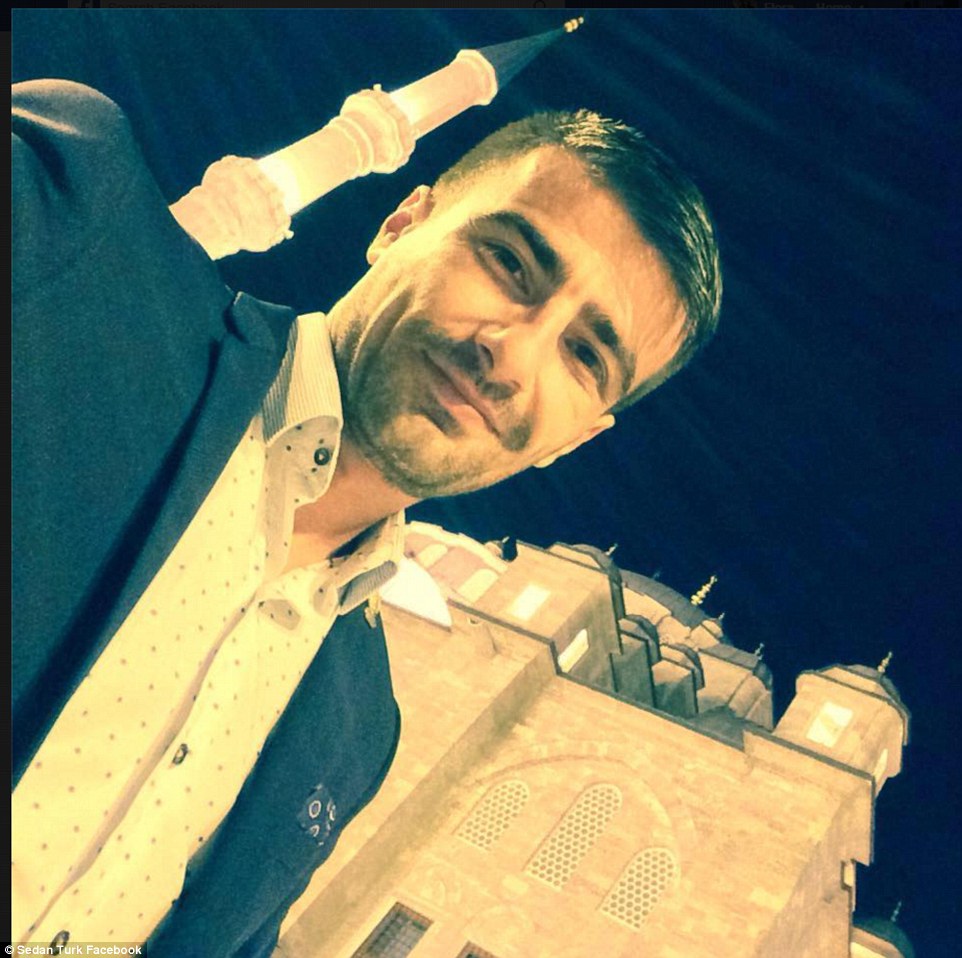
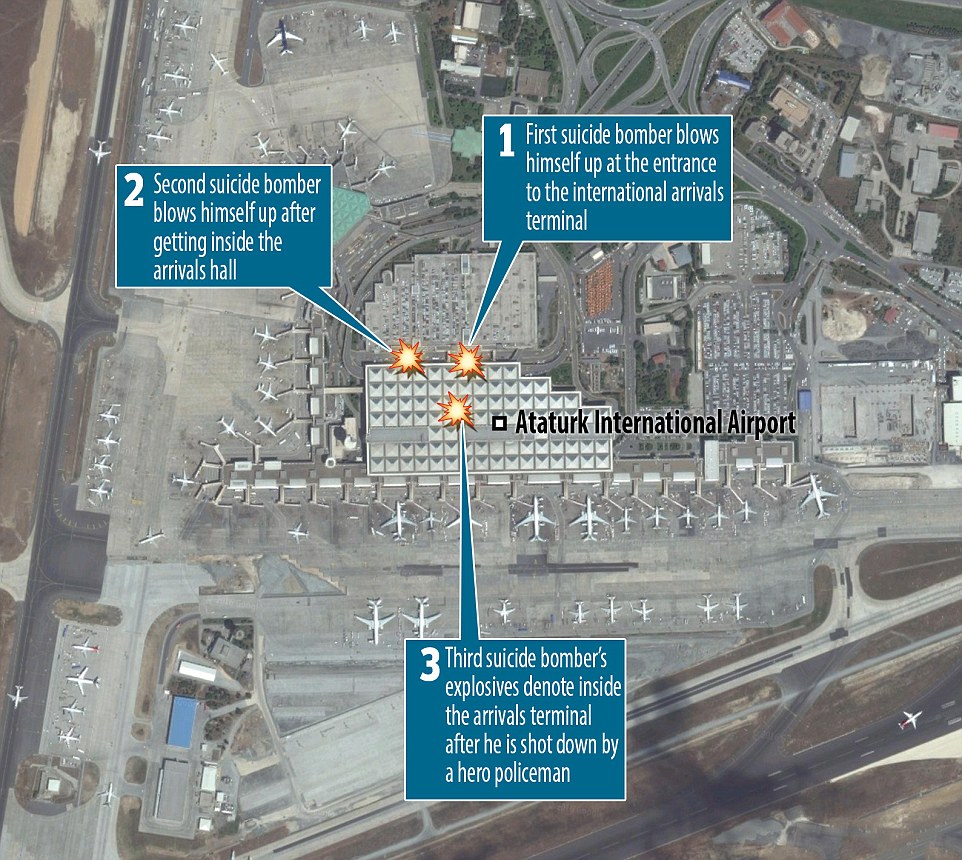
Yesterday a discussion began with commenter “Irene” asking an important question about a photo of one of the Istanbul suicide bombers at the airport, taken some time prior to his self-detonation:
What struck me right away was that, in all the photos, most men were wearing short sleeved shirts”¦except the suicide bomber who was wearing a black, long-sleeved, zipped-up puffy jacket.
Istanbul had a high of 84 and low of 72 yesterday. Anybody walking around dressed the way the suicide bomber was should have been pulled aside by security and asked to unzip his jacket.
Irene’s question highlights several issues vital to decisions on security: what to look for, when to look for it, and what to do about it. In the case of the Istanbul airport, security had already been pushed back to an earlier point than where it begins at many airports in the US: for Istanbul, curbside or the entrance to the airport itself. It wasn’t enough, although it may have helped prevent the bombers from detonating themselves in even more crowded areas than that, and causing even greater loss of life.
My guess is that at whatever point the bomber in the jacket had been noticed by Istanbul security and asked to unzip his jacket, that would have been the moment he would have detonated his explosives (or alternatively, if he also had a gun, as some of the Istanbul terrorists had, he would have shot the security guard if there was enough time to draw and fire). This is one of the risks guards take, of course; to be willing to sacrifice themselves in order to save some lives. If a terrorist is forced to detonate himself prematurely, away from crowds, lives are saved although the terrorist may indeed take the guard with him/her.
But try to imagine the extent of the security apparatus and personnel it would take to spot, and stop, everyone wearing inappropriate clothing on a hot day at every airport. And imagine the inconvenience to the public and the resultant outcry. In addition, it would only work on hot days—in other seasons, heavy garments are not suspicious. What’s more, airports are places where people carry bulky packs and suitcases all the time, and bombs and weaponry can be stored there.
This was my response to Irene. After pointing out that the first Istanbul terrorist attacked right before the first security checkpoint, I mentioned Israel:
In Israel I’ve heard they start their security before the airport, on the road into it. But they are a much smaller country and there’s only one big airport, Ben Gurion. To give you an idea of the comparative figures, Ben Gurion served about 13 million people in the year 2012.
The Istanbul airport is the 11th busiest in the world and served about 61 million people in 2015. For more perspective, Logan in Boston, which is only the 17th busiest airport in the United States, serves about 2 and a half times as many people as Ben Gurion.
You see the dilemma. The sort of screening that Israel is able to put in place is much more problematic at larger airports in larger countries. From what I can see, Istanbul has more security than most airports in terms of number and placement of armed guards.
I saw on the news that in the wake of Istanbul the US has stepped up the number of armed guards at airports (some probably undercover). But I’m unaware of any US airport that has a security checkpoint anywhere in the airport except at the gates, because US security is more concentrated on protecting airplanes than on the airport itself (at least, that’s been the focus of the security we can see; perhaps there’s more that we don’t see). In the past in the US that made sense because the airplanes were the focus of the terrorists, too (9/11 being the prime example).
For Israel it was different: they experienced the Lod Airport massacre of 1972, which I wrote a post about a few years ago:
You may never have heard of it””or of Lod airport, for that matter, which is in Tel Aviv and was later renamed Ben Gurion Airport after Israel’s founder and first prime minister. But the Lod massacre remains one of the most terrifying in the long list of terrorist attacks that have followed, and at the time it was perpetrated (1972) it was especially horrific. Masterminded by the PLO (specifically, its hard left wing the PLFP), it was also a prelude to the much-more-famous Munich Olympics massacre that gripped the world just a few short months later.
The PLO was involved in both, but the Lod massacre featured unusual perpetrators for that organization, and that was part of its shock value: leftist Japanese gunmen. This is the way it went down:
”¦[T]hree inconspicuous Japanese men dressed in business suits disembarked Air France Flight 132 from Rome and strolled into the baggage claim area. After retrieving what appeared to be violin cases, the men pulled out machine guns, opened fire and threw grenades indiscriminately at the crowds of people”¦
The gunmen killed 26 people: 17 Christian pilgrims from Puerto Rico, one Canadian citizen, and eight Israelis, and 80 people were injured”¦
It probably wouldn’t happen exactly that way today, because the guns might be caught by security in the checked baggage, depending on whether all bags are X-rayed. But it could happen in a way similar to what occurred at Istanbul.
In response to the Lod incident as well as others, Israel has put in place a very different approach [hat tip: commenter “Aesop Fan”] :
Israeli authorities have long since recognized that security procedures at the airport, however stringent, can only be partially effective if there’s a great gaping hole of vulnerability before travelers get anywhere near the terminal building. And therefore, at Ben Gurion Airport, all vehicles entering the wider airport area are subject to a first check. It may appear cursory; indeed, it is cursory. But simply asking drivers to lower their windows and lobbing a question or two at them affords the security personnel a first opportunity to register anything suspicious. There’s a second, again relatively cursory check, on everybody entering the terminal ”” another opportunity to pick up on something untoward. And then there’s the vexing issue of passenger profiling ”” a sensitive matter; an ordeal for some passengers. But a process that enables Israeli security to focus its attention on potentially more problematic travelers and thus to reduce the risk to all travelers.
Diverse factors are at work in Israeli passenger profiling techniques. Thirty years ago, at Heathrow Airport, El Al security found a bomb in the baggage of a young Irish woman traveling to Tel Aviv; it had been hidden in the false bottom of her bag by her Jordanian boyfriend. No amount of questioning would have prompted Anne-Marie Murphy to disclose the bomb’s existence, because Nezar Hindawi hadn’t told her it was there. She was carrying his child and he was sending her, his unborn baby and the rest of the passengers to their deaths. But she merited particularly close inspection because she was traveling alone, had never previously been to Israel, and had purchased the ticket a short time before the flight.
There’s probably a lot more to Israeli security than that, but you get the idea. But, as I pointed out in my comment yesterday, Israel is a country so small that such things are easier. It’s also a country that’s been dealing with the problem for a long time and is especially interested in survival. It is willing to commit the resources, and its population is hyper-aware of the dangers and for the most part willing to put up with the inconvenience and the expense. It seems necessary.
Speaking of expense:
In Israel’s case, a generous state budget allows for some 2,000 personnel to work exclusive in airport security roles, and many of those workers are undercover, according to Pini Schiff, CEO of Israel Security Association, one of Israel’s top aviation security experts. Passengers are also checked via radar, cameras and other equipment well before they enter the airport and laws allow for ethnic profiling, he said.
What do people in the US think is necessary at this point? What are they willing to put up with? There is no consensus. It’s my impression, though, that people want the security measures they do undergo to be effective ones rather than empty exercises. With things like removing your shoes at the security checkpoint, it’s hard to see that it helps unless you think that it may have prevented terrorists from using that route. Of course, they can always try another route—the possibilities for wreaking havoc and many and varied, limited only by terrorist imagination. How can security keep ahead of all the possibilities? It can’t.
And then there’s profiling. That is, of course, extremely controversial in this country. It’s not even clear that some of it isn’t done, at least clandestinely (and “profiling” needn’t just be limited to race, as the example of the Irish woman traveling to Israel illustrates).
Commenter “Artfldgr” makes another point, which is that security lines and checkpoints can often act to cluster and concentrate people in a way that makes greater numbers of them more vulnerable to attacks there. That’s part of the reason earlier checkpoints are sometimes instituted. I suspect, for example, that the toll at Istanbul with three well-equipped bombers was somewhat less than it would have been had they managed to make it to lines at the major security checkpoints inside the airport.
And in Israel, the security questions begin with cars approaching the airport. Of course, even that can present a target, because there is the security guard and there is probably a line of stopped traffic for that checkpoint. But again, the damage would be likely to be more limited, since people in cars are both more protected and more spread out than a crowd of pedestrian travelers would be.
The bottom line is that if there are enough terrorists participating in an attack, and they are smart about their approach, they can do a lot of damage. All that security can do is make it harder for them. Israel makes it very, very, very hard.
[NOTE: Of course, the other thing to do is to have better intelligence about terrorist networks in this country and around the world. But in this post I’m focusing on security measures other than prevention.]