↓
 

The New Neo

A blog about political change, among other things

  • Home
  • Bio
  • Email
Home » Page 1018 << 1 2 … 1,016 1,017 1,018 1,019 1,020 … 1,916 1,917 >>

Post navigation

← Previous Post
Next Post→

Convincing reluctant Trump supporters to vote for him

The New Neo Posted on September 3, 2016 by neoSeptember 3, 2016

For a long time I’ve conceptualized Trump voters as falling into two camps: the enthusiastic and the reluctant. No doubt there are some who fall in between, too, but I think that mainly there are those two categories.

The first group are people who supported Trump in the primaries, either as first or second choice. They believe he would be a good president, or at least that he was the best or one of the best of the lot of GOP candidates who originally threw their hats into the ring.

The second group are people who support Trump now only because he’s running against a person they consider worse, Hillary Clinton (if I end up voting for Trump, it will be for that reason).

Members of the first group sometimes appeal to members of the second group, urging them to make sure they vote for Trump. The arguments vary widely (we’ve seen many in the comments section of this blog). Sometimes the argument is that Trump will be a good president and will do a number of good things for the country. Sometimes it’s that Trump will do one or two good things, usually involving SCOTUS justice choices and/or immigration policy. And sometimes it’s that even though we don’t know what Trump might do, we know that Hillary would be awful and there’s at least a chance that Trump would be better.

That latter type of reasoning has probably become the most common argument we see these days, at least as reflected in blog comments and blog posts, in newspaper and magazine columns and TV commentary, plus social media. As Trump’s poll numbers rise and fall and then rise and fall and rise, and state polls become increasingly common, it occurs to me that the latter argument rests almost entirely on the race being at least somewhat close.

For example, let’s say you live in California. If Clinton is ahead by 12% in the polls there (I chose that number because it was the figure in a recent poll, but the point is that no one really disputes that she’s way ahead there), why would a reluctant Trump supporter be motivated to compromise what he/she sees as both his/her principles and integrity by voting for a man he/she detests, if that man is seen as having absolutely no chance of winning in that state? In other words, why prostitute yourself without a payoff?

It behooves Trump to stay close in swing states, because a whole lot of his supporters everywhere are in the category of “reluctant supporters.” Often very reluctant supporters. They will only hold their noses and vote for him in that voting both if they see a good chance of defeating her. Because elections are decided by winning state electoral votes rather than winning the national popular vote, voting decisions will be made by most voters who know much of anything about elections (and I would guess that the category “reluctant Trump voter” is probably made up of people who are aware of the way the Electoral College works) by taking into account this system.

That’s another way in which polls matter. There are margins of error in polls, to be sure, and there are just plain errors, too. But overall, polls that show Trump far behind in a state—particularly a state that usually and reliably goes for the other party; in other words, for Trump supporters that would be blue states—are going to discourage the Trump vote. And polls that show him close will almost certainly encourage it.

Posted in Election 2016, Trump | 75 Replies

Tolstoy post du jour: the voice

The New Neo Posted on September 2, 2016 by neoSeptember 2, 2016

More Tolstoy! Just can’t get enough of that Tolstoy!!

Seriously, though, I came across something extraordinary yesterday. It’s a recording of Tolstoy himself reading an English translation of a book of quotations from other writers (The Thoughts of Wise Men, published as A Calendar of Wisdom in English), that he assembled late in life:

The audio recordings above were made at the writer’s home in Yasnaya Polyana on October 31, 1909, when he was 81 years old. He died just over a year later. Tolstoy apparently translated the passage himself.

Here’s what he’s saying; you can follow along:

That the object of life is self-perfection, the perfection of all immortal souls, that this is the only object of my life, is seen to be correct by the fact alone that every other object is essentially a new object. Therefore, the question whether thou hast done what thou shoudst have done is of immense importance, for the only meaning of thy life is in doing in this short term allowed thee, that which is desired of thee by He or That which has sent thee into life. Art thou doing the right thing?

I find hearing the actual voice of a long-ago historic figure to be a powerful and moving experience. There are a lot of these old audios on YouTube, one of the many reasons I love that site and am addicted to it.

Posted in Historical figures | 7 Replies

Hillary Clinton, fast and loose with security

The New Neo Posted on September 2, 2016 by neoSeptember 2, 2016

It certainly seems that way:

Earlier today, the FBI released its investigative notes on the Hillary Clinton e-mail scandal, including its notes on their interview of Hillary in June. It makes for an interesting read, and a couple of eye-popping moments. For instance, agents showed Hillary the e-mails containing information that investigators had verified had been classified at the time of transmission, including Top Secret/SAP ”” programs so sensitive that even their names were classified. According to pages 26-7 of the first part of the 302, Hillary told them that she believed that the information wasn’t classified, and was not a problem even if the data had gotten into the hands of foreign governments.

More here:

The media is picking up on another interesting tidbit: Clinton claimed she could not remember any kind of training regarding how to handle classified information. The FBI also noted that the former secretary of state may have had as many as 13 devices…

At one point in the interview, an FBI agent noted that Clinton didn’t know the “C” meant classified…

Clinton aides said she often replaced her Blackberry and whereabouts of the old device would “frequently become unknown”…

Here are the files, if you want to read them yourself. I haven’t yet done so; don’t know if I will. The summaries are depressing and outrageous enough.

Posted in Hillary Clinton | 25 Replies

“We’ve always been at war with Eastasia”

The New Neo Posted on September 2, 2016 by neoSeptember 2, 2016

The Soviets were known for their revisionary history, a situation Orwell fictionalized in Nineteen Eighty-Four and immortalized in the quote with which I’ve titled this post.

But it goes on in post-Soviet Russia today, as this ruling indicates:

Russia’s Supreme Court has upheld the conviction of Perm blogger Vladimir Luzgin for reposting a text which states that both Nazi Germany and the Soviet Union invaded Poland in 1939. The Supreme Court’s ruling came on September 1, 2016, the 77th anniversary of Hitler’s invasion of Poland, 17 days before the anniversary of the Soviet invasion from the east…

Perhaps the most chilling aspect of this is that the Perm ”˜historian’, the courts, the prosecutor are doubtless well aware of the historical facts. Luzgin has more than likely been prosecuted for revealing inconvenient facts, and the Russian prosecutor, courts, as well as a historian have all proven complicit in this cynical travesty.

…In parallel with its military aggression against Ukraine, the Kremlin has been trying to reinstate the Soviet narrative about the Second World War in which details of the first almost 2 years during which the Soviet Union was Hitler’s ally are blurred, and the collaboration justified.

Please read the whole thing.

[NOTE: I’ve written before about historical revisionism, here.]

Posted in History | 13 Replies

Eliminating the mosquito: is it nice to fool Mother Nature?

The New Neo Posted on September 2, 2016 by neoSeptember 2, 2016

Apparently we have the ability to completely eliminate that very common pest, the mosquito, through genetic engineering:

Powerful new gene-editing technologies could allow scientists to program mosquito populations to gradually shrink and die off. Some efforts have gained enough momentum that the possibility of mosquito-species eradication seems tantalizingly real.

“I think it is our moral duty to eliminate this mosquito,” entomologist Zach Adelman says about Aedes aegypti, a species carried afar over centuries by ships from sub-Saharan Africa. It derived from a forest dweller and adapted to thrive among humans, to whom the mosquito spreads at least four viruses that cause major diseases.

Prof. Adelman, a virologist and associate professor of entomology at Texas A&M University, is working to program Aedes aegypti mosquitoes to develop as males.

Eventually, the mosquitoes would run out of mates, crashing the species’ population in places it invaded and “cleaning up a global mess,” he says. Female mosquitoes are the only ones that bite people and transmit viruses.

Anyone who’s ever been bitten by one of the little critters—and that’s just about everyone—would probably be tempted to shout “Hip hip hooray!”

But should we?

Everybody probably also recalls the old time travel science fiction dictum of not disturbing the past because you don’t know how it will affect the future. In similar fashion, to purposely eliminate an enormously widespread species—even one so very noxious—could invoke the Law of Unintended Consequences. Some scientists say we don’t know enough about the mosquito and its place in the ecology, and that it does do some good (for example, plant pollination and as food sources for other creatures).

Here’s one approach being considered to eradicate or shrink the population:

Imperial College London researchers are refining a system under development for the past several years to drive a self-destructive genetic trait into the Anopheles gambiae mosquito, the major carrier of malaria in sub-Saharan Africa. The trait could eventually shrink the malaria carrier’s population. Malaria kills an estimated 438,000 people a year.

Aedes aegypti is high on the hit list of more scientists now that Zika has spread from Brazil to Miami, spawning an epidemic that has left hundreds of babies with devastating birth defects…

Many entomologists say eradicating Aedes aegypti would have a minimal impact on the environment. Such mosquitoes thrive around humans, breeding in water that collects in tires, pipes and plastic containers. Humans are their only source of food.

Zika-carrying mosquitoes aren’t very appealing to other animals as a food source, entomologists say.

I must say it’s appealing. But there’s also something in me that says “caution.”

[NOTE: I’ve written about malaria and DDT here.]

Posted in Health, Nature, Science | 24 Replies

Trump’s latest speech on immigration

The New Neo Posted on September 1, 2016 by neoNovember 11, 2024

Byron York discusses it here. The major points, as he sees them:

First, Trump announced that he will aggressively move to deport criminal illegal immigrants – that is, immigrants who have committed crimes beyond the act of entering the country illegally…

…[Secondly,] Trump’s statement that those here illegally would have “one route and only one route” to legal status seems clear. Everybody seeking legalization would have to leave and then return.

But then, a few short paragraphs later, Trump said that “in several years,” when tough enforcement measures are fully in place – not contemplated, not in the planning stage, but actually up and running – then “we will be in a position to consider the appropriate disposition of those who remain.”

Trump was addressing the illegal immigrants who would choose to stay in this country – that is, non-criminals and those who chose not to return to their home countries and get in line to return to the United States. If those people stayed here, Trump said, then their situation would be debated after all the enforcement measures are in effect. At that time, there would be “different options” available for them.

If this is substantially different from Marco Rubio’s position (or that of most of the other GOP candidates) I’ve yet to figure out exactly how, although I suppose that we can nitpick about this or that wording or emphasis. Yes, Trump says please go home (just as Romney did, for which Trump excoriated him), but the request has no teeth—not a single one—because there are no penalties for staying. And then for the stayers there’s a possible path to—something or other, to be specified later. Much much later.

York adds:

But that still leaves the question: Why did Trump and his top lieutenants make things so confusing in recent days? After the speech, CNN’s Maeve Reston tweeted, “Given Trump’s tone, I still don’t understand point of allowing softening/hardening debate to rage over past 2 weeks. What was the point?”

Indeed. After all the talk, that is one question about the Trump immigration drama that remains entirely unanswered.

Actually, I think it’s rather easy to answer. I have noticed ever since the Trump campaign began that Trump specializes in the all-things-to-all-people ambiguous/contradictory multiple-statement approach. He wants his actual policy to be unclear, or at least fluid and hard to pin down, and that has two purposes: (1) he becomes a moving target and maintains plausible (or semi-plausible) deniability about nearly everything; and (2) he can appeal to hardliners and softliners and everything in-between, acting as “a blank screen on which people of vastly different political stripes project their own views.” In Trump’s eyes that’s definitely a feature, not a bug.

Posted in Immigration, Trump | 85 Replies

Your tax dollars, working for you…

The New Neo Posted on September 1, 2016 by neoSeptember 1, 2016

…and for the Clintons:

Bill Clinton’s staff used a decades-old federal government program, originally created to keep former presidents out of the poorhouse, to subsidize his family’s foundation and an associated business, and to support his wife’s private email server, a POLITICO investigation has found.

Taxpayer cash was used to buy IT equipment ”” including servers ”” housed at the Clinton Foundation, and also to supplement the pay and benefits of several aides now at the center of the email and cash-for-access scandals dogging Hillary Clinton’s presidential campaign.

This investigation, which is based on records obtained from the General Services Administration through the Freedom of Information Act, does not reveal anything illegal. But it does offer fresh evidence of how the Clintons blurred the line between their nonprofit foundation, Hillary Clinton’s State Department, and the business dealings of Bill Clinton and the couple’s aides.

This story is interesting in a number of ways. It’s not that it’s a surprise; it’s not. It’s interesting to me because this is Politico, usually very sympathetic to everything Democratic. It’s also interesting because it shows how it’s possible to do something that feels very wrong and yet not be doing anything that’s technically illegal. And lastly, it’s interesting because of how different things used to be in the days when that “decades-old federal government program” was originally set up:

The Act authorizes the GSA to fund the pensions, correspondence, support staff and travel of ex-presidents. It was passed in 1958 to “maintain the dignity” of the presidency by helping former commanders in chief avoid hard times like those that befell Harry S. Truman.

The Clintons have not fallen on hard times, even without this extra money:

The analysis also found that Clinton’s representatives, between 2001, when the Clintons left the White House, and the end of this year, had requested allocations under the Act totaling $16 million. That’s more than any of the other living former presidents ”” Jimmy Carter, George H. W. Bush and George W. Bush ”” requested during that span.

The program supplemented the income of Clinton’s staff, while providing them with coveted federal government benefits, alleviating the need for the Clinton Foundation or other Clinton-linked entities to foot the bill for such benefits.

The Politico article is very long; read the whole thing for the details.

By the way, Trump’s campaign financing and business mix is convoluted enough that I don’t think he’d be much better on this score, despite his supposedly great wealth.

Posted in Finance and economics, Hillary Clinton | 19 Replies

On Trump’s visit to Mexico

The New Neo Posted on September 1, 2016 by neoSeptember 1, 2016

Trump has a low bar to clear: all he has to do to go up in the polls is to appear sane, steady, rational. The more he can do that, the more chance he has of actually beating Hillary Clinton.

Yesterday, Mexican President Peé±a Nieto helped him to do just that by treating him not as a lunatic or as a buffoon but as a normal statesman on a normal diplomatic visit. Trump is, of course, fully capable of acting somewhat “normal” in the public eye if he chooses to, at least for short periods of time; we just haven’t seen enough of it (and we’ve seen too much impulsive behavior that alarms people). And it isn’t clear how long he can sustain such conventional steadiness or under what circumstances.

Naturally, the press had to distort what happened and make it seem as though there was some huge disagreement about—not the wall, nor who was going to pay for the wall, but whether the two men had discussed who was going to pay for the wall. Trump is hardly my favorite character on earth, as everyone who reads this blog knows, but this press-generated (in my opinion) brouhaha is somewhat ridiculous:

The two politicians said they talked about trade, immigration, and security, and each stressed their mutual respect. But, according to Trump, they opted not to discuss the most explosive issue on the table: the GOP nominee’s repeated demands that Mexico pay for a wall along the border.

“We did discuss the wall, we didn’t discuss payment of the wall,” Trump told reporters at a brief press conference alongside Peé±a Nieto after their meeting. “That will be for a later date.”

Peé±a Nieto declined to address Trump’s statement from the podium, but his office rushed to counter Trump’s version of events after the press conference ended, creating confusion about the content of their discussions.

“At the start of my conversation with Donald Trump I made it clear that Mexico will not pay for the wall,” Peé±a Nieto tweeted in Spanish from his official account afterwards. “After that, the conversation moved on to other topics and unfolded in a respectful manner.”

As Bill Clinton might say (that is, if his wife wasn’t Trump’s opponent), it depends what the meaning of “discuss” is. I say that a discussion needs the participation of both parties in the talk, not just one making a statement and the other listening to it. So I see no disagreement between the two versions. A “discussion” is a back and forth, a negotiation—an attempt to do a “deal,” if you were, or at least commence one or set up the possible parameters for one. A statement of an opening move by one party is not a “discussion,” it’s a statement.

Between now and November, the more times that Trump can create optics that make him seem presidential, or even marginally presidential, the better it will be for him. This represents a very real change in direction for him and his campaign, if (big “if”) he can sustain it and keep these calm photo-ops coming.

Hillary’s problems are different. She has to staunch her own bleeding, the continuing revelations of her violations of the basic rules of security and the evidence of more and more corruption and lies.

Posted in Election 2016, Latin America, Trump | 48 Replies

Orwell on Tolstoy vs. Shakespeare: the theme and variations vs. the symphony

The New Neo Posted on August 31, 2016 by neoAugust 31, 2016

[NOTE: I’m not becoming Tolstoy-obsessed, although I’ve written two days in a row on him. However, I think that the topic of both posts is not really Tolstoy per se, but larger philosophical questions about the good life, politics, and art.]

Yesterday, commenter “chuck” linked to a great essay by Orwell on Tolstoy and his virulent criticism of Shakespeare. I’d never before read this work of Orwell’s, and it was a pleasure. I agree with it nearly 100%.

I had vaguely remembered that, back in his curmudgeonly old age when Tolstoy had turned into an esthetic bully, he had put down a lot of writers for being insufficiently didactic (among them, his former writing self). Just as Tolstoy denied himself pleasure for moral and spiritual reasons in his later life, and hoped that others would follow suit, he advocated denial of pleasure in writing—literature now had to be didactic or he hated and despised it.

Shakespeare’s protean nature, his creation of teeming worlds with every manner of being and person in them, was anathema to the moralizing elderly Tolstoy. What’s hard to understand, though, is why Tolstoy says he had always hated Shakespeare (Orwell’s essay discusses this at some length). Perhaps this statement of Tolstoy’s was a form of revisionist history, but I’m going to take him at his word and assume he had in fact always hated Shakespeare. A curious thing in a writer.

In the last half of his life Tolstoy didn’t just renounce his own earlier literary works by turning over the copyrights to his wife (at the same time he was writing fiction that excoriated both her and the institution of marriage). He renounced them by also repudiating them aesthetically. The world continued to love them, though, and continues to this day.

But when I think of Tolstoy’s earlier sprawling novels such as War and Peace, even though it’s fiction, it occurs to me that most of the fictional characters are based very strongly on people he actually knew, such as himself, his wife, and his wife’s family. It occurs to me that it is possible that (unlike Shakespeare) Tolstoy was not really the sort of writer, even when young, who could write well about things extremely “other” than himself and those around him. And in fact the first literary works for which Tolstoy became famous had been an autobiographical trilogy couched as novels, called Childhood, Boyhood, and Youth.

Perhaps his main focus was always himself, a topic on which he worked almost endless variations.

I have long thought that in general fiction writers can be roughly divided into two camps: those who create worlds and those who explore the world they know (or write riffs on it). It’s a form of something I’ve written about before, the theme and variations vs. the symphony:

I’ll let author Milan Kundera take over on the subject now, since he was actually my inspiration in the first place (from The Book of Laughter and Forgetting). Here he is describing his musicologist father who, during the last ten years of his life, had lost the ability to speak:

Throughout the ten years of his illness, Papa worked on a big book about Beethoven’s sonatas. He probably wrote a little better than he spoke, but even while writing he had more and more trouble finding words, and finally his text had become incomprehensible, consisting of nonexistent words.

He called me into his room one day. Open on the piano was the variations movement of the Opus 111 sonata. “Look,” he said, pointing to the music (he could no longer play the piano). And again, “Look,” and then, after a prolonged effort, he succeeded in saying, “Now I know!” and kept trying to explain something important to me, but his entire message consisted of unintelligible words, and seeing that I did not understand him, he looked at me in surprise and said, “That’s strange.”

I know of course what he wanted to talk about, because it was a question he had been asking himself for a long time. Variation form was Beethoven’s favorite toward the end of his life. At first glance, it seems the most superficial of forms, a simple showcase of musical technique, work better suited to a lacemaker than to a Beethoven. But Beethoven made it a sovereign form (for the first time in the history of music), inscribing in it his most beautiful meditations.

Yes, all that is well known. But Papa wanted to know how it should be understood. Why exactly choose variations? What meaning is hidden behind it?

That is why he called me into his room, pointed to the music, and said, “Now I know!”

And, somehow, Kundera the son finally understood (or thought he understood; the father wasn’t telling) what his father meant:

I am going to try to explain it with a comparison. A symphony is a musical epic. We might say that it is like a voyage leading from one thing to another, farther and farther away through the infinitude of the exterior world. Variations are like a voyage. But that voyage does not lead through the infinitude of the exterior world. In one of his pensées, Pascal says that man lives between the abyss of the infinitely large and the abyss of the infinitely small. The voyage of variations leads into the other infinitude, into the infinite diversity of the interior world hidden in all things.

…Variation form is the form in which the concentration is brought to its maximum; it enables the composer to speak only of essentials, to go straight to the core of the matter. A theme for variations often consists of no more than sixteen measures. Beethoven goes inside those sixteen measures as if down a shaft leading into the interior of the earth.

The voyage into that other infinitude is no less adventurous than the voyage of the epic. It is how the physicist penetrates into the marvelous depths of the atom. With every variation Beethoven moves further and further away from the initial theme, which resembles the last variation as little as a flower its image under a microscope.

Man knows he cannot embrace the universe with its suns and stars. Much more unbearable is for him to be condemned to lack that other infinitude, that infinitude near at hand, within reach….

It is not surprising that in his later years variations become the favorite form for Beethoven, who knew all too well…that there is nothing more unbearable than lacking the being we loved, those sixteen measures and the interior world of their infinitude of possibilities.

The wide-ranging Shakespeare is the symphony, the narrow elderly Tolstoy the theme and variations. And although in his younger writing years Tolstoy appeared for a while to be symphonic (certainly War and Peace appears that way), that was either a short-lived experiment or it was in fact an illusion, and his scope was probably always more narrow and focused and self-referential than it had seemed.

Music lovers—and literature lovers—usually make room for both in their hearts, the theme and variations and the symphony, even if writers themselves tend to specialize in one or the other when they work. In his later years Tolstoy wanted to write universally, but because he wrote didactically he ended up narrowing himself still further. You might say his theme and variations became less varied and less tuneful. But every now and then a melody still broke through.

Posted in Getting philosophical: life, love, the universe, Literature and writing, People of interest | 30 Replies

The Trump/Clinton race is now tied

The New Neo Posted on August 31, 2016 by neoAugust 31, 2016

The unpopularity race, that is.

In that respect, they’re both winners.

Posted in Election 2016 | 27 Replies

The leftist president of Brazil is ousted by the Brazilian Senate

The New Neo Posted on August 31, 2016 by neoAugust 31, 2016

Here’s a case of impeachment/conviction:

Brazil’s Senate voted 61-20 to convict Ms. Rousseff on charges that she used illegal bookkeeping maneuvers to hide a growing budget deficit, deemed an impeachable crime in a nation with a history of hyperinflation and fiscal mismanagement. Two-thirds of Brazil’s 81 senators, or 54 votes, were needed to remove Ms. Rousseff from power…

Well before the trial’s final phase opened last week, Ms. Rousseff’s administration had been upended by a brutal recession and a massive corruption scandal at the state oil company that splintered her political base and devastated her popular support. Her departure marks a humiliating end for Brazil’s first female president, and closes 13 years of rule by her leftist Workers’ Party…

Sen. Ronaldo Caiado of the right-wing Democrats party said Ms. Rousseff’s ouster was a repudiation the Workers’ Party and Ms. Rousseff’s predecessor and mentor, Luiz Iné¡cio Lula da Silva, a former metal worker who became president in 2003 and set about expanding social programs to aid Brazil’s poorest citizens.

Without “this populist, Bolivarian and corrupt group,” Mr. Caiado said, “society will be able to breathe easily, even knowing the economic difficulties, the level of unemployment.”

I doubt it.

I think it’s probably a good thing that the leftist president was ousted, and it’s interesting to see that the Brazilian Senate was able to rouse itself to the task. On the other hand (and I have no way of knowing, because not only do I not have my finger on the pulse of Brazil but I don’t have my finger anywhere in the vicinity), my guess is that corruption is very widespread in the country and neither party is the least bit immune.

In fact, here’s a discussion about her successor:

But others say Mr. Temer’s ascension won’t placate a restless public fed up with the political status quo and disgusted by widespread corruption across all major parties. His Brazilian Democratic Movement Party is among those tainted by the graft scandal at Petré³leo Brasileiro SA, or Petrobras, as the state oil company is known. Mr. Temer was loudly booed at the opening ceremonies of the recent Olympics in Rio de Janeiro.

“The ”˜throw the bums out’ feeling about politics””that will not be satiated by Dilma’s removal,” said Matthew Taylor, a professor at American University in Washington and an authority on Brazilian politics. “The kind of smoky-room feeling about the way impeachment has proceeded gives a very sort of unsavory taste to the whole impeachment process.”

Indeed, many Brazilians believe Ms. Rousseff’s fall had less to do with official impeachment charges than her mishandling of South America’s largest economy, which moved from 7.6% GDP growth in 2010, when she was first elected, to the worst downturn since the Great Depression during her second term.

Well, we already know that impeachment is less about crimes and more of a political process. And doesn’t that “throw the bums out” mentality sound familiar? It’s an understandable impulse, but it often leads to worse things than what it replaces.

In fact, Rousseff herself was (and this may sound familiar as well) someone who had never held political office before being elected president in 2010. However—unlike some non-politicians we know who are running for the top job as an entrance-level position—Rousseff was an old party hand and loyalist.

Meanwhile, her successor must try to put Humpty Dumpty back together again:

“Impeachment does not change this scenario much,” said Joé£o Augusto de Castro Neves, a Eurasia Group analyst. “It eliminates the risk of Dilma returning, but [Temer] must deal with the real problems of governance.”

In the end, all presidents have to do that as the real world comes crashing in.

Posted in Latin America | 14 Replies

Tolstoy on Communism—and a lot of other things

The New Neo Posted on August 30, 2016 by neoAugust 30, 2016

Leo Tolstoy lived from 1828 to 1910, and was probably just as famous for his political and religious/social beliefs as he was for his writing (maybe even more so). Tolstoy was a Titan of energy and creativity who later in life attracted many followers and hangers-on eager to surf the wave of the Great Man.

He also gave his wife quite a roller coaster ride, particularly in later life when he became a fanatic of self-denial but still was part of the landed nobility with a large estate and many dependents, a situation over which he and his wife struggled for decades. You can read about the Tolstoys’ astoundingly complex (and literary; both kept voluminous diaries) marriage—one that produced fourteen children, several novels, and lots of angst—here, here, and here.

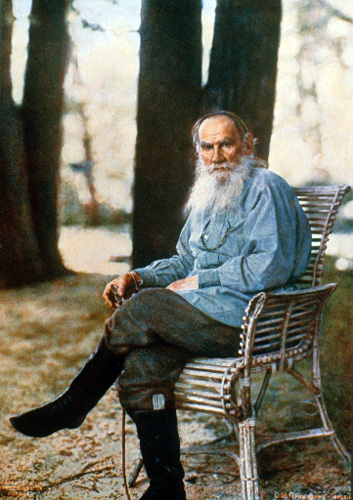
Tolstoi began early adulthood as a pleasure-seeking aristocrat, fond of gambling and licentiousness, but still (in his very Russian way) mulling over those deeper questions of life and existence. With his marriage in his late 30s to a lovely young woman of 18, he embarked on a passage through husband- and fatherhood, and later in midlife had a serious spiritual crisis and depression from which he emerged a very changed man. From henceforth on, he considered literature that lacked a didactic spiritual massage to be garbage, and a life without self-abnegation and sacrifice and a simple faith was likewise. This is the extremely famous later-life Tolstoy whom many people revered as a near-saint, the one with whom you may be familiar from the many photos taken of him (at first I thought this one was colorized, but according to Wiki it’s the first color photo portrait ever taken in Russia):
tolstoy

Many people seem to think that Tolstoy was a man of the left, and some even blame him for influencing the Russian Communist Revolution. But he was not a statist; he could better have been described as an anarchist with a Christian bent (he is actually considered the founder of something called Christian anarchism). Is anarchy left or right? That’s an ancient and complex argument and I don’t want to mire myself in it right now. Suffice to say that anarchists are not statists; they want the state obliterated, and so did Tolstoy.

Tolstoy’s own anarchy seems to have been rooted in his personal crisis, which seems in turn to have been activated (at least in part) by his very strong sense of guilt. Here’s an excerpt from the book Married to Tolstoy (Sonya was the name of Tolstoy’s wife):

But how, without government, could civilization survive? wondered Sonya, who had no more hope than Turgenev of what he called “Christian Nihilism.”…Tolstoy must have known that there were appalling slums in Moscow, but because [during his crisis] for the first time he had been to look at them, he was so much shocked by social injustice that all of a sudden he couldn’t even bear to see his family enjoying their meals—the kind of meals at which he himself habitually ate far more than anyone else. And his personality was so strong that in his presence no one could be so little sensitive as to suffer from his disapproval, even if it remained unvoiced. Everyone developed a sense of guilt and became miserable. Why, indignantly asked Sonya, should innocent children suddenly be made to feel in disgrace for living in the way in which their father had himself been brought up? Did Leo assume that people who behaved normally were necessarily indifferent—that no one but himself was capable of compassion?

The ever-mercurial Tolstoy wasn’t always in such a bad mood, even during that period. But the self-denying strain in his personality become more marked as he got older, and disciples came to visit and at times to live with the family at the country estate where they spent most of their time. Tolstoy did not live to see the Revolution, although his wife (who outlived him by nine years) did. But he showed his prescience by writing in 1904 (also from the book Married to Tolstoy):

The greatest enemy to mankind is this Social Democracy [the Bolshevik Party]. It is preparing for new slavery. It teaches a future good without a present betterment. It promises golden streets without the bloody Gethesmane. It will regulate everything. It will destroy the individual. It will enslave him. It will make chaos out of cosmos, breed terrorism and confusion, which only brute force will be able to destroy.

I think you could safely say he was not a fan.

[NOTE: I put this post in the category “literary leftists,” a series of mine. I don’t think it fits, exactly, because I don’t think Tolstoy was a leftist. But I put it there anyway because as an anarchist he occupied a sort-of-leftist sort-of-rightist gray area. He was also a political changer, too, although not of the conventional sort.]

Posted in Getting philosophical: life, love, the universe, Historical figures, Literary leftists, Literature and writing, Men and women; marriage and divorce and sex, Religion | 30 Replies

Post navigation

← Previous Post
Next Post→

Your support is appreciated through a one-time or monthly Paypal donation

Please click the link recommended books and search bar for Amazon purchases through neo. I receive a commission from all such purchases.

Archives

Recent Comments

  • Karmi on Open thread 9/1/2026
  • Karmi on Open thread 9/1/2026
  • Lee on Open thread 9/1/2026
  • Skip on “Our democracy” in Germany
  • Ilana on Open thread 9/1/2026

Recent Posts

  • Update on my ex
  • Open thread 9/1/2026
  • Letitia James was out to get Trump
  • “Our democracy” in Germany
  • Utopias and dystopias: the twain shall meet

Categories

  • A mind is a difficult thing to change: my change story (17)
  • Academia (328)
  • Afghanistan (98)
  • Amazon orders (6)
  • Arts (8)
  • Baseball and sports (164)
  • Best of neo-neocon (91)
  • Biden (536)
  • Blogging and bloggers (593)
  • Dance (292)
  • Disaster (244)
  • Education (323)
  • Election 2012 (360)
  • Election 2016 (566)
  • Election 2018 (33)
  • Election 2020 (513)
  • Election 2022 (114)
  • Election 2024 (403)
  • Election 2026 (89)
  • Election 2028 (12)
  • Evil (129)
  • Fashion and beauty (324)
  • Finance and economics (1,041)
  • Food (317)
  • Friendship (48)
  • Gardening (18)
  • General information about neo (4)
  • Getting philosophical: life, love, the universe (734)
  • Health (1,160)
  • Health care reform (545)
  • Hillary Clinton (184)
  • Historical figures (337)
  • History (716)
  • Immigration (448)
  • Iran (464)
  • Iraq (227)
  • IRS scandal (71)
  • Israel/Palestine (820)
  • Jews (437)
  • Language and grammar (365)
  • Latin America (212)
  • Law (2,972)
  • Leaving the circle: political apostasy (124)
  • Liberals and conservatives; left and right (1,319)
  • Liberty (1,117)
  • Literary leftists (14)
  • Literature and writing (393)
  • Me, myself, and I (1,496)
  • Men and women; marriage and divorce and sex (929)
  • Middle East (383)
  • Military (324)
  • Movies (353)
  • Music (533)
  • Nature (261)
  • Neocons (32)
  • New England (183)
  • Obama (1,738)
  • Pacifism (16)
  • Painting, sculpture, photography (131)
  • Palin (93)
  • Paris and France2 trial (25)
  • People of interest (1,043)
  • Poetry (258)
  • Political changers (178)
  • Politics (2,793)
  • Pop culture (397)
  • Press (1,634)
  • Race and racism (881)
  • Religion (428)
  • Romney (164)
  • Ryan (16)
  • Science (639)
  • Terrorism and terrorists (971)
  • Theater and TV (266)
  • Therapy (71)
  • Trump (1,629)
  • Uncategorized (4,548)
  • Vietnam (109)
  • Violence (1,442)
  • War and Peace (1,026)

Blogroll

Ace (bold)
AmericanDigest (writer’s digest)
AmericanThinker (thought full)
Anchoress (first things first)
AnnAlthouse (more than law)
AugeanStables (historian’s task)
BelmontClub (deep thoughts)
Betsy’sPage (teach)
Bookworm (writingReader)
ChicagoBoyz (boyz will be)
DanielInVenezuela (liberty)
Dr.Helen (rights of man)
Dr.Sanity (shrink archives)
DreamsToLightening (Asher)
EdDriscoll (market liberal)
Fausta’sBlog (opinionated)
GayPatriot (self-explanatory)
HadEnoughTherapy? (yep)
HotAir (a roomful)
InstaPundit (the hub)
JawaReport (the doctor’s Rusty)
LegalInsurrection (law prof)
Maggie’sFarm (togetherness)
MelaniePhillips (formidable)
MerylYourish (centrist)
MichaelTotten (globetrotter)
MichaelYon (War Zones)
Michelle Malkin (clarion pen)
MichelleObama’sMirror (reflect)
NoPasaran! (bluntFrench)
NormanGeras (archives)
OneCosmos (Gagdad Bob)
Pamela Geller (Atlas Shrugs)
PJMedia (comprehensive)
PointOfNoReturn (exodus)
Powerline (foursight)
QandO (neolibertarian)
RedState (conservative)
RogerL.Simon (PJ guy)
SisterToldjah (she said)
Sisu (commentary plus cats)
Spengler (Goldman)
VictorDavisHanson (prof)
Vodkapundit (drinker-thinker)
Volokh (lawblog)
Zombie (alive)

Meta

  • Log in
  • Entries feed
  • Comments feed
  • WordPress.org
©2026 - The New Neo - Weaver Xtreme Theme Email
Web Analytics
↑