When I was in college, I took a year-long survey course in art history. We began with a deep dive into Greek and Roman art, and then lingered long and hard on the cathedrals of Europe, particularly the Gothic variety. We were required to learn to tell them apart by their myriad minor variations on the theme, and I found the task exceedingly difficult.
All Gothic cathedrals looked pretty much alike to me.
What I remembered most about those cathedrals was not their differences, but how impressive they all were. What an extraordinary effort it was to build them way back then, and on such a scale! Later, when I visited western Europe and saw some of the cathedrals for myself, the scope of the undertaking involved in designing and constructing them seemed even more impressively stunning, a testament to the extreme importance of the Christian religion in the lives of the people of that time. How other-wordly and inspiring it must have been to gather inside such vast and soaring structures to worship and ponder the mysteries. And it still is, I would imagine, for those who do it.
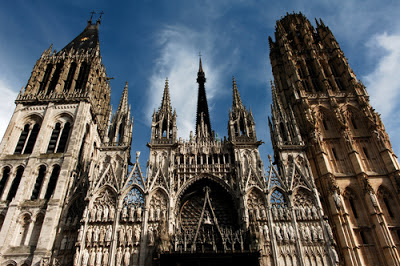
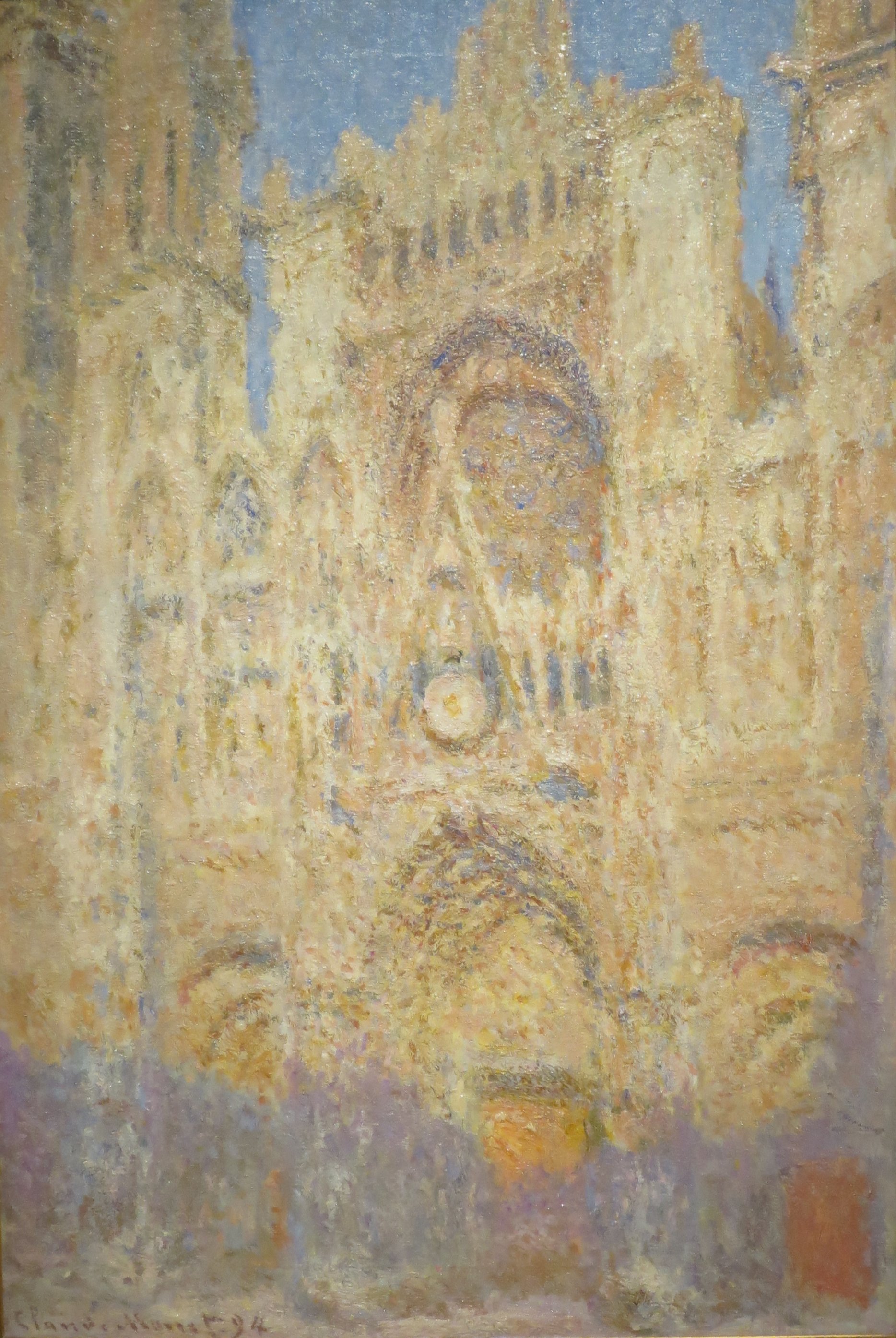
One of the most famous of the huge Gothic cathedrals in France is in Rouen. It was begun in the 12th Century (on the site of an earlier church) and added to slowly but surely during the 13th and 14th centuries, with repairs made in subsequent centuries for various calamities such as lightning strikes, fires, and bombings. It was the world’s tallest building for four years during the late 1800s, and had its portrait painted repetitively just a few years later by Claude Monet in a series of impressionist works that always looked to me as though the cathedral was melting.
I thought of that cathedral—and those paintings—some time ago when I read the news of the murder of a priest near Rouen by an Islamist terrorist, although the church where he was murdered was not that Rouen Cathedral, but another Catholic church nearby.
The centrality of Christian belief in western Europe has been on a long slow decline for centuries (I chronicled a major event connected with that decline here), with no end in sight. And it struck me, when I heard of the priest’s murder in Rouen, that the intensity of faith today in the Muslim world forms a stark contrast to the decline of faith today in western Europe—and that the latter forms a similar contrast to the powerful faith of the western Europeans who built structures such as Rouen Cathedral.
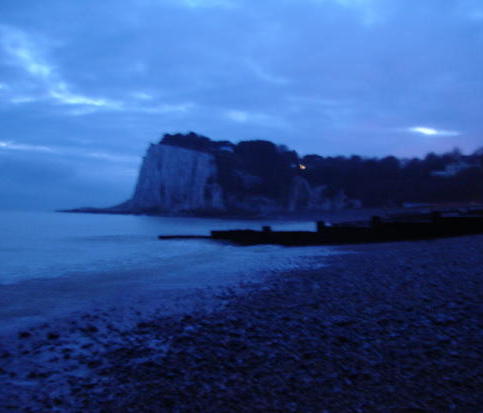
Which in turn put me in mind of Matthew Arnold’s poem “Dover Beach” (please bear with me; there is a tie-in), which begins with the poet describing, appropriately enough, the beach at Dover. Arnold is widely believed to have started writing the poem on his honeymoon, which took place in 1851, although the poem was not published till 1867.
When the poem begins, it is evening:
The sea is calm to-night.
The tide is full, the moon lies fair
Upon the straits; – on the French coast the light
Gleams and is gone; the cliffs of England stand,
Glimmering and vast, out in the tranquil bay.
Come to the window, sweet is the night-air!
Can you not picture it? I think of it as a summer night, cool after a hot day.
In the next stanza (which I’ve omitted) Arnold describes the sound of the waves upon the beach, and throws in a historic allusion to Sophocles. Until that point the poem is good. But then it veers into greatness:
The Sea of Faith
Was once, too, at the full, and round earth’s shore
Lay like the folds of a bright girdle furl’d.
But now I only hear
Its melancholy, long, withdrawing roar,
Retreating, to the breath
Of the night-wind, down the vast edges drear
And naked shingles of the world.
It’s that “melancholy, long, withdrawing roar,/Retreating,” that gives me a chill and shudder. You can hear the tide going out, and what is it taking away with it?
The last stanza is perhaps the most famous one of all, where Arnold takes his stand for love against the emptiness and meaninglessness he fears is what remains once that wave has retreated:
Ah, love, let us be true
To one another! for the world, which seems
To lie before us like a land of dreams,
So various, so beautiful, so new,
Hath really neither joy, nor love, nor light,
Nor certitude, nor peace, nor help for pain;
And we are here as on a darkling plain
Swept with confused alarms of struggle and flight,
Where ignorant armies clash by night.
Those “ignorant armies” are probably another classical reference:
The metaphor with which the poem ends is most likely an allusion to a passage in Thucydides’s account of the Peloponnesian War (Book 7, 44). He describes an ancient battle that occurred on a similar beach during the Athenian invasion of Sicily. The battle took place at night; the attacking army became disoriented while fighting in the darkness and many of their soldiers inadvertently killed each other.
Another apt metaphor. Another chill down the spine.
Why do I love poetry so much? I love it because, although poems say things we are able to say in other ways, there is no substitute for poetry’s ability to merge emotion and mind and gut cognitively, viscerally, and aesthetically. Paraphrasing a poem can explain the thought. But only a poem can express the poem.