Last night I was doing some YouTube surfing (oh, just the usual: makeovers and renovations and twins separated at birth and dancers and anything that isn’t even remotely political) and discovered that I suddenly and inexplicably had audio but no video.
Not a good thing.
I quickly exhausted whatever personal resources I might have for solving the problem unaided, and turned to Google. There was no dearth of suggestions, because it turns out I’m not the only person who’s ever had this problem.
But none of the suggestions I could comprehend worked, and the rest of them I couldn’t even try because I couldn’t comprehend them. They seemed to be written in computereze, or else they referred to something that couldn’t be found on my computer (which, to be fair, has a rather elderly operating system—but then again quite a few of these discussions of the problem were pretty old themselves).
So I activated one of my tried and true options: forget about it till tomorrow, and you may find that the computer or the YouTube program or Flash or whatever it was had healed itself.
And lo and behold, it did! Today everything worked just fine.
That doesn’t mean it will continue to do so, of course. Everything’s temporary in computerland. But I first noticed this phenomenon of the healing of inanimate objects, even machines, many a long year ago. Have you ever experienced it? It’s handy to know about.
When I updated to the new Firefox, a bunch of things came with it. On my home page there was a sampler of websites I’d recently visited, and searches I’d done. I got rid of that almost immediately; I don’t want to be reminded of the fruits of my wanderings.
But there was also a feature that I kept, something called “Recommended by Pocket.” Since my browser knows everything about me (probably more than I know myself), it shows me articles it thinks I would like to read. And sure enough, it often seduces me into reading them, because Pocket is just that smart about people.
So that’s how I ended up back at the New York Times (well you might say oh no, not again!), having clicked on an article called, “Letter of Recommendation: Passport to Your National Parks.” (I actually read it on Chrome, by the way, since I’ve used up my allotment of NY Times articles on Firefox already and I refuse to pay for access.)
The topic seemed innocuous enough, and I like national parks. But this is the Times, and this is the year 2017, so I should not have been surprised that the article (by someone named Jamie Lauren Keiles) began, “I cringe at the thought that I might be patriotic, but the next thing I know, I’m…”
Now, I don’t want to be too hard on Jamie. Seriously, I don’t. She’s young, and that intro is almost obligatory if she wants to remain in any sort of good graces with her peers. After all, she’s writing a piece in praise of—or sort of in praise of—visits to National Park Service sites as listed in a booklet. So her article must begin with the sort of hat in hand, shuffle-shuffle disclaimer that says in effect, Don’t hate me! I’m one of you. I’m not one of them, not one of those troglodyte knee-jerk America-First Trump-loving uneducated bigoted….
It’s hard to be a young person these days, and although I may sound sarcastic I’m actually not meaning to be. Thought-crime is very real and the punishment is swift and cruel, particularly among the young.
The article continues, and the first paragraph expands on the apologia for what she’s about to write:
…I like to think of America [as] less a set of monolithic ideals than a junk drawer full of halftime shows, regional-style pizzas, feuds over what exactly to call “soda” and snippets of marches by John Philip Sousa. But that sort of patriotism, while good enough as entertainment, offers little comfort when I’m up late at night consuming my 25th hour of news. Lately, my America has felt too vast and fragmented, and fixating on regional curiosities like state-fair butter sculptures and St. Paul sandwiches only exacerbates this crisis of faith. I’ve been searching for new ways to keep liking this country, meaningful ways that don’t feel like work.
Once she’s gotten that out of the way, most of the rest of the article is straightforward. But every now and then there’s that little hiccup to let us know Jamie’s on the side of the good.
For example, I find the following to be a fascinating example of the push/pull back-and-forth feelings the author experiences when she comes face-to-face with the grandeur that is one of the greatest sites on earth:
Standing at the South Rim of the Grand Canyon, I imagined what it must have been like to ride a horse through unfamiliar land and come face to face with this immense hole in the ground. I found myself drawn, if only for a moment, to the tantalizing myth of European “discovery.”
She’s drawn—but only for a moment. This myth to which she’s drawn simply must be put in scare quotes to even be uttered (or in this case written). Well, Jamie, I suggest you look at it this way: although the Native Americans were definitely there first—some even lived there—in 1540 they showed it to the Spaniards, and the rest, as they say, is history. You can think of this “discovery” as the canyon’s reveal to the rest of the world of one of the wonders of that world. And thanks to a bunch of dead white guys, we can all stand and see approximately what they all saw that day when it really was an amazing “discovery”—without the scare quotes.
In fact, I’d say it’s still a discovery for anyone who goes there for the first time.
There’s more in the essay, but I’ll tiptoe away now with a request (almost certain to go unheeded) that travel articles could just be written without the political overlay that doesn’t belong there and doesn’t enhance a thing.
I am seriously in awe. A three hundred square foot apartment, and look what they manage to do with it:
Yeah, it’s really really small, and those of you who don’t live in mega-expensive cities such as New York may be horrified. But forget about that part for a moment and see how creative they’ve been in merging form and function and making the most of every inch, without the place looking cramped. It’s the dining table and the couch that especially impress me, but I think the whole thing is creative, harmonious, and well-planned.
Long, long ago Paul Krugman was an economist of some objectivty. Then he added a gig as opinion columnist for the NY Times (around 2000), and since then he’s written about a great deal more than economics, with a remarkable degree of rancor and partisanship.
I previously described my opinion of Krugman—and how I came to form it—in this post. It was written in 2012, but it describes a process that took place about eight years earlier, before I even became a blogger (some of the links are now dead, but they were working at the time I wrote it):
I also know that Paul Krugman is a disingenuous, self-serving egomaniac. How do I know that? Not from reading his economics posts, but from a lengthy bit of research I did in 2003, a year or so before I became a blogger, on the subject of Krugman’s explanation of and apologia for the anti-Semitism of Mahathir Mohamad of Malaysia (I recall that he wrote a subsequent column on the brouhaha as well, and for some reason I can’t locate it right now)…
…I started out having no particular opinion about Krugman except that I knew he’d won a Nobel for economics, and had written some popular books on the subject that I’d heard were pretty fair and fairly good. But when I delved into the story behind Mahathir’s remarks, the more I learned the more I was stunned to discover that Krugman had misrepresented nearly everything about them except the actual quote. For example, Krugman said that Mahathir was using the remarks to shore up his domestic flank, but it turns out that Mathahir was actually retiring from politics. Krugman also failed to mention Mahathir’s lengthy history of anti-Semitism, and Krugman’s deeply entwined relationship with Mathahir and Malaysia.
There was more—much more. But the point was that, on a subject that was much more accessible to me than economics, many hours of research convinced me that Paul Krugman was a man who played fast and loose with the truth, and who would double down on his misrepresentations when accused and challenged.
If you look at Krugman’s Wiki page and go back in time to the Bush II era (which seems like ancient history to me at the moment), you’ll find that he was so hyper-partisan anti-Bush that even some liberals criticized him (much more information on that is available here on Krugman’s transformation from fairly even-handed to hyper-partisan during the Bush administration). I don’t read Krugman often any more, but from what I have read of him, his Trump aversion makes his Bush-hatred seem mild.
But that’s all just the background to what I want to say here (get to the point, neo!), which is that Krugman issued a gloomy 2017-summing-up column on Christmas Day that had the title “America Is Not Yet Lost.” It’s one of those pieces that looks back on the year that was and forward to the year that will be, and evaluates the past and projects into the future.
From the title, I thought for a moment (really, only a moment) that perhaps Krugman was going to give Trump credit for some little thing. But no, of course not; Krugman’s hope is that the Democratic victories in the special elections portend far more Democratic victories to come, and that’s not a surprising point of view for him considering his very “progressive” politics. He also thinks that America’s hope lies in the pussy hat brigade’s resistance, which seems quite a bit more fanciful to me.
Speaking of prognostications—in 2009, Krugman wrote an article for the Times magazine called “How Did Economists Get It So Wrong?”, about the failure of economists to predict the 2008 financial crisis. The title of his article is somewhat ironic, looked at with the perspective of time, because Krugman himself has not been stellar in the prediction game. Among other things, he wrote: “In the years ahead Enron, not September 11, will come to be seen as the greater turning point in U.S. society.” By someone perhaps—maybe even by Paul Krugman—but most people today probably don’t even remember what the Enron scandal was.
If you want to look at more of Krugman’s prognostications-gone-bad, see this. In making predictions that don’t come true, Krugman is hardly unique; the prediction game is rife with errors. But his arrogance is worse than that of most people, coupled with his reluctance to admit the errors he has committed, even some fairly blatant ones that cry out for acknowledgement.
In other words, it’s really amazing to read his Chirstmas Day piece and recall his biggest prediction for last year post-Trump-election, one that most definitely did not come true of the stock market:
That was his prediction last year. One might have thought his slightly-hopeful year-end summing-up column this year might reference the fact that such terrible economic consequences didn’t happen (and that in fact the opposite happened) as a cause for hope. But no; crickets from Krugman about the whole thing.
This does not surprise me and should surprise no one. As I said earlier, one of the first things I learned about Krugman was how disingenuous and self-serving he was. But my question is why Krugman’s bad predictions haven’t seemed to hurt him with either the NY Times or his wide audience. You have only to read the comments to his “America Is Not Yet Lost” column to learn that most of his readers agree with him and are not troubled at all by his omissions (at least, that was true as far as I read; there are over a thousand, so I certainly didn’t read them all).
Krugman is (or used to be, anyway), an economist. Now I know that he had other economic specialties than predicting the stock market’s reaction to an election. But one would think that as a Nobel Prize-winning economist and political pundit he should have at least a trifle more ability in predicting such a thing than some random blogger or the man in the street. And one would think that this failure would invalidate his writings in the minds of a significant number of his readers. But I don’t see it happening.
Krugman is by no means unique in this disconnect. It’s actually a common thing. It’s as though pundits (and not just of the liberal variety, either) exist in another world, a fantasy one in which a clever and/or emotionally satisfying turn of phrase is the goal. If it resonates with the reader at the time—mirrors what the reader is feeling or thinking—that’s good enough. Perhaps that’s the real function of Krugman in his pundit incarnation: to reflect what his readers think and whip them up into greater heights of outrage, rather than to be correct.
In 2009 Krugman indicated that he was “trying to make this progressive moment in American history a success.” Perhaps that’s why he sees the pussy hat demonstrators as a cause for hope, and his goal is to energize them to further protests. I can’t imagine why that would matter in terms of policy. But it might matter in terms of rallying the progressive troops so that the “moment” represented by the Obama administration goes forward (he was critical of Obama for not being “progressive” enough, by the way), and making sure that the detour represented by Trump will be exceedingly brief.
[NOTE: This is another recycled poetic effort of mine. By the way, on the words “the dog,” that’s a picture of the actual dog we had when my son was growing up.]
[NOTE: This is a repeat of a previous post. Merry Night-Before-Christmas and Merry Christmas!]
…a creature was stirring.
Last night was Christmas Eve. I was expecting a visit from my son, who was flying in as a rare treat. I had tidied up, and was putting on the finishing touches while waiting for him to arrive from the airport. As I was poised at the top of the staircase on my way down from the second floor, I saw a movement on one of the lower steps.
A dark shape. A small dark shape—very still, and then in motion again. With tiny little ears, and a long tail.
A mouse. Very much stirring.
I let out a shriek, like in the cartoons. Yes, I know that mice do not hurt people. But yes, they give me the willies when they startle me and scurry around—like—mice. The few times when this has happened before, they’ve always sought the little opening from whence they’d come and scurried away, hardly ever to be seen again.
But this mouse seemed to be lost and disoriented. Maybe because it was almost midnight on Christmas Eve, and no creature was supposed to be scurrying. In the midst of my unreasonable fear was a sort of amusement. What was it doing here, this evening of all evenings?
The mouse was still on the staircase landing, and although I assumed that somehow it had managed to climb the three stairs to where it was, it appeared to be perplexed about how to get up or down from there. I watched it from what I considered a safe distance at the top of the stairs, and I could see it moving back and forth, back and forth, first towards the wall and then towards the edge of the step, but it could not seem to get the courage to make a break for it.
What did I do? I called my son and asked how far away he was. Forty-five minutes. And then I settled in, not for a long winter’s nap but for a long viewing from a good vantage point to monitor the mouse’s position till he arrived. For the moment, the mouse seemed quite well-contained on the stairs, but I didn’t trust that—and sure enough, slowly but surely, with many fits and starts, it managed to get back down those three stairs to the ground floor.
Now, it turns out that watching a mouse is actually sort of interesting. This one darted from stair-bottom to hall to bathroom to bedroom and back again (my place is built upside-down, with the bedroom and bathroom downstairs and living room and kitchen upstairs). I had a special horror of the mouse being in the bedroom—so after its one foray into the bedroom for five minutes and then out again, I slammed the bedroom door shut and placed a thick towel to block the crack at the bottom. The towel seemed to act as an effective barrier, like a small mountain range, and the mouse didn’t venture into that room again.
But back and forth it went—along the wall in the hall, into the bathroom, up a few stairs and then back down them again. I noticed that it seemed to get smarter and smarter; each time it climbed the stairs it was better at it, until it seemed as though it had been doing this all its little life.
And then by trial and error it found the molding along the side of the stairs, which then acted as a sort of ramp by which the mouse could easily climb all the way to the top. This filled me with dread. I was conceding the downstairs for now, but the upstairs was my territory! But what to do? That molding-ramp made it so easy; the mouse was coming up in a determined sort of way, till I could look into its beady little eyes and it could look into mine. I let out another involuntary yelp, stamping my feet and clapping my hands, trying to make enough noise to frighten it off.
I looked and sounded completely and utterly ridiculous.
And yet it was effective; the little thing stopped in its tracks, then turned and went back downstairs again, to my great relief. Then a few minutes later it came up the ramp-molding again, and I re-enacted the same stupid pantomime I had before. The mouse kept coming—up up up, light and fleet of foot, relentless and implacable. I actually thought of throwing something at it to head it off—perhaps my shoe, like Clara in “The Nutcracker.” But oh, for a platoon of tin soldiers like hers! (I’ve cued up this video to start at the right spot, although it’s mistitled because these are not meant to be rats, they’re mice):
But alas, we were alone, just the two of us, mousie and me. And I didn’t really want to hurt it, which I thought might happen if I threw my shoe, so I reached for a pillow—and at that moment I heard the key turn in the lock and my son walked in.
I’m always happy to see him, but perhaps never so happy as this time, as I stood at the top of the stairs in a semi-crouch, clutching a small pillow and making silly-yet-hopefully-scary noises at a mouse that was climbing a molding-ramp on the edge of the staircase.
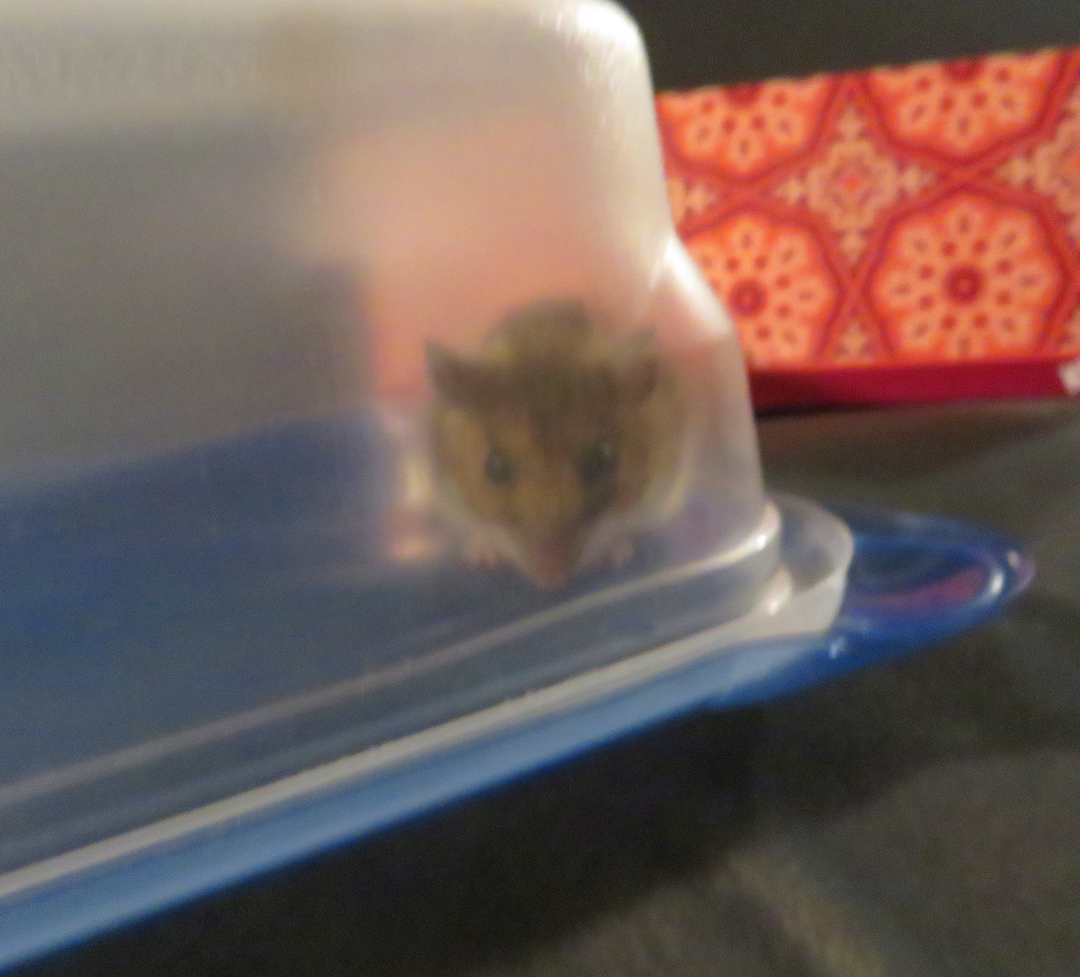
My son managed to keep his disdain under control long enough to catch the mouse in a plastic container and escort it outside to be released, but not before we took a photo though the plastic. Yes, the mouse is cute. But no, I don’t want him in my house, not on Christmas Eve or any other time.
[NOTE: This small poetic effort of mine has become somewhat of a holiday tradition at neo-neocon. So here it comes again—just like the holiday itself. Merry Christmas Eve to you all!]
‘Twas the night before Christmas, when all through the ”˜sphere
Bloggers were glad to see Christmas draw near.
Their laptops were turned off and all put away
The bloggers were swearing to take off the day.
Their children were nestled all snug in their beds
While visions of extra time danced in their heads
With a father or mom not distracted by writing
No posts to compose, and no links to be citing.
But we all know that vows were just meant to be broken
And the vows of a blogger can be a mere token.
There’s always a chance that some sort of temptation
Will rise up to make them of fleeting duration.
For instance, there might be found under the tree
A sleek Mac; well, what better sight could there be?
And who could neglect it and wait the whole day?
It cries to be tried out, one just can’t delay.
Or maybe somewhere there’s a fast-breaking story
Important, and possibly leading to glory.
It can’t be ignored, there’s really no choice,
So add to the din every blogger’s small voice.
And then there are some who may just like to rhyme
(I’m one who at times must confess to this crime),
And it’s been quite a while since Clement Clarke Moore
Wrote his opus (though authorship’s been claimed by Gore)””
So it seems about time it was newly updated
And here’s my attempt””aren’t you glad you all waited?
Forgive if it sounds a bit awkward to read.
In writing, I set a new record for speed.
I had to get under the wire and compose it
Before Christmas Day. Now it’s time that I close it.
But let me exclaim (or, rather, I’ll write)
Happy Christmas to all, and to all a good-night!
Here’s a video of the original, with some 50s-type nostalgia for those who remember. There are a few odd anomalies (“safe in their beds” instead of “snug in their beds”). But it brought back memories of pincurls, and the days when parents were assumed to sleep in twin beds (even though I don’t recall that most people did).
I think I had the book on which this is based. The illustrations look very familiar:
Clicking on the Amazon widget on my right sidebar to get there is the best way to order from Amazon, although if your adblock is on you won’t see the widget. But just disable your adblock on the page and it will appear. Or go here and click on the link within that post.
Bloggers are continually having to make decisions not just on what to write in any particular piece, but how to choose topics and the timing of topics: what to write about, how long to make it, how much variety to have, how often to put up a post. That sort of thing.
Group blogs have it easy in a way, because they can push out content at a regular clip without straining any one person unduly. But as a single blogger rather than a group blogger (although I also post sometimes at the group blog run by law professor William Jacobson, Legal Insurrection), it’s just little old me who makes all these decisions at neo-neocon.
I’m not complaining, not exactly, because I like the autonomy. But it’s not easy to figure out how much content is enough and how much is too much. I’ve fallen into a certain pattern over the years of a few posts a day with some of it political but maybe at least 25-30% of it non-political. I’ve never figured out the exact proportions; I just do what feels right at the time.
I generally have more fun writing the non-political posts than the political ones. Although sometimes the non-politicals go faster, sometimes—particularly when there are a lot of YouTube videos involved, for example with my dance posts—they take a long long time to compose and especially to research. But often they’re so much fun to research that I would be doing it anyway even if I never wrote a thing on the topic. Sometimes posts like those YouTube-heavy dance posts are very popular and draw a lot of comments. But sometimes there are only one or two comments and I begin to question whether other people think the topic is quite as fascinating as it is to me.
Now and then I wonder why it is that I’ve decided to spend my semi-Golden years digesting political news and spitting out my opinions on it. But as with the arts posts, a lot of the political stuff is intrinsically interesting to me and I’d be reading it and thinking about it even if I wasn’t writing about it. It’s also in the process of writing that I refine my thoughts, so there are rewards for me beyond the blog and its audience (although the audience is a big big plus).
So now it’s Christmas weekend, one of the biggest holidays of the year. Traffic goes down online for just about everyone during a holiday, and if this year is anything like all the other years it will go down here. So, for example, I have a big long draft of a big long post on the topic of the GOP’s tax bill and its effect on charitable giving. That topic has the advantage of being timely in two ways: the bill is newly-passed, and December is traditionally the time when a great deal of their money (about 1/3 of the entire year’s haul) is taken in by charities.
But I’ve decided to wait till after Christmas to post it. I find that it’s not a good idea to publish bigger, heavier posts during a holiday because not enough people will see them. The holidays are for holiday-ing, after all—and to that end I hope your weather’s better than mine’s supposed to be.
Much of New England is in the throes of a snow/ice/rain storm right now, for example, and the same is predicted to happen for a goodly portion of Christmas Day. At around 3:30 PM this afternoon I ventured out of my home and ventured right back in again, encountering at least an inch of uneven ice, and a drizzle of what they like to call “mixed precipitation.” No reason to be out unless you have to be.
I’m getting a bit stir crazy and cabin-fevered—more than a bit, to be honest. On Christmas Day I was planning to drive a couple of hours to a friend’s house for dinner and conviviality, and I was looking forward to it. Still am looking forward to it. But I have my doubts as to whether driving will be advisable that day.
[NOTE: Regulars here may remember that most years I put up a family Christmas recipe. And here it is again.]
This recipe was brought over from Germany sometime in the mid-1800s, and was my favorite of all the wonderful treats cooked by my great-aunt Flora, a baker of rare gifts. She and my great-uncle were not only exceptionally wonderful people, but to my childish and wondering eyes they looked very much like Mr. and Mrs. Santa Claus.
The name of the treat is lebkuchen, but it’s quite a different one from the traditional recipe, which I don’t much care for. This is sweet and dense, can be made ahead, and keeps very well when stored in tins.
Flora’s Lebkuchen:
(preheat the oven to 375 degrees)
1 pound dark brown sugar
4 eggs
2 cups flour
1/2 tsp. baking soda
1/2 tsp. baking powder
1 tsp. cinnamon
1/2 cup chopped walnuts
4 oz. chopped dates
1 cup raisins
1 tsp. orange juice
1 tsp. vanilla extract
1 tsp. almond extract
1 tsp. lemon juice
Sift the dry ingredients together (flour, baking soda, baking powder, cinnamon).
Beat the eggs and brown sugar together with a rotary beater till the mixture forms the ribbon. Add the orange juice, lemon juice, and extracts to it.
Add the dry mixture to it, a little at a time, stirring.
Add the raisins, dates, and walnuts.
Grease and flour two 9X9 cake pans. Put batter in pans and bake for about 25 minutes (or a little less; test the cake with a cake tester to see if it’s done). You don’t want it to get too dark and dry on the edges, but the middle can’t still be wet when tested.
Meanwhile, make the frosting.
Melt about 6 Tbs. of unsalted butter and add 2 Tbs. hot milk, and 1 Tbs. almond extract. Add enough confectioner’s sugar to make a frosting of spreading consistency (the recipe says “2 cups,” but I’ve always noticed that’s not exactly correct). You can make even more frosting if you like a lot of frosting.
Let cake cool to at least lukewarm, and spread generously with the frosting. Then cut into small pieces and store (or eat!).
That’s the question asked by Andrew C. McCarthy, who so far has written the most consistently insightful and in-depth articles on the subject of the investigations of Trump by various government agencies.
It’s another of those “read the whole thing even though it’s long” articles. But I’ll offer some excerpts anyway:
According to the now-infamous text message sent by FBI agent Peter Strzok to his paramour, FBI lawyer Lisa Page, it was in McCabe’s office that top FBI counterintelligence officials discussed what they saw as the frightening possibility of a Trump presidency.
That was during the stretch run of the 2016 campaign, no more than a couple of weeks after they started receiving the Steele dossier ”” the Clinton campaign’s opposition-research reports, written by former British spy Christopher Steele, about Trump’s purportedly conspiratorial relationship with Vladimir Putin’s regime in Russia.
Was it the Steele dossier that so frightened the FBI?
I think so.
So, the timing was right. But it wasn’t just the timing:
The Obama-era FBI and Justice Department had great faith in Steele because he had previously collaborated with the bureau on a big case. Plus, Steele was working on the Trump-Russia project with the wife of a top Obama Justice Department official, who was personally briefed by Steele. The upper ranks of the FBI and DOJ strongly preferred Trump’s opponent, Hillary Clinton, to the point of overlooking significant evidence of her felony misconduct, even as they turned up the heat on Trump. In sum, the FBI and DOJ were predisposed to believe the allegations in Steele’s dossier. Because of their confidence in Steele, because they were predisposed to believe his scandalous claims about Donald Trump, they made grossly inadequate efforts to verify his claims. Contrary to what I hoped would be the case, I’ve come to believe Steele’s claims were used to obtain FISA surveillance authority for an investigation of Trump.
The rest of McCarthy’s article contains the details of why he says what he says.