The seeming stupidity of Elizabeth Warren claiming Native American status on the basis of her paltry DNA results points to some deep problems in the leftist identity politics narrative. It goes something like this:
(1) For some identities, leftism dictates that they are self-defined and ignore physical biology. The person creates his or her own reality, and this is most readily apparent with the transgender movement. In fact, once a person has formally identified as a man or a woman, regardless of his or her birth gender, then the world is required to address that person by the preferred gender pronouns whether that new gender seems to fit the person’s appearance or not, and whether or not that person has had sex reassignment surgery. This has already caused some problems in sports (see this, for example).
(2) The history of the assignment of racial identity is fraught with difficult decisions to be made about the governing rules. This is true whether the purpose is discrimination (apartheid, Jim Crow South, Nazis) or the conferring of benefits (affirmative action in the present-day US). Warren tried to take advantage of a minority status in order to gain such advantage in the hiring process (although she denies that motivation). Whatever her reasons, the real question is at what point it becomes ridiculous to claim such racial ties. Warren definitely went far beyond that point; she is no more Native American than most Americans of European descent who wouldn’t even think of claiming it, and a good deal less than some.
(3) Same for Rachel Dolezal, who appears to have had a different motive for her identification with black people although she’s white, probably an emotional one. At any rate, her case highlighted the conflict between the leftist rules about gender identity and the ones about racial identity.
(4) Warren’s case also makes it clear that if she meets the criteria for being a minority, then virtually all of us do, because most people have traces of other races (and often even other species, for example Neanderthals). Once it is accepted that a small amount of a race is enough to confer membership in that race, then the entire edifice collapses because almost anyone could claim membership in any race.
(5) That brings us right back to the more basic question: what is race, how can it be determined, and what is the purpose of such categorization? Why at this point do we have affirmative action or quotas? Why are some races favored and others not? Harvard is having to deal with this question right now regarding their treatment of Asian applicants, and I eagerly await the results of that lawsuit.
[NOTE: It occurs to me that I should point out that the left doesn’t care about the contradictions, although it’s inconvenient for them to have them pointed out. But since the left will say that 2+2=5 if necessary, contradictions are really no big problem for them.]
Most people couldn’t pull off this fashion statement that Melania Trump made during her recent trip to Egypt. For instance, I would like silly in this outfit. But Melania can wear anything and look good, and she looks great here.
I must add that the First Lady of Egypt is one of the few people who can manage to hold her own while standing next to Melania. She has a different (and simpler) vibe and style entirely, but is equally tall and slim, with a natural elegance.
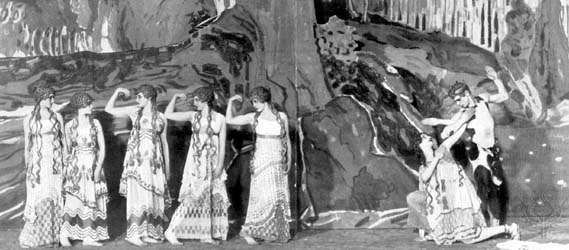
And how about those strange dancers seen from :12-:20? Is that supposed to be some Egyptian dance? It reminds me a bit of the Fokine version of “Afternoon of a Faun” from 1912:
Nijinsky’s ballet caused a huge scandal when it premiered:
The style of the ballet, in which a young faun meets several nymphs, flirts with them and chases them, was deliberately archaic. In the original scenography designed by Léon Bakst, the dancers were presented as part of a large tableau, a staging reminiscent of an ancient Greek vase painting. They often moved across the stage in profile as if on a bas relief. The ballet was presented in bare feet and rejected classical formalism. The work had an overtly erotic subtext beneath its façade of Greek antiquity, ending with a scene of graphic sexual desire.
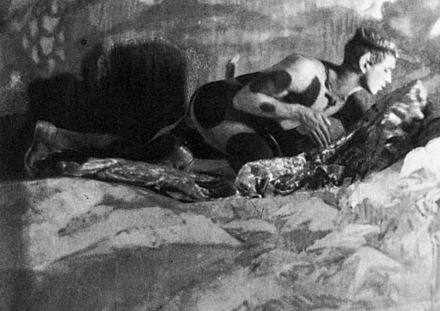
That “scene of graphic sexual desire” was with a veil, by the way, left behind by a nymph. Here’s what actually happens in the scene:
The Faun holds the veil to his face before spreading it on the ground and lowering his body onto it, head tucked in and arms to his sides. Soft horns and harp accompany a final flute passage as his body tenses and curls back, head rising, before relaxing back onto the veil.
That really doesn’t sound all that shocking, does it? But I’ve seen the ballet, and if that part is done well, it actually does convey a very sexual vibe that must have been intensely shocking in 1912.
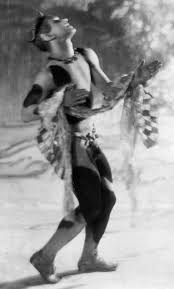
But I very much doubt that anyone can do it the way Nijinsky did it. He was by all accounts one of the greatest dancers of all time, in no small part because of his acting abilities. We do have still photos of him and the veil, although not that final moment. You can see his special qualities:
And here is a video of Nureyev doing the role. I’ve cued up just the last bit:
I’ve come pretty far from talking about Melania’s outfit on her trip to Egypt, haven’t I?
It seems possible that Khashoggi was murdered in order to embarrass Crown Prince bin Salman rather than to protect him.
If he was murdered at all, that is—and on the whole I think it’s likely that he was murdered.
I wonder why Lindsey Graham is falling into the trap of accusing bin Salman before we know more. Maybe Graham just can’t turn off his new-found feistiness. From the quotes in that article (I can’t find a full transcript of Graham’s interview), it appears that Graham isn’t saying “if” about the Crown Prince’s responsibility for the murder; he’s assuming it. This just seems wrong to me, and not smart.
Note that we haven’t yet gotten the promised announcement from the Saudis that CNN had predicted. Time will tell, of course, but CNN is not exactly a consistently trustworthy source. In summary, right now this entire affair is wide open and I’m assuming that we know nothing.
It happened in 1954, which isn’t all that long ago. But it might as well have been hundreds of years ago, because I doubt most Americans are aware of it. I’m pretty sure that if you were to stop 100 people on the street and ask them about it, none or few would have a clue what you were talking about.
So, what am I talking about? The Puerto Rican independence advocates who shot up the House of Representatives, wounding five members of the House, one seriously.
This happened during the “peaceful” 1950s:
When Lebrón’s group reached the visitor’s gallery above the House chamber, they sat while the representatives discussed the Mexican economy and issues of immigration. After Lebrón gave the order, the group quickly recited the Lord’s Prayer. She stood up and shouted, “¡Viva Puerto Rico libre!” (approximately, “Long live a free Puerto Rico!”) and unfurled the flag of Puerto Rico. The group opened fire with semi-automatic pistols directed toward the Representatives below.
Five representatives were shot in the attack. The wounded lawmakers were Alvin M. Bentley (R-Michigan), who took a bullet to the chest, Clifford Davis (D-Tennessee), who was shot in the leg, Ben F. Jensen (R-Iowa), who was shot in the back, as well as George Hyde Fallon (D-Maryland) and Kenneth A. Roberts (D-Alabama). House pages helped carry Alvin Bentley off the House floor. The representatives were treated and recovered.
Lebrón said she fired her shots at the ceiling, while Figueroa’s pistol jammed. Some 30 shots were fired (mostly by Cancel, according to his account), wounding five lawmakers. Upon being arrested, Lebrón yelled, “I did not come to kill anyone, I came to die for Puerto Rico!”
The shooters were tried in the US and given lengthy sentences that were essentially life imprisonment. But guess what? Until I read it while doing research for this post, I had forgotten this little detail (if indeed I ever knew it):
Figueroa Cordero was released in 1978. One year later, in 1979, President Jimmy Carter pardoned the remaining Nationalists. Some analysts said this was in exchange for Fidel Castro’s release of several American CIA agents being held in Cuba on espionage charges, but the US said that was not the case. The Nationalists were received in Puerto Rico with a heroes’ welcome from roughly 5,000 people at San Juan International Airport
The former teenage beauty queen may have been a “terrorist” to most Americans, but she became an almost mythical hero, a kind of Joan of Arc, to many Puerto Ricans both on her native island and in their large New York community. Some, however, felt such violence was a step too far. Others compared her to legendary South American revolutionaries such as Mexico’s Emiliano Zapata and Pancho Villa or later to the Argentine-born hero of the Cuban revolution, Che Guevara. Stylised Che-style portraits of Lebrón began appearing in New York galleries and Che himself said he had been inspired by the gun-toting lady in the silk scarf, dangly earrings, bright lipstick and high heels…
After the Puerto Ricans were freed on 10 September 1979, they were feted as heroes during a tour of Puerto Rican communities in New York and Chicago. They were welcomed by tumultuous crowds, with banners proclaiming “Welcome Lolita!” when they flew into the Puerto Rican capital, San Juan. For the rest of her life, saying she did not regret her action but had renounced violence, Lebrón was known respectfully by her compatriots as Doña Lolita.
I thought about this incident during the recent Kavanaugh hearings, which featured many disruptions from the gallery and the need to escort some of the protestors out. At least we seem to have metal detectors and other protection now; I doubt a group could get in with semi-automatic pistols anymore. But I don’t doubt that there are some people who’d dearly love to (and they’re most likely not Puerto Ricans these days, unlike 1954), and I don’t doubt that they might find some creative way to outwit security and wreak havoc.
Victor Davis Hanson knows his classics, and the title of his latest article, “The Origins of Progressive Agony,” contains a word—agony—that English speakers usually take to mean “intense pain or suffering.” That is its first definition, but its second comes more directly from its Greek root, agon, a word that means “struggle or contest.”
Hanson’s essay is well worth reading in its entirety; a summary hardly does it justice. I believe he intends “agony” in both its meanings, suffering and contest, and I believe it is the correct word for what the left is going through right now. It is by no means clear who will win this struggle, long term.
Here’s Hanson’s description of what happened right after Trump won in November of 2016:
Progressives soon woke up to the reality that without power they were unable to stop Trump, and so they embraced any desperate means necessary to trap the ogre. The effort proved as frenzied as it was impotent: boycotting the inauguration, suing over state voting machines, using the courts to stymie Trump appointments and executive orders, appealing to the emoluments clause and the 25th Amendment of the Constitution, and winking and nodding at the assassination chic of celebrities and politicos such as Johnny Depp, Peter Fonda, Kathy Griffith, Madonna, Robert de Niro, Snoop Dogg, and a host of others. The many methods to subvert Trump’s presidency or fantasize about his gory death were as varied as the number of faux-accusers who would come out of the woodwork to smear Brett Kavanaugh. And the result was eerily the same: the more the impotent frenzy, the more it discredited its source.
It was a sort of boomerang situation, in which the child’s traditional taunt “bounces off me and sticks to you” seemed to come true over and over. The left kept thinking it had driven a stake through the vampire’s heart, only to find that it had missed the mark.
Blacks Lives Matter, Antifa, and #MeToo were all in a sense weaponized to do what elections had not. Finally, in exasperation, Democrats have begun demonizing the Electoral College itself, which has gone from the legal basis of Obama’s treasured “blue wall” to a relic of old, white male Founders who supposedly favored rural hicks over the better people of the cities. Progressives now damn the idea of a nine-person Supreme Court and mysteriously praise the discredited, hare-brained scheme of FDR to pack the court with progressive toady judges.
This is not new. The left only likes any institution as long as they see it as benefiting them. FDR’s original court-packing scheme was in the furtherance of progressive politics, so it is no surprise that the current-day left would be in favor of it. But they’d be against it if the right were proposing it, of course. It’s purely situational.
It is also no coincidence that Democrats are called “Democrats” and Republicans “Republicans.” The Electoral College and the Senate are nods to the fact that the US is a republic rather than a pure democracy. The House is much closer to a democratic legislative body than the Senate, because although the House is representative, those representatives reflect population differences far more closly than the Senate (which totally ignores population and only reflects state entities) and the Electoral College (a sort of middle way between the two). One of the most profoundly frustrating elements of the 2016 presidential election for Democrats was the fact that Hillary actually did win the popular vote, so it makes perfect sense that Democrats would take out their ire on the Electoral College that had foiled them. So near and yet so far!
Another reason for Democrats’ agony is the nature of the contest against an opponent such as Trump. It’s a lesson the Republicans struggled with, too, during the 2016 primary season. Trump had a lot of rivals in the GOP during the primary vying for the nomination, and if you watched closely you saw that all of them, despite their brains and previous power and support, were caught flat-footed by his idiosyncratic approach. They simply didn’t know what to do with him. Conventional debate and conventional means didn’t seem to work; they’d never really seen anything like him in politics before, and they didn’t know how to meet his tactics and win.
During the primaries, Trump’s Republican opponents never quite figured out how to wrestle this particular alligator. In the time since he’s been president, some of the Republican NeverTrumpers are still going at it and failing, although most have given up the agon and praised him, albeit sometimes reluctantly. Now it’s the Democrats who are engaged in a struggle with this strange opponent, continually thinking “Gotcha!!” and continually being bested.
Which brings me to another metaphor, appropriate for this time of year: Trump as knuckleballer. The knuckleball pitcher confounds batters with the zaniness of the ball’s behavior once it leaves his hand. It doesn’t require extreme force but it’s not an easy pitch to throw and it’s a very difficult one to control. But it can make ordinarily good hitters look bad; they often just can’t figure out what’s going on, and they end up looking silly when they swing at a knuckler.
A knuckleball or knuckler is a baseball pitch thrown to minimize the spin of the ball in flight, causing an erratic, unpredictable motion. The air flow over a seam of the ball causes the ball to transition from laminar to turbulent flow. This transition adds a deflecting force on the side of the baseball. This makes the pitch difficult for batters to hit, but also difficult for pitchers to control and catchers to catch; umpires are challenged as well, as the ball’s irregular motion through the air makes it harder to call balls and strikes.
Long ago I read the memoir of prominent knuckleball pitcher Jim Bouton, and later as a Red Sox fan I watched many a game pitched by knuckleballer Tim Wakefield:
On Monday, a federal district court judge in California ruled to dismiss Stormy Daniels’ defamation lawsuit against President Donald Trump…
Trump lawyer Charles Harder released a statement claiming that with the lawsuit’s dismissal, the president is entitled to compensation for his legal fees.
I’ve been avoiding writing about the Khashoggi story for the simple reason that the truth—which is often elusive—seems even more elusive than usual in this matter.
From moment I first read about it, my gut told me the story just didn’t hang together. Continue reading →
No year is the same as any other year, but this fall the New England foliage has been kind of odd. Somewhat muted, for one thing. And we’ve had lots of rain, which always means that the early, more brilliant colors—the scarlets and oranges—drop prematurely.
But it’s always beautiful along the Kancamagus Highway in northern New Hampshire. Here are some of this year’s photos. I won’t say it’s impossible to take a bad picture there, but you have to try really really really hard to accomplish it:
Just for comparison, here are a few I took in 2015 along the same spot. That was an especially brilliant year for color; I think you can see what I mean about the reds and oranges:
Elizabeth Warren’s claim to have Native American ancestry hasn’t been a question I’ve dealt with on this blog except very briefly, in passing. I’ve left that to others, in particular Legal Insurrection, which has gone into it many times in some detail.
Well, now Warren has released a summary of the results of a DNA test, and Professor Jacobson at LI has covered that, too:
Elizabeth Warren is not Native American. Her ancestry has been traced by Cherokee genealogists back to the early 1800s, as far back as there are records, and there are no Native American ancestors…
If Warren can show she truly is a descendant of the original peoples of North America via a DNA test, that’s the start, not the end. She will not have proven she was justified in claiming Native American status for employment (and career advancement) purposes. She still would have to prove the second part of the test, that she maintained cultural identification through tribal affiliation or community recognition.
…I’ve also argued that the focus on a DNA test was a mistake, because Warren likely either had taken or would take a DNA test that would show some miniscule markers from original North American peoples, and she would then declare she was right.
And so it has come to pass. The Boston Globe, Warren’s go-to outlet, reports on a DNA test Warren took. It does not show she is Native American. It shows “strong evidence” of a single ancestor going back 6-10 generations. It’s a very thin analysis, and does not support the headlines being generated that Warren is Native American.
(added) Yet the Globe ran a headline in the print edition (unlike the online edition) suggesting the results proved Warren’s ancestry. Warren has tweeted that print edition headline—“Warren Reveals Test Confirming Ancestry”…
Much more at the link.
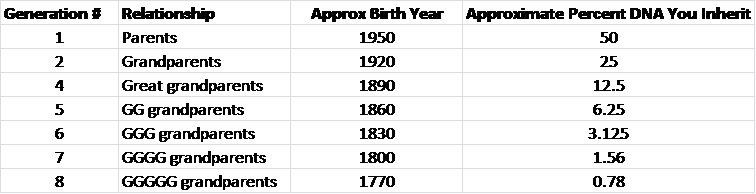
The gist of the actual findings is that Warren’s native American ancestry is less than that of the average American of European origin, and probably somewhere between a possible high of 3% to a low of under 1%. Here’s a chart from this site explaining what a 6th generation back percentage would be; 6th generation is the most recent Native American ancestor Warren might have according to her published results, and it could be as far back as 10th generation.
Here’s the chart:
To put that in further perspective, most non-African people have more Neanderthal ancestry than 1%, and some have more than 3%. In fact, non-African people have a Neanderthal contribution that is “usually somewhere between 1 and 4 percent.”
In addition, here’s what percentages as low as Warren’s generally mean:
In general, DNA showing ethnicity below about 5% is viewed as somewhat questionable and below 2% is often considered to be “noise.”
So Warren’s tests indicate no meaningful Native American ancestry to speak of at all—basically, it’s meaningless noise, and her Native American heritage could easily be even less than that of the average American of European origin, rather than more. And yet she’s trumpeting it, as is the MSM (at least in the headlines, although the fine print might have some caveats).
As for the MSM, it’s become far worse than meaningless noise.
NOTE: Sometimes when I’m bored and get into YouTube surfing, I’ve looked at videos of people opening their DNA results and reacting to them on camera. Often, black Americans state that they’ve been told family legends of having Native American ancestry. Every single video I’ve seen so far features the person who said that opening the results and being surprised at having no significant Native American ancestry at all. I have little doubt that, till that moment, the people involved believed their family legends, which seem rather common. Perhaps that was also originally true for Warren, although she may have just been cynically using the claim to advance her career. But all she had to say was that she believed the family legend and is now learning it’s not true, and I think that would have been the end of it. Instead, she’s apparently trying to prove her ancestry with completely meaningless results.
[ADDENDUM: The Cherokee Nation is not impressed, to say the least:
…Using a DNA test to lay claim to any connection to the Cherokee Nation or any tribal nation, even vaguely, is inappropriate and wrong. It makes a mockery out of DNA tests and its legitimate uses while also dishonoring legitimate tribal governments and their citizens, who ancestors are well documented and whose heritage is prove[n]. Senator Warren is undermining tribal interests with her continued claims of tribal heritage.
Ouch.]
[ADDENDUM II: I used to think that Elizabeth Warren was smart. I disagreed hugely with her politics and her tactics, but long ago she seemed intelligent. I can’t say I’ve been paying all that much attention to her in recent years, but today’s DNA caper seems an indication that if she ever was smart, being in DC so long has caused her to lose whatever savvy she may once have possessed.
In other words, why on earth would she think that releasing these DNA test results would help her cause? On the contrary, the move makes her look like an absolute fool. In doing so, she also robs herself of the “Well, I sincerely thought I was a Cherokee because my family told me that, so it was an innocent mistake” defense. There was nothing mistaken about releasing those tests—she must know they disprove her claims rather than proving them—unless she’s become so stupid she doesn’t even know what percentages mean.
Alternatively, she thinks the American public is abysmally stupid. I certainly hope that particular bet turns out to be wrong.]
“Concerto Barocco” is a Balanchine ballet that was created in 1941 as an exercise for his students. But it is an indisputable masterpiece that seems nearly as fresh today as when it was choreographed. It has the dancers interpreting and reflecting the intricacies of its Bach score without parroting the music slavishly, or doing anything clichéd. The ballet is one of those rare and perfect marriages of music and movement.
The steps themselves are not all that difficult; after all, Balanchine only had students to work with at the time, and technique in general was nothing like as advanced as it later became. The ballet depends on other elements for its beauty and charm: its intense musicality and its inventive, complicated, and somewhat mathematical patterns.
“Concerto Barocco” has been performed by many dancers over the years. As with all ballet choreography, the quality of what the viewer sees—tone, feeling, emphasis, attack, beauty, pace—depends on the dancers of the hour, and not just their technique by any means. I plan to demonstrate that by cueing up the same short segment (about a minute and a half long) done at three different times by different casts so that you can compare and see what I’m talking about. I’m going to show them to you in reverse order of time, to show what we’ve gained and what we’ve lost.
But first here’s a short overview of the role of the corps, which is onstage for the entire 20 minutes of the ballet and dancing up a storm the whole time. Here’s just a little except (a bit over a minute) to show you what I mean, featuring a 2012 version done by the mother ship, the New York City Ballet. As the narrator says: “Hear the dance; see the music”:
Next we have the segment I’m using to compare different versions in different years. It features the two female soloists. I couldn’t find a recent New York City Ballet video that contains this particular passage, so I’ve used the following one, which showcases what appears to be the Paris Opera Ballet. I don’t have the year, but it seems fairly recent (two of the dancers have only very recently retired and one is still performing, so I’m guessing it’s some time between 2005 and 2015). It’s not atypical of the sort of thing you often see today. Here, the solo dancers emphasize their technique and a sort of twisted off-balance esthetic. I’m really not sure what’s going on in terms of what they’re trying to convey, but it’s my least favorite version of the three. I get a sense of strain, stress, and rush, and although they’re dancing on the music they don’t let it flow through them:
This next video is of the New York City Ballet, and it is exceptionally beautiful. It was made in 1966 (a bit blurry, but well worth bearing with that). It features one of the greatest dancers of all time, Suzanne Farrell, when she was 20 or 21 years old. Commentary is almost superfluous here, but I’ll just say that Farrell brings to this (as she brought to virtually all things she danced) a very rare spiritual quality and a spectacular technique that is masked by her exceptional fluidity of movement and her surpassing musicality. She is the second soloist to enter, from the right of your screen, the sweet Apollonian calm in the eye of the storm:
Lastly we have one of the ballet’s very earliest casts. This is Balanchine’s company the New York City Ballet again in 1951, just a few years after the ballet was created. Note the complete absence of strain. Nothing is forced, all is gentle, charming, restrained, and smooth as silk, and yet the movements remain clearly defined (particularly with Le Clercq):
[NOTE: If you want to watch the entire ballet instead of the short segments I’ve selected, just click on the YouTube logo for either the first or the second videos, or both, and you can watch it. Unfortunately, for the third segment, that’s all there is.]
The Democrats thought Brett Kavanaugh was a safe target. Accusing a white prepster named “Brett” would be a great way to achieve several goals: stopping him from changing the balance of SCOTUS in favor of conservatives, and showing solidarity with women and with #MeToo. Who on earth would identify with Kavanaugh except other white preppy guys on the right, and they weren’t going to vote for Democrats anyway, so no great loss.
Well, it turns out that some women are concerned about the men in their lives, too. False accusations can ruin nearly anyone (women included, although I’m not sure how many women consider that aspect).
However, another obvious group that might look at the Kavanaugh hearings and become concerned about what was happening to him is black men. If that sounds counter-intuitive to some people, it certainly doesn’t sound counter-intuitive to me. It occurred to me, while watching the proceedings, that black men might not take too kindly to this little exercise in Believing Women No Matter What.
After all, Clarence Thomas—the man whose position during confirmation for SCOTUS presented the closest analogy to what Brett Kavnaugh faced thirty years later—didn’t call his own hearings “a high-tech lynching” for nothing. Thomas was reminding the country of a terrible past in which black men were lynched not metaphorically but actually, and to whom unspeakable atrocities were committed, merely on the word of a white woman accusing them of rape or other more minor sexual advances. This is not ancient history, either. It is a history that the majority of Americans—and certainly virtually all black Americans—know about.
Why didn’t it occur to Democrats that their approach to Kavanaugh might bother black men as well as white ones? My theory is that Democrats now think so completely along racial lines that it probably wouldn’t occur to them that a black man could identify with something happening to a white man, and a preppy white man at that. That must be why writer Jemele Hill of the Atlantic could write something like this [emphasis mine]:
On Tuesday night, I was in an auditorium with 100 black men in the city of Baltimore, when the subject pivoted to Brett Kavanaugh. I expected to hear frustration that the sexual-assault allegations against him had failed to derail his Supreme Court appointment. Instead, I encountered sympathy. One man stood up and asked, passionately, “What happened to due process?” He was met with a smattering of applause, and an array of head nods.
Hill, who is a black woman (formerly a sportswriter), assumed that these black men would identify with the woman’s story of sexual assault, rather than the man’s story of false accusation. She thought they would accept and perhaps join in with the Democrats’ ridicule and demonizing of Kavanaugh’s rage at being falsely accused.
I’m not a black woman; Jemele Hill is. I don’t pretend for a moment to have my finger on the pulse of the black community or the feelings of black men, and yet I’m not the least bit surprised at their reaction. Anyone with even a smattering of historical knowledge, or a particle of imagination and empathy, should probably have expected it. I am virtually certain that Hill has enough historical knowledge (since I don’t know her, I have no idea about the imagination and empathy part) to have predicted it herself. And yet she did not; her politics blinded her.
David French (a man, but not a black man) has written this piece on the topic, in which he points out that it’s not just knowledge of history that drives this reaction on the part of black men, although that’s part of it. Black men are also the disproportionate targets of a tremendous percentage of the rape and/or sexual abuse accusations today, particularly in Title IX proceedings which have virtually eliminated due process. Between their history of having been lynched (the very definition of the lack of due process) and the reality of being accused of sexual crimes in the kangaroo courts of today’s colleges, is it any wonder that the black man speaking up so “passionately” (Kavanaugh spoke with passion, too) in that meeting Jemele Hill attended was “met with a smattering of applause, and an array of head nods” from the assembled group?
Hill was obviously shocked, however [emphasis mine]:
If you think Kavanaugh receiving some measure of support from black men in inner-city Baltimore is as strange as Taylor Swift suddenly feeling the need to become a modern-day Fannie Lou Hamer, then brace yourself: The caping for Kavanaugh does make a twisted kind of sense. Countless times, black men have had to witness the careers and reputations of other black men ruthlessly destroyed because of unproved rape and sexual-assault accusations.
Why “strange”? And why “twisted”? There’s nothing strange or twisted about it unless your mind is so set along separatist racial and class lines that you think black men can never empathize with the plight of a white man, and vice versa.
Hill continues [emphasis mine]:
Kavanaugh’s emotional defense of his reputation against the claims of a sympathetic white woman resonated with these unlikely allies. And it wasn’t just in Baltimore, at the town hall organized for Ozy Media’s “Take On America” series. This bizarre kinship was something I noticed in my Twitter mentions, too, where black men were tossing out examples of how white lies had wrecked black lives.
“Unlikely.” “Bizarre.” Hill can’t stop being gobsmacked by the common principles that unite this group with Kavanaugh and the obvious similarities. Race and class make it nearly impossible in her mind; that’s all she sees.
And yet she continues to make the case for exactly why these black men would identify with Kavanaugh:
A report released last year, examining 1,900 exonerations over the past three decades, found that 47 percent of the people exonerated were black, despite the fact that blacks make up only 13 percent of the U.S. population. In sexual-assault cases, blacks accounted for 22 percent of convictions, but 59 percent of exonerations.
Hill’s article is titled “What the Black Men Who Identify With Brett Kavanaugh Are Missing.” But basically, she makes a very weak to nonexistent case that they’re missing anything at all. She seems to be saying that because a higher percentage of black men than white men are accused of sexual assault and a higher percentage are convicted or exonerated, that somehow makes a difference and they shouldn’t identify with Kavanaugh. That’s a preposterous argument.
I’ll close with this video I found on YouTube, in which an eloquent black man explains how he feels about what happened to Kavanaugh:
[NOTE: I think the title of this piece would be a good slogan for the GOP to get into the public domain before election day.]