
One of the most chilling aspects of the hatred fanned by the duplicitous reporting on the videotaped incident regarding the Covington students and the 60-something Native American has been the venomous rage directed against the face of one of the students, as well as the conclusions drawn about the expression on the face and what it might signify about the person.
I’ve talked about Orwell before in connection with all of this, and I’m going to bring him up again, because the anger unleashed resembles Orwell’s Two Minutes Hate (although this hasn’t been limited to two minutes at a time). In Nineteen Eighty-Four Orwell wrote of the feeling stirred up in the audience—interestingly enough, by a propaganda film designed for the purpose:
A hideous ecstasy of fear and vindictiveness, a desire to kill, to torture, to smash faces in with a sledge hammer, seemed to flow through the whole group of people like an electric current, turning one even against one’s will into a grimacing, screaming lunatic.
The image that provoked a truly hideous rage in an enormous number of people on the left and some on the right was of a teenaged boy named Nicholas Sandmann, whose statement can be found here along with the video screenshot that seems to have sparked the most outrage:
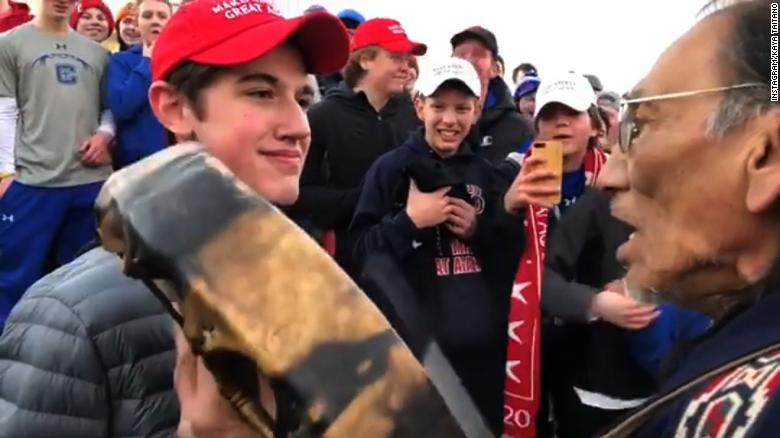
“Bullying” doesn’t even begin to describe what has been done to Sandmann by supposedly responsible and thoughtful adults. Even if the original story of what occurred had been true—and it was most definitely not—the depth of the rage would be way out of line.
Here’s just one example:
That smug, entitled smile is instantly recognizable. https://t.co/rOs0ybXDD5
— Slate (@Slate) January 21, 2019
From the article by Ruth Graham, which shows us what the author is fantasizing based on the manipulated story and video:
I think the real reason the clip has spread is simpler: It’s the kid’s face. The face of self-satisfaction and certitude, of edginess expressed as cruelty. The face remains almost completely still as his peers hoot in awed delight at his bravado. The face is both punchable and untouchable. Many observers recognized it right away.
What is it they “recognized”? A face that is now permissible to hate, apparently; they’re not shy about writing about their hate and signing their names to it. That face is white, male, and supposedly “privileged” (whether they know a single thing about that person’s actual life circumstances or not). I have come to think of it in a kind of shorthand as hatred towards the “frat boy” in their minds. And it’s not new, although I’ve never before seen a national eruption of this hatred expressed towards someone who is not yet an adult.
This hatred is bigoted and prejudiced, pure and simple. The hatred’s origins lie not just in the work the media had undertaken to shape its audience towards feeling this hatred—although that is most definitely part of it—but it also is an opportunity for the viewer to draw in all sorts of historical references to other white men and/or boys they have grown to hate, and to make often-absurd parallels.
Graham obliges by telling us who those other white men she hates might be, the ones Sandmann supposedly resembles and conjures up in her fevered brain [emphasis mine]:
The face is in this photo of a clutch of white young men crowding around a single black man at a lunch counter sit-in in Virginia in the 1960s, and in many other images of jeering white men from that era. The face is the rows of Wisconsin high school boys flashing Nazi salutes in a prom picture last year. The face is Brett Kavanaugh—then a student at an all-boys Catholic prep school—“drunkenly laughing” as he allegedly held down Christine Blasey Ford. Anyone who knew the popular white boys in high school recognized it: the confident gaze, the eyes twinkling with menace, the smirk. The face of a boy who is not as smart as he thinks he is, but is exactly as powerful. The face that sneers, “What? I’m just standing here,” if you flinch or cry or lash out. The face knows that no matter how you react, it wins.
There are hints there of what’s going on in the minds of the haters. A reversal in which the white Sandmann—who actually had been “crowded” by the Native American, Phillips, and was also the object of bigoted racial taunts towards whites from the Black Israelites—becomes falsely identified by Graham with bigoted white aggressors from the past, solely on the basis of their races. Blacks and Native Americans are victims, whites are victimizers, because of the way they look.
The Kavanaugh reference is obvious, and shows the damage done by that entire brouhaha—the stirring up of this same rage against the supposed predations of the “laughing” preppie. Before that, we had the “Jackie” lies in Rolling Stone and the demonization of a fraternity as a result. And prior to that, of course, the Duke lacrosse team falsely accused.
Graham also alludes to more personal origins of this feeling, which for some people at least comes from high school experiences in which some white jock or frat boy was mean to them. That has become a stereotype, reinforced by countless teen flicks and TV shows where this is a stock character. The person is seen as entitled, self-centered, rich, powerful. And hated, well into adulthood.
It’s a pernicious, dangerous game being played here. People such as Graham are now perpetrators who see themselves as the righteous ones. This hatred is growing thanks to the awfulness of Twitter, although it was around long before Twitter ever came to exist. One of the most memorable examples comes from 2003, when TNR’s Jonathan Chait wrote a piece that begins “I hate George Bush” and goes on to say [emphasis mine]:
There, I said it. I think his policies rank him among the worst presidents in U.S. history. And, while I’m tempted to leave it at that, the truth is that I hate him for less substantive reasons, too. I hate the inequitable way he has come to his economic and political achievements and his utter lack of humility (disguised behind transparently false modesty) at having done so. His favorite answer to the question of nepotism—”I inherited half my father’s friends and all his enemies”—conveys the laughable implication that his birth bestowed more disadvantage than advantage. He reminds me of a certain type I knew in high school—the kid who was given a fancy sports car for his sixteenth birthday and believed that he had somehow earned it. I hate the way he walks—shoulders flexed, elbows splayed out from his sides like a teenage boy feigning machismo. I hate the way he talks—blustery self-assurance masked by a pseudopopulist twang. I even hate the things that everybody seems to like about him. I hate his lame nickname-bestowing—a way to establish one’s social superiority beneath a veneer of chumminess (does anybody give their boss a nickname without his consent?). And, while most people who meet Bush claim to like him, I suspect that, if I got to know him personally, I would hate him even more.
There seem to be quite a few of us Bush haters. I have friends who have a viscerally hostile reaction to the sound of his voice or describe his existence as a constant oppressive force in their daily psyche. Nor is this phenomenon limited to my personal experience: Pollster Geoff Garin, speaking to The New York Times, called Bush hatred “as strong as anything I’ve experienced in 25 years now of polling.” Columnist Robert Novak described it as a “hatred … that I have never seen in 44 years of campaign watching.”
Bush, at least, was a grown man and a public figure who had put himself in the limelight. Sandmann is not. And yet the root of the rage appears to be the same.
The people hating on Sandmann ought to be ashamed of themselves, but there is no indication of even a flicker of that feeling. Nor are they likely to damp down their hatred based on the evidence of Sandmann’s innocence.
They know that face, you see, and it’s the face of their enemy.
[ADDENDUM: Some people on the left have been deleting their most rabid tweets, apparently. I would bet a large sum of money that this is because they are afraid of lawsuits. These boys were not public figures, so Sullivan would not apply even for the newspeople.]