I think it’s almost normal for at least one political side to hate a third-party candidate. And it stands to reason that the more appealing the candidate, the more that person will be hated by the side that feels threatened.
It’s commonly believed that third-party candidates cannot win; they can only be spoilers. Under most circumstances that’s true, and although I don’t think it will always be true, I tend to think it’s true of Schultz.
Democrats assume that, as a Democrat-lite, he would siphon off votes for the regular Democratic nominee, since that nominee is probably going to be further to the left than many Democratic voters would like. The Party is afraid that he’ll get some of the independents who hate Trump, too, and therby facilitate the re-election of the dread Trump.
And perhaps that’s the case. I’m not 100% sure of it, simply because there are a lot of Republicans who hate Trump but if it were Trump against, say, Kamala Harris or some other leftish candidate, would hold their noses and vote Trump. But with Schultz in the race, they just might vote for him and lessen Trump’s total.
It’s not even clear that Schultz will run, of course. But the ire on the left is enormous, whereas the right is sort of happy about Schultz.
I can understand this. All I have to do is to remember how I felt back during the 2016 primaries during the time when it seemed that Trump might not get the GOP nomination but might run as a third-party candidate. Remember that? I do. To me, it seemed that if he were to do that, he’d be guaranteeing the election of Hillary Clinton. And I believe that’s exactly what would have happened, but fortunately it didn’t come to that.
Schultz has one characteristic that I personally find appealing, although I’m not planning to vote for him. That characteristic is very simple, and it’s the reassuring sense that he’s not going to do anything too radical and that he loves America. For much of my political life, I felt that way about all the candidates. No more.
[NOTE: There’s long been a question about who Perot hurt most in 1992. But the consensus of the number-crunchers is that he hurt both sides equally and didn’t make that much difference in the end.]
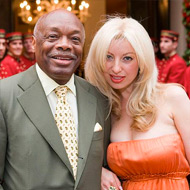
When I met him, Willie [Brown, of San Francisco] was wearing a gold tie collar pin bar something which attaches at the collar and beneath the tie so the knot juts forward.
Is there a standard name for this accessory? The web is not much help.
I could picture it in my mind. I thought I knew what huxley meant. But what on earth was it called? I hadn’t a clue.
But the internet actually is a lot of help. I tried Googling a bunch of things like “men’s jewelry for tie.” But that search kept leading me to tie bars and tie tacks. But I finally hit pay dirt with the very creative (although incorrect; there’s no chain involved) “chain for necktie that makes knot jut forward.”
Which brought me to (drum roll please): the collar pin! And the collar bar! Huxley had it (“collar pin bar something”) and didn’t even know it. There’s also a collar clip.
This guy will solemnly explain it all for you:
As you can see, collar pins had a big heyday in the 1920s and 1930s, as well as a bit of a revival in the 1950s and 1960s. Willie Brown is now 84 years old, having been born in 1935, which means that in his very formative very young years a lot of elegant men still were wearing collar pins, and when he was a young man they were doing it as well.
I think they look mighty sharp, if a man has the inclination to wear one, and the presence to pull it off.
Willie Brown apparently has the inclination—although, try as I might, I could not find a photo of him that clearly shows a collar pin. And Brown most definitely has the panache. In fact, he has long been quite renowned for his style and sartorial elegance.
From a 2010 blog post written by none other than—of all people—Roger Stone, we have this [I corrected some typos]:
From his hand-crafted Brioni suits to his extensive collection of hats, the former California Assembly Speaker could be the best dressed man in America. While most men should avoid brown as a suiting color (Philadelphia brahmin Biddle was once asked why he had over 200 identical bespoke blue suits . “Because brown [the hue, not the person] looks like shit” he replied) Willie Brown pulls it off in both double-breasted and three-piece vested models. As mayor Brown sometimes changed clothes as many as four times a day for his various public ceremonies. A master of color-co-ordination, Brown’s shoes, suit, shirt, necktie and chapeau always complement each other.
And lastly, here is Brown and Sonya Molodetskaya, the girlfriend he’s been with for quite a while:
[Russian refugee] Sonya Molodetskaya was 30 years old when she first met Willie Brown at the restaurant Ana Mandara at Fisherman’s Wharf in 2002. She admitted to San Francisco Magazine that she was engaged to another man at the time, but that night, she was out with friends.
Brown was with Carolyn Carpeneti, the mother of his youngest daughter, at the time. (Their daughter, Sydney, was born in 2001). One of Molodetskaya’s friends knew Brown, and he asked for an introduction.
Molodetskaya and Brown have been together ever since. She told Haute Living in 2018 that she and Brown speak on the phone 5 or 6 times each day…
Molodetskaya has long acknowledged that she did not think Brown was exclusive with her. In 2013, she told San Francisco Magazine, “He was always a playboy. So did he change for me? I don’t think so.”
That San Francisco Magazine interview is from 2013, and it paints a portrait of Molodetskaya that makes you realize why she and Brown are together. She’s pretty audacious herself, has a sense of humor, and is quite the fashion plate. There’s something very forthright about her:
Neither Molodetskaya nor Brown cooks—they typically eat out seven nights a week. Her favorite restaurant is Kokkari; he gravitates to North Beach Restaurant, Waterbar, and Quince. Brown, she says, is “basically going blind” with retinitis pigmentosa, so she reads him the menu. Because his hearing isn’t what it used to be, she reads loudly. What do they talk about? Usually not politics. From the beginning, “he knew I knew nothing about politics. He knew I wasn’t rich, that there was nothing he could get out of me. But he still found subjects of interest to talk to me about. You would think it was just to get me in bed, but 10 years later, it’s still the story.”
That’s quite a track record for a man who writes firmly in his memoir, “I convey to women who are in relationships with me, ‘Because we go out, because we date, because we sleep together, that doesn’t mean there’s supposed to be anything permanent. Do not expect it. Do not demand it.’” In his column, Brown always refers to Molodetskaya coolly as “my friend” or “my lady friend.”
Nevertheless, Wilkes Bashford, Willie’s droll best friend and clothier, says that that’s just Brown talking big…adding that you have only to look at the longevity of the Molodetskaya–Brown pairing to see that there are genuine feelings between them. “C’mon, 10 years tells the story, doesn’t it? They have as much fun now as before. They’ve maintained the excitement and allure. When it really gets down to it, they respect each other.”…
When I approach [Brown] and tell him that I’m working on an article about Molodetskaya, he shrieks in mock disdain: “You are?! Why?” Brown doesn’t like to be upstaged. I ask him for the secret of their longevity. “Ten years ago! Ten years ago!” he repeats, as if he can’t believe it. “I fear the Russian Mafia,” he says, his eyes twinkling mischievously. “She’s a fun lady. She’s really funny.”
And he was attracted to Molodetskaya at Ana Mandara…“Instantly,” he interjects. “Instantly!”
“Instantly what?” Molodetskaya calls over her shoulder from the jewelry counter, where she’s been eavesdropping. “Instantly fall in love with me?”
“No, never!” Brown says. “Attracted, yes. Love, no.”
“I guess our stories are different,” Molodetskaya replies, belting out a belly laugh that carries across the room.
Third-party candidates just about always strike fear into one party more than the other, and it’s the party that figures it stands most to lose. In the case of candidate Howard Schultz, that’s the Democrats.
Schultz is (or was) basically a Democrat, although he knows they won’t nominate him and that has caused him to run as an Independent. Although until now he’s not been a politician, he reminds me in many ways of the sort of Democrat that used to be relatively common in my youth and early adulthood: a mostly moderate one who appreciates America and capitalism’s achievements. And although he’s not especially moderate on social issues, he’s moderate compared to much of the rest of the Democratic Party.
In more recent (although not so recent) years, Bill Clinton took a more moderate tack than much of the rest of the Party when he ran for president as a Democrat. That was part of his political genius; he realized that a Democrat candidate that was too far left wasn’t going to win back then. And he won, big time, although that was at least partly due to his considerable charm (you may disagree about the charm, but a lot of people were susceptible to in, and not just women whose pants he wanted to get into), and partly due to failings of the GOP candidates opposing him.
Steven Hayward of Powerline says this about Schultz’s candidacy and the Democrats:
But even if he can’t win, he might pull the Democratic nominee, whoever z/he is, toward the center. This might seem to risk losing progressive voters, but I’m guessing not much: the progressive left that is agitating for full socialism hates Trump so much that they’ll likely turn out no matter how weak they think the Democratic nominee is.
It is worth noting further just why Schultz is so unacceptable to today’s Democratic Party, with his plain and sensible talk about the debt, deficits, and the fantasy of Medicare-for-All. (By the way, how come nobody ever advocates Medicaid-for-All? Someone ought to ask. . .) Hang around a college campus as I do (so that you don’t have to), you soon discover that the au courant left doesn’t just hate Ronald Reagan, Margaret Thatcher, and the ideas of Milton Friedman and Friedrich Hayek—they also hate Bill Clinton and Tony Blair. Say what?
Will Schultz pull the eventual Democratic nominee to the center? I don’t think so. I think the Democratic nominee will pull to the center in the general, however, but that’s because it always happens. Obama certainly did it, and not just in the general, because most extreme candidates want to hide their extremism until they are safely in office.
What passes for “center” to the Democrats these days, however, is a lot more left than it used to be. I don’t think that certain Democratic contenders can successfully do it, unlike Bill Clinton. Nor do I think most of them will even want to do it, because the Democratic Party has gone so far to the left and their extreme wing is so large and so extreme that pulling to the center really does risk having that large wing stay home.
[NOTE: By the way, Schultz (like Trump) is a New Yorker. Unlike Trump he’s Jewish, which is unusual for major candidates for president. The only one who comes to mind in recent years is Joe Lieberman. And we know what happened to him. Also, in the intervening years, the Democratic Party has become a home for a lot more anti-Semitic politicians that used to be the case.]
The big news is the midwest big chill. It’s really really really cold—although as a person who’s been in the midwest in winter for extended periods of time, I have to say that far-below-zero temperatures aren’t unusual there. But this is record-setting cold even for that region, and it extends over a large area:
Records are being shattered and communities are enduring the harshest cold in years as the polar vortex tightens its grip on the midwestern United States.
After the polar vortex plunged southward, temperatures plummeted under 20 below zero F from North Dakota to northern Illinois on Wednesday morning.
Biting winds made the extreme cold more life-threatening as AccuWeather RealFeel® Temperatures dropped under 50 below zero. Frostbite can occur in mere minutes on exposed skin in these conditions.
Not here in sunny New England. We’ve had what I consider a pretty mild winter so far.
The incendiary story of an alleged hate crime attack targeting Empire actor Jussie Smollett immediately went viral yesterday, with media reporting the attackers made racial and anti-gay comments while using President Trump’s “MAGA” slogan during the 2 a.m. assault in downtown Chicago.
But conflicting versions of the incident from Smollett himself, and details reported by the media being outright contradicted by Chicago Police have raised questions about what actually happened.
Debra Heine noted on the PJ Media last night that police had found surveillance video of Smollett, but had not been able to find video of the alleged assailants.
Many more details of the shifting stories at the link.
If it is a hoax, or at least partly a hoax, those MAGA-hatted perps would be the tell. After all, we now know—thanks to the uproar created by a smiling Catholic teenager wearing one—that a MAGA hat is the new KKK hood. So of course they’re going to be assaulting Smollet while wearing the emblems of their hateful creed.
I had never heard of Jussie Smollet before this incident, which tells you how out of touch I am. I had barely read about this incident before today. And I have no idea what actually happened. But Smollet’s story is appearing fishier by the moment.
One thing I do know is that Smollet hates President Trump (although I think “hate” may be way too weak a word to describe Smollet’s sentiment):
Shut the hell up you bitch ass nigga. You will continue to run this country further into the ground and risk lives every time you breathe. You’re not the president. Just a dumpster full of hate. FOH. Sick to my stomach that literal shit currently represents America to the world. https://t.co/qoNWllmZIm
That plea certainly isn’t being made by me. It’s being made by Monica Hesse, who is something called a “style reporter” at the WaPo.
The reason?:
Our collective consciousness has been raised and so we’ll begin by … excavating one of the candidate’s decades-old love life?
Sigh.
The candidate in question is Sen. Kamala D. Harris (D-Calif.), whose past relationship with former San Francisco mayor Willie Brown was confirmed for the national media when Brown published an op-ed: Yes, they’d dated. And, yes, he “may have influenced her career” by appointing her to two commissions…
We talk about men abusing power. We talk about women not even deserving power. The distinction matters, because the conversation isn’t really about sex, it’s about legitimacy. It’s about who we think has earned the right to be successful, and what criteria we’ll invent, and who we’ll apply it to.
“Maybe we should stop accusing women of ‘sleeping their way’ to the top,” Erin Gloria Ryan wrote in the Daily Beast in 2017. “Maybe because men have been the ones sleeping women to the middle and bottom.”
Ryan was talking specifically about women in the entertainment industry whose reputations were stained by Harvey Weinstein’s predation. But the application is more general, and the pattern is often the same: a talented woman dates a powerful man. And from then on, whether the relationship lasted two decades or two months, her success will be traced back to that man. As if her own hard work were less important than his cameo appearance in her life — as if she were actually the cameo in her own story.
Actually, among the reasons we talk about such things is because they tend to reflect on the person’s morality and ruthlessness, as well as the use they make of their own attractiveness and sexuality to achieve power. In Harris’s case, it is also relevant that Brown was 60 at the time and she was 30, and it becomes difficult if not impossible to imagine that his power—and what he could do for her career—was not the biggest part of any attraction she might have felt for him at the time.
And “dated” is a coy euphemism, by the way, one used by Brown himself but then seconded by Hesse.
Oh, and Brown was married at the time—or, as Hesse coyly writes, “technically still-married.”
She also writes this:
Does it help your career, to date someone powerful? I’d assume so. Does it also help to play golf with someone powerful, or smoke cigars with someone powerful, or belong to Skull and Bones? I’d assume that, too. But for decades we’ve accepted those relationships — many of which benefited only men — as standard procedure for how executives and politicians get ahead.
She only assumes it helps a woman’s career to “date” someone powerful? And does Hesse really mean to equate—on the moral, personal, philosophical scale—playing golf with someone in order to get ahead with having sex with them in order to get ahead? I believe so—at least, if it could help the female candidate most people see as one of the strongest in the 2020 Democratic field. I have a hunch that were Harris a conservative who’d slept with a powerful guy to get some political favors, Hesse would be singing another tune.
By my calculations, Hesse is thirty-six years old (I base that on some information in this article). I would guess that her attitude about sex and women is shared by a large number of her age cohorts, who have learned not only to excuse anything a Democratic candidate does but who also have learned that sex is about as deep an exchange as smoking cigars, and that on any moral plane, smoking a cigar is far worse (especially around other people who might get the stinky secondhand smoke) than loveless sex for mutual exploitation.
Now, Kamala Harris may have genuinely been attracted to Brown. Stranger things have happened, and in fact I ascribe to the idea that—as no less a personage than Kissinger has observed—“power is the ultimate aphrodisiac.” Now, that’s an interesting conversation to have. But so is the one about Kamala Harris’s career. If you can’t stand the heat, get out of the bedroom—and politics.
Ah, but Hesse is worried:
…[T]he only way a woman is ever going to be elected to the top of anything is if we stop making insinuations about how she got there.
So, we cannot judge women for what they do, sexually or otherwise. Even if they’re running for the highest office in the land. Because—well, because if we did discuss them as we discuss men, no woman would be elected to high office. That contention seems to sell women rather short, doesn’t it? But of course what Hesse means is that women are held back from “the top” by unfair discrimination, and they need to receive special dispensation from criticism as a sort of compensation.
And the sad thing is that this sort of reasoning is probably persuasive for a lot of people desperate to get a Democrat elected to the presidency in 2020.
I have no idea whether this is stunning, wonderful news that will come true, or something that will fizzle. It would be tremendously wonderful if it was the former:
A small team of Israeli scientists think they might have found the first complete cure for cancer.
“We believe we will offer in a year’s time a complete cure for cancer,” said Dan Aridor, of a new treatment being developed by his company, Accelerated Evolution Biotechnologies Ltd. (AEBi), which was founded in 2000 in the ITEK incubator in the Weizmann Science Park. AEBi developed the SoAP platform, which provides functional leads to very difficult targets.
Tim Foley turned 20 on 27 June 2010. To celebrate, his parents took him and his younger brother Alex out for lunch at an Indian restaurant not far from their home in Cambridge, Massachusetts. Both brothers were born in Canada, but for the past decade the family had lived in the US. The boys’ father, Donald Heathfield, had studied in Paris and at Harvard, and now had a senior role at a consultancy firm based in Boston. Their mother, Tracey Foley, had spent many years focused on raising her children, before taking a job as a real estate agent. To those who knew them, they seemed a very ordinary American family, albeit with Canadian roots and a penchant for foreign travel…
After a buffet lunch, the four returned home… There came a knock at the door, and Tim’s mother called up that his friends must have come early, as a surprise.
At the door, she was met by a different kind of surprise altogether: a team of armed, black-clad men holding a battering ram. They streamed into the house, screaming, “FBI!” Another team entered from the back…
The two brothers watched, stunned, as their parents were put in handcuffs and driven away in separate black cars. Tim and Alex were left behind with a number of agents, who said they needed to begin a 24-hour forensic search of the home; they had prepared a hotel room for the brothers. One of the men told them their parents had been arrested on suspicion of being “unlawful agents of a foreign government”.
Alex presumed there had been some mistake – the wrong house, or a mix-up over his father’s consultancy work…
But the FBI had not made a mistake, and the truth was so outlandish, it defied comprehension. Not only were their parents indeed Russian spies, they were Russians. The man and woman the boys knew as Mom and Dad really were their parents, but their names were not Donald Heathfield and Tracey Foley. Those were Canadians who had died long ago, as children; their identities had been stolen and adopted by the boys’ parents.
Well worth reading the whole thing.
The story—which appeared in the Guardian—labels the truth as “outlandish” and “defying comprehension.” But I don’t find it the least bit outlandish, although of course (thankfully) most people’s parents don’t lead double lives as ordinary citizens and spies. But that’s what spies do—they deceive. They lie, even (or perhaps especially) to their children (although there’s a tentative indication in the story of at least a possibility that the children did in fact know, and that they themselves are now lying).
A larger question is why this couple had children in the first place. Was it part of their cover as a normal family? Or did they just want children for the usual reasons? They seemed to have loved them, at least according to their sons.
The story makes me wonder whether most spies have children. Of course, some spies decide to go into the spying business after they’ve already had kids (the Rosenbergs might qualify, for example, although I’m not sure at what point they made that decision). But that wasn’t true for this couple; they were already spies when they had their first child.
Well, lo and behold, an article appeared in Psychology Today back in 2010 when this spy story first came out, discussing that very issue:
In this case, there are eight kids whose lives were impacted by dangerously crafted games played by their parents. While the details seem to come directly out of a 1960s Ian Fleming or John le Carre Cold War novel, the reality is it’s 2010 and these kids live in a fast-paced technological world where their faces are spread around the globe in an instant (their names are all over the Internet; I will not use their names). Not like the pre-Web Rosenberg boys, who were eventually lost to obscurity.
All children, at some point, ask the question, “Who am I?” Not only do these kids of Russian spies have to deal with the crimes their parents are charged with, they have to figure out who their parents really are, and in some cases, who they themselves really are. They grew up as all-American kids for the most part with moms making Statue of Liberty cupcakes, picnics with hamburgers and hotdogs, PTA events, “Suburbia 101” as one neighbor described the spy family next door. The painted shutters, the refrigerator magnets and the hydrangeas have now crumbled for these kids like a house of cards.
The article goes on to say that most of the kids are “overachievers” and all the parents seem to have been good parents—except for this one little detail of the magnitude of the deception. Kids can be pretty resilient; I hope these are, but I have little doubt that there will be scars.
[NOTE: This TV series was based at least partly on this incident. I’ve never seen the show.]
[NOTE: We had a discussion here the other day on why leftism, despite its failures, remains so appealing to so many people. I thought it might be time to revisit this post from 2014 on that topic. So here it is, with a tiny bit of editing.]
Communism/Socialism is an idea whose time has always come, ever-fresh and ever-new. It keeps rearing its ugly head wearing a new mask, like some vampire returning in a new guise. But can’t we finally drive a stake through its wretched heart?
In 2014 (but still quite relevant today, if not more so), Robert Stacy McCain wrote an essay describing the latest renaissance of the idea that persists in the face of all empirical evidence to the contrary, and which was correctly critiqued by the economist Ludwig von Mises not long after the Soviets came to power:
In his classic work Socialism, Mises explained that the attempt to replace the market system with central economic planning could not succeed, because the planners could not possibly have the information necessary to make all the decisions which, in a market economy, are made by individuals whose needs and desires are reflected in prices: “The problem of economic calculation is the fundamental problem of Socialism.”
“Everything brought forward in favour of Socialism during the last hundred years,” Mises wrote in 1922, “in thousands of writings and speeches, all the blood which has been spilt by the supporters of Socialism, cannot make Socialism workable. …. Socialist writers may continue to publish books about the decay of Capitalism and the coming of the socialist millennium; they may paint the evils of Capitalism in lurid colours and contrast with them an enticing picture of the blessings of a socialist society; their writings may continue to impress the thoughtless — but all this cannot alter the fate of the socialist idea.”
The rest of the McCain article is worth reading. My response is that this persistence of the idea of socialism/Communism despite evidence of its awfulness when put into practice in the real world should not be at all surprising. And I don’t think we’ll ever find the proper stake to drive into its still-beating heart, because the nature of this beast is that it represents an idea with strong appeal to a vast number of human beings. No amount of empirical or historical evidence can permanently teach enough people otherwise.
The rhetoric of Socialism/Communism has intrinsic appeal to certain groups of people and some members of each group are always likely to fall under its spell: the guilt-ridden wealthy and/or their even-more-guilt-ridden spawn, the poor who feel they’ve been screwed by society, the politically and economically naive intelligentsia who feel they know better than others, the religious and/or idealistic who want everyone to be loving and good and selfless, and those who just like the idea of power and control over others and plan to be the ones in charge.
Combine all that natural appeal with the undeniable propagandist skill of the left—including their willingness to lie in the most brazen manner—and you have an even greater effect. And then combine all of that with ignorance of history and economics, our culture’s reluctance to teach the young our good points and its eagerness to harp on our bad ones, and the fact that people only tend to really learn something through bitter and personal experience.
The wonder is that more people don’t believe that socialism/Commmunism is the answer to the world’s prayers, not that so many succumb to it in the first place. Never imagine that the fight, especially in the intellectual and educational and propaganda spheres, can be over. It would be too bad if each generation had to learn the lesson through personal suffering rather than in the realm of ideas.
Victor Davis Hanson sums up what we now know about the Covington Lie, as he terms it [emphasis mine]:
The entire psychodrama boiled down not to what the facts on the ground showed, but rather who each party was perceived innately to be…
Progressives, NeverTrumpers, identity politics activists and associated social justice warriors all rivaled each other to see who might be the first and the most venomous to indict, try, and metaphorically execute the cookie-cutter whites and privileged…
The key in these Internet lynchings is to get in first and worst—and keep at it. Yet, in French Revolutionary street style, the initial outraged tweeters and posters were almost automatically seen as passe in a nanosecond: Dox the boys. No, write their school to abort their careers. No, go to their schools and protest at their homes. No, punch them. No, burn them alive. No, stuff them into wood chippers…
We have been here before, from the Tawana Brawley farce and the Duke Lacrosse myth to the Ferguson “hands up, don’t shoot” and the University of Virginia fraternity rape yarns—and dozens of staged truth-to-power race and gender mythologies in between. And we know that past purveyors of those lies, whether Al Sharpton, or the Duke faculty, or Rolling Stone, were hardly contrite, but rightly assumed that because such fantasies could be true in a racist society, then they should have been true–and damn the bothersome facts.
Hanson writes that defamation suits for this sort of thing are few and far between, and mostly ineffective. They certainly haven’t stopped this sort of behavior so far, that’s for sure, although I do believe that in this case the suits will be filed and have at least a chance of being found for the plaintiffs. But even so, I doubt it will stop the next similar campaign by the Twitter mob.
Hanson is correct in identifying this m.o. as being of some antiquity; just say the words “Al Sharpton pushes the Tawana Brawley accusations.” It’s all part of the long slow grind by the Alinskyite left, which has—as Hanson later points out—been quite effective:
The progressive cause feels it is close to victory. Big money is now hard left…Universities, the media, Hollywood, professional sports—they are all now progressive. The 2016 election is seen as an aberration, a road bump on the path to utopia. From now on the Left feels it has the material resources and informational clout to construct any reality it wishes. We can see that clear enough, from Phillips’ apologists who never backed down, but instead insisted that the kids’ faces and “attitude” nonetheless exuded privilege and thus culpability.
I hate to be so pessimistic, but that is my strong sense as well. The left smells conservative blood everywhere, and they are in a feeding frenzy. Gaining the House in the 2018 election has been part of what has engendered such a heady feeling on their part, and the ongoing sequential arrests in the Mueller investigation feed the beast as well.
One necessary development for all of this to succeed was the work of academics (including many feminists both inside and outside of academia) who made sure to drive home the message that objective evidence-based logic is an oppressive ploy by white male patriarchy, and that it can be discarded in favor of emotional perceptions combined with racial and gender identity claims [see NOTE below].
Or, as Hanson puts it:
Higher truth is fact free and deals with cosmic justice: people of color confronting whites. End of story.
[NOTE: I noticed some of this elevation of personal feelings over objectivity back when I was in graduate school during the early 90s, as I described here. I didn’t know exactly where it would lead, and at the time I was still a liberal Democrat, but it shocked me and I felt it was a very ominous sign. Here’s the story:
…[T]he young women in an undergraduate class I was required to take for my Master’s—–a class which, being in the social sciences, consisted almost entirely of women—–were virtually all in favor of a definition of actionably offensive speech that went something like this: “speech that offends any person in the subjective sense, rather than speech that is in fact objectively offensive.” In vain I stood up in front of the 100-or-so students, most of them around twenty years younger than I, to ask what the limits of this might be, to suggest that it was wrong to allow the most sensitive among us to dictate what was unacceptable, and to speak up for free speech in general. I was met with uncomprehending stares and impatient dismissal, a fossil in my own time.
I realized that something was terribly, terribly wrong. Not one person appeared to agree with me, or if they did they weren’t saying so publicly or privately. And the professor, a woman just a couple of years younger than I, was clearly on their side. I have never forgotten it, and although at the time I didn’t put it in a political left/right context (that came later), I realized it was a frightening development and it made me feel very, very uneasy and quite alone.
That happened over 25 years ago.]
[ADDENDUM: And the #MeToo movement is part of the elevation of emotion over facts; see this.]
Please note her book’s date of publication: May 1, 2014. Therefore, it had to have been written some time before that—and certainly long before the FBI and the DOJ were engaged in investigating Donald Trump and his aides and acquaintances.
Powell herself immediately got my attention in a way that few speakers do. She was calm and logical, and presented a case so distressing—in particular about Andrew Weissmann, Mueller’s right-hand man, but hardly limited to him—that I was riveted for the entire interview, which I now present here. It may make your blood run cold, if you hadn’t reached that state already:
Powell’s been talking about this for quite some time, too. But don’t sit on a hot stove till the major organs of the MSM spotlight what she’s been saying. An excerpt from that article I just linked, from October of 2017, goes like this [the site interviewing Powell spells Weissmann’s name wrong multiple times, which I’ve corrected]:
“I was holding out hope on Mueller, but as soon as he picked Weissmann, I knew what direction Mueller was going.”
Weissmann was the federal prosecutor in charge of the Enron investigation until complaints about his practices led to his resignation from the case…
Typical of Weissman’s tactics was his pre-dawn July 26 SWAT raid on the home of Paul Manafort, the former chairman of the Trump campaign.
“Mueller knows what Weissmann is about and how he likes to work,” she said.
“I no longer trust Mueller,” she said. “Look at Weissmann’s cases, why choose him to do anything? He should have been disbarred.”
Roger Stone’s pre-dawn arrest is also how Weissmann “likes to work.”
Powell is hardly alone in pointing this out; here’s another person similarly concerned [emphasis mine] [there were more misspellings of Weissmann’s name in this excerpt, too, which I’ve corrected]:
“The integrity of the “investigation” and of the “investigators” must be a paramount priority in our criminal justice system at all times,” said David Schoen, a civil rights and defense attorney, who has been outspoken on the special counsel investigation. “Certainly this fundamental guiding principle must be followed when it comes to an investigation of the duly elected President of the United States. The outcome potentially affects every one of us in very real terms…There were many alternatives to Mr. Mueller and his team and all of their very troubling baggage.”
“(Mueller and Weissmann) were both connected to two of the biggest scandals in FBI history,” Schoen added…
Weissmann, described by the New York Times as Mueller’s ‘pit bull’ was Mueller’s legal advisor for national security in 2005 and later was selected by Mueller to be his General Counsel at the FBI….Weissmann, was a specialist in tracking financing and corruption, was at the time head of the Department of Justice’s criminal fraud section. Mueller saw nobody better than Weissmann to help navigate the murky waters of the investigation and Weissmann was lauded by some and criticized by others, for doing whatever it took to win a case, as reported.
Mueller was also aware of critical issues with Weissmann’s handling of the Enron and Arthur Anderson cases, as well as his involvement in the Eastern District of New York’s case against the Colombo crime family.
Weissmann’s involvement in the Colombo case in the 1990s was the first of many cases that would draw criticism from his peers but this case, in particular, would be one of the FBI’s biggest blunders. As I outlined last month, Judge Charles P. Sifton reprimanded Weissmann for withholding evidence from the defense, as previously reported. Weissmann allowed a corrupt FBI agent to testify against the defendants in the case despite having knowledge that the agent was under investigation. The agent had a nefarious relationship with a reputed underboss of the Colombo crime family, who was accused later of numerous murders, court records reveal…
There would be no one better than Weissmann to do what needs to be done, if your goal is to get Trump and/or those under him, the better to squeeze them. I will close with a movie clip you’ve probably seen before. But it continues to be relevant:
The thing is, plenty of people cut down the law and still do stand upright in the winds that blow. Weissmann certainly has, so far.
And I don’t see anything in his way right now, with the sole exception (perhaps, if we’re very very lucky) of William Barr.