↓
 

The New Neo

A blog about political change, among other things

  • Home
  • Bio
  • Email
Home » Page 714 << 1 2 … 712 713 714 715 716 … 1,934 1,935 >>

Post navigation

← Previous Post
Next Post→

I was thinking this, but he said it better

The New Neo Posted on March 31, 2020 by neoMarch 31, 2020

First we have a comment by “Rufus T. Firefly” about how the media will continue this:

Now the media knows it has a shiny, new toy; viral and bacterial infections that kill primarily elderly and infirm Americans. It’s been around forever. And, like clockwork, ramps up every fall and runs for months. And the media knows a panic might cause another shutdown. This has been a boon for the media. Do you think they will let this go this fall when those red circles start popping up on the map again?

They won’t hit Governors with the data and demand action? “Governor Johnson, there are already 100 deaths in your state and estimates are that number will soar in the next weeks, thousands are likely already infected. Governor Smith has already said he may not accept visitors from your state. Why won’t you act?!”

Then there’s this post by Ace, indicating that the original warning that masks don’t work was probably an attempt to keep the public from purchasing them in such numbers that health care professionals would run out. Now, it doesn’t bother me that people in health care would be prioritized; their need is great. And telling us so would probably cause even more panic. But I also don’t like being lied to.

Posted in Uncategorized | 59 Replies

Media misdirection on COVID-19

The New Neo Posted on March 31, 2020 by neoMarch 31, 2020

When I write “media misdirection,” I’m not just talking about the hate-Trump or the anti-US or the pro-China propaganda, although that is certainly commonplace and damaging as well as purposeful. I’m talking about rather neutral scientific articles such as this one at NPR.

It is titled “Why Germany’s Coronavirus Death Rate Is Far Lower Than In Other Countries,” and the title is at least somewhat true: German’s COVID-19 death rate is lower than in quite a few other countries. But it depends what countries we’re talking about.

Germany’s death rate at present is 8 deaths per million, much lower than Italy (206), Spain (177), France (54), Switzerland (50), Belgium (61), Netherlands (61), and Luxembourg (37). For a developed first-world country, Germany is doing well – so far. But so are plenty of other countries: the US (11), Canada (3), and Norway (7), to mention just a few western ones. And just about every other third-world country (there’s a long long list at the link) has hardly been hit at all. (In my discussion I’m going to leave out China and Iran, because I don’t trust their statistics).

So in summary, Germany is doing quite well so far in terms of death rate, as is the US although NPR doesn’t mention that. Both statistics are expected to go up, of course, but the question is how much, and how much relative to the rest of the world.

And that’s just the title.

However, as the article goes on, it becomes clear that the author is not talking about death rate at all. He’s talking about case fatality rate, which is quite a different thing and is dependent on how many cases have been identified. I wasn’t careful about the terminology distinguishing between the two when I first started writing about COVID, although I understood the difference between the two concepts from the start. But quite some time ago I found it necessary to make my language more precise on that score. Why hasn’t NPR done the same?

The article goes on and on and on in that vein, and explaining how it’s a function of testing. That’s certainly true, but why focus on that measure alone (not to mention why call it by the wrong name)? At this point in time it’s a less meaningful statistic than the actual death rate – deaths per million. And Germany still comes out well ahead on keeping that number low so far.

The article is illustrated by a large photo of people in a park, with the subtitle: “Young people gather in the Volkspark am Friedrichshain in Berlin on March 18. Germany’s fatality rate so far — just 0.5% — is the world’s lowest, by a long shot.” No it’s not. First of all, it’s not a fatality rate, it’s a case fatality rate. But second of all, it’s not even the world’s lowest case fatality rate (forget the “by a longshot). A simple look at this chart and a little work with a calculator will tell you that. For example, South Africa presently has a .3% case fatality rate, Iceland has .17%, and Australia .4%. And there are others.

The article does make this interesting point:

“We have a culture here in Germany that is actually not supporting a centralized diagnostic system,” said Drosten, “so Germany does not have a public health laboratory that would restrict other labs from doing the tests. So we had an open market from the beginning.”

In other words, Germany’s equivalent to the U.S. Centers for Disease Control and Prevention — the Robert Koch Institute — makes recommendations but does not call the shots on testing for the entire country. Germany’s 16 federal states make their own decisions on coronavirus testing because each of them is responsible for their own health care systems.

That’s the opposite of the initial reaction in the US, and I think it matters.

You might wonder why I’m bothering to deal with this article. After all, its misdirection is relatively mild compared with a lot of what we read every day. But it’s interesting to me because it’s subtle, and also because to me it’s a bit puzzling. Why get such a simple thing wrong at this point? Why focus on a less meaningful statistic and never mention a more meaningful statistic? And in this article, there’s not even an obvious anti-US slant – if there is one it’s very mild.

[NOTE: I always get nervous when I write a post with a lot of math and do it super-quickly, which is what happened with this one. That’s especially true when I’m criticizing another author’s errors. But I am relatively sure that my readers will fill me in on any errors I may have made.]

Posted in Health, Press | Tagged COVID-19 | 56 Replies

Comforting images

The New Neo Posted on March 31, 2020 by neoMarch 31, 2020

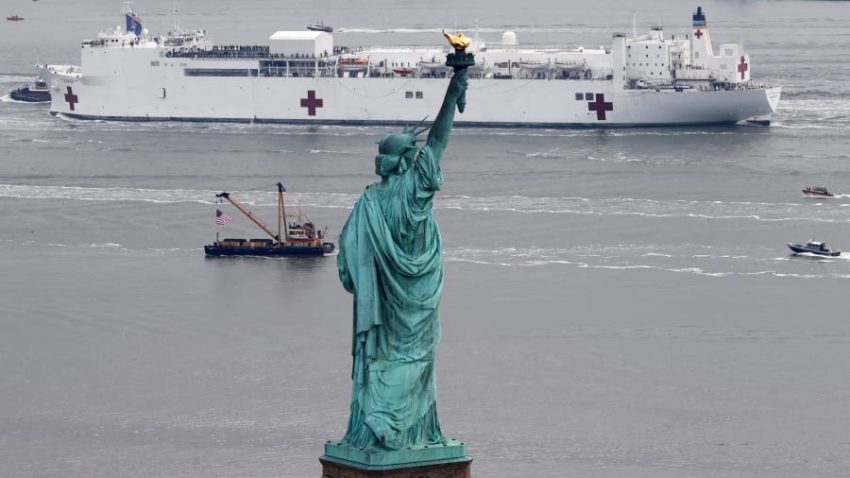
USNS Comfort comes to town:

More photos here.

Those photos conjure up childhood memories for me. I was born a few years after the end of WWII, but in my childhood there was still a lot of war consciousness. My parents spoke of the war at times. War movies were regularly shown on TV, and I watched them all. I doubt I ever saw a large floating hospital sip with big red crosses on it like the Comfort, but nevertheless these photos made me think of the unabashed patriotism and national solidarity of those days.

And New York harbor and the Statue of Liberty always make me think of my childhood.

The last two big crises we’ve had – 9/11 and this – both have had New York City as their center.

Posted in Me, myself, and I, War and Peace | 12 Replies

What we’ve learned so far

The New Neo Posted on March 31, 2020 by neoMarch 31, 2020

Not meant to be an inclusive list. And by “we,” I certainly don’t mean everyone.

(1) China is a bad actor.
(2) Trump was right about China.
(3) Borders are important.
(4) Trump was right about borders.
(5) We need to be more self-sufficient in the manufacture of vital goods.
(6) Trump was right about #5.
(7) Even in a crisis, the press’s top priority is to criticize Trump and the GOP.
(8) Trump was right about #7.

Theoretically at least, a person can dislike Trump intensely and disagree with most of his politics, but the things on the above list would seem to me to be self-evident. So one might think that just about everyone would notice them. WRONG!

Posted in Uncategorized | 52 Replies

Samaritan’s Purse sets up a field hospital in Central Park

The New Neo Posted on March 30, 2020 by neoMarch 30, 2020

What wonderful people:

Kelly will be among a few dozen nurses and doctors from Samaritan’s Purse, a nondenominational evangelical Christian humanitarian organization, working at a field hospital set up in Central Park — across the street from Mount Sinai Hospital — for patients battling COVID-19, the disease caused by the coronavirus. The organization is led by Franklin Graham, the son of Billy Graham.

The field hospital will have 68 beds, 10 of them in a makeshift intensive care unit for patients who need ventilators. It took 48 hours to build and will be operational by Tuesday, said Melissa Nystrom, a spokeswoman for Samaritan’s Purse, which is working with Mount Sinai Health System.

Seventy-two disaster assistance response specialists from Samaritan’s Purse worked around the clock with local volunteers to build the hospital, Nystrom said.

…”I know I’m going to be working in an ICU, and that’s where a lot of the deaths happen, and so, yes, I am prepared for that,” Kelly said. “As prepared as you can possibly be as a practitioner walking into that kind of situation.”

Her previous assignments with the organization have taken her to the Philippines, Ecuador and the Democratic Republic of the Congo and twice to Iraq.

I am in awe of the strength of people who undertake that kind of risk to do that kind of work.

I also wonder whether some people who have contempt for evangelicals will revise their opinions of them on hearing this news.

Posted in Health, Religion | 56 Replies

This seems too good to be true

The New Neo Posted on March 30, 2020 by neoMarch 30, 2020

But I sure hope it is true.

Posted in Uncategorized | 42 Replies

COVID roundup

The New Neo Posted on March 30, 2020 by neoMarch 30, 2020

There are so many good articles around that I despair of doing them all justice with a full discussion, so here’s a short roundup of some of the best or most interesting.

(1) Germany has a plan to start testing people for antibodies to determine who has gained immunity to the virus and therefore can go back out into the world:

The antibodies will indicate that the test participants have had the virus, have healed and are thereby ready to re-enter society and the workforce. The researchers plan to test 100,000 members of the public at a time, issuing documentation to those who have overcome the virus.

The researchers will use the information to determine how to properly end the county’s lockdown, including re-opening schools and allowing mass gatherings.

It’s conducted by a research firm. But there’s something somewhat creepy about a country (especially Germany, I must say) issuing certificates of healing to certain people that allow them safe passage into the world, while everyone else must stay put. I understand the need, but it still gives me the willies. Will we do something similar?

(2) There’s an analogy to be made between Trump’s approach to cutting red tape now and his method for restoring NY’s Wollman skating rink, 34 long and winding years ago. I remember, back when Trump was campaigning for the Republican nomination in 2016 and I was so heavily critical of him, many pro-Trump commenters would point out what he did with the rink. My reply at the time (if I recall correctly) was that it was nice but small potatoes and could not even be remotely compared to the tasks of a POTUS. Well, it was indeed relatively small potatoes, but many of the skills involved are the same, and one big one is the need to cut red tape.

(3) Rhode Island is serious.

(4) The governor of Michigan has been threatening doctors and pharmacists for providing a drug treatment that seems safe and has shown promise. I wonder whether Chuck Todd will ask her one day if she has blood on her hands?

(5) The biggest lesson we actually should be learning is this one, which is that government regulations have crippled our response to COVID. Please read the whole thing.

Posted in Health | 40 Replies

COVID-19: and what of Mexico?

The New Neo Posted on March 30, 2020 by neoMarch 30, 2020

Here’s a good question from commenter “Sharon W”:

Shouldn’t [Mexico’s] numbers be worse than ours, not having enacted any orders and living life in normal fashion? I thought maybe the weather, but I checked Tijuana and it is the same as here in L.A.

Pandemics behave in different ways in different countries and areas of the world, and even in territory within a country. If you look at just the US at present, you can see what I mean. The disease’s effects are mostly concentrated in the NY metropolitan area, with a few other states pretty bad (Washington, Louisiana, Michigan) but nowhere near as bad as NY (and Washington was hit early and hard, and has since leveled off considerably). For all the other states, if we weren’t already alerted to the thing, COVID would barely be a blip on the radar screen. And what of Chicago, one of our largest cities? Why is the number of deaths there from the disease relatively low? And I could point to many other US cities and ask the same question.

You can think of reasons why NYC would be hardest hit: congestion, travel hub, later imposition of social distancing. But I don’t think it really explains all the disparity, although perhaps I’m wrong about that. You can also say – as some prognosticators and politicians do – that NYC is just a forecast of what will happen soon all around the country. And perhaps that’s correct, but I don’t think so and I sincerely hope I’m right in this case. There is little doubt in my mind that things will get worse everywhere before they get better, but how much worse? Hopefully not NYC levels of worse.

As for Mexico – some predict that it will get very bad there [emphasis mine]:

AMLO’s [AMLO is the president’s nickname] advice [no social distancing], experts say, is deadly. What makes matters worse is that his policies over the past few years have set the stage for a profound health crisis. In a major effort to cut government spending, AMLO has reduced funds for the country’s hospitals and medical centers by millions. It’s left the nation short of physicians, medical equipment, beds, and coronavirus tests.

That last part is especially frustrating, because Mexico has been hit hard by outbreaks before. In 2009, the H1N1 influenza was identified, originating in Mexico before it spread around the world, killing about 17,000 people in an initial count. (A 2012 Lancet study estimated there were hundreds of thousands of deaths associated with the disease.) Then, Mexico aggressively tested hundreds of thousands of its citizens to identify clusters of infection and stem the tide against transmission, said Alejandro Macías, the “czar” for the government’s emergency response at the time. “We acted then like South Korea has today,” he told me.

That’s not happening this time. The country has barely tested people, likely accounting for the low official number of 475 cases as of March 26. That comes as millions continued to move freely outside, including tens of thousands who attended a large outdoor festival in Mexico City last week.

So has COVID actually already hit Mexico somewhat, but because there’s little or no testing for it, we don’t know much about it? If a small number (relatively speaking) of people are dying in Mexico from COVID, and if they’re not being tested for it, they will not appear in any statistics unless the numbers finally increase so much that it cannot be ignored.

I hope for Mexico’s sake that doesn’t happen. One thing I can say is that I don’t trust the predictions of experts, either the catastrophic or the milder ones. I just don’t think they know enough at this point to issue anything but a description of possibilities.

Posted in Health, Latin America | 43 Replies

April is…

The New Neo Posted on March 29, 2020 by neoMarch 29, 2020

…the cruelest month.

Or at least, a cruel month. But it’s not really a surprising announcement; I didn’t think the edicts would be lifted as soon as right after Easter.

That line about April being the cruelest month is usually quoted alone, and it’s a great line. But here it is in context:

April is the cruellest month, breeding
Lilacs out of the dead land, mixing
Memory and desire, stirring
Dull roots with spring rain.
Winter kept us warm, covering
Earth in forgetful snow, feeding
A little life with dried tubers.

I have very mixed feelings about T. S. Eliot. On the one hand, I think “The Waste Land” and “The Love Song of J. Alfred Prufrock” are masterpieces, although I don’t much care for his other poetry. On the other hand, he gave us the poems that were the inspiration for the musical “Cats,” and for that it is hard to forgive him.

Posted in Health, Poetry | Tagged COVID-19 | 34 Replies

Songs for our times

The New Neo Posted on March 28, 2020 by neoMarch 28, 2020

You may have noticed that on weekends I often like to post something about the arts. Because everything’s been so COVID-centric lately, this is the song that has been rolling around in my mind. So – merging arts with COVID – we have the old but still very apropos “Keep Your Distance.”

Enjoy! But don’t get too close.

Posted in Uncategorized | 21 Replies

Conversations with friends: “Trump did nothing”

The New Neo Posted on March 28, 2020 by neoApril 8, 2020

Now that we’re all housebound, I find myself talking on the phone to friends more often. Sometimes they’re people I’m not often in touch with, and – since I don’t ordinarily bring up politics in conversation anyway – most of them are people I rarely if ever talk with about politics. However, just about all of them know about my political change and therefore have at least a rough idea of my politics.

Ever since the COVID phenomenon began, though, I’ve noticed that most of them can’t seem to resist dropping quick political statements into the conversation, usually about Trump. These come unexpectedly and are often just a sentence long. They are a sorrowful reminder (although I really don’t need reminding) of the gap between most people I know and me. In this time of loneliness, that makes me feel even more lonely.

I’ve noticed that these statements seem to take one (or both) of two forms. The first one can be summed up as “Trump did nothing and that let coronavirus get a grip here.” The second is “Trump hates science.”

Let me assure you that all these people are very smart in the conventional sense. But they have been Democrats all their lives and they get their news solely from sources such as the NY Times, NPR, CNN, MSNBC, and the New Yorker. Plus, they live in places where the vast vast majority of people they meet agree with them. It occurred to me the other day that I’m probably the only person most of them know who might disagree with them on politics. Or at least, the only one to whom they still talk.

Sometimes I think that what’s happening is just a form of habit. People are used to throwing a few Trump-bombs into the conversation, have everyone nod, and then move on to the next topic. It’s almost like saying “Ummm” or “Uhhh” during a pause in the conversation. So even though my politics are known to them, they may not be trying to start a fight or even a discussion with me. They may just be assuming I’ll agree, because doesn’t everyone?

Even though I realize I will not convince a single person, I usually respond by saying something on the order of “Well, you know, Trump actually did do quite a bit early on” and list things such as the early travel restrictions on China and the appointment of the task force. The task force is especially useful because there are plenty of scientists on it, the better to refute the “Trump hates science and doesn’t believe in it” contention.

But after I state my small piece, there’s usually a silence and then we go on to another topic. It’s treated as though I did something a bit rude but rather minor, like burping loudly in public, something that’s best ignored.

I had originally wanted to end this post with a timeline showing the Trump administration’s actual responses to COVID-19. But I got tired of looking for a site with the information. No matter which search engine I used (although DuckDuckGo was much better than Google), I got inundated with articles saying how awful Trump was and how terribly he’d messed up, rather than an actual list of actions that had been taken.

So I’ve given up for now; perhaps you can find it. The only thing I found – and only through DuckDuckGo – were a few statements such as this one from people already involved in the administration, and this statement by Marc Siegel, a doctor who often comments at Fox. These few positive articles were lost against the vast and concerted effort to say “Trump did nothing, and what he did was awful.”

It’s really quite impressive to see the coordination and scope of the effort to get the word out. And my friends have certainly received the message, loud and clear.

[NOTE: And please don’t tell me to get new friends. Some of the people I’m describing are beloved relatives, and the rest are long-term friends I care about and who cannot be replaced and would be sorely missed. And yes, I do have some friends (and an ex-husband with whom I’m friendly) who are in basic political agreement with me. But they are very much in the minority.]

Posted in Friendship, Leaving the circle: political apostasy, Me, myself, and I, Politics | 147 Replies

Flu vs. COVID-19: worrying about hospital shortages is nothing new

The New Neo Posted on March 28, 2020 by neoMarch 28, 2020

Commenter “Montage” writes:

Covid-19 is not just like the flu, which some want you to believe. In all the years of the flu we didn’t have hospital bed shortages or a worry about the number of ventilators that will be needed.

Here’s the part with which I agree: COVID-19 is not like the flu, at least not exactly. First of all, it’s a coronavirus rather than an influenza virus. That may seem like a nit-picking (or virus-picking) point to make, but it actually matters. The reason is this:

Making vaccines is always challenging. Developing this one is made more difficult because there has never been a vaccine for any type of coronavirus. “We don’t have a production platform, we have no experience in safety, we don’t know if there will be complications. We have to start from scratch, basically,” Krammer says.

It was much easier to make a vaccine for H1N1, known as swine flu, which emerged as a never-before-seen virus in 2009. “There are large vaccine producers in the US and globally for flu,” Krammer says. Manufacturers were able to stop making the vaccine against the seasonal flu and start making a vaccine for this new strain of flu. “They didn’t need clinical trials, they just had to make the vaccine and distribute it,” he says.

We have a lot more experience with the flu in every way. But talking about “flu” as though it’s a single entity is misleading, of course. That’s why there are “bad” flu seasons and “good” ones – that is, strains of flu that become ascendant in a particular year that kill more people or fewer people. The range is fairly wide:

Influenza spreads around the world in yearly outbreaks, resulting in about three to five million cases of severe illness and about 290,000 to 650,000 deaths… Death occurs mostly in high risk groups—the young, the old, and those with other health problems.

In the United States, the range of deaths per year from seasonal flu is between 12,000 and 61,000. Those deaths don’t occur at a rate that’s equal throughout the year, either; they are concentrated in flu season, which doesn’t have a strict calendar beginning and end but tends to be late fall to early spring. Therefore, in a “good” year with 12,000 deaths, I would estimate that during the months of flu season the US death rate from flu is very approximately 2,000 per month, and in a “bad” one it is close to 10,000 per month, with deaths dropping enormously in the other non-flu-season months of the year. Or, the deaths may be more spread out than that, but certainly not evenly distributed among all the months.

That’s a lot of people. That number of people may still be dying of the flu, for all I know, and all the COVID deaths are in addition. But maybe not – perhaps someone here can find some statistics on that.

But those are “regular” flu years. There are pandemic flu years such as 1957, 1968, and 2009:

In the 20th century, three influenza pandemics occurred: Spanish influenza in 1918 ([worldwide] 17–100 million deaths), Asian influenza in 1957 (two million deaths), and Hong Kong influenza in 1968 (one million deaths).

The death tolls from these pandemics in the US were much higher than in ordinary flu years, particularly in 1918. The death toll from 2009’s flu pandemic H1N1 (as estimated by the CDC) ended up being not as bad as originally predicted; it caused the death of between 8868 and 18,306 Americans.

So it actually is highly possible that COVID-19 will end up with a death toll no higher than the toll in a “bad” flu year. Or it could be worse, even much worse. Neither of those possibilities takes in the huge economic toll of the extreme strategies used to combat it, of course. How will we know if they will have been worth it? I suppose some day the number crunchers will analyze the data and come up with an answer, or several competing answers from which you can probably pick and choose. We don’t have a control world to compare it to, where we went on with business as usual.

And now let’s take up the last part of Montage’s statement: “In all the years of the flu we didn’t have hospital bed shortages or a worry about the number of ventilators that will be needed.”

Well, we don’t yet have hospital bed shortages in this country with COVID-19 either, although there’s no shortage of people claiming that we do. But at some point we may indeed have some shortages (as they seem to have in Italy), and we’re planning for that and preparing for that (here’s an example of the preparations).

However, we certainly have worried about hospital bed shortages with the flu in the past. Remember this from October 2009? I didn’t either, but take a look:

If a third of people wind up catching swine flu [H1N1], 15 states could run out of hospital beds around the time the outbreak peaks, a new report warns Thursday.

The nonprofit Trust for America’s Health estimates the number of people hospitalized could range from a high of 168,000 in California to just under 2,500 in Wyoming.

The public health advocacy group used government flu computer models to study how quickly hospitals would fill up during a mild pandemic, like the kind the swine flu — what doctors prefer to call the 2009 H1N1 strain — is shaping up to be.

It based its estimates on the mild 1968 pandemic, suggesting up to 35 percent of the population could fall ill.

Even though only a fraction would be sick enough to be hospitalized, health officials are bracing: When H1N1 first appeared in the spring, more than 44,000 people visited emergency rooms in hard-hit New York City, the report noted. Just sorting out which patients are sick enough to be admitted from the vast majority who need to go home is a big job. And hospital capacity varies widely.

By the outbreak’s peak, the new report suggests Delaware and Connecticut hospitals would fill up soonest. Also on that list: Arizona, California, Hawaii, Maryland, Massachusetts, Nevada, New Jersey, New York, Oregon, Rhode Island, Vermont, Virginia and Washington.

I found a host of articles like that one from 2009. But it never came to pass.

And what of a “regular” flu year? This is from January of 2018, entitled “A severe flu season is stretching hospitals thin. That is a very bad omen”:

A tsunami of sick people has swamped hospitals in many parts of the country in recent weeks as a severe flu season has taken hold. In Rhode Island, hospitals diverted ambulances for a period because they were overcome with patients. In San Diego, a hospital erected a tent outside its emergency room to manage an influx of people with flu symptoms.

Wait times at scores of hospitals have gotten longer.

But if something as foreseeable as a flu season — albeit one that is pretty severe — is stretching health care to its limits, what does that tell us about the ability of hospitals to handle the next flu pandemic?

Good question, eh?

More:

That question worries experts in the field of emergency preparedness, who warn that funding cuts for programs that help hospitals and public health departments plan for outbreaks and other large-scale events have eroded the very infrastructure society will need to help it weather these types of crises…

A dozen years ago or so, government officials placed pandemic influenza preparedness efforts on the front burner because of fears that a dangerous bird flu strain — spreading quickly across Asia at the time — might trigger a catastrophic pandemic…

Then in 2009, the first flu pandemic in four decades did hit. But instead of bird flu, it was a swine flu virus called H1N1. There were not mass casualties…

Pandemic influenza lost its big, bad bogeyman status. And in the years since, budgets for preparedness work have suffered…

Hospital and public health preparedness programs have sustained cuts in the order of about 30 percent in recent years, said Dr. Oscar Alleyne, a senior adviser with the National Association of County and City Health Officials, adding: “The level of funding is a concern to us.”

…A modeling program called FluSurge developed by the Centers for Disease Control and Prevention to help hospitals plan generates some pretty sobering scenarios, he noted. In a bad pandemic, hospitals might have four times more people in need of a ventilator than they have ventilators, and far too few intensive care beds for the seriously ill.

“So there would be a big mismatch between demand for care, lifesaving care, and the ability to provide it,” Inglesby said. “We would have a huge problem in this country.”

…Getting help from elsewhere — as a community will often do in the case of a major medical disaster — isn’t really an option during flu epidemics, because other places are either dealing with their own or steeling themselves for a wave that’s about to hit.

Please read the whole thing.

Posted in Health, History, Politics | 45 Replies

Post navigation

← Previous Post
Next Post→

Your support is appreciated through a one-time or monthly Paypal donation

Please click the link recommended books and search bar for Amazon purchases through neo. I receive a commission from all such purchases.

Archives

Recent Comments

  • Art Deco on Trump says his deportation program might have been too tough
  • Sharon W on This type of ed is special, all right
  • Barry Meislin on Open thread 11/10/2026
  • Barry Meislin on Open thread 11/10/2026
  • Barry Meislin on Open thread 11/10/2026

Recent Posts

  • The refinery issue
  • This type of ed is special, all right
  • Open thread 11/10/2026
  • Trump says his deportation program might have been too tough
  • Worldwide “anti-Zionism” – trolls and others

Categories

  • A mind is a difficult thing to change: my change story (17)
  • Academia (330)
  • Afghanistan (98)
  • Amazon orders (6)
  • Arts (8)
  • Baseball and sports (164)
  • Best of neo-neocon (91)
  • Biden (536)
  • Blogging and bloggers (599)
  • Dance (292)
  • Disaster (244)
  • Education (329)
  • Election 2012 (360)
  • Election 2016 (566)
  • Election 2018 (33)
  • Election 2020 (514)
  • Election 2022 (114)
  • Election 2024 (403)
  • Election 2026 (125)
  • Election 2028 (14)
  • Evil (130)
  • Fashion and beauty (324)
  • Finance and economics (1,054)
  • Food (319)
  • Friendship (48)
  • Gardening (18)
  • General information about neo (4)
  • Getting philosophical: life, love, the universe (737)
  • Health (1,169)
  • Health care reform (546)
  • Hillary Clinton (184)
  • Historical figures (338)
  • History (719)
  • Immigration (452)
  • Iran (467)
  • Iraq (227)
  • IRS scandal (71)
  • Israel/Palestine (836)
  • Jews (445)
  • Language and grammar (365)
  • Latin America (216)
  • Law (2,997)
  • Leaving the circle: political apostasy (125)
  • Liberals and conservatives; left and right (1,335)
  • Liberty (1,119)
  • Literary leftists (14)
  • Literature and writing (394)
  • Me, myself, and I (1,523)
  • Men and women; marriage and divorce and sex (935)
  • Middle East (385)
  • Military (327)
  • Movies (355)
  • Music (534)
  • Nature (262)
  • Neocons (32)
  • New England (185)
  • Obama (1,740)
  • Pacifism (16)
  • Painting, sculpture, photography (132)
  • Palin (93)
  • Paris and France2 trial (25)
  • People of interest (1,051)
  • Poetry (259)
  • Political changers (179)
  • Politics (2,797)
  • Pop culture (397)
  • Press (1,636)
  • Race and racism (885)
  • Religion (431)
  • Romney (164)
  • Ryan (16)
  • Science (642)
  • Terrorism and terrorists (983)
  • Theater and TV (266)
  • Therapy (71)
  • Trump (1,638)
  • Uncategorized (4,634)
  • Vietnam (109)
  • Violence (1,465)
  • War and Peace (1,035)

Blogroll

Ace (bold)
AmericanDigest (writer’s digest)
AmericanThinker (thought full)
Anchoress (first things first)
AnnAlthouse (more than law)
AugeanStables (historian’s task)
BelmontClub (deep thoughts)
Betsy’sPage (teach)
Bookworm (writingReader)
ChicagoBoyz (boyz will be)
DanielInVenezuela (liberty)
Dr.Helen (rights of man)
Dr.Sanity (shrink archives)
DreamsToLightening (Asher)
EdDriscoll (market liberal)
Fausta’sBlog (opinionated)
GayPatriot (self-explanatory)
HadEnoughTherapy? (yep)
HotAir (a roomful)
InstaPundit (the hub)
JawaReport (the doctor’s Rusty)
LegalInsurrection (law prof)
Maggie’sFarm (togetherness)
MelaniePhillips (formidable)
MerylYourish (centrist)
MichaelTotten (globetrotter)
MichaelYon (War Zones)
Michelle Malkin (clarion pen)
MichelleObama’sMirror (reflect)
NoPasaran! (bluntFrench)
NormanGeras (archives)
OneCosmos (Gagdad Bob)
Pamela Geller (Atlas Shrugs)
PJMedia (comprehensive)
PointOfNoReturn (exodus)
Powerline (foursight)
QandO (neolibertarian)
RedState (conservative)
RogerL.Simon (PJ guy)
SisterToldjah (she said)
Sisu (commentary plus cats)
Spengler (Goldman)
VictorDavisHanson (prof)
Vodkapundit (drinker-thinker)
Volokh (lawblog)
Zombie (alive)

Meta

  • Log in
  • Entries feed
  • Comments feed
  • WordPress.org
©2026 - The New Neo - Weaver Xtreme Theme Email
Web Analytics
↑