↓
 

The New Neo

A blog about political change, among other things

  • Home
  • Bio
  • Email
Home » Page 708 << 1 2 … 706 707 708 709 710 … 1,934 1,935 >>

Post navigation

← Previous Post
Next Post→

Israeli politics: the headline tells the tale

The New Neo Posted on April 20, 2020 by neoApril 21, 2020

[See UPDATE below.]

Here it is: “Reports Fly That Unity Government Is Imminent: Earlier Reports Indicated Collapse.”

That makes it all crystal clear, doesn’t it?

Contradicting earlier reports that coalition talks had collapsed, Israeli media now reporting that an agreement between the Likud and Blue and White parties is imminent.

The Times of Israel is reporting that Israeli television reported that the last sticking point – the issue of judicial appointments – has been resolved and an agreement is imminent.

Blue and White is set to hold a meeting on a coalition agreement soon.

Earlier in the day, it appeared that Israel was headed to a fourth election in a little more than a year.

Can you imagine? Four elections in a year?

Another reason I’m glad we don’t have a parliamentary system.

UPDATE: It’s a deal. The coalition is in place:

As part of the deal, Prime Minister Benjamin Netanyahu, who has served as caretaker prime minister since December 2018, will remain prime minister for another 18 months and then will be replaced in October 2021 by Blue and White leader Benny Gantz, who will serve as vice prime minister in the meantime. Netanyahu will become vice prime minister under Gantz after that – but if he leaves the Prime Minister’s Office sooner, Gantz will take over…

“We prevented a fourth election,” Gantz said. “We will protect our democracy and fight against the coronavirus.”

US President Donald Trump’s peace plan, including its clauses enabling Israel to apply sovereignty in Judea and Samaria, will be able to be implemented in July, when maps are set to be finalized.

It’s complicated, of course:

The government is expected to have 36 ministers and 16 deputies, split equally between the Center-Right and Center Left. Besides Likud and Blue and White, the government will include Shas, United Torah Judaism, Labor and the Gesher Party of MK Orly Levy-Abecassis.

Posted in Israel/Palestine, Politics | 17 Replies

What we’ve learned from COVID-19 so far

The New Neo Posted on April 20, 2020 by neoApril 20, 2020

Aside from a crash course in Epidemiology 101 and terms like “flatten the curve”?

Here’s a list:

Top Ten Surprising Consequences of Covid-19 Hysteria:

1: Democrat governors rediscover federalism.
2: Wanna-be totalitarians can’t help but unmask themselves.
3: Trump gets a daily platform to smack the media around (watched by millions).
4: The CDC is exposed as just another dysfunctional gov. agency.
5: FDA, same as above.
6: WHO, same as FDA, CDC.
7: The US media is in China’s pocket.
8: “Models” completely useless except to frighten citizens.
9: We now know Nancy Pelosi has a $24,000.00 fridge.

And the 10th most surprising consequence of the Covid-19 hysteria? Donald Trump was right about China the whole time, and everybody who didn’t know it before knows it now.

Not all are surprising, in my estimation. In fact, I’m not sure any of them are.

And actually, about #9, we’ve learned that Nancy’s got two fridges, each of which I’m told probably cost somewhere between 15K and 20K. But we already knew she was extraordinarily rich. So if we thought about her fridges at all, we should have assumed they’d be multiple, huge, and top-of-the-line.

I think there’s an eleventh thing we’ve learned, also not really a surprise. But it’s been informative to see it revealed so quickly:

The coronavirus now has put the European Union and its comfort zone face-to-face with all its weaknesses, decadence and cowardice…

When Italy called for solidarity from its European neighbors, they declined…

Because of the coronavirus, Europe’s Schengen Area of passport-free travel inside the EU — one of the two pillars of EU dogma (the other being the euro) — was suspended in a hurry and internal borders closed without coordinated action. During the the first two weeks of March, nine countries closed their borders; followed by the partial closure of Germany’s borders. The EU then announced the closure of its external borders for 30 days.

“Do you not understand the emergency we are going through?”, Spain’s prime minister, Pedro Sánchez, asked German Chancellor Angela Merkel during one of the EU’s latest summits…

A report by the Bertelsmann Foundation found that Germany, which accounts for more than a quarter of the eurozone’s economic output, benefited most from the EU’s single market, earning an extra 86 billion euros a year because of it. It is likely this financial bonus that now helps Germany in contending with the epidemic. Germany had 25,000 ventilators; France had only 5,000, and Italy was forced by a lack of ventilators to make agonizing decisions about whom to treat. “Wouldn’t European solidarity mean Germany deliver [sic] at least some of the new ventilators to countries that currently need them most?”, asked Die Zeit’s journalist Jochen Bittner.

Among the European states, however, even faster than empathy and solidarity, spread bitterness and resentment.

You might say that, considering the controversy about the effectiveness of ventilators in treating COVID patients having trouble breathing, the shortage of ventilators in Italy may not have been as detrimental as initially thought. But some patients do seem to need them and be helped by them; the problem is figuring out which ones. At any rate, when Italy was being refused those ventilators, they were thought to be absolutely vital to the survival of the more critical patients.

I have often wondered how anyone could think the EU could overcome the nationalism of its various countries, after centuries of separateness. There are reasons for nation-states, and there is separate history as well as separate culture and economic strength. I don’t think most people much like being dictated to by a distant group of bureaucrats, and the more distant, the less they like it.

Posted in Politics | Tagged COVID-19, European Union | 88 Replies

Memoir: the whole truth and nothing but?

The New Neo Posted on April 18, 2020 by neoMay 2, 2020

Memoir is a strange genre of writing. It’s not always good, but when it’s good, it’s very very good. Two examples of which I’m very fond are Nabokov’s magnificently written Speak, Memory and Updike’s remarkable Self-Conciousness.

They may not be to your taste, but they certainly are to mine. Both writers are incredible and impeccable prose stylists. Both books are somewhat peculiar for memoirs in that they don’t aim to tell the story of the authors’ lives. Perhaps both Nabokov and Updike realize that is futile, because we only get a controlled snapshot in any memoir anyway. So they don’t even try; each book is a series of somewhat discrete vignettes, and although both have revealing passages, each man keeps the secrets of his inmost heart well-hidden.

I recently discovered that a women who was a very good friend of mine for years – we’ll call her Linda – has written a memoir. Linda’s a good writer, something I know because we used to be in a writing group together. She also has an extraordinary story to tell, which I also know because for years I was a confidante of hers. So I was looking forward to reading the memoir, realizing the story would probably be both well-written and intensely familiar to me.

I bought it and read it. You’ll see in a moment why I’m not going to give you the link, or tell you her real name.

As I said, I know Linda’s story very well. Do I know everything that ever happened in her life? Of course not. But I know the story she is writing about, which involves a series of tragic and improbable circumstances that she managed to survive. There are probably at least four or five intertwined main threads to her tale, some involving relatives, boyfriends, husbands, and acts of nature.

But the book deals with only one part of the story and ignores all the others, even though they are closely linked and dependent on each other to give the story its full and astounding depth.

I haven’t spoken to her yet about it. We haven’t talked in a couple of years, although there was no estrangement between us. I’m not sure whether or not to ask her why? Why leave out the parts of the story that make it so unique and so incredible?

I may already know the answer, though. Some of the parts that were left on the cutting room floor reflect poorly on other people. Some may even reflect poorly on my friend herself. But without them, although the book is good, to me it seems a shadow of what it might have been.

Writers of memoir (or even the sort of fiction that is thinly-disguised memoir) face a dilemma about how much to reveal, particularly if the truth might hurt someone. Some writers are ruthless and don’t care at all. Some shy away from the genre entirely. And some, like my friend, choose a middle position – one that may harm the work. Or it may give it more artistic cohesiveness.

Apparently my friend thought her heavily-expurgated story was still worth telling. Her publisher thought so, too. And I think they’re right. But I read the book looking for the things that were missing, and missing the things that I was looking for.

Tell all the Truth but tell it slant —
Success in Circuit lies
Too bright for our infirm Delight
The Truth’s superb surprise

As Lightning to the Children eased
With explanation kind
The Truth must dazzle gradually
Or every man be blind —

Posted in Getting philosophical: life, love, the universe, Literature and writing, Me, myself, and I, Poetry | 72 Replies

To ventilate or not to ventilate?

The New Neo Posted on April 18, 2020 by neoApril 18, 2020

That is the question – or at least a question, and a big one – that doctors treating COVID-19 face. Some say the usual protocols for ARDS (acute respiratory distress syndrome) should be followed. Some say no. And some say sometimes.

It’s a dilemma doctors face in real time while trying to save patients:

I don’t have the medical background to evaluate the question and have an informed opinion on which mechanism is dominant with COVID-19, although I’ve read quite a few articles on the subject and it seems important for medical people to answer it in order to get the best treatment possible. What a strange beast this virus is!

Here’s a summary of the quandary:

An oxygen saturation rate below 93% (normal is 95% to 100%) has long been taken as a sign of potential hypoxia and impending organ damage. Before Covid-19, when the oxygen level dropped below this threshold, physicians supported their patients’ breathing with noninvasive devices such as continuous positive airway pressure (CPAP, the sleep apnea device) and bilevel positive airway pressure ventilators (BiPAP). Both work via a tube into a face mask.

In severe pneumonia or acute respiratory distress unrelated to Covid-19, or if the noninvasive devices don’t boost oxygen levels enough, critical care doctors turn to mechanical ventilators that push oxygen into the lungs at a preset rate and force…

The question is whether ICU physicians are moving patients to mechanical ventilators too quickly. “Almost the entire decision tree is driven by oxygen saturation levels,” said the emergency medicine physician, who asked not to be named so as not to appear to be criticizing colleagues.

That’s not unreasonable. In patients who are on ventilators due to non-Covid-19 pneumonia or acute respiratory distress, a blood oxygen level in the 80s can mean impending death, with no room to give noninvasive breathing support more time to work. Physicians are using their experience with ventilators in those situations to guide their care for Covid-19 patients. The problem, critical care physician Cameron Kyle-Sidell told Medscape this week, is that because U.S. physicians had never seen Covid-19 before February, they are basing clinical decisions on conditions that may not be good guides…

In a letter last week in the American Journal of Respiratory and Critical Care Medicine, researchers in Germany and Italy said their Covid-19 patients were unlike any others with acute respiratory distress. Their lungs are relatively elastic (“compliant”), a sign of health “in sharp contrast to expectations for severe ARDS.” Their low blood oxygen might result from things that ventilators don’t fix. Such patients need “the lowest possible [air pressure] and gentle ventilation,” they said, arguing against increasing the pressure even if blood oxygen levels remain low. “We need to be patient.”

“We need to ask, are we using ventilators in a way that makes sense for other diseases but not for this one?” Gillick said. “Instead of asking how do we ration a scarce resource, we should be asking how do we best treat this disease?”

And then there is the hemoglobin-attack debate. It’s another highly technical question, so I’ll pass on the details, but here’s an article that’s critical of the theory. Make of it what you will.

I will add that I have a personal interest in this question because I have a defect – or at least, an anomaly – of one of the two genes that determine beta hemoglobin, since I’m a carrier of beta thalassemia. I haven’t a clue whether or not that affects my chances with COVID-19, but it certainly might. And yet I haven’t seen a particle of research on the subject of COVID and thalassemia trait or sickle cell trait, both of which are fairly common as mutations go. Both protect to a certain extent against malaria, by the way – not that I’m going to wade into a malarial swamp to test it.

[NOTE: I don’t know whether this article from 2015 is relevant, because (once again) it’s very technical and I find it quite impenetrable. But it may be dealing with a similar hemoglobin question, this time related to ARDS.]

Posted in Health | Tagged COVID-19 | 55 Replies

Neo’s all-purpose shutdown soup

The New Neo Posted on April 18, 2020 by neoApril 18, 2020

I made this soup a while back and ate it day after day for almost a week. That sounds terrible, but the thing that was so great was that I didn’t tire of it.

The challenge of what to eat during the shutdown is formidable for me, because ordinarily I shop every other day or so. I like to decide on the spur of the moment what appeals to me, and I like fresh produce.

Now, food shopping has to last at least two weeks and maybe three. I don’t especially want to make extra grocery store trips just for my own amusement. I try to plan ahead, and the biggest challenge is pacing myself. The fresh food goes first, of course; don’t want to waste anything.

This soup is versatile. You may hate it or love it or be indifferent to it, but I like it and I think it fits the nutrition bill quite nicely. It’s based on a Moroccan soup called harira, but it’s my own variation on the theme. You can find tons of recipes online, but here’s what I do.

To taste, as you wish: saute chopped onions and garlic in oil. Stir in spices, also as you wish, but I use lots of cumin and also some coriander (the spice), cardamon, cinnamon, salt and pepper. Add chopped carrots and celery, and stir till everything is somewhat soft. Then add lentils and water (you’ll have to gauge the amounts for yourself; I just do it by eye, and you can add more water later if needed). You can add saffron threads, if you like.

At some point I also add some sort of meat; either chicken or hamburg or ground lamb or stew meat. Not too much of it because this is mainly a lentil soup. Cook till the lentils are soft. Then you can add chopped tomatoes (not necessary, but good), and lots of cut up greens. I like chard or baby spinach. If you like chopped cilantro that’s good too. And if you prefer spicy food, you can add cayenne or even tabasco. Cook till the greens are done.

You can see that this is a big soup that’s an entire meal. I don’t have a photo because it’s not much to look at.

Oh, and when you get around to eating it, you also can add a little lemon juice or red wine vinegar to the bowl to give it some added zing.

Posted in Food, Me, myself, and I | 26 Replies

Late start today…

The New Neo Posted on April 18, 2020 by neoApril 18, 2020

…but I’m here.

I had a couple of long talks with family and friends. Now, to work.

Posted in Uncategorized | 4 Replies

Cutting my own hair

The New Neo Posted on April 17, 2020 by neoApril 17, 2020

I’d already been due for a haircut when the whole COVID thing hit – in fact, overdue. I have the sort of hair that’s hard to cut well, and so I’d been putting it off.

Turns out that wasn’t the greatest of ideas. Of course, it doesn’t really matter how I look because it’s not as though the world sees much of me right now. But I have to look at myself in the mirror, and I’m also tired of looking really wild when I go out for my walks and pass people from 6 feet away.

When I was a teenager I had a little business cutting the hair of friends in both high school and college. I also cut my own hair for years and years. It was easier back then. I sported mainly a blunt cut, and then set it on rollers, and it always looked fine.

Now it’s more challenging. There’s more curl and more layers and a far more complex arrangement, although rollers are no longer involved.

But I didn’t do a half bad job, if I do say so myself.

My scissors was smaller than his:

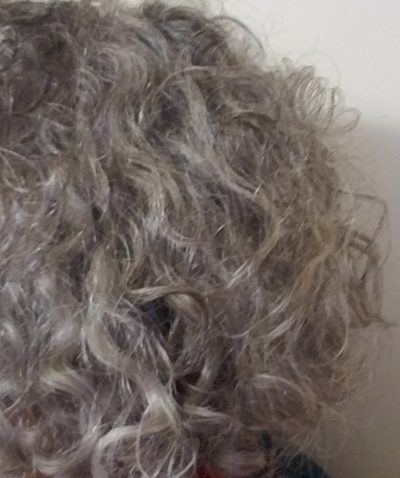
Here’s a photo of the back of my hair. No apple necessary. The back’s the hardest to cut yourself, especially without a mirror.

Don’t be too cruel.

Posted in Fashion and beauty, Me, myself, and I | 68 Replies

The second wave…

The New Neo Posted on April 17, 2020 by neoApril 17, 2020

…in Hokkaido.

It stands to reason that there would be a second wave. This is especially true if the first one was clamped down so quickly – as in Hokkaido – that few people gained immunity.

I trust the figures from Japan. Not so from China, but for what it’s worth, the Chinese have revised their death numbers:

China’s state-run media on Friday reported that the death toll in the city of Wuhan — the initial epicenter of the coronavirus pandemic — was off by almost 1,300 due to lapses in reporting.

The new numbers raised the total number of deaths in the central Chinese city by more than 50 percent to 3,869 and took the national death toll to 4,632.

Many American lawmakers, including President Trump, have speculated that China had been covering up its true number of COVID-19 deaths, but Beijing on Friday denied that the misreporting was part of a cover-up, Reuters reports.

I don’t think anything China says should be believed. They have forfeited any trust they might otherwise have had, which wasn’t all that much to begin with.

Posted in Health | Tagged China, COVID-19 | 20 Replies

Old codgers with pre-existing conditions

The New Neo Posted on April 17, 2020 by neoApril 17, 2020

We keep reading that COVID-19 kills mostly the old and infirm. Except, from where I sit, a person doesn’t have to be so very old or infirm to be in those categories.

Yes, the disease kills a lot of very debilitated extremely elderly people in nursing homes, the same group that has a high death rate every year from “ordinary” seasonal flu. But COVID also seems to kill younger old people in fairly high numbers, and those with rather common pre-existing conditions such as obesity, asthma, cancer, diabetes, heart disease, and hypertension.

At least, that’s what we’ve been led to believe so far. But it’s not easy to get good statistics. For example (and I’ve mentioned this before) a lot of people over 60 have one or even several of those conditions. Are we just talking about age being the real factor? Are people over 60 with those conditions dying in higher percentages than the frequency of the conditions in the general over-60 population?

Just taking one of these conditions, we hear about obesity. But it turns out that preliminary research indicates that obesity is a factor only in the group younger than 60 years of age. That’s – interesting.

There’s also asthma, which originally was listed as a risk factor and the most recent data from NY is now indicating that it is not an extra risk factor, although this may seem counter-intuitive.

This article at Vox is one of few I’ve found that looks at age more carefully, and discusses age decade by decade – up to a point. That point is reached at 70, when it lumps everyone over 70 into a single category. I find that quite unhelpful.

However, for ages 50-60, the article contains this useful information:

Almost half of Americans ages 55 to 64 have at least one preexisting condition, according to the Kaiser Family Foundation.

Those numbers are only going to increase as people get older.

Most of the data on age and COVID deaths is expressed in terms of what percentage of cases in each age group die (case fatality rate). Although it may exist somewhere, I have yet to see what I’m really looking for: what percentage of all COVID deaths occur in each age group.

I did find this:

Among the 105 patients who had died in Italy as of March 4, two-thirds had three or more preexisting conditions. The most common was hypertension, followed by ischemic heart disease and diabetes mellitus.

That’s a small group, but it bears out what I’ve suspected: it’s often a combination of pre-existing conditions rather than a certain condition on its own that increases the risk so dramatically. The study cited and linked to is in Italian, so I’m not going to tackle that right now.

And here’s an invitation to you to attempt to answer some of these questions if you can find relevant studies that I haven’t been able to find. Or even to ask more questions.

Posted in Health | Tagged COVID-19 | 40 Replies

They’re all here for me

The New Neo Posted on April 17, 2020 by neoApril 17, 2020

I get several emails every day that chorus, “We’re here for you!”

The pharmacy, the grocery store, Walmart, my doctors, the hairdresser I went to briefly ten years ago, ditto a trainer and physical therapist. The universities I attended in the distant past, which weren’t really even there for me back then, I’m afraid.

But all of them are here for me now. And even though some of it seems ridiculous – my alma matres, really? – much of it is very real. My supermarket is there for me, with stockers and clerks increasing their own risk in order to serve the public. Doctors and nurses and the local hospital – they are brave souls. Even the pizza delivery driver I sometimes see in the neighborhood, wearing a mask and gloves these days, is performing a yeoman’s task in being there for me and for you.

I haven’t ordered a pizza, though. I would probably just scarf it down. Best to keep the eating as light as possible to avoid the weight gain that a lot of my friends are complaining has happened to them.

Posted in Me, myself, and I | Tagged COVID-19 | 16 Replies

What did the FBI know and when did they know it? Plenty, and early.

The New Neo Posted on April 16, 2020 by neoApril 16, 2020

No surprise here:

Additional information released on Wednesday shows exactly when in 2017 the FBI received evidence that Russian intelligence operatives fed Steele with disinformation.

The FBI obtained information on Jan. 12, 2017, two days after BuzzFeed News published the dossier, Steele’s allegation that former Trump lawyer Michael Cohen visited Prague in August 2016 was likely the product of Russian disinformation.

The FBI received evidence on Feb. 27, 2017 that Russians may have fed disinformation to Steele regarding his most explosive claim: that Donald Trump used hookers during a 2013 trip to Moscow. (RELATED: The FBI Knew The Steele Dossier Contained Russian Disinformation Three Years Ago — And Somehow That Never Leaked)

The footnotes declassified on Wednesday say that the FBI’s Transnational Organized Crime Intelligence Unit sought a validation review of Steele as an FBI source in 2015 because of his links to five Russian oligarchs.

The footnote says that the FBI unit found that five Russian oligarchs who sought meetings with the FBI that year had intermediaries who contacted Steele.

I doubt many people are paying attention to this, with COVID-19 dominating everything. And even if there was no pandemic, I very much doubt the news would make a particle of difference to most (perhaps all) of the Trump opposition.

Posted in Election 2016, Trump, Uncategorized | Tagged FBI, Russiagate, Steele dossier | 38 Replies

Using “history” to push the continuation of social distancing

The New Neo Posted on April 16, 2020 by neoApril 16, 2020

Some people clearly want draconian forms of social distancing to go on and on and on. Some of them probably say this from fear. Some of them probably say it because of a desire to control people. Some of them are merely following those epidemiologists who advocate it.

And some are quoting misinformation such as this, which I’ve seen floating around lately here and there. It’s rather typical of the sort of thing one often sees on social media:

People grew sick of the social distancing measures as they dragged on into the summer of 1918. When the Great War finally ended in late November, people took to the streets to celebrate their good fortune. In the coming weeks, the second wave of the pandemic killed more people than the war. It’s not a game…

Let’s take this point by point.

The Great War didn’t end in late November; it ended on November 11, 1918. But when did the parades occur? Well, in a quick search, I found this large one in NYC in September of 1919, a date much too late for the above quote. The troops hadn’t come back the moment the war ended:

Demobilization began in late 1918; by September 1919 the last combat divisions had left France, though an occupation force of 16,000 U.S. soldiers remained until 1923…

It’s hard to get a sense of when most of the parades were held. This article mentions some in St. Louis that occurred almost immediately after the armistice, but the larger ones (you have to scroll down to see the articles) seem to have occurred in 1919.

The case of Philadelphia has come up before in various articles, but its parade that is linked to a huge increase in flu occurred before the war’s end:

Two days after the parade, the city’s public health director Wilmer Krusen, issued a grim pronouncement: “The epidemic is now present in the civilian population and is assuming the type found in naval stations and cantonments [army camps].”

Within 72 hours of the parade, every bed in Philadelphia’s 31 hospitals was filled.

And yet the situation was nowhere near as simple as that:

If St. Louis had waited another week or two, they might have fared the same as Philadelphia, says the lead author on the first study, Richard Hatchett, M.D., an associate director for emergency preparedness at NIAID. Despite the fact that these cities had dramatically different outcomes early on, all the cities in the survey ultimately experienced significant epidemics because, in the absence of an effective vaccine, the virus continued to spread or recurred as cities relaxed their restrictions.

The second study also shows that the timing of when control measures were lifted played a major part. Cities that relaxed their restrictions after the peak of the pandemic passed often saw the re-emergence of infection and had to reintroduce restrictions, says Neil Ferguson, D.Phil., of Imperial College, London, the senior author on the second study. In their paper, Dr. Ferguson and his coauthor used mathematical models to reproduce the pattern of the 1918 pandemic in different cities. This allowed them to predict what would have happened if cities had changed the timing of interventions. In San Francisco, which they found to have the most effective measures, they estimate that deaths would have been 25 percent higher had city officials not implemented their interventions when they did. But had San Francisco left its controls in place continuously from September 1918 through May 1919, the analysis suggests, the city might have reduced deaths by more than 90 percent.

Perfect timing is impossible; we simply don’t know enough. And diseases often come roaring back no matter what we do. In addition, if extreme social isolation measures continue, a city dies in other ways.

With COVID-19, there are scientists who are saying that extreme social distancing doesn’t matter all that much because the disease follows a certain course with or without it. Make of the following what you will:

A prominent Israeli mathematician, analyst and former general claims simple statistical analysis demonstrates that the spread of COVID-19 peaks after about 40 days and declines to almost zero after 70 days — no matter where it strikes, and no matter what measures governments impose to try to thwart it.

Prof Isaac Ben-Israel, head of the Security Studies program in Tel Aviv University and the chairman of the National Council for Research and Development, told Israel’s Channel 12 (Hebrew) Monday night that research he conducted with a fellow professor, analyzing the growth and decline of new cases in countries around the world, showed repeatedly that “there’s a set pattern” and “the numbers speak for themselves.”

While he said he supports social distancing, the widespread shuttering of economies worldwide constitutes a demonstrable error in light of those statistics.

To get back to the original quote that began my post – “In the coming weeks [following WWI victory celebrations], the second wave of the pandemic killed more people than the war…”. But that’s a misleading connection, too.

The second wave was very deadly around the world, including countries that were not really major participants in WWI, and it peaked before the war’s end for the most part [emphasis mine]:

The second wave of the 1918 pandemic was much more deadly than the first. The first wave had resembled typical flu epidemics; those most at risk were the sick and elderly, while younger, healthier people recovered easily. By August, when the second wave began in France, Sierra Leone, and the United States, the virus had mutated to a much more deadly form. October 1918 was the month with the highest fatality rate of the whole pandemic.

Lest you think (as I did) that Sierra Leone had nothing to do with WWI, there actually was some action involving military there, but it occurred solely in West Africa and was not part of the European theater of war. At any rate, as you can see from the above quote, the second wave was well underway in the US and elsewhere prior to the end of WWI and was especially deadly in the month before the war’s end.

I am heartily sick of the sharing of information that is based on nothing but someone’s statement, and designed to lead to a certain result. In this case, that result is the continued clamping down on the US public, and the damping down of objections to it.

Personally, I’m all for the continuation of a certain amount – a milder amount – of social distancing. And in particular, since I’m in a high risk group because of age and a pre-existing condition, I plan to be fairly strict with myself. But that has nothing to do with what should happen in the larger society. I wouldn’t advocate a bunch of parades, of course. But I believe businesses need to reopen and people need to get back to something approximating regular commerce and regular life, and it needs to happen pretty soon in most places.

It is possible that there are huge costs in terms of illness, but it is virtually certain there are huge costs as well in keeping things closed. Those latter costs are not just economic, either. They can and probably will impact on physical and mental health as well, with people shut in and worried about their livelihoods, taking it out on each other in many instances, drinking, not exercising, overeating, becoming depressed, and not tending to other medical needs.

Posted in Health, History | 28 Replies

Post navigation

← Previous Post
Next Post→

Your support is appreciated through a one-time or monthly Paypal donation

Please click the link recommended books and search bar for Amazon purchases through neo. I receive a commission from all such purchases.

Archives

Recent Comments

  • Sharon W on This type of ed is special, all right
  • Barry Meislin on Open thread 11/10/2026
  • Barry Meislin on Open thread 11/10/2026
  • Barry Meislin on Open thread 11/10/2026
  • Richard Aubrey on This type of ed is special, all right

Recent Posts

  • The refinery issue
  • This type of ed is special, all right
  • Open thread 11/10/2026
  • Trump says his deportation program might have been too tough
  • Worldwide “anti-Zionism” – trolls and others

Categories

  • A mind is a difficult thing to change: my change story (17)
  • Academia (330)
  • Afghanistan (98)
  • Amazon orders (6)
  • Arts (8)
  • Baseball and sports (164)
  • Best of neo-neocon (91)
  • Biden (536)
  • Blogging and bloggers (599)
  • Dance (292)
  • Disaster (244)
  • Education (329)
  • Election 2012 (360)
  • Election 2016 (566)
  • Election 2018 (33)
  • Election 2020 (514)
  • Election 2022 (114)
  • Election 2024 (403)
  • Election 2026 (125)
  • Election 2028 (14)
  • Evil (130)
  • Fashion and beauty (324)
  • Finance and economics (1,054)
  • Food (319)
  • Friendship (48)
  • Gardening (18)
  • General information about neo (4)
  • Getting philosophical: life, love, the universe (737)
  • Health (1,169)
  • Health care reform (546)
  • Hillary Clinton (184)
  • Historical figures (338)
  • History (719)
  • Immigration (452)
  • Iran (467)
  • Iraq (227)
  • IRS scandal (71)
  • Israel/Palestine (836)
  • Jews (445)
  • Language and grammar (365)
  • Latin America (216)
  • Law (2,997)
  • Leaving the circle: political apostasy (125)
  • Liberals and conservatives; left and right (1,335)
  • Liberty (1,119)
  • Literary leftists (14)
  • Literature and writing (394)
  • Me, myself, and I (1,523)
  • Men and women; marriage and divorce and sex (935)
  • Middle East (385)
  • Military (327)
  • Movies (355)
  • Music (534)
  • Nature (262)
  • Neocons (32)
  • New England (185)
  • Obama (1,740)
  • Pacifism (16)
  • Painting, sculpture, photography (132)
  • Palin (93)
  • Paris and France2 trial (25)
  • People of interest (1,051)
  • Poetry (259)
  • Political changers (179)
  • Politics (2,797)
  • Pop culture (397)
  • Press (1,636)
  • Race and racism (885)
  • Religion (431)
  • Romney (164)
  • Ryan (16)
  • Science (642)
  • Terrorism and terrorists (983)
  • Theater and TV (266)
  • Therapy (71)
  • Trump (1,638)
  • Uncategorized (4,634)
  • Vietnam (109)
  • Violence (1,465)
  • War and Peace (1,035)

Blogroll

Ace (bold)
AmericanDigest (writer’s digest)
AmericanThinker (thought full)
Anchoress (first things first)
AnnAlthouse (more than law)
AugeanStables (historian’s task)
BelmontClub (deep thoughts)
Betsy’sPage (teach)
Bookworm (writingReader)
ChicagoBoyz (boyz will be)
DanielInVenezuela (liberty)
Dr.Helen (rights of man)
Dr.Sanity (shrink archives)
DreamsToLightening (Asher)
EdDriscoll (market liberal)
Fausta’sBlog (opinionated)
GayPatriot (self-explanatory)
HadEnoughTherapy? (yep)
HotAir (a roomful)
InstaPundit (the hub)
JawaReport (the doctor’s Rusty)
LegalInsurrection (law prof)
Maggie’sFarm (togetherness)
MelaniePhillips (formidable)
MerylYourish (centrist)
MichaelTotten (globetrotter)
MichaelYon (War Zones)
Michelle Malkin (clarion pen)
MichelleObama’sMirror (reflect)
NoPasaran! (bluntFrench)
NormanGeras (archives)
OneCosmos (Gagdad Bob)
Pamela Geller (Atlas Shrugs)
PJMedia (comprehensive)
PointOfNoReturn (exodus)
Powerline (foursight)
QandO (neolibertarian)
RedState (conservative)
RogerL.Simon (PJ guy)
SisterToldjah (she said)
Sisu (commentary plus cats)
Spengler (Goldman)
VictorDavisHanson (prof)
Vodkapundit (drinker-thinker)
Volokh (lawblog)
Zombie (alive)

Meta

  • Log in
  • Entries feed
  • Comments feed
  • WordPress.org
©2026 - The New Neo - Weaver Xtreme Theme Email
Web Analytics
↑