
Try try again:
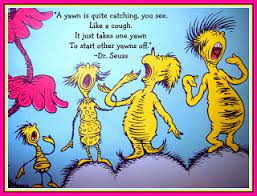
“A yawn is quite catching, you see, like a cough…
…It just takes one yawn to start other yawns off.”
That’s a quote from one of the Dr. Suess books that’s still being allowed (for now). I used to read it to my son at bedtime in hopes it would make him a little more inclined to go to sleep. He was one of those kids who, right from birth, seemed to have trouble making the transition to dreamland.
Watch out even for the word “yawn”:
Platek says that yawning is contagious in about 60 to 70 percent of people—that is, if people see photos or footage of or read about yawning, the majority will spontaneously do the same. He has found that this phenomenon occurs most often in individuals who score high on measures of empathic understanding. Using functional magnetic resonance imaging (fMRI) scans, he found that areas of the brain activated during contagious yawning, the posterior cingulate and precuneus, are involved in processing the our own and others’ emotions. “My capacity to put myself in your shoes and understand your situation is a predictor for my susceptibility to contagiously yawn,” he says.
Along with being contagious, yawning is highly suggestible, meaning that for English speakers, the word “yawn” is a representation of the action, a symbol that we’ve learned to create meaning. When we hear, read or think about the word or the action itself, that symbol becomes “activated” in the brain. “If you get enough stimulation to trip the switch, so to speak, you yawn”…
I’m surprised to hear it’s only 60-70% of people. I had assumed it affected close to everyone.
It’s probably a bit early in the day for this:
The wheels of justice in Fulton County, Georgia certainly grind slow…
…and we don’t know whether they will grind fine, how long it will take, and whether it will even matter if and when they do.
But a judge just ordered absentee ballots in Fulton County unsealed for an audit. The usual suspects have praised the move and the usual suspects have criticized it, but this particular statement by this particular player is a bit surprising to me:
Secretary of State Brad Raffensperger…issued a statement Friday, supportive of recourse through courts.
“From day one I have encouraged Georgians with concerns about the election in their counties to pursue those claims through legal avenues,” the statement read. “Fulton County has a long standing history of election mismanagement that has understandably weakened voters’ faith in its system. Allowing this audit provides another layer of transparency and citizen engagement.”
Seems to me that, at least for a while, Raffensperger was part of that mismanagement on the state level.
By the way, I put the ellipsis there in the spot where the article said that Raffensperger had been “on the receiving end of calls from former President Donald Trump pressuring him to overturn election results.” Well, no; Trump was actually pressuring him to investigate the anomalies and he was saying that he was certain that such an investigation would end up overturning the results. I wrote about the phone call transcript here but especially in this post. Note the discussion, towards the end of that post, of whether the truth will ever come out. We still don’t know the truth, but there certainly were major anomalies.
Caroline Glick explains the balance of power in the Middle East right now
…[I]n the minds of the Iranian leadership and those of their Hamas proxies, the Abraham Accords represent the single greatest military and political threat to Iran’s nuclear and hegemonic ambitions. Destroying them is their strategic goal.
The Abraham Accords provide a formal framework for the operational partnership that developed since 2006 between Israel and the Sunni Arab states that, like Israel, are threatened by Iran. In formalizing those ties, the Abraham Accords split the Arab/Islamic world into two camps. The first camp includes Iran and the states and terror groups Iran supports, controls and is allied with. Political forces hostile to Israel in the West support this camp. Members of the Iran camp and its supporters in the West insist the Jewish state is the greatest source of instability and the primary obstacle to peace in the Middle East.
The second camp is comprised of Israel and the Arab states that understand that Iran is the greatest threat to peace and security in the Middle East. Arab members of this camp include Saudi Arabia, the UAE, Bahrain, Egypt, Sudan and Morocco. These Arab states believe that in alliance with Israel they will be able to contain and eventually defeat the Iranian regime.
Until the Abraham Accords were formalized, only the Iranian camp had an international presence. The anti-Israel, pro-Iran narrative, which claims that Israel is the greatest threat to regional and world peace, had the stage to itself from Tehran to California. Since the Abraham Accords were signed last September, the Iranian camp has been on the defensive.
In a press briefing on Tuesday, President Joe Biden’s spokeswoman Jen Psaki indicated that the administration is just as unhappy with the Abraham Accords as the Iranians and Palestinians are. In response to a reporter’s question about the Trump administration’s peace efforts, Psaki pretended that the Abraham Accords don’t exist.
This asinine statement put paid the notion that Biden will ever opt for an alliance with the Abraham Accords member nations over the Iran/Hamas axis. Just as the administration refuses to even utter the term “Abraham Accords,” so it insists on ignoring their political significance for the states of the region and their military capacity to contain Iran.
Obama cast his lot with Iran during his presidency, without the support of the American people at the time. Whether he did it for malign reasons or out of enormous incompetence and stupidity is unclear to me, although I think it’s mostly the former.
Biden is doing what he’s told, but he’s also willingly following in Obama’s footsteps, just as he did when he was Obama’s VP. It’s an easy decision for Biden’s advisors (and for Biden, to the extent that he makes decisions these days) because Biden’s general course of action is “when in doubt, just do the opposite of what Trump did.”
Open thread 5/22/21
One take:
The Wuhan lab origin theory of COVID is finally getting some respect…
…after having been “debunked” for such a long time.
I think when “debunked” is used by the MSM, the social media woke, and the left in general, it should now should be translated as “pay no attention to that man behind the curtain.”
Bowling Alone revisited
I’m unfamiliar with the site and the author, but this article certainly is interesting. I’m curious what you all think of it. The title is “Bowling Alone: How Washington Has Helped Destroy American Civil Society and Family Life.”
I’m familiar with the original “bowling alone” thesis; the book was published in 2000. The article is written by someone else and is a much more recent piece, although I can’t find a date on it.
There’s a vote audit going on in Windham, NH
The town of Windham, NH is undergoing a voting audit. It involves a local contest that had been decided by 24 votes. But when officials performed a recount requested by the loser, they discovered not a slight change in votes but some large discrepancies (large in terms of the smallness of the town, that is). And strangely enough, all the corrections involved the Republicans gaining votes in the recount. And so a forensic audit is now going on to see why this may have occurred.
NH is somewhat unusual in its voting procedures. For one thing, NH has a small population. For another, the state uses all paper ballots although this year there were more mail-in ballots than usual. It also uses counting machines in which voters place the ballots themselves. Therefore there are always paper ballots that can be hand-counted and examined visually, if necessary.
The vote-counting machines used in Windham and about 85% of cities and towns in New Hampshire are one of the oldest models in circulation, with a memory chip that dates back to 1981, Hursti said.
“This device is predating the internet,” he said.
Later he added, “The technology is so old that the modern computer is unable to read it.”
While it’s outdated, Hursti said, the machine is harder to hack than more modern vote-counting machines because the paper ballots it counts provide backup.
This is the theory at the moment about what may have happened in Windham, and it could affect the whole state:
The work of closely examining each of Windham’s 10,000 ballots from the November 2020 election is expected to last three days, but auditors and volunteers at the secure audit facility in Pembroke could be inching closer to an explanation for the discrepancies.
“Something we strongly suspect at this juncture, based on various evidence, is that in some cases, fold lines are being interpreted by the scanners as valid votes,” said independent auditor Mark Lindeman.
Auditors said the scanners could be interpreting the fold lines as a vote when they go through a “vote target,” or a candidate’s name on the ballot. They said a lot of Windham’s ballots appear to have fold lines across the target of a Democratic state representative candidate.
“Wherever the fold happened to be was, I guess, most commonly through my name,” said the candidate, Kristi St. Laurent.
Auditors said that could explain why St. Laurent [who had requested the recount because of the closeness of the vote] lost 99 votes in the hand recount last year, while Republican candidates gained votes.
“Because if someone voted for all four Republican candidates and the ballot happened to have its fold line going through St. Laurent’s target, then that might be interpreted by the machines as an overvote, which would then subtract votes from each of those four Republican candidates,” said auditor Philip Stark. “Conversely, if there were not four votes already in that contest by the voter, a fold line through that target could have caused the machine to interpret it as a vote for St. Laurent.”
A discussion of the NH machines, in an article written before the election, can be found here. It’s really a very simple system and seemingly a trustworthy one – till now. It also has the advantage of going straight from voter to counter with no middleman involved:
The AccuVote optical reader has been part of Granite State elections since the early 1990s, when it was first accepted by the Secretary of State’s office.
It’s a 14-pound box that looks like an oversized laptop computer sitting on top of a collection bin. As each voter leaves the polling place, poll workers slip their ballot into the AccuVote slot and the machine bounces light off the paper. Sensors tally filled-in circles next to candidates’ names and then the ballot falls into the bin below the reader.
After polls close, the reader prints out the results, with all the paper ballots available for a recount.
Other technologies have come and gone over the years but AccuVote has remained, and today is still the state’s only legal ballot-counting technology…
The AccuVote readers have been involved in thousands of elections, giving polling officials experience in its operation, and in hundreds of recounts, giving experience in its reliability.
It’s also disconnected from the internet or other networks, making it very difficult to hack…
But old technology can be worrisome, too. The software for the AccuVote reader runs on WindowsXP, an operating system that hasn’t been supported by Microsoft since 2014, making it vulnerable to crashes. The machines themselves aren’t made anymore, so the provider has to buy old ones and cannibalize them for parts when repairs are needed…
“The more software that is contained, the more suspicious people become of their ability to properly count ballots,” Scanlan said. “We would probably have to come up with some kind of system to audit ballots after the fact.”
Regular audits after elections is a hot topic in New Hampshire. The Secretary of State’s office has long opposed them as an unnecessary expense but some advocates say they can help instill confidence in the election system. A bill before the House would allow voters in any AccuVote community to request a post-election audit, a request currently limited to when results are very close or somehow contested.
As I said, that was written before the 2020 election and all its woes.
Other states use the same system, but I haven’t been able to get a list of which ones. My guess is that they are small states such as New Hampshire.
In 2016 in New Hampshire, Republican Senator Kelley Ayotte was defeated for re-election to the US Senate by Maggie Hassan, who won narrowly by 1,017 votes. It’s not clear whether that year the ballot folds were placed in such a way that it would have affected that election (and I’m pretty sure that folds only affected mail-in ballots anyway, and I imagine that in 2016 there were fewer of those than in 2020). I certainly haven’t seen any discussion of the 2016 NH election of Hassan in light of what happened in Windham in 2020, nor of how many mail-in ballots were received that year. So it’s certainly possible there is no way such a problem would have affected that election, even with such a small margin. But I’d certainly like to know – because in 2020, the Senate was won so narrowly by the Democrats that an Ayotte win in 2016 would have given the Republicans the majority in the Senate right now.
I haven’t seen any discussion of whether the Windham audit involves any re-counting of presidential votes for 2020, but I doubt it. I wonder whether the fold went through any of the presidential candidates’ names; haven’t read anything about that, either. At any rate, in NH this year Biden won by 7 points and Shaheen (the other Democratic senator in NH) won by 15, so it’s unlikely this fold problem affected those races in that particular state – although who knows?
Doesn’t exactly inspire confidence, does it? Not that we had much confidence left.
Open thread 5/21/21
The bird’s not a fan of low-flow showers:
The official Capitol Police letter that wasn’t
It appears rather Ratheresque.
You probably remember Rathergate, the fake letter about Bush and his National Guard service that became a big big story prior to the 2004 election. Somehow, despite everything, those who accepted the letter at face value never really owned up to their stupidity and/or culpability, and Hollywood decided to make near-heroes out of them in a movie.
The moral of the tale is that a fake story can get believed by a lot of people if the perps never quite fully admit it’s not authentic. Just hedge around the issue if discovered, and concede that you made a few mistakes while claiming that the story might nevertheless be true in its essence.
So now we have the Capitol Police letter:
Yesterday…Capitol Hill was abuzz, as a letter circulated that the United States Capitol Police (USCP) was harshly critical of the Republican members and senators opposing the forming of a commission to look into the Capitol riot in January. It was a scathing rebuke against political posturing, and perfectly illuminated the GOP as hypocritical and dodging the inflammatory issue.
…[T]his letter emerged from the offices of Rep. Jamie Raskin, and it was distributed and broadcast by the press. Politico’s Olivia Beavers was one who — early on — got the letter spread around, but by 5:00 pm, trouble began to emerge. Some intrepid reporters actually decided to act like journalists and thought to contact the USCP about the letter. They received an official statement from the group declaring by practice they never make official comments on political activity…
Throughout the afternoon and into the night, through Cohen, we see the evolution of the story, beginning with the disavowal from the USCP until, into the evening, when the origination of this letter has dwindled down to just a solitary police officer — who remains anonymous and has no way of being verified as a legitimate source…
But even by this point, when this story should be completely laughed out of the Beltway, Cohen still tells us as a conclusion, “It’s also important that this officer’s view be taken seriously.”
…The letter was clearly not an official dispatch as it is un-dated, signed merely with “Proud Members Of The United States Capitol Police,”; it bears no official names or offices, and is attributed to a lone individual who is being kept off the record. Pretty much everything surrounding this letter is suspect, and there should be an investigation into the involvement of Rep. Raskin to find out who was trying to pass off this note as an official, USCP. document.
The larger story of course is the commission itself, and the fact that 35 Republicans in the House joined the Democrats in voting for it and yet Senate Republicans are coming out against it.
Theft in California: Annals of completely predictable logical consequences
How astounding – if you eliminate penalties for certain crimes, you will get more of those crimes. And there will be consequences to that, as well:
By a margin of 60 to 40 percent, the idiots of California basically legalized shoplifting. Proposition 47, which passed in 2014, no longer made it a felony to steal if the value of what you steal doesn’t exceed $950. It’s also no longer a felony to receive stolen property valued at less than $950. And so…
Instead of being punished as a felon, you are hit with a misdemeanor, and in many cases not even that.
As you can imagine, this has turned into a free-for-all for shoplifters and a stone cold nightmare for retailers.
The result?
According to this headline in the far-left San Francisco Chronicle… “Out of control’: Organized crime drives S.F. shoplifting, closing 17 Walgreens in five years.”…
“This has been out of control,” said Supervisor Ahsha Safaí, who held a hearing Thursday with retailers, police, the district attorney and probation departments. “People are scared to go into these stores — seniors, people with disabilities, children. It’s just happening brazenly. We can’t just as a city throw up our hands and say this is OK. We have to come up with solutions.”
How was Proposition 47 passed? In the usual leftist manner, by giving it a pretty name and dressing it up as helping matters and guaranteeing the opposite of what it would almost inevitably lead to:
The measure was also referred to by its supporters as the Safe Neighborhoods and Schools Act.
Let that sink in for a moment. Orwell knew exactly what he was talking about.
How did they sell the idea that this would lead to safer neighborhoods and schools? Here’s how [emphasis mine]:
The measure’s main effects were to convert many nonviolent offenses, such as drug and property offenses, from felonies to misdemeanors. These offenses include shoplifting, writing bad checks, and drug possession. The measure also required that money saved as a result of the measure would be spent on “school truancy and dropout prevention, victim services, mental health, and drug abuse treatment, and other programs designed to keep offenders out of prison and jail.”
It’s a bit parallel to the idea that police officers can be replaced by social workers to deal with volatile and potentially violent situations. The appeal is to the idea that prevention will work and we know how to do it, and that either/or is a better way to approach it than combining both penalties and attempts at prevention.
Well, it did reduce the prison population, apparently. No surprise there. And that saved the state money. Quality of life? Not so much – at least, not for the regular non-offending population who might want to go to a convenient Walgreens, or feel safe going into stores in general.
Predictions from the bill’s opponents:
Opponents of the measure include Mark A. Peterson, the District Attorney of Contra Costa County, who wrote before its passage that the measure “would make our neighborhoods and schools less safe”. It was also criticized by Nancy O’Malley, the District Attorney of Alameda County, who said it would “expose Californians to significant harm” and called it a “Trojan horse”.[
What happened:
Numerous media outlets have continued to report an increase in retail theft related to the passage of Prop 47. Large retailers Safeway, Target, Rite Aid and CVS pharmacies reported in 2016 that shoplifting increased from 15 percent to (in some cases) over 50 percent since voters approved Proposition 47. The Los Angeles Times reported in 2017 that the California Supreme Court ruled that a person convicted of a felony for stealing a car may have that conviction reduced to a misdemeanor if the vehicle was worth no more than $950, and in 2018 that researchers found Prop 47 contributed to a jump in car burglaries, shoplifting and other thefts. The San Francisco Chronicle reported in 2018 that Prop. 47 led to a rise in the larceny theft rate of about 9 percent compared to the 2014 rate.
By 2019, organized retail theft was on the rise; police and store owners attributed it to Prop 47. Fox News reported that post Prop 47 both shoplifters and fencers operated openly and with impunity, with both criminals and storekeepers aware that selective enforcement policies mean police largely ignore reports of shoplifting, or respond too slowly. President of the California Retailers Association Rachel Michelin stated that thieves will bring in calculators to ensure that they do not go over the $950 limit and that “one person will go into a store, fill up their backpack, come out, dump it out and go right back in and do it all over again.” She also reported that out-of-state crime rings use children as they are even less likely to be prosecuted, and that even when police make arrests, charges are dropped or downgraded by the district attorney.
Safe Neighborhoods and Schools, indeed.
Biden can’t even steal a joke right
[Hat tip: commenter “AesopFan”.]
Turns out that Joe Biden’s Coast Guard joke that fell flat wasn’t even originally his, it was Reagan’s. Reagan delivered it a whole lot better, and without the insults:
There are many astounding things about the mess we’re in today, but one of the most astounding is that the same people who thought Trump was not just evil but stupid – and didn’t get his genuinely funny jokes – are pretending to think that Biden is completely in charge of his faculties as well as witty.
Actually, come to think of it, they thought Reagan was stupid, too.
Now, you might say that this Biden screw-up is a minor event in the scheme of things, and I think you’d be right. But it’s also symbolic of the point we’ve reached. There is a certain farcical element, to be sure. If someone had scripted a president like Biden, it would be played as an “Airplane” type of comedy. But this is real, and this mentally deficient person is either our president and in charge, or partly in charge, or not at all in charge and shadow unknowns are in charge – and half the country either doesn’t notice or care.
And that’s the same half who hated Reagan as a half-wit (an evil half-wit, actually), and hated Trump as another evil half-wit only without Reagan’s charm.
We are in a surreal zone, and part of the unreality is the different perceptions of a reality that seems obvious.