
…that if Trump were convicted of something and imprisoned, he could run from prison and make a campaign promise to pardon himself if elected.
FBI infiltration of the Proud Boys
We’ve seen this movie before.
The document represented just one more instance of how a government agent helped shape the government’s narrative that the Proud Boys plotted in advance to carry out an “insurrection” on January 6. In fact, much like the FBI-engineered plan to “kidnap” Michigan Governor Gretchen Whitmer in 2020, court proceedings confirm that FBI assets might outnumber criminal defendants.
You may recall that not only were there many many agents connected with the Michigan group, but they had a major role in hatching the Whitmer kidnapping plot and escalating it.
More on the Proud Boys and January 6th:
At least 10 and possibly up to 15 FBI informants were embedded in the group months before and continuing after the events of January 6. Informants participated in numerous group chats, cozied up to leadership, and even accompanied the Proud Boys to Washington.
One known informant, according to a September 2021 New York Times report, was involved in the first breach of Capitol grounds and entered the building that afternoon.
But prosecutors and Judge Timothy Kelly have tried their best to prevent the public from learning the full scope of the FBI’s involvement…
Kelly also took the highly unusual and prejudicial step of requiring the defense to “pre-clear” questions with prosecutors before asking a witness about the use of informants—but information is slowly trickling as the defense finally gets their turn.
For the second time this month, Kelly suspended the trial on Wednesday after prosecutors confessed that a key witness for the defense, who was scheduled to testify on Thursday, had worked as an FBI informant during the entire investigation. Although prosecutors have known for months that the defense might call this person as a witness, they waited until the last minute to tell defense attorneys, who were blindsided by the news.
This was no ordinary FBI informant. This person continued to be “embedded” with the group as it prepared its defense. I’m not an expert on FBI informants, but I believe that’s quite unusual. And if it’s not illegal, it should be.
More:
A bombshell motion filed by the defense shortly after the disclosure revealed the informant cozied up to defendants and their attorneys for more than 20 months—from April 2021 until January 2023 when the trial began.
“During this period of time, the CHS (confidential human source) has been in contact via telephone, text messaging and other electronic means, with one or more of the counsel for the defense and at least one defendant,” wrote Carmen Hernandez, the public defender representing Zachary Rehl.
The left used to hate the FBI for this sort of thing when it was directed against them. Now they love it.
Open thread 3/27/23
To take your mind off politics
What a guy:
ADDENDUM: I just learned that Hodes died on March 15 of this year at the age of 98. Here’s his obituary; a full and active life with so many accomplishments.
Or perhaps high-fat foods just taste better?
I’m trying to figure this one out:
The reason why we love french fries, crisps and chocolate bars so much has less to do with a lack of willpower and more to do with the brain learning to prefer such high-fat, sugary foods, according to a new study by German and U.S. researchers.
Learning to prefer? Casual observation of children’s first tastes of such things indicates to me that no learning is necessary.
More:
During their investigation, researchers gave one group of volunteers a small pudding containing a lot of fat and sugar per day for eight weeks in addition to their normal diet.
A second, control group received a pudding that contained the same number of calories, but less fat. The volunteers’ brain activity was measured before and during the eight weeks.
“Using an interventional study in healthy, normal-weight participants, we demonstrate that, independent of body weight gain and alterations in metabolic markers, exposure to [high-fat, high-sugar] food reduces preferences for low-fat food,” the study said.
That, in turn, “plays a critical role in up-regulating brain responses to anticipation and consumption of highly palatable, energy-dense food, and has a generalized effect on the neuronal encoding of PEs in the context of associative learning and independent of food rewards.”
Researchers found in the group that ate the high-sugar and high-fat pudding that brain’s responses to them were greatly increased. For those participants, the diet activated the dopaminergic system — the region in the brain responsible for motivation and reward.
I wonder why they used pudding, which to me doesn’t seem like a very high-reward food at all in general (unless it’s tapioca, which has sentimental appeal related to my youth). But as a person who has eaten low-fat pudding and high-fat pudding, sweet pudding and less sweet pudding, my guess is that if all you eat is the low-fat low-sugar variety you get used to it, and then when you eat a higher-fat higher-sugar type you think where have you been all my life? I just don’t think a ton of learning is involved. I’d say it’s more of a reminder of how much better that stuff can taste compared to the other stuff.
And then there’s this curious fact:
Researchers said, though, that the participants who ate high-fat, high-sugar pudding did not gain more weight than those in the other group, and their blood sugar or cholesterol did not change, either.
And all you low-carb advocates note: the pudding wasn’t only higher-fat, it was higher-sugar.
Hmmm, pudding. When was the last time I had pudding? I have the distinction of being 100% lactose intolerant – they did a nasty test on me many years ago, which involved having me drink what seemed like a gallon of lactose after a fast, and then measuring my blood sugar at intervals. No absorption of the lactose at all, and I’ll spare you the other sordid details of what happened to me that day. But I do eat milk products on occasion anyway, and I recall that as a child I was very fond of that My-T-Fine butterscotch type. It was especially good when it was allowed to develop a “skin” on top, something you’re supposed to discourage but something I thought was…mighty fine.
DeSantis responds when asked if he’d accept being Trump’s VP choice
Talk about hypotheticals!
Of course, stranger things have happened than Trump choosing DeSantis as VP candidate. But not many stranger things; I give it close to zero chance of happening.
Nevertheless, DeSantis gave an interesting response to the question:
I think I’m probably more of an executive guy. think that you want to be able to do things. That’s part of the reason I got into this job is because we have action. We’re able to make things happen, and I think that’s probably what I am best suited for…
The whole party, regardless of any personalities or individuals, you have got to be looking at 2024 and saying, if the Biden regime continues, and they’re able to pick up 10-15 seats in the House and a Senate seat or two, this country is going to be in really, really bad shape.
DeSantis decided to accentuate his own positives – his success in an executive office – and not engage Trump at all. That second paragraph is also a recognition that Republicans should stop tearing each other apart if they want to have any chance of defeating the left in 2024. That should be top priority.
So, what did Trump say about “death and destruction”?
Trump has written a couple of things lately in response to Bragg that have created the familiar storm of indignation.
Let’s take this one first:
Potential death and destruction? He continued to step on the rake…wow. ?????? pic.twitter.com/W8dXZmG6qP
— Rocky (@wavechaser2024) March 24, 2023
Trump has long had a propensity for saying outrageous things that are often true and that send a lot of people through the roof. You might say it’s his stock in trade.
In this case, I don’t think it’s true that Bragg is a “degenerate psychopath” – I think he’s a typical leftist. You might say that those two things – “degenerate psychopath” and “typical leftist” are not mutually exclusive, but neither are they identical. Bragg has been making some tactical moves that may have backfired, but they are moves that many on the left have been trying and will continue to try against the right.
Does Bragg “truly hate” the US? That may indeed be the case, just as most people on the left truly hate the US in its present form. They think, or seem to think, they can improve things by throwing out the protections that have made this country a defender of liberty. Whether they sincerely think this (some do) or whether they are merely into their own power (some are), this is also business as usual for the left.
How about the “death and destruction” part? That’s gotten a lot of response, as though Trump were inciting an insurrection – or still another insurrection, depending on one’s view of January 6th. But again, what he’s saying is simply true in the objective sense: for someone of one party to arrest a former president and current leading candidate in the other party, on (forgive the pun) trumped-up charges, would indeed have the potential (that’s the word Trump uses) of leading to some sort of violence on the part of the arrested candidate’s supporters. Such an arrest would be a coup attempt under legal cover, and should be recognized as such if it were to occur, and might indeed generate a violent response. So Trump is merely describing something rather than calling for it.
But of course there’s a fine line between the two. Trump’s supporters are not robots, programmed to obey the call to violence – if indeed there is a call. They are already plenty angry, however, and with very good reason. Trump’s statement isn’t designed to calm them down.
Trump also posted two side-by-side photos [see *ADDENDUM below] that he has apparently taken down, but here’s what they looked like:
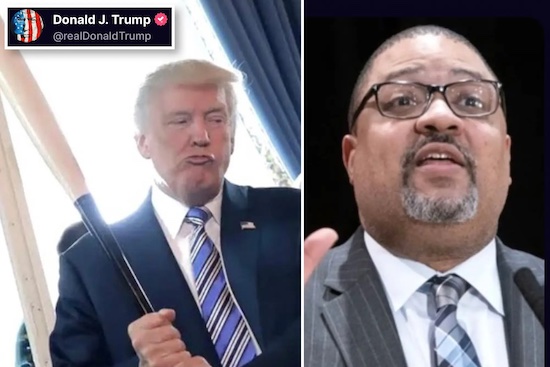
That’s juvenile and stupid, in my opinion, as well as needlessly provocative. It’s an own goal, and I think Trump may on second thought have agreed, because as noted he took it down.
Trump has continued to disappoint in several ways in recent months. But I’m amazed he’s kept it together as well as he has, considering the war against him (and I’m deliberately using provocative language there). He is who he is; we know his strengths and weaknesses. He has both, and displays both quite regularly. His critics on left and right go nuts – or pretend to go nuts – when Trump does this sort of thing. All of it is theater and a distraction, but the issues are very real and very serious. “Potential death and destruction” is not a far-fetched possibility, whether or not Trump says a single word about it.
*ADDENDUM: About the photo of Trump with the baseball bat, next to one of Bragg’s head – apparently Trump didn’t purposely combine those photos, and perhaps didn’t even intend to post them. They were part of an article he was linking to:
The National File chose to juxtapose the image of Trump holding a bat in 2017 with a picture of Alvin Bragg. That editorial decision makes it seem as if Trump is swinging the bat in Bragg’s direction.
What’s important to emphasize is that the photo comes from The National File and appeared automatically in Trump’s “truth” sharing the article about Bragg’s unpopularity and lack of mandate[.]
Thing is, he had to have noticed it and didn’t immediately delete it, although he later did delete it.
Open thread 3/25/23
JonathanTurley on Biden’s knowledge of his family’s influence-peddling
I remember back when I used to think that, if most Democratic voters learned how corrupt a certain candidate was, it would matter. I stopped thinking that a long time ago.
So I doubt these facts will change a thing:
For years, President Joe Biden has maintained a Sgt. Schultz defense to allegations that his family has profiteered on influence peddling with foreign countries and companies. Despite mounting evidence to the contrary, Biden maintains that he “knows nothing, nothing” about Hunter Biden’s business deals. He recently doubled down on this defense by even denying that family members received money from foreign sources. He repeated his denial even after the release of financial transfer reports from his own administration showing millions transferred from China.
Biden may be somewhat cognitively challenged, but one thing he does know is that he can say anything, tell any lie, and most of his voters will stick with him, and the MSM will mostly defend him and lie and/or coverup and/or rationalize for him as well.
More:
Now, emails have emerged that show that Biden personally helped draft responses to the controversial deals in 2015 when he was Vice President. It also appears that Biden officials like former Biden Communications Director Kate Bedingfield knew of his role as the President continued to deny any involvement.
Fancy that.
For years, the media has continued to report President Biden’s repeated claim that “I have never spoken to my son about his overseas business dealings.” At the outset, the media only had to suspend any disbelief that the president could fly to China as Vice President with his son on Air Force 2 without discussing his planned business dealings on the trip.
Of course, the emails on the laptop quickly refuted this claim. However, the media buried the laptop story before the election or pushed the false claim that it was fake Russian disinformation.
Some in the media have repeated those denials…
The refusal of the media to see what is now in plain view will convince no one. At some point, Democratic leaders will have to recognize the obvious or join the Bidens (and many journalists) in the cast of this theater of the absurd.
It’s in that last paragraph that Turley shows his naivete, IMHO. The media’s behavior convinces plenty of people – and if “convinces” isn’t exactly the right word, then let’s just say that many many people who voted for Biden will pretend to be convinced because they simply don’t care how corrupt Biden is as long as he does the left’s bidding. The same for Democrat leaders, who will not change their tune no matter the degree of Biden’s corruption revealed. It is simply a non-issue (or mere potential inconvenience) for them and will remain so, and even though the corruption has become more and more difficult to deny, they are fully up to and even dedicated to the task.
Behind the riots in Israel
Melanie Phillips writes:
The focus of opposition [and riots] is [Netanyahu’s] proposed judicial reforms. The protests are also fueled, however, by fear of the nationalist and religious ultras in the governing coalition and by hatred of Netanyahu, who for some people has achieved near-demonic status.
Netanyahu has some similarities to Trump in that regard, and the split in Israeli society, although certainly not the same as in the US, has some similarities to it.
Phillips continues:
Significant as these factors are, a convulsion of this magnitude suggests that something even more fundamental is at play. What is striking about the protests is the irrationality at their core. Although there are legitimate concerns about aspects of the reform package, the overwrought opposition to it is out of all proportion.
The place of the judicial system in Israel is different than in the US, however. Phillips explains the history:
The protesters claim, for example, that giving politicians a decisive role in selecting new judges, as is being proposed, will destroy the rule of law and an independent judiciary.
They say the changes, which would stop the courts from overturning laws made by the Knesset, end the power of legal advisers to prevent government ministers from enacting the policy programs for which they were elected and end the slippery concept of “reasonableness” through which the judges have substituted politics and ideology for law, would herald the end of democracy and the abolition of civil rights.
Yet as law professor Avi Bell has pointed out, for many decades after the State of Israel was founded, only the Knesset could legislate and no court could overturn legislation for any reason. Attorneys-general and all other legal advisers could be dismissed and their legal opinions bound no one. No government action could be reversed by the Supreme Court simply because the Court considered it “unreasonable.”
In other words, the reforms will largely return Israel to the situation that prevailed before 1993, when Supreme Court President Aharon Barak launched his revolutionary campaign of judicial activism.
You can learn much more about the Israeli court system and how judges are chosen here. A quote:
“The system today gives the entirety of the public in Israel a minority in the committee, which is unheard of. It’s really unheard of for unelected officials to have this kind of power, to have a self-perpetuating court. In almost every other democratic country, the system gives the power to the ruling majority to appoint judges,” said Rothman.
There are also issues involving the fact that Israel has no written constitution, and therefore judges are not ruling on new laws in terms of a written document.
Phillips contnues:
Democracy is rooted in [the following] core principle: The laws governing the people are founded upon the consent of the people. That consent is demonstrated by the people’s election of representatives in parliament who pass those laws. That’s why, although government needs checks and balances, the elected parliament in a Western nation is supreme.
But now, the very idea of the Western nation itself is under sustained assault. The progressive narrative, so dominant in Western culture, holds that the Western nation is exclusive, racist and oppressive.
National laws must therefore be superseded by universal “human rights” laws promulgated by international judges, as well as domestic judges who prioritize those laws over the laws of their own nation. The democratic process by which those national laws are formed and passed is disdained.
That process is what is now under attack in Israel by those protesting against the judicial reforms. The agenda of the politicians who have been elected by the people conflicts with the liberal universalism of man-made human rights that prioritizes approved minorities over the majority and is promulgated by Israel’s activist Supreme Court.
As the American foreign-policy specialist David Wurmser has observed, the “illiberal” left no longer believes that elections matter. They believe instead that there is a moral objective to policy matters that the left has the power to divine and define…
…[W]hat all the protesters have in common is that, at base, they would prefer rule by judges to rule by an elected government. Although one might recoil from some members of the government or despair of Israel’s dysfunctional political system, this is a dangerous tipping point—and one that has a baleful resonance far beyond Israel.
For this is the West’s post-democracy moment, in which a dominant mindset is prioritizing universal laws over national ones, elevating the legitimacy of street protests and appointing politically activist judges as the shock troops of the progressive assault on traditional values.
You may indeed recognize this as a process going on in the entire Western world today. Israel is just another example.
On the difficulties of research with human subjects
Commenter “Frederick” makes a good point about retractions of research results:
The retractions and replication problems affect some sciences way more than others. Physics, chemistry, math, hardly at all. Medicine, psychology, social sciences, quite a bit.
To oversimplify, some disciplines rely heavily on trying to tease small effects out of very noisy data, and the statistical rules of thumb that have been relied on are not sufficient to do that reliably. The data is noisy and the effects are small not because scientists in general are lazy or incompetent. It’s because studying anything alive, or anything involving human behavior, is very difficult, because humans and other living systems are incredibly complex.
Some disciplines do not labor under this handicap.
Not only that, but there are enormous ethical restrictions on what researchers are allowed to manipulate in terms of human subjects, as well as rules about informed consent. Lastly, a great deal of research on humans can be easily used to make a political point, and so the temptation is great to present the data in a certain way to conform with a desired outcome. How often does this happen? Hard to say, but politics certainly affects funding, hiring, and publication decisions.
That holds true in some of the “harder” sciences, as well, in particular “climate science” – which, although supposedly a harder science, has some things in common with the softer sciences (noisy data and small effects, for starters), and is highly highly politicized. AGW “deniers” are considered pariahs in academia at this point.