↓
 

The New Neo

A blog about political change, among other things

  • Home
  • Bio
  • Email
Home » Page 1900 << 1 2 … 1,898 1,899 1,900 1,901 1,902 … 1,931 1,932 >>

Post navigation

← Previous Post
Next Post→

Time marches on: Lenin who?

The New Neo Posted on October 5, 2005 by neoAugust 28, 2009

The first time I ever saw a photo of Lenin’s embalmed corpse on display in its mausoleum in Moscow, the sight gave me the creeps. There was something dreadful about making a body into an icon–a sort of zombie-esque quality to the whole enterprise. The Soviets may have abolished (or sought mightily to abolish) religion, but they seemed to have replaced it with ghoulish hero-worship.

Little did I know the lengths to which the Soviets actually went to keep the remains intact all these long years. And it’s not just the Soviets who were big on these body-as-holy-relic displays; it turns out it’s a Communist thing. Uncle Ho is on view in Hanoi, having been secretly super-embalmed by a special Soviet team sent to the North Vietnamese jungle especially for that purpose in 1970 (the Wikipedia article mentions that this seems to have gone against Ho’s express wishes, which were to be cremated; it also mentions that other bodies on similar display are Mao Zedong and Kim Il-Sung).

Stalin used to lie under glass in Red Square alongside his illustrious predecessor; I recall seeing photos in my youth of the two of them, looking like bizarro twin Snow Whites waiting for princes who never came. But when Stalin was discredited during the Khrushchev era, he was removed from Lenin’s side and buried under the Kremlin wall.

Now a similar fate might await Lenin. The NY Times reports that talk of his burial has been revived, and Putin is in favor of it, although the idea has its detractors.

But to me the most interesting part of the article was the following quote at the end:

No matter what Mr. Putin decides, there already are indications that time may ultimately do what no politician has yet achieved. The youngest Russian adults barely recall the Communist times, and some show little interest in looking back. “Lenin,” mused Natasha Zakharova, 23, as she walked off Red Square on Tuesday, admitting that she was not quite sure whose body she had just seen. “Was he a Communist?”

Ozymandias

I met a traveler from an antique land
Who said: Two vast and trunkless legs of stone
Stand in the desert. Near them, on the sand,
Half sunk, a shattered visage lies, whose frown,
And wrinkled lip, and sneer of cold command,
Tell that its sculptor well those passions read,
Which yet survive, stamped on these lifeless things,
The hand that mocked them, and the heart that fed,
And on the pedestal these words appear:
“My name is Ozymandias, King of Kings:
Look upon my works, ye Mighty, and despair!”
Nothing beside remains. Round the decay
Of that colossal wreck, boundless and bare
The lone and level sands stretch far away.

Posted in Historical figures, History | 10 Replies

Recap: elections round the world

The New Neo Posted on October 5, 2005 by neoAugust 28, 2009

Let’s see now, we’ve got the Freedom Trifecta of Howard, Bush, and Blair (in chronological order), all somehow re-elected and returned to power despite the incessant carping of the left. Then of course there’s Afghanistan, in its second largely peaceful postwar election. Also, purple, green, and orange revolutions in Iraq, Lebanon, and Ukraine.

Now there’s Poland, and Japan seems to be on board, as well. Practically a clean sweep for the coalition, the neocons, and the hawks.

The results of the German elections are as yet unclear. But recently there was new evidence that the end result could be the unseating of Schroder:

Chancellor Gerhard Schré¶der seemed Monday to soften his resistance to giving up his post, hinting for the first time that he would not oppose a decision by his party to share power with the opposition conservatives even if it meant accepting somebody else as chancellor.

“I will not stand in the way of anything that would lead to a continuation of the reform processes that I started and a stable government in Germany,” Mr. Schré¶der said…This is not about my prerogatives and absolutely not about me as a person,” he said.

True, although it’s surprising that Schroder himself is actually admitting it.

And then, of course, there’s Spain–whose voters, with the timely assistance of al Qaeda, managed to turn a lead for the party of pro-coalition Aznar into an election for the appeaser Zapatero. But that’s about it, so far, for the anti-coalition forces in elections during the past year and a half.

Perhaps I’m missing something, but I sense a trend here, and it’s one the left won’t like.

Oh, and by the way–I know it’s been said before, but I was just struck once again by how much Zapatero resembles Mr. Bean. Separated at birth?

Posted in Politics | 7 Replies

Believe your enemy

The New Neo Posted on October 4, 2005 by neoAugust 28, 2009

A while back, commenter Richard Aubrey wrote here:

The neat thing about our current situation is that we don’t have to make stuff up about what our enemies want. They tell us. The problem is in believing them.

But you can’t say they don’t make their intentions crystal clear. As if we needed another example, LGF today provided evidence, in the form of an interview six weeks ago with the very spiritual Bashir, in which he is quoted as stating:

ABB: Osama believes in total war. This concept I don’t agree with. If this occurs in an Islamic country, the fitnah [discord] will be felt by Muslims. But to attack them in their country [America] is fine.

SA: So this fight will never end?

ABB: Never. This fight is compulsory. Muslims who don’t hate America sin…As long as there is no intention to fight us and Islam continues to grow there can be peace. This is the doctrine of Islam. Islam can’t be ruled by others. Allah’s law must stand above human law. There is no [example] of Islam and infidels, the right and the wrong, living together in peace.

Who knew that Bashir was a disciple of Samuel Huntington? Islam has bloody borders, indeed–you heard it straight from the horse’s mouth.

[NOTE: To try to stave off the inevitable commenters who write that not all Moslems feel this way, let me just say: I agree with you. Not all Moslems feel this way. The trouble is that way too many of their leaders, “spiritual” or otherwise (and the powerful, vocal ones at that), do. And there is too much in Moslem scripture and history that backs them up. I’d love the so-called “moderate Moslems”–whom I believe exist–to gain a great deal more power over their religion and be successful in reforming and modernizing it. But I wouldn’t suggest sitting on a hot stove till that happens.]

Posted in Terrorism and terrorists, War and Peace | 20 Replies

Definitely not a bicycle built for two

The New Neo Posted on October 4, 2005 by neoAugust 28, 2009

Oh-oh.

Danger, and from an unexpected source. Men, you may want to leave the room now, especially if you are the sensitive sort.

Today’s NY Times has an article on the hazards of bike-riding–yes, you heard me, bike riding, specifically the bicycle seat. And don’t think you’ll avoid the problem by using one of those new-fangled ergonomically blah-blah-blah seats, either. No; they appear to be, if anything, worse.

Since the Times is registration-only, I’ll give an excerpt–a rather expurgated excerpt. Read the whole thing for the precise anatomical details–if you dare.

The studies add to earlier evidence that traditional bicycle saddles, the kind with a narrow rear and pointy nose, play a role in sexual impotence.

Some saddle designs are more damaging than others, scientists say. But even so-called ergonomic seats, to protect the sex organs, can be harmful, the research finds. The dozen or so studies, from peer-reviewed journals, are summarized in three articles in September’s Journal of Sexual Medicine…

Researchers have estimated that 5 percent of men who ride bikes intensively have developed severe to moderate erectile dysfunction as a result. But some experts believe that the numbers may be much higher because many men are too embarrassed to talk about it or fail to associate cycling with their problems in the bedroom.

The link between bicycle saddles and impotence first received public attention in 1997 when a Boston urologist, Dr. Irwin Goldstein, who had studied the problem, asserted that “there are only two kinds of male cyclists – those who are impotent and those who will be impotent.”

Although Bostonians (and even Boston neurologists, as far as I know) are not ordinarily given to hyperbole, the evidence is that Dr. Goldstein was over-the-top on this one. But 5% is nothing to sneeze at, either. So, forewarned is forearmed, all you bicycle-riding guys out there.

Posted in Health | 10 Replies

Yeah, and Goebbels was the “spiritual leader” of the Nazis

The New Neo Posted on October 3, 2005 by neoAugust 28, 2009

I am truly sick and tired of this business of calling terrorist cheerleaders “spiritual leaders.”

In some ways it’s worse than the “militant” thing; at least terrorists are militant. But how are people such as Abu Bakar Bashir, a cleric who most agree is the one who inspires and guides the murderers of Jemaah Islamiyah “spiritual” (unless, of course, the spirit of evil and hatred counts)?

Is it because he hides behind the role of cleric? Well, the mere title “cleric” does not a spiritual leader make. It’s a perversion of the word and the concept “spiritual” to use it to refer to people like Bashir–or to that other well-known spiritual leader, the late Sheikh Ahmad Yassin (see this).

And why, by the way, are these guys so often frail and elderly? Here is the wispy and oh-so-spiritual Bashir in 2002 on the subject of the first Bali bombings:

Asked if there was anything he wanted to say to families who lost relatives in the bomb blast, he said: “My message to the families is please convert to Islam as soon as possible.”

Mr Bashir offered no sympathy for those who died; just his belief that by converting to Islam, the survivors could ensure they would avoid the fate of those non-Muslims who died and went to hell.

Sitting cross-legged on the carpet in a run-down house that serves as headquarters for the Indonesia Mujahideen Council, an umbrella group for a cluster of radical Muslim groups, the gently spoken cleric also had a more ominous message he wanted conveyed to Australians.

“The second message is for Australia because you suffered the most: please advise your government not to follow the US policy because it will bring tragedy for your country”…

I think the bomb was done by foreign intelligence, especially US intelligence. The indications are Americans and Jews did it to justify the claims that have been made so far that Indonesia is a terrorist haven. What they mean by terrorists is Muslims. So to prove their theory they created the incident in Bali.

Spiritual as all get-out.

Posted in Terrorism and terrorists | 11 Replies

The varieties of pacifism (Part IIA): the conflicted Quaker history

The New Neo Posted on October 3, 2005 by neoAugust 25, 2015

[This is the second segment of my multi-part series on pacifism. The first, which dealt with Gandhi, can be found here. This second part discusses the Quaker approach. It also will be divided into two smaller sections, of which this is the first. I think that’s quite complicated enough, don’t you think?]

During the long build-up to the Iraq war and for quite some time after, my regular driving route took me past the local Quaker church. In front was a large banner, prominently displayed, that read, “WAR IS NOT THE ANSWER”. Driving by, I often had to fight the urge to stop my car, walk inside, and ask them: What’s the question? And what’s your answer?

I wouldn’t have minded quite so much if the banner had read “We believe that war is not the answer” or even better “We hope that war is not the answer.” It was the absolute and sweeping nature of the statement that got to me: was war never a proper response to a situation? Was it not sometimes the least terrible of the “choices among crazinesses?”

It turns out that, despite the banner, at least some Quakers have always answered “yes” to the latter question. The Quaker attitude is far more nuanced (pardon the expression) than the banner would indicate.

Although pacifism is a basic tenet of Quaker belief—the thing that most often comes to mind when the word “Quaker” is brought up in conversation among non-Quakers—by no means do Quakers universally agree as to its dimensions and scope. In fact, the argument within the Quaker faith on this point goes back hundreds of years, to its founding in the 1600s by George Fox, and the disagreement mirrors in some interesting ways arguments in the larger world about pacifism itself.

Here’s a brief history of the dilemma within the Quaker faith, taken from this piece by Quaker Vernon Mullen:

There have been several sides to the pacifist stand from George Fox’s time. The question has always been: How far should one go in refusing to use force to try to bring about peace and justice? On one side stand the pure idealists who have renounced force or violence in any form; on the other are the pragmatists, although they may be pacifists, who are willing to use force to maintain law and order.

George Fox’s declaration of 1661 to Charles II is referred to as the Friends historic peace testimony: “We utterly deny all outward wars and strife and fightings with outward weapons, for any ends or under any pretence whatsoever. And this is our testimony to the whole world.” The rulers feared that the Quakers might lead some kind of revolution against their authority, and Fox wanted to assure them that the Quakers were peaceful.

In his biography of George Fox, First Among Friends, Larry Ingle says:

“Fox was not a pacifist in the modern sense that he utterly rejected participating in all wars and violent conflicts. He couldn’t imagine himself bearing the sword, at least under {his} present circumstances… but he also recognized that someone must wield the sword against evil-doers.”

Ingle goes on to say, “Fox would not condone violence except ‘in the cause of justice’… ‘in a war with the devil and his works’… ‘for a righteous cause’… or for ‘keeping the peace and protecting people’s estates’ (i.e. not their property but their condition), and Ingle continues that Fox would ‘never deny the right of a nation’s rulers to wield weapons in defense of a just cause. The problem was in defining such a cause.’ Thus the dilemma.

The old question keeps on appearing: “What would you do if you saw your mother being raped?” [neo-neocon note: sound familiar, Mike Dukakis?] I know my answer: I would use whatever force or weapon I had available to protect her. I would not try to kill or maim but use only enough force to stop the aggressor. Yes, I would respect “that of God” in the aggressor, but I must respect it also in the victim. I believe this principle applies as well to nations.

So here we have a Quaker tradition that runs a surprising gamut from what I call “absolute pacifism” (what Mullen refers to as the “pure idealists”) to “relative pacifism” (what Mullen refers to as the “pragmatists”). The pragmatists adhere to a doctrine that is somewhat similar to the “just war” doctrine of Catholicism (another topic for another day, perhaps) although the Quaker version seems to me to be the slightly more restrictive one.

The Civil War presented a particularly compelling case to Quakers as being both just and necessary, since Quakers had long been in the forefront of the abolitionist movement. In fact–as Ingle himself writes here–despite the “peace testimony” being the heart of Quakerism, at least some Quakers have participated in every war since the religion’s founding in the 1600s.

Ingle describes the conflict within Quakerism on this issue, and emphasizes the individual nature of the Quaker decision about pacifism vs. war (and in his description of the William Penn approach you may find, as I did, a hint at the genesis of many modern-day strains of pacifism, both Quaker or otherwise):

…Fox, at least, never betook himself to deny the right, even duty, of a ruler to wield weapons in a just cause. The problem was determining exactly what such a cause was and by whose standards it would be judged. In this sense, it fed the individualism at the heart of Quakerism, for it ultimately left to each Friend the responsibility of making that determination.

In addition, since the statement spoke only for Friends and formally represented only the signers’ personal testimony against participation in war, it never presumed to speak for those beyond the bounds of the Quaker faith. Certainly in denying carnal weapons, it was not making a universal statement. Hence its spirit was foreign to the kind of Enlightenment optimism that practically oozed from William Penn’s 1693 Essay “Towards the Present and Future Peace of Europe,” only a bit more than a generation later.

This pamphlet proposed a structure for a united European parliament that would end international conflict and secure peace. The difference between the two approaches involved more than the mere passage of time: one from two ill-educated Quakers, whose despair at the Stuart Restoration gave them little hope of ever seeing “the Day of the Lord” or having to personally confront the question of wielding the sword in a just cause; the other from the pen of a thoughtful, well-off, and worldly educated imperial proprietor who oversaw his colony’s rules.

The implications of the peace testimony thus stand apart from most modern Quaker peacemaking, which owes more to the aristocratic Penn than to the ruder Fox and Hubberthorne….our 1661 authors…[who gave] a sectarian call to Friends to be faithful to the word of God they had heard in the silence of their meetings; it spoke only to those who had been convinced of its truth and knew themselves called to uphold a unique standard.

So the original pacifist Quaker position was a highly individual one, more akin to that of the modern-day conscientious objector who cannot himself fight but who might support a war in other ways by being a medic or ambulance driver, for example. The second, or William Penn strain, is the “international law” variety so popular today, and often espoused by those who are not aligned with any religious movement, Quakerism or otherwise. This second type of pacifism embraces the idea that courts and the UN and treaties and disarmament will usher in the era of the lion lying down with the lamb, and among Quakers it is connected with the mission to work as social activists to hasten the arrival of that day.

The first wing of Quakerism is eloquently represented here, by one of its early founders, Penington, writing in 1661:

I speak not against any magistrates or peoples defending themselves against foreign invasions; or making use of the sword to suppress the violent and evil-doers within their borders – for this the present estate of things may and doth require…There is to be a time when ‘nation shall not lift up sword against nation; neither shall they learn war any more’…This blessed state, which shall be brought forth [in society] at large in God’s season, must begin in particulars [that is, in individuals].

So, Penington’s position is: for now, war is necessary and will not be opposed, except by individual non-participation based on individual decision. Quakers in their pacifism have a special call to be a sort of harbinger of the world to come, when war will no longer be necessary. This state will be brought about through God’s will and the efforts of individual humans such as Quakers.

The dangers of pacifism, especially of the absolute variety, were well-expressed in 1974 by the British Quaker writer and teacher Wolf Mendl (who, by the way, began life as a German Jew—an unusual journey, I would imagine):

Because of their personal experience and convictions, [early] Friends did not deny the reality of evil and of conflict. Nor did they equate conflict with evil. They were well aware of the suffering which a non-violent witness could bring in an imperfect world. This is in contrast to those who identify peace with the absence of conflict and value that above all things. It is the latter who have given modern pacifism its bad name and have led their critics to refer to them contemptuously as ‘passivists’. The failure to take evil and conflict into account as elements in our human condition and an obsession with the need for peace and harmony have led pacifists badly astray… Christian pacifists [are] not exempt from the temptation to sacrifice others for the sake of peace.

Mendl is not exactly a hawk, to be sure. But his writing shows a deep awareness on the part of at least some Quakers about what is at stake, and of the damage that can be done by “passivists” in the name of goodness.

[Go here for Part I, and here for Part IIB, the final post in the series.]

Posted in Pacifism, War and Peace | 24 Replies

The Gandhi nobody knows

The New Neo Posted on October 2, 2005 by neoMay 22, 2011

In response to my post about Gandhi’s pacifism, a number of people (Ed Driscoll publicly, others in private e-mails) have called my attention to Richard Grenier’s essay on Gandhi that appeared in a 1983 issue of Commentary.

Driscoll calls it “undoubtedly one of the most incredible film reviews ever written,” and I second the motion.

Driscoll’s reference is quite the wry understatement. The essay is far more than a film review, although its take-off point is indeed a critique of the Oscar-winning movie of 1982. Whether the movie “Gandhi” could truly be termed a film biography is doubtful; it probably is so only in the Oliver Stone-ish sense.

Grenier writes what could more rightly be called a fisking of the Gandhi movie–in the course of which he pretty effectively demolishes the Gandhi myth as well. He makes a very good case that the actual historical figure is a far more complex and flawed person than the Gandhi most of us think we know.

Here’s an excerpt which is especially relevant to the pacifism discussion on the earlier thread:

“Gandhi”, then, is a large, pious, historical morality tale centered on a saintly, sanitized Mahatma Gandhi cleansed of anything too embarrassingly Hindu (the word “caste” is not mentioned from one end of the film to the other) and, indeed, of most of the rest of Gandhi’s life, much of which would drastically diminish his saintliness in Western eyes…

[I]t is not widely realized (nor will this film tell you) how much violence was associated with Gandhi’s so-called “nonviolent” movement from the very beginning. India’s Nobel Prize-winning poet, Rabindranath Tagore, had sensed a strong current of nihilism in Gandhi almost from his first days, and as early as 1920 wrote of Gandhi’s “fierce joy of annihilation,” which Tagore feared would lead India into hideous orgies of devastation–which ultimately proved to be the case. Robert Payne has said that there was unquestionably an “unhealthy atmosphere” among many of Gandhi’s fanatic followers, and that Gandhi’s habit of going to the edge of violence and then suddenly retreating was fraught with danger. “In matters of conscience I am uncompromising,” proclaimed Gandhi proudly. “Nobody can make me yield.” The judgment of Tagore was categorical. Much as he might revere Gandhi as a holy man, he quite detested him as a politician and considered that his campaigns were almost always so close to violence that it was utterly disingenuous to call them nonviolent.

For every satyagraha true believer, moreover, sworn not to harm the adversary or even to lift a finger in his own defense, there were sometimes thousands of incensed freebooters and skirmishers bound by no such vow. Gandhi, to be fair, was aware of this, and nominally deplored it–but with nothing like the consistency shown in the movie. The film leads the audience to believe that Gandhi’s first “fast unto death,” for example, was in protest against an act of barbarous violence, the slaughter by an Indian crowd of a detachment of police constables. But in actual fact Gandhi reserved this “ultimate weapon” of his to interdict a 1931 British proposal to grant Untouchables a “separate electorate” in the Indian national legislature–in effect a kind of affirmative-action program for Untouchables. For reasons I have not been able to decrypt, Gandhi was dead set against the project, but I confess it is another scene I would like to have seen in the movie: Gandhi almost starving himself to death to block affirmative action for Untouchables.

…Meanwhile, on the passionate subject of swaraj Gandhi was crying, “I would not flinch from sacrificing a million lives for India’s liberty!” The million Indian lives were indeed sacrificed, and in full. They fell, however, not to the bullets of British soldiers but to the knives and clubs of their fellow lndians in savage butcheries when the British finally withdrew.

I came across Grenier’s piece about a year ago and found it extraordinary, and extraordinarily shocking. I’ve done a fairly extensive online search to see whether anyone has effectively countered any of the facts in it, and have found nothing save ad hominem attacks on Grenier himself. Makes me think he may have gotten his facts right. (Here, by the way, is a short bio on Grenier himself.)

Read Grenier’s piece and judge for yourself.

Posted in Historical figures, Pacifism, People of interest | 34 Replies

It’s official: I’m a centrist

The New Neo Posted on October 2, 2005 by neoOctober 2, 2005

You are a

Social Moderate
(55% permissive)

and an…

Economic Liberal
(38% permissive)

You are best described as a:

Centrist

You exhibit a very well-developed sense of Right and Wrong and believe in economic fairness.

The test didn’t pick up on the fact that it would be more accurate to describe me as an economic illiterate than an economic liberal. But at least it got the “centrist” part right.

Posted in Uncategorized | 12 Replies

How Tuvia Grossman got to be a “Palestinian”

The New Neo Posted on October 1, 2005 by neoAugust 28, 2009

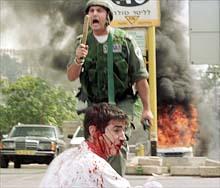
In case you missed the story the first time round, Richard Landes of Second Draft has a post at Solomonia on the misidentification of Tuvia Grossman by the press.

Grossman, an American Jew studying in Israel, was beaten by a mob in the Arab section of Jerusalem and rescued by an Israeli policemen. When the photo of the bloodied Grossman appeared, a club-wielding and shouting policeman standing over him,

it was released by the AP and flashed all over the world–including the NY Times–with the laconic caption, “An Israeli policeman and a Palestinian on the Temple Mount.” The reader was led to the inescapable conclusion that the Israeli had beaten the defenseless Palestinian youth.

To this day, that misapprehension continues among many, despite attempts at correction. The photo was originally used as propaganda for the Palestinian intifada; it is still used for propaganda purposes by the Palestinians. After all, what are facts when there’s a larger truth to consider?

Landes makes the important point that the misidentification most likely had to do with the expectations of the press that any photo featuring “bloodied youth and Israeli policeman with club” would just have to be of a Palestinian who had been beaten by said policeman. Psychologists have long known that human beings function in the world by setting up such templates as shortcuts to ordering observations.

I became curious to know more of the details of the chain of events involved in this error. Who actually had been responsible for the mistaken caption? Who had taken the photo, for example; had he/she originally identified the people in it, and if so, how? Was the error the photographer’s, or had someone else along the way goofed–or even lied?

It took some digging to find any answers, and at first I found only a fragment. It appeared in this recent article from the Jerusalem Post on the subject of the Grossman photo (Tuvia himself, by the way, has emigrated permanently to Israel, according to the article).

Here’s the passage relevant to the caption’s genesis and evolution:

…a freelance photographer took a shot of one of the soldiers, his club in the air, standing over a bloody Grossman. The Associated Press, in giving a caption for the photo, identified the gas station, outside the Old City, as the Temple Mount and the victim as a Palestinian.

From this we learn that a freelance photographer took the shot, and someone at the AP gave it the caption (we also learn that the policeman in question may have actually been a soldier, although the words “soldier” and “policeman” seem to be used interchangeably at times in articles about the incident, including even this one by Grossman himself. An unimportant distinction, perhaps, but it illustrates what an elusive quarry accuracy can be–as does this whole affair).

So, we still haven’t a clue as to how the AP managed to get the information so very wrong. Even CAMERA, which has a good summary of the development of the story and the differing retractions and corrections along the way (including the AP’s first correction, which again misidentifies Tuvia, this time as an Israeli medic) fails to shed light on the question.

Here is the most complete set of facts describing how the caption came to be written that I’ve been able to find. It’s not perfect, but it will have to do. The link is to a reprint of an article that originally appeared in the NY Times about a week after the story broke. Here’s the relevant quote (note that the soldier [?] has turned back into a police officer):

A picture of Tuvia Grossman, his head bloodied and sitting in front of the approaching police officer, was taken by an Israeli photographer for Zoom 77, an Israeli agency, and sent that Friday, Sept. 29, to The A.P. in Jerusalem with a garbled Hebrew caption that misidentified Mr. Grossman as an Israeli ambulance medic.

The A.P., which had received many pictures of injured Palestinians that day, did not clarify the garbled caption but sent the picture to subscribers with a caption based on the erroneous assumption that Mr. Grossman was a Palestinian. It also misidentified the site, first as the Temple Mount and later as another site in the Old City.

Many newspapers published the picture and erroneous captions based on The A.P.’s information. The New York Times misidentified Mr. Grossman in last Saturday’s issue as a Palestinian and in some copies misidentified the site as the Temple Mount. In a correction on Wednesday, The Times noted that the wounded man was Tuvia Grossman, a student from Chicago, but–using erroneous information from The A.P.–mistakenly said the site of the attack was in the Old City.

So: we’ve learned that the photographer was an Israeli who originally made an error about Grossman’s identification–a different and much smaller error than the one later made by the AP. At least the photographer got the fact that Grossman was a Jew and not a Palestinian correct–and that the policeman/soldier was protecting him rather than beating him. (At the same time we’ve learned why it was that the AP’s first correction of the caption had misidentified Grossman still again, this time as an Israeli medic–the AP was simply using the information supplied by the photographer’s original caption to make its correction. One almost begins to have some sympathy for the AP at this point–almost.)

The incident began with the fact that the photographer’s original caption had somehow become garbled (unintelligible? illegible?). But the AP, instead of asking for clarification from the photographer–as it should have if it had any interest in accuracy–seems to have filled in the blanks (just as Landes has suggested it did) with its own expectations and assumptions that the bloodied man had to have been a Palestinian victim of Israeli aggression. All the other papers followed the lead of the AP, not having any reason to suspect a mistake. The Times, when informed of the error (by Tuvia’s father, by the way), continued to err in the first of its several corrections by relying on the already-discredited AP for the location shown in the photo.

A story of astounding carelessness, expectations, assumptions, and multiple misidentifications on the part of the press, particularly the AP–although one that does not seem to include deliberate lying, except on the part of the Palestinian organizations still using the photo even today.

The whole thing would be relatively trivial if the subject matter weren’t so important, and hadn’t been so inflammatory. The photo and caption have already done their dirty work, and I doubt that many of the people who saw the original caption have ever caught the correction, or ever will.

Posted in Israel/Palestine, Press | 13 Replies

Our need to know–the ACLU and Abu Ghraib

The New Neo Posted on September 30, 2005 by neoAugust 28, 2009

Let’s see if I’ve got this straight: US District Court Judge Alvin K. Hellerstein has ordered the release of more Abu Ghraib photos to help the ACLU prove that prisoners have been abused, and it’s OK because the terrorists don’t need those photos in order to hate us, they can do it very well for no reason at all.

And to think I used to give money to the ACLU.

This article from about a month ago makes the situation even more puzzling. Apparently, back then, Judge Hellerstein seemed to be very hesitent to release the photos because of the national interest involved. Why the change in one short month?

I haven’t found an answer, but the article explains why the ACLU is so hot to have these photos splashed all over the cable news networks and the newspapers: they’re only thinking of us:

ACLU lawyer Amrit Singh argued that release of the pictures was necessary for the public to assess the scope of the abuse and whether it could have been carried out without the knowledge of military leaders.

Thanks a lot, ACLU. I really, really appreciate it. I’m sure that once I look at those photos I’ll instantly know how high up the responsibility goes–no doubt, one of them features Rumsfeld holding a naked prisoner on a leash.

The underlying basis of Judge Hellerstein’s decision appears to be compliance with the Freedom of Information Act. Apparently, the present rule is that information should be released under the act unless “disclosure would be harmful.”

Our legal system ordinarily requires that a rape victim’s name not be released because it might be harmful to her. A juvenile’s court records are sealed because it might be harmful to the minor in question. The potential harm in both situations trumps the public’s right to know.

In the present case, the public has seen photos of Abu Ghraib ad nauseum, so seeing a few more is hardly likely to give the us needed and vital information. The only effect such release is likely to have is to harm us, our soldiers, and our country still further.

Whether or not the terrorists need such information to hate us is hardly relevant; they could certainly use it.

I’m with Dickens–the law is an ass (not to mention the ACLU).

[ADDENDUM: I didn’t see this when I wrote the post, but in the NY Times article on the subject, it mentions that, when the photos are to be released, the rights of the detainees to privacy will be protected:

Judge Hellerstein ordered that the images be edited to hide the faces of the Iraqi prisoners, to avoid violations of their privacy under the Geneva Conventions. He concluded that one videotape sought by the A.C.L.U. could not be adequately edited, and that it not be released.

So, to recap: a certain videotape will be surpressed because the right of the detainee to privacy overrides our need to see still more and more and more photos of abuse that has already been more than adequately covered in the press. But the rights of our servicemen and women to be protected from further inflammatory publicity on the matter, and our own right to be protected against increased rage in the Islamicist world, are both less powerful than that detainee’s right to privacy. I’m in awe.

It’s certainly possible that this decision makes perfect sense, if I were to read the entire transcript of the judge’s ruling. Sometimes learning the details of a case makes all the difference in the world. But from what I’ve read in the press so far, this one seems misguided.

It’s being appealed; it will be interesting to see what ultimately happens. But I think cases like this are an excellent example of why the public has become more dissatisfied with the judicial system in general.]

Posted in Iraq, Law, War and Peace | 26 Replies

Martha Gellhorn on press censorship during WWII

The New Neo Posted on September 29, 2005 by neoAugust 28, 2009

After reading Martha Gellhorn’s remarkably prescient
1961 Atlantic Monthly article
about the Palestinians, I wanted to read more of her work. I recently and serendipitously happened upon a copy of her Travels with Myself and Another (the “other” being short-term husband Ernest Hemingway), and have been slowly savoring it.

Gellhorn had a mordantly witty and idiosyncratic approach to travel in some very out-of-the-way places–in fact, the book is devoted to what she calls “horror journeys.” She throws herself into adventure with the reckless abandon worthy of a Hemingway heroine, although she herself was angry that her biographers tended to focus on her brief marriage to him. Despite the fact that this is a travel book–although it’s a travel book like no other–it was as a war correspondent that she made her name.

Gellhorn began her war reporting with the Spanish Civil War and ended it in the 80s with the fighting in Panama, and spent a long time arguing passionately against the Vietnam War (and those of you who have read my Vietnam essays here know that I now have some disagreements with that point of view).

In the following passage, Gellhorn is looking back on the outset of WWII. Though a seasoned war correspondent, she accepts the necessity for press censorship at the time:

During that terrible year 1942, I lived in the sun, safe and comfortable and hating it. News reached us at regular hours on the radio and none of it was good. But we didn’t understand how bad it was; piecemeal and (I now see) wisely censored, the news gave us no whole view. The only war I understood or could imagine was war on land and that was enough to shake the heart with the Germans moving like a tidal wave into Russia and Rommel rampaging in the desert. I think my ignorance was typical; the general public, which is most of us, did not realize that the fatal danger was on the sea. We would have lost the war if we went on losing ships at the appalling rate of 1942.

To Gellhorn, and to other Americans, censorship was a question of survival. Her words remind me of Sandlin’s essay on the chaos of WWII as it was actually lived through in real time, discussed here. That Gellhorn, a woman dedicated to getting the truth out during war, came to realize that it was necessary to block the terrible news of the first year of WWII in order to sustain morale on the home front, was an admission of the extreme importance attached to winning that particular war, the “good war.”

I’m not suggesting we go back to generalized censorship of war news. I’m not even so sure it could be accomplished any more, global communications being what they are. But it sometimes seems nowadays as though we’ve gone to the opposite extreme, and that the news is skewed to the worst rather than the best. It’s almost as though the goal were to demoralize those at home.

Posted in Press, War and Peace | 15 Replies

Will someone please inform this woman how time zones work?

The New Neo Posted on September 29, 2005 by neoAugust 28, 2009

Rand Simberg has a wonderful fisking of unrependent CBS producer Mary Mapes’ self-serving new book. Mapes’ head is bloody, but unbowed.

Simberg’s post is very very funny. Mapes herself, on the other hand, makes me very very sad, and very very angry. Her statements are so illogical that she makes me wonder whether any sort of critical thinking at all is required for a job as a producer with CBS. Perhaps not.

Mapes writes, among other things:

I was told that the first posting claiming the documents were fakes had gone up on Free Republic before our broadcast was even off the air!

Anyone who has followed the story knows that the theory of the early posting has been totally discredited by the fact that it involves a confusion between time zones. So Mary either doesn’t grasp the time zone concept, or she is disingenuous in using the covering phrase “I was told.” Either way, not good.

Mapes also writes:

There was no analysis of what the documents actually said, no work done to look at the content, no comparison with the official record, no phone calls made to check the facts of the story, nothing beyond a cursory and politically motivated examination of the typeface. That was all they had to attack, but that was enough.

Yes, Mary, let me try to explain it to you: ordinarily, when a document is proven fake, that fact automatically discredits its contents (some of the comments on the Simberg thread are hilarious along this vein). Mapes seems unable to grasp that simple concept–or perhaps she hopes that we will be unable to grasp it.

Is Mapes stupid, or is she ignorant–or is she banking on the fact that we are stupid and ignorant?

Posted in Press | 15 Replies

Post navigation

← Previous Post
Next Post→

Your support is appreciated through a one-time or monthly Paypal donation

Please click the link recommended books and search bar for Amazon purchases through neo. I receive a commission from all such purchases.

Archives

Recent Comments

  • huxley on Open thread 10/31/2026
  • om on Open thread 10/31/2026
  • Snow on Pine on Open thread 10/31/2026
  • om on The Polish conflict seems to be about control of the nation’s high court
  • Davemay on The Polish conflict seems to be about control of the nation’s high court

Recent Posts

  • Potemkin: the Odessa steps scene
  • Pelosi walks the tightrope on Mamdani and El-Sayed
  • The Polish conflict seems to be about control of the nation’s high court
  • Open thread 10/31/2026
  • I wouldn’t want Bari Weiss’s job

Categories

  • A mind is a difficult thing to change: my change story (17)
  • Academia (330)
  • Afghanistan (98)
  • Amazon orders (6)
  • Arts (8)
  • Baseball and sports (164)
  • Best of neo-neocon (91)
  • Biden (536)
  • Blogging and bloggers (598)
  • Dance (292)
  • Disaster (244)
  • Education (328)
  • Election 2012 (360)
  • Election 2016 (566)
  • Election 2018 (33)
  • Election 2020 (513)
  • Election 2022 (114)
  • Election 2024 (403)
  • Election 2026 (113)
  • Election 2028 (13)
  • Evil (129)
  • Fashion and beauty (324)
  • Finance and economics (1,052)
  • Food (319)
  • Friendship (48)
  • Gardening (18)
  • General information about neo (4)
  • Getting philosophical: life, love, the universe (737)
  • Health (1,168)
  • Health care reform (546)
  • Hillary Clinton (184)
  • Historical figures (338)
  • History (718)
  • Immigration (452)
  • Iran (466)
  • Iraq (227)
  • IRS scandal (71)
  • Israel/Palestine (834)
  • Jews (444)
  • Language and grammar (365)
  • Latin America (216)
  • Law (2,996)
  • Leaving the circle: political apostasy (124)
  • Liberals and conservatives; left and right (1,329)
  • Liberty (1,118)
  • Literary leftists (14)
  • Literature and writing (394)
  • Me, myself, and I (1,518)
  • Men and women; marriage and divorce and sex (934)
  • Middle East (384)
  • Military (326)
  • Movies (355)
  • Music (534)
  • Nature (262)
  • Neocons (32)
  • New England (184)
  • Obama (1,740)
  • Pacifism (16)
  • Painting, sculpture, photography (132)
  • Palin (93)
  • Paris and France2 trial (25)
  • People of interest (1,051)
  • Poetry (259)
  • Political changers (179)
  • Politics (2,796)
  • Pop culture (397)
  • Press (1,636)
  • Race and racism (885)
  • Religion (430)
  • Romney (164)
  • Ryan (16)
  • Science (642)
  • Terrorism and terrorists (983)
  • Theater and TV (266)
  • Therapy (71)
  • Trump (1,634)
  • Uncategorized (4,624)
  • Vietnam (109)
  • Violence (1,465)
  • War and Peace (1,034)

Blogroll

Ace (bold)
AmericanDigest (writer’s digest)
AmericanThinker (thought full)
Anchoress (first things first)
AnnAlthouse (more than law)
AugeanStables (historian’s task)
BelmontClub (deep thoughts)
Betsy’sPage (teach)
Bookworm (writingReader)
ChicagoBoyz (boyz will be)
DanielInVenezuela (liberty)
Dr.Helen (rights of man)
Dr.Sanity (shrink archives)
DreamsToLightening (Asher)
EdDriscoll (market liberal)
Fausta’sBlog (opinionated)
GayPatriot (self-explanatory)
HadEnoughTherapy? (yep)
HotAir (a roomful)
InstaPundit (the hub)
JawaReport (the doctor’s Rusty)
LegalInsurrection (law prof)
Maggie’sFarm (togetherness)
MelaniePhillips (formidable)
MerylYourish (centrist)
MichaelTotten (globetrotter)
MichaelYon (War Zones)
Michelle Malkin (clarion pen)
MichelleObama’sMirror (reflect)
NoPasaran! (bluntFrench)
NormanGeras (archives)
OneCosmos (Gagdad Bob)
Pamela Geller (Atlas Shrugs)
PJMedia (comprehensive)
PointOfNoReturn (exodus)
Powerline (foursight)
QandO (neolibertarian)
RedState (conservative)
RogerL.Simon (PJ guy)
SisterToldjah (she said)
Sisu (commentary plus cats)
Spengler (Goldman)
VictorDavisHanson (prof)
Vodkapundit (drinker-thinker)
Volokh (lawblog)
Zombie (alive)

Meta

  • Log in
  • Entries feed
  • Comments feed
  • WordPress.org
©2026 - The New Neo - Weaver Xtreme Theme Email
Web Analytics
↑