
↓
 

The New Neo

A blog about political change, among other things

  • Home
  • Bio
  • Email
Home » Page 1874 << 1 2 … 1,872 1,873 1,874 1,875 1,876 … 1,918 1,919 >>

Post navigation

← Previous Post
Next Post→

Life imitates art: “The Mikado” comes to India

The New Neo Posted on January 4, 2006 by neoJuly 30, 2010

In a public park in the small town of Meerut in northern India (named, ironically enough, after Gandhi, famous advocate of nonviolence) the police went on a rampage against–of all things–necking couples, for what in my youth used to call PDA’s (public displays of affection).

And, as was hyperbolically said in my youth–in 1968, during a Chicago police action against a different sort of public display–“the whole world is watching,” since the entire episode appears to have been purposely televised. Well, maybe not the whole world watching, in the present case (or, for that matter, in the earlier one). But a goodly portion of it: the population of India–and the readers of the New York Times, via this article:

Apparently intended to clamp down on what the police consider indecent public displays of affection among unmarried couples, the nationally televised tableau in Gandhi Park backfired terribly. It set off a firestorm of criticism against police brutality, prompted at least one young unmarried pair to run away from home for a couple of days, and revealed a yawning divide on notions of social mores and individual rights in a tradition-bound swath of India where the younger generation is nudging for change…

Meerut police officials conceded that some officers overreacted. But they also defended their actions. Couples sat in “objectionable poses,” said a defiant Mamta Gautam, a police officer accused in the beatings, including some with their heads in their partners’ laps. Yes, Ms. Gautam went on, she had slapped those who tried to run away when the police asked for names and addresses. “If they were not doing anything illegal, why they wanted to run away?” the policewoman demanded in an interview. “I do not consider that what we did was wrong.”

By the end of the week, as public outrage piled on, Ms. Gautam and three other police officers, including the city police superintendent, were suspended pending an internal investigation.

In a society where dating is frowned upon, public parks remain among the only places where couples can avail themselves of intimacy, from talking to necking and petting with abandon under the arms of a shady tree. Even if it is in broad daylight in a public park, romance before marriage remains taboo in small-town India, which is why the spectacle in Gandhi Park turned out to be such a big deal: to be outed in this way, on national television, is to bring terrible shame and recrimination on yourself and your family.

It’s hard to fathom just what the police were thinking. Perhaps they’d recently attended a particularly inspiring performance of Gilbert and Sullivan’s Mikado, the operetta in which a mythical Japanese ruler fashions Draconian laws against flirting, making romance a capital offense:

Our great Mikado, virtuous man,
When he to rule our land began,
Resolved to try
A plan whereby
Young men might best be steadied.
So he decreed, in words succinct,
That all who flirted, leered or winked
(Unless connubially linked),
Should forthwith be beheaded.

And I expect you’ll all agree
That he was right to so decree.
And I am right,
And you are right,
And all is right as right can be!

This stem decree, you’ll understand,
Caused great dismay throughout the land!
For young and old
And shy and bold
Were equally affected.
The youth who winked a roving eye,
Or breathed a non-connubial sigh,
Was thereupon condemned to die–
He usually objected.

And you’ll allow, as I expect,
That he was right to so object.
And I am right,
And you are right,
And everything is quite correct!

To paraphrase another playwright, the course of love–true or otherwise–never did run smooth. At least here, the Meerut police drew the line at beheading.

But actually, this is no joking matter, no comic operetta. From so-called “honor killings” and stonings for adultery (Gates of Vienna is a good blog for information about such things), to this milder clamping down on youthful fraternizing, it’s stunning to think that what was parody way back in 1885, when Gilbert and Sullivan wrote “The Mikado,” is close to being a grim reality in some parts of the world–in 2006.

Posted in Liberty, Men and women; marriage and divorce and sex, Music | 3 Replies

Cat call

The New Neo Posted on January 4, 2006 by neoJanuary 4, 2006

This Boston Globe AP article tells a story that would have been hard to believe, even if it had been about a dog. But a cat, making a 9/11 call to save its owner? And yet that seems to have been just what transpired in the case of one Ohio man and his faithful feline, Tommy.

Police aren’t sure how else to explain it. But when an officer walked into an apartment Thursday night to answer a 911 call, an orange-and-tan striped cat was lying by a telephone on the living room floor. The cat’s owner, Gary Rosheisen, was on the ground near his bed having fallen out of his wheelchair.

Rosheisen said his cat, Tommy, must have hit the right buttons to call 911.

“I know it sounds kind of weird,” Officer Patrick Daugherty said, unsuccessfully searching for some other explanation.

Rosheisen said he couldn’t get up because of pain from osteoporosis and ministrokes that disrupt his balance. He also wasn’t wearing his medical-alert necklace and couldn’t reach a cord above his pillow that alerts paramedics that he needs help.

Daugherty said police received a 911 call from Rosheisen’s apartment, but there was no one on the phone. Police called back to make sure everything was OK, and when no one answered, they decided to check things out.

That’s when Daugherty found Tommy next to the phone.

I was thinking this was some sort of strange fluky coincidence, trying to picture the chain of circumstances. Let’s see: the cat accidentally knocks the receiver off the hook, walks over the phone and by chance happens to press a speed dial that happens to have been programmed to call 9/11.

But then, towards the very end of the text, the article divulges that this was no fluke at all: the owner had originally trained the cat to call 9/11.

I think that this fact is just as astonishing (maybe even more so) as my original assumption that the cat called 9/11 by accident.

Posted in Uncategorized | 10 Replies

Marine Corps art

The New Neo Posted on January 4, 2006 by neoJanuary 4, 2006

I’ve added a new blog to my blogroll (via Dr. Sanity). It’s called “Fire and Ice,” and it’s the blog of Michael Fay, the artist in residence for the US Marine Corps.

You may say, as I did, wha??? There’s a Marine Corps artist in residence? Who knew? It’s not an oxymoron, it’s a fact; there is–and he’s got a blog, and it’s worth a look.

Not only that, but in one of those small coincidences that so often occur, his blog bears the name of one of Robert Frost’s most famous poems, in keeping with some of the recent discussions here.

Some say the world will end in fire,
Some say in ice.
From what I’ve tasted of desire
I hold with those who favor fire.
But if it had to perish twice,
I think I know enough of hate
To know that for destruction ice
Is also great
And would suffice.

A look at Fay’s Blogger Profile evinces a man of wide-ranging talents and interests, including the literary. And I’m glad to see that, like me, he’s a fan of the movie “Groundhog Day,” which, if you follow Kundera, makes him an optimist.

Posted in Uncategorized | 3 Replies

The return of the eternal return of the…

The New Neo Posted on January 3, 2006 by neoFebruary 8, 2013

In yesterday’s post about “The Road Not Taken,” the first commenter, “anonymous,” related the poem to the second-guessing of political and military decisions.

Anonymous writes:

Frost’s poem reminds me once again why I get so annoyed with those who demand that President Bush acknowledge and apologize for mistakes made in Iraq. How can he or we know if more troops would have made a difference, or perhaps fewer troops. How can we know if different plans would be better or worse.

I keep imagining Bush critics, when facing a major decision, running first down one road one hundred yards and then running back to go three hundred yards down the other. Finally, exhausted, they collapse at the Y with nothing accomplished.

World leaders have to make decisions; the image of being stuck at the fork in the road and collapsing, exhausted, doesn’t inspire confidence. And yet, once decisions are made, we have to at least try to evaluate them in order to learn from them. But the task is complicated, not just by political partisanship (on both sides), but by the difficulty of ever knowing what the proposed alternative actions might have led to instead.

Interestingly enough, in the Kundera novel I quoted in that Frost post–The Unbearable Lightness of Being–Kundera himself relates the idea of the non-repeatability of human life to the process of political and national decision-making. He writes:

Several days later, [Tomas] was struck by another thought, which I record here as an addendum to the preceding chapter: Somewhere out in space there was a planet where all people would be born again. They would be fully aware of the the life they had spent on earth and of all the experience they had amassed here.

And perhaps there was still another planet, where we would all be born a third time with the experience of our first two lives,

And perhaps there were yet more and more planets, where mankind would be born one degree (one life) more mature.

That was Tomas’s version of eternal return.

Of course we are here on earth (planet number one, the planet of inexperience) can only fabricate vague fantasies of what will happen to man on those other planets. Will he be wiser? Is maturity within man’s power? Can he attain it through repitition?

Only from the perspective of such a utopia is it possible to use the concepts of pessimism and optimism with full justification: an optimist is someone who thinks that on planet number five the history of mankind will be less bloody. A pessimist is one who thinks otherwise.

Or, to look at it from the perspective of a moviegoer: the optimist enjoys “Groundhog Day” (preferably, over and over); the pessimist prefers “Peggy Sue Got Married.”

The Unbearable Lightness of Being (made into a movie that I, for one, considered unbearable, especially compared to the book that inspired it) was written in 1984, when Kundera’s native Czechslovakia was still under Soviet domination. Kundera could not see past the curve in the road to a future that was not even so very distant; he did not imagine that a Communist collapse was imminent (of course, in that lack of foresight, he had plenty of company).

Concerning decision-making in Czech history, Kundera wrote:

There is only one history of the Czechs. One day it will come to an end, as surely as Tomas’s life, never to be repeated.

In 1618, the Czech estates took courage and vented their ire on the emperor reigning in Vienna by pitching two of his high officials out of a window in the Prague Castle. Their defiance led to the Thirty Years War, which in turn led to the almost complete destruction of the Czech nation. Should the Czechs have shown more caution than courage? The answer may seem simple; it is not.

Three hundred and twenty years later, after the Munich Conference of 1938, the entire world decided to sacrifice the Czech’s country to Hitler. Should the Czechs have tried to stand up to a power eight times their size? In countrast to 1618, they opted for caution. Their capitulation led to the Second World War, which in turn led to the forfeit of their nation’s freedom for many decades or even centuries. What should they have done?

If Czech history could be repeated, we should of course find it desirable to check the other possibility each time and compare the results. Without such an experiment, all considerations of this kind remain a game of hypotheses…

The history of the Czechs will not be repeated, nor will the history of all of Europe. The history of the Czechs and of Europe are a pair of sketches from the pen of mankind’s fateful inexperience.

We remain trapped in “mankind’s fateful inexperience,” I’m afraid. Human life and history contain too much complexity, too many unpredictabilities and uncertainties, for us to ever really know whether the best decision was made. We can only try to apply the lessons of the past, knowing full well that we can never learn them quite well enough.

Posted in Best of neo-neocon, Getting philosophical: life, love, the universe, Literature and writing, War and Peace | 6 Replies

The other Robert Frost: “The Road Not Taken”

The New Neo Posted on January 2, 2006 by neoFebruary 8, 2013

What’s happening in this photo? Actually, it’s a photo of me, walking in the woods on a chilly day in early spring—that’s why I’m wearing a fairly bulky jacket.

The place? The grounds of the Robert Frost Farm in Derry, NH, on a visit there about two years ago.

What am I doing? Well, I’m caught in the act of unconsciously illustrating his famous poem “The Road Not Taken.”

When I came upon these two paths diverging in the Frost woods (not “a yellow wood,” but hey, that’s poetic license) I don’t recall which one I took. But I’m pretty certain it didn’t make a particle of difference.

You probably all know the poem. Maybe you studied it in college, as I did. Maybe you first encountered it even earlier, as I had (in junior high; my brother read it to me), and loved it even at that young age. Maybe you think you know what it’s about, as I did then.

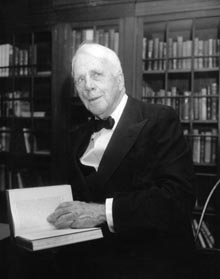
Robert Frost is one of the most popular American poets, one of the few whose poems are known to more than just a handful of poetry aficionados. He carefully cultivated his public image as the crusty old New Englander, he of the simple declarative words and the keen nature observations. He even looked like the grandfatherly type:

Those of you who read this blog regularly may know that I’m a fan of Robert Frost. A big fan, actually. I consider him a poet of surface simplicity and great underlying complexity, a complexity I neither saw nor understood when young. But perhaps I felt it and sensed it.

I think Frost can be appreciated on both levels, actually. But it’s the second I’m interested in writing about today.

Here’s the poem, “The Road Not Taken,” to refresh your memory:

Two roads diverged in a yellow wood,
And sorry I could not travel both
And be one traveller, long I stood
And looked down one as far as I could
To where it bent in the undergrowth;

Then took the other, as just as fair,
And having perhaps the better claim,
Because it was grassy and wanted wear;
Though as for that the passing there
Had worn them really about the same,

And both that morning equally lay
In leaves no step had trodden black.
Oh, I kept the first for another day!
Yet knowing how way leads on to way,
I doubted if I should ever come back.

I shall be telling this with a sigh
Somewhere ages and ages hence:
Two roads diverged in a wood, and I–
I took the one less traveled by,
And that has made all the difference.

Like much of Frost, it seems to say one thing—it even does say that one thing—and yet on further study it also is saying something else, something more difficult to discern. It’s that second “something,” combined with the first, that gives the poem its great resonance and power.

On the surface, of course, it’s a lovely poetic expression of an obvious and perhaps even cliched thought: we come to a crossroads in life, make a decision, and that decision affects our entire future.

Or does it?

The poem is also about the speaker, an older person looking back and telling a tale—“constructing a reality” as it were—in reminiscence. The poem contains a set of lines that the casual reader can ignore or think unimportant, but good poets such as Frost rarely waste words.

Why does he initially describe the road he takes as less traveled (“it was grassy and wanted wear”) and then immediately contradict himself (“Though as for that the passing there/Had worn them really about the same”)? Earlier, too, he has said the other road was “just as fair”—another sign of equality. And then, just to make sure we haven’t missed it, he adds “And both that morning equally lay/In leaves no step had trodden black.” Different, or equal? What gives here?

Well, as Frost himself said, “It’s a trick poem—very tricky.” But it’s more than tricky, and more than a joke or a puzzle, because it contains both thoughts at once, and the juxtaposition makes it even more profound. How can we ever know the result of the decisions we make? We can’t, because the road not taken—the one we don’t choose—has consequences we can’t see. We can only guess at any of this, and then later sit back and reflect and tell tales that sound like an explanation. And perhaps the explanation is even true—who knows?

I’m reminded—as I so often am—of one of my very favorite authors, Milan Kundera. He begins The Unbearable Lightness of Being with a reflection on Nietzsche’s strange notion of eternal return—that in some dimension, our lives repeat again and again:

The idea of eternal return is a mysterious one, and Nietzsche has often perplexed other philosophers with it: to think that everything recurs as we once experienced it, and that this recurrence itself recurs ad infinitum? What does this mad myth signify?…

If eternal return is the heaviest of burdens, then our lives stand out against it in all their splendid lightness.

Kundera describes his vacillating hero, Tomas, in the throes of making a decision about whether or not he is in love with a certain woman:

He remained annoyed with himself [for not knowing what he should do] until he realized that not knowing what he wanted was actually quite natural.

We can never know what to want, because, living only one life, we can neither compare it with our previous lives nor perfect it in our lives to come…There is no means of testing which decision is better, because there is no basis for comparison. We live our lives without warning, like an actor going on cold.

We come to that proverbial fork in the road and a decision must be made. We make it, sometimes after a great deal of vacillation. And then we tell ourselves—with either satisfaction, regret, or ambivalence—that our decision, the road we took, “has made all the difference.”

And perhaps, indeed, it has. Or perhaps we’re just fooling ourselves if we think so. The poet doesn’t have the answer. But he’s awfully good at stating the question, and presenting the paradox in words and images that speak to the heart as well as the mind.

[NOTE: Comments to this post didn’t transfer properly from my old blog. If you wish to see them, click here.]

Posted in Best of neo-neocon, New England, Poetry | Leave a reply

New Years Day

The New Neo Posted on January 1, 2006 by neoJanuary 1, 2006

I’m taking the day off, just relaxing. At the moment I’m enjoying my new computer, which is finally connected and running.

Once again, Happy New Year to you all–and see you tomorrow!

Posted in Uncategorized | 7 Replies

And a Happy New Year to you all!

The New Neo Posted on December 31, 2005 by neoDecember 31, 2005

Don’t get me wrong; I do indeed enjoy a party, and hardly ever turn down an opportunity to go to one.

But I’ve always seen New Year’s Eve more as a time for reflection and nostalgia than wild celebration, kind of bittersweet: out with the old, in with the new, transitions, changes, auld lang syne, all that jazz. As a teenager, I did my raucous bit in going to Times Square, but nowadays it’s more likely to be a get-together with old friends, as it is tonight (with a stop-off at my mother’s place; they party rather early there).

I want to wish all of you a wonderful New Year’s Eve, partying or no, wild or staid, late or early–and, more importantly, a wonderful New Year.

Posted in Uncategorized | 12 Replies

Let me have just a few words with you…

The New Neo Posted on December 31, 2005 by neoOctober 23, 2009

Since I’ve been blogging, every now and then I’ve heard from readers complaining to me that—well, there’s just no good way to put this—my posts are much too long.

Recently I received an e-mail on the subject from reader David Foster, which was a model of succinctness:

Your blog is great, but I have only one objection…your posts are waaaay too long. Can’t you condense your thoughts a little?

Therein lies a tale. Allow me to explain. Got a moment? (Or an hour?)

It’s not as though I don’t understand exactly what all these readers are saying. In fact, I would dearly love to be able to condense my thoughts—not just a little, but a lot. It would be a great thing all around.

I’ve noticed that many of the popular bloggers write quick and punchy. They say something in quick little jabs, and then move on. I like to read them, too—easy on the eyes, easy on the time. I think it’s clear that more people are going to want to read something that doesn’t take so much effort to plow through, rather than something so long and—yes, some would even say, so boring.

I’ve tried to shorten my posts, believe me. And every now and then I do write a short post.

But I have to admit that the majority of my posts range from somewhat long to superlong. They take work, and often a lot of that work is research.

So, why do I do it that way? I’ve asked myself that question many times. Am I a glutton for punishment–for both dishing it out, and for taking it?

The answer is as that I just can’t write short and punchy, even if I set out to do so—at least, not very often. I think the reason is that the topics and the questions that most interest me seem complex; and the answers, likewise, complex. I want to explain, I want to explore many sides of a question, and in the process I want to make myself as clear as possible. I want to present the details that so fascinate me and give color and richness. I want to build a case.

Sometimes the details are the very things that drove me to do the research in the first place, and I want to flesh them out. Sometimes it’s the most complete possible understanding I’m striving for (such as with my “change” series). Sometimes it’s the story of an entire life—such as Paul Robeson. How can such a thing be told quickly? The evidence has to be amassed, just as the life has to be lived—slowly.

I think each blogger, each writer, has a niche and a specialty. Sometimes we don’t choose them, exactly; they seem to choose us. And I seem to have chosen this one, or vice versa.

I hope that those of you who stick with me enjoy the journey, and I thank you for your patience and for your fascinating (and sometimes quite thorough!) comments.

There, now–that didn’t take too long, did it?

[ADDENDUM: After reading many of the comments, I want to add two things. The first is that the original message from Mr. Foster seemed to me to be a basically friendly one (and one I even share, in a way). I never thought he was suggesting I turn the blog into a series of pithy sound bites, just some judicious condensation.

The second is to offer a hearty thanks to everyone who expressed appreciation for my posts—whether they read them all or not. If I do meander, I always try to do so with a purpose.]

Posted in Blogging and bloggers, Me, myself, and I | 41 Replies

To speak or not to speak: coming out as a neocon

The New Neo Posted on December 30, 2005 by neoFebruary 8, 2010

This essay, which appeared at the American Thinker, is by blogger and sometime visitor Bookworm, of Bookwormroom.

It’s entitled, “Confession of a Crypto-Conservative Woman,” and it’s on a topic dear to my heart: being a closet neocon (a neo-neocon, at that) in a true blue town.

Bookworm writes:

I was at a party last year when a woman I know suddenly burst out, “I hate Bush. He’s evil. I wish he’d just drop dead” ”“ and everyone around her verbally applauded that statement.

At a lunch with some very dear friends, the subject of the Iraq war came up and one of my friends, a brilliant, well-read, well-educated man, in arguing against the War, announced as his clinching argument the “fact” that “Bush is an idiot.”…

This is me: I grew up in this same liberal environment and was a life-long Democrat. ..And then things changed: Although I realize that my journey to the right began before 9/11, there is no doubt that 9/11 was my moment to cross the Rubicon…I suddenly had to confront the fact that I was a neocon living in one of the bluest of Blue corners in America.

How did I react to my change? With silence. You see, having lived a lifetime on the Left myself, I instantly realized that my new outlook would not be greeted as an intellectual curiosity, to be questioned politely and challenged through reasoned argument.

Instead, I would be deemed to have gone to the dark side. After all, if Bush is evil, his followers must be evil too. …I also knew from my years on the Left that the debate wouldn’t revolve around facts and the conclusions to be drawn from those facts…it’s the futility of argument and the personal animus behind political argument in Liberal communities that results in something I call closet- or crypto-conservatism. I further believe that this is a syndrome especially prevalent amongst women…

In a woman’s world, you don’t earn any social points for staking out an extreme position and defending it against all comers. Men might garner respect for doing so, and experience the exhilaration of battle along the way; women are more likely find themselves on the receiving end of some serious social isolation, and to find the road to this isolation stressful and frightening.

Did I mention how nice my community is? And how child oriented? I enjoy being well-integrated into this community, as do my children, and neither the kids nor I would function well in light of the inevitable social repercussions that would occur if I were to admit that, well, I kinda, sorta, well, yeah, I voted for “that man ”“ that evil man.” …I’ve also managed to confirm through talking to a few other conservative women I know who also live in liberal communities that they too keep their mouths shut about their politics…

The question I struggle with is whether I ought to elevate my political principles over my day-to-day needs. Currently, I don’t believe there is any benefit, large or small, moral or practical, to such a step…

I’ve quoted liberally (pun intended) from Bookworm’s essay because I want to convey the full flavor of the dilemma she faces. It’s one I understand only too well, and one with which I sympathize. I’ve written about it before, here (note, especially, the comments section). I know the ostracism of which she speaks, and I know how important social connection are, and what it’s like to be looked at by supposed friends whose eyes are forever changed and distanced.

But, despite all that empathy for Bookworm, I have to say that I part company with her conclusion. Oh, it’s not that I speak up all the time (if you look at that post of mine I previously linked to, you’ll see that in fact I don’t). I weigh each situation to decide whether it seems like a good idea or whether it seems like an exceptionally futile exercise, and try to act accordingly.

At social gatherings where I’m among strangers, people I’m not likely to meet again, I often don’t bother. But with anyone who is a friend—close, or even not-so-close—sooner or later I feel the need to “come out” and declare myself.

Why? After all, I’m not that keen on combat, or on spinning my wheels in useless arguments. I like to have my friends and keep them, too; I’m not interested in attaining pariah status for the sake of being able to pat myself on the back for bravery.

But over the past couple of years I’ve spoken out to virtually every friend I have, and gotten quite a variety of responses. A few have stopped speaking to me, and that makes me both sad and angry. Many look at me ever after with “that look” in their eyes—at least, I perceive that look, and I don’t think I’m imagining things. It appears that my relationship with them has changed in some subtle way, and not for the better; they now see me as strange and somehow not quite trustworthy or kindly.

Some tease me, as though they can’t quite believe it’s true and are trying to test things out in a light way. A few had extremely angry and rejecting outbursts at first, but then got over it—outwardly, at least. A couple of people have decided never to speak politics to me again, in order to preserve our friendship. Still others, to my delight, can have lucid and calm discussions with me on the topic.

There are really two reasons I’ve decided to speak out to friends. The first is personal—and perhaps self-indulgent, in a way. I’ll call it, for want of a better name, integrity. Or perhaps that old liberal notion: authenticity. Or maybe honesty.

Call it what you will. The idea is that I can’t keep as a deep dark secret something so important and basic to my way of thinking from people I consider my friends. Painful though it may be, if the friendship can’t handle it, I’m willing to kiss the friendship goodbye. Because what sort of a friendship is it, if it’s based on something so very fragile?

The second reason I tell friends is actually more important, because it’s not about me. It’s this: if I don’t speak up, and if people like me (and Bookworm, and her other crypto-con friends) don’t speak up and “out” ourselves, then it simply perpetuates the myths of those who consider The Other Side to be monstrous.

Yes, some will consider you an awful person if you tell the truth about your current beliefs. But your speaking up may make others wonder about their preconceptions. If Republicans and neocons and even liberal hawks are considered the absolute Other, they can continue to be demonized and typecast. If it’s you, on the other hand, who’s the neocon—and not some stranger—you, that nice mother down the street who bakes the brownies; you, the one with the jokes and the helping hand; you, who’s always been so smart and so kind–then how can all of Bush’s supporters be cruel and stupid?

It’s easy to move through life in a liberal bubble if everyone around who disagrees is silent and invisible. The only way to change that is to challenge it by standing up, speaking out, and bursting the bubble. It’s very difficult; but you may find, as I did, that most of your worthwhile relationships survive the blow, although many are never quite the same again.

Posted in Friendship, Leaving the circle: political apostasy, Neocons | 121 Replies

What hath monotheism wrought?

The New Neo Posted on December 29, 2005 by neoDecember 15, 2007

This will be a short riff–a mere sketch, really–sparked by a comment that was part of an interview in the NY Times Magazine, drawn to my attention by this post of Gerard Van der Leun’s at American Digest.

A historian named Peter Watson, author of the recent Ideas: A History of Thought and Invention, From Fire to Freud, is being interviewed by the Times:

Q: What do you think is the single worst idea in history?

WATSON: Without question, ethical monotheism. The idea of one true god. The idea that our life and ethical conduct on earth determines how we will go in the next world. This has been responsible for most of the wars and bigotry in history.

Q: But religion has also been responsible for investing countless lives with meaning and inner richness.

WATSON: I lead a perfectly healthy, satisfactory life without being religious. And I think more people should try it.

I suggest you read Van der Leun’s post, which skewers Watson so effectively and thoroughly that there’s no need for me to even attempt to add anything to that endeavor (although Watson proves himself to be an enticing target by managing to be exceptionally condescending to both taxi drivers and the institution of the novel, which he says offers truths that “don’t stay with you very long or help you do much”–speak for yourself, Watson!)

Although Watson is billed as a historian, his background is not as a historian per se, it’s as a journalist and, of all things, a psychiatrist (he left the field way back in the 60s).

As Van der Leun points out, Watson is somehow ignoring the vast good that ethical monotheism has done in setting up our entire “inner-directed system of morals.” It is indeed extraordinary that Watson can call it “the single worst idea in history,” whatever suffering has been inflicted, at times, in its name.

What is going on here, besides the fact that Watson considers himself to be both an atheist and a fine fellow, and conveniently ignores the underpinnings of the society of which he is a member, and the fruits of which he enjoys? Well, although Watson shows himself in the short but decidedly unsweet Times interview to be both elitist and arrogant, my guess is that he’s not quite as dumb as he sounds.

What I believe is actually lurking somewhere in the background of Watson’s murky thoughts is a different but tangentially related idea, once that is worth discussing. That thought is the following: religions which teach that (1) they are not just the answer, but the only answer, and (2) this answer is the only one for everyone on earth, and (3) this answer must be spread not just by proselytizing but also by violence, if necessary, and (4) great rewards in the afterlife will be bestowed on those who spread that religion through violence–such religions are indeed responsible for a great deal of suffering on earth, past and present.

Right now, however, the list of religions that fit that description is rather short. In fact, the only one I know of happens to be Islam–in fact, only certain subgroups of Islam. But ’tis enough, ’twill serve.

Posted in Religion | 41 Replies

Ten Worst Americans

The New Neo Posted on December 28, 2005 by neoAugust 28, 2009

It seems to be the time of year for Lists of Ten. The beautiful Alexandra of the beautiful blog All Things Beautiful has challenged bloggers to name the Ten Worst Americans of the past 230 years.

I might be able to come up with some better candidates than the following if I were to do a couple of hours’ research on this. But right off the top of my head, these are my choices, take ’em or leave ’em (offered in no particular order):

(1) Benedict Arnold can’t possibly be left off such a list. His name has become synonymous with “traitor,” and his aim appears to have been money and self-aggrandizement, rather than any higher priniciple.

In this, Arnold seems to have something in common with…

(2) Aldrich Ames. Betrayal after betrayal, cold as ice. And the motive? Filthy lucre, and perhaps just the sheer thrill and gamesmanship of it all.

Very much like…

(3) Robert Hanssen, another long-time spy who seemed to thrive on the idea of spying and betraying.

And now we jump to…

(4) Father Coughlin, radio broadcaster and Fascist-admiring anti-Semitic bigot of the 30s. He’d fit right in today, I think, by the looks of this quote:

Stalin’s idea to create world revolution and Hitler’s so-called threat to seek world domination are not half as dangerous combined as is the proposal of the current British and American administrations to seize all raw materials in the world. Many people are beginning to wonder who they should fear most–the Roosevelt-Churchill combination or the Hitler-Mussolini combination.

But far worse were…

(5) lynch mobs. Murder, bigotry, and disrespect for the rule of law.

Speaking of murder, we have…

(6) Timothy McVeigh. Mass murderer, American terrorist.

And then there’s our own American Brutus….

(7) John Wilkes Booth, who thought he’d be applauded for bringing down the tyrant Lincoln.

Someone who might have helped bring down a real tyrant, but didn’t, was…

(8) Walter Duranty, Pulitzer-prizewinning liar, whose mendacity helped millions die under Stalin when the truth might have alerted the world to what was going on.

Speaking of mendacity (although of a much less consequential level than Duranty’s in terms of lives lost) we have a personal unfavorite of mine….

(9) Michael Moore, another propagandist with a marked lack of devotion to the truth.

And, in the category of charismatic and destructive charlatans, there is…

(10) Jim Jones. His descent into madness and true evil cost the lives of close to one thousand people. If you want to learn how he managed to exert that sort of control over so many, read this extraordinary account of how it happened.

Posted in People of interest | 27 Replies

Top 10 things New Yorkers can do to stay sane in ’06

The New Neo Posted on December 28, 2005 by neoAugust 28, 2009

I’ve been asked by Shrinkwrapped to come up with my suggestions for the “Top Ten Things New Yorkers Can Do to Stay Sane in ’06.”

I’m not ordinarily one for giving advice (I don’t think people usually take it), nor am I a New Yorker any more.
But hey, I’ve been asked, so I’ll give it a shot.

Some of the following are specific to New Yorkers. But most are for anyone (including the author: physician, heal thyself!):

(1) Don’t believe everything you read in the NY Times. I was going to say “don’t believe anything you read in the NY Times,” but that would lead to insanity of a different–and more serious–variety.

(2) Walk more. Manhattan’s a small place, actually. And when you take the subway, look around and take satisfaction in the amazing diversity that is America.

(3) If watching Bush makes your stomach churn with rage, turn off the TV. I used to do it back when I was a liberal, first with Nixon and then with Reagan. It got me through some hard times.

(4) Forget about trying to eat merely to fuel your body. Food isn’t only sustenance. It is pleasure, entertainment, solace, etc., and trying to take that away from the equation will just lead to misery. Ask the Puritans.

(5) Don’t try to protect your children from all hurt. It won’t help them, and it’s impossible, anyway. But don’t you be the one to dole out the hurt unnecessarily. There’s plenty that will come naturally; your task is to help them get through it.

(6) If you’ve sustained a loss, remember that grieving doesn’t have a time frame. In fact, it can take many years, or even a lifetime. Loss changes you, and there’s no going back, so don’t expect to.

(7) Visit flyover country at least once. Maybe Kansas City, for some BBQ?

(8) Remember the words of Winston Churchill–almost any words of Churchill will do–but how about these, for starters: “Success is going from failure to failure without a loss of enthusiasm.”

(9) When on vacation, turn off your cellphone and stay away from the computer.

(10) Do as I say, not as I do.

[NOTE: Here’s the link to Shrinkwrapped’s compendium of the psychobloggers’ lists.]

Posted in Getting philosophical: life, love, the universe | 18 Replies

Post navigation

← Previous Post
Next Post→

Your support is appreciated through a one-time or monthly Paypal donation

Please click the link recommended books and search bar for Amazon purchases through neo. I receive a commission from all such purchases.

Archives

Recent Comments

  • charles on An update on my ex
  • Sharon W on An update on my ex
  • om on News roundup
  • huxley on Open thread 9/9/2026
  • Niketas Choniates on Postpartum psychosis is not postpartum depression

Recent Posts

  • An update on my ex
  • News roundup
  • The New Hampshire primary and the continuing saga of Jeanne Shaheen
  • Open thread 9/9/2026
  • Another day, another fraud

Categories

  • A mind is a difficult thing to change: my change story (17)
  • Academia (328)
  • Afghanistan (98)
  • Amazon orders (6)
  • Arts (8)
  • Baseball and sports (164)
  • Best of neo-neocon (91)
  • Biden (536)
  • Blogging and bloggers (595)
  • Dance (292)
  • Disaster (244)
  • Education (323)
  • Election 2012 (360)
  • Election 2016 (566)
  • Election 2018 (33)
  • Election 2020 (513)
  • Election 2022 (114)
  • Election 2024 (403)
  • Election 2026 (94)
  • Election 2028 (13)
  • Evil (129)
  • Fashion and beauty (324)
  • Finance and economics (1,043)
  • Food (317)
  • Friendship (48)
  • Gardening (18)
  • General information about neo (4)
  • Getting philosophical: life, love, the universe (734)
  • Health (1,162)
  • Health care reform (545)
  • Hillary Clinton (184)
  • Historical figures (337)
  • History (716)
  • Immigration (449)
  • Iran (465)
  • Iraq (227)
  • IRS scandal (71)
  • Israel/Palestine (821)
  • Jews (437)
  • Language and grammar (365)
  • Latin America (212)
  • Law (2,977)
  • Leaving the circle: political apostasy (124)
  • Liberals and conservatives; left and right (1,322)
  • Liberty (1,117)
  • Literary leftists (14)
  • Literature and writing (394)
  • Me, myself, and I (1,499)
  • Men and women; marriage and divorce and sex (930)
  • Middle East (384)
  • Military (324)
  • Movies (353)
  • Music (533)
  • Nature (261)
  • Neocons (32)
  • New England (184)
  • Obama (1,738)
  • Pacifism (16)
  • Painting, sculpture, photography (131)
  • Palin (93)
  • Paris and France2 trial (25)
  • People of interest (1,043)
  • Poetry (258)
  • Political changers (178)
  • Politics (2,793)
  • Pop culture (397)
  • Press (1,635)
  • Race and racism (882)
  • Religion (428)
  • Romney (164)
  • Ryan (16)
  • Science (641)
  • Terrorism and terrorists (971)
  • Theater and TV (266)
  • Therapy (71)
  • Trump (1,630)
  • Uncategorized (4,558)
  • Vietnam (109)
  • Violence (1,446)
  • War and Peace (1,028)

Blogroll

Ace (bold)
AmericanDigest (writer’s digest)
AmericanThinker (thought full)
Anchoress (first things first)
AnnAlthouse (more than law)
AugeanStables (historian’s task)
BelmontClub (deep thoughts)
Betsy’sPage (teach)
Bookworm (writingReader)
ChicagoBoyz (boyz will be)
DanielInVenezuela (liberty)
Dr.Helen (rights of man)
Dr.Sanity (shrink archives)
DreamsToLightening (Asher)
EdDriscoll (market liberal)
Fausta’sBlog (opinionated)
GayPatriot (self-explanatory)
HadEnoughTherapy? (yep)
HotAir (a roomful)
InstaPundit (the hub)
JawaReport (the doctor’s Rusty)
LegalInsurrection (law prof)
Maggie’sFarm (togetherness)
MelaniePhillips (formidable)
MerylYourish (centrist)
MichaelTotten (globetrotter)
MichaelYon (War Zones)
Michelle Malkin (clarion pen)
MichelleObama’sMirror (reflect)
NoPasaran! (bluntFrench)
NormanGeras (archives)
OneCosmos (Gagdad Bob)
Pamela Geller (Atlas Shrugs)
PJMedia (comprehensive)
PointOfNoReturn (exodus)
Powerline (foursight)
QandO (neolibertarian)
RedState (conservative)
RogerL.Simon (PJ guy)
SisterToldjah (she said)
Sisu (commentary plus cats)
Spengler (Goldman)
VictorDavisHanson (prof)
Vodkapundit (drinker-thinker)
Volokh (lawblog)
Zombie (alive)

Meta

  • Log in
  • Entries feed
  • Comments feed
  • WordPress.org
©2026 - The New Neo - Weaver Xtreme Theme Email
Web Analytics
↑