↓
 

The New Neo

A blog about political change, among other things

  • Home
  • Bio
  • Email
Home » Page 1847 << 1 2 … 1,845 1,846 1,847 1,848 1,849 … 1,932 1,933 >>

Post navigation

← Previous Post
Next Post→

Remembering Friedman

The New Neo Posted on November 30, 2006 by neoNovember 30, 2006

I’ve written about economist Milton Friedman’s life, here, but I wanted to add a link to a lovely reminiscence by Friedman’s good friend Mark Skousen, complete with Mutt-and-Jeff photo of Friedman next to John Kenneth Galbraith (and the equally tall George Stigler).

[Via Pajamas Media.]

Posted in Uncategorized | 2 Replies

The paradoxial dangers of “humane war”

The New Neo Posted on November 29, 2006 by neoAugust 3, 2007

Varifrank has written about our modern way of warfare and our attempt to wage it with greater respect for human life. Please take a look.

Respect for human life is a good thing, right? I would be the first to say so. War is an affront to that respect because it inevitably involves wholesale killing–not only of the military, but of civilians.

The history of warfare is of one horrific mess of slaughter and destruction. In ancient times whole cities were routinely razed, their inhabitants slain or sold into slavery. Those traditional Four Horsemen of the Apocalypse–Pestilence, War, Famine, and Death–rode together for a reason, because the deliberate killing of warfare was often accompanied by disease and starvation.

The First World War represented a new crescendo in terms of military casualties (take a look; it makes shocking reading even now). World War I could aptly be described as a carnage that destroyed a large percentage of the best and brightest of a whole generation of Western Europe, and all for a cause that remained murky. That war, in particular, represented a turning point in the whole idea of war as a glorious endeavor, and replaced it with the notion of war as a dreadful and in many cases pointless slaughter.

This new idea, of course, did not stop the world from entering into an even worse conflagration in just a few years. I say “worse” because of sheer numbers and scope, as well as the much higher number of deaths within the civilian population. During World War I most civilian deaths had been at the hands of the ancillary Horseman of Pestilance: specifically, influenza. During World War II most civilian deaths were from the widescale aerial bombardment of cities.

Pacifists like to say that war has never solved anything. But that is most manifestly untrue. Certain things have indeed been solved by war, such as the ambitions of Adolf Hitler, and/or the ownership of certain territory.

It depends, of course, on one’s definition of the word “solved.” Human nature is such that the lion permanently bedding down with the lamb seems highly unlikely. Conflicts continue and almost certainly always will. New tyrants rise up–and, strangely enough, those tyrants tend to resist efforts at talk and/or reason and/or compromise. The call of power and violence always beckons.

But we have become reluctant to respond by killing on the scale of previous wars. That seems a good thing, an example of progress in the way people look at each other–not as cannon fodder, but as fellow human beings. At the same time (and this is no coincidence) we have been able to develop weapons so smart that we can come much closer than ever before to realizing our humane goal of reducing casualties, especially civilian ones.

It’s a one-sided development, however, and therein lies the rub. The enemy doesn’t seem to share it; and, although they also don’t yet share our possession of nuclear weapons, they are determined to acquire them and no doubt they will do so in fairly short order.

What’s more, the enemy has learned how to use our reluctance to harm civilians to their advantage, by the use of human shields and the purposeful targeting of civilians on both sides. This enemy doesn’t just not care how many of us they kill; they are positively delighted to do so, and revel in it; and they are not at all reluctant to kill a goodly number of their own civilians, either directly, or by letting us do them the favor as they carefully position those civilians in harm’s way.

Good intentions are something, but they are not everything. As the proverb says, they often have a tendency to backfire and lead to their opposite. The enemy doesn’t see our kindly attitude as an example of what nice guys we are; they see it as a weakness to be exploited. And exploit it they do.

So we are left with a dilemma. Our kindness will probably lead to widespread killing–if not now, then later; if not by us, then by others. So many make the argument that if we are to wage war, it must be waged with greater vigor and ruthlessness than we seem able to muster lately.

Varifrank points to how the Allies in World War II managed to “persuade” European civilians to cooperate and turn in insurgents hiding in their midst: by artillery barrage of the town itself. He also points out that our failure to do this sort of thing in the current situation of assymtrical warfare with the present enemy leaves civilians open to the tender mercies of those enemies. And that unfortunately, is no mercy at all.

If you haven’t yet read Meade’s essay on the Jacksonian tradition, please do. The Jacksonian strain in American culture is not eager to go to war. But it argues that if one does do so, it can’t be done with halfway measures. And this is not because Jacksonians are especially bloodthirsty. Rather, they believe that, in the end, a polite and respectful war leads to more bloodshed, and fails to resolve even the limited number of problems that wars can resolve.

This doesn’t mean that every war requires the no-holds barred use of every weapon in our arsenal. But the Gulf War is an excellent modern-day example. Our failure to topple Saddam did no favor to anyone, and some of the distrust sown in the civilian population of Iraq for our reneging on promises bore fruit in their reluctance to trust us in this later, and linked, war.

The official combat phase of the present Iraq war was so quick and inflicted so few casulaties on us that people often fail to realize that one of the reasons for this was not just our superior firepower, but the fact that the enemy had learned that conventional war was not the best way to engage us. So it laid low and made plans for an “insurgency” that would have absolutely no mercy on the civilian population. This would not only have the effect of terrorizing that unforunate group, but of sapping American will, already considered weak.

Speaking of that weakness, one would do well to ponder this statement by Joseph Stalin, made to Zhou Enlai in 1952 and quoted in the book Vietnam the Necessary War by Michael Lind (an author who, by the way, defies attempts at right-left categorization):

No, Americans don’t know how to fight. After the Korean War, in particular, they have lost the capability to wage a large-scale war…They are fighting little Korea, and already people are weeping in the USA. What will happen if they start a large scale war? Then, perhaps, everyone will weep.

And so it still plays out. Whether the Jacksonian impulse will reassert itself in American life–what it might require to get to that point, what form the response will take, and how many will weep as a result–is anybody’s guess. It won’t be pretty–but then, war never is, despite our best efforts to make it so.

Posted in War and Peace | 87 Replies

Chaos, tyranny, and fledgling democracies in the Middle East

The New Neo Posted on November 28, 2006 by neoJuly 25, 2009

Listening to part of President Bush’s press conference in Estonia (see the middle section of the linked article for a small discussion), two things struck me.

The first was the support Bush still gets from a country such as Estonia, so recently emerged from its own long nightmare of Soviet domination, and undergoing the struggles all such nations experience in trying to implement the goal of becoming a democratic and functioning nation. Estonians and other post-Soviet Eastern Europeans understand the hardships involved better than most nations on earth do; certainly better than we in the United States.

The second was that Bush is not abandoning the Iraqis to the tender mercies of realpolitik–at least rhetorically speaking, at least not yet.

As I wrote not too long ago [I’m in a hurry so will supply the links later]–in dysfunctional nations, there are mostly two choices: chaos or tyranny. If the tyranny is neither too tyrannical nor too dangerous to the rest of the world, tyranny may sometimes be the best of a bad business. The Shah’s Iran is a good example of that; it was replaced with a far worse tyranny.

As Bush pointed out in his press conference, not only Iraq but Lebanon is undergoing a chaotic passage right now. Both nations are struggling democracies attempting to resist both tyranny and chaos. Of course it’s hard, slow, and exceedingly difficult going.

The forces of evil (yes, I will most definitely use that word) are determined to sow chaos in both countries, and in any country in the area that tries to wrest itself from the grip of tyranny. Those pernicious forces know that chaos suits their purposes–not only tempermentally, because they love its nihilistic violence, but strategically as well, because it frightens the populations of the countries involved into desiring the strong hand of a strong leader to make a semblance of order out of the chaos.

Another strategic aim of these forces (which hasn’t been reached so far in the case of Iraq, but might be close to being reached) is to frighten and exhaust the US into abandoning the nation in question to either its chaos or its tyrant (who cares which? then the news will go off our front pages)–or, as the lamentable Jonathan Chait suggested recently in the LA Times, to restore an especially vicious tyrant (none other than Saddam Hussein himself) to power, in order to control the chaos. The truth is that in a place such as Iraq, the chaos was always underneath the surface, waiting to erupt.

And no matter what we do and which we choose: the support of a tyrant, or the attempt to pass through the chaos towards a better government for that country– the chaos and/or the tyranny inherent in such places can always be blamed on the US. And we can run from that chaos, crying that it’s too much for us.

I don’t blame the US for either the tyranny or the chaos. I do blame us, however, for not committing fully to doing whatever needed to be done to subdue the chaos when it first erupted, and for not being ready enough for it. Looters should have been shot at the outset. Al Sadr should have been defanged before his movement had time to grow.

I understand why it wasn’t done; we didn’t want to seem to be a heavy-handed occupying force. But we were an occupying force, occupying a nation that had been defeated in war. We used to know how to do this sort of thing; the aftermath of World War II and the occupation of Germany and Japan are excellent examples. But we no longer seem to have the belief that such a thing is possible. And that belief is key. Without it, we will abandon these countries to their Hobson’s choice of chaos or tyranny.

Posted in Liberty | 74 Replies

It’s all French to me: the Luré§at trial on a technicality?

The New Neo Posted on November 28, 2006 by neoSeptember 19, 2007

This is quite unofficial, but I got an email about the verdict in the Luré§at trial. It was in French, so I used Babelfish to decipher it; therefore the following information is extremely preliminary and rather suspect. However, from what I could discern, it appears he may have gotten off on a technicality that doesn’t go to any of the important issues in the trial.

When I wrote this piece about the trial, I mentioned, “one of [Luré§at’s] defenses appeared to be that he hadn’t actually written the words in question on his website; someone else had.”

And that appears to be the point on which he may have been successful. More later, as I learn it.

[See this and this for additional information about the trial and the more substantive issues it presented. The third trial, that of Gouze, is due to start right about this time.]

Posted in Paris and France2 trial | 2 Replies

Vietnamization; Iraqization: (Part II)

The New Neo Posted on November 27, 2006 by neoMay 21, 2007

[Part I here]

Whatever your opinion of President Nixon’s politics and policies, I think most of us can agree he was a strange and duplicitous man. I was not a fan, to say the least.

I watched many of his televised speeches at the time. They were not memorable, except for a few catch-phrases–mostly ridiculed by college and grad students such as myself–for example, “the silent majority.”

But in my quest to learn more about the Vietnamization phase of the Vietnam War, the part Nixon presided (literally) over, I read this speech of Nixon’s from November of 1969, in which he introduced and elucidated the concept of Vietnamization (as well as mentioning that famous “silent majority”). And it struck me that—well, see for yourselves:

…let me begin by describing the situation I found when I was inaugurated on January 20.
-The war had been going on for 4 years.
-31,000 Americans had been killed in action.
-The training program for the South Vietnamese was behind schedule.
-540,000 Americans were in Vietnam with no plans to reduce the number.
-No progress had been made at the negotiations in Paris and the United States had not put forth a comprehensive peace proposal.
-The war was causing deep division at home and criticism from many of our friends as well as our enemies abroad.

In view of these circumstances there were some who urged that I end the war at once by ordering the immediate withdrawal of all American forces.

From a political standpoint this would have been a popular and easy course to follow. After all, we became involved in the war while my predecessor was in office. I could blame the defeat which would be the result of my action on him and come out as the peacemaker. Some put it to me quite bluntly: This was the only way to avoid allowing Johnson’s war to become Nixon’s war.

But I had a greater obligation than to think only of the years of my administration and of the next election. I had to think of the effect of my decision on the next generation and on the future of peace and freedom in America and in the world.

Well, it’s always risky quoting Nixon, a deeply flawed President. He was paranoid about his enemies, and his paranoia was part of what did him in, via his illegal actions in Watergate. He initiated the notorious “secret bombing” of Cambodia. He was a man profoundly uncomfortable in his own skin, as well. And, in the phrase he used in this speech, Johnson’s war did indeed become Nixon’s war.

But whatever I might think of Nixon, I have to say that his rhetoric in this speech seems unimpeachable (to coin a phrase). Because, in fact, the abandonment of Vietnam, which finally occurred post-Watergate, in 1975, led to a worldwide sense that America had lost the will to fight. We are still feeling its effects now in terms of international perception; the jihadists certainly have taken note, as they will if we withdraw too quickly and too precipitously from Iraq. The Democratic Congress would do well to ponder Nixon’s words and his warnings:

…many others, I among them, have been strongly critical of the way the war has been conducted.

But the question facing us today is: Now that we are in the war, what is the best way to end it?

In January I could only conclude that the precipitate withdrawal of American forces from Vietnam would be a disaster not only for South Vietnam but for the United States and for the cause of peace.

For the South Vietnamese, our precipitate withdrawal would inevitably allow the Communists to repeat the massacres which followed their takeover in the North 15 years before…

For the United States, this first defeat in our Nation’s history would result in a collapse of confidence in American leadership, not only in Asia but through-out the world.

And try this on for size:

-A nation cannot remain great if it betrays its allies and lets down its friends.
-Our defeat and humiliation in South Vietnam without question would promote recklessness in the councils of those great powers who have not yet abandoned their goals of world conquest.
-This would spark violence wherever our commitments help maintain the peace in the Middle East, in Berlin, eventually even in the Western Hemisphere.
Ultimately, this would cost more lives.
It would not bring peace; it would bring more war.

Nixon went on to outline the principle that Vietnamese forces should be fighting for Vietnamese freedom. He outlined the goal of withdrawing American troops while training the South Vietnamese to take over, but he said:

I have not and do not intend to announce the timetable for our program. And there are obvious reasons for this decision which I am sure you will understand.

And then there’s the following; if more prescient words were ever spoken about Vietnam, I’m not aware of them [emphasis mine]:

In speaking of the consequences of a precipitate withdrawal, I mentioned that our allies would lose confidence in America.

Far more dangerous, we would lose confidence in ourselves. Oh, the immediate reaction would be a sense of relief that our men were coming home. But as we saw the consequences of what we had done, inevitable remorse and divisive recrimination would scar our spirit as a people…Let us be united for peace. Let us also be united against defeat. Because let us understand: North Vietnam cannot defeat or humiliate the United States. Only Americans can do that.

Vietnamization was dismissed by many as a sham, and of course in the end our financial abandonment of the ARVN and the South Vietnamese meant we’ll never know what would have happened if we had kept up the economic support at a decent level. This article posits a believable case that, by the time we pulled the plug on the South, a turning point had been reached that would have allowed them to repel the North if they had been given the financial resources to do so. We will never know for sure, of course.

At any rate, we do know that Nixon’s Vietnamization policy did “work” in one respect: he withdrew US fighting forces from Vietnam. It occurred over a period of four years; here’s a chart that shows the pace of reduction of US combat forces, which were all gone by 1973:

The goal of withdrawal was accomplished. But Nixon’s greater fears–the loss of faith in the US, both abroad and at home–were realized. We stand on the brink of major decisions in Iraq which could cause an intensification of this realization, with far graver possible consequences.

Posted in Iraq, Vietnam | 49 Replies

Realism for our times*

The New Neo Posted on November 27, 2006 by neoNovember 27, 2006

Robert Kagan and William Kristol have something to say in the Weekly Standard about the new yen for realpolitik:

So let’s add up the “realist” proposals: We must retreat from Iraq, and thus abandon all those Iraqis–Shiite, Sunni, Kurd, and others–who have depended on the United States for safety and the promise of a better future. We must abandon our allies in Lebanon and the very idea of an independent Lebanon in order to win Syria’s support for our retreat from Iraq. We must abandon our opposition to Iran’s nuclear program in order to convince Iran to help us abandon Iraq. And we must pressure our ally, Israel, to accommodate a violent Hamas in order to gain radical Arab support for our retreat from Iraq.

This is what passes for realism these days. But of course this is not realism. It is capitulation. Were the United States to adopt this approach every time we faced a difficult set of problems, were we to attempt to satisfy our adversaries’ every whim in order to win their acquiescence, we would rapidly cease to play any significant role in the world. We would be neither feared nor respected–nor, of course, would we be any better liked. Our retreat would win us no friends and lose us no adversaries.

What our adversaries in the Middle East want from us is very simple: They want us out. Unless we are prepared to withdraw, not just from Iraq but from the entire region, and from elsewhere as well, we had better start figuring out how to pursue effectively–realistically–our interests and goals. This is true American realism. All the rest is a fancy way of justifying surrender.

And the Washington Post seems to me to be suffering from multiple personality–or it just that this editorial was written by a committee? For the most part, the author[s] explain why Iran and Syria can’t be reasoned with, and do it rather well. They call for more than talks as a remedy; a “big stick” is needed. But there is a strange reliance on the supposed power of UN sanctions–not only a pipe dream at this point, but a worthless pipe dream, at that.

The Post seems relatively clear on what the problem is. But I’m afraid their solution more closely resembles a small toothpick than a big stick.

[* See this.]

Posted in Uncategorized | 21 Replies

“Obsession”–the Left has theirs, as well

The New Neo Posted on November 26, 2006 by neoNovember 26, 2006

Fox News has been doing some interesting and rather gutsy things of late, not by blogosphere standards but by network standards. First, there was the Glenn Beck airing of “Exposed,” and now a recent showing of a broadcast featuring the film “Obsession.”

Some of the footage in the two works is similar or the same. Much or most of it is familiar to those who read blogs But apparently this sort of thing is news to many people.

Taking a look at it last night, I watched footage of radical jihadist Islamists ranting against the US, Israel, the Jews, and the West in the fashion I’ve come to consider typical of the genre, and it struck me that their message is the worst and most blatant example of imperialistic ambition I’ve ever seen.

Of course, I wasn’t around when Alexander was setting about his conquests, nor even for Hitler, and both were determined to have the world fall under their dominion and sway. Nor, as far as I know, were they especially secretive about their ambitions.

But there are a few things about radical Islamist jihadists that make them potentially even more dangerous. As the program pointed out, the pool of willing jihadists is potentially larger–there are more countries and people involved available for recruitment. Nazism, although theoretically appealing to any person on earth, was in fact a more local German/Austrian phenomenon; the exceptions never constituted a real movement in other countries.

Islamist jihadists have been from the start a pan-Islamic movement, and Islam covers a lot of territory already. They also have a beachfront among the Muslim population of the Western world, and can attract a certain number of followers there for perpetrating inside jobs. In addition, of course, there is the fact that the movement is based on, and feeds off, a religion rather than a “mere” political movement, and therefore is not really of this world–which gives it a far more powerful draw, and far more powerful weapons to use: eternal reward, and war for the glory of God.

But its blatant and domineering imperialism, whose goal (among other things) it to destroy human freedom and all the wonders of the Enlightenment, is minimized or virtually ignored by the Left for the most part (or even tacitly supported, as a foil to Western imperialism, capitalism, whatever “ism” offends the Left) because of its third world origins. The Left follows the rules of the PC Commandments (and if you don’t recall them, now would be a good time for a quick review).

Islamist jihadist imperialist ambitions don’t fit into the Left’s preconceived and rather rigid notions of what’s dangerous or even what’s possible. Nothing in the third world can threaten us, by definition, and everything bad about it is caused by us, by definition. And so the clear and forthright, unashamed, unrepetant threats, ambitions, and raw hatred being expressed on a daily basis in the world of the jihadi are not taken seriously, except as responses to Western crimes, both real and imaginary.

[CORRECTION: It’s been pointed out to me that Glenn Beck’s “Exposed” was aired on CNN, not Fox.}

Posted in Uncategorized | 72 Replies

More fun with sitemeters: reading in Tehran

The New Neo Posted on November 25, 2006 by neoJuly 25, 2009

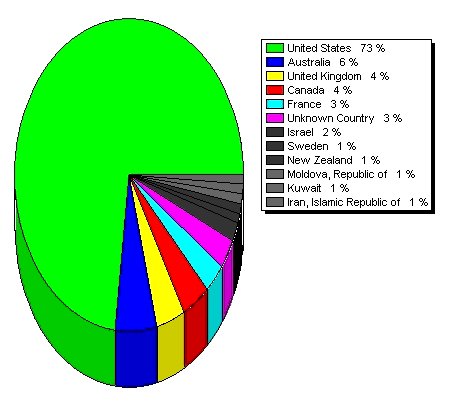
When I first started my blog one of the main attractions was to click on my sitemeter. It was astounding for me to see that anyone was reading here at all, and to watch the numbers climb was satisfying. There was a time when 100 visitors in a day seemed a richness beyond measure. Viewing the breakdown of countries from which they came was an occasion for more awe: someone in Japan, reading my blog? Australia, India, Kuwait?

Now, of course, I’m somewhat jaded. But never totally so; it still seems a wonderful and almost magical thing that people from all over the world can come to read the words I type (excuse me: keyboard) onto a computer in a little room on the second floor of a house in a moderate-sized town in northern New England. I’m often alone when I write and when I hit that “publish post” button. But I’m never really alone at all.

The other night I took a glance at the country distribution on my sitemeter. I hadn’t done that in a long time. What I found was a typical late-night spread here:

I noticed the one from Iran especially. I’ve found in the past that this sort of visitor is usually–although certainly not always–the result of a Google search.

So, what had brought this particular visitor to my blog? Perhaps, I thought, it was my series on the Iranian revolution, a hefty three-parter? Or my post on Nafisi’s Reading Lolita in Tehran?

No, no, a thousand times no. It was a search for discussion of Robert Frost’s poem “The Road Not Taken,” which had led to this post of mine.

So, not Lolita in Tehran, but the quintessential New England poet Robert Frost in Tehran. Somehow, that made me very happy. Call me a cultural imperialist if you wish (and I’m sure some of you will wish), but I like to think that people everywhere have the same basic underlying makeup, and the same response to beauty and the truths expressed in great literature.

Posted in Blogging and bloggers | 21 Replies

Leftovers: the day after

The New Neo Posted on November 24, 2006 by neoNovember 24, 2006

For some it’s Black Friday–biggest shopping day of the year. For me, though, it’s the day of the leftovers. I’m taking the day off from blogging and just having fun with family, friends, and food. Not a bad combination. See you tomorrow!

Posted in Uncategorized | 1 Reply

Happy Thanksgiving: and here’s your pre- or post-prandial podcast

The New Neo Posted on November 23, 2006 by neoNovember 23, 2006

I hope everyone is now safely ensconced with the relatives and friends of your choice, with the turkey about to be eaten, or roasting away merrily in the oven, right on schedule.

In my family (I’m here in NY, by the way) we tend to have a late, leisurely, really fine meal. This year features a reunion of sorts with various distant and usually unseen familial elements; should be interesting.

Hope you have a lot to be thankful for. And hope that one of those things is the latest Sanity Squad podcast, one with a Thanksgiving theme. (How’s that for a segue?)

Listen to it pre- or post-dinner (I would not suggest during). And a wonderful holiday to all–even to my friends around the globe who don’t celebrate it!

Posted in Uncategorized | Leave a reply

Talking with the enemy: Syria and Iran

The New Neo Posted on November 22, 2006 by neoJuly 25, 2009

[The follow-up second part of yesterday’s post on Vietnamization and Iraqization is coming soon. It was postponed for this one.]

Assassinations are a dime a dozen in the Middle East. Lebanon, in particular, has seen quite a spate of them within the last two years.

And now it’s Industry Minister Pierre Gemayal’s turn. His death is a whodunit worthy of Agatha Christie, most especially And Then There Were None:

Anti-Syrian Parliamentary leader Saad Hariri interrupted a press conference to accuse the Syrian regime of “trying to kill every free person” in Lebanon.

“The cycle (of killings) has resumed,” he said.

The usual suspects? Syria. With Iran perhaps somewhere in the mix. With the resignation of Shiite Cabinet ministers about a week ago in a bid for power and control by Hezbollah (see this), the idea is to topple the fragile “Cedar Revolution” government.

It’s the old Mideast dilemma: how can a democratic government stay in power, when murderous thugs who will stop at nothing to undermine that government see it (and all non-thug governments) as inherently weak? Beats me. But that’s what realpolitik was all about; the propping up of a thug who was “our thug,” but a thug nevertheless, because thuggery was seen as necessary to fight even worse thuggery.

One of the few silver linings in the dark Lebanese cloud is this: “Lebanese Murder May Weaken Push in US to Engage Syria in Iraq.”

Was there ever really such a push, and how strong was it? I can’t bring myself to believe that the Administration was ever that insane. Jon Alterman, director of the Middle East program at the Center for Strategic and International Studies in Washington, seems to agree with me. He says that deeper U.S. engagement with Syria on Iraq “was unlikely and is now even more unlikely.” Sounds reasonable to me.

James Baker may think otherwise. But how did his Iraq Study Group suddenly get elevated to superstar status? It will be making recommendations, it’s true. But we don’t even know what those recommendations are yet, although Baker himself is on record as advocating (as a general principle, at least) talking with the enemy.

But all rumors of the recommendations the Iraq Study Group will make seem to be just that at the moment–unsourced rumor, reverberating in the echo chamber that is the MSM. And, even if the MSM turns out to be correct, and the ISG does end up making a recommendation to talk to Syria and Iran re Iraqi “stabilization,” no one need act on those recommendations.

Mary Madigan thinks such talk would be like trying to negotiate with the Mob. I like the analogy, except that the mob had far more honor and far less power than these guys in Syria and Iran. Tony Blankly, in an article in RealClearPolitics, writes what appears to me basic common sense on the matter:

Iran has been our persistent enemy for 27 years — Syria longer. They may well be glad to give us cover while we retreat, but that would merely be an exercise in slightly delayed gratification, not self-denial, let alone benignity.

What’s up with this belief in the power of talk? Yes, sometimes, if there’s something in it for them, one can talk with the enemy and convince them to cooperate in an endeavor that gives them some sort of secondary gain. Or, it can work if we couple it with a big enough threat; but our threats are getting a bit hollow these days.

I read this editorial, and especially the quoted paragraph that follows, over and over, trying to parse some sort of sense from its Alice-in-Wonderland reasoning. I failed; perhaps you can enlighten me:

There is little doubt that Iran and Syria, especially the former, can play a crucial role in bringing peace to Iraq. Teheran’s influence on Iraq’s Shia political alliance and their numerous militias is hardly a secret. Iran has skilfully used its friends in Iraq to send the message to Washington that it could add to its woes, if the US pressured it on the question of nuclear programme.

Let’s see; I could paraphrase it something like this:

There is little doubt that the fox can play a crucial role in bringing peace to the henhouse. The fox’s raids on the chickens are hardly a secret. The fox has skillfully sent a message to the chicken farmers that it could add to their woes, if the chicken farmers tried to shoot it.

Even for therapists–and therapists believe in talk–there’s a time when talk is not appropriate–in dealing with relationships in which there are massive differentials of power, and ones that involve violence, for example. That’s when the law steps in.

There’s an almost unbelievably ridiculous and misplaced faith in talk across the land, a faith not-above-board players such as Syria and Iran do not share. They view our devotion to talk and to pacts and truths as a wonderful opportunity to exploit the naivete and weakness of the West. And they are right.

Munich was a wonderful talkfest, as well. And the ever-eloquent Churchill had something to say about it, too:

…[T]he terrible words have for the time being been pronounced against the Western democracies: “Thou art weighed in the balance and found wanting”. And do not suppose that this is the end. This is only the beginning of the reckoning. This is only the first sip, the first foretaste of a bitter cup which will be proffered to us year by year unless by a supreme recovery of moral health and martial vigour, we arise again and take our stand for freedom as in the olden time.

Churchill didn’t want a world war; he wanted to prevent one by taking a stand at the right time for the right thing. But he knew that trusting the words of an enemy such as Hitler was no way to go about avoiding one; au contraire.

[ADDENDUM: Victor Davis Hanson agrees.]

Posted in Iran | 85 Replies

Vietnamization; Iraqization (Part I)

The New Neo Posted on November 21, 2006 by neoSeptember 19, 2007

Wars tend to be hard on Presidents as well as on nations. Lincoln barely survived the Civil War before he was assassinated. Wilson’s health permanently deteriorated in the immediate aftermath of WWI, when he undertook a grueling speaking tour in a vain attempt to rally the country around support for the League of Nations. FDR died shortly before WWII ended, leaving the unseasoned Harry Truman to make vital decisions at its conclusion.

The Vietnam War was a bit different; no executive died (although my guess is that it may have hastened the death of Johnson, who already had a bad heart). But there’s little doubt that it prematurely ended the political career of Johnson, who’d been elected in a huge landslide in 1964 but declined to run in 1968. And of course Richard Nixon, the proximate cause of whose political demise was Watergate rather than Vietnam, had to leave office before the war was over, leaving the unelected Gerald Ford to preside inneffectually over Congress’s final financial abandonment of the South Vietnamese.

President Bush is still with us, despite the war (and those who wish he’d drop dead). This time, the casualty was Republican control of Congress. The Iraq War will have been started by a Republican executive paired with a Republican Congress, and will now be continued by a Republican President (at least for now) and a Democratic Congress.

Many people who have only a passing acquaintance with the history of the Vietnam War fail to realize that the first phase, escalation of American combat forces in the country, was engineered by two Democrat Presidents (Kennedy but then much more importantly Johnson) and a strongly Democratic Congress. The second part–Vietnamization, or the drawing down of US combat forces, ceding the actual fighting to the South Vietnamese–was undertaken by a Republican executive, Nixon, working with a profoundly Democratic Congress. The third stage, occurring when there were no more US combat troops in Vietnam, was presided over by a weak and unelected Republican President and a Democratic Congress, although it was the Democratic Congress that was the main player in the cutoff of funding to the South Vietnamese, sealing their fate; President Ford was active in that decision mainly by his failure to fight it, or to suggest alternatives. We can say that the Vietnam War was a bipartisan affair, but Democrats had the leading role, especially in stages one and three.

Why am I bringing this up now? We seem to be facing a decision somewhat similar to that faced by Nixon on his election: how to deal with a war that isn’t going as anyone would have hoped. This commission or that commission or the other commission is studying the problem: realpolitik or not? more troops or fewer? big, long, or home?

Victor Davis Hanson, an expert on military history, has recently written a column in which he weighs current suggestions for Iraq policy, especially troop increases. He says–and I agree–that it’s the second stage of the Vietnam War our present involvement should try to resemble (only we need to accomplish it more effectively, of course): that of Vietnamization.

In contrast to Vietnam, the US political parties involved in the Iraq War are somewhat reversed. The first stage of the Iraq War (if this election can be said to mark the end of the first stage, which I believe it does) was as much a Republication endeavor as the first stage of Vietnam was a Democratic one: Republican President, Republican Congress. And now, although the change of party power is different than it was in 1968 (change of legislature rather than executive) the Democrats get a chance to try their luck at the second stage, Iraqization, just as the Republican Nixon did back in early 1969 when he introduced Vietnamization. It can either be done slowly and carefully, or quickly and recklessly.

As with all parallels to Vietnam, this one is far from an exact comparison. For one thing, President Bush and the Defense Department have been trying for years to Iraqicize the conflict, although without enough success. Another difference is that the American presence in Iraq has never been close to what it was in Vietnam in terms of numbers or casualties. We deposed Saddam’s regime at the outset of the war, and in record time; we never achieved that goal in Vietnam with the North Vietnamese (in fact, it doesn’t really seem to have been one of our goals there). In Iraq, we’re facing a conflict that’s less clear geographically (although Vietnam was far from clearly demarcated), and involves far more sides, including ancient religious clashes as well as modern-day jockeying for secular power, and an enemy that’s even more brutal than the North Vietnamese were (and that’s saying something).

Vietnam became a war in which both Democrats and Republicans had a chance to make decisions. Peggy Noonan writes, reflecting on the change represented in the recent midterm election:

We are in a 30-year war. It is no good for it to be led by, identified with, one party. It is no good for half the nation to feel estranged from its government’s decisions. It’s no good for us to be broken up more than a nation normally would be. And straight down the middle is a bad break, the kind that snaps.

“Vietnamization” was a word that became a sort of joke to many liberals and those on the Left, representing the shoring up of a corrupt regime in South Vietnam, the secret bombings of Cambodia (and thus, more deception to the American people), and the final retreat and abandonment of the country. In Part II, I plan to take up a discussion of what Vietnamization actually was, and how it might relate to the decisions we face today.

Posted in Iraq, Vietnam | 31 Replies

Post navigation

← Previous Post
Next Post→

Your support is appreciated through a one-time or monthly Paypal donation

Please click the link recommended books and search bar for Amazon purchases through neo. I receive a commission from all such purchases.

Archives

Recent Comments

  • Bauxite on Haley Stevens of Michigan endorses Rogers the Republican and becomes a pariah
  • Molly G on I am extremely apprehensive about tomorrow
  • mkent on Haley Stevens of Michigan endorses Rogers the Republican and becomes a pariah
  • chazzand on I am extremely apprehensive about tomorrow
  • Brian E on I am extremely apprehensive about tomorrow

Recent Posts

  • What happened to Oakland?
  • I am extremely apprehensive about tomorrow
  • Haley Stevens of Michigan endorses Rogers the Republican and becomes a pariah
  • Open thread 11/2/2026
  • Potemkin: the Odessa steps scene

Categories

  • A mind is a difficult thing to change: my change story (17)
  • Academia (330)
  • Afghanistan (98)
  • Amazon orders (6)
  • Arts (8)
  • Baseball and sports (164)
  • Best of neo-neocon (91)
  • Biden (536)
  • Blogging and bloggers (598)
  • Dance (292)
  • Disaster (244)
  • Education (328)
  • Election 2012 (360)
  • Election 2016 (566)
  • Election 2018 (33)
  • Election 2020 (513)
  • Election 2022 (114)
  • Election 2024 (403)
  • Election 2026 (115)
  • Election 2028 (13)
  • Evil (129)
  • Fashion and beauty (324)
  • Finance and economics (1,052)
  • Food (319)
  • Friendship (48)
  • Gardening (18)
  • General information about neo (4)
  • Getting philosophical: life, love, the universe (737)
  • Health (1,168)
  • Health care reform (546)
  • Hillary Clinton (184)
  • Historical figures (338)
  • History (718)
  • Immigration (452)
  • Iran (466)
  • Iraq (227)
  • IRS scandal (71)
  • Israel/Palestine (834)
  • Jews (444)
  • Language and grammar (365)
  • Latin America (216)
  • Law (2,997)
  • Leaving the circle: political apostasy (125)
  • Liberals and conservatives; left and right (1,330)
  • Liberty (1,118)
  • Literary leftists (14)
  • Literature and writing (394)
  • Me, myself, and I (1,519)
  • Men and women; marriage and divorce and sex (934)
  • Middle East (384)
  • Military (326)
  • Movies (355)
  • Music (534)
  • Nature (262)
  • Neocons (32)
  • New England (184)
  • Obama (1,740)
  • Pacifism (16)
  • Painting, sculpture, photography (132)
  • Palin (93)
  • Paris and France2 trial (25)
  • People of interest (1,051)
  • Poetry (259)
  • Political changers (179)
  • Politics (2,796)
  • Pop culture (397)
  • Press (1,636)
  • Race and racism (885)
  • Religion (430)
  • Romney (164)
  • Ryan (16)
  • Science (642)
  • Terrorism and terrorists (983)
  • Theater and TV (266)
  • Therapy (71)
  • Trump (1,634)
  • Uncategorized (4,625)
  • Vietnam (109)
  • Violence (1,465)
  • War and Peace (1,034)

Blogroll

Ace (bold)
AmericanDigest (writer’s digest)
AmericanThinker (thought full)
Anchoress (first things first)
AnnAlthouse (more than law)
AugeanStables (historian’s task)
BelmontClub (deep thoughts)
Betsy’sPage (teach)
Bookworm (writingReader)
ChicagoBoyz (boyz will be)
DanielInVenezuela (liberty)
Dr.Helen (rights of man)
Dr.Sanity (shrink archives)
DreamsToLightening (Asher)
EdDriscoll (market liberal)
Fausta’sBlog (opinionated)
GayPatriot (self-explanatory)
HadEnoughTherapy? (yep)
HotAir (a roomful)
InstaPundit (the hub)
JawaReport (the doctor’s Rusty)
LegalInsurrection (law prof)
Maggie’sFarm (togetherness)
MelaniePhillips (formidable)
MerylYourish (centrist)
MichaelTotten (globetrotter)
MichaelYon (War Zones)
Michelle Malkin (clarion pen)
MichelleObama’sMirror (reflect)
NoPasaran! (bluntFrench)
NormanGeras (archives)
OneCosmos (Gagdad Bob)
Pamela Geller (Atlas Shrugs)
PJMedia (comprehensive)
PointOfNoReturn (exodus)
Powerline (foursight)
QandO (neolibertarian)
RedState (conservative)
RogerL.Simon (PJ guy)
SisterToldjah (she said)
Sisu (commentary plus cats)
Spengler (Goldman)
VictorDavisHanson (prof)
Vodkapundit (drinker-thinker)
Volokh (lawblog)
Zombie (alive)

Meta

  • Log in
  • Entries feed
  • Comments feed
  • WordPress.org
©2026 - The New Neo - Weaver Xtreme Theme Email
Web Analytics
↑