As you know, this blog is all about change.
So, if you glance to the upper right of this page, you’ll see that there’s a new neo-neocon. Or, you might say, a neo-neo-neocon (neo cubed?)

As you know, this blog is all about change.
So, if you glance to the upper right of this page, you’ll see that there’s a new neo-neocon. Or, you might say, a neo-neo-neocon (neo cubed?)
Okay, I’ll set the scene: I’m trapped in my house on a beautiful day, canceling all other plans in order to wait for the telephone repair people who may or may not come within the next three hours.
In addition, they may or may not call me on my cell phone to tell me when they are or aren’t coming. They may or may not decide it’s “safe” (a word they refuse to define) to come up my street because they may or may not want to drive around the detour set up by the guys working on the installation of the new sewer pipes, a task that has been going on since June, much of it directly in front of my house.
There, there, neo. Take a deep breath.
A little history: last night I discovered that my landline was playing tricks on me. I could make calls out, but no calls could come in. I did the requisite unplugging and replugging and testing of the phones, but none of them could receive calls; it seemed the trouble was outside.
Phoning Verizon (are you still with me, folks?) only elicited a long chain of interactions with an electronic person of unfailing politeness. She apologized for repeatedly failing to understand me–which is more than most people do (“I’m sorry, my error again…”) when I said, with increasing vehemence, “I want to speak with an agent!” (It turns out, by the way, that just saying the word “agent” will do the trick. But I digress.)
The agent instructed me to go to the outside of my house, where there is a gray tester box, and to plug in my non-remote phone for testing. This could end up saving me a lot of money if the trouble was in the phone and not in the lines. The metal box was cleverly placed in the most inaccessible corner of the building, at about the height the average eight-footer could reach handily. The cover was securely fastened on for maximum convenience, requiring a screwdriver for removal.
But I was up to the task. Opening it, I found a little diagram of its innards, including a highlighted red spot which represented the opening where the jack was supposed to be plugged in. Only problem was–as so often is the case–the map was not the territory. There was no such spot in the actual box, which did not even remotely correspond to said diagram.
Oh, and then the guys in the street told me to move my car and park it further down the road because my driveway would be blocked for the afternoon. And oh, did I forget to mention that I left my cell phone charger at the home of an out-of-town friend the other day, and that, although it’s been mailed to me, it has not yet arrived? So in order to charge said phone, I would have to get into my car and drive around, not only using up precious gas and money in the process, but abandoning my post waiting for the telephone repair guy. Which of course I cannot and will not do.
There. I feel better now.
[ADDENDUM: It’s OK. I’m all right. Doing that diaphragmatic breathing stuff.
They never arrived. And at 6 PM, the deadline, when I called the Verizon repair line for the umpteenth time today and barked “Agent!” into the phone, the lovely lady who answered and then called the dispatcher came back and told me they weren’t coming. I could make another appointment to wait in my house for four hours tomorrow. And oh, yes, I should have insisted when I originally called that I be put on the “pre-assigned” list. Although, as I pointed out, I only just now learned that little tip.
There’s more, but I’ll spare you–and myself–and skip it. However, I did get my cell phone charger in the mail, so I’m all set in that respect. And I did get a promise from the Verizon woman that if I stay within a fifteen-minute range of my house tomorrow–which covers everything I need to do–the repairmen will call me on my cell phone fifteen minutes before their arrival so I can hotfoot it back.
All will be well. I can feel it:
ESTRAGON:
You’re sure it was this evening?
VLADIMIR:
What?
ESTRAGON:
That we were to wait.
VLADIMIR:
He said Saturday. (Pause.) I think.
ESTRAGON:
You think.
VLADIMIR:
I must have made a note of it. (He fumbles in his pockets, bursting with miscellaneous rubbish.)
ESTRAGON:
(very insidious). But what Saturday? And is it Saturday? Is it not rather Sunday? (Pause.) Or Monday? (Pause.) Or Friday?….]
[ADDENDUM II: Oh, and then Blogger went down for scheduled repairs when I first attempted to publish this.]
[UPDATE 9/22/06 4:42 PM: Fixed. And it only cost the paltry sum of $100 for twenty minutes of work. The culprit was an old unused jack that some previous owner had placed in an outdoor location. Time and weather had wreaked havoc on it, and it affected the entire system.]
I’m not exactly sure what this is all about. Or what it has to do with GE. But I know I like it.
Yoo hoo! Calling Dr. Sanity! Calling Shrinkwrapped! Psychiatrist sought by world leader Hugo Chavez!
And, as Michael Ledeen would say in only a slightly different context: mé¡s ré¡pidamente, por favor!
The most astounding case of Bush Derangement Syndrome ever was paraded before the UN today by the Venezuelan President, who addressed the General Assembly and referred to Bush as the devil. That’s a step up in the evil sweepstakes from Hitler, the usual comparison.
The AP story I linked states that Chavez called Bush “the devil,” and even spotlights that fact in its headline. But it still fails to give the full flavor of Chavez’s remarks. Fortunately the blogosphere has come to the rescue in Musing Minds (via Pajamas Media), which provides a fuller translation.
Chavez’s address read a bit like a piece in the Onion, as has happened so many times recently. But it’s not. In it, Chavez waxes eloquent on the topic, complete with appropriate gestures:
Yesterday the devil came here. Right here. (crosses himself) Right here. And it smells of sulfer still today. This table that I am now standing in front of, yesterday ladies and gentlemen, from this rostrum, the President of the United States, the gentleman to whom I refer as ‘the devil’ came here talking as if he owned the world. Truly as the owner of the world.
Personally, I’m not much into people/devil comparisons. But if the words “the devil came here” had to be used to describe any appearance at the UN yesterday, they might better have been applied to Ahmadinejad.
It’s no surprise that Chavez doesn’t see it that way. After all, he’s making a bid to become a powerful leader, defining himself in opposition to the US (or, as Chavez says, as “the voice of the Third World”) and as allied with Iran, Syria, and Cuba.
In his speech, Chavez called for a psychiatrist. Unfortunately, it’s not for himself; it’s for an analysis of what motivates Bush:
I think we can call a psychiatrist to analyze yesterday’s statement made by the President of the United States. As the spokesman of imperialism he came to share his nostrums. To try to preserve the current pattern of domination, exploitation and pillage of the peoples of the world.
Chavez then makes an interesting cinematic comparison:
An Alfred Hitchcock movie could use it as a scenario. I would even propose a title, ‘The Devil’s Recipe’.
I think Chavez hasn’t been watching too many Hitchcock movies lately. They don’t tend to be about devils emitting sulfuric fumes–or maybe, to give Chavez the benefit of the doubt, there’s something wrong with the Spanish translations of Hitchcock, whose main theme–ironically enough–was that of an innocent man charged falsely and having difficulty defending himself.
In fact, in a famous Hitchcock movie of my youth, “North by Northwest,” there’s even a scene set in the UN itself. Cary Grant is the man who falls into a trap there: a diplomat is murdered by someone else while talking to Grant, and the crime is captured on camera by the press, making it seem as though Grant has committed a murder:
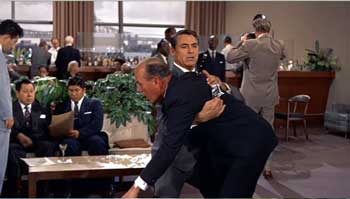
Of course, in Hitchcock movies, justice always triumphs in the end, although not without some mishaps along the way:
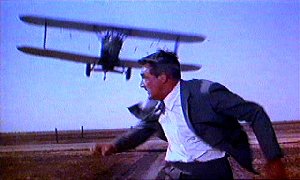
Hitchcock always cleared the innocents’ names, and the guilty were identified and led away for punishment. Would that life mirrored art. Faster, please.
Our new Sanity Squad podcast is up. This one’s about the Pope’s speech about reason and faith, and the unreasonable reaction of a great deal of the Moslem world towards his remarks.
Wretchard at Belmont Club has a post about the France2 case, in which he asks the following question:
While the Press is probably honest in most things — who won the NASCAR race, what the stock price is, who won a particular election, etc — in certain areas more than others a kind of horrible distortion has crept into their coverage. And the question is why. Members of the press are not inherently evil. They are not very different from most white collar workers or academics. With their individual foibles to be sure, but no inherited large scale defects in character. The reason huge events, like the Ukraine famine, for example, and perhaps the recent war in Lebanon, can be so horribly misreported is a subject worthy of a whole book. I tend to think that the memetic cavalry of ideologies is drawn towards certain issues and makes certain they spin them. The effect is that in areas we care about most we have inaccurate coverage, but in areas we care about least (say the yearly production of Ipods) we have the most accurate coverage. Well, I’m not the one to write that book.
I’m not the one to write that book–or books–either. Others have done so before me, notably Bernard Goldberg and Peter Braestrup.
I utterly agree with Fernandez, as far as he goes. I would add that I think there really is a belief held by too many in the MSM that “fake, but accurate,” is an okay stance to adopt, due to post-modern “truth is relative” thinking. Combine this with the strength of mindset and pre-existing belief systems in shaping our perceptions of events, and you have paved the way to this sort of media madness.
There are often personality factors operating, as well. Arrogance is one. In the France2 case, Enderlin was not only arrogant–and if you read Nidra Pollner’s latest description of the trial proceedings, you’ll see just how far that arrogance went–but, in addition, Enderlin had a decade-long relationship of trust with his cameraman, Talal. It was on the strength of that cameraman’s word that Enderlin, who was not present at the scene in Gaza, spread the news about Israelis murdering the 12-year-old al Durah. And once an arrogant person has backed a lie and thrown his entire reputation behind it, it’s very difficult to have the humility to face the truth and publically reverse yourself. There’s humiliation involved, and also acknowledgement of betrayal by someone you once thought your friend and trusted colleague. Often, it’s just too big and bitter a pill to swallow, and so it is spit out instead, sometimes with enormous consequences.
I’m going to talk about Iran and regime change.
But first I’m going to take a detour for some news of the day. The latter may seem totally unrelated to the former, but please bear with me: though this be madness, yet there is method in’t.
A military coup is going on in Thailand right now. For most of us who were not especially conversant with politics in Thailand prior to this–and I most definitely count myself among them–it’s catch-up time. Reports indicate that the military has taken over from Thai’s Prime Minister Thaksin, who was widely seen as corrupt. What’s more, there’s been unrest in the country for quite some time now; last April, after demonstrations against Thaksin resulted in a special election, the results of that poll were abrogated by the courts, leaving the country without a functioning legislature.
Now, there are those who might say that the phrase “functioning legislature” is somewhat of an oxymoron. But it does seem as though the situation in Thailand–a country which also faces a violent Moslem insurgency in its south–was ripe for change. The army took charge, as it often has in Thailand; there’s a history of military coups there. Stability is provided by Thailand’s 78-year old monarch Bhumibol, who has limited powers but has in the past used those powers, as well as his personal influence, to force compromise and allow Thailand to continue to function despite its history of coups.
This time the Thais are hoping it will happen again. Bhumibol, by the way, is the world’s longest-reigning monarch, having been king of Thailand for 60 years (little- known piece of trivia: he was born in Cambridge, Massachusetts).
The fact that the military is behind the coup is not surprising. Not only does Thailand have a recent history of military coups, but coups are in general far more common around the world than revolutions coming from what Marxists like to call “the masses.” That’s especially true in countries where the people don’t generally–or are not allowed to–bear arms, and in which the government is willing to gun down the opposition. Since those governments against which people might most want to rebel often have those two characteristics, that leaves those who would revolt (and those who would support them) in a quandary: how can it be successfully done?
Which brings us to Iran and regime change. Those who would like to avoid a repetition of the invasion of Iraq (and I think that includes virtually all of us) and who also consider the mullahs’ fall a consummation devoutly to be wished (ditto), have puzzled over the conundrum of how such a change–which would amount to a revolution, or the undoing of a revolution that many in Iran now regret–could be accomplished.
Not only is it unclear how it might happen, but there’s a sense that we’re running out of time. Michael Ledeen’s refrain “faster, please!” has taken on greater and greater urgency.
I was reading an interview with Ledeen recently. He’s far from a warmonger, although he’s sometimes portrayed as such; Ledeen believes in political change through encouraging the people of Iran to overthrow the regime. Although this may sound naive, he’s no dummy. And as I read the interview, the following passage caught my eye:
How far would the regime go to retain power? Nobody knows. But the regime does not believe the army would kill large numbers of Iranians, and the regime has its doubts about even the Revolutionary Guards, whose leadership changes quite often. Today the regime is shutting down any publication that expresses even the vaguest criticism, which to me suggests the regime is insecure.
Because the military in the US has a tradition of absolute loyalty to whatever “regime” is in office, we often forget that the military constitutes a separate force in many countries, a loose cannon of sorts (in fact, I seem to recall that this was used as an argument against the all-volunteer military when the draft was about to end). Even the most repressive regimes have to keep their militaries in line, because the military represents a potential danger. After all, one thing the military does is to bear arms. And those arms can work against any regime in several ways: either by action, such as supporting a coup (as in Thailand); or by inaction, refusing to enforce the will of the leaders (as in Iran in 1979), or through some combination of the two.
Ledeen’s commentary in the interview rang a bell for me. In one of my recent pieces on the 1979 Iranian revolution that got us into this mess in the first place, I wrote:
But as things escalated, and the Shah eventually lost the support of the army and the police (a turning point), few seemed to be prescient enough to predict what forces would replace his regime.
Hmmm. There’s also this statement from commenter “ForNow” on the SAVAK thread on this blog:
…I had heard from an Iranian whom I knew back during Carter’s presidency when the Shah was still in power…Back then, this Iranian said he was son of one of the Shah’s generals, a claim which I was able by chance to corroborate…He said that all sectors of Iranian society hated the Shah and his secret police, and that his own father — a general under the Shah — hated the Shah…
When hatred of a ruler or rulers is so widespread that it has become rampant among those who would protect those rulers or enforce their edicts, then those rulers may be in big trouble, no matter how repressive and brutal they are willing to be to suppress dissent. Because they cannot do it alone; they must have a cooperative armed apparatus in place to enforce their will.
The 1979 revolution had a course that was not only difficult to predict, it also occurred rather swiftly once the Shah lost the support of those bearing arms. Could this happen now, with the mullahs? Faster, please.
[ADDENDUM: This is Thailand’s 20th coup since 1932, when it established democracy over a previously absolute monarch. That’s a lot of coups. And I seem to recall something about that absolute monarchy in Thailand (originally Siam); wasn’t it the topic of the musical “The King and I?” This is not a joke, although it sounds like one; the lyrics to the song “Is a Puzzlement” contain a fairly serious discussion of the burdens and decisions an absolute monarch faces in times of cultural transition.]
The memorial service for the father of a good friend of mine was held at the retirement community where he and his wife had lived for the last couple of years. The place is one of those spectacularly lovely and well-designed “total life care” environments, independent living and assisted living and skilled nursing care in one facility, with movement from one section to another possible as time and health dictates.
My son is about the same age as this friend’s children, and during the twenty-five years I’ve known her we’ve shared several Thanksgivings and Christmases and weddings. That’s where I met her parents.
So I already knew that her father had been a great raconteur with a seemingly endless supply of funny stories, and a skilled craftsman who loved to build things around the house. But at the service I learned he’d been much more. As we entered the room we saw a display of photos of her parents and the family–parties and trips and good times, and several of her father when he’d served in the army with Patton during World War II. During the service I heard warm and loving recollections from his children and grandchildren, and from colleagues and friends.
But one person was mysteriously missing: his wife. They’d met at the age of thirteen and been married for sixty-six long and happy years. I looked around the room but could not find her. Then during the service, the minister explained that no, his wife would not be attending.
I’d known that she was in the middle stages of Alzheimer’s disease. But I also knew that she’d been told about her husband’s death, and since they’d still been living together in an assisted living apartment, surely she felt his absense, whether she could recall it or understand it. But the minister noted that experts in Alzheimer’s had suggested that her attendance at a service such as this would be a pointless cruelty: she would only be saddened by it and yet would not remember it. It would reopen the wound of her husband’s death freshly from moment to moment, to no purpose. And so it had been recommended she stay away, and come down only for the reception and luncheon, which would seem to her a sort of party.
And a sort of party it was, actually. When a 90-year-old dies after a rich full life, that life can mostly be celebrated, although of course there’s grieving, as well.
My friend’s mother looked very well when she arrived, greeting all with a smile, clearly happy to see the assembled crowd of relatives and old friends. Someone such as myself–a very tangential figure in her life–no longer was identifiable, although graciousness still ruled her behavior and she greeted me warmly.
But for now she still knows her close family and dearest friends, although that will fade, sadly enough. Throughout the luncheon her smile seemed genuine, seated next to her older sister on her right and her younger brother on her left, all looking far younger than their 90-or-so years. And even when, because of her Alzheimer’s, she forgot to use her fork, and picked up pieces of her salad with her hand, her fingers grasped the lettuce leaf oh-so-delicately in a gesture that could only be described as polite and refined.
Gone are the days she used to hold forth with strength and vigor, speaking on many subjects, giving advice and counsel. Now she seems tentative and childlike, with a sweetness about her that makes everyone want to protect her. But protection can only go so far; although I hope it surrounds her to the end.
Years ago I read Dylan Thomas’s famous admonition to his father to fight against the vagaries of age and the coming of death:
And you, my father, there on the sad height,
Curse, bless, me now with your fierce tears, I pray.
Do not go gentle into that good night.
Rage, rage against the dying of the light.
Perhaps that way is best for some. But for others, perhaps it’s best to try to say with Ecclesiastes:
To every thing there is a season, and a time to every purpose under the heaven:
A time to be born, and a time to die; a time to plant, and a time to pluck up that which is planted.
A time to kill, and a time to heal; a time to break down, and a time to build up;
A time to weep, and a time to laugh; a time to mourn, and a time to dance…
What went wrong at Camp David? Read Pejman Yousefzadeh’s review of Dennis Ross’s exhaustive book The Missing Peace, a description of what led to the failure of the 2000 negotiations.
It’s difficult to believe that it was only six short years ago that a negotiated peace in the Middle East seemed possible, around the corner, close at hand. Ross, who was Middle East negotiator for the US at Camp David and during the twelve years leading up to it, feels there’s plenty of blame to go around.
But there’s no doubt who the major obstacle was, and that was Arafat. According to Ross, Arafat simply could not countenance ending the conflict; his whole life was built on it as the foundation of his power, and, as Ross stated, to end the conflict is to end himself. So, no deal, no matter how reasonable the concessions, how hardworking and accommodating the diplomats.
Arafat himself is now ended, since no one is immortal, even supreme egotists and power-mad tyrants. But the conflict he refused to end–or to at least ameliorate–shows no signs of abating.
If Saddam says so, I guess it must be the truth.
No, I haven’t forgotten my “A mind is a difficult thing to change” series, even though it might seem that way. I haven’t posted a segment in quite a while, but that doesn’t mean it won’t happen. What it does mean is I’m a bit frazzled and overextended with everything else I’ve been doing (including intermittent but valiant attempts to “have a life”).
So, although I make no promises, I want to acknowledge that I intend and hope to write the next installment within the next month or so.
In honor of Oriana Fallaci, the fearless and uniquely outspoken correspondent who died yesterday in Florence Italy, I’m posting excerpts from her 1979 interview with Ayatollah Khomeini, which occurred not long after he came to power (these quotes appeared as part of a piece written by the New Yorker’s Margaret Talbot that was published in June of 2006, just a few months before Fallaci’s death).
The feisty Fallaci never pulled her punches, even with the grim Ayatollah:
Fallaci had travelled to Qum to try to secure an interview with Khomeini, and she waited ten days before he received her. She had followed instructions from the new Islamist regime, and arrived at the Ayatollah’s home barefoot and wrapped in a chador. Almost immediately, she unleashed a barrage of questions about the closing of opposition newspapers, the treatment of Iran’s Kurdish minority, and the summary executions performed by the new regime.
Fallaci kept pressing Khomeini with questions about the dreadful treatment of women under his regime, including ones about the chador. He replied, “If you do not like Islamic dress you are not obliged to wear it. Because Islamic dress is for good and proper young women.”
Fallaci knew an opportunity when she saw one; she thanked the Ayatollah and proceeded to dump her chador. Her little strip tease (at least, in Islamist terms) was the final straw for Khomeini–he ordered her out and fumed for a day or two before he deigned to resume the interview. But Fallaci was ready for him:
When Khomeini let her return, his son Ahmed gave Fallaci some advice: his father was still very angry, so she’d better not even mention the word “chador.” Fallaci turned the tape recorder back on and immediately revisited the subject. “First he looked at me in astonishment,” she said. “Total astonishment. Then his lips moved in a shadow of a smile. Then the shadow of a smile became a real smile. And finally it became a laugh. He laughed, yes. And, when the interview was over, Ahmed whispered to me, ”˜Believe me, I never saw my father laugh. I think you are the only person in this world who made him laugh.’ ”
But a rare moment of affability displayed by the old tyrant didn’t make Fallaci a fan. She told Talbot:
“…it did not take long to realize that in spite of his quiet appearance he represented the Robespierre or the Lenin of something which would go very far and would poison the world. People loved him too much. They saw in him another Prophet. Worse: a God.”
Upon leaving Khomeini’s house after her first interview, Fallaci was besieged by Iranians who wanted to touch her because she’d been in the Ayatollah’s presence. “The sleeves of my shirt were all torn off, my slacks, too,” she recalled. “My arms were full of bruises, and hands, too. Do believe me: everything started with Khomeini. Without Khomeini, we would not be where we are. What a pity that, when pregnant with him, his mother did not choose to have an abortion.”