
Email this article to some Obama supporters you know. It will be hard for them to dismiss the evidence therein because it appeared in the extremely liberal Boston Globe. But they may find a way.
And speaking of prom attire…
…which I was, here—did you know there are websites that feature maternity prom dresses?
In Unity: Hillary stands by her man once again
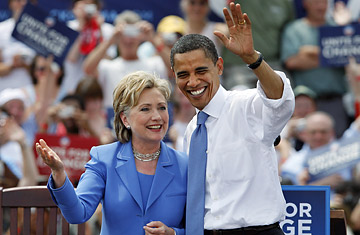
The Unity NH love fest (unity, get it?) involving Hillary and Obama featured a sartorial demonstration of the bond between them. As though they were a couple at a prom, his tie matched her suit, which was in a color close—but not identical to—the light turquoise shade I’ve come to think of as Hillary Blue. Continue reading →
The joys of cantaloupe
I was in New York City the other day and bought a cantaloupe from a small grocery store that was the best one I’ve ever eaten in my life.
I’m somewhat of a cantaloupe connoisseur, so that’s saying quite a lot. Continue reading →
Gerard Baker sums it up: we’re winning
Gerard Baker of the Times Online offers a valiant effort to counter the tide of defeatism that continues in the so-called “war on terror” despite strong evidence to the contrary. Good luck, Mr. Baker.
He makes some good points, to wit:
Next time you hear someone say that the war in Afghanistan is an exercise in futility ask them this: do they seriously think that if the US and its allies had not ousted the Taleban and sustained an offensive against them for six years that there would have been no more terrorist attacks in the West?
Baker also describes the success of the surge. Continue reading →
Heller and the Supreme Court
With the caveat that I’ve not read the full text of the SCOTUS opinion on Heller, but am relying on summaries and articles about it, I will say that I agree that there is nothing in the Second Amendment that would indicate its protection of the right to bear arms should be narrowly limited to militias. But I understand that it is an issue that has been debated for decades, and that the closeness of the decision—another 5-4 vote—underscores not only the political leanings of the current Justices, but the complexity of the discussion. Continue reading →
Writing by hand: the medium affects the message
[NOTE: I’m trying to make this blog an Obama-free zone for at least one more day. One day at a time, they say.]
This Atlantic article by Nicholas Carr is a recommended read, about the reported loss of concentration and patience for absorbing longer works that he believes comes from too much internet Googling.
Don’t skim it, now; read the whole thing!
I’m not so sure we suffer from the phenomenon that Carr describes so much as that we lack the time to read in a leisurely fashion, in part because there now are too many competing entertainments and methods of gathering information.
But I was especially intrigued by an anecdote from the article about how the medium by which a person writes, rather than reads, can change an author’s style. Continue reading →
So this is how Glenn Reynolds does it
It’s an idea whose time has come—and not just to Instapundit, but to Chrysler. Continue reading →
Modernizing the King James Bible
[NOTE: Yesterday I wrote about literary style vs. substance. I concluded that it’s possible to have the first while lacking the second, especially in the realm of politics. Today I’m writing about a work that undoubtedly has both style and substance—the King James Version of the Bible—and the effect of changing the style.] Continue reading →
Wordsmiths for Obama: style vs. substance, poetry vs. prose
In trying to understand what about Obama appeals so powerfully to his supporters, I’ve decided that some—perhaps even much—of it is style.
He gives a good speech. He has a deep voice. He’s tall. He’s slender. He knows what a dap is. And he can turn a literary phrase. Continue reading →
Have they mentioned he’s black?
Barack Obama, the candidate who wants to end divisiveness, and who wants to run a clean and honorable campaign without negativity, said the following in a recent campaign speech at a Florida fund-raising reception:
It is going to be very difficult for Republicans to run on their stewardship of the economy or their outstanding foreign policy. We know what kind of campaign they’re going to run. They’re going to try to make you afraid. They’re going to try to make you afraid of me. He’s young and inexperienced and he’s got a funny name. And did I mention he’s black?”
We have here a truly masterful attempt to flames of paranoia on the part of his followers and adopt the mantle of victimization for himself, thus raising rather than lowering the amount of divisiveness and vitriol in the campaign. Pretty good for just a couple of sentences. Continue reading →
More on clean hands and evil triumphing
Commenter “gringo” wrote in earlier thread:
Re keeping hands clean. That was one motive for my becoming a Conscientious Objector during the Vietnam War.
The genocide in Cambodia changed my mind. One has “clean hands” and stands on the sidelines while others are slaughtered.
Sorry, “clean hands” become bloodstained in such abstention, from my point of view. Continue reading →