↓
 

The New Neo

A blog about political change, among other things

  • Home
  • Bio
  • Email
Home » Page 1734 << 1 2 … 1,732 1,733 1,734 1,735 1,736 … 1,933 1,934 >>

Post navigation

← Previous Post
Next Post→

Gee, I can’t imagine why any sane person would object to Charles Freeman’s appointment

The New Neo Posted on March 11, 2009 by neoMarch 11, 2009

I also can’t imagine why he would be accused of being anti-Jewish or anti-Israel. His parting words on withdrawing his name from consideration to chair the National Intelligence Council certainly give no indication of any bias on his part [emphasis mine]:

I do not believe the National Intelligence Council could function effectively while its chair was under constant attack by unscrupulous people with a passionate attachment to the views of a political faction in a foreign country….

The libels on me and their easily traceable email trails show conclusively that there is a powerful lobby determined to prevent any view other than its own from being aired, still less to factor in American understanding of trends and events in the Middle East. The tactics of the Israel Lobby plumb the depths of dishonor and indecency and include character assassination, selective misquotation, the willful distortion of the record, the fabrication of falsehoods, and an utter disregard for the truth. The aim of this Lobby is control of the policy process through the exercise of a veto over the appointment of people who dispute the wisdom of its views, the substitution of political correctness for analysis, and the exclusion of any and all options for decision by Americans and our government other than those that it favors.

There is a special irony in having been accused of improper regard for the opinions of foreign governments and societies by a group so clearly intent on enforcing adherence to the policies of a foreign government ”“ in this case, the government of Israel. I believe that the inability of the American public to discuss, or the government to consider, any option for US policies in the Middle East opposed by the ruling faction in Israeli politics has allowed that faction to adopt and sustain policies that ultimately threaten the existence of the state of Israel. It is not permitted for anyone in the United States to say so. This is not just a tragedy for Israelis and their neighbors in the Middle East; it is doing widening damage to the national security of the United States.

In other words, as Slublog (at Ace’s) says: “Shorter Chas: ‘It was the Joooooooos!'”

So, as Bret Stephens points out, what of those Chinese dissidents who objected so strenuously to Freeman’s appointment? Are they members of the far-reaching Israel lobby as well (“funny, you don’t look Jewish…)? And what about Freeman’s history of being a paid representative for the Saudis?

Not to mention 9/11—which is also the fault of the Jewish lobby, according to Freeman:

“We have paid heavily and often in treasure in the past for our unflinching support and unstinting subsidies of Israel’s approach to managing its relations with the Arabs,” [Freeman] said in 2006. “Five years ago we began to pay with the blood of our citizens here at home.”

I can’t say I see that Freeman is currently being silenced much by those nefarious Jews—he seems rather talkative to me. But I suppose that Jews—unlike every other group in America—have no right to voice an opinion about the appointment to a position of power in this administration of a person they see as biased against them.

Note, also, Mark Steyn’s piece on how the entire Freeman controversy has fallen under the radar screen of the MSM until now. Could it possibly be because it reflects badly on this current administration?

No, of course not. Even if it turns out that Freeman was never even vetted (or maybe especially if it turns out that Freeman was never even vetted).

Posted in Israel/Palestine, Jews, Obama | 13 Replies

Lifting the stem-cell research “ban”

The New Neo Posted on March 10, 2009 by neoMarch 10, 2009

Google “did bush ban stem cell research?” and you get this gaggle of articles. Some of the titles announce that Obama has ended Bush’s stem cell research ban, while others refer to Bush’s policy as a funding ban.

What a difference a word makes! The second set of articles more closely approximates the truth. But to be even more correct you would have to add “federal government” to “funding ban,” and change the word “ban” to “restriction,” as well as adding “embryonic” to modify “stem cell.” Bush never banned stem cell research nor even government funding for all of it; he did limit government funding to lines that had been developed prior to August 9, 2001, and he never had any problem funding adult stem cell research.

Many people have applauded Obama’s actions. But to agree with Obama’s new policy is it really necessary to distort history? Although it is indeed likely that the Obama directive reversing the Bush position will open up more opportunities for research with stem cells, it’s not as though under Bush things were not progressing, through the use of adult stem cells and other creative solutions (see this and this for two examples). But to acknowledge that would be to acknowledge that Bush wasn’t really against science, just a particular form of science that he considered unethical.

Obama has released a so-called “fact sheet” in tandem with his new executive order on stem cell research funding. In it he writes:

The previous Administration allowed the National Institutes of Health to fund human embryonic stem cell research on cell lines created before an arbitrary date, August 9, 2001, but prohibited research on cell lines created after that date. The Executive Order signed by President Obama today lifts this restriction, which has no basis in science and was not required by any law.

There it is again [emphasis mine]: “prohibited research on cell lines created after that date.” No, it did not; it just withdrew federal funding. And of course the Bush restriction had “no basis in science;” that’s a straw man argument. Bush never alleged it to have such a basis.

It was a decision about the ethics of science, and the way in which ethics and science interface. You may or may not agree with Bush’s decision; Obama clearly does not. But to pretend otherwise is to be disingenuous.

Posted in Obama, Science | 39 Replies

This Czech…

The New Neo Posted on March 10, 2009 by neoMarch 10, 2009

…has been there. And he’s telling Obama he doesn’t want to go there again.

Posted in Uncategorized | 6 Replies

The uncharismatic Bayh isn’t buying

The New Neo Posted on March 10, 2009 by neoMarch 10, 2009

I was watching Fox News last night and saw Greta Van Susteren interview Evan Bayh.

Long considered one of the Senate’s more moderate Democrats, Bayh announced back in December of 2008, shortly after Obama’s election, that he planned to form a coalition of other Democrat moderates in the Senate that would somewhat resemble the House’s Blue Dog coalition. In the Susteren interview last night, Bayh said he will vote against the current budget bill because this is neither the time nor the place to pass it with so many earmarks (bipartisan ones, by the way; some of them are pet Republican projects).

No one is quite clear on whether any of this will matter, because the bill may have plenty of votes without Bayh and his group. But he and Senator Feingold have urged Obama to veto the bill it if it passes.

This will not happen; of that much I’m certain. Obama has already said he intends to sign it, and launched his administration’s gobbledygook explanation that it all doesn’t signify much—pay no attention to the man behind the curtain, there are no broken promises about earmarks—because, after all, it’s “last year’s business.” Whaaa?

Perhaps the most interesting part of the Bayh interview was his comment that he believes one of the main reasons he has the perspective he does is that he was a governor before becoming a senator, and had to balance a budget. That’s certainly not the only explanation—I would imagine, for example, he’s hearing from his constituents that they don’t like the bill. Also he may really be enjoying the spotlight. But still, I think he’s onto something.

One of the major criticisms of Obama is that he has virtually no executive experience. Obama’s resume is especially thin in this regard. But a great many senators (John McCain was one) are lacking in that area.

I started to look up the resumes of every single Senator, but I got very weary and stopped at number twenty (alphabetical order). Among those twenty, however, there were only three who had been governors. Among the rest there was a smattering of businesspeople and a couple of Attorneys General. But the road to the Senate seems to pass overwhelmingly through the House.

Legislators tend to be career legislators, with previous political experience mostly in the legislature at a lower level (state and/or House) before they become senators. This was certainly true of Obama, who had also barely kept his Senate seat warm before he vacated it to run for President.

You think it doesn’t matter? Generally, it does. But charisma trumps experience nearly every time. Poor Evan Bayh could hardly scare up any support when he ran for president in 2008. In December of 2006 he dropped out of the race, just a little while after he entered it:

[I]t became crystal-clear to Sen. Bayh in New Hampshire last weekend that his candidacy lacks the requisite buzz. While Obama attracted thousands of purring supporters and dominated national headlines, Bayh couldn’t fill a room, and elicited little mention in the press.

A former Governor of Indiana, the soft-spoken Bayh is serving his second term in the U.S.Senate, where he’s earned a low-key profile as a fiscal conservative and a social moderate.

I suspect that Bayh would have made a better president than Obama. Heck, he even supported the Iraq War—a fact that worked against him as a candidate for the Democratic nomination, campaigning as he did at the end of 2006. But Bayh just didn’t—and doesn’t—have that certain something, that spark, that pizazz, the thing that made Chris Matthews’ leg tingle when Obama entered the room. And you know how much we all need pizazz and tingle in our leaders.

I’m being sarcastic here. But in a way I’m not. Because it’s an undeniable and bipartisan truth that that undefinable thing called charisma seems to be important for winning a presidential election.

It’s not that candidates can’t ever win without it—Richard Nixon, for example, was an anomaly since he was remarkably lacking in that quality, as well as several others (although he did have experience; if it weren’t for his paranoia and ethical flaws—big “ifs,” to be sure—he might even have made a fairly good president).

But pizazz usually counts for a great deal in the minds of the electorate. In the case of Obama, it counted for even more.

[ADDENDUM: Why, now it seems as though those moderate Democrats are giving Obama some trouble on card check, one of the worst proposals of the entire Obama administration so far.

Good.]

Posted in Politics | 9 Replies

Deeply undemocratic

The New Neo Posted on March 10, 2009 by neoMarch 10, 2009

Evan Bayh has another ally in opposing the budget bill: Senator Robert Menendez from New Jersey, who is protesting a little item that was slyly slipped into the bill while no one was looking. Menendez, the son of Cuban immigrants, was stunned to find a provision there that would relax rules on travel and imports to Cuba.

Senator Menendez seems to be pretty liberal, and he would have otherwise supported this bill. But he’s not just annoyed, he’s enraged—enough to offer this bit of stinging rhetoric to the supposedly “transparent” administration, as well as Congressional leaders Reid and Pelosi:

The process by which these changes have been forced upon this body is so deeply offensive to me, and so deeply undemocratic, that it puts the omnibus appropriations package in jeopardy, in spite of all the other tremendously important funding that this bill would provide.

“Deeply undemocratic”—I’m sure Menendez meant “undemocratic” with a small “d.”

I find it pretty offensive as well, but not because it’s undemocratic (small or large “d”). Slipping in provisions without debate on them is certainly not unheard of in Washington. But the especially offensive (“deeply offensive”) part is the hypocrisy of the promises on which Obama ran versus the reality of his actual presidency.

Transparent? Yes. But not in the way Obama meant.

Posted in Obama, Politics | 5 Replies

One guy…

The New Neo Posted on March 9, 2009 by neoMarch 9, 2009

…wasn’t too surprised that Tim Geithner hasn’t been all that impressive.

Read it and weep.

Posted in Uncategorized | 21 Replies

Notes from Chairman Lenin—and Dostoevsky

The New Neo Posted on March 9, 2009 by neoMarch 10, 2009

A few days ago a commenter here offered a link to this page of Lenin quotes. Some of them seem pretty apropos in light of recent developments, and so I offer them to you for your contemplation [I’ve emphasized some of the most “interesting” by highlighting them in bold]:

A lie told often enough becomes the truth.

Democracy is indispensable to socialism.

Give me four years to teach the children and the seed I have sown will never be uprooted.

It is true that liberty is precious; so precious that it must be carefully rationed.

One man with a gun can control 100 without one.

The best way to destroy the capitalist system is to debauch the currency.

The goal of socialism is communism.

The way to crush the bourgeoisie is to grind them between the millstones of taxation and inflation.

There are no morals in politics; there is only expedience.

No amount of political freedom will satisfy the hungry masses.

The final quote is of special interest because of the way it dovetails with the insights of the Russian writer Fyodor Dostoevsky. Although Lenin was a mere nipper of ten when Dostoevsky wrote “The Grand Inquisitor,” (a chapter from Dostoevsky’s masterpiece The Brothers Karamazov, written in 1880), Lenin seemed to steal a page (or several) out of his book.

Dostoevsky was no stranger to the revolutionary socialist zeal and terrorist nihilism that was already beginning to shake Russia in the second half of the nineteenth century, which terminated in the Russian Revolution and the ascent of Communism there. Although he died in 1881 and did not live to see the final flowering of the movement that had taken root decades earlier, he had been a revolutionary himself in his youth, and had actually faced a firing squad after being arrested for subversive activities.

It was a traumatic experience for Dostoevsky, already a highly emotional and even unstable youth. He and his companions were subject to a mock execution, their sentences commuted at the last moment to years of harsh labor in prison camp. That experience and others made Dostoevsky a “changer;” he later renounced both socialism and a host of other Western ideas, embraced Russian Orthodoxy and a mystical spirituality, and became one of the world’s greatest writers.

I came across Dostoevsky’s works in high school and then again in college, during the period of upheaval and unrest that started in the late 1960s. In high school we were assigned to read Crime and Punishment, as well as the “Grand Inquisitor” excerpt from Karamazov, and in college I read his chilling work The Demons (then titled The Possessed), about the spiritual and moral bankruptcy of the revolutionaries.

Did I understand these works then? Not as well as I think I understand them now. But of all the lessons I learned during my school days, and of all the books I was assigned to read, these made perhaps the deepest and most powerful impression on me.

Much of school felt like the memorization of dry and irrelevant facts. Many novels seemed obscure and and hardly applicable to my life, and one would have thought that would have been even more true of these startling and intense Russian works from a time that seemed so distant then (although it seems much closer now; odd how that happens).

But something in them rang a bell, especially as the political upheaval of the 60s progressed. That bell had a sound not only of strange and inexplicable familiarity, it was also an ominous toll of warning. The books seemed to speak to the troubled times in which I was living, and made me realize that there is hardly any new thought under the sun. Those headstrong revolutionaries of the far-off Russian past were not stilted figures in an old and faded photo; they too closely and uncomfortably resembled the rebels of my own generation, who thought they had invented protest and cast off the shackles of the past.

I’ve quoted the following excerpt before on this blog. I’m quoting it again now. And I wouldn’t be at all surprised if I have reason to quote it in the future.

In this excerpt Dostoevsky’s Grand Inquisitor is addressing Christ, who has returned to earth but is arrested and imprisoned again:

Oh, never, never can [people] feed themselves without us [the Inquisitors and controllers]! No science will give them bread so long as they remain free. In the end they will lay their freedom at our feet, and say to us, “Make us your slaves, but feed us.” They will understand themselves, at last, that freedom and bread enough for all are inconceivable together, for never, never will they be able to share between them! They will be convinced, too, that they can never be free, for they are weak, vicious, worthless, and rebellious. Thou didst promise them the bread of Heaven, but, I repeat again, can it compare with earthly bread in the eyes of the weak, ever sinful and ignoble race of man?

[ADDENDUM: And then there’s Machiavelli.]

[ADDENDUM II: For an interesting discussion as to whether the Lenin quotes are authenticated or not, please see the comments section.]

Posted in Liberals and conservatives; left and right, Literature and writing | 50 Replies

Jim Cramer gets it—and then he doesn’t

The New Neo Posted on March 9, 2009 by neoMarch 9, 2009

Jim Cramer is puzzled, and just a little bit angry.

When Cramer said that the Obama administration is destroying wealth in this country, he thought his liberal bona fides would protect him. He also thought that the fact that he was, you know, speaking the truth might have some effect as well.

Cramer may have thought that liberals would defend speaking truth to power; after all, it’s one of their favorite phrases. But it depends what “truth” and it depends what “power.” If the powerful people being criticized just happen to be liberals or the Left, then it can’t really be “truth,” you see, whatever its obvious merits might be. And the person so bold as to utter that truth not only had better shut up, but he/she immediately becomes fair game for attack, ridicule, and/or distortions of what was said.

Now, as Cramer looks around from his perch under that crowded bus, he is surprised. He shouldn’t be. Welcome, Cramer, to the first step on the long road to change.

Not that Cramer will necessarily take any of the next steps. But it can be profoundly disturbing to discover (as Cramer now has) that those whom you thought were interested in actually solving a problem and listening to honest criticism are far more interested in silencing and marginalizing the opposition.

Posted in Uncategorized | 14 Replies

The dreaming dog

The New Neo Posted on March 8, 2009 by neoMarch 8, 2009

Finally, here’s a bit that has nothing whatsoever to do with Obama. At least, I can’t find a tie-in. Watch it and brighten your day/night/whatever (hat tip Rachel Lucas).

Posted in Uncategorized | 18 Replies

A trend?

The New Neo Posted on March 7, 2009 by neoMarch 7, 2009

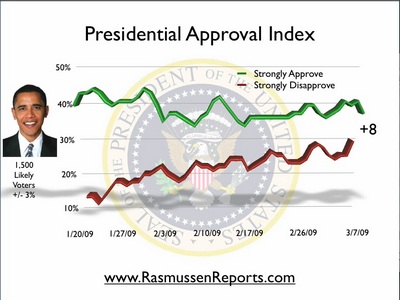
Do I spot a trend? Hope so:

approvedisapprove.jpg

One of the more interesting aspects of this graph is that the convergence of the two lines is caused more by steeply growing “strongly disapprove” rates rather than sharply falling “strongly approve” ones.

That makes a good deal of sense. Those who were weakly for Obama—the ones who thought he’d be a nice moderate guy—are learning the hard way, while the Leftists who adored him before the election probably adore him even more now.

And for those moderates who are having second thoughts because they trusted him, Ace offers this comfort. Enjoy—and, in the immortal words of the great John Belushi, start drinking heavily (but shhh!, don’t say I told you to do that).

Posted in Obama | 52 Replies

On our republic and the “transfer” of wealth

The New Neo Posted on March 7, 2009 by neoMarch 7, 2009

Sometimes a seemingly random word or two can be very instructive, if you want to know what a person really thinks. That is the reason I (and so many others) paid quite a bit of attention to a couple of revealing moments leading up to the election.

One was Obama’s “spread the wealth” comment to Joe the Plumber. While some might say it was just a single insignificant phrase uttered during an impromptu give-and-take, I would respond that no one would express such a thought unless it matched his/her internal concept of the world and how it should function.

In other words, it was a moment in which Obama’s carefully constructed mask slipped.

The same was true for the surfacing of a tape in which Obama calmly said that his energy policies were intended to bankrupt coal plants and cause the price of electricity to “skyrocket.” Prior to this, we all know he was an environmentalist. But the radical nature of his “solutions” had not been so nakedly revealed.

I wrote this post in the week before the election, entitled “Will the real Obama please stand up?” In it, I quoted Tony Blankley on the subject of Obama’s true intentions as opposed to his facade.

It made chilling reading then. But it makes prescient reading now:

But of course, throughout history when dangerous, radical men have offered themselves up for leadership, their moderate supporters have rationalized their early support by hoping that the dangerous man is really a sensible man like them and doesn’t believe some of those wild things he has said to his more fervent followers.

But as the campaign clock ticks down to its last days and hours, prudent people have to consider the possibility that beneath that easy manner and calming voice is the pulsating heart of a genuine man of the radical left.

That brings us to a telling remark Obama made during his February 24, 2009 speech to a joint session of Congress. It slipped right by me at the time. But Jacob Sullum, writing in Reason, has kindly underlined it.

In the sentence in question, Obama doesn’t mention Bush by name. But it appears fairly clear that he is speaking of the beginnings of the Bush administration, when Bush inherited a budget surplus from President Clinton (let’s leave aside for the moment the interesting question of whether it was technically a surplus or not; we can certainly agree it was at the very least a greatly reduced deficit). Obama said:

A surplus became an excuse to transfer wealth to the wealthy instead of an opportunity to invest in our future.

Sullum points out:

Whatever you think of the wisdom of Bush’s tax cuts, they amounted to taking less from people, not giving more to them. Obama makes it sound as if there is no meaningful difference between robbing Peter to pay Paul (which is what he has in mind when he talks about “rebalancing the tax code”) and leaving Peter alone (or, more accurately, robbing him less thoroughly)””except that the latter option is, in Obama’s view, morally inferior.

I believe that this, more than any other statement Obama has made, underlines the deeply radical Leftist underpinnings of Obama’s thoughts about wealth and capital. By labeling the act of allowing people to keep more of the money they have already earned as a “transfer of wealth to the wealthy,” he indicates that he actually doesn’t think that money belongs to them in the first place.

Now, you may think the tax code isn’t progressive enough. You may think that the rich should be paying an even bigger share than their already substantial portion of the tax burden. But the idea that a reduction in a still-high tax rate, that allows the rich to keep more of the money they have earned, represents an actual transfer of wealth to them is a very odd—and hugely telling—notion.

The second part of the quote is interesting, as well. Obama says the wealth transfer has been a substitute for “an opportunity to invest in our future.” But wait—do not the wealthy “invest in our future,” by starting businesses, growing the GNP, and employing people in a myriad of ways? Of course, not all of their money goes to this purpose. They keep quite a bit (are allowed to keep quite a bit?) to furnish their lavish homes, and to buy their yachts and other playthings. But some of that surplus owned by the wealthy (yes, they do own it) is put in the service of driving the engine of our economy for us all.

Does Obama not realize this? Perhaps—but I think he does actually know it. I just think that, when he says “our future,” he’s envisioning a different sort of future.

What is this “future” in which Obama would have us invest? It appears to be one in which government makes the decisions as to who should own wealth, because that wealth actually belongs to the people as a whole. One in which that wealth can be redistributed by the government according to its own ideas of fairness. A government which, under Obama, will come to resemble either a social welfare state of the type popular in Europe, or perhaps even a socialist state approximating Venezuela under the reprehensible Hugo Chavez.

Think it can’t happen here? Think again.

Obama’s proposed tax structure will have an interesting effect. According to Michael Boskin, writing in the WSJ:

New and expanded refundable tax credits would raise the fraction of taxpayers paying no income taxes to almost 50% from 38%. This is potentially the most pernicious feature of the president’s budget, because it would cement a permanent voting majority with no stake in controlling the cost of general government.

And that, in turn, reminds me of this thought, attributed (perhaps falsely) to Alexander Fraser Tytler:

A democracy cannot exist as a permanent form of government. It can only exist until the voters discover that they can vote themselves largesse from the public treasury. From that moment on, the majority always votes for the candidates promising the most benefits from the public treasury with the result that a democracy always collapses over loose fiscal policy, followed always by a dictatorship. The average age of the world’s greatest civilizations has been 200 years.

Now, I’m not sure about the word “always.” And it also seems there are democracies that have lasted more than 200 years. Also, of course, we can quibble with the word “democracy” because we are a republic.

But it seems true that it would take a very stalwart and unusual group of people to stop voting funds for themselves from the money machine our government has become. I’m not sure we are that people any more. And the quote dovetails nicely with another thought, this one attributed to Ben Franklin:

When the people find they can vote themselves money, that will herald the end of the republic.

Far from being naive about money and taxes and their effects on the general public, I see signs that the Democrats and Obama are very sophisticated indeed. It’s not that their goal is to destroy the republic. But I’m not sure that they care all that much if it happens. It may just be an unintended consequence of their drive for power.

Posted in Finance and economics, Liberals and conservatives; left and right, Obama | 22 Replies

It’s official, it’s the Obama bear…

The New Neo Posted on March 7, 2009 by neoMarch 7, 2009

obamabear.jpg

…MARKET.

According to the site, though, the “limited President Barack Obama Bears” are disappearing quickly.

As is what’s left of the stock market.

Posted in Uncategorized | 7 Replies

Post navigation

← Previous Post
Next Post→

Your support is appreciated through a one-time or monthly Paypal donation

Please click the link recommended books and search bar for Amazon purchases through neo. I receive a commission from all such purchases.

Archives

Recent Comments

  • Chases Eagles on If you don’t vote because you’re tired of voting for the lesser of two evils, you get the greater of two evils
  • JohnTyler on My trusty rusty old car
  • Variant on If you don’t vote because you’re tired of voting for the lesser of two evils, you get the greater of two evils
  • Barry Meislin on On fraud: New Hampshire turns blue with a tiny purple spot
  • Sgt. Mom on My trusty rusty old car

Recent Posts

  • My trusty rusty old car
  • If you don’t vote because you’re tired of voting for the lesser of two evils, you get the greater of two evils
  • On fraud: New Hampshire turns blue with a tiny purple spot
  • Open thread 11/7/2026
  • So, why am I renewing my passport?

Categories

  • A mind is a difficult thing to change: my change story (17)
  • Academia (330)
  • Afghanistan (98)
  • Amazon orders (6)
  • Arts (8)
  • Baseball and sports (164)
  • Best of neo-neocon (91)
  • Biden (536)
  • Blogging and bloggers (599)
  • Dance (292)
  • Disaster (244)
  • Education (328)
  • Election 2012 (360)
  • Election 2016 (566)
  • Election 2018 (33)
  • Election 2020 (513)
  • Election 2022 (114)
  • Election 2024 (403)
  • Election 2026 (124)
  • Election 2028 (14)
  • Evil (130)
  • Fashion and beauty (324)
  • Finance and economics (1,053)
  • Food (319)
  • Friendship (48)
  • Gardening (18)
  • General information about neo (4)
  • Getting philosophical: life, love, the universe (737)
  • Health (1,169)
  • Health care reform (546)
  • Hillary Clinton (184)
  • Historical figures (338)
  • History (718)
  • Immigration (452)
  • Iran (467)
  • Iraq (227)
  • IRS scandal (71)
  • Israel/Palestine (835)
  • Jews (444)
  • Language and grammar (365)
  • Latin America (216)
  • Law (2,997)
  • Leaving the circle: political apostasy (125)
  • Liberals and conservatives; left and right (1,334)
  • Liberty (1,119)
  • Literary leftists (14)
  • Literature and writing (394)
  • Me, myself, and I (1,523)
  • Men and women; marriage and divorce and sex (934)
  • Middle East (385)
  • Military (327)
  • Movies (355)
  • Music (534)
  • Nature (262)
  • Neocons (32)
  • New England (185)
  • Obama (1,740)
  • Pacifism (16)
  • Painting, sculpture, photography (132)
  • Palin (93)
  • Paris and France2 trial (25)
  • People of interest (1,051)
  • Poetry (259)
  • Political changers (179)
  • Politics (2,797)
  • Pop culture (397)
  • Press (1,636)
  • Race and racism (885)
  • Religion (431)
  • Romney (164)
  • Ryan (16)
  • Science (642)
  • Terrorism and terrorists (983)
  • Theater and TV (266)
  • Therapy (71)
  • Trump (1,637)
  • Uncategorized (4,631)
  • Vietnam (109)
  • Violence (1,465)
  • War and Peace (1,035)

Blogroll

Ace (bold)
AmericanDigest (writer’s digest)
AmericanThinker (thought full)
Anchoress (first things first)
AnnAlthouse (more than law)
AugeanStables (historian’s task)
BelmontClub (deep thoughts)
Betsy’sPage (teach)
Bookworm (writingReader)
ChicagoBoyz (boyz will be)
DanielInVenezuela (liberty)
Dr.Helen (rights of man)
Dr.Sanity (shrink archives)
DreamsToLightening (Asher)
EdDriscoll (market liberal)
Fausta’sBlog (opinionated)
GayPatriot (self-explanatory)
HadEnoughTherapy? (yep)
HotAir (a roomful)
InstaPundit (the hub)
JawaReport (the doctor’s Rusty)
LegalInsurrection (law prof)
Maggie’sFarm (togetherness)
MelaniePhillips (formidable)
MerylYourish (centrist)
MichaelTotten (globetrotter)
MichaelYon (War Zones)
Michelle Malkin (clarion pen)
MichelleObama’sMirror (reflect)
NoPasaran! (bluntFrench)
NormanGeras (archives)
OneCosmos (Gagdad Bob)
Pamela Geller (Atlas Shrugs)
PJMedia (comprehensive)
PointOfNoReturn (exodus)
Powerline (foursight)
QandO (neolibertarian)
RedState (conservative)
RogerL.Simon (PJ guy)
SisterToldjah (she said)
Sisu (commentary plus cats)
Spengler (Goldman)
VictorDavisHanson (prof)
Vodkapundit (drinker-thinker)
Volokh (lawblog)
Zombie (alive)

Meta

  • Log in
  • Entries feed
  • Comments feed
  • WordPress.org
©2026 - The New Neo - Weaver Xtreme Theme Email
Web Analytics
↑