↓
 

The New Neo

A blog about political change, among other things

  • Home
  • Bio
  • Email
Home » Page 1710 << 1 2 … 1,708 1,709 1,710 1,711 1,712 … 1,917 1,918 >>

Post navigation

← Previous Post
Next Post→

Signs of the tea party times—and of the demise of the press

The New Neo Posted on April 16, 2009 by neoApril 16, 2009

The weather at the tea party I went to yesterday was lovely, the sky blue and a little chill. The surprisingly large crowd was extremely varied, from young to old and everything in between, their mood buoyant and assertive.

I forgot my camera, but I took note of the fact that all the signs were homemade, and there was very little repetition of slogans.
Here are a few that caught my eye:

[held by a young adult male] I’ll still be paying on this bill when you’re all dead.

The power to tax is the power to destroy—John Marshall.

Debt—change you can believe in.

Of all tyrannies, a tyranny sincerely exercised for the good of its victims may be the most oppressive.

King George read his tax bills.

We’ll keep our money and our guns, you keep the “change.”

I am a taxpayer and I’m mad as hell. I am not a right-wing extremist.

There was a great deal of energetic honking from passing cars. Only one driver yelled anything in opposition (“Obama! Obama!”) although many who passed by were silent.

What does it all mean? Not all that much, at this point. The tea parties represent an already-existing point of view and channel it. But they don’t create it; events create it. As time goes on, either more people will become dissatisfied with this President and this Congress and throw them out, or they will not.

But if the discontent does grow, it certainly won’t be because the press has done its job in spreading the news. A quick perusal of MSM coverage indicates that, on the contrary, the word is out (a) to minimize coverage of the demonstrations (do you think for one moment that if such numbers had gathered to promote a liberal cause, that fact wouldn’t rate top headlines and huge stories with photos?); and (b) to characterize the tea party participants—in any press mention that might happen to pass the filter—as right-wing extremists, as well as obedient minions whipped to a snarling froth by the few right-wing media outlets that still exist.

The Boston Globe‘s “coverage” seems typical. I choose the Globe because you would think that, with the local angle—Boston being the home of the original tea party and all—the hometown paper would see fit to give the movement, and the Boston demonstration itself, some special coverage. But the Globe, being a bluer-than-blue paper in a bluer-than-blue town, offered only this brief and very general AP article, with its telling lede [emphasis mine]:

Whipped up by conservative commentators and bloggers, tens of thousands of protesters staged “tea parties” around the country yesterday to tap into the collective angst stirred up by a bad economy, government spending, and bailouts.

The article only contains 245 words. But among them, the Globe managed to find room for these:

The tea parties were promoted by FreedomWorks, a conservative nonprofit advocacy group based in Washington and led by Dick Armey of Texas, a former Republican House Majority Leader who is now a lobbyist.

While FreedomWorks insisted the rallies were nonpartisan, they have been seized on by many prominent Republicans who view them as a promising way for the party to reclaim its momentum.

Dick Armey. Republicans. Lobbyists. ‘Nuff said—that is, enough for most Globe readers to safely dismiss the story.

Note the comments after the Globe article. Quite a few of them mention the Globe’s well-deserved insolvency. The Globe (like so many papers these days) is in a heap of financial trouble, as this Christian Science Monitor article discusses. That article mentions “the deteroriating economy” as at least part of the reason, and no doubt it is. But is it possible, as so many of the comments to the Globe article indicate, that the paper’s exceedingly biased coverage could have anything to do with it?

No, not if you listen to a speech on the subject of “The Incredible Shrinking Newsroom” that Globe editor Marty Baron gave two weeks ago at the University of Oregon School of Journalism and Communication. In it, he describes the cutbacks that his paper and so many others have had to make as their fortunes decline.

Baron decided to close the Globe’s foreign bureaus, which were already much diminished. But he reiterates the paper’s firm commitment to local news:

We would not—I certainly was unwilling—to erode our local coverage to maintain foreign bureaus. Coverage of Greater Boston—everything about it, from the courts to the arts, schools to sports and business—was central to our mission. Above all else, it is our mission.

Well, Marty, “mission unaccomplished.”

He went on to say [emphasis miine]:

Local coverage is at the top of the reasons that people come to us. We do more of it, and are better at it in Boston, than anyone else…The people of Boston and Massachusetts see themselves in our pages. Our paper reflects the personality of the region. And it sets the news agenda.

Baron makes no mention of the fact that perceived bias on the part of his paper—the particular “news agenda” that it sets—might have anything to do with the paper’s declining revenues. And perhaps it doesn’t—after all, Boston is one of the most liberal cities in the country. But perhaps, just perhaps, it does—if many of the comments to the Boston tea party non-article are any indication.

Baron does report that:

…confidence in the press is at a humiliating low…Sixty percent of Americans disagree with the statement that the press tries to report news without bias. More than half say we’re out of touch with mainstream Americans…

But then he fails to relate these facts to much of anything, and certainly not to his own newspaper; he just drops them.

Towards the end of his speech, Baron declares [emphasis mine]:

…There are risks that journalism will turn cynically to the quick, the easy, and the cheap—that a story’s greatest accomplishment will be to get a million page views, rather than to correct an injustice, or unearth wrongdoing, or give voice to people who would not otherwise be heard.

Perhaps Baron sees such social work, and “speaking truth to power,” as the highest mission of journalism. It certainly has a place there. But when journalists (they don’t call themselves “reporters” any more, do they?) go into the field because they have this agenda, they need to take special care that they don’t lose sight of another supposed central objective of theirs: offering the reader unbiased descriptions of what’s actually happening out there—otherwise known as “the news.”

Newspapers do get to pick and choose what to cover, and to set the “news agenda.” And so Baron does not include the tea party protesters in his list of “people who would not otherwise be heard,” whose voices he feels the paper has a duty to amplify. Those voices got mighty short shrift today in the biggest newspaper published in the town where it all began: Boston.

[NOTE: And isn’t it odd that the Boston Herald, the more conservative Boston rag, managed to get its own reporter out to cover the local tea party festivities? Although the Herald’s article is only marginally longer than the one in the Globe, it’s more neutral and focuses on the New England demonstrations, as well as giving an estimate of the afternoon Boston tea party crowd as “several thousand” instead of the Globe’s “a few hundred.” Here’s the Herald:

Libertarian leader Carla Howell told an early morning crowd of about 100 on the Common to engage in direct political action, voting for small government candidates. Several thousand people showed up for the noon rally on the Common and at Christopher Columbus Park at 4 p.m., where the crowd sang the national anthem, threw tea chests and chanted “you work for us,” a message aimed at pols.

And although you may have already seen CNN’s coverage in action, here’s that video of the CNN reporter hounding and interrupting a tea party demonstrator while purporting to interview him:

[ADDENDUM: And the link to this followup was posted in a comment:
Posted in Liberals and conservatives; left and right, Liberty | 51 Replies

Thoughts on tax (and tea party) day

The New Neo Posted on April 15, 2009 by neoApril 15, 2009

Here’s an article on the history of taxes in America. Summary: early on there were few, and the federal taxes that were levied were temporary and used to raise money to fight wars. But since the beginning of the twentieth century the tax burden has had a generally upward trend, especially for the top-earning half of the populace.

If you add up state, local, and federal taxes, most Americans pay “between 20 percent and 45 percent of their income—not including taxes on capital gains, interest and other incidentals.” And yet:

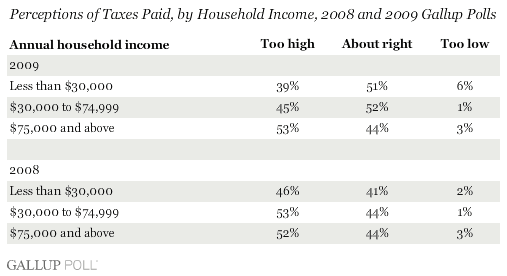
According to [a Gallup poll released yesterday], 48 percent of Americans said their tax rates were “about right,” 46 percent said they were “too high,” and 3 percent said they were “too low.” On the income tax alone, 61 percent called the amount they had to pay this year “fair.”

As one might expect, these responses differ by income, with people in lower brackets being more satisfied with their taxes than people in higher ones. And Republicans are more unhappy than Democrats. No surprises there.

But the differences between groups were not as great as I would have imagined. Take a look:

tax3.gif

taxes2.gif

So, what does it all mean? Is it that people actually think they’re getting a lot for their money? Or do they believe “well, it could be worse; look at Europe?” Have they just gotten so used to the state of things, like the frogs in the pot that slowly comes to a boil, that they’ve lost perspective? And what does the word “fair” mean to most of the respondents—“fair” as compared to other Americans, “fair” in the abstract sense, or “fair” in the sense of the income redistribution that Obama plans to make more of a feature of our tax structure?

Taxes are not a unitary matter. People’s opinions of them depend at least in part on where they perceive the money to be going, and how it will be administered. If people believe they are getting something valuable for their hard-earned bucks, that helps. There’s a general agreement that some sort of taxes are needed for the basics: infrastructure repair, armies, police, firefighters, and primary and secondary education and state colleges. There is disagreement about what may constitute other “basics,” but what most raises the ire of many Americans who are dissatisfied with their taxes is the sense that there is a great deal of graft and corruption in government, and/or that the fruit of their labor is going to support many people who voluntarily choose laziness, or in some cases are not even citizens at all. And it is especially galling when the dole is seen as permanent rather than a temporary bootstrap operation for a significant proportion of those who receive it.

Now, with the huge bailouts and the gargantuan Obama budget proposals, the role of government is poised to rise dramatically, and the “fairness” goal of taxes in the sense of income redistribution is very likely to rise as well. Thus, the stage has been set for today’s tea parties.

Marc Cooper, writing in the LA Times, doesn’t get why the tea party folks are so upset; they must be loony. After all, who could be offended when only the very richest are seeing their taxes go up, and then only by 3%? He calls the protesters “silly” (and that’s when he’s being nice—he also calls them “insane”); after all, every reasonable person knows the bailouts are for our own good, and that the money will be used to save our jobs and our homes, and who cares about the filthy rich anyway?

On reading Cooper’s article, the first thing that struck me was his condescending tone of ridicule towards anyone who might disagree with him on the issue: his need to downplay the populism of the tea party sentiments and to recast participants as the lunatic fringe of a party that has lost its way rather than representing a popular groundswell of protest. My guess is that he is ignoring both the grassroots nature of the tea parties and their appeal to non-fringe elements (and as well as to some Democrats) because it is almost literally incomprehensible to him that there could be a populist movement that aligns more with traditional Republican sentiments than Democrat ones and that could have a grievance that is valid even though it happens to be something with which he disagrees.

Cooper and those who agree with him are also failing to understand where this outrage is coming from (they also tend to cite the excesses of the Bush budgets, saying “he did it, too,” and ignoring the scale difference between Bush and Obama as well as the fact that a great number of Republicans disliked Bush for that very reason). My sense is that what’s behind Cooper’s disdain, and that of many others who don’t understand the tea party protests, is a major disagreement on the role of government in our lives, and on government’s ability to demonstrate wisdom and efficiency when performing a task such as bank bailouts and increasing regulation of the economy. He doesn’t seem to understand that some people, even if they are not rich, believe (as Joe the Plumber did) that someday they may get there, and that the rich are neither demons nor ever-flowing ATM machines for the country, but serve to drive its economy when they keep cash in the private sector and create businesses and jobs.

In short, most of those participating in tea parties define “fairness” quite differently. This philosophical divide is the source of much of the dissatisfaction demonstrated in the protests, and whether Cooper agrees with them or not, they do have a valid argument with a long and illustrious history.

Let’s hear, for example, from Thomas Jefferson, in his First Inaugural Address:

[W]ith all these blessings, what more is necessary to make us a happy and a prosperous people? Still one thing more, fellow-citizens””a wise and frugal Government, which shall restrain men from injuring one another, shall leave them otherwise free to regulate their own pursuits of industry and improvement, and shall not take from the mouth of labor the bread it has earned. This is the sum of good government, and this is necessary to close the circle of our felicities.

Although most people think it was Jefferson who said “the government is best that governs least,” and although he may indeed have agreed with the sentiment, it was actually John O’Sullivan, founder of the United States Magazine and Democratic Review, who in 1837 wrote the sentence in that journal. It was followed by:

No human depositories can with safety, be trusted with the power of legislation upon the general interests of society so as to operate directly or indirectly on the industry and property of the community. Such power must be perpetually liable to the most pernicious abuse, from the natural imperfection, both in wisdom of judgment and purity of purpose, in all human legislation, exposed constantly to the pressure of partial interests; interests which, at the same time they are essentially selfish and tyrannical, are ever vigilant, persevering, and subtle in all the arts of deception and corruption. In fact, the whole history of human society and government may be safely appealed to, in evidence that the abuse of such power a thousand fold more than overbalances its beneficial use.

I’m not as down on government as O’Sullivan was; I think there’s much less than a “thousand fold” difference. But his generally cautionary message continues to ring true today; history has certainly offered a lot more evidence to bolster his argument in the years that have passed since he wrote those words.

And now, I’m outta here—to mail in my taxes, fair or unfair. And then to go toss some tea with a few like-minded individuals.

Posted in Finance and economics, Liberals and conservatives; left and right | 72 Replies

Updike on the Kennedy assassination

The New Neo Posted on April 14, 2009 by neoApril 14, 2009

When writer John Updike died last January I wrote this tribute to him, as well as this discussion of his brave and well-articulated stance on the Vietnam War, a position that estranged him from many of his friends and the literary lights of his day.

Some of the comments to those posts made me realize that Updike’s inimitable style was hard to capture and to describe. So here’s another example, originally published at the time of the JFK assassination in the “Notes and Comments” segment of The New Yorker, and featured again in this New Yorker tribute to Updike published shortly after the author’s death.

It is the only piece of which I’m aware that captures the surrealistic and intense nature of the emotional reaction of those who experienced the event at the time. I tried my hand briefly at describing it; Updike’s hand is infinitely more deft:

It was as if we slept from Friday to Monday and dreamed an oppressive, unsearchably significant dream, which, we discovered on awaking, millions of others had dreamed also. Furniture, family, the streets, and the sky dissolved, only the dream on television was real. The faces of the world’s great mingled with the faces of landladies who happened to house an unhappy ex-Marine; cathedrals alternated with warehouses; temples of government with suburban garages; anonymous men tugged at a casket in a glaring airport; a murder was committed before our eyes; a Dallas strip-tease artist drawled amiably of her employer’s quick temper; the heads of state of the Western world strode down a sunlit street like a grim village rabble; and Jacqueline Kennedy became Persephone, the Queen of Hades and the beautiful bride of grief. All human possibilities, of magnificence and courage, of meanness and confusion, seemed to find an image in this long montage, and a stack of cardboard boxes in Dallas, a tawdry movie house, a tiny rented room where some shaving cream still clung to the underside of a washbasin, a row of parking meters that had witnessed a panicked flight all acquired the opaque and dreadful importance that innocent objects acquire in nightmares.

And here’s Jacqueline Kennedy as Persephone, the Queen of Hades and the beautiful bride of grief:

jackiepersephone-2.jpg

Posted in Literature and writing | 11 Replies

When the world is stumped by the Somali pirates…

The New Neo Posted on April 14, 2009 by neoApril 14, 2009

…it’s the dolphins to the rescue.

But alas, there are only so many dolphins in the world, and they can’t be everywhere at once. The pirates have wasted no time boarding four more vessels. This time, however, the targets were not American, but Lebanese, Greek, and Egyptian, with a mostly Filipino crew on the Greek vessel.

Piracy has an ancient and varied tradition, and has existed as long as people have plied the seas. The Somali pirates are currently big on braggadocio; here’s a (self-appointed?) pirate spokesperson speaking:

“Our latest hijackings were meant to show that no one can deter us from protecting our waters from the enemy because we believe in dying for our land,” Omar Dahir Idle, a pirate based in the coastal town of Harardhere, told The Associated Press by telephone. “The recent American operation, French navy attack on our colleagues or any other operation mean nothing to us.”

Interesting rhetoric, coming from a pirate. “Protecting” their waters? Dying for their land? Perhaps it’s meant to deter any efforts to destroy the coastal havens from which they operate. The pirates rightly reckon that the whole thing is a test of warring resolves, and that the world may not have the stomach for the fight and would rather continue to pay them lucrative ransoms.

I say “the world” because Obama has carefully framed this as a multilateral effort:

“I want to be very clear that we are resolved to halt the rise of piracy in that region and to achieve that goal, we’re going to have to continue to work with our partners to prevent future attacks,” Obama told reporters Monday.

It will be exceedingly interesting to see just how much cooperation he will actually get, in the practical sense. And then, if the answer is “not much,” it will be even more interesting to see just how far Obama is willing to go it alone.

Then again, there’s always the dolphins. Perhaps Obama can learn to speak their language.

Posted in Terrorism and terrorists | 18 Replies

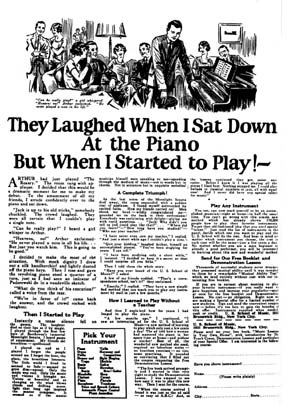
They laughed when she stood up to…

The New Neo Posted on April 13, 2009 by neoApril 13, 2009

…sing:

laughedpiano.jpg

Posted in Music, Pop culture | 28 Replies

The Pirates of Somalia

The New Neo Posted on April 13, 2009 by neoApril 13, 2009

In my youth, the word “pirate” had become somewhat of a joke, with overtones of operetta (“The Pirates of Penzance”) crossed with Disney’s version of Robert Louis Stevenson (Treasure Island) and Halloween costumes featuring funny hats and eyepatches.

Lately, of course, the joke’s been on us and the rest of the Western world—and it’s not a funny one. Piracy has become the profession for go-getters in the anarchic failed nation of Somalia. There is essentially no effective central government within Somalia to stop them or the terrorist elements that find a home there. And, as we’ve learned so many times before, the local problems of failed nations can tend to metastasize.

It is highly ironic, but not really all that contradictory, that the Maersk Alabama was on its way to deliver food aid for the people of Uganda and Somalia when it was boarded by the Somalian pirates. Failed nations are failed nations, and they fail in a number of ways all at once—including the failure to feed their people.

The scope of the problem makes possible remedies more complex. The simplest one would be for shipping companies to permit the captains (and perhaps selected crew members) of the vessels at risk to bear arms for self-defense:

[L]awyers [advising the companies] misinterpret the Law of the Sea Treaty and the Geneva Conventions and fail to apply the powerful international laws that exist against piracy. The right of self-defense — a principle of international law — justifies killing pirates as they try to board a ship.

Nonetheless, entire crews are unarmed on the ships that sail through the Red Sea and the Gulf of Aden. Shipowners pretend that they cannot trust their crews with weapons, but the facts don’t add up.

Here’s another good idea, if the international community could ever get its act together long enough to implement it:

The international right of self-defense would also justify an inspection and quarantine regime off the coast of Somalia to seize and destroy all vessels that are found to be engaged in piracy.

The situation in Somalia itself is a much knottier problem. Is the world—or the US, which is what these things often boil down to—ready to take on the rebuilding of another failed and chaotic nation, especially one that seems to have little strategic importance? Very doubtful. And, since these pirates don’t tend to sit together around campfires singing “Yo heave ho and a bottle of rum,” surgical strikes would be unlikely to be all that surgical.

Posted in Violence | 52 Replies

Those uneasy royal heads

The New Neo Posted on April 13, 2009 by neoApril 13, 2009

I know it must be difficult to be a royal and all, especially nowadays when their roles are devoid of power and merely ceremonial. How to find purpose in such an empty, fishbowl existence? It gives new meaning to Shakespeare’s observation that uneasy lies the head that wears a crown.

Oh, there are perks, of course. Money. Castles. More castles. Horses and dogs, if you like that sort of thing, as well as more jewels than you can count.

Notoriety, wanted or un. Tabloids peering into your business. And for the ladies, obligatory hats.

Now, most of us don’t look all that good in hats. It takes a certain savoir faire, panache, je ne sais quoi to wear them well.

From the looks of their Easter bonnets yesterday, the British royal family seems to lack those very qualities (perhaps that’s why the phrases are in French rather than English). In fact, several of them seem to have given up all pretense of trying.

Here are the photos.

First up, the Queen herself, who exhibits a certain style that is so far beyond style that it is above style. It is, simply, Her Look, no more and no less than the same timeless frumpiness she displayed even in her early days as a young and beautiful monarch, back in the 50s. And very matchy-matchy indeed:

bonnetqueen.jpg

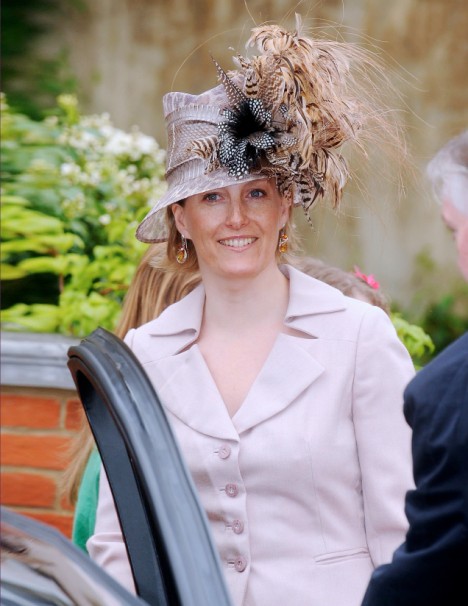
Next, the Countess of Wessex, Prince Edward’s somewhat-Dianaish-lookalike wife. She’s an attractive woman, to be sure. But I think she overdoes the hunting motif in a hat that is bewildering and overwhelming—is that an entire quail (or perhaps a young turkey) nesting on a really tall fedora made of gauze?:

countess-of-wessex.jpg

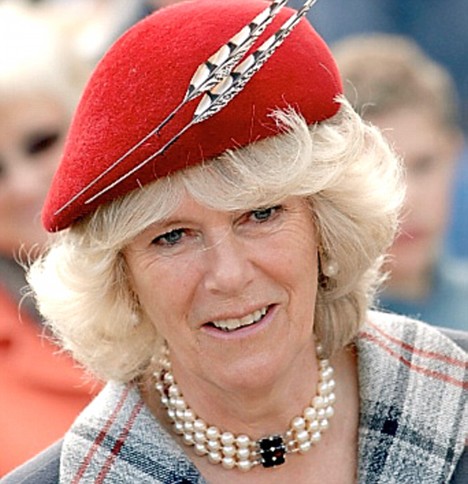
Let’s turn to the relative restraint of the The Duchess of Cornwall, otherwise known as Prince Charles’ wife Camilla. Perhaps her red beret with the two sharp feathers is as good as it can possibly get for her, hatwise. But it’s at odds with the romantic pearl choker—and then there’s that huge collar and the flippy dippy 80s hairdo. I dunno, you decide:

bonnetcamilla.jpg

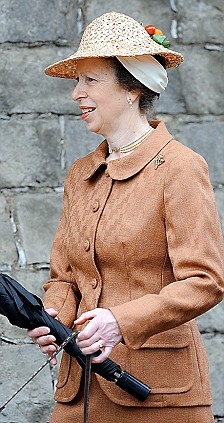
But I’ve saved the strangest for last. I have a certain sympathy for Princess Anne. She’s long seemed to me to be a no-nonsense sort who’d rather be doing almost anything than wearing these silly hats and waving to the crowds; maybe mucking out a stable or something. But even though she’s not into fashion, does she have to go to such extremes to prove it?:

bonnetanne.jpg

bonnetanneback.jpg

Posted in Fashion and beauty | 25 Replies

Captain freed

The New Neo Posted on April 12, 2009 by neoApril 13, 2009

This excellent news is just in: the American captain has been freed by the US Navy.

Details are sketchy as yet:

Three pirates were killed and one was in custody after what appeared to be a swift firefight off the Somali coast, the official said. Phillips, who was not hurt, was safely transported to a Navy warship nearby.

The official was not authorized to discuss the matter publicly and spoke on condition of anonymity.

This article offers a bit more information. It appears that talks broke down when the US insisted that the pirates be tried for their crimes. The Somali side disagreed, and later a firefight of some sort ensued, with the result that several of the pirates were killed and Phillips freed.

Three cheers for the US Navy!

[ADDENDUM: Now there are reports are that the firefight began when the captain jumped overboard under cover of darkness.]

[ADDEUNDUM II: The above is confirmed. Phillips is doubly a hero, having jumped overboard and sparked the Navy SEALS’ attack on the pirates, as well as having earlier offered himself as hostage to save his crew.

Phillips is 53, and seems to be in the mold of another modest and 50-something hero Captain Sullenberger, who likewise managed to save all aboard his vessel as well as himself. Phillips hails from New England’s only coastally-challenged state, Vermont, and is described by those who know him well in terms very similar to those used for Sullenberger:

Phillips’ sister-in-law said the captain’s self-sacrifice was characteristic of the man. “That is what he would do. It’s just who he is and his response as a captain,” Gina Coggio told ABC.

His mother, Virginia Phillips, said: “I’m sure it’s going to be OK. I know my son. He’s a survivor.”

There’s also this, from the father of one of the crew:

“He says that he’s one of the most diligent masters he’s ever seen,” Joseph Murphy said. “Very, very particular about how things are done and wants them done perfectly, and he drills until he gets it.”

We’ll probably be hearing more details, some of them from Phillips himself:

Phillips has a reputation for telling stories about his adventures at sea. “The way the guy tells a story is amazing,” said Tom Coggio, 41, Phillips’ brother-in-law. “We’re just all waiting for him to get home and tell this one.”]

[ADDENDUM III: As far as Obama’s role in all of this, we really don’t know. At the very least, he doesn’t appear to have done anything foolish. Also, he may have been responsible for the refusal to allow the pirates to release their hostage without consequences, and the insistence that the perpetrators be brought to justice as part of any deal. If so, he is to be commended.

The fact that this incident occurred on the high seas was actually a plus, as was its relatively small scale. This meant that, unlike the debacle of Carter’s Iran hostage crisis, the captive could not be paraded before cheering crowds or unfriendly cameras, and no invasion of a faroff foreign land was necessary to mount a rescue operation. You may recall that Carter’s one attempt went very poorly indeed.]

[ADDENDUM IV: Obama is reported to have authorized the military to use force to rescue the hostage. Good.

The order of things has also become a bit unclear to me. Did Phillips jump overboard first, or was the order to fire given first? Here’s a report that Phillips was judged to be in imminent danger of being killed when the rescue began.]

[ADDENDUM V: I had pictured the lifeboat as being relatively open. But I just heard on Fox that it was closed, with a fairly small open hatch that would have been the only way to fire on the pirates. So the SEALS’s feat is even more amazing.

As was Captain Phillips’s. Apparently, he may have been tied up when he jumped into the water. According to terrorism expert Bob Newman, currently speaking on Fox, Phillips’s alma mater the Massachusetts Maritime Academy trains its graduates in fairly advanced water survival techniques.]

Posted in Uncategorized | 47 Replies

The perfect jelly bean

The New Neo Posted on April 12, 2009 by neoApril 12, 2009

There is only one jelly bean worth eating at Easter or any other time of year.

No, not those weirdly flavored “gourmet” Jelly Bellys (I consider the term “gourmet jelly bean” to be an oxymoron). The traditionalist in me abhors them, despite Reagan’s fondness. As for those jelly beans placed on the endless supermarket aisles of Easter treats that tempt us from Valentine’s Day until tomorrow—when the remnants go on sale and those get scarfed up as well—the vast majority should not be consumed by anyone above the age of four. Maybe even by anyone below the age of four.

What should? I submit these, which are a tad more expensive but probably will not break the bank:

jellybeans.jpg

Traditionally fruit-flavored, made with smooth and succulent pectin, with a lovely and slightly translucent sheen, they go down easy. Maybe too easy; it is possible to eat quite a few before realizing what’s happening. Take it from one who knows.

How did jelly beans come to be associated with Easter? It seems a no-brainer because of their egglike shape, but apparently the tradition didn’t really get going until the 1930s. Jelly beans are far older than that, however, making their debut as the confection promoted by Schrafft of Boston for sending to Union soldiers during the Civil War (a crafty man, that Schrafft).

A little-known jelly bean fact (at least to me) is that, “in United States slang in the 1910s and early 1920s a ‘Jelly bean’ or ‘Jellybean’ was a young man who made great efforts to dress very stylishly, presumably to attract women, but had little else to recommend him…The word was also used as a synonym for pimp.”

Returning to the actual candy, I offer a caveat: there is hardly anything worse than the shock of thinking you’re biting into a normal fruit-flavored jelly bean and getting a spicy one. They should be identified by special markings, like those insects that are bad to eat, as a warning to others. I suggest racing stripes.

But if you buy the Russell Stovers, no need to be on the spice alert. And remember: tomorrow the sales begin! Although, come to think of it, it’s a sign of this particular jelly bean’s superiority that not only are they generally available year-round, but at some stores they are exempted from the post-Easter markdowns. They’re that good.

Posted in Food | 13 Replies

Happy Easter!

The New Neo Posted on April 12, 2009 by neoApril 12, 2009

Happy Easter to all my celebratory Christian readers, and to all those who just enjoy the holiday as well!

One year when my son was little, I spent the week prior to Easter blowing out eggs and dying them. Now that he’s grown and away, the eggs are packed away in boxes and stored in parts unknown. If I could get my hands on them I’d photograph them for you, because even all these years later they are beautiful, with dyes both subtle and unsubtle, interesting etched patterns and rainbow effects—definitely one of my finest crafts hours (to tell the truth, I didn’t have so many fine crafts hours, although there was also a gingerbread house we made that was stored in the attic and alas, eaten by small creatures–and not human ones, at that.)

Blown-out eggs are well worth the trouble, and why? Because they last. And nothing eats them. You only have to make them once, and you’re all set. They are a bit fragile, but not so very.

So here’s my Easter present to you (not that you couldn’t find it yourself): the instructions for blowing eggs:

First, you’ll need to make a tiny pin hole on each end of the egg. A pin works well, or a wooden kitchen skewer or even the tip of a sharp knife. Gently work the tip of the pin/skewer/knife in a circular motion until a tiny hole appears. Repeat on the other side. Then insert the pin or skewer (the knife will be too big here) far enough into the egg to break the yolk. Use your mouth [blow] to expel the contents of the egg.

And here is a more complex–but perhaps better–way, for those obsessive-compulsives among us.

These aren’t mine, but they’ll have to do as substitute:

[NOTE: This is a repost from Easters past. But it still works for me.]

Posted in Uncategorized | 8 Replies

You want arrogant, dismissive, and derisive? I’ll give you Obama Press Secretary Gibbs

The New Neo Posted on April 11, 2009 by neoApril 11, 2009

At the outset I ignored this business about Obama’s Saudi bow. No, I didn’t like it and yes, I thought it was just another sign of Obama’s inattention to American traditions and history, including the precedent of not bending low to foreign royalty.

But I didn’t think it important enough to write about until an anonymous White House aide made an excuse for the bow that was patently absurd on its face (in other words, a baldfaced lie): that it wasn’t a bow, but instead a dip in order to equalize height during a two-handed handshake. I forgive mistakes much more easily than lies, you see, especially lies that insult the intelligence of the listener.

But even then I figured that there was a possibility that this was a rogue statement by an anonymous White House aide. Now that reservation has been removed—unless, of course, you would like to claim that Obama’s Press Secretary Robert Gibbs is not an official spokesperson for the President himself.

Not only did Gibbs lie about Obama’s bow at a recent press conference by telling the same tale, but he did it with a smile that was—dare I say it?—as arrogant and derisive as they come, and added some dismissive comments, as well:

Here’s a transcript, just in case you didn’t catch it (although the text fails to capture the all-important tone of Gibbs’s remarks):

QUESTION: And then one unrelated question. When the president met with King Abdullah, there was something that took place which I believe the White House explained as just the president being taller than the king. We took a look at the video, and it does appear that the president actually bowed to King Abdullah. Did he bow or didn’t he?

GIBBS: No, I think he bent over with both to shake ”” with both hands to shake his hand, so I don’t”¦

QUESTION: (OFF-MIKE) one hand, that he ”” he was just”¦

GIBBS: Well I ”” I ”” I ”” this is”¦

QUESTION: Did he bow or didn’t he?

GIBBS: No, but I think this meeting was like a week ago, right?

QUESTION: That’s right, but this is something that a lot of people are still talking about today.

GIBBS: I can only imagine it is of great cause and concern for many people struggling with the economy.

As usual, it’s not the original act so much as the coverup. This particular coverup is somewhat like trying to hide something under a piece of Saran wrap. The truth is obvious to any person who objectively studies the tape; therefore the lie is also obvious.

I cannot recall another administration so willing to offer lies that are so unconvincing and so easily identified as such (when Clinton denied his relationship with Monica Lewinsky, for example, the American people hadn’t yet seen the evidence, and I assume he was hoping they never would). The closest I can come is Richard Nixon, the “Rose Mary stretch,” and the erased audiotape. But at least that happened during Watergate, when Nixon was fighting for his political life.

In contrast, the Obama administration tells obvious lies over events that seem relatively unimportant; why not just say the bow was an error? I can only conclude that this administration’s behavior stems not only from an amoral disregard for truth and falsehood (not all that unusual in politicians, sad to say), but from a concomitant arrogance so deeply ingrained as to be reflexive, and a profound contempt for the American people’s judgment. I can only hope that events will prove Obama and Gibbs wrong in that last assessment.

Posted in Obama | 37 Replies

The roots and longevity of anti-Americanism

The New Neo Posted on April 11, 2009 by neoApril 11, 2009

The topic for the day is anti-Americanism.

Some liberals think it all started with Bush. Some Leftists like to pretend it did, although they may know better. And some people think it’s because America is a swaggering, aggressive, imperial power, and that if Obama abdicates that role and says the proper mea culpas, it will all go away.

Anti-Americanism may not be up there with anti-Semitism in its longevity and protean nature, but it has one characteristic in common: it’s a shape-shifter. Anyone who thinks anti-Americanism (or anti-Semitism) is due to a particular thing, and that if that thing were changed or eliminated it would disappear, is ignoring the hatred’s long and varied history.

If you’re not familiar with James Ceasar’s 2003 essay on anti-Americanism, please give it a read. Ceasar writes that “anti-Americanism reigns as the lingua franca of the intellectual class” in Europe, and that it “rests on the singular idea that something associated with the United States, something at the core of American life, is deeply wrong and threatening to the rest of the world.”

The remainder of Caesar’s essay is dedicated to analyzing the components of that idea as well as its antiquity. Along the way there is much that is fascinating—for example, he traces pre-WWII Japanese concepts of America to the influence of German philosophers on Japan’s elite.

Anti-Americanism started at virtually the same time as the country’s birth—actually, even before its birth—and was a European creation that later spread around the world. Ceaser has identified five epochs and types of anti-Americanism, although there is same overlap among them. But the main point is that any hatred that has persisted for so long in so many differing manifestations partakes a great deal of the irrational, no matter how rational some of its points may sound.

One of the many underpinnings of anti-Americanism—although Ceasar does not focus on this particular one—is America’s idea of itself as an exceptional country. This is somewhat similar to the largely misunderstood idea that the Jews think they are a chosen people, and is used as an excuse for hating each group. Although there’s a great deal of disagreement as to what “American exceptionalism” acutally means (in fact, the notion was coined by a Frenchman, de Tocqueville) in general it refers to the fact that America thinks it has a special place in the world as the bastion of liberty.

This seems to be okay with Europe as long as America is involved in defending Europe’s liberty, which it did at great cost during WWII and the Cold War. And although even then anti-Americanism was rampant in the western part of that continent—especially in academia and lofty philosophical circles—the subsequent fall of the Soviet Union caused western Europe to perceive less need for us, and anti-Americanism began to grow and spread.

George Bush’s presidency served as a focal point and multiplier for an already-existing dislike. Barack Obama will be able to damp down that hatred only to the extent that he humiliates America before the world, surrenders individualism for the collective, and joins Europe in its statist tendencies and welfare-state economy—in other words, to the extent that he surrenders the idea of American exceptionalism.

Posted in History | 40 Replies

Post navigation

← Previous Post
Next Post→

Your support is appreciated through a one-time or monthly Paypal donation

Please click the link recommended books and search bar for Amazon purchases through neo. I receive a commission from all such purchases.

Archives

Recent Comments

  • Charles R Harris on The AfD does very well in the recent German elections in Saxony-Anhalt
  • Charles R Harris on The AfD does very well in the recent German elections in Saxony-Anhalt
  • om on The AfD does very well in the recent German elections in Saxony-Anhalt
  • SHIREHOME on The AfD does very well in the recent German elections in Saxony-Anhalt
  • Barry Meislin on Open thread 9/7/2026

Recent Posts

  • The AfD does very well in the recent German elections in Saxony-Anhalt
  • Happy Labor Day
  • Open thread 9/7/2026
  • A restrained AI spam comment
  • A lost skill

Categories

  • A mind is a difficult thing to change: my change story (17)
  • Academia (328)
  • Afghanistan (98)
  • Amazon orders (6)
  • Arts (8)
  • Baseball and sports (164)
  • Best of neo-neocon (91)
  • Biden (536)
  • Blogging and bloggers (595)
  • Dance (292)
  • Disaster (244)
  • Education (323)
  • Election 2012 (360)
  • Election 2016 (566)
  • Election 2018 (33)
  • Election 2020 (513)
  • Election 2022 (114)
  • Election 2024 (403)
  • Election 2026 (93)
  • Election 2028 (13)
  • Evil (129)
  • Fashion and beauty (324)
  • Finance and economics (1,042)
  • Food (317)
  • Friendship (48)
  • Gardening (18)
  • General information about neo (4)
  • Getting philosophical: life, love, the universe (734)
  • Health (1,161)
  • Health care reform (545)
  • Hillary Clinton (184)
  • Historical figures (337)
  • History (716)
  • Immigration (448)
  • Iran (464)
  • Iraq (227)
  • IRS scandal (71)
  • Israel/Palestine (821)
  • Jews (437)
  • Language and grammar (365)
  • Latin America (212)
  • Law (2,975)
  • Leaving the circle: political apostasy (124)
  • Liberals and conservatives; left and right (1,321)
  • Liberty (1,117)
  • Literary leftists (14)
  • Literature and writing (394)
  • Me, myself, and I (1,498)
  • Men and women; marriage and divorce and sex (929)
  • Middle East (384)
  • Military (324)
  • Movies (353)
  • Music (533)
  • Nature (261)
  • Neocons (32)
  • New England (183)
  • Obama (1,738)
  • Pacifism (16)
  • Painting, sculpture, photography (131)
  • Palin (93)
  • Paris and France2 trial (25)
  • People of interest (1,043)
  • Poetry (258)
  • Political changers (178)
  • Politics (2,793)
  • Pop culture (397)
  • Press (1,635)
  • Race and racism (882)
  • Religion (428)
  • Romney (164)
  • Ryan (16)
  • Science (641)
  • Terrorism and terrorists (971)
  • Theater and TV (266)
  • Therapy (71)
  • Trump (1,630)
  • Uncategorized (4,555)
  • Vietnam (109)
  • Violence (1,445)
  • War and Peace (1,027)

Blogroll

Ace (bold)
AmericanDigest (writer’s digest)
AmericanThinker (thought full)
Anchoress (first things first)
AnnAlthouse (more than law)
AugeanStables (historian’s task)
BelmontClub (deep thoughts)
Betsy’sPage (teach)
Bookworm (writingReader)
ChicagoBoyz (boyz will be)
DanielInVenezuela (liberty)
Dr.Helen (rights of man)
Dr.Sanity (shrink archives)
DreamsToLightening (Asher)
EdDriscoll (market liberal)
Fausta’sBlog (opinionated)
GayPatriot (self-explanatory)
HadEnoughTherapy? (yep)
HotAir (a roomful)
InstaPundit (the hub)
JawaReport (the doctor’s Rusty)
LegalInsurrection (law prof)
Maggie’sFarm (togetherness)
MelaniePhillips (formidable)
MerylYourish (centrist)
MichaelTotten (globetrotter)
MichaelYon (War Zones)
Michelle Malkin (clarion pen)
MichelleObama’sMirror (reflect)
NoPasaran! (bluntFrench)
NormanGeras (archives)
OneCosmos (Gagdad Bob)
Pamela Geller (Atlas Shrugs)
PJMedia (comprehensive)
PointOfNoReturn (exodus)
Powerline (foursight)
QandO (neolibertarian)
RedState (conservative)
RogerL.Simon (PJ guy)
SisterToldjah (she said)
Sisu (commentary plus cats)
Spengler (Goldman)
VictorDavisHanson (prof)
Vodkapundit (drinker-thinker)
Volokh (lawblog)
Zombie (alive)

Meta

  • Log in
  • Entries feed
  • Comments feed
  • WordPress.org
©2026 - The New Neo - Weaver Xtreme Theme Email
Web Analytics
↑