It’s been shaping up for quite some time now—the Democrat explanation in the event of an Obama loss.
Of course, if Obama should win the election—a distinct possiblity—excuses will not come into play. It will be the Republicans who will have to regroup. But in the case of Republicans I think there will be no mystery: Bush’s enormous unpopularity, and the tendency of Americans to want change after many years of a single party in office, are explanation enough. Some will also feel that Republicans would do better to run a “true” Conservative, whatever that is. Whether correct or not, this is at least a theory that has to do with issues and political philosophy.
When Dukakis lost in 1988 Democrats seemed to be fairly realistic in their reactions, perhaps helped along by the fact that his loss was so definitive. Continue reading →
I’ve long had a soft spot in my heart for Neanderthals.
The ancient ones, that is, those early humans who’ve gotten a bad rap as powerful heavy-browed vulgarians, but about whose culture we really know very little, and who seem to have buried their dead and perhaps had speech.
In college I took a physical anthropology course in which the professor was strongly in the camp of those who felt Neanderthals had interbred with the more modern Cro-Magnons to produce us. This idea comforted me. For some reason I preferred that a tiny spark of Neanderthal survive than that the entire group, dominant and widespread for hundreds of thousands of years, be totally obliterated leaving no issue whatsoever. Continue reading →
Obama is keeping mum on the details of what he thinks of all the financial plans swirling around lately, or what he would propose if he were President in these trying times.
If you’re already an Obama fan you probably think this is evidence of his lofty post-partisan superiority as well as his depth of thought. And perhaps it is. But this would be easier to believe if he didn’t have such a long history of protecting himself—and his status as a blank slate on which people can project their dreams—from commitment. Continue reading →
In a sense, the public has willed its way into government intervention by entertaining socialist expectations of a capitalist economy. Housing values were not supposed to fall and neither were any of the investments for which they served as collateral. Once enough citizens collateralise their investments with the roof over their heads, and once it becomes impossible to disentangle mortgages from other investment instruments, then the ordinary, healthy working of creative destruction will drive thousands of small-time investors from their homes. Small-time investors won’t tolerate it. Almost every institution in the financial sector, big or not so big, looks too important to fail.
Interesting. Was “the public” as a whole entertaining socialist expectations that they would be protected from ever losing a home for default on a mortgage, or from housing prices ever dropping? I’ve heard this said not just by Caldwell, but by many others. Continue reading →
Here’s today’s market bulletin from that newly-minted financial “expert” of the day, neo-neocon.
This comment from reader “John F. Opie” got me thinking about how the practice known as fair value accounting enters the current picture (see this for Opie’s point of view). This Forbes article, written back in June, stated rather presciently:
…”fair value accounting” was aimed at consistent reporting among comparable firms. Assets would be labeled in one of three categories depending on their relative liquidity, with the hardest-to-value assets put in “Level 3.” But the rules, in the works for years and put in place just as the credit crisis hit, didn’t anticipate the amplifying effects of market turmoil. Continue reading →
There’s a new star on the New York City Ballet horizon: Daniel Ulbricht. The fact that I’d never even heard of him (or most of the current dancers in the company) until I read this article reminds me how long it’s been since I saw the NYCB, and how fortunate I was to have seen the company in its glory days, when George Balanchine was still alive and well and directing the show.
But I take issue with the following assertion of writer Scot Paltrow in the article:
That Ulbricht is emerging as a star is somewhat surprising, given his physique. In ballet, height and body type are brutally determinative. Dancers who are too short and lack perfect “line,” even if extremely talented, are relegated to secondary roles””if they get into a professional company at all. Ulbricht’s feet are on the small side and, at least for a dancer, his legs are short compared with the length of his torso. When asked, he at first says his height is 5 foot 6, then confesses, “We round up” by a fraction of an inch.
Mr. Paltrow seems to have a background in political investigative reporting and finance rather than dance. So perhaps he can be forgiven for not knowing exactly whereof he speaks.
Yes, height is important in partnering, and all else being equal, taller male dancers have more choice in female partners. But in the dance world in general, height does not make right. The stage adds height to dancers rather than subtracting it, so audiences might be very surprised to learn how miniscule some of their towering favorites actually are. Since this rule is true for female dancers as well, even though their height is augmented by being on point in most ballets, there are usually adequate numbers of diminutive partners from which a dancer such as Ulbricht might choose (or rather, from which his company’s director might choose).
Not only that, but there are reasons why short dancers are actually favored in ballet, much as shortness is an advantage in ice skating and even more clearly in gymnastics. A compact body allows for better control, especially in turns and jumps. The longer line of tall dancers tends to be more beautiful, it’s true, but the length of their extremities makes it more difficult for most tall dancers to coordinate the structure and to bring it all together for the quickness and strength involved in certain moves. The ideal dancer seems to be a compromise between the advantages of the short and the tall, and most tend to come down on the side of the former rather than the latter.
His height puts Ulbricht squarely in the category of two men who are arguably the greatest male dancers of modern times, or perhaps of all time: Mikhail Baryshnikov and Vaslav Nijinsky. Both are (or in the case of Nijinsky, were) every bit as small or smaller than Ulbricht. Nijinsky is reported to have been five feet four inches, and I can personally attest to the fact that Barishnikov is certainly no taller than that, since I stood next to him once. You might be surprised to learn that even Nureyev, who on stage looked to be long and lean, was actually no taller than 5’8″.
Dancers deal in strength, grace, and illusion. Posture and carriage and height of jump can make them look like giants even when they’re not. For example, the ability to appear to pause in mid-air during a jump (known as “ballon” and discussed by me here), is ordinarily easier for the shorter dancer.
I haven’t seen Ulbricht, it’s true. And dancers can really only be judged in person; the camera flattens the experience and diminishes the illusion of height and scope.
But on a blog, the camera is all we’ve got. Unfortunately, there are very few videos of Ulbricht posted on You Tube, and most are of poor quality. In this one, however, you can see some of the quality of his jump and of his ballon.
While I’m at it, I’ll show you a clip of Baryshnikov at the height (pun intended) of his fame in the old chestnut “Don Quixote.” Let me just tell you right now that this video has about one percent of the wattage of his performance in person, which I was lucky enough to watch many times:
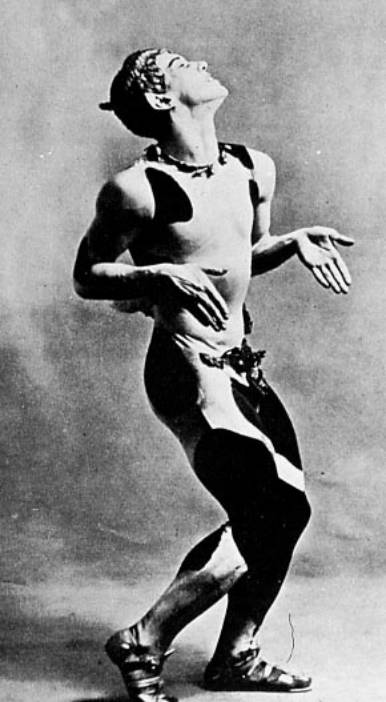
Alas, there are no videos of Nijinsky available. As best I can recall, the entire film record of his brief and tragic career consists of a few seconds of grainy and choppy footage. The still photos are strange, as well—mostly angular and offbeat poses that accentuate the old-fashioned nature of the choreography and costumes, reminding us that although ballet can create beautiful poses, the essence of dance is kinetic and three-dimensional.
Here he is nevertheless, preserved in a static version of one of his signature roles, the Faun in Debussy’s “Afternoon of a Faun,” which created a sexual scandal at the time:
And that brings us to another video—Ulbricht again, looking exceedingly young. It’s a very short clip of him backstage preparing for a role as another faun, in Jerome Robbins’ “The Four Seasons.” I include it for the tie-in to the Nijinksy photo, and because it indicates something about the quality of Ulbricht’s movement and his jump:
How did all these brilliant economic minds, and our dedicated public servants in Congress and the White House, fail to foresee and prevent the current fiscal crisis?
My take on the matter is not the opinion of an expert; au contraire. But my little crash course (pun intended) of the last couple of days has led me to the following observations: Continue reading →
Michael Seitzman knows what’s wrong with with McCain/Palin/Bush voters: they’re knuckledragging IQ-challenged morons (perhaps they’re even moronic enough to think that Bush isn’t running for re-election this year. But how would I know? After all, I’m just one of them.)
…why the McCain campaign doesn’t whip out an ad showing the deep links between Obama’s economic advisors Johnson and Raines and the current crisis?* Or Obama’s own receipt of contributions from Fanny and Freddy? Or McCain’s own warning two years ago about the looming crisis?
[* For this one, it may be because so many Republicans—although seemingly not as many Republicans as Democrats—were implicated as well, including McCain adviser Gramm.]